

ABSTRACT
Artificial intelligence (AI) has permeated into every aspect of medicine and promises to provide accurate diagnosis, better management decision and improved outcome for patients and healthcare system. However, ethical, social and legal issues need to be resolved for successful implementation of AI tools in clinical practice. In order to gain trust and acceptance, AI algorithms should offer maximum explainability and inclusiveness. Robust evidence of benefit to patients and healthcare services has to be provided to gain justification of using these tools. Doctor–patient relationship needs to be maintained in order to gain trust and acceptance of users. Autonomy of decisions and dignity of patients need to be preserved while using machine in healthcare. Responsibility and accountability in the use of AI in medicine should be deliberated and defined before mishaps and damage occur. A new role of healthcare providers will emerge with the advancement of technology and changes are inevitable. This manuscript is based on the Gordon Arthur Ransome Lecture 2022 entitled “Artificial Intelligence in Medicine: Ethical, Social and Legal Perspective”. It represents the opinion of the orator.

“Our future is a race between the growing power of our technology and the wisdom with which we use it. Let’s make sure that wisdom wins.” — Stephen Hawking
The tsunami of artificial intelligence (AI) has arrived in medicine, penetrating every clinical specialty. Deep learning algorithms enable highly sensitive and specific diagnosis of diabetic retinopathy. Breast cancer screening using mammography can be performed by machine-learning devices, saving much time and effort for radiologists. Automated classification of skin conditions using convoluted neural network (CNN) programme in smart phones enables dermatologists to make vital diagnosis from a distance. Neural network algorithms can detect and characterise colorectal polyps during colonoscopy, reducing the chance of missing such potentially malignant lesions and deciding on whether polypectomy is needed. AI may also facilitate patient education, checking medication compliance and enhancing self-management, such as diet and exercise in chronic diseases. Increasingly, machine learning (ML) devices will replace repetitive, time-consuming, labour-intensive and mundane tasks of clinicians. If that is so simple, why is the implementation of AI in medicine still going relatively slow?
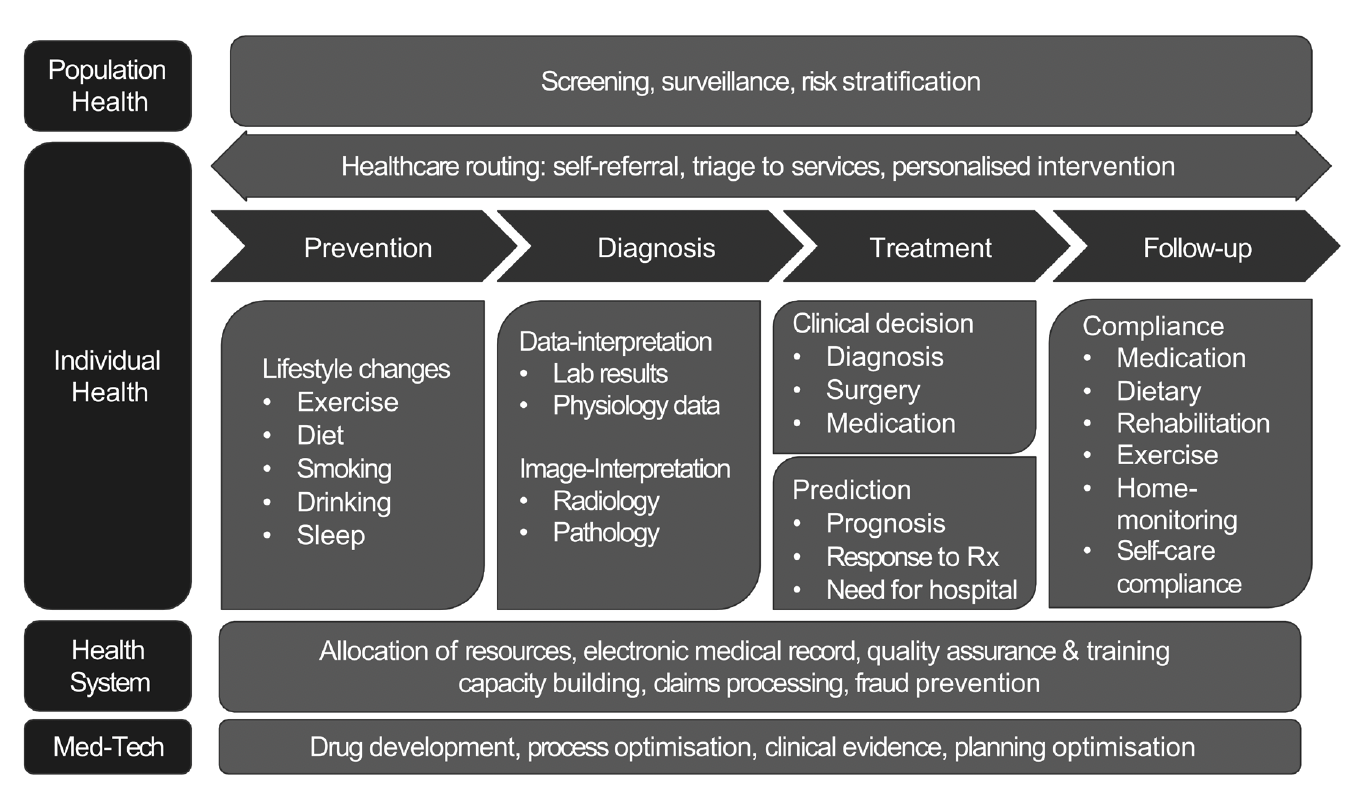
While there are numerous reports on innovations of AI in medicine, we can summarise its potential into three categories: (1) at the level of individual clinician-led consultation, AI can improve the speed and accuracy of diagnosis (especially with image-interpretation assisting diagnosis), recommend and direct best choice of therapy and prognosticate outcome; (2) at the healthcare system level, AI can improve efficiency and accessibility of healthcare service; (3) at the population level, AI can help individuals in the public to modify their lifestyle and behaviour, hence promoting health of the population. The power of AI in medicine is summarised in Fig. 1.
Fig. 1. Potential capabilities of AI in healthcare, from individual level to healthcare system and population health.
However, in order to be able to achieve these capabilities, AI tools require three things: (1) collection of huge volume of genomic, environmental and lifestyle data of high quality and representative of the respective populations; (2) immense analytic capability to build models and algorithms for the study of diseases based on strong and weak signals in the individual’s genome and environment; (3) good governance system of data collection, analysis and utilisation of such tools developed.
Technology alone cannot solve all problems instantaneously. We cannot simply impose technology into healthcare systems and medical practices without considering trust, acceptance and compliance of stakeholders, including healthcare providers and receivers. Before AI can be extensively used in clinical practice and widely trusted by doctors and patients, there are a series of ethical, social and legal issues that need to be resolved.
Successful Implementation of AI. First, in order to gain trust and acceptance of stakeholders, AI algorithms should have maximum “explainability” and “interpretability”, explaining why such diagnoses are made, what basis are recommendations formulated and what are the mechanisms and rationale behind them. Modern AI algorithms based on complex ML methods are often not annotated and unsupervised. Because of their complexity, such tools provide answers beyond biological rationalisation and human comprehension, and these algorithms are widely treated as “black boxes”. When specific features of differentiation in the ML process cannot be explained fully, it becomes difficult for doctors to explain their recommendation to patients, and patients may hesitate to accept recommendations from a machine that even their doctors do not understand.
Some AI believers argue that many time-honoured effective drugs, such as aspirin, metformin and acetaminophen, have been used for decades with undisputed efficacy; yet their mechanism of action is still unclear. They point out that healthcare strategies should not insist on demanding full interpretability as it may stifle development of new treatment modalities.1 Most clinicians and the public, however, believe that AI developers and scientists should continue to maximise the explainability and interpretability of algorithms in these tools. As development of AI tools strive to achieve maximum explainability and interpretability, the process should continue to evolve and improve while being used.
Explainability of AI tools can be uncovered in a stepwise approach. The output of algorithm, which can be a clinical diagnosis, choice of treatment and prognostication of outcome, can be tested in validation cohorts and clinical studies.2 When clinical experience accumulates, iteration and feedback of clinical experience should offer the opportunity to continue improving the algorithms. The cycle of revision and reinvention should continue to expand the applications of such algorithms.
Since we may not understand fully the rationale behind these algorithms, AI tools should be validated with solid clinical evidence for healthcare benefit. To date, robust evidence of benefit in using AI tools for clinical management is lacking in many applications. Improved outcomes, such as shortened hospital stay, obviation of invasive procedures and surgery, lower treatment cost, improved quality of life and lengthening survival are strong evidence to support use of AI.
The number of AI-related articles in medical literature has increased dramatically in the past decade, but only a minority of them are prospective randomised controlled trials (RCT) and even fewer produce clinically relevant outcomes. Systematic reviews published recently showed that among over 12,000 publications from 13 medical specialties using AI in healthcare, there are only a handful of RCTs compared to numerous AI-assisted tools in standard-of-care management.3,4 Furthermore, not all published studies utilised the clinically relevant endpoints mentioned above. Carefully designed clinical trials are urgently needed to justify the use of AI tools in medicine.
As we are striving for evidence to prove that AI works well in management of diseases, AI should be used to support but not undermine the doctor–patient relationship. In the past decades, developed countries such as the US, UK and Europe reported that the modern healthcare system was spending more money, expending more manpower, and allocating more time for patient management, but in return, resulting in lower patient satisfaction. Patients often feel that their doctors spend too much time during consultations on the computer in front of them and spare no time to talk or even listen to them for their complains and suffering.
Despite the advancements in science and technology, the doctor–patient relationship remains the cornerstone of healthcare. When AI is introduced into health services, it is meant to assist, not to replace, healthcare providers’ role in the caring process. This underpins the importance of integrating doctors and machines working together as a “team”. Patients value the doctor–patient relationship and this should not be jeopardised because of the use of machines in the care process.5 Social and emotional support from the healthcare providers to patients suffering from chronic conditions are crucial, on top of professional services. With AI assisting in retrieving and interpreting data for the clinical decisions, providers should have more time to listen, understand the need of the patients, and explain to them the options and expected outcome of treatment. Doctors are not, and should not be, technicians to carry out orders of machines or AI tools. With AI technology integrated into healthcare, doctor–patient relationships should be enhanced and not undermined.
In order to enhance integration of healthcare providers and machine to work as a team, the importance of early access to education and training to work with machines cannot be overstated. Training should start from school days, and the medical curriculum needs to be extensively revised and overhauled. AI tools should also be developed with an aim to eliminate, or at least minimise, existing biases arising from differences in race, culture, age and gender. AI devices must not only serve the wealthy and technology savvy population. Instead, it should be used to provide services to the under-privileged community and the technology-deprived populations, such as the elderly and the disabled. The government needs to eliminate the pre-existing “digital divide” to the use of technologies so that the benefit can be inclusive.
Ethical and Legal Considerations. Furthermore, the use of AI must not undermine human autonomy.6 Autonomy is about respecting one’s values: to treat or not to treat, quality of life versus length of survival, dignity versus efficacy of treatment, etc. In the context of healthcare, this means that humans should remain in control of medical decisions and the choice of therapy. Ideally, patients’ values and their preferred choices of treatment could be incorporated into the algorithm. This is especially important in patients suffering from multiple comorbidities and chronic illnesses where options are many and choices can be made. Respect for a person’s dignity is an important principle in care services, and this moral attitude should be kept in the centre stage in decision-making by individuals, groups and institutions.7 When offering AI-assisted treatment to patients, healthcare professionals need to allow patients to apply their own values to consent and participation.8 If employed wisely, AI has the potential to empower patients and communities to assume control of their own healthcare better. But if we do not implement it carefully, AI could lead to situations where life-and-death decisions, that should be made by providers and their patients, are transferred to machines, leading to loss of autonomy.6
Last, but not least, responsibility and accountability in the use of AI in medicine should be deliberated and better defined. Despite strong efforts on national, regional and international levels to develop frameworks ensuring quality control of AI tools and patient safety, there is still uncertainty regarding the exact requirements to be enacted by regulatory agencies.9 In the case of misdiagnosis or mistreatment of a patient involving the use of AI, liability should be shared among various parties from manufacturer, health administrator to care provider depending on issues such as the scope of duty of care, causation and remoteness of damage and finding of vicarious liability. In legal proceedings, responsibility is often a function of “control” over consequences. Depending on the specific facts and circumstances of each case, the degree of “control” exercised by each party over the AI system and the decision-making process can be an important factor in allocation of responsibility.10 Liability should be apportioned to the producer, users and healthcare system according to their respective share of “control” in the decision-making process (Fig. 3).
AI is coming to redefine the role of doctors and allied health workers. For successful implementation of this powerful tool into daily clinical practice, robust clinical studies need to be conducted, explainability of the AI algorithms need to be maximised, autonomy of patients and healthcare providers need to be preserved, doctor–patient relationships cannot be undermined, and legal and liability issues need to be deliberated.
References
- Wang F, Kaushal R, Khullar D. Should health care demand interpretable artificial intelligence or accept “black box” medicine? Ann Intern Med 2020;172:59-60.
- Poon AIF and Sung JJY. Opening the black box of AI Medicine. J Gastroenterol Hepatol 2021;36:581-4.
- Lam TYT, Cheung MFK, Munro YL, et al. Randomized controlled trials of artificial intelligence in clinical practice: systematic review. J Med Internet Res 2022;24:e37188.
- Plana D, Shung DL, Grimshaw AA, et al. Randomized clinical trials of machine learning interventions in health care: a systematic review. JAMA Netw Open 2022;5:e2233946.
- Khullar D, Casalino LP, Qian Y, et al. Perspectives of patients about artificial intelligence in healthcare. JAMA Network Open 2022;5:e2210309.
- World Health Organization. Ethics and governance of artificial intelligence for health. WHO Guidance. Geneva: World Health Organization; 2021. Licence: CC BY-NC-SA 3.0 IGO..
- Xafis V, Schaefer GO, Labude MK, et al. An ethics framework for big data in health and research. Asian Bioeth Rev 2019;11:227-54.
- Stewart C, Wong SKY, Sung JJY. Mapping ethical-legal principles for the use of artificial intelligence in gastroenterology. J Gastroenterol Hepatol 2021;36:1143-8.
- He J, Baxter SL, Xu J, et al. The practical implementation of artificial intelligence technologies in medicine. Nat Med 2019;25:30-6.
- Sung JJ and Poon NC. Artificial intelligence in gastroenterology: where are we heading? Front Med 2020;14:511-7.
