

Dear Editor,
Severe mitral regurgitation (MR) is associated with significant mortality and morbidity when left untreated.1 In patients who are not suitable for surgery, transcatheter edge-to-edge repair (TEER) provides a minimally-invasive therapeutic option. The MitraClip (Abbott Cardiovascular) is the most widely used TEER device globally, with the first human implantation performed in 2003 and the first case in Singapore and Asia in 2011.2,3 The underlying concept of the TEER technique involves grasping the anterior and posterior mitral valve leaflets and approximating them to reduce MR. Since then, other TEER devices with their own unique features have emerged, with PASCAL (Edwards Lifesciences) being the next to receive commercial approval in Europe and the US. The authors herein report the first case of TEER using the PASCAL system in Singapore and Southeast Asia at the National Heart Centre Singapore (NHCS).
A 77-year-old female was managed in NHCS for symptomatic severe degenerative MR. She had New York Heart Association (NYHA) functional class II dyspnoea on exertion and a prior heart failure admission. Her comorbidities included hypertension, dyslipidaemia, lumbar spondylosis and a history of falls with bilateral hip fractures requiring hip replacements. A transthoracic echocardiogram (TTE) showed severe MR, a dilated left ventricle (LV) with normal LV systolic function, and an elevated pulmonary artery systolic pressure of 58 mmHg. Transoesophageal echocardiogram (TEE) demonstrated posterior mitral valve prolapse at the P2 segment with a flail tip resulting in severe MR (Figs. 1A-B). Coronary angiography showed moderate coronary artery disease. She was evaluated for mitral valve surgery but declined. Following a Heart Team discussion, she was deemed an appropriate candidate for TEER due to her age, comorbidities and suitable mitral valve anatomy.
Fig. 1 Mitral valve transcatheter edge-to-edge repair with PASCAL system.
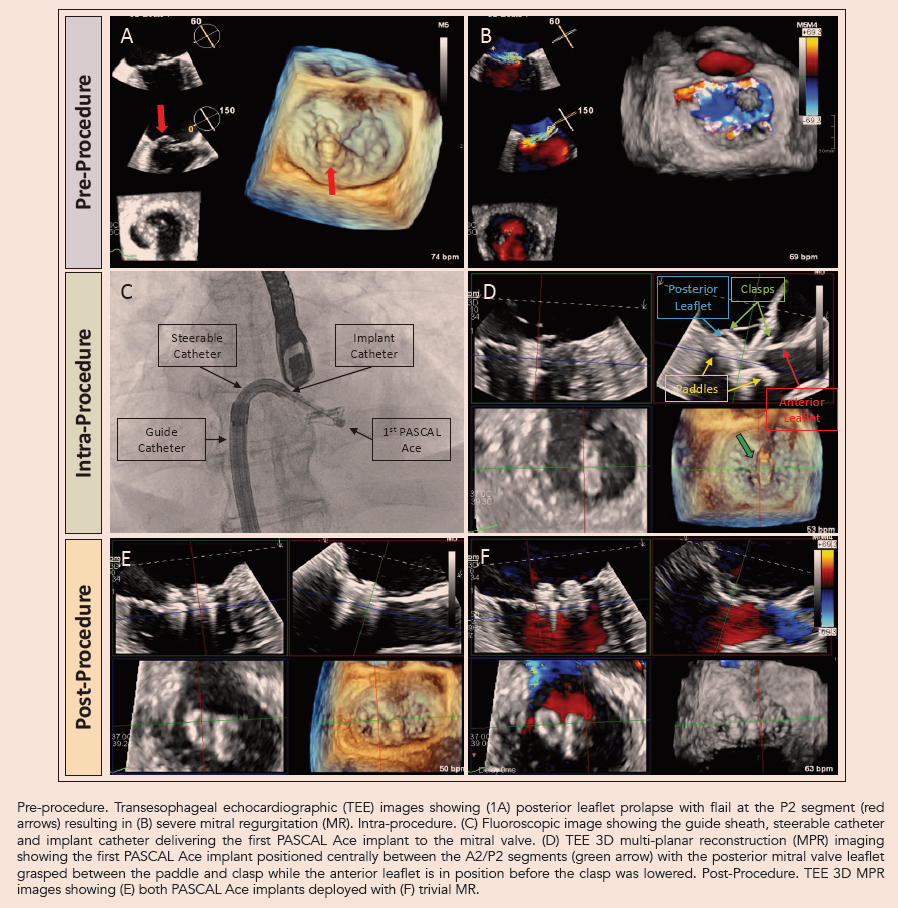
The procedure was performed in the cardiac catheterisation laboratory under general anaesthesia with TEE guidance. Vascular access was obtained through the right femoral vein and left atrial (LA) access was secured through a transseptal puncture. The guide sheath was then introduced into the LA, through which the steerable and implant catheters were manoeuvred to the mitral valve (Fig. 1C). Two PASCAL Ace implants were placed centrally at the site of P2 prolapse. TEE imaging was used to confirm adequate leaflet grasping between the implant’s paddles and clasps before deployment (Fig. 1D). MR severity was reduced to trivial with a satisfactory mitral inflow gradient of 3 mmHg (Figs. 1E and 1F). The delivery system was removed, and the right femoral vein access site was closed with 2 Perclose ProGlide (Abbott Cardiovascular) vascular closure devices. The patient was extubated immediately after the procedure and monitored overnight in the high-dependency unit. She ambulated well and was discharged the next day in stable condition. At 1 month, her symptoms improved to NYHA functional class I, with only trivial MR on TTE.
The MitraClip device, as the pioneer in TEER, has demonstrated its safety and efficacy through robust clinical trials with EVEREST II for degenerative MR and COAPT for functional MR.4,5 The PASCAL device was subsequently introduced and evaluated in the CLASP IID trial, which randomised patients with moderate-to-severe or severe symptomatic degenerative MR at prohibitive surgical risk to undergo TEER with either MitraClip or PASCAL.6 The trial demonstrated that PASCAL was comparable to MitraClip in terms of safety and efficacy, with no differences in all-cause mortality, heart failure hospitalisations, major adverse events and MR reduction at 1 year.
The PASCAL implant features broad-contoured paddles (compared to MitraClip’s narrower arms) and clasps armed with a single row of retention elements (as opposed to MitraClip’s gripper with multiple rows) (Supplementary Table S1). These design differences aim to reduce stress and potential leaflet injury. Additionally, the PASCAL implant incorporates a central spacer to bridge the coaptation gap and features a flexible nitinol structure with passive closure, allowing the implant to flex and extend with leaflet motion (whereas MitraClip employs a rigid mechanical active closure). Its ability to elongate and slenderise makes it easier to navigate around the subvalvular apparatus, reducing the risk of chordal entanglement. The PASCAL is available in 2 sizes: the original PASCAL, or “P10”, with a 10 mm width and a larger spacer; and the PASCAL Ace, which is narrower at 6 mm with a smaller spacer. In contrast, the MitraClip device offers 4 clip sizes with varying widths (4 mm and 6 mm) and lengths (9 mm and 12 mm), designated as NT, NTW, XT and XTW (“W” indicating a wider clip and “X” a longer clip). The PASCAL Precision delivery system consists of 3 components (guide sheath, steerable catheter and implant catheter) that allow for independent movements, enhancing flexibility and manoeuvrability, while the MitraClip delivery system comes in 2 components (steerable guide catheter and clip delivery system).
The introduction of the PASCAL system marks a significant advancement in transcatheter mitral valve repair in Singapore, offering an additional TEER option for patients unsuitable for open-heart surgery. Alongside the MitraClip, the availability of 2 distinct TEER devices, each with their unique designs, enables treatment for a broader range of mitral valve anatomies.
Supplementary Material
Supplementary Table S1. Comparison between MitraClip and PASCAL.
REFERENCES
- Messika-Zeitoun D, Candolfi P, Vahanian A, et al. Dismal Outcomes and High Societal Burden of Mitral Valve Regurgitation in France in the Recent Era: A Nationwide Perspective. J Am Heart Assoc 2020;9:e016086.
- Condado JA, Acquatella H, Rodriguez L, et al. Percutaneous edge-to-edge mitral valve repair: 2-year follow-up in the first human case. Catheter Cardiovasc Interv 2006;67:323-5.
- Yeo KK, Ding ZP, Chua YL, et al. Percutaneous mitral valve repair with MitraClip for severe functional mitral regurgitation. Singapore Med J 2013;54:e9-12.
- Feldman T, Foster E, Glower DD, et al. Percutaneous repair or surgery for mitral regurgitation. N Engl J Med 2011;364:1395-406.
- Stone GW, Lindenfeld J, Abraham WT, et al. Transcatheter Mitral-Valve Repair in Patients with Heart Failure. N Engl J Med;379:2307-18.
- Zahr F, Smith RL, Gillam LD, et al. One-Year Outcomes From the CLASP IID Randomized Trial for Degenerative Mitral Regurgitation. JACC Cardiovasc Interv 2023:S1936-8798(23)01358-4.
Written informed consent was obtained from the patient for publication of this case report and any accompanying images.
Ningyan Wong and See Hooi Ewe have received honoraria fees from Abbott Vascular. Khung Keong Yeo has received research funding from Abbott Vascular, consulting or honoraria from Abbott Vascular and Peijia Medical and speaker or proctor fees from Abbott Vascular and Peijia Medical. Wei Chieh Jack Tan has received educational grants from Abbott Vascular and Edwards Lifesciences. lgnasius Aditya Jappar declares no affiliations or financial involvement with any commercial organisation with a direct financial interest in the subject or materials discussed in the manuscript.
Dr Ningyan Wong, Department of Cardiology, National Heart Centre Singapore, 5 Hospital Drive, Singapore 169609. E-mail: [email protected]
