

ABSTRACT
Artificial intelligence (AI) is rapidly transforming healthcare, providing tools that support diagnosis, streamline workflows and enhance patient outcomes. However, its adoption has been uneven—hindered by ethical, legal and operational concerns. We propose that augmented intelligence (AugI)—AI designed to enhance, rather than replace, human decision-making—is the most practical and ethically sound model for integrating AI into healthcare. Key challenges in AI adoption include responsibility gaps, stakeholder resistance and outdated expectations about how clinicians should work. AugI provides a middle ground: preserving human oversight while leveraging the power of machine learning. As AI becomes an indispensable part of modern medicine, healthcare systems must shift toward a paradigm that embraces AI as a collaborative partner.
Artificial intelligence (AI) has become a transformative force across industries, including healthcare. In medicine, AI promises to assist in diagnosis, clinical documentation, triage and medical imaging interpretation, among other tasks.1-3 Despite its potential, AI adoption in healthcare remains limited, largely due to ethical, legal and practical concerns.4,5 Various experts have suggested a more human-centred approach, often termed “augmented intelligence”, to address these challenges. This framework places human experts at the centre while leveraging machine learning for support, emphasising enhancement over replacement and aligning better with the realities of clinical accountability and patient care.2-6 To avoid acronym ambiguity, we will use “AugI” when referring to augmented intelligence and reserve “AI” for artificial intelligence.
The responsibility gap: Why full automation falls short
A defining limitation of current AI systems is their inability to assume responsibility for outcomes. In the use of many AI-enhanced diagnostic or decision-making models, industries still require a human expert to review the results and approve them. This reflects a broader issue across healthcare AI: even highly accurate systems cannot operate independently because of the unresolved question of legal liability.4
This is not unique to healthcare. The same concern is evident in the slow adoption of fully autonomous vehicles. Accidents involving self-driving cars raise challenging legal and ethical questions. Who is at fault—the car, software, manufacturer or human passenger? These questions are particularly amplified in healthcare, where a misdiagnosis can result in severe and catastrophic consequences. As Gerke et al. described, the black box nature of many AI systems further complicates accountability and trust.4
An AugI model sidesteps this issue by preserving human oversight while integrating AI to improve performance. In this model, clinicians retain responsibility while AI serves as a powerful analytical tool.5 Examples of real-world applications include AI triaging of chest x-rays before radiologist review, AI-assisted pathology to improve diagnostic consistency, and oncology algorithms that suggest treatment options with final clinician oversight. These examples demonstrate collaboration in action, enhancing the productivity of clinicians while engaging and involving them.
The human factor: Incentives, ownership and resistance
When one attempts to launch AI-driven projects in a clinical setting, institutional resistance may sometimes be palpable. Stakeholders may cite competing priorities and a lack of resources. Past negative experiences with information technology systems—particularly electronic medical records (EMR)—have heightened clinician skepticism, as early EMRs have also contributed to physician burnout due to the increased administrative burden involved. Potential risks posed by AI are also an added burden to implementation, though conversely, its potential to significantly reduce administrative work is an incentive for implementation.
Despite the potential to streamline workflows, the lack of clear and immediate incentives has created a barrier. This challenge reflects a recurring theme in the implementation of AI in healthcare: successful adoption requires more than technological feasibility—it demands alignment with user motivations.7,8 The question of “what is in it for me now” for the user, whether in terms of ownership, credit or incentives, can significantly impact support or adoption.
AI systems are not plug-and-play. They require customisation, training, validation and maintenance. In environments where clinicians are already overextended, introducing a novel tool—however promising—will likely fail unless it brings tangible benefits to those investing the time and effort to implement it. As described by Davenport and Kalakota, the success of AI projects hinges on user trust and perceived value at the individual level.3
Moreover, healthcare AI development is a team endeavour. Without a sense of ownership and creative investment, it is difficult to garner support. These social and organisational dynamics must be addressed upfront when introducing AI projects. Specific strategies for creative investment include clinician co-design workshops, innovation grants for pilot AI projects, and incorporating AI leadership into promotion pathways.
The new normal: AI is not a good-to-have but a must-have
In daily clinical life, the use of AI-enabled tools is becoming increasingly common. Generative AI, such as ChatGPT and other large language models, is utilised to aid in drafting clinical notes, patient instructions and academic writing.6,9 This review itself was initially drafted through dictation using speech-to-text voice recognition and later refined using AI.
AI has also significantly advanced fields, such as cancer detection by improving accuracy, speed and accessibility through applications in imaging and genomics, leading to better outcomes and reduced mortality rates. While clinical integration remains challenging due to issues such as data quality, regulatory concerns and model transparency, these barriers can be overcome through interdisciplinary collaboration using multimodal approaches, explainable AI and federated learning.10 An essential aspect of deployment is the ongoing monitoring of AI performance, including the detection of model drift, bias and accuracy over time, to ensure continued safety and effectiveness. For example, AI-assisted mammography and colonoscopy have been associated with earlier cancer detection and improved survival outcomes in population studies (e.g. the National Cancer Institute’s Surveillance, Epidemiology, and End Result and World Health Organization reports).11
Still, the stigma surrounding AI use persists. In outdated expectations of work, doctors are dissuaded from using AI, and students are discouraged from using AI tools to assist in writing their assignments or theses. While intended to preserve academic integrity, this approach overlooks a crucial shift: AI tools are becoming foundational to modern work. Rajkomar et al. argued that machine learning in medicine should not be viewed as a threat, but as a means to enhance clinician performance through data synthesis and decision support.7
We feel that an analogy to calculators is apt. Just as we expect financial professionals to use spreadsheets and engineers to use modelling software, the clinicians of tomorrow will need to be proficient in AI-assisted decision-making. If an accountant fails to use the appropriate accounting tools, they will be called into question. Similarly, a clinician of the future who fails to utilise the appropriate, approved and generally accepted AI tool could be held accountable for negligence.
AugI: A more trustworthy model
The term “artificial intelligence” evokes ideas of synthetic, potentially untrustworthy agents. In contrast, “augmented intelligence” suggests partnership, support and human-centred design. The American Medical Association has endorsed the use of this latter term to reflect AI’s appropriate role in clinical care, as a tool that enhances human judgement without supplanting it.2 Human-AI collaboration can be understood as occurring at 3 levels: (1) human-in-the-loop, where clinicians are actively involved in each decision; (2) human-over-the-loop, where clinicians oversee multiple AI processes without direct involvement at every decision point; and (3) human-out-of-the-loop, which is generally unacceptable in healthcare. Augmented human intelligence encompasses primarily (1) and (2), balancing safety with scalability. Fig. 1 demonstrates how AugI is a subset of AI where humans remain in the loop, while acknowledging that there are many aspects of AI where humans are no longer in the loop (Fig. 1). We think that the AugI subset is where the use of AI healthcare is best accepted and understood at present.
Fig. 1. Graph depicting how AugI is a subset of AI that keeps humans in the loop, while AI as a whole includes models where humans are no longer in the loop.
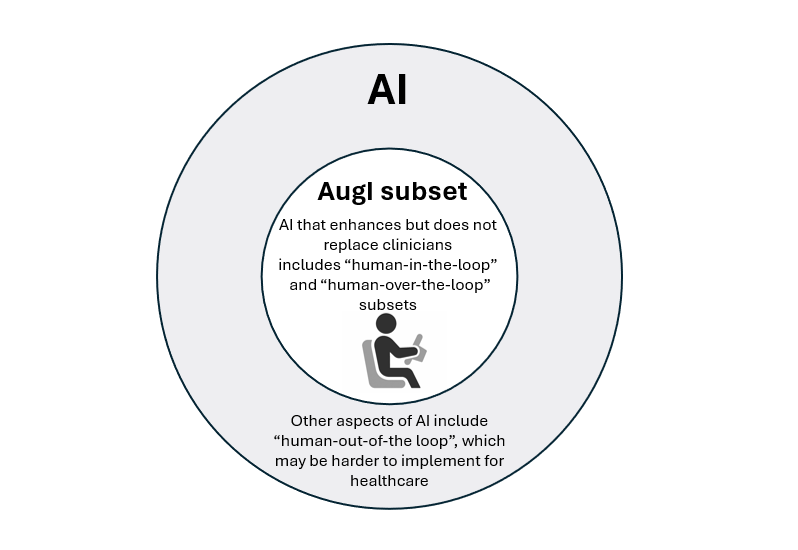
AI: artificial intelligence; AugI: augmented intelligence
Topol et al. have emphasised that the future of high-performance medicine lies in collaboration between human intelligence and algorithmic processing.6 In this framework, clinicians are not replaced by machines but are empowered by them, with AugI functioning as a tireless assistant in a data-rich, time-limited environment. A responsible car driver may not need to know how the car is built, but they will need to drive the car safely and responsibly on the road the moment their hands are placed on the steering wheel. This is no different from AugI. The new generation of healthcare practitioners will not need to know anything about coding; however, to deliver AugI-enabled care to patients, it is critical that the consumers, in this case, healthcare practitioners, be trained on the basics of using AI tools in a safe and responsible manner. This framing also better addresses concerns about ethics, transparency and patient trust.9,12,13 Yu et al. emphasised the need for AI systems to be interpretable, reliable and accountable to human oversight.14 Patient involvement at all levels will further ensure patient relevance in the development and implementation of processes.15 Implementation and social sciences are crucial, as the adoption of AugI tools requires an understanding of clinician behaviour, workflow dynamics and organisational culture, which are as important as technical performance.
CONCLUSION
Lakhani states “AI won’t replace humans—but humans with AI will replace humans without AI”.16 In the same way, AI will not replace doctors. However, doctors who utilise AI may replace those who do not. As data volume and clinical complexity increase, AI will become a necessary companion in medicine. The key is to adopt a model that enhances rather than replaces the clinician, that is, AugI. This approach respects the ethical, legal and emotional stakes of healthcare decisions while allowing us to harness the best of what AI has to offer. It also reminds us that the standard expected in healthcare is now higher, with the augmentation that technology now provides.
Clinicians, educators, developers and regulators must collaborate to design systems that are not only powerful but also user-friendly, transparent and equitable. By doing so, we can build a future where AI is not an intruder in medicine, but a trusted partner.
REFERENCES
- Thirunavukarasu AJ, Ting DSJ, Elangovan K, et al. Large language models in medicine. Nat Med 2023;29:1930-40.
- Americal Medical Association. Augmented Intelligence in Medicine. Published 2024. https://www.ama-assn.org/practice-management/digital-health/augmented-intelligence-medicine. Accessed 5 June 2025.
- Davenport T, Kalakota R. The potential for artificial intelligence in healthcare. Futur Healthc J 2019;6:94-8.
- Gerke S, Minssen T, Cohen G. Ethical and legal challenges of artificial intelligence-driven healthcare. Artif Intell Healthcare 2020:295-336.
- Obermeyer Z, Emanuel EJ. Predicting the Future – Big Data, Machine Learning, and Clinical Medicine. N Engl J Med 2016;375:1216-9.
- Topol EJ. High-performance medicine: the convergence of human and artificial intelligence. Nat Med 2019;25:44-56.
- Rajkomar A, Dean J, Kohane I. Machine Learning in Medicine. N Engl J Med 2019;380:1347-58.
- Beam AL, Kohane IS. Big data and machine learning in health care. JAMA 2018;319:1317-8.
- Ong JCL, Chang SY, William W, et al. Medical Ethics of Large Language Models in Medicine. NEJM AI 2024;1.
- Yao IZ, Dong M, Hwang WYK. Deep Learning Applications in Clinical Cancer Detection: A Review of Implementation Challenges and Solutions. Mayo Clin Proc Digit Heal 2025;3:100253.
- Tan C, Tan EY, Tan GP, et al. Advancing breast cancer and lung cancer screening: Expert perspectives to advance programmes in Singapore. Ann Acad Med Singap 2025;54:498-504.
- Ong JCL, Chang SYH, William W, et al. Ethical and regulatory challenges of large language models in medicine. Lancet Digit Heal 2024;6:e428-32.
- Esteva A, Robicquet A, Ramsundar B, et al. A guide to deep learning in healthcare. Nat Med 2019;25:25-9.
- Yu KH, Beam AL, Kohane IS. Artificial intelligence in healthcare. Nat Biomed Eng 2018;2:719-31.
- Goh WWB, Tan CH, Tan C, et al. Regulating, implementing and evaluating AI in Singapore healthcare: AI governance roundtable’s view. Ann Acad Med Singap 2025;54:428-36.
- Lakhani K. AI Won’t Replace Humans — But Humans With AI Will Replace Humans Without AI. Harvard Business Review. 4 August 2023. https://hbr.org/2023/08/ai-wont-replace-humans-but-humans-with-ai-will-replace-humans-without-ai. Accessed 16 June 2025.
Not applicable as no study participants are involved.
There was no grant funding for this manuscript. The authors declare there are no affiliations with or involvement in any organisation or entity with any financial interest in the subject matter or materials discussed in this manuscript.
Prof William Ying Khee Hwang, National Cancer Centre Singapore, 30 Hospital Boulevard, Singapore 168583. Email: [email protected]
