

ABSTRACT
Introduction: Human papillomavirus (HPV) causes over 95% of cervical cancers. The American Society for Colposcopy and Cervical Pathology (ASCCP) guidelines support a risk-based approach using the most informative test, which may include high-risk (HR) or extended genotyping. Most laboratories perform partial genotyping. This study reports findings from the comprehensive genotyping of all 14 HR HPV genotypes in cervical samples from the Singapore population.
Methods: A total of 2497 cervical specimens collected in ThinPrep PreservCyt vials underwent full HPV genotyping using real-time polymerase chain reaction TOCE technology (Seegene Inc, Seoul, South Korea). Among these, 327 (13.1%) tested positive for HPV. Cytology results were available for 275 (84.1%) of these HPV-positive cases. The authors examined genotype prevalence and cytology correlations, and compared follow-up management under the Society for Colposcopy & Cervical Pathology of Singapore (SCCPS) guidelines versus ASCCP 2019 guidelines.
Results: HPV52 and 58 were the most prevalent genotypes, accounting for 32.2% of all detected HPV genotypes. Co-infections were seen in 20.2% of samples. Among 31 (9.5%) HPV16/18 cases, most had normal cytology, though some showed atypical or low-grade changes. Under the ASCCP guidelines for primary screening, 16.8% of cases could defer to repeat HPV testing in 1 year instead of immediate cytology triage under SCCPS. In co-testing, ASCCP-guided management reduced colposcopy referrals by 7.4% since these cases would only require repeat HPV testing in 1 year.
Conclusion: Comprehensive HPV genotyping enhances risk stratification and enables more efficient patient management. Compared to SCCPS, the ASCCP guidelines reduce unnecessary procedures while preserving safety, supporting broader adoption of full genotyping and risk-based triage in cervical screening programmes in Singapore.
CLINICAL IMPACT
What is New
- Using the Seegene assay, 55 cases (16.8%; 55/327) were found to be positive for HPV59/56/66. These are genotypes often missed by partial genotyping methods.
- All were negative for the other 11 high-risk genotypes, making them eligible for deferred testing under the American Society for Colposcopy and Cervical Pathology (ASCCP) guidelines.
Clinical Implications
- Comprehensive genotyping improves risk stratification.
- Applying the ASCCP co-testing guidelines results in a 7.4% reduction in unnecessary colposcopy referrals, supporting safer and more cost-effective cervical screening in Singapore.
The human papillomavirus (HPV) is a primary aetiological agent responsible for more than 95% of cervical diseases and cancers globally, presenting a significant public health concern. HPV comprises numerous genotypes, among which 14 are classified as high-risk (HR) due to their strong association with the progression of cervical cancer. The American Society for Colposcopy and Cervical Pathology (ASCCP) 2019 guidelines, also known as the Enduring Guidelines, use a risk-based approach to manage abnormal cervical screening results. Recognising the specific HR HPV genotype present in patients is critical, as the Enduring Guidelines recommend a stratified risk-based clinical management approach tailored to individual HPV genotype risks.
The World Health Organization has set an ambitious global mission to eliminate cervical cancer, defined by the 90-70-90 targets by 2030: 90% of girls fully vaccinated with the HPV vaccine by age 15; 70% of women screened using high-performance tests, which refer to HPV-based testing rather than cytology, by age 35 and again by age 45; and 90% of women identified with cervical disease receiving appropriate treatment.1
Despite these guidelines and objectives, most laboratories in Singapore currently perform only partial HPV genotyping, typically limited to identifying a subset of HPV genotypes. This substantially restricts the clinical utility of these results, potentially undermining effective patient management. Limited genotyping prevents healthcare providers from making fully informed decisions based on comprehensive genotype-specific risk assessment.
To address this clinical gap, this study aims to implement comprehensive genotyping for all 14 HR HPV genotypes in cervical swab samples collected in Singapore from October 2024 to June 2025. The primary objectives are to determine the prevalence and distribution of individual HPV types, investigate co-infection patterns and evaluate the relative significance of HR HPV genotypes HPV16 and 18 compared to other HR genotypes within the Singapore population. Moreover, cytology results are correlated with genotypic data where available, providing further clinical insights. An additional objective is to compare the differences in clinical management recommendations between primary HPV screening and co-testing strategies outlined in the Society for Colposcopy & Cervical Pathology of Singapore (SCCPS) and the ASCCP 2019 Risk-Based Management Consensus guidelines.2,3
METHODS
Cervical specimens (n=2497) were collected in ThinPrep PreservCyt collection vials and submitted to iGene Laboratory, Singapore for routine HR HPV deoxyribonucleic acid (DNA) polymerase chain reaction (PCR) screening. These samples were collected from primary care clinics and specialist Obstetrics and Gynaecology centres across Singapore. Of the 2497 cervical samples analysed, nationality data were available for 1720 cases. Among these, 1015 (59%) were from Singaporean citizens. Of the Singaporean cases with age data available, 56 (5.5%) were aged below 30 years, while 954 (94.5%) were aged 30 and above. Percentages reported are based on cases with available demographic data. Prior to nucleic acid extraction, samples underwent standardised pre-treatment by transferring 1 mL of the ThinPrep sample into a Hologic Aptima Specimen Transfer tube, followed by gentle inversion 3–5 times. Nucleic acid extraction was performed using the MagMAX Viral/Pathogen Nucleic Acid Isolation Kit (Thermo Fisher Scientific, Waltham, MA, US) on the KingFisher Flex Purification System (Thermo Fisher Scientific, Waltham, MA, US), according to the manufacturer’s instructions and internal standard operating procedures.
HPV genotyping was performed using the Seegene Allplex HPV HR Detection assay (Seegene Inc, Seoul, South Korea), which employs multiplex real-time PCR incorporating Tagging Oligonucleotide Cleavage and Extension (TOCE) technology. This platform detects and distinguishes 14 HR HPV genotypes (HPV16, 18, 31, 33, 35, 39, 45, 51, 52, 56, 58, 59, 66, 68) in a single reaction tube. TOCE technology leverages target-specific tagging oligonucleotides and signal generation control through a single melting curve per target, offering precise and reliable genotyping with high sensitivity and specificity. PCR amplification was carried out on the CFX96 Dx System (Bio-Rad Laboratories, Hercules, CA, US), using CFX Manager Dx Software version 3.1 (Bio-Rad Laboratories, Hercules, CA, US). Genotyping analysis was performed using Seegene Viewer software (Seegene Inc, Seoul, South Korea), which, along with the Seegene Allplex HPV HR Detection assay, is approved by the Health Sciences Authority for clinical use in Singapore.
For samples with available cytology, Papanicolaou test (Pap smear) test results were retrieved and categorised according to the Bethesda System for Reporting Cervical Cytology.4 These were compared to the corresponding HPV genotypes to evaluate co-infection profiles and genotype-cytology correlations.
In addition to the descriptive analysis of genotype prevalence and co-infection patterns, all HPV-positive cases with or without cytology were reviewed to assess clinical management recommendations based on both the SCCPS and ASCCP guidelines.2,3 Each sample was stratified according to HPV genotype and cytology status. Appropriate management actions (e.g. colposcopy, cytology triage or repeat HPV testing) were determined under both guideline frameworks. Concordance and discrepancies in management pathways were documented to assess the impact of guideline selection on clinical outcomes and resource utilisation.
Descriptive statistics were used to summarise HPV genotype prevalence, co-infection rates and cytology results. Proportions were compared using Fisher’s Exact test. A P value of <0.05 was considered statistically significant. Statistical analyses were performed using GraphPad Prism version 5.0 (GraphPad Software, San Diego, CA, US).
RESULTS
Of the total 2497 specimens received, 327 tested positive for HPV DNA using real-time PCR, yielding a positivity rate of 13.1% (95% confidence interval 11.8–14.5).5
HPV genotype prevalence
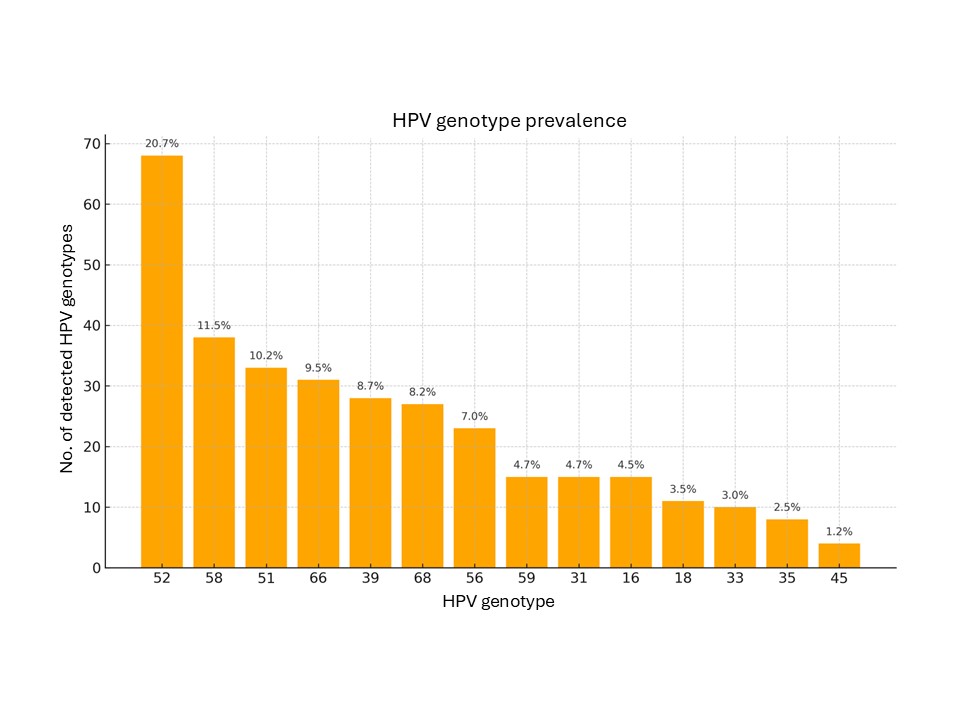
Among the 14 HR HPV genotypes where 401 HPV genotypes were detected, HPV52 (20.7%, n=83) and HPV58 (11.5%, n=46) were the most prevalent in the study cohort. There were 4 cases (1.2%, n=4) with co-infections involving both HPV52 and 58. In total, 125 cases (38.2%; 125/327) had HPV52/58 and were significantly more prevalent compared to HPV16/18 (9.5%; 31/327) among HPV-positive samples (P<0.0001, Fisher’s Exact test). These findings highlight the dominant presence of non-HPV16/18 genotypes, in particular HPV52 and 58 in the Singapore population, consistent with regional trends in Southeast Asia.6,7
HPV co-infection distribution
Most samples (79.8%, n=261) tested positive for a single genotype, while 59 cases (18.0%) showed co-infection with 2 genotypes, and 7 (2.1%) had 3 or more. While most cases involved a single HR HPV type, the presence of multiple infections may impact persistence and disease progression.8
Comparison with cytology results
Among the 327 HPV-positive cases, 275 had concurrent liquid-based cytology (Pap smear) performed, enabling co-testing analysis. Among these, 196 (71.3%) showed normal cytology (negative for intraepithelial lesion or malignancy [NILM]); 33 (12.0%) demonstrated atypical squamous cells of undetermined significance (ASC-US); 35 (12.%) showed low-grade squamous intraepithelial lesions (LSIL); 3 (1.1%) had atypical squamous cells, cannot exclude high-grade squamous intraepithelial lesions (HSIL) (ASC-H); 1 (0.4%) showed dysplasia/cervical dysplasia (CIN 1–2); and 4 (1.5%) had HSIL (Table 1).
Table 1. Number of HPV positive cases (n=327) with available cytology results (n=275).
|
Cytology group |
Description |
No. of samples |
Percentage (%) |
|
HSIL |
High-grade squamous intraepithelial lesion |
4 |
1.5 |
|
Dysplasia/CIN 1–2 |
Moderate abnormal changes, possibly cervical intraepithelial neoplasia 2 |
1 |
0.4 |
|
LSIL, ASC-H |
Mixed low- and possibly high-grade findings |
3 |
1.1 |
|
ASC-H |
Atypical squamous cells, cannot exclude HSIL |
3 |
1.1 |
|
LSIL |
Low-grade squamous intraepithelial lesion |
35 |
12.7 |
|
ASC-US |
Atypical squamous cells of undetermined significance |
33 |
12.0 |
|
NILM |
Negative for intraepithelial lesion or malignancy—normal cytology |
196 |
71.3 |
|
Total |
275 |
||
Note: The table includes cytology results for 275 out of 327 HPV-positive cases. Cytology results are classified according to the Bethesda system. Percentages are based on total cases with available cytology.
Cytology results in HPV16/18-positive cases
Among the 327 HPV-positive cases, 31 (9.5%) tested positive for HPV genotype 16/18. In accordance with SCCPS and ASCCPS guidelines, these individuals would be directly referred for colposcopy regardless of cytology results due to the high oncogenic risk associated with these genotypes. These cases were compared with available cytology results (n=24): 17 (70.8%) had NILM, 1 (4.2%) demonstrated ASC-US, 2 (8.3%) showed LSIL, 2 (8.3%) had ASC-H and 2 (8.3%) had LSIL with ASC-H (Table 2). No HSIL or CIN2+ cases were observed in this group. Nonetheless, due to the consistently high oncogenic potential of HPV16 and 18, current ASCCP and SCCPS guidelines recommend immediate colposcopy referral for individuals testing positive for these genotypes, regardless of cytology status. This approach ensures that early high-grade lesions are not missed, even in the presence of cytological findings that may appear benign or equivocal.
Table 2. Comparison of cytology results between HPV16/18 and non-HPV16/18 genotypes.
|
Cytology group |
HPV16/18 (n=24) |
Non-HPV16/18 (n=251) |
P value (Fisher’s Exact)a |
Total (n=275) |
HPV16/18 (%) |
Non-HPV16/18 (%) |
|
NILM |
17 |
179 |
1.0000 |
196 |
70.8 |
71.3 |
|
ASC-US |
1 |
32 |
0.3291 |
33 |
4.2 |
12.7 |
|
LSIL |
2 |
33 |
0.7498 |
35 |
5.7 |
13.1 |
|
ASC-H |
2 |
1 |
0.0208b |
3 |
8.3 |
0.4 |
|
LSIL with ASC-H |
2 |
1 |
0.0208b |
3 |
8.3 |
0.4 |
|
Dysplasia / CIN 1–2 |
0 |
1 |
1.0000 |
1 |
0.0 |
0.4 |
|
HSIL |
0 |
4 |
1.0000 |
4 |
0.0 |
1.6 |
ASC-H: atypical squamous cells, cannot exclude HSIL; ASC-US: atypical squamous cells of undetermined significance; HSIL: high-grade squamous intraepithelial lesion; LSIL: low-grade squamous intraepithelial lesion; NILM: negative for intraepithelial lesion or malignancy
a P values calculated using Fisher’s Exact test (GraphPad Prism version 5.0 [GraphPad Software, San Diego, CA, US]).
b Statistically significant differences observed for ASC-H and LSIL with ASC-H groups but based on small numbers.
Cytology results in non-HPV16/18-positive cases
For the 251 cases positive only for non-HPV16/18 genotypes where cytology results are available, 179 (71.3%) had NILM. The remaining cytological findings included ASC-US (12.7%, n=32), LSIL (13.1%, n=33), ASC-H (0.4%, n=1), mixed findings of LSIL with ASC-H (0.4%, n=1), dysplasia/CIN 1–2 (0.4%, n=1) and HSIL (1.6%, n=4) (Table 2). In total, among the HPV16/18-positive cases with cytology, 6 (25.0%; 6/24) had abnormal results, compared to 72 (28.7%; 72/251) in non-HPV16/18 cases (P=1.0000, Fisher’s Exact test), indicating no statistically significant difference. These findings highlight the importance of full HPV genotyping in identifying women at elevated risk for CIN2+, while also helping to avoid unnecessary immediate interventions.
Importantly, 55 cases (16.8%; 55/327) that tested positive for HPV59/56/66 and negative for HPV16/18 would qualify for deferred repeat testing in 1 year under the ASCCP guidelines. Of these cases, 48 (87.3%) had available cytology results and none had high-grade findings (Table 3). This highlights the value of extended genotyping to identify low-risk profiles and avoid unnecessary referrals, ensuring that healthcare resources are focused on individuals at genuinely elevated risk.
Table 3. Number of HPV59/56/66 cases (non-HPV16/18) with available cytology results (n=48).
|
Cytology group |
Description |
No. of samples |
Percentage (%) |
|
LSIL |
Low-grade squamous intraepithelial lesion |
7 |
14.6 |
|
ASC-US |
Atypical squamous cells of undetermined significance |
9 |
18.8 |
|
NILM |
Negative for intraepithelial lesion or malignancy—normal cytology |
32 |
66.7 |
|
Total |
48 |
||
Note: The table includes 48 cases positive for HPV59/56/66, excluding any cases with HPV16/18. Cytology results are classified according to the Bethesda system.
DISCUSSION
Regional genotype patterns and clinical implications of co-infection
The findings confirm the high prevalence of non-HPV16/18 HR genotypes in the Singapore population, particularly HPV52 and 58. Together, they accounted for 32.2% of all HR HPV genotypes (Fig. 1). Such findings are consistent with previous epidemiological studies in East and Southeast Asia, where HPV52 and 58 are reported as the most common non-vaccine types.7,8 Their oncogenic potential and frequent presence among HPV-positive cases further reinforce the need to incorporate them into screening and vaccine considerations.
Fig. 1. Distribution of high-risk HPV genotypes among 327 HPV-positive cases, showing HPV52 and 58 as the most prevalent types in the study cohort.
Furthermore, this study revealed a notable proportion of co-infections where 20.2% of HPV-positive samples harboured 2 or more genotypes (Fig. 2). Although the clinical significance of co-infections remains debated, some evidence suggests a higher likelihood of persistent infection or progression to high-grade lesions in the presence of multiple HPV types.9
Fig. 2. Co-infection distribution showing the number of HPV genotypes detected per sample. Most cases (79.8%) had a single genotype, while 20.2% showed multiple infections. 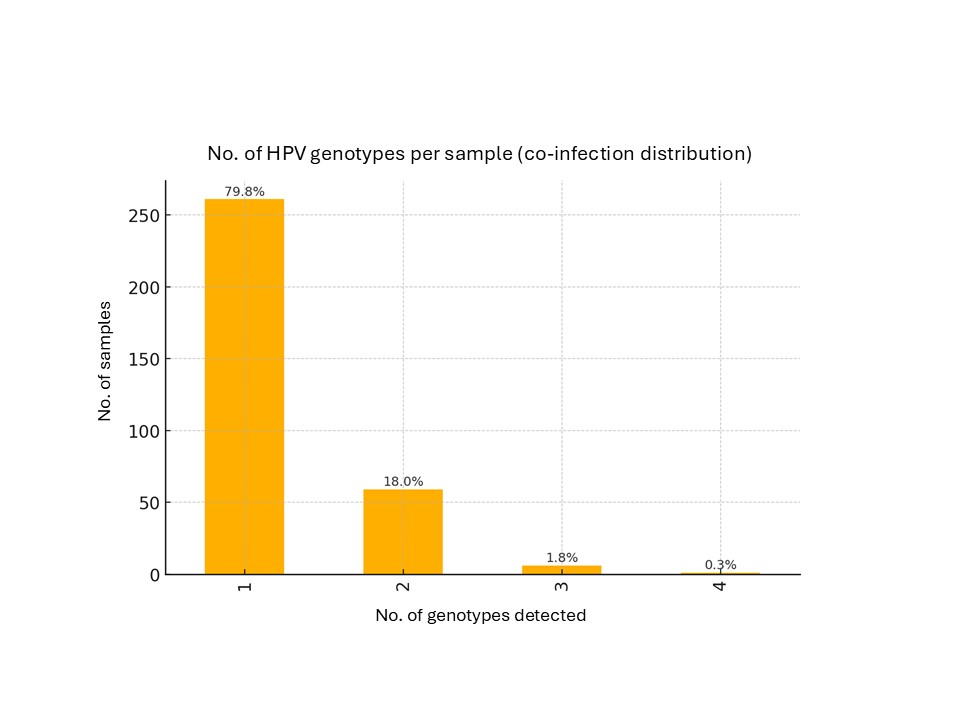
Triage and management stratification
The remaining 296 (90.5%) HPV-positive cases tested positive for 1 or more of the other 12 HR genotypes (i.e. excluding HPV16 and 18). In accordance with SCCPS guidelines for primary screening, these cases were subjected to cytology triage. Those with negative cytology (NILM) would be scheduled for repeat HPV testing in 1 year, while individuals with abnormal cytology (≥ASC-US) would be referred for colposcopy. This stratification allowed a direct comparison of the SCCPS’s recommendations with international benchmarks, such as the 2019 ASCCP guidelines for HPV primary screening (without co-testing).
When comparing follow-up management strategies for primary HPV screening between the SCCPS and ASCCP guidelines, a significant difference in downstream procedures was observed. Under SCCPS, all 296 non-HPV16/18 positive cases would be directed to immediate cytology triage following a positive HPV test. In contrast, the ASCCP guidelines adopt a more risk-stratified approach, whereby only 241 of these cases (73.7%) (positive for non-HPV16/18 genotypes, such as HPV31, 33, 35, 39, 45, 51, 52, 58, or 68) would undergo cytology triage, while the remaining 55 cases (16.8%) could defer management and undergo repeat HPV testing after 1 year (Fig. 3).
Fig. 3. Comparison of clinical management categories under SCCPS and ASCCP for primary HPV screening. ASCCP guidelines allowed 55 cases to defer to repeat testing, while SCCPS directed all to follow-up cytology or immediate colposcopy. 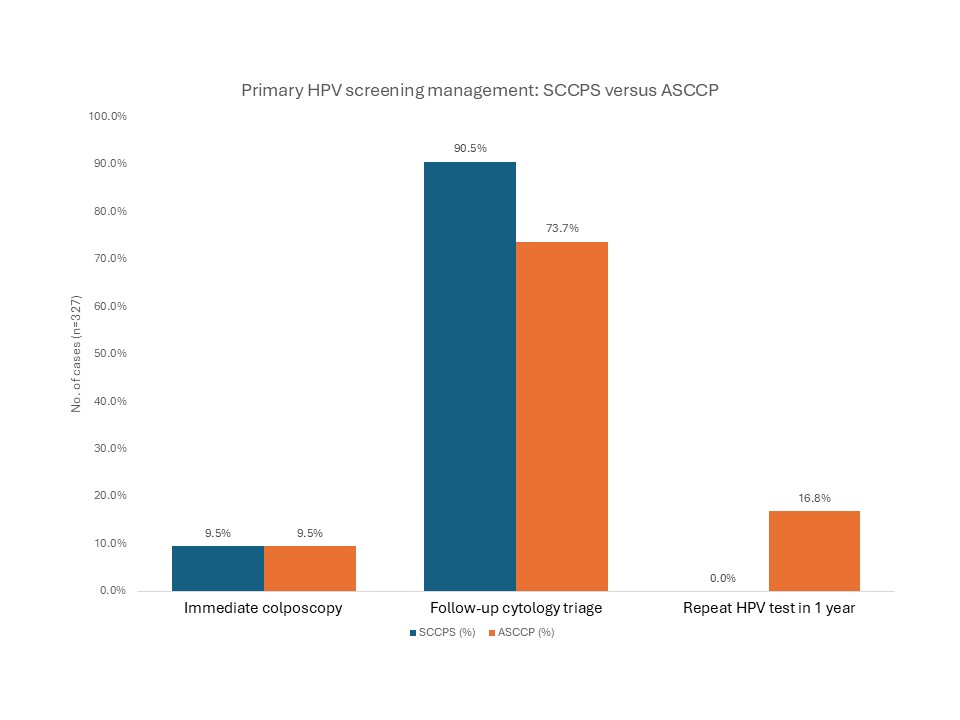
This highlights the potential of ASCCP’s framework to reduce unnecessary cytological evaluations, thereby conserving clinical resources and reducing patient anxiety, without compromising the safety of screening outcomes.
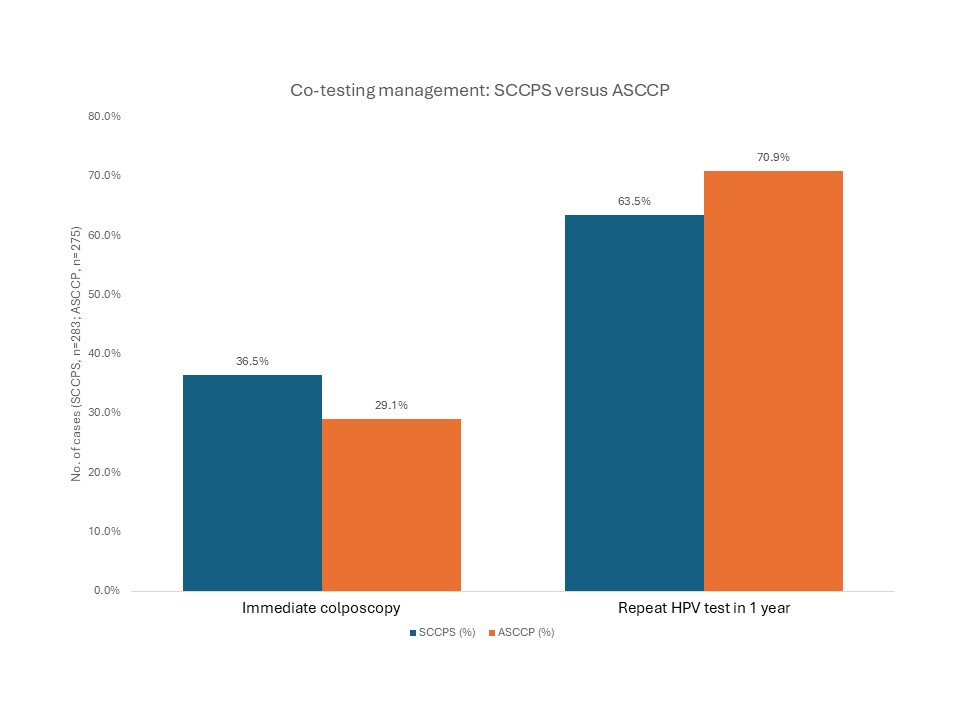
When analysing clinical management outcomes for cases undergoing HPV/cytology co-testing, notable differences were observed between SCCPS and ASCCP guidelines. Colposcopy referrals decreased from 36.5% (103/282) under SCCPS to 29.1% (80/275) under ASCCP, representing a 7.4% reduction. Although this difference did not reach statistical significance (P=0.0711, Fisher’s Exact test), the observed trend suggests a meaningful potential to ease the burden on specialist services and reduce patient exposure to unnecessary invasive procedures. In addition, a greater proportion of cases—70.9% (n=195)—would be managed with repeat HPV testing in 1 year under ASCCP, compared to 63.5% (n=179) under SCCPS (Fig. 4). This 7.4% increase in deferred follow-up highlights the utility of ASCCP’s risk-based approach, which prioritises long-term monitoring for lower-risk cases while preserving clinical vigilance for HR scenarios. These findings suggest that the adoption of ASCCP guidelines may support more efficient resource allocation and reduce patient anxiety, without compromising clinical safety. However, it is important to note that the ASCCP risk-based management framework was developed using longitudinal datasets from specific US Food and Drug Administration-approved platforms such as BD Onclarity HPV assay and Cobas 4800 HPV test. For instance, BD Onclarity groups certain genotypes together (e.g. HPV33 and 58, HPV56/59/66), limiting precise genotype-specific risk assessment. In contrast, the Seegene Allplex HPV HR Detection assay used in this study provides full individual genotyping of all 14 HR types, which may offer a more refined understanding of genotype-associated risk. Nonetheless, the Seegene assay has not yet been incorporated into the datasets that informed the ASCCP risk models. Large-scale prospective studies are therefore needed to establish genotype-specific risk estimates applicable to this platform and to evaluate its utility within an ASCCP-aligned management framework.
Fig. 4. Comparison of SCCPS and ASCCP co-testing management recommendations. ASCCP resulted in fewer colposcopy referrals (n=80) and more cases managed with repeat HPV testing (n=195) compared to SCCPS (n=103 and n=179, respectively).
In this study, all cases testing positive for HPV16/18 (n=31) would be referred for immediate colposcopy under both SCCPS and ASCCP guidelines due to their high oncogenic potential. However, when examining the approach for non-HPV16/18 genotypes, key differences between the guidelines emerge. Under SCCPS guidelines, all 296 (100.0%) non-HPV16/18 cases require follow-up cytology triage. In contrast, the ASCCP guidelines adopt a more risk-based strategy where only 241 (73.7%) of these cases would undergo cytology triage, while 55 cases (16.8%) could safely defer to a repeat HPV test in 1 year (Fig. 3). This more tailored approach reduces unnecessary cytology tests and supports resource optimisation without compromising patient safety.
There are several limitations in this study. First, the number of samples with paired cytology results was relatively small (n=275), which may limit the strength of genotype-cytology correlations. Second, the clinical indications for testing and patients’ medical histories were not available. It was assumed that all samples were submitted for routine cervical cancer screening, although this could not be independently verified. Third, while the findings highlight the genotype distribution in a screened population, the absence of biopsy-confirmed CIN2+ or cancer data limits the interpretation of genotype-specific oncogenic risk. Prospective studies with histological endpoints are necessary to evaluate clinical outcomes more definitely.
CONCLUSION
Although individual-level clinical data were unavailable, partial demographic information suggests that the cohort reflects the Singapore screening population. Nationality data were available for over 68% of cases, with the majority being Singaporean residents. Nevertheless, this study demonstrates the value of comprehensive HR HPV genotyping in cervical screening, especially in the Singapore population where non-HPV16/18 genotypes such as HPV52 and 58 are highly prevalent. Comprehensive HPV genotyping combined with cytology improves risk stratification and enables more targeted management. Risk-based frameworks such as SCCPS and ASCCP help avoid overtreatment, enhance clinical outcomes and conserve resources by identifying cases suitable for conservative follow-up instead of immediate colposcopy.
Acknowledgements
The authors would like to express their sincere gratitude to Ms Nurul Junaidi and Mr Mitra Tjhin for their invaluable assistance in retrieving and consolidating laboratory and clinical data used in this study. The authors also acknowledge Ms Mujibur Rahman Zafirah for her dedicated support in performing the HPV genotyping tests and contributing to the technical execution of the laboratory work. Their contributions were essential to the successful completion of this study. Written permission has been obtained from these individuals to include them in the acknowledgements of this manuscript.
REFERENCES
- World Health Organization. Global strategy to accelerate the elimination of cervical cancer as a public health problem. Geneva: WHO; 2020.
- Singapore Cancer Society. Cervical cancer prevention and screening guidelines. Singapore: SCS; 2020.
- Massad LS, Clarke MA, Perkins RB, et al. Applying Results of Extended Genotyping to Management of Positive Cervicovaginal Human Papillomavirus Test Results: Enduring Guidelines. J Low Genit Tract Dis 2025;29:134-43.
- Nayar R, Wilbur DC, editors. The Bethesda system for reporting cervical cytology: definitions, criteria, and explanatory notes. 3rd ed. New York: Springer; 2015.
- Kohn MA, Senyak J. Sample Size Calculators [website]. UCSF CTSI. 9 January 2025. https://www.sample-size.net/. Accessed 30 July 2025.
- Raub SHA, Isa NM, Zailani HA, et al. Distribution of HPV genotypes in cervical cancer in multi- ethnic Malaysia. Asian Pac J Cancer Prev 2014;15:651-6.
- Xia C, Li S, Long T, et al. Current Updates on Cancer-Causing Types of Human Papillomaviruses (HPVs) in East, Southeast, and South Asia. Cancers (Basel) 2021;13:2691.
- Bonde J, Bottari F, Iacobone AD, et al. Human Papillomavirus Same Genotype Persistence and Risk: A Systematic Review. J Low Genit Tract Dis 2021;25:27-37.
- Luo Q, Zeng X, Luo H, et al. Epidemiologic characteristics of high-risk HPV and the correlation between multiple infections and cervical lesions. BMC Infect Dis 2023;23:667.
This study utilised strictly de-identified data that was anonymised prior to collection and analysis by the research team. In accordance with the National Healthcare Group Domain Specific Review Board policy, this study is classified as Review Not Required and defined as non-human subject research.
The authors declare there are no affiliations with or involvement in any organisation or entity with any financial interest in the subject matter or materials discussed in this manuscript. All authors have no conflicts of interest to declare. This research received no specific grant from any funding agency. The authors used ChatGPT (OpenAI, San Francisco, CA, US) to refine language, check grammar and improve clarity during manuscript preparation. The authors take full responsibility for the content generation and interpretation of the manuscript.
Dr Sherry Sze Yee Ho, iGene Laboratory Private Limited, 1 Science Park Road, #04-10, Science Park 2, The Capricorn, Singapore 117528. Email: [email protected]
