

ABSTRACT
Traditional Chinese Medicine (TCM) is gaining prominence within Singapore’s predominantly Western medicine (WM) system, reflecting a broader shift towards integrative care. This commentary argues that education is the primary engine of TCM integration, with reforms in professional recognition, competency-based assessments, bilingual curricula, and structured clinical training aligning TCM with contemporary standards and enabling collaboration with WM. These educational advances have catalysed changes in clinical practice, most notably the incorporation of acupuncture into public healthcare institutions, and strengthened research through targeted funding, formal ethics oversight, and TCM–WM partnership.
Despite progress, persistent barriers remain. Limited interprofessional education and communication impede collaborative care and fuel uncertainty about concurrent TCM–WM use. Financial constraints, including restricted subsidies, shape access and care-seeking for TCM. Safety concerns about Chinese proprietary medicines, including risks of adulteration, affect public and professional trust. Foundational differences in diagnostic frameworks and research methodologies complicate evaluation and standardisation, while patient non-disclosure of TCM use fragments care.
Singapore’s experience illustrates that safe, evidence-informed TCM integration depends on sustained investment in interprofessional education, equitable financing, robust safety surveillance, and high-quality translational research. Advancing these priorities can support holistic, person‑centred care across both systems.
Introduction
Complementary medicine refers to a non-mainstream therapeutic approach used alongside Western medicine (WM) to improve outcomes, with acupuncture alone and the full range of Traditional Chinese Medicine (TCM) therapies being the most widely accepted.1 Reflecting global momentum, the World Health Organization (WHO) Global Traditional Medicine Strategy 2025–2034 sets out principles,2 and the WHO publishes benchmarks for TCM and acupuncture on terminology,3 training,4 and clinical practice.5 Singapore, shaped by Asian and Western traditions, offers a salient case of TCM’s adoption within a predominantly WM system. This commentary reviews Singapore’s TCM landscape across education, practice, and research, highlighting advances and persistent challenges.
TCM, introduced during the colonial era, is now used by 20% of adults in Singapore, with nearly 40% reporting concurrent use with WM for the same condition (Singapore’s National Population Health Survey 2022).1 This prevalence is comparable to estimates from China (19%),2 Taiwan (27%),3 and South Korea (26%).3 Regional approaches to TCM integration vary: South Korea’s National Health Insurance covers the full range of traditional medicine treatments,4 while Hong Kong SAR has developed a dedicated Chinese Medicine Hospital, provided government-subsidised TCM, integrated TCM–WM services, and supported education and research.5 In contrast, Singapore has taken a selective, evidence-based path, focusing on targeted subsidies and the integration of specific modalities, most notably acupuncture, into public healthcare institutions. In Singapore, the TCM Practitioners Board (TCMPB) regulates the registration of TCM practitioners (TCMPs), registration, accreditation of approved training institutions, continuing professional education, and ethical and professional conduct.1 According to the latest TCMPB annual report, Singapore has 3242 TCMPs and 260 acupuncturists,6 with more than half aged 50–69 years.7
SUCCESSES OF TCM
Education
TCM education has evolved from apprenticeship to recognised academic and professional pathways. Fig. 1 maps key milestones in this development.
Fig. 1. Roadmap of TCM education development in Singapore.
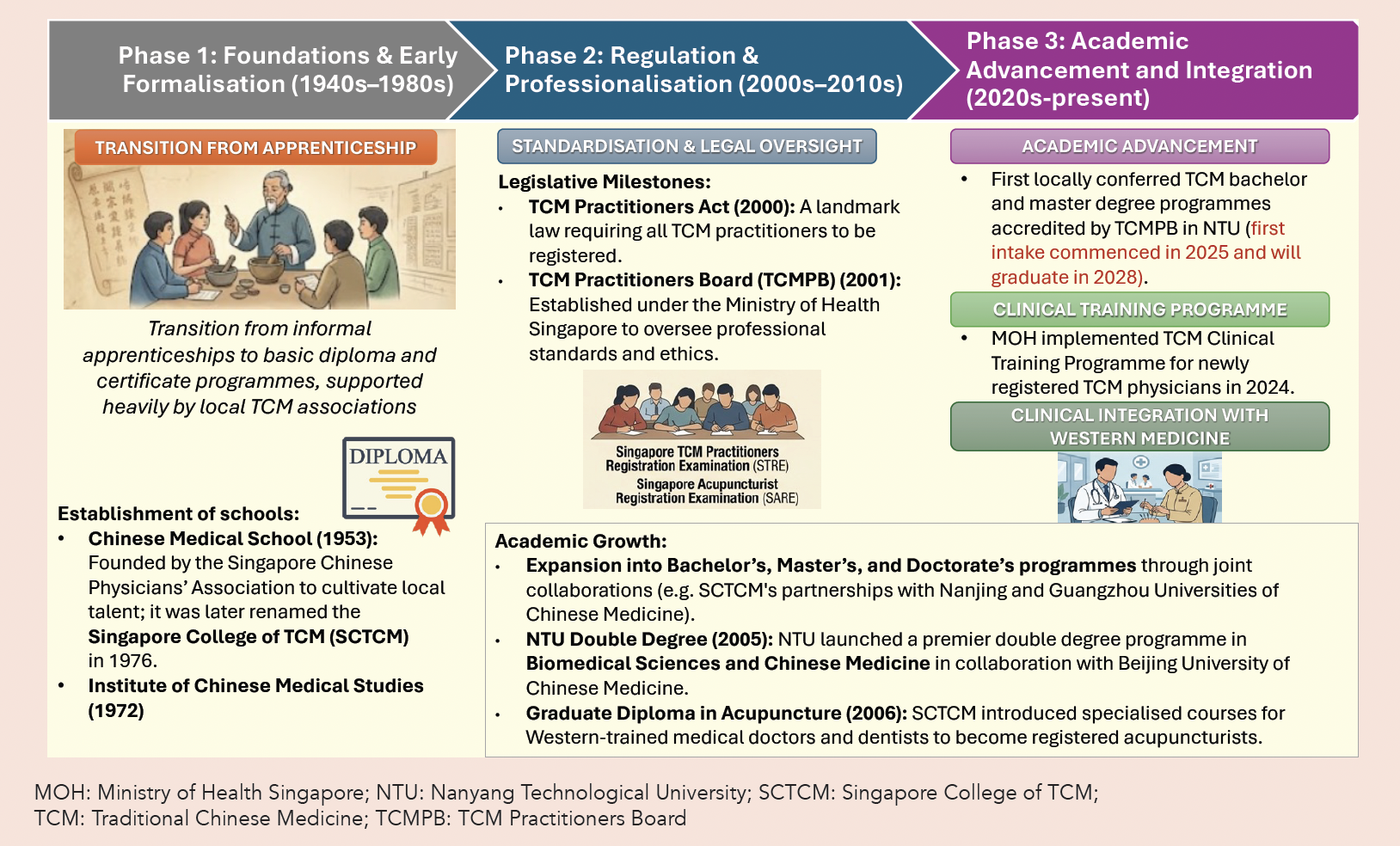
Recent reforms aim to meet local needs, raise training standards, and attract younger entrants. Nanyang Technological University (NTU) is transitioning to a 4-year, bilingual Bachelor of Chinese Medicine (BCM), replacing its previous 5-year double-degree programme with Beijing University of Chinese Medicine. The first cohort is expected to graduate in 2028. The curriculum integrates technology-enabled and team-based learning, longitudinal clinical training, and TCM research, with emphasis on ageing and preventive care, aligned with Healthier SG—Singapore’s national initiative to shift the healthcare system from treating illnesses to preventive care.8 NTU also launched a Master of Science in Chinese Medicine in 2026, expanding annual capacity to about 40 Bachelor’s9 and 30 Master’s graduates10—up from 30 undergraduates previously.
The Singapore TCM Physicians Registration Examination and the Singapore Acupuncturists Registration Examination were revamped in 2025 to emphasise clinical competency.11 From 2027, both examinations will adopt an Objective Structured Clinical Examination format, aligning TCM assessment with practices familiar to medical, nursing, and allied health training.
In 2024, Singapore’s Ministry of Health (MOH) implemented a 1-year TCM clinical training programme that places selected TCMP trainees in 3-month rotations across 4 participating TCM institutions, mirroring housemanship in WM. The programme uses a competency-based framework, Entrustable Professional Activities (EPAs), to progressively entrust trainees with patient care under the supervision of clinical mentors.12 This structured transition from training to independent practice is intended to raise care standards. MOH also supports TCMPs’ professional development and service provision through the TCM Development Grant.13
Adoption of bilingual instruction and the EPA framework signals Singapore’s commitment to modernising TCM education and aligning it with contemporary standards. Standardised competencies foster an integrated, person-centred workforce. While bilingual instruction may strengthen communication between TCM and WM professionals and prepare graduates for practice and research, reduced emphasis on Mandarin could limit engagement with classical TCM texts and weaken cultural transmission. Preserving classical literacy and the cultural foundations of TCM should remain a priority within bilingual curricula.
Practice
Singapore’s 3 public healthcare clusters—National Healthcare Group Health, National University Health System, and Singapore Health Services (SingHealth)—practise predominantly evidence-based WM. In 2005, acupuncture, supported by research and broad acceptance, is available in most public health institutions (PHIs). Since 2020, the Agency for Care Effectiveness, Singapore’s health technology assessment and clinical guidance agency, has recommended subsidies at PHIs for needled acupuncture, with or without electrostimulation, for adults with neck and low back pain.14 Expanding access reflects growing institutional recognition of acupuncture as an adjunct therapy that delivers clinical value, and signals a more pluralistic model in which treatments are valued for their outcomes rather than their origins.
WM–TCM integration in Singapore is supported by interdisciplinary dialogue. Through events such as the annual Forum on the Use of Evidence-Based TCM in WM Practice, co-organised by SingHealth and the Academy of Chinese Medicine Singapore,15 practitioners from both fields explore incorporating evidence-based TCM into mainstream care, aiming to build mutual understanding, shape common evidence-based practices, and promote high-value care, collaborative research, and education. This aligns with MOH’s sandbox initiative, launched in 2025, which examines how integrative care affects outcomes.16 Ongoing reviews of the clinical-effectiveness and cost-effectiveness of acupuncture and Chinese proprietary medicines for chronic and non-chronic disease management1 and further position Singapore’s healthcare system to deliver holistic care.
Digital health is reshaping TCM practice. China’s experience with TCM internet hospitals,17 artificial intelligence (AI)-powered language models (e.g. TCMChat, MedChatZH)18 and disease-specific databases (e.g. TCM2COVID for COVID-19, TCM-ADIP for Alzheimer’s disease)18 illustrates potential gains in access and decision support. In Singapore, teleconsultation, AI-assisted technologies (e.g. TCM Tuina robot), and digital diagnostic tools (e.g. automated pulse analyser, AI-based tongue analysis) are being piloted. These innovations aim to enhance diagnostic accuracy, improve reproducibility, and integrate TCM into modern healthcare through evidence-based data—but they must first secure the Health Sciences Authority’s clearance or registration exemption, supported by robust research studies on validation, reliability, and data governance. Rigorous evaluation is essential before routine adoption.
Research
The MOH’s TCM Research Grant (TCMRG) funds collaborative studies between TCM organisations and PHIs or academic institutions. For interventional studies, a WM principal investigator is required to ensure rigorous, safe evaluation and credible translation into evidence-based policy and practice.19 Research is further supported by the Academy of Chinese Medicine, Singapore Institutional Review Board, an independent ethics review committee that applies standards equivalent to those in 20
CHALLENGES OF TCM
Education
Opportunities for collaboration between WM and TCM students are limited, creating a barrier to integration. Earlier structured exposure may improve interdisciplinary work. The National University of Singapore’s Yong Loo Lin School of Medicine runs a pre-clinical common curriculum for medical, nursing, dentistry, and pharmacy students to cultivate teamwork and interprofessionalism.21 Without an equivalent platform linking WM and TCM students, mutual understanding remains limited, risking future silos. From 2027, final-year NTU TCM students will begin clinical rotations at Tan Tock Seng Hospital to observe integrated TCM–WM practice.22 While promising, this initiative currently involves only 1 TCM school, 1 medical school, and 1 hospital. Expanding placements across more PHIs would broaden exposure and better prepare future TCMPs.
Limited TCM knowledge among WM practitioners can compromise advice on concurrent TCM use and potential herb–drug interactions.23 As integration grows, incorporating foundational TCM content into WM undergraduate curricula and continuing professional education and, conversely, introducing WM fundamentals into TCM training would strengthen interdisciplinary understanding and support safer, coordinated care.
Practice
Although acupuncture for neck and low back pain has been subsidised since 2020, MediSave coverage remains limited (capped at SGD200), and patients seeking acupuncture for other indications in PHIs pay private rates. By contrast, MediSave and other government financing schemes (Community Health Assist Scheme, Chronic Disease Management Programme) primarily support WM-based inpatient care and outpatient chronic disease management, respectively, with limited coverage for TCM. Local healthcare providers sometimes attribute adrenal insufficiency or Cushing’s syndrome to prior TCM use because of the perceived steroid-like effects of TCM herbs. Only a limited number of herbs have well-established steroidal activity, and much of the evidence is pre-clinical.24 The addition of medicinal substances such as steroids and heavy metals is also prohibited by the Health Sciences Authority.25 Adulteration of herbal products with exogenous glucocorticoids, falsely marketed as TCM, remains a recurring issue.26
Non-disclosure of TCM use to WM doctors is common and increases the risk of unrecognised potential herb–drug interactions. A local study revealed that 70% of breast cancer patients did not share TCM use with their WM doctors, citing perceived opposition or limited understanding of TCM among WM doctors.27 Such non-disclosure, driven by fear of dismissal or misunderstanding, fragments care. These findings underscore the need for deeper TCM–WM integration to safeguard patient safety and improve outcomes. Equity of access across Singapore’s multi-ethnic population also warrants attention. Although TCM is used most by Chinese patients, followed by Malay and Indian patients,28 ethnic differences in TCM access, acceptance, and utilisation remain understudied. Research is needed to identify potential disparities and ensure benefits are equitable.
Research
While the sandbox creates pathways for WM–TCM integration, it also surfaces potential friction. Differences in ontology lead to gaps in understanding. TCM’s diagnostic approach centres on syndrome differentiation and patterns of disharmony, whereas scientific explanations for TCM mechanisms remain varied. These divergent frameworks can hinder communication, underscoring the need for mutual literacy.
Methodological differences add complexity. TCM care is often individualised via syndrome differentiation, while WM typically applies disease-specific treatments that are guided by quantitative indicators. WM research prioritises standardisation and precise endpoints, an approach that can struggle to capture the dynamic nature of TCM interventions. Aligning methods and evaluating outcomes across both systems remain challenging.
CONCLUSION
Singapore’s healthcare system remains predominantly WM-based, yet TCM, particularly acupuncture, is widely accepted and increasingly relevant for preventive care and chronic disease management. Advances in TCM education, practice, and research have strengthened its place within the national healthcare landscape. As education underpins effective integration, Singapore should prioritise mandatory interprofessional exposure within healthcare curricula to foster mutual understanding and collaborative practice. System-level measures—including expanded financing for selected evidence-based TCM indications and routine documentation of TCM use during medication reconciliation—can improve accessibility and safety. Together, these strategies support safer, more coordinated, and person-centred care across both systems.
REFERENCES
- Ng HP, Zhong LL, Pei WWL, et al. Integrating traditional Chinese medicine into disease management in Singapore. Ann Acad Med Singap 2025;54:491-7.
- Liu T, Li X, Zou Z-Y, et al. The Prevalence and Determinants of Using Traditional Chinese Medicine Among Middle-aged and Older Chinese Adults: Results From the China Health and Retirement Longitudinal Study. J Am Med Dir Assoc 2015;16:1002.e1-5.
- Huang CW, Hwang IH, Lee YS, et al. Utilization patterns of traditional medicine in Taiwan and South Korea by using national health insurance data in 2011. PLoS One 2018;13:e0208569.
- Lim B. Korean medicine coverage in the National Health Insurance in Korea: present situation and critical issues. Integr Med Res 2013;2:81-8.
- The Government of the Hong Kong Special Administrative Region of the People’s Republic of China. Chinese Medicine Hospital Project. https://www.healthbureau.gov.hk/en/chinese_medicine/index.html. Accessed 27 July 2026.
- TCMP Board. TCMPB Annual Report 2024. 2025. https://file.go.gov.sg/tcmpb-annual-report-2024.pdf Accessed 27 July 2026.
- TCMP Board. TCMPB Annual Report 2019. 2020. https://isomer-user-content.by.gov.sg/80/c45fac4c-91db-48f3-a2c9-360491a9fe3f/tcmpb-annual-report-2019.pdf. Accessed 27 July 2026.
- Ministry of Health, Singapore. Nanyang Technological University’s Launch of New Chinese Medicine Degree Programme, 15 November 2023 [Press release]. https://www.moh.gov.sg/newsroom/nanyang-technological-university-s-launch-of-new-chinese-medicine-degree-programme/. Accessed 23 May 2026.
- Tan C. NTU to Launch Master’s in Chinese Medicine. The Straits Times, 28 September 2025. https://www.straitstimes.com/singapore/health/new-masters-degree-ai-lab-for-tcm-among-initiatives-to-enhance-field-in-spore. Accessed 23 May 2026.
- Ying LL. NTU to Offer New TCM Degree Programme in August 2024. The Straits Times, 15 Noveember 2023. https://www.straitstimes.com/singapore/ntu-to-offer-new-degree-programme-for-traditional-chinese-medicine-in-aug-2024. Accessed 23 May 2026.
- Traditional Chinese Medicine Practitioners Board (TCMPB). Registration Requirements, updated 22 December 2025. https://www.tcmpb.gov.sg/for-professionals/apply-for-registration/registration-requirements/. Accessed 1 April 2026.
- Ministry of Health, Singapore. Traditional Chinese Medicine Clinical Training Programme. Ministry of Health Singapore, 12 August 2025. https://hpp.moh.gov.sg/programmes/traditional-chinese-medicine-clinical-training-programme/. Accessed 1 April 2026.
- Ministry of Health, Singapore. Traditional Chinese Medicine Development Grant, 30 July 2026. 2025. https://www.moh.gov.sg/others/research-grants/tcm-development-grant/. Accessed 1 April 2026.
- Agency for Care Effectiveness. Acupuncture for Adults with Low Back Pain and Neck Pain, https://www.ace-hta.gov.sg/healthcare-professionals/ace-technology-guidance/medical-technology-guidance/acupuncture-for-adults-with-low-back-pain-and-neck-pain/. Accessed 1 April 2026.
- SingHealth Academy. 2nd Annual Forum on the Use of Evidence-Based Traditional Chinese Medicine in Western Medicine Practice — Welcome Message, 12 July 2026. https://www.singhealthacademy.edu.sg/TCM2026/tcm2026-home. Accessed 1 April 2026.
- Ang Q. MOH Studying 18 Proposals to Integrate TCM into Public Healthcare. The Straits Times, 6 July 2025. https://www.straitstimes.com/singapore/health/moh-studying-18-proposals-to-integrate-tcm-into-public-healthcare. Accessed 23 May 2026.
- Wang Y, Song M, Pang Z, et al. Health Service Early-Stage Digital Adaptation of Traditional Chinese Medicine Internet Hospitals: Qualitative Exploratory Study. JMIR Form Res 2025;9:e77686.
- Guo P, Jiang M, Hu S, et al. Advancing the modernization of traditional Chinese medicine through artificial intelligence and multimodal data integration. Chin Med 2026;21:54.
- Ministry of Health, Singapore. Traditional Chinese Medicine Research Grant (TCMRG), updated 4 February 2026. https://www.moh.gov.sg/others/research-grants/tcm-research-grant/. Accessed 23 May 2026.
- Academy of Chinese Medicine Singapore. TCM Research — ACMS Institutional Review Board, https://academycms.org/en/tcm-research-en/. Accessed 24 May 2026.
- NUS Yong Loo Lin School of Medicine. NUS Common Curriculum for Health Professional Education. 2024. https://medicine.nus.edu.sg/prospective-students/bachelor-of-medicine-and-bachelor-of-surgery-mbbs/nus-common-curriculum-for-health-professional-education/. Accessed 1 April 2026.
- Tan J. TTSH to Train TCM Students from NTU on Patient, Integrative Care. 2025. The Straits Times, 9 October 2025. https://www.straitstimes.com/singapore/health/ttsh-to-train-tcm-students-from-ntu-on-patient-palliative-care. Accessed 1 April 2026.
- Wong LY, Toh MPHS, Kong KH. Barriers to patient referral for Complementary and Alternative Medicines and its implications on interventions. Complement Ther Med 2010;18:135-42.
- Fung FY, Linn YC. Steroids in traditional Chinese medicine: what is the evidence? Singapore Med J 2017;58:115-20.
- SingHealth Academy. Symposium 1: Governance and Development of Evidence-Based TCM in Public Healthcare Institutions (PHIs), 2025. https://www.singhealthacademy.edu.sg/TCM2026/programme/Symposium1. Accessed 23 May 2026.
- Health Sciences Authority, Singapore. Summary of illegal health products reported to HSA in 2024 and 2025. Adverse Drug Reaction News 2025;27:3-4. https://isomer-user-content.by.gov.sg/409/cc029f8a-07b2-4871-bc88-d42774c454cf/adr_news-dec-2025-vol-27-no-3.pdf. Accessed 1 April 2026.
- Lee WQ, Teoh J, Lee PZK, et al. Factors influencing communication of traditional Chinese medicine use between patients and doctors: A multisite cross-sectional study. J Integr Med 2019;17:396-403.
- Lim MK, Sadarangani P, Chan HL, et al. Complementary and alternative medicine use in multiracial Singapore. Complement Ther Med 2005;13:16-24.
Not applicable, as no patient data was used.
The authors declare that they have no affiliations or financial involvement with any commercial organisation with a direct financial interest in the subject or materials discussed in the manuscript.
Dr Desmond B Teo, Integrated Medicine Programme, Alexandra Hospital, 378 Alexandra Road, Singapore 159964. Email: [email protected]
