

ABSTRACT
Introduction: Hospital admissions provide an important opportunity for smoking cessation interventions. However, factors associated with willingness to quit smoking among hospitalised smokers remain underexplored, particularly in the multi-ethnic Asian population.
Methods: In this cross-sectional study of hospitalised smokers referred to an inpatient smoking cessation service between 2021 and 2025, enrolment data on willingness to quit, demographics, and clinical characteristics were analysed using multivariable logistic regression. A clinical feature score was developed to assess dose–response associations.
Results: Of 953 smokers (median age 57 years; 92% male), 49% reported willingness to quit smoking. In the multivariable analysis, ischaemic heart disease (odds ratio [OR] 2.20, 95% confidence interval [CI] 1.50–3.24, P<0.001), cerebrovascular accident (OR 2.30, 95% CI 1.30 –4.12, P=0.005), chronic obstructive pulmonary disease assessment score ≥10 (OR 2.16, 95% CI 1.10–4.38, P=0.03), modified Medical Research Council dyspnoea score ≥2 (OR 1.87, 95% CI 1.06–3.31, P=0.03), post-secondary education (OR 13.47, 95% CI 5.51–38.75, P<0.001), and primary/secondary education (OR 3.49, 95% CI 1.45–9.85, P=0.01) relative to no formal education and respiratory admission or visit in the past year (OR 3.55, 95% CI 1.43–9.87, P=0.009) remained associated with willingness to quit smoking. A graded association was observed between accumulation of these clinical features and readiness to quit, with each additional feature associated with higher odds of willingness to quit (OR 2.79, 95% CI 2.18–3.57, P<0.001).
Conclusion: Greater clinical burden was associated with willingness to quit smoking among referred hospitalised smokers. Accumulated clinical risk factors may help identify patients with greater readiness to quit and guide targeted counselling although longitudinal studies are needed to assess clinical utility.
CLINICAL IMPACT
What is New
- In a multi-ethnic Asian cohort of 953 hospitalised smokers referred to an inpatient cessation service, approximately half reported willingness to quit.
- Cardiovascular comorbidities, respiratory symptoms, recent respiratory healthcare visits, and educational attainment were associated with willingness to quit.
- A graded association was observed between accumulated clinical features and greater willingness to quit, with each additional feature associated with more than twice the odds.
Clinical Implications
- Greater clinical burden may provide an opportunity to engage hospitalised smokers in cessation counselling.
- Accumulated clinical features may help identify patients with greater readiness to quit and inform personalised counselling, while cessation support should be offered universally.
- Tailoring cessation support and public health messaging to different educational backgrounds may help address potential inequalities.
Cigarette smoking is a leading cause of preventable morbidity and mortality, and is a major contributor to premature death and cancer burden globally.1,2 Although the prevalence of smoking has declined since the 1970s, approximately 1 billion people continue to smoke worldwide.3 In Singapore, while the prevalence of daily smoking decreased from 12.0% in 2017 to 8.4% in 2024, smoking continues to impose substantial health and economic burden.4,5 The 2021 Global Burden of Disease Study revealed that the percentage of disability-adjusted life years caused by smoking was 1.80% for women and 8.80% for men in Singapore.6 Smoking-related cost in Singapore has been estimated at approximately USD500 million, with USD14.9 million attributed to direct healthcare expenditure.7
Smoking cessation significantly reduces the adverse health consequences of tobacco use. A significant reduction in total mortality has been associated with quitting smoking among older Chinese adults in Singapore.8 The World Health Organization identified smoking cessation support as a core tobacco control measure and strongly recommends offering intensive cessation support to smokers interested in quitting smoking in the forms of behavioural counselling and pharmacotherapy.9
Various factors have been identified as improving the success of smoking cessation, one of which is an individual’s motivation and intention to quit smoking.10-13 Higher motivation to quit has been shown to predict quit attempts and cessation success in both primary care and specialist settings.14,15 Identifying factors associated with willingness to quit smoking may help healthcare providers recognise individuals who are more receptive to smoking cessation interventions.
Hospitalisation provides a critical opportunity for smoking cessation. Acute illness, increased perceived health risk, and a smoke-free hospital environment may enhance engagement with cessation services and influence readiness to quit. In Singapore, a 2024 national health survey has identified sociodemographic correlates of intention to quit smoking, and prior inpatients studies have focused primarily on cessation outcomes rather than readiness to quit.10,11 However, factors associated with willingness to quit smoking among hospitalised smokers have not been well characterised in multi-ethnic Asian population.
This study aimed to assess factors associated with willingness to quit smoking among hospitalised smokers referred to an inpatient smoking cessation service, and to determine the proportion of symptomatic smokers and airflow obstruction.
METHODS
Study population
Current smokers (n=953) admitted to Singapore General Hospital and referred to the inpatient smoking cessation service between 2021 and 2025 were consecutively recruited. Current smokers were defined as persons who have smoked at least 100 cigarettes and now smoke either every day or some days. Smoking status was routinely assessed at each inpatient admission by the admission nurse. Patients identified as current smokers were offered referral to the inpatient smoking cessation service, and referrals were generated if the patient agreed. For patients who initially decline referral, the inpatient team could generate a referral following further clinical assessment and discussion. At recruitment, demographic characteristics, comorbidities, and clinical data were collected through a medical record review and supplemented by patient interview. Willingness to quit smoking, chronic obstructive pulmonary disease (COPD) Assessment Test (CAT) score; COPD Diagnostic Questionnaire (CDQ); and the presence and duration of respiratory symptoms (cough, sputum production, dyspnoea) and chronic bronchitis were assessed at recruitment. Willingness to quit smoking was assessed using a standardised clinical question and categorised as “yes”, “undecided”, or “no”. For analysis, this was dichotomised into “willing” (yes) and “not willing” (undecided/no). High symptom burden was categorised as CAT≥10 and modified Medical Research Council (mMRC) dyspnoea score ≥2.
Portable spirometry (Spirolab, MIR, Rome, Italy) was performed when clinically appropriate and in the absence of contraindications, to identify smokers with airflow limitation that do not have chronic respiratory disease. Patients with known chronic respiratory diseases—including COPD, asthma, bronchiectasis, and interstitial lung disease—were excluded. Spirometry was therefore performed in a subset of patients and was not systematically conducted for all patients.
Ischaemic heart disease (IHD) was defined as history of acute coronary syndrome, coronary artery disease, myocardial infarction, coronary bypass surgery, percutaneous coronary intervention, or ischaemic aetiology of heart failure. Cerebrovascular accident (CVA) was defined as history of rapid onset of focal or global neurological deficit lasting more than 24 hours and attributable to vascular cause.16 All other comorbidities were recorded as per electronic medical record.
Respiratory admission or visit in the past year was defined as inpatient, emergency department, or specialist outpatient visit for respiratory-related causes including upper and lower respiratory tract infection, bronchitis, and pneumonia within the preceding year. Upper respiratory tract infection (URTI) in the past year was defined as patient-reported acute self-limiting illness with nasal congestions, throat irritation, or cough symptoms without healthcare utilisation.17 Chronic bronchitis was defined as presence of chronic cough and sputum production for most days in at least 3 months over 2 consecutive years.18 Prior smoking cessation counselling was defined based on patients’ self-report of having previously participated in a formal smoking cessation counselling session prior to the index hospitalisation. All study data were entered into REDCap electronic data capture tools hosted at Singapore General Hospital.19,20
Spirometry
Spirometry was performed in accordance with American Thoracic Society/European Respiratory Society standards, with reference values derived from the Global Lung Function Initiative 2012.21
Statistical analysis
All analyses were performed using RStudio version 4.4. (R Foundation for Statistical Computing, Vienna, Austria) within the RStudio integrated development environment (Posit Software, Boston, MA, US). Continuous variables were assessed for normality using the Shapiro–Wilk test. All continuous data that were not normally distributed were presented as median (interquartile range, IQR). Between-group comparisons were performed using the Mann–Whitney U test for continuous variables, and the chi-square test for categorical variables. Variables that demonstrated statistical significance in univariate analyses (P<0.05) and were clinically relevant were entered into a multivariable logistic regression model to identify factors associated with willingness to quit smoking using “glm” function in R. Model performance was assessed using the likelihood ratio test, area under the receiver operating characteristic curve (AUC), Hosmer–Lemeshow goodness-of-fit test, and pseudo-R² measures. Multicollinearity was assessed using variance inflation factors, with values <2 indicating low collinearity. Clinical features demonstrating a statistically significant association with willingness to quit smoking in the multivariable model were selected for dose–response analysis. The relationship between the number of such features present and willingness to quit smoking was assessed using chi-square tests and multivariable logistic regression. Missing data for CAT score (n=263 missing) was handled using a complete-case approach, and patients with missing CAT scores were excluded from the multivariable analysis. For the sensitivity analysis, multiple imputation using chained equations (m=5) with predictive mean matching was performed to account for missing CAT values using the mice package. The imputation model included all variables from the multivariable model, including the outcome variable, and estimates were pooled using Rubin’s rules. Statistical significance was defined as P<0.05.
RESULTS
Clinical characteristics
A total of 953 patients referred to the inpatient smoking cessation service were included in the analysis. The study population was predominantly male (92%) and of Chinese ethnicity (60%), with 49% having post-secondary education. The median age was 57 years (IQR 49–65), and the median smoking exposure was 23 pack-years (IQR 13–40). The most common comorbidities were hypertension (45%), hyperlipidaemia (45%), and IHD (31%).
Factors associated with willingness to quit smoking
Overall, 49% of the patients reported willingness to quit smoking at recruitment. Willingness to quit smoking was significantly associated with having post-secondary education (61% versus [vs] 38%, P<0.001). Clinical factors associated with willingness to quit included higher symptom burden (CAT score ≥10 and mMRC dyspnoea scale score ≥2), respiratory admission or visit in the past year (6.9% vs 2.0%, P<0.001), and prior smoking cessation counselling (48% vs 37%, P<0.001) compared with those who were undecided or not willing to quit smoking. A higher proportion of patients expressing willingness to quit smoking had IHD (40% vs 23%, P<0.001), CVA (13% vs 8.4%, P=0.038), chronic bronchitis (18% vs 10%, P<0.001), or ≥2 URTI in the preceding year (11% vs 6.5% , P=0.035) There were no significant differences between groups with respect to age, sex, ethnicity, and number of smoking pack-years (Table 1). Supplementary Table S1 outlines additional baseline characteristics.
The authors evaluated factors associated with willingness to quit smoking using multivariable logistic regression. Variables that were statistically significant in the univariate analysis and clinically relevant were included in the multivariable model: IHD, CVA, highest education level attained, CAT score ≥10, and mMRC dyspnoea scale score ≥2, respiratory admission or visit in the past year, ≥2 URTI in the past year, chronic bronchitis, prior smoking cessation counselling, age, sex, and smoking pack-years. In the multivariable analysis of 667 patients (excluding those with missing CAT score and education level), IHD (odds ratio [OR] 2.20, 95% confidence interval [CI] 1.50–3.24, P<0.001), CVA (OR 2.30, 95% CI 1.30–4.12, P=0.005), CAT score ≥10 (OR 2.16, 95% CI 1.10–4.38, P=0.03), mMRC dyspnoea scale score ≥2 (OR 1.87, 95% CI 1.06–3.31, P=0.03), patients with post-secondary education (OR 13.47, 95% CI 5.51–38.75, P<0.001), and primary/secondary education (OR 3.49, 95% CI 1.45–9.85, P=0.01) relative to no formal education and respiratory admission or visit in the past year (OR 3.55, 95% CI 1.43–9.87, P=0.009) remained associated with willingness to quit smoking (Fig. 1). The multivariable model demonstrated good overall fit (likelihood ratio χ²(13)=160.82, P<0.001), with good discrimination (AUC=0.77) and acceptable calibration (Hosmer–Lemeshow P=0.49). The model explained a moderate proportion of variance (Nagelkerke R²=0.29). In sensitivity analyses using multiple imputation for missing CAT score, the associations observed in the primary complete-case analysis remained largely consistent (Supplementary Table S2).
Fig. 1. Multivariate analysis of factors associated with willingness to quit smoking at enrolment.
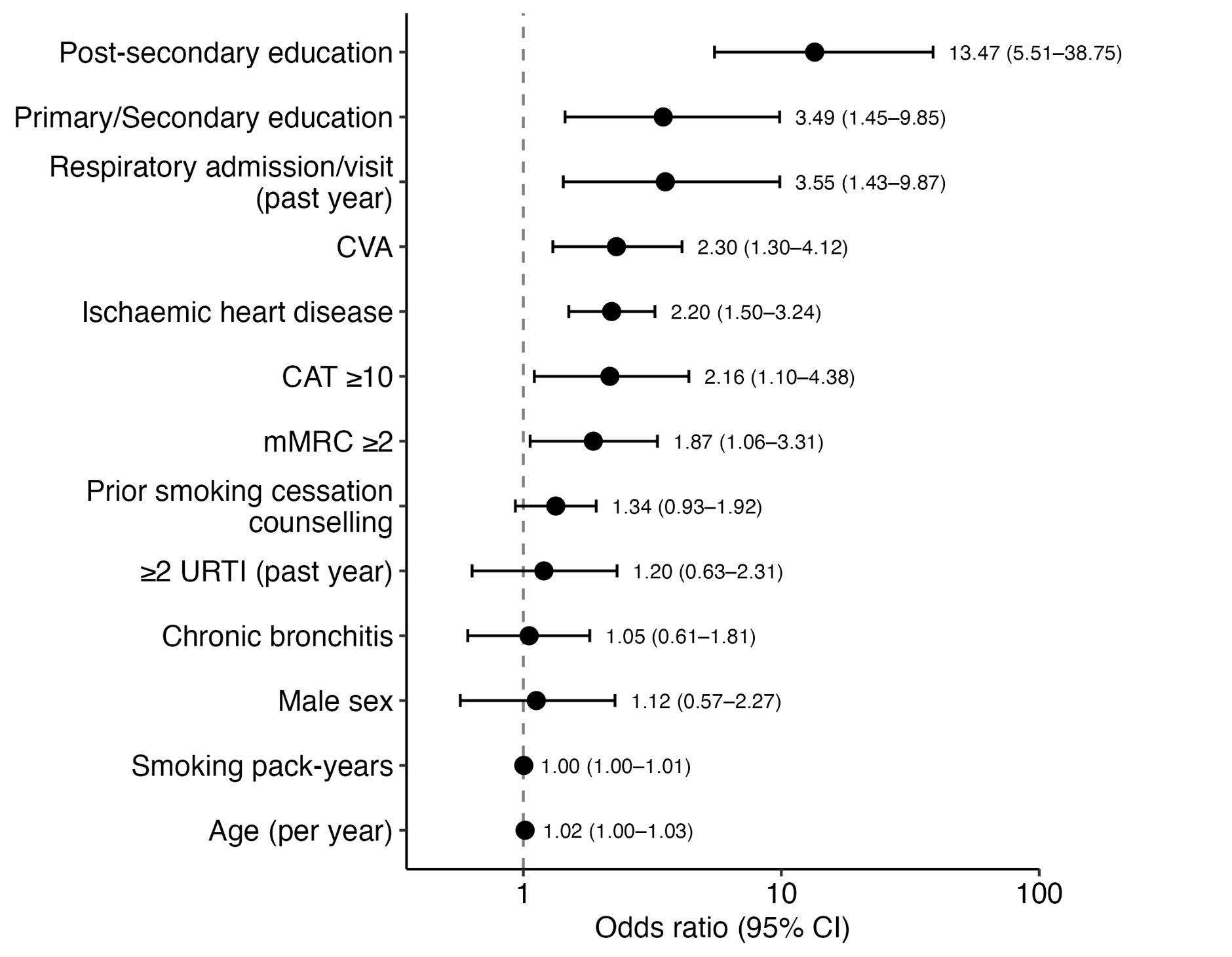 CAT: chronic obstructive pulmonary disease assessment test; CI: confidence interval; CVA: cerebrovascular accident; mMRC: modified Medical Research Council dyspnoea scale; URTI: upper respiratory tract infection

Forest plot illustrates the adjusted odds ratio of willingness to quit smoking. Dot indicates odds ratio and error bar indicates 95% confidence interval.
Odds ratio for Post-secondary education and Primary/Secondary education are shown relative to the reference category of no formal education. For binary variables, absence of the characteristic was used as the reference category unless otherwise stated.
Dose–response relationship
The authors examined the dose–response relationship of the 5 clinical features that remained significant in the multivariable model (IHD, CVA, CAT ≥10, mMRC≥2, and respiratory admission or visit in the past year). The presence of each feature was coded as 1, and a composite feature score (range 0–5) was calculated by summing the number of features present for each patient. Individuals with missing CAT scores were excluded. The proportion of patients expressing willingness to quit smoking increased progressively with the number of features present: 27.6% among those with no features, 58.4% with 1 feature, 66.7% with 2 features, and 87.5% with 3 features. None of the patients in this study population had more than 3 features. This demonstrates a graded, dose–response relationship between the number of clinical features and willingness to quit (Fig. 2).
Fig. 2. Dot plot illustrates the dose–response relationship between number of features present and willingness to quit smoking.
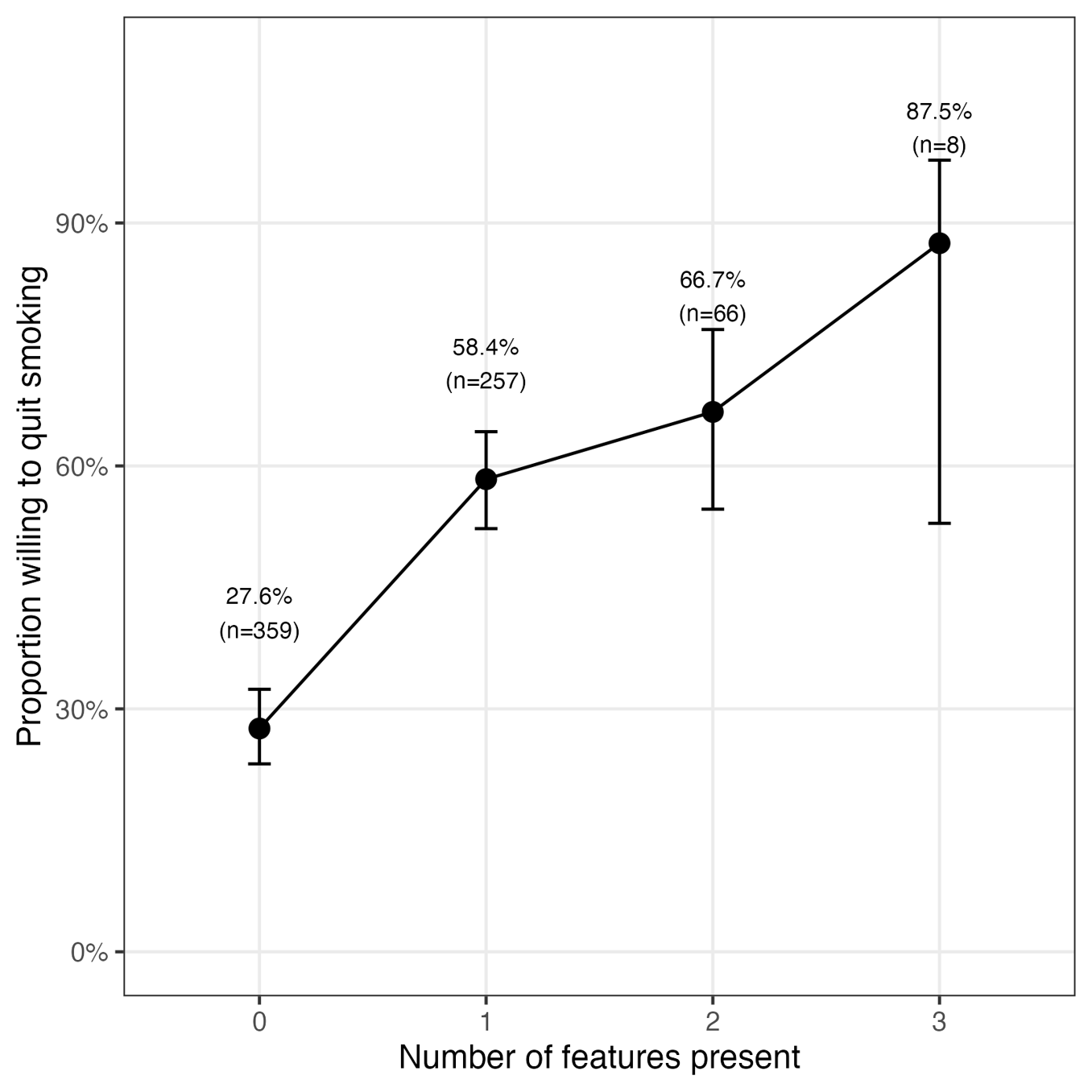
Points represent observed proportions, and error bars indicate 95% confidence intervals.
In multivariable logistic regression adjusted for age and sex, the composite feature score was significantly associated with willingness to quit smoking, demonstrating a graded dose–response association. Each additional clinical feature was associated with more than a 2-fold increase in the odds of expressing willingness to quit smoking (OR 2.79, 95% CI 2.18–3.57, P<0.001).
Spirometry characteristics in a subgroup of smokers
The median CDQ score for the overall study population was 17 (IQR 12–22), with 340 patients (36%) having a CDQ score ≥20, which indicates a high likelihood of COPD.22,23 However, only 68 patients underwent inpatient spirometry, with a median FEV₁/FVC ratio of 77.6% (IQR 72.3–82.6). Among them, 11 patients (16.2%) demonstrated airflow obstruction, defined as FEV₁/FVC<0.70. The CDQ score was significantly higher in patients with obstructive spirometry compared with those without obstruction (median 25 vs 21, P=0.014). In contrast, there was no significant difference in CAT scores between the 2 groups (median 7 [IQR 5–7] vs 4.5 [IQR 2–12], P=0.50). Neither CDQ score nor the presence of airflow obstruction was significantly associated with willingness to quit smoking. As spirometry was performed in a minority of patients, these findings should be interpreted as exploratory.
DISCUSSION
In this study, the authors identified several clinical factors associated with willingness to quit smoking among smokers who were referred to an inpatient smoking cessation service during a hospitalisation episode. High symptom burden, recurrent URTIs, respiratory admission or visit in the past year, comorbid IHD, and CVAs were associated with readiness to quit. Importantly, the authors observed a graded association between the accumulation of these clinical factors and willingness to quit, with each additional factor associated with more than a 2-fold increase in the odds of expressing a willingness to quit.
The findings suggest that greater clinical burden may coincide with increased receptiveness to smoking cessation during hospitalisation, consistent with prior studies.24-26 Cardiovascular comorbidities have been associated with higher smoking cessation success rate compared to those without, particularly among older adults.27 However, substantial variations in cessation rates among individuals with cardiovascular comorbidities have been reported across countries, likely reflecting differences in socioeconomic factors, tobacco control policies, and the smoking cessation programmes.28 The association between IHD/CVA and willingness to quit may reflect greater perceived health risk and disease burden. However, recent hospitalisation for an acute cardiovascular or cerebrovascular event may have also served as a teachable moment that increased patients’ motivation to quit smoking.
Presence of respiratory symptoms had previously been associated with greater intention to quit smoking, whereas associations with objective measures of lung function severity have been inconsistent.29 Results of this study were similar, where higher symptom burden was associated with willingness to quit smoking, while the presence of airflow obstruction was not. CDQ scores were higher among patients with obstructive spirometry, but objective airflow limitation did not appear to influence readiness to quit. This may reflect the fact that spirometry abnormalities are often asymptomatic or less perceptible to patients compared to overt cardiovascular events or symptomatic respiratory illness. However, as spirometry was performed in a minority of patients in this study, these findings should be interpreted cautiously.
The association between lower educational attainment and reduced willingness to quit smoking is consistent with previous Singapore and international data.11,30,31 These findings have broader implications for public health strategy and health literacy, and may highlight an issue of inequality in health campaigns. Messaging about the harms of smoking may be disproportionately directed towards individuals with higher health literacy, inadvertently neglecting those with lower educational attainment. Tailoring public awareness campaigns and cessation support strategies to individuals with varying educational backgrounds may help address these inequities.
While prior studies have demonstrated ethnic differences in smoking cessation outcomes in Western populations, the authors did not observe a significant association between ethnicity and willingness to quit smoking in the study population.32 This discrepancy may reflect differences in study populations, the distinction between readiness to quit and actual cessation outcomes, and potential limitations in statistical power. Further studies are needed to explore these relationships in diverse populations.
Singapore’s Health Promotion Board has a comprehensive smoking cessation strategy spanning primary care and hospital settings, incorporating behavioural counselling and pharmacotherapy, both of which are key to successful cessation.33,34 Nevertheless, smoking cessation programme quit rates in Singapore remain comparable to global outcomes, at approximate 25%.35,36
Smoking cessation is a process of dynamic behavioural change, and willingness to quit smoking is only 1 component of motivational readiness. While willingness to quit assessed at a single time point is not equivalent to sustained cessation behaviour, it may represent an important intermediate transitional state associated with subsequent quit attempts and treatment engagement.14,15 Although smoking cessation support should be offered universally, the findings suggest that cumulative clinical burden may represent a transient period of enhanced motivation, potentially providing an opportunity for more targeted smoking cessation engagement.
Key strengths of this study include the prospective recruitment of hospitalised smokers referred to the inpatient smoking cessation service, systematic clinical assessment, and the use of validated questionnaires to evaluate symptom burden in a large, multi-ethnic inpatient group. The programme-based study population reflects real-world referral patterns within an inpatient care setting, enhancing the practical relevance of the findings.
Several limitations should be acknowledged. First, as the study population comprised hospitalised smokers referred to the inpatient smoking cessation service, selection bias may have been present. Although smoking status was systematically assessed on admission, referral depended on patient agreement and clinician judgement, potentially favouring individuals who were more motivated to quit or clinically prioritised. Therefore, the findings may not be generalisable to all hospitalised smokers.
Second, subsequent smoking cessation outcomes could not be ascertained. Although willingness to quit is an important component of behaviour change, it does not necessarily translate into sustained smoking cessation. As such, the clinical implications of the findings should be interpreted with caution. Future longitudinal studies are needed to determine whether the identified clinical factors and composite risk scores are associated with quit attempts, treatment engagement, and long-term abstinence. Third, willingness to quit was self-reported and assessed at a single time point, which may represent a transient state that does not necessarily translate into quit attempts or sustained abstinence. Additionally, a validated scale was not used, as a pragmatic assessment approach was adopted within a real-world clinical programme.
Fourth, the composite clinical feature score was constructed post hoc based on variables identified in the multivariable model and should therefore be interpreted as exploratory. The observed dose–response relationship may be subject to overfitting, and no formal validation was performed. As such, this finding should be considered hypothesis-generating and requires confirmation in independent cohorts. Fifth, spirometry was performed in a minority of patients, which limits any conclusions regarding airflow obstruction, and fixed ratio rather than lower limit of normal was used which may yield different prevalence.
Finally, data on nicotine dependence (e.g. Fagerstrom score) and prior quit attempts, socioeconomic status and psychological state were not assessed—these could not be included in the analysis, which may result in residual confounding. Despite these limitations, this study provides valuable insight into the factors associated with willingness to quit smoking and highlights the cumulative effect of multiple clinical features on willingness to quit in a group of smokers enrolled in the inpatient smoking cessation service.
CONCLUSION
Greater clinical burden was associated with willingness to quit smoking among referred hospitalised smokers. Accumulated clinical risk factors may help identify patients with greater readiness to quit and guide targeted counselling. However, longitudinal studies are needed to determine whether willingness to quit translates into sustained smoking cessation and to evaluate the clinical utility of these findings in guiding smoking cessation interventions.
Table S1. Additional baseline characteristics of smokers referred to an inpatient smoking cessation service stratified by willingness to quit smoking at enrolment.
Table S2. Factors associated with willingness to quit smoking in multivariable logistic regression.
Annex S1. STROBE checklist for cross-sectional studies.
REFERENCES
- GBD 2023 Disease and Injury and Risk Factor Collaborators. Burden of 375 diseases and injuries, risk-attributable burden of 88 risk factors, and healthy life expectancy in 204 countries and territories, including 660 subnational locations, 1990–2023: a systematic analysis for the Global Burden of Disease Study 2023. Lancet 2025;406:1873-922.
- GBD 2019 Cancer Risk Factors Collaborators. The global burden of cancer attributable to risk factors, 2010–19: a systematic analysis for the Global Burden of Disease Study 2019. Lancet 2022;400:563-91.
- Dai X, Gakidou E, Lopez AD. Evolution of the global smoking epidemic over the past half century: strengthening the evidence base for policy action. Tob Control 2022;31:129-37.
- Ministry of Health, Health Promotion Board, Singapore. National Population Health Survey (NPHS) 2017 Report. https://www.moh.gov.sg/others/resources-and-statistics/nphs-2017/. Accessed 22 September 2026.
- Disease Policy and Strategy Division, and Health Analytics Division, Ministry of Health Policy, Research & Surveillance Group, Health Promotion Board, Singapore. National Population Health Survey (NPHS) 2024 Report. https://www.moh.gov.sg/others/resources-and-statistics/national-population-health-survey–nphs–2024-report/. Accessed 22 September 2026.
- GBD 2021 ASEAN Tobacco Collaborators. The epidemiology and burden of smoking in countries of the Association of Southeast Asian Nations (ASEAN), 1990–2021: findings from the Global Burden of Disease Study 2021. Lancet Public Health 2025;10:e442-55.
- Cher BP, Chen C, Yoong J. Prevalence-based, disease-specific estimate of the social cost of smoking in Singapore. BMJ Open 2017;7:e014377.
- Lim SH, Tai BC, Yuan JM, et al. Smoking cessation and mortality among middle-aged and elderly Chinese in Singapore: the Singapore Chinese Health Study. Tob Control 2013;22:235-40.
- World Health Organization. WHO Clinical Treatment Guideline for Tobacco Cessation in Adults. https://www.who.int/publications/i/item/9789240096431. Accessed 22 September 2026.
- See JHJ, See KC. Impact of Admission Diagnosis on the Smoking Cessation Rate: A Brief Report From a Multi-centre Inpatient Smoking Cessation Programme in Singapore. J Prev Med Pub Health 2020;53:381-6.
- Koh YS, Sambasivam R, AshaRani P, et al. Factors influencing smoking cessation: Insights from Singapore’s nationwide health and lifestyle survey. Ann Acad Med Singap 2024;53:608-20.
- Kng KK, Lauw XT, Tan AS, et al. Effectiveness of smoking cessation services in Tan Tock Seng Hospital, Singapore. Ann Acad Med Singap 2012;41:230-2.
- Zow HC, Hsu AA, Eng PC. Smoking cessation programme: the Singapore General Hospital experience. Singapore Med J 2004;45:430-4.
- Klemperer EM, Mermelstein R, Baker TB, et al. Predictors of Smoking Cessation Attempts and Success Following Motivation-Phase Interventions Among People Initially Unwilling to Quit Smoking. Nicotine Tob Res 2020;22:1446-52.
- Piñeiro B, López-Durán A, Del Río EF, et al. Motivation to quit as a predictor of smoking cessation and abstinence maintenance among treated Spanish smokers. Addict Behav 2016;53:40-5.
- Campbell BCV, Khatri P. Stroke. Lancet 2020;396:129-42.
- Heikkinen T, Ruuskanen O. UPPER RESPIRATORY TRACT INFECTION. Encyclopedia of Respiratory Medicine 2006:385-8.
- Braman SS. Chronic Cough Due to Chronic Bronchitis: ACCP evidence-based clinical practice guidelines. Chest 2006;129:104S-15S.
- Harris PA, Taylor R, Minor BL, et al. The REDCap consortium: Building an international community of software platform partners. J Biomed Inform 2019;95:103208.
- Harris PA, Taylor R, Thielke R, et al. Research electronic data capture (REDCap)—A metadata-driven methodology and workflow process for providing translational research informatics support. J Biomed Inform 2008;42:377-81.
- Graham BL, Steenbruggen I, Miller MR, et al. Standardization of Spirometry 2019 Update. An Official American Thoracic Society and European Respiratory Society Technical Statement. Am J Respir Crit Care Med 2019;200:e70-88.
- Stanley AJ, Hasan I, Crockett AJ, et al. COPD Diagnostic Questionnaire (CDQ) for selecting at-risk patients for spirometry: a cross-sectional study in Australian general practice. NPJ Prim Care Respir Med 2014;24:14024.
- Price DB, Tinkelman DG, Nordyke RJ, et al. Scoring system and clinical application of COPD diagnostic questionnaires. Chest 2006;129:1531-9.
- Martins RS, Junaid MU, Khan MS, et al. Factors motivating smoking cessation: a cross-sectional study in a lower-middle-income country. BMC Public Health 2021;21:1419.
- Buczkowski K, Marcinowicz L, Czachowski S, et al. Motivations toward smoking cessation, reasons for relapse, and modes of quitting: results from a qualitative study among former and current smokers. Patient Prefer Adherence 2014;8:1353-63.
- Gallus S, Muttarak R, Franchi M, et al. Why do smokers quit? Eur J Cancer Prev 2013;22:96-101.
- Kim Y, Cho WK. Factors associated with successful smoking cessation in men with or without cardiovascular disease or cancer: Nationwide Korean population analysis. Tob Induc Dis 2023;21:28.
- Arda YG, Ozturk GZ. Assessment of smoking cessation outcomes in patients with cardiovascular disease: A retrospective cohort study from Türkiye. Tob Induc Dis 2025;23:1-12.
- Melzer AC, Feemster LC, Crothers K, et al. Respiratory and Bronchitic Symptoms Predict Intention to Quit Smoking among Current Smokers with, and at Risk for, Chronic Obstructive Pulmonary Disease. Ann Am Thorac Soc 2016;13:1490-6.
- Ruokolainen O, Härkänen T, Lahti J, et al. Association between educational level and smoking cessation in an 11-year follow-up study of a national health survey. Scand J Public Health 2021;49:951-60.
- Siahpush M, McNeill A, Borland R, et al. Socioeconomic variations in nicotine dependence, self-efficacy, and intention to quit across four countries: findings from the International Tobacco Control (ITC) Four Country Survey. Tob Control 2006;15 Suppl 3:iii71-5.
- Avila JC, Sokolovsky AW, Nollen NL, et al. The effect of race/ethnicity and adversities on smoking cessation among U.S. adult smokers. Addict Behav 2022;131:107332.
- Ministry of Health, Singapore. Tackling Tobacco: Singapore’s Multi-Strategy Approach. https://www.healthhub.sg/well-being-and-lifestyle/personal-care/tobacco-and-tax. Accessed 23 June 23 2026.
- Rigotti NA, Kruse GR, Livingstone-Banks J, et al. Treatment of Tobacco Smoking: A Review. JAMA 2022;327:566-77.
- See JHJ, Yong TH, Poh SLK, et al. Smoker motivations and predictors of smoking cessation: lessons from an inpatient smoking cessation programme. Singapore Med J 2019;60:583-9.
- Tønnesen P. Smoking cessation: How compelling is the evidence? A review. Health Policy 2009;91:S15-25.
This study was approved by the SingHealth Centralised Institutional Review Board (CIRB 2020/2584). Written informed consent was obtained from all participants at recruitment.
The authors declare that they have no affiliations with or involvement in any organisation or entity with any financial interest in the subject matter or materials discussed in this manuscript.
Dr Liesel Fong, Department of Respiratory and Critical Care Medicine, Singapore General Hospital, 20 College Road, Academia, Singapore 169856. Email: [email protected]
