

Dear Editor,
Primary spontaneous pneumothorax (PSP) is a common emergency department (ED) presentation, typically affecting young, thin, and healthy individuals.1 While recent evidence increasingly supports conservative management for clinically stable patients with moderate-to-large PSP, practice variation persists internationally. The landmark randomised trial by Brown et al. demonstrated non-inferiority of conservative care compared with interventional treatment for radiographic resolution at 8 weeks, with fewer adverse events.2 Updated guidelines from the British Thoracic Society (BTS) and the European Respiratory Society (ERS) now reflect this shift.3,4 However, no study has examined PSP management preferences among ED physicians in Singapore. The authors conducted a nationwide survey to address this gap.
The authors administered a nationwide anonymous online cross-sectional survey targeting physicians practising in adult EDs across Singapore’s 3 public healthcare clusters: Singapore Health Services, National Healthcare Group (NHG), and National University Health System (NUHS). The survey was hosted on FormSG, a secure self-service web application provided by the Government Technology Agency of Singapore.
The survey instrument was informed by current international guidelines (BTS 2023 and American College of Chest Physicians [ACCP] 2001) and recent randomised trials supporting conservative management of PSP. It was adapted from the questionnaire developed by Kelly et al.5 for Australian and New Zealand clinicians, and was modified for the Singapore context. Three clinical scenarios were designed to represent realistic ED presentations of moderate-to-large PSP with increasing radiological severity while maintaining clinical stability across cases: moderate-to-large PSP without collapse (Scenario 1), large PSP with lung collapse (Scenario 2), and large PSP with mediastinal shift (Scenario 3). Scenarios depicted young patients (aged 19–28 years) who were haemodynamically stable and minimally dyspnoeic, with well-controlled pain and no social vulnerability factors. Two symptom-duration variants were tested per scenario: >24 hours versus (vs) 6–8 hours from onset. Response options included conservative management (observation with or without supplemental oxygen), needle aspiration, small-bore intercostal catheter (≤14 French), and large-bore intercostal catheter (≥16 French). Respondents also used 5-point Likert scales to rate the factors influencing their management decisions and their self-reported awareness of guidelines.
A total of 122 physicians responded (with an estimated response rate of 25–30%, based on the approximate number of practising ED physicians), comprising specialists (51.6%, 63/122), registrars (21.3%, 26/122), and junior doctors (27.0%, 33/122), distributed across all 3 healthcare clusters and both tertiary referral centres (52.5%) and general hospitals (47.5%). Most respondents reported that their institution had a PSP protocol (84.4%, 103/122), typically developed by a multidisciplinary team (65.6%, 80/122).
Vital signs were the most influential factor prompting intervention (99.2%, 121/122), followed by guideline recommendations (95.9%, 117/122), radiological features other than size (95.1%, 116/122), patient-reported dyspnoea (89.3%, 109/122), pneumothorax size on chest X-ray (82.8%, 101/122), and follow-up availability (82.0%, 100/122). The mean patient age above which respondents favoured intervention was 52.9 years (standard deviation 16.9 years). Preference for conservative management decreased markedly with increasing radiological severity, from 65% in Scenario 1 to 15% in Scenario 2, and only 3% in Scenario 3, even though all patients were clinically stable. This suggests that conspicuous imaging abnormalities, such as lung collapse or mediastinal shift, continue to drive clinicians towards drainage, even when physiological parameters are reassuring.6,7 These findings support the need for clearer Singapore guidance on how radiological severity should be interpreted alongside clinical stability.3,4
Important differences emerged by physician seniority. Specialists were significantly less likely to cite medicolegal risk as an important factor in decision-making (34.9% vs 66.7% of junior doctors, P=0.002), possibly reflecting greater confidence in evidence-based approaches. In Scenario 3, specialists were more likely to choose small-bore catheters, while a significantly higher proportion of those selecting large-bore drains were non-specialists (71.4% vs 28.6%, P=0.045). Overall, medicolegal concern was prominent, with 46.7% reporting worry about non-intervention in stable large PSP, rising to 72.1% with mediastinal shift (difference of 25.4 percentage points, 95% confidence interval 13.5–37.3, P<0.001).
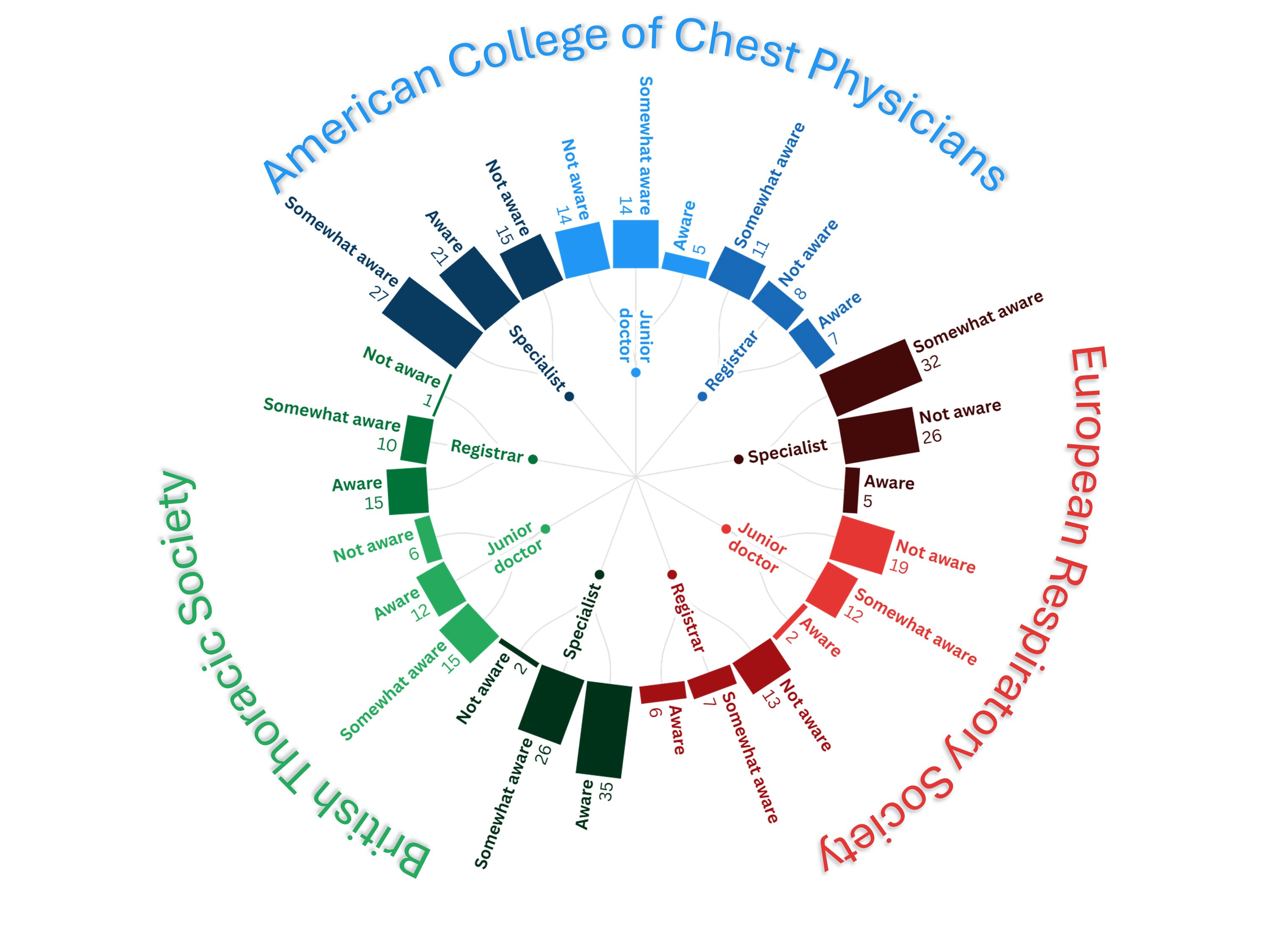
Self-rated guideline awareness was high for the BTS guidelines (92.6% at least somewhat aware) but notably poor for the ERS 2024 guidance, with 47.5% reporting no awareness even though it is the most recently published guidance assessed in the survey.4 Crucially, awareness alone did not translate into a preference for conservative management, particularly for scenarios with more pronounced radiological findings. By physician grade, specialists were more aware of the ACCP and BTS guidelines than non-specialists (P=0.028 and 0.049, respectively) (Fig. 1).
Fig. 1. Awareness of guidelines by physician grade.
Healthcare cluster-level analysis revealed that physicians from NUHS, which has an established institutional PSP pathway, reported the highest awareness of local protocols (92%) and the lowest preference for interventional management.6 The cluster’s tertiary hospital has operated a multidisciplinary conservative management pathway since April 2021, offering eligible patients outpatient observation rather than routine chest tube insertion. These findings suggest that structured institutional pathways, rather than guideline knowledge alone, may be key drivers of practice alignment with contemporary evidence.
This study and that of Kelly et al.5 identified vital signs as the most important factor influencing clinicians’ decisions to intervene, suggesting that reliance on physiological stability as a decisive threshold may be consistent across emergency medicine practice internationally. However, Singapore respondents were notably more likely to select large-bore intercostal catheters for PSP with mediastinal shift (>16% vs 1.6%), even though existing evidence suggests that small-bore catheters are associated with fewer complications and shorter hospital stays.8 This highlights an area where Singapore practice could better align with current evidence.
This study has limitations. Self-reported preferences may not fully reflect actual clinical behaviour, and the simplified scenarios could not capture the full complexity of ED encounters, including patient preferences and shared decision-making. The estimated response rate of 25–30% may limit generalisability, although representation across all clusters, physician grades, and hospital types supports the breadth of perspectives captured. The anonymous, voluntary design also precluded characterisation of non-responders.
In conclusion, Singapore ED physicians demonstrate considerable variation in PSP management preferences, associated with radiological severity, physician seniority, and institutional factors. Standardised multidisciplinary pathways, targeted education for junior clinicians on small-bore catheter use, improved dissemination of contemporary guidelines (particularly ERS 2024), and shared decision-making resources may help reduce unwarranted variation and promote evidence-aligned care.
REFERENCES
- Hallifax R. Aetiology of Primary Spontaneous Pneumothorax. J Clin Med 2022;11:490.
- Brown SGA, Ball EL, Perrin K, et al. Conservative versus Interventional Treatment for Spontaneous Pneumothorax. N Engl J Med 2020;382:405-15.
- Roberts ME, Rahman NM, Maskell NA, et al. British Thoracic Society Guideline for pleural disease. Thorax 2023;78:1143-56.
- Walker S, Hallifax R, Ricciardi S, et al. Joint ERS/EACTS/ESTS clinical practice guidelines on adults with spontaneous pneumothorax. Eur Respir J 2024;63:2300797.
- Kelly AM, Muruganandan S, Jones P, et al. Current practice and attitudes in emergency department management of primary spontaneous pneumothorax in Australia and New Zealand: a scenario‐based/survey. Intern Med J 2025;55:944-50.
- Hallifax RJ, Roberts M, Russell N, et al. Pneumothorax management: current state of practice in the UK. Respir Res 2022;23:23.
- Barton EC, Walker SP. The Medical Management of Spontaneous Pneumothorax: A Concise Review. Br J Hosp Med (Lond) 2024;85:1-13.
- Chang S-H, Kang Y-N, Chiu H-Y, et al. A Systematic Review and Meta-Analysis Comparing Pigtail Catheter and Chest Tube as the Initial Treatment for Pneumothorax. Chest 2018;153:1201-12.
Ethics approval with waiver of documented informed consent was obtained from the NHG Domain Specific Review Board (2024/4345).
The authors declare that they have no affiliations or financial involvement with any commercial organisation with a direct financial interest in the subject or materials discussed in the manuscript. The study did not receive funding.
Dr Win Sen Kuan, Emergency Medicine Department, National University Hospital, 9 Lower Kent Ridge Road, Level 4, Singapore 119085. Email: [email protected]
