

ABSTRACT
Introduction: Aerobic and mind–body exercise may help manage anxiety in older adults, but the optimal dose remains uncertain. This meta-analysis examined randomised controlled trials (RCTs) in adults aged ≥60 years.
Methods: PubMed, Embase, Web of Science, and Cochrane Library were searched from inception through October 2025. Standardised mean differences (SMDs) with 95% confidence intervals (CIs) were pooled using a fixed-effect model when P≥0.10 and I²≤50%; otherwise, a DerSimonian-Laird random-effects model was applied. The primary analysis included general, state, and trait anxiety, whereas death anxiety and social physique anxiety were included only in the sensitivity analysis. Subgroup analyses were conducted, and risk of bias was assessed using the Cochrane risk of bias 2 tool.
Results: Twenty RCTs were included, with 18 contributing to the primary analysis of general anxiety. Compared with control conditions, aerobic and mind–body exercise interventions were associated with lower general anxiety scores (SMD = −0.65, 95% CI −0.87 to −0.42; P<0.001), although substantial heterogeneity was observed across studies (I²=72.2%). The trim-and-fill analysis imputed no studies and did not alter the pooled estimate, and the sensitivity analysis yielded similar results. Subgroup analyses showed reductions in anxiety scores across different dose categories, without statistically significant differences between subgroups for session duration, weekly frequency, or intervention period. However, these findings were exploratory and hypothesis-generating and were insufficient to determine the optimal exercise dose.
Conclusions: Aerobic and mind–body exercise interventions may alleviate general anxiety symptoms in older adults. However, given the substantial heterogeneity across studies and the risk of bias, the magnitude of the overall effect should be interpreted with caution, while the subgroup findings should be regarded as exploratory.
CLINICAL IMPACT
What is New
- Aerobic and mind–body exercise interventions were associated with lower general anxiety scores than control conditions, although the pooled effect was likely overestimated.
- Distinguishing general anxiety from death anxiety and social physique anxiety yielded consistent pooled findings, providing a more focused assessment of exercise-related anxiety outcomes in older adults.
Clinical Implications
- Aerobic and mind–body exercise interventions may represent scalable adjunctive options alongside usual care for late-life anxiety.
- Clinical practice should emphasise the sustainability of exercise programmes and participant adherence, while specific exercise doses require further validation.
As projected by the World Health Organization, the global number of people aged ≥60 years is expected to rise from nearly 1 billion to approximately 1.4 billion between 2020 and 2030, and further to about 2.1 billion by 2050.1 With the accelerated ageing of the global population, anxiety has increasingly become a significant but long-overlooked mental health problem among older adults. Existing research shows that the prevalence of anxiety symptoms in older adults may be as high as 28%, affecting nearly a quarter of the world’s older adults. Moreover, this prevalence has been reported to be higher than that observed in other age groups, placing a substantial burden on existing public health systems.2 Anxiety symptoms may contribute to a significant decline in older adults’ quality of life, impair their social functioning,3 aggravate their chronic conditions and symptoms, and increase medical expenses.4 However, in the routine primary care and health assessments of older adults, anxiety symptoms are often overlooked or attributed to other physical diseases or to normal ageing, which may delay diagnosis or lead to inadequate treatment.5 For older adults, delayed diagnosis or ineffective treatment may further aggravate their long-term health problems.6 Therefore, early identification and effective management of anxiety in later life are not only clinically important but also crucial for reducing the broader social and economic burden.7
Aerobic exercise refers to rhythmic, sustained physical activity that involves the use of oxygen.8 Aerobic exercise has broad benefits for physical and mental health in later life.9 The present review focuses on 1 clinically relevant aspect of these benefits: its potential role in reducing anxiety symptoms among older adults. Aerobic exercise typically engages large muscle groups and is sustained for a period of time, which can improve cardiorespiratory function and endurance. Typical forms of aerobic exercise include walking, running, swimming, and cycling.10 Alongside conventional aerobic exercise, mind–body exercise is a multicomponent form of exercise that integrates coordinated physical movement with controlled breathing and focused attention. Common forms of mind–body exercise include tai chi, qigong, yoga, and Pilates.11 In recent years, aerobic and mind–body exercise have increasingly been regarded as non-pharmacological strategies that may help alleviate anxiety symptoms in older adults.12,13 For older adults, aerobic exercise can improve overall fitness. Compared with high-intensity or competitive sports, it carries lower risk, is easier to adopt, and is better aligned with the physical condition and functional limitations often seen in later life.14 Existing studies also suggest that different aerobic exercise interventions have beneficial effects on anxiety symptoms among older adults.15,16 For instance, a systematic review and meta-analysis of patients with chronic obstructive pulmonary disease (COPD) aged 60 years or older reported that mind–body exercise moderately reduced anxiety symptoms compared with routine care or non-exercise control groups (standardised mean difference [SMD] = −0.59). Between-study heterogeneity was very low, indicating generally consistent intervention effects across the included studies.17 From a mechanistic perspective, these anxiolytic effects are often explained by the combined action of multiple pathways.18 Aerobic exercise may reduce hypervigilance by regulating stress-response systems, and it may also support a return to a more stable state by promoting psychological and physiological adaptation processes.19 Aerobic exercise may therefore support both physiological regulation and psychological adaptation, helping older adults improve emotional well-being and perceived control.
Given the wide variation in exercise tolerance and adherence among older adults,20 many trials have evaluated low-impact, sustainable aerobic exercise and mind–body exercise interventions. These interventions often include tai chi, yoga, dance-based exercise, and interactive exergames, and such trials commonly evaluate emotional outcomes such as anxiety. In practice, these modalities may support continued physical activity while maintaining a manageable cardiorespiratory load in older adults.13 Evidence suggests that they can also reduce anxiety symptoms in older populations.21 Recent evidence further supports these findings. Traditional Chinese exercises, including tai chi and qigong, are significantly associated with improvements in anxiety and depression in older adults.22 Network meta-analyses reach a similar conclusion: mind–body modalities—such as tai chi, qigong, yoga, dance-based exercise, and Pilates—generally perform better than non-exercise controls on anxiety-related outcomes, although their relative rankings are not fully consistent across analyses.23 At the same time, technology-assisted exercise is also expanding accessibility. For example, interactive motion-sensing exercises delivered through platforms such as Xbox Kinect (Microsoft Corporation, Redmond, WA, US) can increase the enjoyment of exercise and are well suited to home-based exercise. For older adults with limited mobility and travel, or a lack of confidence in exercise, such methods provide more flexible options and lower the threshold for starting to exercise.24 One trial reported that 6 weeks of Xbox Kinect exercise reduced anxiety in older adults.25
Although many studies have examined the impact of aerobic and mind–body exercise on anxiety in older adults, variations in baseline mobility and functional status may influence the feasibility and effects of exercise prescriptions.26 Uncertainty therefore remains regarding the optimal exercise dose, including session duration, weekly frequency, and intervention length. Previous systematic reviews and meta-analyses have often focused on specific clinical groups and/or been limited to a particular type of exercise. Few studies have systematically assessed the “dose–response effects” of aerobic and mind–body exercise on anxiety in the general older population. In other words, although exercise may be effective, it remains unclear which prescription parameters are more likely to produce consistent and durable improvements. Therefore, this study conducted a systematic review and meta-analysis covering a wider range of older adults, integrating results obtained from randomised controlled trials (RCTs) to evaluate the overall impact of aerobic and mind–body exercise on anxiety in older adults. Subgroup analyses were conducted on session duration, weekly frequency, and intervention period to explore potential influencing factors. The findings aim to inform non-drug interventions for anxiety disorders in the older adult population and support clinical practice and public health decision-making.
METHODS
Protocol and registration
This study was designed and reported in line with the Cochrane Handbook for Systematic Reviews of Interventions and the Preferred Reporting Items for Systematic Reviews and Meta-Analyses (PRISMA) statement (Appendix S1).27,28 This meta-analysis was registered with the International Prospective Register of Systematic Reviews (PROSPERO) on 9 December 2025 (CRD420251249958), after database searching and study screening had commenced.
Protocol amendments
In accordance with PRISMA item 24c, the registered protocol was amended to include mind–body exercise and 1 trial with a sertraline comparator. The primary analysis was restricted to general, state, or trait anxiety, while death anxiety and social physique anxiety were included in a sensitivity analysis. Modality, dose subgroup, and Grading of Recommendations Assessment, Development and Evaluation (GRADE) analyses were added after registration. Because the PROSPERO record contained inconsistent language criteria, the completed review included only English-language studies.
Data sources and search strategy
PubMed, Web of Science, Embase, and the Cochrane Library were searched to identify relevant studies, with no restrictions on publication date. The strategy focused on 3 concepts: older adults (≥60 years), aerobic exercise or aerobic-type physical activity, and anxiety-related outcomes, including anxiety, anxiety symptoms, and anxiety disorders. Search terms were developed based on previous systematic reviews and refined with input from experts in the field. Searches were completed in October 2025. Full database-specific search strings are provided in Appendix S2.
Study selection
All retrieved records were independently screened by 2 researchers. Screening was conducted in 2 stages. In the first stage, titles and abstracts were examined, and records that were clearly unrelated to the research question were removed. In the second stage, the full text of each potentially eligible study was obtained and evaluated against the pre-specified inclusion and exclusion criteria to determine final eligibility. Disagreements were resolved by team discussion until consensus was reached.
Inclusion and exclusion criteria
This systematic review and meta-analysis pre-specified and strictly applied inclusion and exclusion criteria. Only studies that fulfilled the following conditions were retained in the analysis:
(1) Study design: Only RCTs were included. The design type of each eligible trial was checked during study selection and data extraction. All studies included in the final meta-analysis were individually randomised parallel-group RCTs. In the evidence hierarchy of evidence-based medicine, RCTs are generally considered to have a high degree of methodological rigour.29 Because a meta-analysis quantitatively combines multiple studies, and the quality of the included studies directly affects the reliability of the pooled effect size, inclusion was limited to RCTs to minimise the risk of bias and improve the robustness of the conclusions.
(2) Study participants: Participants were older adults, defined as individuals aged ≥60 years, with no major cognitive impairment. There were no restrictions on gender, living environment, or general health condition, except that studies focusing primarily on older adults with major cognitive impairment were excluded.
(3) Interventions: Eligible interventions were aerobic exercise or mind–body exercise programmes. Aerobic exercise included conventional endurance-based activities, dance-based exercise, and interactive exergaming. Mind–body exercise included tai chi, qigong, yoga, and Pilates.
(4) Outcomes: Studies were required to report at least 1 quantitative anxiety-related outcome, including anxiety symptom severity or anxiety disorder-related measures, with available pre- and post-intervention data or sufficient information to calculate effect sizes.
(5) Data: Studies also had to provide original data or report adequate statistical information (e.g. means, standard deviations, change scores, or confidence intervals [CIs]) to enable effect size estimation.
(6) Language: Only studies published in English were included.
The original protocol specified usual care, health education, or waitlist controls. During the full-text review, 1 eligible trial used a pharmacological comparator rather than these pre-specified control conditions. This was treated as a minor protocol deviation, and the trial was retained because the intervention arm consisted of aerobic exercise, whereas the comparator did not include aerobic exercise. The potential influence of this broader comparator category was considered when interpreting clinical heterogeneity.
Studies were excluded if they met any of the following criteria: (1) non-randomised study designs, including cross-sectional, case–control, and cohort studies; reviews; and conference abstracts; (2) interventions that did not involve either aerobic exercise or mind–body exercise; (3) study populations that did not include older adults, or for which data on older adults could not be extracted separately; (4) absence of anxiety-related outcome measures or insufficient data to compute effect sizes; and (5) publications written in languages other than English.
Data extraction
All data were organised and managed using a standardised Excel spreadsheet (Microsoft Corporation, Redmond, WA, US). Data extraction for the included studies was performed independently by 2 researchers. The 2 completed extraction forms were compared, and any inconsistencies were discussed until consensus was reached. The following information was extracted from each eligible study: (1) basic study information: first author, year of publication, country or region of study; (2) participant characteristics: age range, sample size, and main baseline characteristics; (3) intervention characteristics: intervention modality and content, duration of each session, weekly frequency, and total intervention period; and (4) outcome information: for studies with anxiety as the primary outcome, the name of the anxiety assessment scale and the measurement results of anxiety symptoms after the intervention were recorded. For studies that did not provide sufficient quantitative data for effect-size calculation, the authors further checked whether anxiety-related findings were reported qualitatively, such as between-group statistical significance, direction of effect, or narrative descriptions. Studies without extractable quantitative data and without sufficient qualitative information on anxiety outcomes were excluded from both the meta-analysis and narrative synthesis.
When a study presented the post-intervention anxiety outcome only graphically, Engauge Digitizer (Zenodo) was used to obtain numerical data.30,31 In studies with multiple follow-up time points, to ensure comparability, only the results measured immediately after completion of the intervention were included in the pooled analysis. If standard deviations were not explicitly reported, they were estimated from the 95% CIs of the group means, where available.
Drawing on classification approaches used in previous relevant studies, intervention characteristics were systematically extracted and classified according to intervention modality.32,33 The interventions were categorised as aerobic exercise or mind–body exercise. Aerobic exercise included walking, running, cycling, dance-based exercise, and interactive exergaming; mind–body exercise included tai chi, qigong, yoga, and Pilates. Control groups were categorised as either other intervention or no intervention. For subgroup analyses, the study grouped the main intervention parameters. The subgroup cut-offs were selected to provide clinically interpretable categories and were informed by previous exercise-related meta-analyses as well as the distribution of intervention characteristics across the included trials.34,35 Session duration was categorised as 1–30, 31–60, and >60 minutes per session to distinguish shorter, moderate, and longer sessions. Weekly frequency was categorised as 1–2, 3–4, and 5–7 sessions per week to reflect low, moderate, and higher weekly frequency. Intervention length was categorised as 1–12, 13–24, and >24 weeks to distinguish short-, medium-, and long-term programmes. These categories were used to facilitate interpretable and comparable subgroup analyses across heterogeneous exercise interventions.
Quality assessment
Risk of bias in the included studies was assessed with the Cochrane risk-of-bias (RoB) 2 tool for randomised trials across 5 core domains: (1) bias arising from the randomisation process; (2) bias due to deviations from intended interventions; (3) bias due to missing outcome data; (4) bias in measurement of the outcome, with particular attention to the implementation of blinding and the assessment methods for anxiety outcomes; and (5) bias in the selection of the reported result. Once these 5 domains were evaluated, an overall risk-of-bias judgment was assigned to each study. Each domain and the overall rating were categorised as low risk, some concerns, or high risk, in line with the RoB 2 guidance.
Certainty assessment
The GRADE framework was applied to evaluate the overall certainty of the evidence across outcomes. GRADE is widely used in systematic reviews and meta-analyses to rate the certainty of evidence in a structured and transparent manner. In this study, evidence certainty was assessed across 5 domains: risk of bias, inconsistency, indirectness, imprecision, and publication bias.36
Statistical analysis
This study evaluated the effects of aerobic and mind–body exercise interventions on anxiety levels among older adults. Because all anxiety outcomes were continuous variables, SMDs with 95% CIs were calculated. The primary analysis included only general, state, or trait anxiety measures. Trials assessing death anxiety or social physique anxiety were included only in a sensitivity analysis. Effect sizes were interpreted using Cohen’s standard thresholds (0.2 small, 0.5 medium, and 0.8 large).37 Between-study heterogeneity was assessed using Cochran’s Q test and quantified using the I² statistic. According to the Cochrane Handbook for Systematic Reviews of Interventions, I²≤25%, 25–50%, 50–75%, and >75% were interpreted as low, moderate, substantial, and considerable heterogeneity, respectively.38 The selection of the effect model depended on the extent of heterogeneity. When heterogeneity across studies was low (P≥0.10 and I²≤50%), a fixed-effect model was applied; otherwise (P<0.10 or I²>50%), a DerSimonian–Laird random-effects model was used.39 In addition, potential sources of heterogeneity were explored through subgroup analyses, with formal tests used to assess differences between subgroups. Funnel plots and asymmetry tests were then used to assess small-study effects and potential publication bias. Statistical tests for publication bias were performed using Begg’s rank correlation test and Egger’s regression test.40 A P value >0.05 was taken to indicate no clear evidence of publication bias, whereas P<0.05 suggested that publication bias may exist, in which case the pooled results should be interpreted with caution. In the random-effects model, the trim-and-fill method was also used to further evaluate publication bias and determine whether imputation of potentially missing studies was needed to make the funnel plot more symmetrical.41 The stability of the conclusions was examined using a leave-one-out sensitivity analysis, in which individual comparisons were removed 1 at a time to determine whether the overall effect changed substantially. If the pooled effect remained statistically significant (P<0.05) after removing any comparison and the effect size remained within the original 95% CI, the results were considered robust and unlikely to be driven by a single comparison. The main meta-analyses, heterogeneity tests, publication-bias assessments, trim-and-fill analyses, and sensitivity analyses were conducted using Stata version 15.1 (StataCorp, College Station, TX, US). Subgroup analyses and visualisation of the RoB 2 results were performed using R version 4.5.1 (R Core Team, Vienna, Austria).
RESULTS
Trial selection
To ensure the standardisation and accuracy of the screening process, 2 researchers independently screened titles and abstracts and then full texts. Cohen’s kappa coefficient was used to quantify inter-rater agreement at each stage. Kappa values were interpreted using a common classification: 0.40–0.59, moderate agreement; 0.60–0.74, substantial agreement; and >0.75, excellent agreement.42
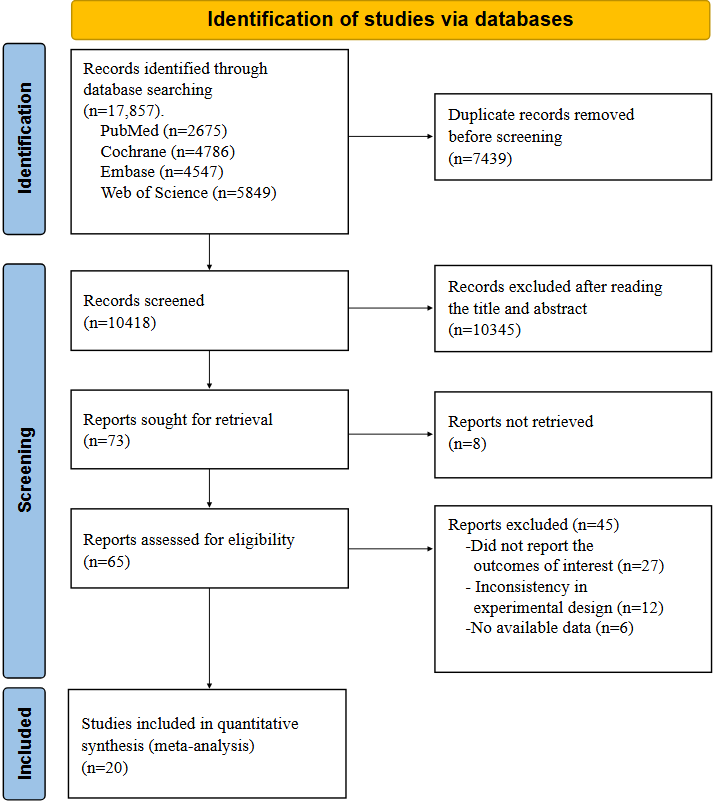
A total of 17,857 records were identified. After duplicates were removed (n=7439), 10,418 records remained. Title and abstract screening excluded 10,345 records, leaving 73 reports for full-text retrieval. Inter-rater agreement at the full-text stage was substantial (Cohen’s kappa = 0.69). Of these, 8 full texts could not be obtained and 65 reports were assessed for eligibility. Inter-rater agreement at this stage was substantial (Cohen’s kappa=0.66). Of the 65 full-text reports assessed, 45 were excluded, mainly because they did not report anxiety outcomes (n=27), had an ineligible study design (n=12), or provided insufficient data for analysis (n=6). These 6 studies were further examined to determine whether anxiety-related findings could be summarised qualitatively. However, they did not provide sufficient anxiety-specific between-group results, direction-of-effect information, or narrative descriptions suitable for qualitative synthesis; therefore, they were not included in a narrative summary. Finally, 20 studies were included in the quantitative synthesis (Fig. 1). Agreement for the final inclusion decisions was also substantial (Cohen’s kappa=0.71).
Fig. 1. PRISMA flow diagram of the study process.
PRISMA: Preferred Reporting Items for Systematic Reviews and Meta-Analyses
Adapted from Page MJ, McKenzie JE, Bossuyt PM, et al. The PRISMA 2020 statement: an updated guideline for reporting systematic reviews. BMJ 2021;372:n71.
Trial characteristics
Table 1 presents the main characteristics of the 20 RCTs included in the quantitative analysis, published between 1990 and 2023. The included trials were geographically diverse. Most trials were conducted in China (n=5), the US (n=4), Spain (n=3), Iran (n=2), and Brazil (n=2), with 1 study each conducted in Australia, Lithuania, Greece, and Tunisia. In total, 1499 participants were included in this meta-analysis, with 759 assigned to the intervention groups and 740 to the control groups. Participants included both community-dwelling older adults and older adults with specific clinical or health-related conditions. These conditions included osteoarthritis, COPD, depressive symptoms, sedentary lifestyles, and postmenopausal status.
Table 1. Included trials and studies.
The aerobic and mind–body exercise modalities included in this review were diverse, encompassing a range of exercise intensities and delivery formats. Across the included trials, aerobic exercise interventions included walking, aerobics, running, cycling, Xbox Kinect exercise delivered through a technology-assisted platform, and dance-based programmes classified as aerobic exercise. Mind–body exercise interventions included tai chi, qigong, yoga, and Pilates. Session duration typically ranged from about 20 to 120 minutes. Exercise frequency varied from 1 to ≥4 sessions per week. Intervention periods ranged from single-session studies to long-term interventions lasting up to 52 weeks. Control conditions primarily included no intervention or maintenance of usual daily activities (no intervention), usual or best care, and other comparator interventions not involving aerobic or mind–body exercise (other intervention), such as health education, stretching or relaxation training, social activities, or pharmacological treatment. Anxiety outcomes were assessed using a range of standardised instruments, including both self-reported scales and clinician-rated measures. Some studies used commonly applied general anxiety scales, whereas others used tools designed for specific contexts or populations. This variation in measurement tools indicates heterogeneity in how anxiety was assessed across studies.
Risk of bias
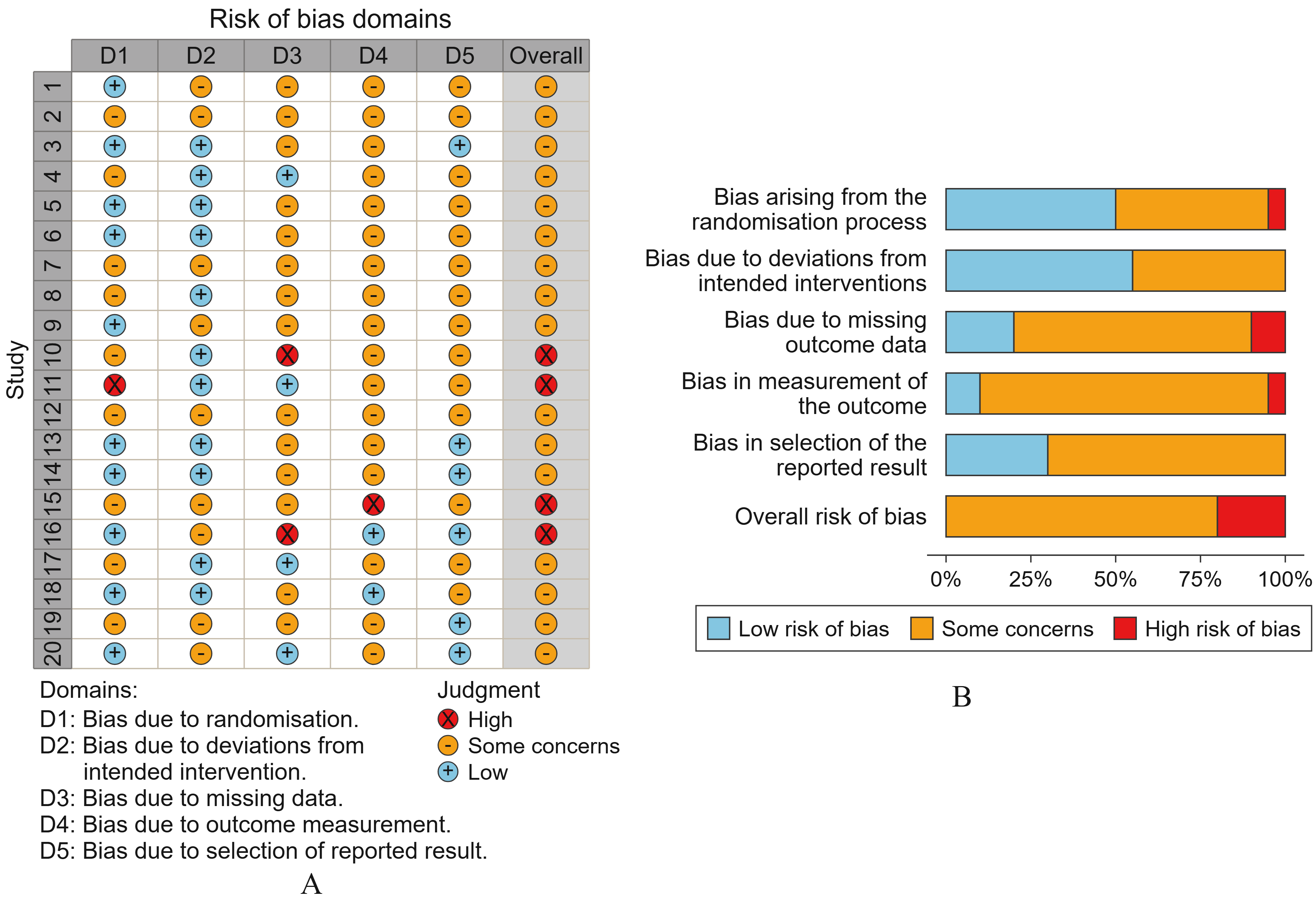
The methodological quality of the included evidence was evaluated in a structured manner with the Cochrane RoB 2 tool for randomised trials. Risk of bias was assessed at the study level for all 20 included RCTs. Risk-of-bias judgments at both the domain and overall levels are displayed in Figs. 2A and 2B. In total, 16 studies (80.0%) were judged to have some concerns regarding risk of bias, whereas the remaining 4 studies (20.0%) were judged to be at high risk of bias. No studies received an overall judgment of low risk. The main sources of concern arose from limited reporting of the randomisation procedures and from the inherent challenges of achieving blinding of participants and intervention staff in exercise-based trials. A small subset of studies was judged to be at high risk because of substantial missing outcome data or inadequate description of how attrition was handled.
Fig. 2. (A) Risk-of-bias assessment of the included studies. (B) Distribution of risk-of-bias judgments in the included studies.
Meta-analysis
Overall effects of aerobic and mind–body exercise interventions on general anxiety in older adults
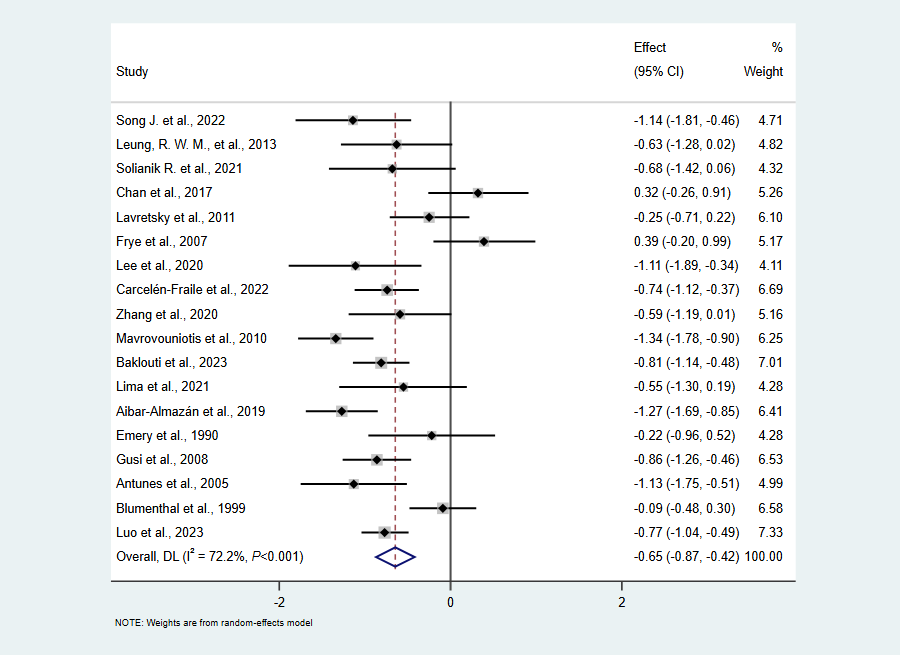
The primary analysis included 18 RCTs, comprising 18 independent comparisons, to assess the effects of aerobic and mind–body exercise interventions on general anxiety in older adults. As illustrated in Fig. 3, participants in aerobic or mind–body exercise interventions showed a statistically significant decrease in general anxiety scores relative to control groups (SMD = −0.65, 95% CI −0.87 to −0.42, P<0.001). Heterogeneity across studies was substantial (I²=72.2%, P<0.001); therefore, a random-effects model was applied. When the 2 trials assessing death anxiety and social physique anxiety were included in the sensitivity analysis, the pooled estimate was SMD = −0.76 (95% CI −1.03 to −0.49), with I²=83.2%, indicating that the pooled estimate did not change materially. An additional sensitivity analysis was performed by excluding Blumenthal et al., who used sertraline as an active comparator.57 The pooled effect across the remaining 17 trials was SMD = −0.69 (95% CI −0.91 to −0.47; I²=68.8%; P<0.001), indicating that the overall findings remained robust compared with the primary analysis (Appendix S3C). Taken together, the results suggest that aerobic and mind–body exercise interventions were associated with lower general anxiety scores among older adults.
Fig. 3. Forest plot of the overall effects of aerobic and mind–body exercise interventions on anxiety in older adults.
CI: confidence interval
Subgroup analyses by exercise prescription characteristics and intervention modality
As multiple subgroup comparisons were conducted without adjustment for multiplicity, the likelihood of statistically significant findings arising by chance was increased; therefore, these results should be interpreted with caution. The results of the subgroup analyses are presented in Table 2 and Fig. 4A–D. Across exercise dose categories, aerobic and mind–body exercise interventions were associated with reductions in anxiety scores among older adults. Pooled effects varied across subgroups, although formal tests for subgroup differences were not statistically significant for session duration, weekly exercise frequency, or intervention period.
For session duration (Fig. 4A), sessions of 31–60 minutes were associated with lower anxiety scores (SMD = −0.62, 95% CI −0.94 to −0.31, P<0.001), with considerable heterogeneity even within this duration band (I²=78.3%). Both 1–30 minutes per session and >60 minutes per session were associated with significant reductions in anxiety, and the test for differences between duration subgroups was not statistically significant (P=0.767).
Regarding weekly exercise frequency (Fig. 4B), 3–4 sessions/week was associated with lower anxiety scores (SMD = −0.51, 95% CI −0.93 to −0.08, P=0.020), but heterogeneity was substantial (I²=74.9%). Exercise at 1–2 sessions per week was also associated with a significant reduction in anxiety. Although the results for 5–7 sessions per week suggested a beneficial effect, they should be interpreted cautiously because of the limited number of studies included. The test for differences between frequency subgroups was not statistically significant (P=0.658). For the intervention period (Fig. 4C), exercise interventions lasting more than 24 weeks were associated with lower anxiety scores (SMD = −0.77, 95% CI −1.04 to −0.49, P<0.001), although this subgroup comprised only 1 study, precluding an assessment of between-study heterogeneity. Interventions lasting 1–12 weeks and 13–24 weeks were also associated with lower anxiety scores, but the between-subgroup difference was not statistically significant (P=0.602).
Overall, the subgroup analyses indicated that aerobic and mind–body exercise interventions across different dose categories were associated with reductions in anxiety scores among older adults. However, these analyses did not provide sufficient evidence to identify an optimal exercise dose. Finally, the subgroup analysis by intervention modality (Fig. 4D) showed that both aerobic and mind–body exercise were associated with significant reductions in anxiety scores among older adults. The pooled effect size was −0.71 for aerobic exercise (95% CI −1.16 to −0.27; I²=77.1%; P=0.002) and −0.61 for mind–body exercise (95% CI −0.88 to −0.35; I²=71.9%; P<0.001). Although the pooled effect estimate was numerically larger for aerobic exercise, the formal test for subgroup differences did not reach statistical significance (P=0.706), indicating that the available evidence was insufficient to demonstrate a difference in effect between the 2 intervention types.
Publication bias
Publication bias was initially assessed using funnel plots (Appendix S3A), followed by Begg’s rank correlation test and Egger’s regression test. Neither test reached statistical significance (Begg: P=0.762; Egger: intercept=1.07, 95% CI −2.04 to 4.18, P=0.478), providing no clear statistical evidence of small-study effects. A trim-and-fill analysis was subsequently conducted under a random-effects model (Appendix S3BC). No hypothetical studies were imputed, and the pooled effect estimates remained unchanged under both fixed-effects (SMD = −0.68, 95% CI −0.80 to −0.57) and random-effects models (SMD = −0.65, 95% CI −0.87 to −0.42). Sensitivity analyses using a leave-one-out approach showed stable pooled estimates (Appendix S3C), supporting the robustness of the findings.
Certainty assessment results
Based on the GRADE framework, the certainty of evidence for the general anxiety outcome was judged to be low, primarily because of risk of bias and inconsistency (Table 3).
Table 3. GRADE assessment of the certainty of evidence for the anxiety outcome.
DISCUSSION
Main results
This meta-analysis included 20 RCTs to evaluate the impact of aerobic and mind–body exercise interventions on anxiety in older adults. In the primary analysis restricted to measures of general anxiety, aerobic and mind–body exercise interventions were associated with lower general anxiety scores, and the findings did not change materially when the 2 construct-specific outcomes were included in the sensitivity analysis. Subgroup analysis by intervention modality showed significant reductions in anxiety scores for both aerobic exercise and mind–body exercise. Although the pooled effect estimate was numerically larger for aerobic exercise, the formal test for subgroup differences was not statistically significant (P=0.706). Despite substantial heterogeneity between the studies, the direction of the overall effect was consistent. Subgroup analyses by dose characteristics showed that all dose categories were associated with reductions in anxiety scores, but no statistically significant differences were detected between categories of session duration, weekly frequency, or intervention period. Given that the overall certainty of evidence for the general anxiety outcome was rated as low under the GRADE framework, these dose-related findings should be considered exploratory and interpreted with caution.
Comparison with existing literature
Building on previous research, this study evaluated aerobic and mind–body exercise in a broader population of older adults and examined their effects separately by intervention modality. The direction of the effects observed in the present study was broadly consistent with that reported in previous meta-analyses, and the pooled effect size was generally comparable to previous estimates. Goodarzi et al. reported an overall effect size of SMD = −0.66 for the effect of physical activity interventions on anxiety in older adults and an effect size of SMD = −0.82 in the aerobic exercise subgroup.15 In another meta-analysis, Goodarzi et al. reported an overall effect size of SMD = −0.60 using a random-effects model estimated by restricted maximum likelihood23; Dong et al. reported an effect size of SMD = −0.87 in their network meta-analysis of mind–body exercise interventions.13 In comparison, the primary overall effect size for general anxiety in the present study was SMD = −0.65, which was approximately 2% smaller and 8% larger in absolute magnitude than the overall estimates of −0.66 and −0.60, respectively. The aerobic exercise subgroup estimate in the present study (SMD = −0.71) was approximately 13% smaller in absolute magnitude than the aerobic exercise subgroup estimate of −0.82 reported by Goodarzi et al. Similarly, the mind–body exercise subgroup estimate (SMD = −0.61) was approximately 30% smaller in absolute magnitude than the estimate of −0.87 reported by Dong et al.13 However, the formal test for subgroup differences was not statistically significant (P=0.706), indicating insufficient evidence that the effects differed between the 2 intervention modalities.
Although the overall and subgroup effect estimates were broadly comparable to those reported in previous meta-analyses, their magnitudes may still have been overestimated due to methodological limitations. First, because some of the included studies had small sample sizes, small-study effects may have shifted the pooled estimate towards a larger effect. Second, none of the included trials was rated as having an overall low risk of bias, which reduces confidence in the magnitude of the estimated effects. Third, blinding of participants and intervention providers is generally not feasible in exercise intervention trials, while anxiety outcomes are primarily assessed using self-report scales or other subjective measures. Therefore, the lack of blinded outcome assessment may have contributed to uncertainty in the effect estimates and substantial between-study heterogeneity. Accordingly, the specific magnitudes of both the overall and subgroup effects observed in the present study may have been overestimated and should be interpreted with caution.
Existing evidence suggests that regular physical activity may be associated with reduced anxiety symptoms in older adults.43,44 RCTs have also reported improvements in anxiety-related outcomes and psychological well-being following mind–body exercise interventions such as Pilates and yoga.45,46 More recent randomised evidence also suggests that group-based walking exercise may improve specific anxiety-related outcomes, such as social physique anxiety, in older women.47 However, previous studies varied substantially in participant characteristics and intervention definitions, and many analyses combined different forms of physical activity, limiting modality-specific conclusions. In contrast, the present review distinguished aerobic exercise from mind–body exercise and examined their effects separately in a broader population of older adults, thereby providing modality-specific estimates of their effects on general anxiety without establishing a statistically significant difference between the 2 exercise modalities.
Potential mechanisms
Both aerobic and mind–body exercise may alleviate anxiety in older adults through biological and psychological pathways. Aerobic exercise may directly modulate central neurotransmitter systems. During exercise, levels of serotonin, dopamine, and endorphins tend to increase, which may improve emotional experience, enhance pleasure, and reduce tension and anxiety, thereby producing a direct anxiolytic effect.48 Aerobic exercise can also upregulate brain-derived neurotrophic factor, thereby facilitating hippocampal neurogenesis and synaptic plasticity.49 In addition, aerobic exercise may influence the central nervous system through peripheral circulating signalling molecules, such as osteocalcin, and this “peripheral-to-central pathway” has also been associated with reduced anxiety.50 Dysregulation of the hypothalamic–pituitary–adrenal axis and cortisol signalling has been implicated in anxiety disorders, and aerobic exercise may improve stress-system regulation, thereby reducing vulnerability to anxiety.51 Both aerobic and mind–body exercise may also relieve anxiety indirectly by improving sleep quality, enhancing self-efficacy, and strengthening perceived self-control. Group-based exercise may further promote social interaction and social participation, providing supportive interpersonal contact and a stronger sense of belonging. Sleep disturbances, particularly insomnia, may share a bidirectional relationship with anxiety symptoms.52 Mind–body exercise, which commonly integrates coordinated movement, breathing regulation, and focused attention, may additionally engage psychological regulatory pathways related to anxiety. However, the relative contribution of these shared and modality-specific mechanisms requires further verification and quantification.
Discussion of subgroup analysis results
Subgroup analyses evaluated the anxiety outcome across 4 dimensions: intervention type, session duration, weekly frequency, and intervention period. Both aerobic and mind–body exercises were associated with significant reductions in anxiety scores, but the test for subgroup differences was not statistically significant (P=0.706). Substantial heterogeneity remained within both subgroups, indicating that intervention type alone could not fully explain the between-study heterogeneity.
Longer sessions, higher weekly frequency, or longer programmes did not consistently produce larger effects. Instead, the observed differences across dose categories should be regarded as exploratory and hypothesis-generating. Differences in pooled effects were observed across session duration, weekly frequency, and intervention period, but no particular dose category demonstrated a clear advantage. Previous meta-analyses have also suggested that exercise prescription parameters, including duration, frequency, and intensity, may influence the magnitude of improvement in psychological outcomes.53
Similar benefits have also been reported in older adults with chronic diseases, suggesting that the anxiolytic effects of mind–body exercise may extend across different older populations.54 However, psychological benefits may not increase linearly with exercise dose. Too little exercise may be insufficient to trigger sustained adaptation, whereas excessive load may reduce marginal benefits or increase the risk of adverse responses.
Differences between subgroups may also reflect heterogeneity in participant characteristics and intervention protocols. Health status, comorbidity profiles, and treatment backgrounds varied across the included older adult populations, which may have influenced tolerance and responsiveness to the same exercise dose. In addition, studies differed in exercise supervision, intensity control, adherence management, and the amount of attention received by control groups. These factors may have amplified or attenuated intervention effects and contributed to apparent differences between subgroups. Therefore, the subgroup findings should be interpreted as preliminary signals for future research rather than as definitive evidence for exercise prescription. This interpretation is also limited by the fact that the included trials did not consistently report anxiety outcomes according to baseline mobility, functional status, or health conditions, which prevented further subgroup analyses based on these factors.
In addition, several potential confounding factors should be considered. Some included participants had comorbidities such as chronic obstructive pulmonary disease, osteoarthritis, depressive symptoms, or postmenopausal status, and medications used for these conditions may have influenced anxiety outcomes. In some trials, exercise was combined with usual care or antidepressant medication, making it difficult to isolate the independent effect of the exercise interventions. Moreover, individual and group-based exercise formats may influence anxiety outcomes through different pathways. Group-based exercise may provide additional social interaction and support, whereas individual exercise may offer greater flexibility and may be more feasible for older adults with mobility limitations or scheduling barriers. These factors may partly explain the observed heterogeneity and should be better controlled or reported in future studies.55
Strengths and limitations
This study has several methodological strengths. First, restricting inclusion to RCTs reduced the potential influence of confounding compared with the inclusion of non-randomised studies, although causal interpretation remains limited by the risk of bias in the included trials. The pooled sample included 1499 participants from different countries and regions and covered older adults with diverse health conditions, which may enhance the generalisability of the findings. In addition, the review followed a registered protocol, assessed risk of bias using the Cochrane RoB 2 tool, and rated the certainty of evidence using the GRADE framework. This approach provides a transparent basis for interpreting both the direction of the findings and the confidence that can be placed in them. Intervention modality, session duration, weekly frequency, and intervention length were also examined as potential prescription-related moderators. By evaluating intervention type and dose-related characteristics across RCTs, this review provides hypothesis-generating information to guide future trials of exercise interventions for anxiety in older adults.
Several limitations should be considered when interpreting these findings. First, some included trials had small sample sizes and may have had insufficient statistical power, thereby increasing imprecision. Second, substantial heterogeneity was observed across the included studies (I²=72.2%). Considerable heterogeneity also remained within both the aerobic and mind–body exercise subgroups, indicating that intervention modality alone did not fully explain the between-study variability. Two trials assessed death anxiety and social physique anxiety, which are conceptually distinct from general, state, or trait anxiety and may have contributed to construct heterogeneity. However, including these trials in the sensitivity analysis did not materially change the pooled estimate. This heterogeneity may be related to differences in intervention modality, intensity control, delivery format, supervision, adherence, and anxiety assessment measures; such variability is common in behavioural intervention studies and may also reflect the small sample sizes and differences in intervention protocols reported in previous anxiety-related research.
Third, baseline mobility, functional status, and health conditions may have contributed to the observed heterogeneity. However, most included trials did not report anxiety outcomes separately according to functional status, mobility level, or specific health conditions. Therefore, subgroup analyses based on these factors were not feasible, and the inability to examine heterogeneity according to functional and health-related characteristics should be considered an important limitation of this review. Fourth, 1 included trial used sertraline hydrochloride as the comparator, which differed from the usual care, health education, or waitlist controls specified in the protocol. Although this trial was retained because the comparator did not include either aerobic or mind–body exercise, the pharmacological control condition may have contributed to clinical heterogeneity and should be considered when interpreting the pooled effect.
Fifth, most included trials did not report anxiety outcomes separately by age strata, such as 60–70, 70–80, or ≥80 years. Sixth, because the included studies used different anxiety scales and clinical thresholds, and most did not require clinically significant anxiety as an inclusion criterion, reliable subgroup analyses or meta-regression based on baseline anxiety severity could not be conducted. Therefore, the clinical significance of the pooled effect should be interpreted with caution. The present findings should be interpreted as applying to older adults aged ≥60 years as a whole rather than to specific age subgroups. Although these findings are consistent with prior evidence and suggest a generally favourable direction of effect, large, high-quality RCTs with standardised outcome measures and extended follow-up are warranted to confirm and refine aerobic and mind–body exercise prescriptions for anxiety management in older adults.
Future recommendations
When designing interventions for older adults, healthcare and exercise professionals may consider evidence-informed programmes that are both effective and sustainable. The optimal exercise dose for reducing anxiety in older adults remains uncertain, and the observed dose patterns should be regarded as preliminary and hypothesis-generating. To support real-world uptake, programmes should be easy to access and simple to deliver; community- and home-based formats may facilitate this. Modalities should also suit older adults (e.g. tai chi or yoga, where appropriate), and prescriptions still need to be individualised to health status, functional capacity, and personal preferences.
Future head-to-head trials should directly compare different session durations, weekly frequencies, and intervention periods, while also reporting intervention delivery formats more clearly and examining whether individual- and group-based programmes differ in feasibility, adherence, and anxiety-related effects. These points align with broader physical activity guidance for older adults and are relevant to public health. Future studies should examine how well these programmes translate across diverse older populations, clarify key mechanisms, and identify practical ways to support long-term adherence.
CONCLUSION
This review synthesised evidence from 20 RCTs, of which 18 were included in the primary analysis of general anxiety. Compared with non-exercise control conditions, aerobic and mind–body exercise interventions were associated with lower general anxiety scores in adults aged ≥60 years. Including the 2 trials assessing death anxiety and social physique anxiety in the sensitivity analysis did not materially change the pooled estimate. However, between-study heterogeneity was substantial, and risk-of-bias concerns were common; therefore, the pooled effect should be interpreted with caution. In the subgroup analysis stratified by prescription characteristics, the direction of effect remained consistent, but the effect size varied by dose category. The subgroup analyses did not establish that any particular session duration, weekly frequency, or intervention period was more effective than the others. Given the low certainty of evidence, these findings should be interpreted with caution and do not establish an optimal exercise dose. Aerobic and mind–body exercise interventions may represent pragmatic non-pharmacological options for late-life anxiety.
Appendix S1. PRISMA 2020 checklist.
Appendix S2. Search strategy.
Appendix S3. Publication bias and sensitivity analyses.
S3A. Sensitivity analysis.
S3B. Assessment of publication bias.
S3C. Trim-and-fill adjustment.
Data availability
The analytic dataset is provided as a supplementary file; other materials are available from the corresponding author on reasonable request.
Trial registration
PROSPERO CRD420251249958.
Acknowledgements
The authors thank all colleagues and staff who provided support during participant recruitment, data collection, and project coordination.
REFERENCES
- World Health Organization. Ageing and health. https://www.who.int/news-room/fact-sheets/detail/ageing-and-health. Accessed 18 October 2026.
- Shafiee A, Mohammadi I, Rajai S, et al. Global prevalence of anxiety symptoms and its associated factors in older adults: A systematic review and meta‐analysis. J Gen Fam Med 2025;26:116-27.
- Hohls JK, König H-H, Quirke E, et al. Anxiety, depression and quality of life—a systematic review of evidence from longitudinal observational studies. Int J Environ Res Public Health 2021;18:12022.
- Slee A, Nazareth I, Freemantle N, et al. Trends in generalised anxiety disorders and symptoms in primary care: UK population-based cohort study. Br J Psychiatry 2021;218:158-64.
- Wolitzky‐Taylor KB, Castriotta N, Lenze EJ, et al. Anxiety disorders in older adults: a comprehensive review. Depress Anxiety 2010;27:190-211.
- Hendriks SM, Spijker J, Licht CM, et al. Long-term disability in anxiety disorders. BMC Psychiatry 2016;16:248.
- Atchison K, Wu P, Samii L, et al. Detection of anxiety symptoms and disorders in older adults: a diagnostic accuracy systematic review. Age Ageing 2024;53:afae122.
- Bull FC, Al-Ansari SS, Biddle S, et al. World Health Organization 2020 guidelines on physical activity and sedentary behaviour. Br J Sports Med 2020;54:1451-62.
- Smith PJ, Merwin RM. The role of exercise in management of mental health disorders: an integrative review. Annu Rev Med 2021;72:45-62.
- Yao L, Fang H, Leng W, et al. Effect of aerobic exercise on mental health in older adults: A meta-analysis of randomized controlled trials. Front Psychiatry 2021;12:748257.
- Lin X, Zheng J, Zhang Q, et al. The effects of mind body exercise on anxiety: A systematic review and meta-analysis of randomized controlled trials. Ment Health Phys Act 2024;26:100587.
- Lo YP, Chiang SL, Lin CH, et al. Effects of individualized aerobic exercise training on physical activity and health-related physical fitness among middle-aged and older adults with multimorbidity: a randomized controlled trial. Int J Environ Res Public Health 2021;18:101.
- Dong Y, Zhang X, Zhao R, et al. The effects of mind-body exercise on anxiety and depression in older adults: a systematic review and network meta-analysis. Front Psychiatry 2024;15:1305295.
- Brahms CM, Hortobágyi T, Kressig RW, et al. The interaction between mobility status and exercise specificity in older adults. Exerc Sport Sci Rev 2021;49:15-22.
- Goodarzi Z, Levy A, Whitmore C, et al. A systematic review and meta-analysis on physical activity for the treatment of anxiety in older adults. Int Psychogeriatr 2025;38:100044.
- Lee SY, Kua HA, Qiu W, et al. Exercise as medicine in frailty prevention and management: why now, why here, and making it happen. Ann Acad Med Singap 2020;49:810-3.
- Yan Z, Zhang T, Ding Z, et al. Effects of a mind-body exercise intervention on anxiety, depression and quality of life in elderly patients with chronic obstructive pulmonary disease: A systematic evaluation and META analysis. Complement Ther Med 2025;93:103237.
- Moylan S, Eyre H, Maes M, et al. Exercising the worry away: how inflammation, oxidative and nitrogen stress mediates the beneficial effect of physical activity on anxiety disorder symptoms and behaviours. Neurosci Biobehav Rev 2013;37:573-84.
- Fang Z, Qian Y, Sun S, et al. Mechanisms of exercise against anxiety disorder: A review of the research progress. Sports Med Health Sci 2025;8:145-52.
- Picorelli AMA, Pereira LSM, Pereira DS, et al. Adherence to exercise programs for older people is influenced by program characteristics and personal factors: a systematic review. J Physiother 2014;60:151-6.
- Kuang X, Dong Y, Song L, et al. The effects of different types of Tai Chi exercise on anxiety and depression in older adults: a systematic review and network meta-analysis. Front Public Health 2024;11:1295342.
- Dong Y, Pang D, Xiang J, et al. Exploring the benefits of traditional Chinese exercises (Tai Chi and Qigong) on the anxiety and depression of older adults: A systematic review and meta-analysis. Medicine (Baltimore) 2025;104:e41908.
- Goodarzi S, Teymouri Athar MM, et al. Effect of physical activity for reducing anxiety symptoms in older adults: a meta-analysis of randomized controlled trials. BMC Sports Sci Med Rehabil 2024;16:153.
- Seinsche J, de Bruin ED, Hinrichs T, et al. Effects of home-based interventions using exergames on physical and cognitive functions in community-dwelling older adults: a PRISMA-P-compliant protocol for a systematic review. Front Public Health 2024;11:1291120.
- Evangelista de Lima B, Passos GS, Youngstedt SD, et al. Effects of Xbox Kinect exercise training on sleep quality, anxiety and functional capacity in older adults. J Bodyw Mov Ther 2021;28:271-75.
- Tay LB, Chua MP, Tay EL, et al. Multidomain geriatric screen and physical fitness assessment identify prefrailty/frailty and potentially modifiable risk factors in community-dwelling older adults. Ann Acad Med Singap 2019;48:171-80.
- Higgins JPT, Thomas J, Chandler J, et al. Cochrane Handbook for Systematic Reviews of Interventions version 6.4 (updated August 2023). Cochrane; 2023.
- Page MJ, Moher D, Bossuyt PM, et al. PRISMA 2020 explanation and elaboration: updated guidance and exemplars for reporting systematic reviews. BMJ 2021;372:n160.
- Brighton B, Bhandari M, Tornetta P, et al. Hierarchy of evidence: from case reports to randomized controlled trials. Clin Orthop Relat Res 2003:19-24.
- Jelicic Kadic A, Vucic K, Dosenovic S, et al. Extracting data from figures with software was faster, with higher interrater reliability than manual extraction. J Clin Epidemiol 2016;74:119-23.
- Yuan QL, Wang P, Liu L, et al. Acupuncture for musculoskeletal pain: a meta-analysis and meta-regression of sham-controlled randomized clinical trials. Sci Rep 2016;6:30675.
- Li S, Xiao Z, Wang H, et al. Effects of different physical activity interventions on women’s sleep: a systematic review and network meta-analysis. Front Psychol 2025;16:1704980.
- Kazeminia M, Salari N, Vaisi-Raygani A, et al. The effect of exercise on anxiety in the elderly worldwide: a systematic review and meta-analysis. Health Qual Life Outcomes 2020;18:363.
- Lin M, Ma C, Zhu J, et al. Effects of exercise interventions on executive function in old adults with mild cognitive impairment: A systematic review and meta-analysis of randomized controlled trials. Ageing Res Rev 2022;82:101776.
- Ye M, Song T, Xia H, et al. Effects of aerobic exercise on executive function of healthy middle-aged and older adults: A systematic review and meta-analysis. Int J Nurs Stud 2024;160:104912.
- Balshem H, Helfand M, Schünemann HJ, et al. GRADE guidelines: 3. Rating the quality of evidence. J Clin Epidemiol 2011;64:401-6.
- Cohen J. Statistical power analysis for the behavioral sciences. New York, NY: Routledge; 2013.
- Higgins JP, Thompson SG, Deeks JJ, et al. Measuring inconsistency in meta-analyses. BMJ 2003;327:557-60.
- Borenstein M, Hedges LV, Higgins JPT, et al. A basic introduction to fixed‐effect and random‐effects models for meta‐analysis. Res Synth Methods 2010;1:97-111.
- Egger M, Davey Smith G, Schneider M, et al. Bias in meta-analysis detected by a simple, graphical test. BMJ 1997;315:629-34.
- Duval S, Tweedie R. Trim and fill: a simple funnel-plot–based method of testing and adjusting for publication bias in meta-analysis. Biometrics 2000;56:455-63.
- Sim J, Wright CC. The kappa statistic in reliability studies: use, interpretation, and sample size requirements. Phys Ther 2005;85:257-68.
- Ofosu EF, de Nys L, Connelly J, et al. Dimensions of physical activity are important in managing anxiety in older adults: a systematic review and meta-analysis. J Aging Phys Act 2023;31:679-92.
- Antunes HK, Stella SG, Santos RF, et al. Depression, anxiety and quality of life scores in seniors after an endurance exercise program. Braz J Psychiatry 2005;27:266-71.
- Aibar-Almazán A, Hita-Contreras F, Cruz-Díaz D, et al. Effects of Pilates training on sleep quality, anxiety, depression and fatigue in postmenopausal women: A randomized controlled trial. Maturitas 2019;124:62-7.
- Baklouti S, Fekih-Romdhane F, Guelmami N, et al. The effect of web-based Hatha yoga on psychological distress and sleep quality in older adults: A randomized controlled trial. Complement Ther Clin Pract 2023;50:101715.
- Khalili S, Shirinkam F, Ghadimi R, et al. The effect of group walking program on social physique anxiety and the risk of eating disorders in aged women: A Randomized Clinical Trial study. Appl Nurs Res 2022;64:151555.
- Rao YQ, Zhou ZY, Yang ZQ, et al. Unraveling the molecular underpinnings: the therapeutic impact of aerobic exercise on anxiety disorders. Curr Med Sci 2025;45:405-14.
- Nowacka-Chmielewska M, Grabowska K, Grabowski M, et al. Running from stress: neurobiological mechanisms of exercise-induced stress resilience. Int J Mol Sci 2022;23:13348.
- Kang Y, Yao J, Gao X, et al. Exercise ameliorates anxious behavior and promotes neuroprotection through osteocalcin in VCD‐induced menopausal mice. CNS Neurosci Ther 2023;29:3980-94.
- Tafet GE, Nemeroff CB. Pharmacological treatment of anxiety disorders: the role of the HPA axis. Front Psychiatry 2020;11:443.
- Palagini L, Miniati M, Caruso V, et al. Insomnia, anxiety and related disorders: a systematic review on clinical and therapeutic perspective with potential mechanisms underlying their complex link. Neuroscience Appl 2024;3:103936.
- Li X, Chen W, Zhang Z, et al. Association between physical activity and risk of anxiety: a dose-response meta-analysis of 11 international cohorts. EClinicalMedicine 2025;84:103285.
- Leung RWM, McKeough ZJ, Peters MJ, et al. Short-form Sun-style t’ai chi as an exercise training modality in people with COPD. Eur Respir J 2013;41:1051-7.
- Tcymbal A, Abu-Omar K, Hartung V, et al. Interventions simultaneously promoting social participation and physical activity in community living older adults: A systematic review. Front Public Health 2022;10:1048496.
- Emery CF, Gatz M. Psychological and cognitive effects of an exercise program for community-residing older adults. Gerontologist 1990;30:184-8.
- Blumenthal JA, Babyak MA, Moore KA, et al. Effects of exercise training on older patients with major depression. Arch Intern Med 1999;159:2349-56.
- Frye B, Scheinthal S, Kemarskaya T, et al. Tai chi and low impact exercise: effects on the physical functioning and psychological well-being of older people. J Appl Gerontol 2007;26:433-53.
- Gusi N, Reyes MC, Gonzalez-Guerrero JL, et al. Cost-utility of a walking programme for moderately depressed, obese, or overweight elderly women in primary care: a randomised controlled trial. BMC Public Health 2008;8:231.
- Mavrovouniotis FH, Argiriadou EA, Papaioannou CS. Greek traditional dances and quality of old people’s life. J Bodyw Mov Ther 2010;14:209-18.
- Lavretsky H, Alstein LL, Olmstead RE, et al. Complementary use of tai chi chih augments escitalopram treatment of geriatric depression: a randomized controlled trial. Am J Geriatr Psychiatry 2011;19:839-50.
- Chan AW, Yu DS, Choi KC. Effects of tai chi qigong on psychosocial well-being among hidden elderly, using elderly neighborhood volunteer approach: a pilot randomized controlled trial. Clin Interv Aging 2017;12:85-96.
- Lee P, Cai S, Lu EY, et al. Qigong reduces depressive symptoms of Taiwanese elderly with chronic physical illness: a randomized controlled trial. J Altern Complement Med 2020;26:76-8.
- Zhang Y-X, Quan Y, Chen M-H, et al. Does Liuzijue Qigong affect anxiety in patients with chronic obstructive pulmonary disease, even during the COVID-19 outbreak? a randomized, controlled trial. Trad Med Res 2020;5:216-28.
- Solianik R, Mickevičienė D, Žlibinaitė L, et al. Tai chi improves psychoemotional state, cognition, and motor learning in older adults during the COVID-19 pandemic. Exp Gerontol 2021;150:111363.
- Babaei Bonab S, Parvaneh M. The effect of twelve weeks of tai chi exercises on sleep quality, pain perception, and death anxiety in elderly women. Ann Med Psychol (Paris) 2022;180:905-11.
- Carcelén-Fraile MDC, Aibar-Almazán A, Martínez-Amat A, et al. Qigong for mental health and sleep quality in postmenopausal women: a randomized controlled trial. Medicine (Baltimore) 2022;101:e30897.
- Song J, Wei L, Cheng K, et al. The effect of modified Tai Chi exercises on the physical function and quality of life in elderly women with knee osteoarthritis. Front Aging Neurosci 2022;14:860762.
- Luo C, Jiang H, Li H, et al. Effects of Tai Chi on patients with moderate to severe COPD in stable phase. Medicine (Baltimore) 2023;102:e33503.
This systematic review and meta-analysis was based on secondary analysis of previously published aggregate data. Therefore, ethics approval and informed consent were not required for the present study.
This work was supported by the 2026 Zhaoqing Municipal Science and Technology Program General Project (Grant no. 260902133085477) and the University-Level Scientific Research Project of Zhaoqing University (Grant no. gcc202609). The authors declare that they have no affiliations with or involvement in any organisation or entity with any financial interest in the subject matter or materials discussed in this manuscript.
Dr Dong Li, School of Physical Education and Health, Zhaoqing University, No. 55, Zhaoqing Avenue (or Xinghu Avenue), Duanzhou District, Zhaoqing City, Guangdong Province, China. Email: [email protected]
