

Dear Editor,
Cancer cases in Singapore have increased nearly sevenfold from 12,072 in 1968–1972 to 84,002 in 2017–2021.1 Despite this, survival rates have improved due to early detection and advancements in treatment, resulting in a shift in focus to long-term survivorship and quality of life. Women who survive cancer are increasingly interested in fertility preservation, especially before gonadotoxic treatments. The American Society of Clinical Oncology advises oncologists to discuss fertility risks with reproductive-age patients and refer them to specialists when necessary.2 However, referral rates remain low globally, highlighting an unmet need. A Hong Kong survey found high interest among women in learning about and considering fertility preservation, even if it delays cancer treatment.3 Options include embryo and oocyte cryopreservation, which are well-established methods, while ovarian tissue cryopreservation and in-vitro maturation are less commonly used. Currently, Singapore lacks data on fertility preservation referral practices, types of procedures performed and outcomes, which this review aims to present.
This retrospective study reviewed all female patients at KK Women’s and Children’s Hospital from 2010 to 2019 who sought fertility preservation. It aimed to assess uptake rates, identify barriers, analyse the types of procedures performed, and evaluate fertility outcomes. The study received approval from SingHealth Centralised Institutional Review Board (Reference number: 2019/2854).
Fig. 1. Referral rates from 2010 to 2019.
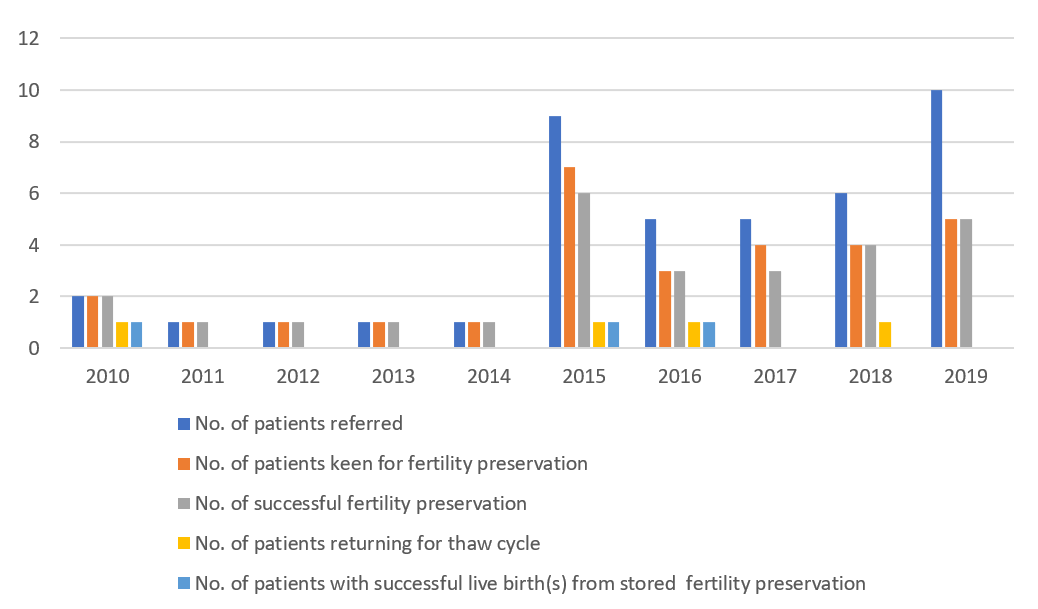
Fig. 1 illustrates the annual referral rates and a breakdown of women who successfully underwent fertility preservation, as well as those who returned for a thaw cycle and achieved live births. There has been a general upward trend in the number of patients referred for fertility preservation over the years.
A total of 41 women were referred for fertility preservation from 2010 to 2019, and 29 (70.7%) opted for fertility preservation. Among them, 27 successfully banked oocytes, embryos or ovarian tissue. Embryo cryopreservation was the most common (44.4%), followed by oocyte cryopreservation (33.3%). A small subset (11%) underwent ovarian tissue cryopreservation, primarily for urgent cancer treatment or in prepubertal girls. The procedures yielded promising outcomes: 4 women achieved successful live births—3 via cryopreserved gametes and 1 from spontaneous conception post-cryopreservation
The following case studies illustrate the potential for success in Singapore:
- A 22-year-old woman with ovarian cancer underwent ovarian tissue extraction and ex vivo oocyte maturation, resulting in a live birth—the first reported case from ex-vivo oocytes globally.4
- A 32-year-old woman with breast cancer successfully had a baby after embryo transfer from cryopreserved tissues.
- A woman with thyroid cancer stored oocytes before radioactive iodine therapy, leading to 2 live births following embryo transfer.
- A woman with gastric cancer conceived spontaneously post-therapy, delivering a healthy baby.
While these successes are encouraging, in our study, 12 out of 41 patients (29.2%) declined fertility preservation. The following are the reasons as barrier to utilisation: financial constraints were cited by 4/12 women (33.3%), while other women were deemed unsuitable for fertility preservation/informed of low success rates (3/12; 25%) or chose not to delay treatment (2/12; 16.6%).
The cost of fertility preservation procedures in Singapore ranges from SGD10,000 to SGD17,000 per cycle. Government schemes offer partial subsidies—particularly for married women under 40 years, and allow MediSave withdrawals of up to SGD6000 per cycle with a lifetime cap of SGD15,000. However, this coverage is insufficient, especially for single women or those who do not meet eligibility criteria. The high out-of-pocket costs, in addition to indirect expenses, deter many women from pursuing preservation. Unlike Singapore, countries like Japan and Korea offer partial insurance coverage for some fertility preservation options.5 In August 2024, Singapore’s Ministry of Health outlined plans to extend co-funding and insurance support for young cancer patients,6 reflecting governmental commitment to promoting fertility and parenthood, though this initiative is still under development.
Additionally, the lack of systematic referral pathway is another reason for low fertility preservation uptake. Until recent years, there was minimal data on fertility preservation referral practices, procedure types and outcomes in Singapore. The absence of such data hampers the development of targeted policies or resource allocation strategies aimed at bridging these gaps. Unlike countries like Israel, which have successfully implemented dedicated onco-fertility referral algorithms, Singapore lacks a formalised national protocol. This results in inconsistent referral practices, missed opportunities and lower awareness among both oncologists and patients. A study of Italy’s PREgnancy and FERtility project demonstrated that structured referral pathways could significantly increase counselling and treatment uptake.7 Having a specific referral algorithm for women with breast cancer led to 34.6% (55/159) of participants receiving comprehensive reproductive counselling at fertility clinics, with 52.7% (29/55) of counselled women opting for fertility preservation, similar to Singapore’s interest rate of 70.7%.
To our knowledge, our study is the first on fertility preservation uptake and usage rate in Singapore. However, its retrospective design bears inherent limitations, including potential data loss and recall bias.
Nevertheless, in conclusion, this study has shown that Singapore is facing pressing challenges in providing equitable and timely access to fertility preservation. Addressing these gaps would require strengthening multidisciplinary referral pathways, increasing public and clinician awareness, and expanding government support to alleviate the cost of fertility preservation procedures. These measures may improve the uptake of fertility preservation. Establishing a nationwide, prospective, multicentre registry could also improve follow-up, resource allocation and ultimately, reproductive outcomes for women affected by cancer.
REFERENCES
- Health Promotion Board, Ministry of Health, Singapore. Singapore Cancer Registry 50th Anniversary Monograph (1968–2017). https://www.nrdo.gov.sg/publications/cancer. Accessed 17 June 2025.
- Lee SJ, Schover LR, Partridge AH, et al. American Society of Clinical Oncology Recommendations on Fertility Preservation in Cancer Patients. J Clin Oncol 2006;24:2917-31.
- Fisch B, Abir R. Female fertility preservation: past, present and future. Reproduction 2018;156:F11-27.
- Prasath EB, Chan ML, Wong WH, et al. First pregnancy and live birth resulting from cryopreserved embryos obtained from in vitro matured oocytes after oophorectomy in an ovarian cancer patient. Hum Reprod 2014;29:276-8.
- Harzif AK, Santawai VPA, Maidarti M, et al. Investigation of Society for Fertility Preservation in Asia. Front Endocrinol 2019;10:151.
- Ministry of Health, Singapore. Speech by MOS Rahayu on the Adjournment Motion on Fertility Preservation for Young Cancer Patients. 6 August 2024. https://www.moh.gov.sg/newsroom/speech-by-mos-rahayu-on-the-adjournment-motion-on-fertility-preservation-for-young-cancer-patients. Accessed 17 June 2025.
- Lambertini M, Anserini P, Fontana V, et al. The PREgnancy and FERtility (PREFER) study: an Italian multicenter prospective cohort study on fertility preservation and pregnancy issues in young breast cancer patients. BMC Cancer 2017;17:346.
The study received approval from the SingHealth Centralised Institutional Review Board (2019/2854).
The author(s) declare there are no affiliations with or involvement in any organisation or entity with any financial interest in the subject matter or materials discussed in this manuscript.
Dr Toon Wen Tang, Department of General Obstetrics & Gynaecology, KK Women’s and Children’s Hospital, 100 Bukit Timah Rd, Singapore 229899. Email: [email protected]
