

ABSTRACT
Introduction: The high prevalence and mortality rates of breast cancer and lung cancer in Singapore necessitate robust screening programmes to enable early detection and intervention for improved patient outcomes, yet current uptake and coverage remain suboptimal. This narrative review synthesises expert perspectives from a 2024 roundtable discussion and proposes strategies to advance breast cancer and lung cancer screening programmes.
Method: A 2024 roundtable convened clinical practitioners, health policymakers, researchers and patient advocates discussed current challenges and opportunities for improving cancer screening in Singapore. Perspectives and insights were analysed to identify themes related to existing programme gaps, opportunities for innovation and implementation challenges.
Discussion: Singapore’s national breast cancer screening programme has been in place for over 2 decades, yet screening uptake remains suboptimal. A national lung cancer screening programme, in contrast, is still in its early stages of implementation. Regardless, employment of risk stratification approaches that integrate genetic, demographic and lifestyle factors could enhance screening effectiveness by identifying high-risk individuals, while also taking Singapore’s epidemiological trends into consideration. Integration of digital health technologies, artificial intelligence and behavioural change models can enhance cancer screening uptake and accuracy to overcome barriers such as low awareness, cultural beliefs and socioeconomic factors that contribute to low participation rates.
Conclusion: Key recommendations include enhancing public awareness, refining screening guidelines, expanding access and applying innovative technologies. A coordinated effort among stakeholders is crucial to continually assess and enhance screening programmes to narrow the practice-policy gap and ultimately reduce breast cancer and lung cancer burden in Singapore.
CLINICAL IMPACT
What is New
- This narrative review highlights the breast cancer and lung cancer burden in Singapore and underscores the need for improved uptake and coverage for cancer screening programmes.
- Strategies are proposed to improve cancer screening programmes.
Clinical Implications
- Risk stratification approaches and the adoption of innovative technology in screening protocols are strategies to improve screening coverage and diagnostic accuracy.
- Coordinated efforts beyond the clinic are necessary to improve public perception and acceptance of cancer screening programmes.

The high disease burden of both breast cancer and lung cancer in Singapore has necessitated the rapid evolution and advancement of breast and lung health management in Singapore.1 A 2024 roundtable in Singapore brought together clinical practitioners, health policymakers, researchers and patient advocates to discuss the current landscape of breast cancer and lung cancer in Singapore, identify unmet needs and put forward strategies to address these gaps.2 A key topic of discussion was the current state of cancer screening programmes in Singapore, alongside potential technologies and approaches to advance these programmes. Cancer screening programmes serve to enable early cancer detection and treatment, which has been associated with significant improvements in survival, reductions in morbidity and amelioration of disease burdens for breast cancer and lung cancer.3 However, the importance of screening needs to be continually publicised and emphasised at the societal level, otherwise screening rates can decline over time. This is seen in the case of cervical cancer screening in Singapore, where there was an alarming decline in cervical cancer screening rates from 57.9% in 2007 to 43.1% in 2022.4 Furthermore, when there is better understanding of certain barriers to cervical cancer screening such as fear and discomfort, new approaches such as self-sampling can be adopted, which can offer new ways to improve the acceptability and uptake of these screening tests.5
Comparing across various cancer screening programmes in Singapore, the national breast cancer screening programme was established over 2 decades ago, while a national screening programme for lung cancer is still in nascent stages of implementation.6,7 Regardless of when a screening programme is established, technological and research advancements should be continually assessed for application to screening programmes to improve patient outcomes and overall population health. This review aims to summarise expert perspectives that were discussed, bring together relevant insights to help shape a framework to facilitate screening coverage and uptake, improve access and advance cancer screening programmes for earlier detection of breast cancer and lung cancer in Singapore.
METHOD
The roundtable was held in October 2024 and convened clinical practitioners, health policymakers, researchers and patient advocates discussed current challenges and opportunities for improving cancer screening in Singapore. Perspectives and insights were analysed to identify themes related to existing programme gaps, opportunities for innovation and implementation challenges.
RESULTS
Breast cancer screening in Singapore
In Singapore, the age-standardised incidence rate (ASIR) for breast cancer has risen from 20.1/100,000 population in 1968–1972 to 76.2/100,000 population in 2018–2022, with approximately 25% of breast cancer diagnoses in younger women under 50 years of age as of 2018–2022.8 Similarly, the age-standardised mortality rates (ASMR) reported for breast cancer in Singapore has also increased from 5.7/100,000 population to 11.6/100,000 population.8 While diagnoses at advanced stage III or later breast cancer has remained constant, an increase in the incidence in ductal carcinoma in situ and stage I breast cancer cases has been observed over the past decade, with 58% of breast cancer diagnoses being in stage I.8
In 2002, the national breast cancer screening programme was started to enable early detection of breast cancer to reduce mortality. Current screening guidelines recommend breast cancer screening starting at 50 years of age, with screening recommended for women 40–49 years at physician’s discretion, dependent on an individual’s risk-factor profile.9 With the rising and significant proportion (20.1%) of breast cancer diagnoses in younger women 40–49 years, current screening programmes may overlook this high-risk population, as genetic risk factors are typically not tested for.8,9
Since the inception of the national breast cancer screening programme, screening rates have improved from 29.7% before 2002 to 39.6% in 201010; however, current local screening programmes for breast cancer have stagnated and report low screening rates of about 40% in 2019, which is much lower than in other high-income countries, with screening rates of 72% in New Zealand, 75% in both Norway and the United Kingdom, and 90% in Sweden.11 In multicultural Singapore, Malay ethnicity and low socioeconomic status have been significantly associated with poorer cancer screening uptake,12 presenting unique challenges in screening relating to Singapore’s ethnic and cultural diversity. The Singapore Breast Cancer Cohort, established in 2010 as an ongoing multi-ethnic cohort study, aims to help better evaluate the phenotypic and genetic risk factors for breast cancer in Singapore, so that more people who are at higher risk of breast cancer are identified and better informed to take the necessary precautionary and early screening measures.13
Low awareness, misconceptions about personal risk factors and poor understanding of screening eligibility have been cited as contributors to lower screening uptake.11 As many people in Singapore are time-poor, the time required for screening, alongside their low perceived susceptibility to breast cancer also serve as barriers to preventive care.14,15
Lung cancer screening in Singapore
With lung cancer remaining a leading cause of mortality worldwide, its late diagnosis has been identified as a contributing factor to high mortality rates and poor patient outcomes.16,17 Although the decreasing trend of ASIR for lung cancer in men in Singapore has been encouraging, at 30.0/100,000 population in 2018–2022, many of the patients diagnosed with lung cancer are diagnosed at advanced stages of the disease, with 60% of diagnoses at stage IV.8 The ASMR for lung cancer in men in Singapore was 20.1/100,000 population in the same period, with one of the lowest survival rates of 21.9% among common cancers in Singapore.8 Similar to men, the ASIR and ASMR of lung cancers in women have gradually declined over the past decade.8 However, there is a notable increase in lung cancers among female non-smokers (60–80% of all female lung cancers) and most cases were diagnosed at late stages (70.5%).18-21 The unique epidemiology of lung cancer in Singapore, where there are trends of rising cases of lung cancer in female non-smokers, and the relatively higher rates of lung cancer being first diagnosed at the late stages, may warrant targeted risk-based lung cancer screening guidelines and recommendations that take into account Singapore data and trends.
The current lung cancer screening guidelines adopted both in Singapore and globally recommend lung cancer screening in individuals aged 50–80 years with a 20 pack-year smoking history, and who currently smoke or have quit in the past 15 years.22 However, a local study showed that implementation of these criteria in Singapore could miss about 42% of lung cancer patients, as the criteria do not account for risk factors associated with females and/or never-smokers.21
With a national lung cancer screening programme in its nascent stages of implementation, updates to screening eligibility criteria are necessary to reflect local disease epidemiology and improve sensitivity of the programme in identifying those with high-risk.23 In addition, the use of low-dose computed tomography (LDCT) scans to enable earlier diagnosis has been recommended for lung cancer screening, and should be considered when a national lung cancer screening programme is established.7,23 Nevertheless, LDCT is unable to reliably differentiate between malignant nodules from incidental tuberculosis findings, which may necessitate additional testing to confirm a diagnosis alongside additional psychological and cost implications.24 While systematic reviews have showed cost-effectiveness of lung cancer screening with LDCT, further evaluation on the impact and feasibility of a national screening programme is needed, to take into account Singapore’s healthcare landscape, infrastructure readiness and funding model, especially when planning to screen more people in the higher risk groups and subpopulations.23,25
Risk stratification approach for cancer screening
The changing epidemiological trends of both breast cancer and lung cancer highlight the need for more precision and higher resolution in identifying those at high risk of cancer for targeted screening. A risk stratification approach would enable the consideration of multiple genetic, demographic and behavioural risk factors to assign cancer risk, and identify those who are at high cancer risk. With growing understanding on genetic risk factors and hereditary components for breast cancer and lung cancer, there is strong evidence to employ a risk-based stratified approach for breast cancer and lung cancer screening, ensuring coverage of populations that are under-represented, at high risk and unique to the epidemiology of Singapore.26-29 A wider and risk-based cancer screening approach would mean higher rates of detection of cancer at the earlier stages, where treatment is less costly and survival rates are better, to reduce the overall cancer burden in Singapore.
Risk stratification for breast cancer
In breast cancer, a risk stratification approach that considers ethnic background and other polygenic factors, alongside traditional risk factors such as age and family history, would enable more precise identification of those at high risk of breast cancer over age-based screening criteria.26,27 Breast cancer risk varies across ethnicities in Singapore, with the Malay population in Singapore being at higher risk compared to the other populations.13 Breast cancer in Malay women typically presents at a younger age, at more advanced stages and with more aggressive tumour biology.30-32 More specifically, mutations in the breast cancer genes (BRCA) have been established to confer significantly higher oncogenic risk for breast cancer.27 Although BRCA testing is internationally recognised, uptake of BRCA testing is still low in Singapore, even when recommended to patients based on their risk profiles.33
Risk stratification for lung cancer
Emerging evidence indicate family history of lung cancer as being a significant risk factor for lung cancer in Asian populations.34 In addition, oncogenic factors, such as epidermal growth factor receptor gene (EGFR) mutations, have been found to have a major role in the pathogenesis of lung cancer in females and never-smokers, a seemingly unique phenomenon in Asia.28,29,35 Family history, alongside genetic factors, should be considered when determining risk of lung cancer to ensure that this high-risk population is identified for screening. Using a risk stratification approach would also help guide conversations and promote understanding of cancer risk, and in turn facilitate screening acceptance.36
Integrating digital health for improved detection and care
In today’s digitised and data-rich society, risk stratification in the screening for breast cancer and lung cancer is more feasible than before and would, at the same time, enable more convenient and robust data collection across the population.37 Using artificial intelligence, models may be trained on this population health dataset to identify high-risk patients and provide personalised health and screening advice to facilitate screening adherence and uptake.38,39 A comprehensive population health dataset would also allow timely and informed formulation of public health policies, cancer screening protocols and healthcare resource allocation to improve access of high-risk populations to screening programmes.
In diagnostic radiology, machine learning-based radiomics may augment LDCT for better detection of small nodules, which will aid radiologists and patients in the earlier detection of lung cancer.40 However, members of the roundtable acknowledge that optimisation is still required on the interpretation of small and subsolid nodules to differentiate between early cancer and tuberculosis, and that as technology evolves, this will be less of an issue over time.40
Behavioural health science in promoting preventive care
Identification of high-risk populations, improvement of screening protocols and increased subsidised cancer screening do not automatically lead to increased uptake in screening.41 A deeper understanding of the underlying factors that drive compliance and application towards effecting health behavioural changes is necessary to lead reductions in certain behaviours, increase compliance to cancer screening guidelines and drive improvement in screening uptake rates.42 The use of behavioural change models to encourage preventive care seeking behaviours should be leveraged, as it has been shown to ameliorate the uptake of cancer screening.43 Motivational interviewing by healthcare professionals has been shown to be helpful in engaging with patients more meaningfully in their decision-making for cancer screening, ensuring awareness and understanding of the importance and value of cancer screening.44
The cost of screening and genetic testing, lack of perceived value, and spiritual and religious beliefs have been cited as barriers to both routine breast cancer screening and BRCA testing in Singapore.11,33,45 Raising public awareness of risk factors for breast cancer and lung cancer is crucial for patients to better understand their cancer risk and the importance of cancer screening, so as to facilitate discussions on cancer screening with their physician.36 For lung health, public awareness campaigns should focus on smoking cessation, mitigating risk factors that affect lung health and improving awareness of comorbidities associated with lung cancer development, such as chronic obstructive pulmonary disorder.46 These lung cancer campaigns should of course target smokers and ex-smokers, providing a platform that encourages them to reduce their risk factors, seek preventive care and participate in general health screening programmes.
Community activities also play a role in raising awareness and improving cancer screening uptake. Patient- and community-led initiatives, such as the Mammo-bus, a mobile mammography unit, can drive engagement and participation in community breast cancer screening programmes.11 In Singapore, the Lung Cancer Consortium was established to unify clinical, research and community efforts, bringing together programmes such as “I Quit” by the Health Promotion Board and other awareness campaigns to combat tobacco use.
DISCUSSION
It is normal that practice runs ahead of policy—what differentiates an exceptional healthcare system from a good one is its ability to keep the practice-policy gap as small as possible. This ensures that the healthcare system is able to push evidence synthesis to be as near the edge as possible, while ramping up health technology assessments to keep up with the latest science, technology and evidence; so that health policy keeps pace with the rate of change in clinical practice.
Successful cancer screening programmes require concerted national efforts with support from across clinical practitioners, researchers and health policymakers. Overall, the key priorities for cancer screening programmes in Singapore are to improve screening uptake, to improve screening coverage for at-risk populations, to detect cancer earlier and at earlier stages, and to provide patients with timely medical advice and treatment. For breast cancer, one of the key thrusts is to support research to better understand the attitudes and behaviours towards breast cancer screening, and discern effective strategies to change behaviours and improve screening uptake. Another focus should be on updating breast cancer screening guidelines to include more definitive guidance on screening in those aged 40–49 years of age, employing a risk stratification approach to improve coverage and access to screening for those at risk.
For lung cancer, policy and practice updates should focus on the implementation of a risk-based national screening programme. This requires development of an evidence-based protocol for lung cancer screening, which includes updates to the screening criteria in a way that is progressive and offers flexibility to account for unique phenotypes that present in Asia, while also using LDCT as a screening tool. Further research is required on the use of artificial intelligence to improve specificity of LDCT in identifying lung cancer, as well as to investigate cost and resource implications with employing LDCT in a national lung cancer screening programme.
To evaluate the effectiveness and impact of population- and risk-based cancer screening programmes, experts from the roundtable had suggested several metrics to be measured and tracked (Table 1), which can be used for assessing against set benchmarks and targets. Setting of targets and benchmarks should be policy- and evidence-based, and done in close consultation with clinicians, researchers and policymakers.
Table 1. Proposed metrics to evaluate performance of cancer screening programmes.
|
Proposed metric |
Objective |
Relevant screening programme |
|
Screening recommendation rates |
Assess identification of at-risk populations |
Breast cancer Lung cancer |
|
Screening uptake rates |
Assess screening participation |
|
|
Equity of access to screening |
Assess screening coverage |
|
|
Screening interval adherence and follow-up timelines |
Assess screening protocols |
|
|
Diagnostic accuracy |
||
|
Patient experience |
||
|
Cost effectiveness |
Assess economic impact of new technologies |
Lung cancer |
CONCLUSION
Fig. 1. Proposed strategies for advancing breast cancer and lung cancer screening programmes in Singapore.
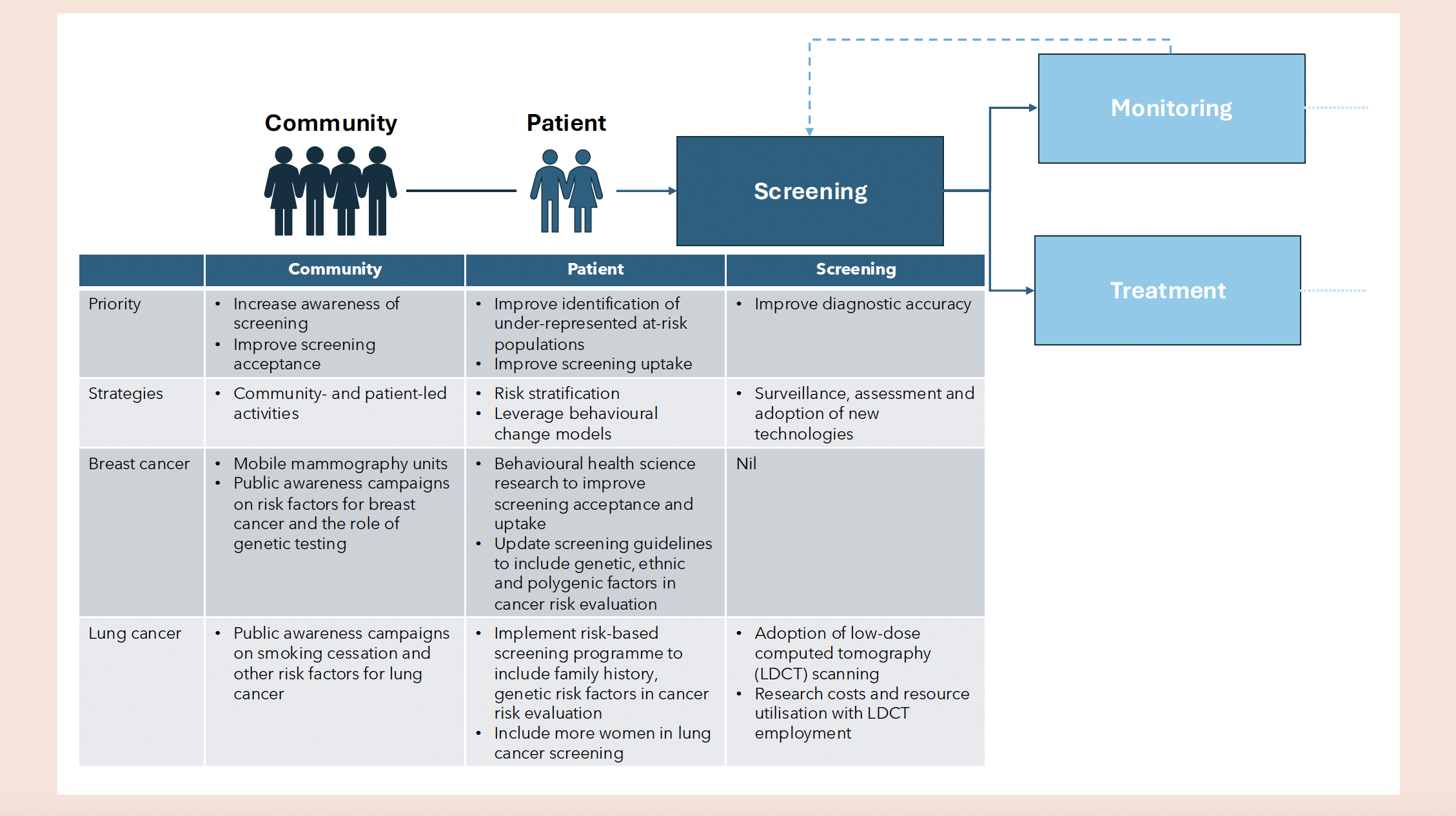
The expert roundtable discussions provided insights on gaps in current screening programmes for both breast cancer and lung cancer and helped put forth strategies to bridge these gaps, facilitate earlier detection and reduce morbidity of cancer in Singapore (Fig. 1). These strategies include integration of a risk stratification approach that would underpin cancer screening criteria to improve screening coverage in under-represented, high-risk populations; the adoption of new technologies to enhance diagnostic accuracy of screening protocols; and change behaviour strategies to improve acceptance, normalise evidence-based cancer screening and improve participation rates. Acknowledging that utilisation of these strategies to inform and update health policies requires time, investment and training. Changes in screening programmes, thresholds for cancer screening and the use of new technology should be evidence-based and take into consideration local data and epidemiological trends, cultural sensitivities, and healthcare system capacity and complexities.
Acknowledgements
The authors would like to acknowledge the contributions of the clinical practitioners, health policymakers, researchers and patient advocates who attended the “Policy & Practice Roundtable Series – New Perspective on Beast Health & Lung Health in the Healthier SG Era” on 1 October 2024, for their insights and perspectives that contributed to the content for the development of this publication. The full list of participants is listed in the event report, accessible via https://www.dhs-sea.com/events. In addition, the authors would like to thank Dr Kelvin Bryan Tan for an early review of the publication, and Yen May Ong for medical writing support.
REFERENCES
- Dee EC, Laversanne M, Bhoo-Pathy N, et al. Cancer incidence and mortality estimates in 2022 in southeast Asia: a comparative analysis. Lancet Oncol 2025;26:516-28.
- Digital Health Society of South East Asia, Precision Public Health Asia Society & Society of Behavioural Health, Singapore. The Policy & Practice Roundtable Series – New Perspectives on Breast Health & Lung Health in the Healthier SG Era. 2024. https://www.dhs-sea.com/post/policy-and-practice-roundtable-on-breast-and-lung-health-1-october-2024. Accessed 6 August 2025.
- Crosby D, Bhatia S, Brindle KM, et al. Early detection of cancer. Science 2022;18:375:eaay9040.
- Chin FHX. Evaluating the effectiveness of cervical cancer screening and prevention in Singapore. Ann Acad Med Singap 2024;28:53:338-9.
- Chan GMF, Ong LSD, Shen L, et al. High acceptability of HPV self-sampling in a Singapore primary care setting. Ann Acad Med Singap 2025;54:319-21.
- Wang SC. The Singapore National Breast Screening Programme: Principles and Implementation. Ann Acad Med Singap 2003;466-76.
- Aggarwal, B, Coughlan, D. Low-dose computerised tomography screening for lung cancer in Singapore: Practical challenges of identifying participants. Ann Acad Med Singap 2022;51:648-50.
- National Registry of Diseases Office. Singapore Cancer Registry Annual Report 2022. https://www.nrdo.gov.sg/docs/librariesprovider3/default-document-library/scr-ar-2022_web-report6c6e8522-cf39-416f-9390-5fe903065927.pdf. Accessed 6 August 2025.
- Chootipongchaivat S, Wong XY, Ten Haaf KS et al. Cost-effectiveness analysis of breast cancer screening using mammography in Singapore: A modeling study. Cancer Epidemiol Biomarkers Prev 2021;30:653-60.
- Loy EY, Molinar D, Chow KY, et al. National breast cancer screening programme, Singapore: Evaluation of participation and performance indicators. J Med Screen 2015;22:194-200.
- Rajendram P, Singh P, Han KT, et al. Barriers to breast cancer screening in Singapore: A literature review. Ann Acad Med Singap 2022:51;493-501.
- Chan TK, Tan LWL, van Dam RM, et al. Cancer Screening Knowledge and Behavior in a Multi-Ethnic Asian Population: The Singapore Community Health Study. Front Oncol 2021;11:684917.
- Ho PJ, Yeoh YS, Miao H, et al. Cohort profile: The Singapore Breast Cancer Cohort (SGBCC), a multi-center breast cancer cohort for evaluation of phenotypic risk factors and genetic markers. PLoS One 2021;16:e0250102.
- Surendran S, Foo C, Tan DHY, et al. Understanding Barriers and Facilitators of Breast and Cervical Cancer Screening among Singapore Women: A Qualitative Approach. Asia Pac J Cancer Prev 2023;24:889-95.
- Lim SK, Teo XL, Ng JL, et al. A Survey on Singaporean Women’s Knowledge, Perception and Practices of Mammogram Screening. Ann Acad Med Singap 2015;44:317-25.
- Woodard GA, Jones KD, Jablons DM. Lung Cancer Staging and Prognosis. In: Reckamp, KL (Ed), Lung Cancer Treatment and Research. Cham: Springer;2016.
- GBD 2021 Causes of Death Collaborators. Global burden of 288 causes of death and life expectancy decomposition in 204 countries and territories and 811 subnational locations, 1990–2021: a systematic analysis for the Global Burden of Disease Study 2021. Lancet 2024;403:2100-32.
- Toh CK, Ong WS, Lim WT, et al. A Decade of Never-smokers Among Lung Cancer Patients-Increasing Trend and Improved Survival. Clin Lung Cancer 2018;5:e539-50.
- Toh CK, Gao F, Lim WT, et al. Never-Smokers With Lung Cancer: Epidemiologic Evidence of a Distinct Disease Entity. J Clin Oncol 2006;24:2245-51.
- Chang GC, Chiu CH, Yu CJ, et al. Low-dose CT screening among never-smokers with or without a family history of lung cancer in Taiwan: a prospective cohort study. Lancet Respir Med 2024;12;141-52.
- Loh CH, Koh PW, Ang DJM, et al. Characteristics of Singapore lung cancer patients who miss out on lung cancer screening recommendations. Singapore Med J 2022;65:279-87.
- Chapter of Respiratory Physicians. Lung Cancer Screening in Singapore. January 2025. https://www.ams.edu.sg/view-pdf.aspx?file=media%5C7406_fi_190.pdf Accessed 6 August 2025.
- Liew CJY, Leong LCH, Teo LLS, et al. A practical and adaptive approach to lung cancer screening: A review of international evidence and position on CT lung cancer screening in the Singaporean population by the College of Radiologists Singapore. Singapore Med J 2019;60:554-9.
- Ang YLE, Chia PL, Chua KLM, et al. Lung Cancer in Singapore. J Thorac Oncol 2021;16:906-11.
- Grover H, King W, Bhattarai N, et al. Systematic review of the cost-effectiveness of screening for lung cancer with low dose computed tomography. Lung Cancer 2022;170:20-33.
- Gierach GL, Choudhury PP, García-Closas M. Toward Risk-Stratified Breast Cancer Screening: Considerations for Changes in Screening Guidelines. JAMA Oncol 2020;6:31–3.
- Obeagu EI, Obeagu GU. Breast cancer: A review of risk factors and diagnosis. Medicine (Baltimore) 2024;103:E36905.
- Ha SY, Choi SJ, Cho JH, et al. Lung cancer in never-smoker Asian females is driven by oncogenic mutations, most often involving EGFR. Oncotarget 2015;6:5465-74.
- Moorthi S, Paguirigan A, Itagi P, et al. The genomic landscape of lung cancer in never-smokers from the Women’s Health Initiative. JCI Insight 2024;9e174643.
- Bhoo-Pathy N, Hartman M, Yip CH, et al. Ethnic differences in survival after breast cancer in South East Asia. PLoS One 2012;7:e30995.
- Tan EY, Wong HB, Ang BK, et al. Locally Advanced and Metastatic Breast Cancer in a Tertiary Hospital. Ann Acad Med Singap 2005;34:595-601.
- Pek CH, Tan EY, Chen JJ, et al. Advanced Breast Cancer—Are We Doing Enough? Breast J 2012;18:644-6.
- Chiang J, Ngeow J. The management of BRCA1 and BRCA2 carriers in Singapore. Chin Clin Oncol 2020; 9:62.
- Ang L, Chan CPY, Yau WP, et al. Association between family history of lung cancer and lung cancer risk: a systematic review and meta-analysis. Lung Cancer 2020;148:129-37.
- Zhou F, Zhou C. Lung cancer in never smokers-the East Asian experience. Transl Lung Cancer Res 2018;7:450-63.
- Taylor LC, Hutchinson A, Law K, et al. Acceptability of risk stratification within population-based cancer screening from the perspective of the general public: A mixed-methods systematic review. Health Expect 2023;26:989-1008.
- Powell D. Walk, talk, think, see and feel: harnessing the power of digital biomarkers in healthcare. NPJ Digit Med 2025;7:45.
- Chandran U, Reps J, Yang R, et al. Machine Learning and Real-World Data to Predict Lung Cancer Risk in Routine Care. Cancer Epidemiol Biomarkers Prev 2023;32:337-43.
- Zhang B, Shi H, Wang H. Machine Learning and AI in Cancer Prognosis, Prediction, and Treatment Selection: A Critical Approach. J Multidiscip Healthc 2023;26:1779-91.
- Geppert J, Asgharzadeh A, Brown A, et al. Software using artificial intelligence for nodule and cancer detection in CT lung cancer screening: systematic review of test accuracy studies. Thorax 2024;79:1040-9.
- Institute of Medicine (US) and National Research Council (US) National Cancer Policy Board. Fulfilling the Potential of Cancer Prevention and Early Detection. In Curry SJ, Byers T, Hewitt M (Eds.). Washington, DC: National Academies Press; 2003.
- A report of an Expert Group. Research in the behavioural and social sciences to improve cancer control and care: a strategy for development. Eur J Cancer 2004:40:316-25.
- Dsouza JP, Broucke SVD, Pattanshetty S, et al. A comparison of behavioural models explaining cervical cancer screening uptake. BMC Womens Health 2022;22:235.
- Chan DNS, So WKW. Effectiveness of motivational interviewing in enhancing cancer screening uptake amongst average-risk individuals: A systematic review. Int J Nurs Stud 2021;113:103786.
- Moey SF, Sowtali SN, Mohamad Ismail MF, et al. Cultural, Religious and Socio, Ethical Misconceptions among Muslim Women towards Breast Cancer Screening: A Systematic Review. Asian Pacific Journal of Cancer Prevention 2022;23:3971-82.
- Durham AL, Adcock IM. The relationship between COPD and lung cancer. Lung Cancer 2015;90:121-7.
No patient data were used in the development of the manuscript.
The authors received a grant from AstraZeneca for the development of this publication in accordance with Good Publication Practice 2022 guidelines.
Dr Clive Tan, Department of Epidemiology and Preventive Medicine, Tan Tock Seng Hospital, 11 Jalan Tan Tock Seng, Singapore 308433. Email: [email protected]
