

ABSTRACT
Introduction: Cardiovascular disease remains a leading cause of morbidity and mortality in Singapore, with rising demand for longitudinal cardiovascular care driven by ageing and metabolic risk factors. Cardiology pharmacists support medication optimisation, transitions of care and patient education across hospital, ambulatory and community settings. However, limited specialist accreditation pathways, uneven service distribution and emerging digital requirements constrain scalable delivery to match national needs.
Methods: This position paper was developed by the Pharmaceutical Society of Singapore Cardiology Pharmacy Working Group. A multidisciplinary consensus approach was adopted, guided by RIGHT and AGREE II principles to ensure transparency, applicability and editorial independence. Evidence synthesis drew from published literature, national epidemiology and institutional experience, contextualised within governance under the Healthcare Services Act and Collaborative Prescribing Agreement.
Results: Cardiology pharmacists are essential to medication safety, adherence support and protocol-guided dose optimisation under physician oversight. Key gaps include delayed post-discharge follow-up, fragmented hospital-primary care alignment, telehealth implementation challenges and a limited pipeline of accredited specialists, restricting capacity to achieve guideline-directed therapy targets and sustained continuity of care.
Conclusion: Five priorities were endorsed: strengthening specialist workforce capability; enhancing early post-discharge reviews; integrating pharmacists across care settings; leveraging digital-enabled care; and expanding medication-focused roles in prevention, atrial fibrillation, palliative heart failure and precision medicine. Cardiology pharmacists are critical contributors to a safe, coordinated and future-ready cardiovascular care ecosystem. A physician-led, pharmacist-enabled model supports national goals under Healthier SG.
CLINICAL IMPACT
What is New
- First multidisciplinary consensus reflecting on pharmacists’ role with the current governance under the Healthcare Services Act and Collaborative Practice Agreement.
- Clearly defines cardiology pharmacists’ remit within physician-led practice.
- Identifies workforce, service distribution and digital readiness gaps.
- Proposes a scalable roadmap aligned with Healthier SG and value-based models.
Clinical Implications
- Enhances continuity and optimisation of pharmacotherapy across care transitions.
- Supports coordinated medication governance between hospital and primary care.
- Applies digital tools to expand pharmacist-enabled care safely and sustainably.
- Reinforces cardiology specialist pharmacists’ capacity without compromising statutory boundaries.
Cardiovascular disease (CVD) remains one of Singapore’s leading causes of morbidity and mortality, accounting for a growing proportion of hospital admissions and chronic disease burden.1,2 This trend reflects an ageing population and an increasing prevalence of metabolic risk factors such as diabetes, hypertension and dyslipidaemia.3 As the nation advances towards Healthier SG, a national strategy that prioritises preventive, community-based and longitudinal care, the management of cardiovascular conditions must evolve in tandem.4
Within this landscape, cardiology pharmacists play a pivotal role in optimising pharmacotherapy, supporting adherence and ensuring medication safety across the continuum of care. Their contributions are particularly evident in heart failure (HF) titration clinics, post-acute myocardial infarction (AMI) follow-up,5,6 anticoagulation management and lipid optimisation services. These services exemplify collaborative, physician-led but pharmacist-enabled practice—augmenting specialist capacity without substituting medical authority. However, despite their integral presence in multidisciplinary teams, most pharmacists practising cardiology today have developed their expertise through institutional training and on-the-job experience rather than through structured, accredited pathways. This results in variability in practice depth and limited scalability of advanced services, especially as cardiovascular care becomes more complex.
The runway to specialisation for pharmacists under the Singapore Pharmacy Council and national residency frameworks remains long and resource-intensive, with only a handful of formally accredited cardiology specialist pharmacists across Singapore’s public healthcare system.7,8 Many capable practitioners operate at advanced levels of clinical service but lack a clearly recognised pathway for progression, creating challenges in sustainability recognition and workforce development.
This position paper arises from that need. It seeks to articulate the role, scope and governance of cardiology pharmacists in Singapore’s evolving healthcare system—not as independent providers, but as clinically embedded partners who extend cardiologists’ reach and strengthen medication-related outcomes. The paper proposes a physician-led, pharmacist-enabled model of care, aligned with existing regulatory frameworks such as the Collaborative Prescribing Agreement (CPA), Healthcare Services Act (HCSA) and national competency standards for advanced practice pharmacists.
The intention is not to redefine medical authority, but to ensure that medication optimisation, adherence support and pharmacovigilance receive the depth of attention they deserve throughout the cardiac patient’s journey (Table 1). Through this partnership model, pharmacists contribute to safer, more efficient and more patient-centred cardiovascular care—a necessity as Singapore faces an escalating burden of CVD2 and increasing demands on its specialist workforce.8
Table 1. What this position paper is not proposing.
|
This position paper does not advocate for autonomous or independent clinical practice by pharmacists in cardiology. Rather, it supports a physician-led, pharmacist-enabled model that reinforces collaboration, safety and accountability within Singapore’s regulatory frameworks. Specifically, this statement does not propose that pharmacists: (1) Independently diagnose, manage or determine treatment plans for acute coronary syndromes, heart failure or arrythmias, or other cardiovascular problems. (2) Order or interpret diagnostic tests beyond privileges defined in the Collaborative Prescribing Agreement or institutional policies, or operate outside the governance of the Healthcare Services Act. (3) Conduct standalone or parallel clinics that replace cardiologist-led consultations or compete with specialist services. Pharmacists practise within defined collaborative agreements approved by supervising cardiologists, focusing on medication optimisation, adherence support and pharmacovigilance. This ensures that care remains integrated, team-based and patient-centred, augmenting, not replacing, physician-led cardiovascular care. |
METHODS
Consensus development
Governance and frameworks
This position paper was developed under the Pharmaceutical Society of Singapore to describe the scope, practice standards and strategic directions of cardiology pharmacy in Singapore. The development process was guided by principles from the Reporting Items for Practice Guidelines in Healthcare (RIGHT) Statement and Appraisal of Guidelines for Research and Evaluation II (AGREE II) instrument to ensure transparency, inclusivity and editorial independence, though not all domains were applied in full.9 The process was contextualised within Singapore’s HCSA and CPA frameworks, which govern multidisciplinary prescribing and advanced practice models.10
Working group composition
A national expert panel of 22 members was convened in January 2024 under the auspices of the Pharmaceutical Society of Singapore. Members were invited as independent subject matter experts, representing cardiology pharmacists, cardiologists from recognised specialty chapters and senior nursing and academic leaders across major restructured hospitals and professional bodies in Singapore.
The working group was divided into 3 disease-focused teams: acute coronary syndrome (ACS), HF and arrhythmias (atrial fibrillation [AF] and related conditions)—each comprised cardiology-trained pharmacists with a physician and nursing collaborator. Each subgroup examined current practice, emerging trends and service gaps within its assigned domain, drawing upon published Singapore data to propose forward-looking recommendations. A central coordination team, comprising the chair, methods lead and secretariat, ensured alignment across the 3 groups and consistency in the framing of recommendations.
Scope and approach
Each subgroup reviewed its assigned disease area following a common framework encompassing:
- Disease burden and prevalence within Singapore and comparable regions;11,12
- Current models of care and pharmacist roles across hospital, ambulatory and community settings;
- Challenges and service gaps identified from literature and institutional experience; and
- Future-state aspirations for workforce, technology and service integration.
Information sources included peer-reviewed articles, Singapore’s Ministry of Health (MOH) and Health Promotion Board publications and government statistics and institutional data. Searches were conducted between February and April 2024, using databases such as PubMed and MOH repositories with keywords including: cardiology pharmacist, HF, myocardial infarction, AF, Singapore, collaborative prescribing and telehealth.
Evidence was appraised for relevance and applicability in Singapore rather than through formal Grading of Recommendations Assessment, Development and Evaluation system scoring, as this work represents a consensus position statement rather than a clinical practice guideline. Nonetheless, development and reporting were informed by established quality frameworks: RIGHT principles supported clarity of purpose, rationale and evidence presentation, while AGREE II domains guided stakeholder involvement, structured deliberation and assurance of editorial independence.13 Feasibility within CPA governance structures and health-service implementation considerations in Singapore were prioritised to ensure the recommendations are deliverable within current regulatory and care models.
Development
Draft statements were generated independently by each subgroup and synthesised by the methods lead. A 3-stage consensus process was then conducted:
- Initial drafting: Subgroups prepared narrative summaries and draft recommendations supported by evidence tables and key references.
- Panel review: Statements were circulated to all 22 members for iterative feedback. Divergent points were discussed during virtual meetings and via email exchanges to harmonise scope and terminology.
- Final reconciliation: The full panel met in July 2024 to review and endorse the consolidated draft. Consensus was achieved through structured discussion and majority agreement, ensuring all statements reflected collective and multidisciplinary endorsement.
Although a formal Delphi process was not undertaken, the methodology incorporated its core elements of iterative feedback, anonymity of opinion during drafting and transparent documentation of changes.14,15
Conflict of interest and editorial independence
The workgroup comprised independent experts in cardiology practice who were invited to contribute their professional perspectives. Members had no prior affiliations beyond their clinical scope and received no honoraria or financial incentives. The work received no external or industry funding, and editorial independence was maintained by the writing group and the Pharmaceutical Society of Singapore secretariat, consistent with RIGHT item 19.
Consensus context and applicability
Implementation considerations were guided by prevailing regulatory and institutional frameworks at the time of drafting. Each recommendation was developed with reference to publicly available guidance from MOH and relevant professional standards to ensure consistency with existing governance under CPA and HCSA. While no formal implementation audit was conducted, feasibility and alignment with clinical practice were discussed by the working group to ensure practical applicability. The statements presented herein reflect consensus agreement at the time of publication. Future updates may be considered should substantive regulatory or policy changes arise.
Cardiology pharmacy practice in Singapore
Cardiology pharmacy practice in Singapore has evolved within a structured national framework that recognises pharmacists as integral partners in multidisciplinary cardiovascular care. Within the physician-led, pharmacist-enabled model, pharmacists extend specialist capacity by ensuring that pharmacotherapy decisions are evidence-based, safe and contextualised to the patient’s comorbidities, care goals and care setting. Their role complements that of physicians, nurses and allied health professionals, reinforcing medication governance, continuity of care and therapeutic precision within institutional and national frameworks.16
Evolution of cardiology pharmacy practice in Singapore
To meet the growing demand for advanced cardiovascular expertise, MOH later established the National Pharmacy Residency Programme, including Residency Year 2 Programme (R2) in Cardiology Pharmacy, launched in 2016. The programme employs a portfolio-based exit assessment and provides structured, longitudinal training across acute, ambulatory and community settings. It also cultivates competencies in clinical leadership, research and education—reflecting the evolution of pharmacy from a product-oriented to a patient- and outcomes-oriented discipline.
Cardiology pharmacy practice now operates through 2 progressive tiers. One tier comprises cardiology-trained pharmacists. They are practitioners with advanced, disease-specific knowledge who practice within CPA frameworks under physician oversight. They co-manage conditions such as acute and chronic coronary syndromes and HF, focusing on drug optimisation, adherence and safe transitions of care.
The other tier comprises cardiology specialist pharmacists who operate at a higher tier of clinical and system leadership. They manage complex or overlapping cardiovascular conditions such as pulmonary hypertension, cardio-oncology or advanced HF requiring device or transplant support. Beyond clinical practice, they lead service design, formulary governance, clinical research, education and often represent pharmacy in interprofessional working groups that shape national guidelines, policy frameworks and quality metrics.
Together, these tiers form a continuum of practice that supports Singapore’s move towards Healthier SG, a national strategy centred on preventive, team-based and longitudinal care. As cardiovascular care grows more complex, specialist pharmacists are increasingly required to manage multimorbidity, device-based therapies and precision medicine considerations under physician direction. Conditions such as HF with preserved ejection fraction, AF with renal impairment and polypharmacy in older adults demand advanced pharmacotherapy judgement, rapid dose adjustments and close monitoring that extend beyond generalist skills. Cardiology specialist pharmacists therefore function as force multipliers to cardiologists—supporting safe expansion of services into ambulatory and primary care settings while maintaining governance and clinical accountability. By embedding pharmacists within multidisciplinary pathways, the model ensures that therapy decisions made in tertiary hospitals are sustained through follow-up in ambulatory and community settings, reducing fragmentation and enhancing care consistency.17
Clinical roles across the care continuum
Cardiology pharmacists are strategically embedded across the hospital, ambulatory and community continuum, providing expertise that ensures medication safety, treatment optimisation and continuity between care settings.18
Hospital and critical care services
In tertiary and teaching hospitals, cardiology pharmacists provide co-managed care for patients admitted with ACS, HF, AF or complex cardiovascular comorbidities.19 They participate in multidisciplinary rounds, perform medication reconciliation, evaluate drug-disease and drug-drug interactions and adjust dosing for renal or hepatic impairment. Within CPA frameworks, they implement protocol-guided titration of evidence-based therapies such as renin-angiotensin-aldosterone system inhibitors, beta-blockers, sodium-glucose cotransporter-2 inhibitors and diuretics once indications and targets are established by cardiologists. Pharmacist involvement in ACS and HF co-management has been associated with reduced medication errors, improved optimisation of guideline-directed medical therapy and lower rates of adverse event-related readmissions.5,20
In high-dependency and coronary care units, pharmacists contribute to the management of critically ill patients requiring vasoactive infusions, mechanical circulatory support or complex anticoagulation. They provide dosing and monitoring recommendations for agents used in extracorporeal membrane oxygenation or continuous renal replacement therapy, where pharmacokinetic profiles are altered. These contributions are vital in maintaining therapeutic precision and reducing iatrogenic risk.
Pharmacists also play a stewardship role in anticoagulation management programmes, reviewing the appropriateness of warfarin and direct oral anticoagulants, assessing bleeding risk and coordinating follow-up with cardiologists or respective medical subspecialities.21 Their structured documentation within CPA systems enhances accountability, auditability and cross-disciplinary communication.
Ambulatory and specialist clinics
In outpatient settings, cardiology pharmacists provide early post-discharge reviews (typically within 2–4 weeks) to identify medication-related problems such as hypotension, renal impairment or non-adherence (see Appendix S1 for examples of ambulatory pharmacist-led cardiology clinics in Singapore). Early pharmacist-supported reviews within 2–4 weeks post-discharge have demonstrated faster achievement of target therapy doses and improved adherence compared with standard care. They conduct structured medication reviews, reinforce education on side-effect recognition and coordinate investigations under physician direction.22,23
They are also integral to disease-specific clinics, such as HF optimisation, lipid management and anticoagulation safety. Within these programmes, pharmacists titrate therapies toward guideline-directed medical therapy (GDMT) targets, track patient-reported outcomes and document progress through shared care plans. These services have been shown to enhance adherence, improve biomarker control and reduce unplanned readmissions.24 As for niche specialised areas such as cardio-oncology, pharmacist medication optimisation clinic had shown to similarly strengthen therapy safety and continuity for patients receiving cardiotoxic cancer treatments.25
Community and telehealth integration
Aligned with Healthier SG, pharmacists increasingly participate in transitional and community-based care, ensuring that medication plans initiated in hospitals are appropriately continued in the primary care setting. They liaise with general practitioners and community pharmacists to ensure that dose adjustments reduce polypharmacy, and contraindications and monitoring intervals are clearly communicated.26
Telehealth platforms and home-based monitoring technologies now allow cardiology pharmacists to review remote vital signs, wearable device data and medication adherence in real time, offering timely interventions and improving patient convenience. These innovations strengthen accessibility and continuity for patients with chronic cardiovascular disease, especially those with mobility or financial constraints.
Advanced pharmacotherapy and collaborative prescribing
Advanced cardiology pharmacy practice centres on therapeutic optimisation and collaborative prescribing. Pharmacists interpret clinical and laboratory data to guide medication adjustments that achieve therapeutic goals while maintaining safety within CPA-defined boundaries.
The Collaborative Prescribing Programme has formalised this model nationally, enabling credentialled pharmacists to prescribe and monitor medications for chronic diseases, including cardiovascular conditions within the CPA. Cardiology specialist pharmacists often act as pharmacy service leads—designing protocols, ensuring adherence to evidence-based standards, mentoring newly credentialled colleagues and serving as institutional champions for medication governance.
This tiered and accountable system ensures scalability while maintaining safety and regulatory integrity. It exemplifies how pharmacist involvement can extend specialist reach without encroaching upon physician oversight, aligning professional accountability with national healthcare transformation goals.27
Education, leadership and research
Cardiology pharmacists are not only clinicians but also educators, researchers and leaders driving quality and innovation in cardiovascular care.
They:
- Educate and mentor pharmacy residents, junior doctors and nurses on cardiovascular pharmacotherapy, ensuring standardisation and competence in complex drug regimens.
- Teach in national and postgraduate programmes, integrating evidence-based practice, patient safety and interprofessional learning.
- Lead quality-improvement and formulary initiatives, optimising medication use, cost-efficiency and adherence to national guidelines.
- Conduct and support research in clinical pharmacy, service design and health outcomes—such as medication adherence, readmission rates and patient satisfaction.
At the specialist level, pharmacists engage in health services and implementation research, contributing to the evidence base for designing models of care. Many serve on policy or professional committees, influencing the development of prescribing frameworks, credentialling standards and training curricula. This scholarly and leadership dimension reinforces the sustainability of the cardiology pharmacy workforce and promotes continuous professional growth.28
Integration, governance and future directions
Cardiology pharmacy practice today represents a mature, integrated model aligned with Singapore’s national priorities for chronic disease management. It links acute stabilisation, ambulatory titration and community prevention through a unified framework of clinical governance and collaborative accountability.
The next phase of development will focus on:
- Expanding telehealth and digital prescribing infrastructure to support hybrid models of care.
- Building workforce resilience through continuous education, mentorship and interprofessional collaboration.
As cardiovascular disease continues to be a leading cause of morbidity and mortality in Singapore, cardiology pharmacists are poised to play an increasingly important role in sustaining safe, effective and patient-centred care.
Identifiable care gaps
To clarify the evolving role of cardiology pharmacists in Singapore, this section presents 2 categories of gaps identified by the working group: (A) gaps in cardiovascular care that pharmacists are well-positioned to address and (B) limitations in pharmacy workforce, training and infrastructure that must be overcome to support that role (see Appendix S2A–2B for projections of Singapore’s cardiovascular disease burden and future service demand).
(A) Gaps in cardiovascular care that pharmacists can address
1. Insufficient access to early post-discharge follow-up care
Reliable access to early post-discharge review is essential to safeguarding the high-risk transition period from hospital to home. When timely follow-up is not available, therapy optimisation and close monitoring may be delayed, reducing opportunities to detect and address issues such as intolerance, hypotension, renal impairment or non-adherence. This gap occurs precisely when patients are most clinically vulnerable and at greatest risk of preventable deterioration and readmission. Enhancing early ambulatory access is therefore a critical, system-level lever to sustain guideline-directed therapy momentum, reinforce self-management and ultimately improve long-term cardiovascular outcomes.29,30
2. Need for stronger hospital-community alignment
The lack of coordinated care between hospitals and primary care facilities, such as polyclinics, leads to duplicated efforts, patient confusion and inefficient resource use. This is particularly problematic in medication adjustments and managing cardiovascular risk factors, where disjointed communication can result in conflicting treatment plans and delayed care. Improved coordination and communication between healthcare providers are essential to streamline patient care, reduce redundancies and optimise disease management across settings.
3. Challenges in telehealth implementation
Limited administrative and technical support hinders the effective implementation of telehealth services. This lack of infrastructure often leads to inefficient teleconsultations, disrupting continuity of care and patient management. The absence of seamless integration between telehealth platforms and existing healthcare systems further complicates the process, leading to delays in medication management, challenges in patient monitoring and difficulties in conducting comprehensive assessments. Inadequate training in telehealth technology exacerbates these issues, reducing the effectiveness of remote care and intervention strategies.31
4. Emerging opportunities for specialist pharmacist involvement
Cardiology pharmacist ambulatory care services currently focus mainly on post-ACS and HF management. However, pharmacists are increasingly needed in emerging domains such as:
- AF: Management of AF in primary care faces significant challenges, including undiagnosed AF, inadequate anticoagulation and lack of expertise in interpreting electrocardiograms. Enhanced pharmacist involvement could improve screening, anticoagulant use and patient education, reducing the risk of complications like stroke.
- HF and palliative care: Palliative care for end-stage HF remains underdeveloped. Pharmacists can play a crucial role in symptom management and deprescribing. Integrating palliative care with HF management can significantly enhance patient outcomes.32
- Multimorbid patients: These patients present with complex pharmacotherapy needs spanning coronary syndromes, HF, AF, renal impairment and frailty. Cardiology-trained pharmacists can manage these regimens within multidisciplinary teams.
- Pharmacogenomics: As personalised medicine becomes more prevalent, pharmacists are well-positioned to provide guidance on genetic testing, dose optimisation and patient counselling.
(B) Gaps in pharmacy workforce, training and practice capacity
1. Workforce and training capacity requires review and scaling up
A shortage of cardiology-trained pharmacists across care settings hampers optimal medication management, especially in complex cases. Limited R2 Cardiology Residency positions are offered in Singapore each year and as of 2024. Nationally, uptake of the R2 Cardiology Residency positions has been limited. As of 2024, across Singapore, there are about 60 pharmacists who provide cardiology-related services but only a subset are cardiology specialist pharmacists. This constrained training pipeline limits the ability to scale services.
2. Uneven distribution of services and manpower
Although cardiology pharmacy services exist in 14 hospitals and polyclinics, projections suggest that 20–30 service points will be needed nationally to match population health needs. The current manpower does not adequately cover community and primary care sectors, where cardiovascular burden is growing.
3. Limited role recognition and accreditation pathways
Many cardiology-trained pharmacists provide advanced clinical services without formal recognition or specialist accreditation. This lack of structured career pathways, credentialling support and institutional incentives impedes professional growth; service development leading to service innovation is constrained; and long-term career sustainability for cardiology pharmacists remains uncertain.
Bridging to recommendations
Addressing these systemic and workforce gaps will require coordinated action across professional, institutional and policy levels. Expanding specialist training and recognition, strengthening care coordination and embedding pharmacists in digital and community health ecosystems are essential steps to take. The following section outlines the recommendations and strategic priorities proposed by the expert panel to advance cardiology pharmacy practice in Singapore.
RESULTS
Recommendations and strategic priorities
Addressing the identified gaps in workforce capacity, service structure and governance requires coordinated national action. The following recommendations were developed through expert consensus and endorsed across multiple institutions. They outline strategic priorities for advancing cardiology pharmacy practice within a physician-led, pharmacist-enabled framework that is anchored in patient safety, digital transformation and interprofessional collaboration.
1. Strengthening workforce capacity and specialist training
A sustainable cardiology pharmacy workforce is essential for delivering quality cardiovascular care and ensuring service continuity. Although the number of cardiology-trained pharmacists has increased, the pool of formally accredited specialists remains small. Expanding and retaining talent are required to support advanced practice development.
Strategic priorities:
- Build a cardiology pharmacist community of practice with strong mentorship.
- Raise awareness among junior pharmacists and administrators of resourcing needs.
- Develop accredited training programmes (e.g. workshops, courses, clinical attachments) to standardise cardiovascular education.
- Expand advanced cardiology training via early-career pathways and continuing professional development.
- Fast-track specialist accreditation for in-service pharmacists.
- Secure sustainable manpower by linking reimbursement and protected headcounts to clear key performance indicators.
- Inclusion of cardiology pharmacists in value-based care models that are being piloted under the national Healthier SG framework.
- Exploring integration into bundled payment systems for cardiovascular episodes of care (e.g. post-AMI bundles), where pharmacist interventions reduce readmissions.
2. Enhancing early post-discharge reviews and transitions of care
The post-discharge period remains a vulnerable transition point associated with high rates of medication discrepancies, non-adherence and avoidable readmissions. Embedding pharmacists into co-managed reviews with cardiologists and nurses can ensure timely titration and safer continuity of care.
Strategic priorities:
- Launch co-managed, early post-discharge clinics with cardiologists and advanced practice nurses.
- Implement protocol-guided titration and monitoring of cardiovascular therapies to pre-defined targets under CPA oversight, with explicit escalation criteria for abnormal findings.
- Integrate pharmacists into hospital-to-home programmes and community nursing teams, ensuring consistent medication reconciliation and patient education across care settings.
- Monitor impact through outcome indicators such as adherence rates, GDMT target achievement and 30-day readmission reduction.
3. Integrating pharmacist support across the care continuum
Cardiology pharmacists are trained to provide comprehensive care across critical, inpatient, outpatient and community settings. Their integration into multidisciplinary teams improves medication optimisation, reduces inappropriate polypharmacy and enhances clinical outcomes, while easing the burden on cardiologist clinics. New care models, such as the Acute Myocardial Infarction: Allied Health-Oriented, Patient-Centred Technology-Enabled (AMI-HOPE) programme,33 launched in October 2022, exemplify this shift. This initiative leverages pharmacists, telemonitoring and teleconsultations to improve post-AMI outcomes and reduce costs. Patients share vital signs with pharmacists for timely intervention soon after discharge, with stable cases transitioning to polyclinic follow-up.
Strategic priorities:
- Embed pharmacists in multidisciplinary teams managing disease-specific programmes (e.g. HF, lipid management and anticoagulation) under direct cardiology supervision.
- Identify and engage primary care physician champions to advocate for pharmacist cardiology services.
- Establish pharmacist HF clinics in primary care, modelled after the AMI-HOPE framework.
- Publish and disseminate guidelines and escalation protocols for primary care pharmacists managing cardiovascular diseases.
- Integrate pharmacists’ clinical input in co-developing shared-care protocols with primary care providers to define referral pathways, communication standards and follow-up intervals.
4. Leveraging digital health, telemonitoring and artificial intelligence (AI)
Digital transformation provides a scalable platform for optimising pharmacotherapy and patient engagement. Telehealth, wearables and data-driven tools can extend pharmacist-enabled services while maintaining oversight through defined clinical governance.
Strategic priorities:
- Incorporate wearable-derived data (e.g. blood pressure, heart rate, body weight) into shared dashboards for proactive dose titration and escalation to supervising physicians.
- Pilot AI-assisted triage and adherence tools that provide reminders, safety alerts and predictive insights under established data-governance frameworks.
- Strengthen administrative and technical support for seamless virtual care.
5. Expanding roles in prevention, AF, palliative HF and precision medicine
As Singapore’s population ages, cardiology pharmacists must evolve beyond acute management to address prevention, chronic care and personalised medicine. The National Population Health Survey 202034 highlights a significant burden from newly diagnosed hypertension, hyperlipidaemia and diabetes, necessitating a systemic approach to preventive cardiology. Pharmacists are well-positioned to strengthen this aspect of care, leveraging their expertise in pharmacogenomics, deprescribing and patient counselling to deliver holistic and person-centred support.
Strategic priorities:
- Expand pharmacist integration into preventive cardiology by embedding pharmacists within programmes to support risk-factor optimisation, lifestyle interventions and medication adherence.
- Enhance AF detection and management by implementing opportunistic community screening and integrating pharmacist into anticoagulation and rate/rhythm control support within primary care under cardiologist oversight.
- Incorporate pharmacist roles in HF care across the disease trajectory, including optimisation of guideline-directed therapy and palliative support, such as medication rationalisation and deprescribing with specialist involvement.
- Enable pharmacogenomics-informed cardiovascular therapy through structured pathways for genotype-guided optimisation medicines (e.g. clopidogrel, statins), supported by validated laboratory and governance frameworks.
- Align service development with the specialist training pipeline so that emerging care priorities inform R2 curriculum design, ensuring that competencies in multimorbidity management, cardiology therapeutics and advanced communication continue to evolve with system needs.
These expanded roles will ensure cardiology pharmacists remain essential contributors to Singapore’s shift towards preventive, personalised and sustainable cardiovascular care. While Singapore’s cardiovascular care is already anchored in established essential service domains, Table 2 maps these existing areas and critically outlines the emerging service roles in which pharmacists can add value under physician-led governance, with suggested indicators to stage adoption, assure safety and demonstrate impact.
Table 2. Essential and emerging cardiology pharmacy services.
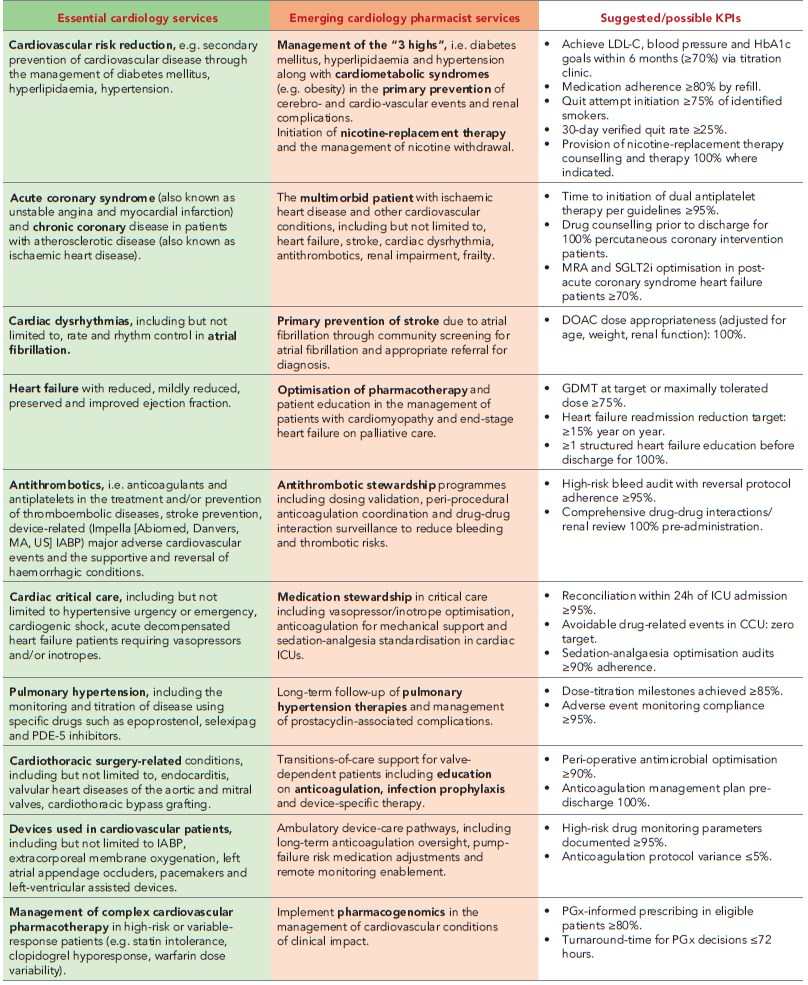
CCU: critical care unit; DOAC: direct oral anticoagulant; GDMT: guideline-directed medical therapy; Hb: haemoglobin; IABP: intra-aortic balloon pump; ICU: intensive care unit; KPI: key performance indicator; LDL-C: low-density lipoprotein cholesterol; MRA: mineralocorticoid receptor antagonist; PDE: phosphodiesterase; PGx: pharmacogenomics; SGLT2i: sodium-glucose cotransporter-2 inhibitors
Collectively, these recommendations provide a pragmatic framework to strengthen governance, training and service innovation within Singapore’s cardiovascular care ecosystem. They emphasise that the cardiology pharmacist’s role is not autonomous but integrative—embedded within multidisciplinary, physician-led teams that prioritise safety, continuity and evidence-based optimisation of therapy. As the profession evolves toward digitally enabled and outcomes-driven practice, these strategies offer a foundation for sustainable implementation and measurable impact at both institutional and national levels.
CONCLUSION
These recommendations outline a pragmatic and forward-looking roadmap for advancing cardiology pharmacy services in Singapore. By strengthening workforce capability, embedding pharmacists within multidisciplinary physician-led models and embracing digital innovation, the profession can play a transformative role in achieving the goals of Healthier SG—a healthcare system that is safe, coordinated and future-ready.
Appendix S1. Emerging cardiology pharmacist services in Singapore.
Appendix S2A–B. Projection of the cardiovascular disease burden in Singapore.
Acknowledgements
This position paper reflects the collective dedication of professionals across Singapore committed to advancing cardiology pharmacy practice. We thank the members of the working group for their contributions, including representatives from Changi General Hospital, Ng Teng Fong General Hospital, Khoo Teck Puat Hospital, National Heart Centre Singapore, National University Heart Centre Singapore, Tan Tock Seng Hospital, SingHealth Polyclinics, Woodlands Health Campus, National University Hospital, Singapore General Hospital, National University Polyclinics and iRx Clinical Pharmacy.
We are grateful to A/Prof Doreen Tan and Ms Wong Yee May for their valuable guidance and to Ms Jessica Lu for technical support in preparing the manuscript. We also acknowledge the Singapore Cardiac Society and the Chapter of Cardiologists for their collaboration and the Pharmaceutical Society of Singapore for providing the platform for this work.
Finally, we extend our appreciation to all cardiology specialists and pharmacists whose dedication to patient care continues to drive this field forward.
REFERENCES
- HealthHub Singapore. Principal causes of death. 3 August 2023. https://www.healthhub.sg/a-z/health-statistics/principal-causes-of-death. Accessed 12 October 2025.
- National Registry of Diseases Office, Health Promotion Board. Singapore Myocardial Infarction Registry: Annual Report 2021. September 2023. https://www.nrdo.gov.sg/docs/librariesprovider3/default-document-library/smir-annual-report-2021-(web)_final.pdf?sfvrsn=3418ed95_0. Accessed 14 October 2025
- Sia CH, Simon O, Loh PH. et al. Atherosclerotic cardiovascular disease landscape in Singapore. Front Cardiovasc Med 2024;11:1342698.
- Ministry of Health, Singapore. What is Healthier SG? https://www.healthiersg.gov.sg/about/what-is-healthier-sg. Accessed 19 October 2025.
- Tan JWC, Yeo TJ, Tan DSY, et al. Strategies to prevent cardiovascular disease in Singapore: A call-to-action from the Singapore Heart Foundation, Singapore Cardiac Society and Chapter of Cardiologists of the Academy of Medicine Singapore. Ann Acad Med Singap 2024;53:23-33.
- El Hajj MS, Kaddoura R, Abu Yousef SEA, et al. Effectiveness of a structured pharmacist-delivered intervention for patients post-acute coronary syndromes on all-cause hospitalizations and cardiac-related hospital readmissions: a prospective quasi-experimental study. Int J Clin Pharm 2023;45:630-40.
- Ministry of Health, Singapore. Professional Training & Education for Pharmacists. 18 February 2025. https://hpp.moh.gov.sg/career-practice/pharmacists-professional-training-education/?utm_source=chatgpt.com. Accessed 19 October 2025.
- Singapore Pharmacy Council. Register of Specialist Pharmacists. 13 October 2025. https://www.spc.gov.sg/for-professionals/apply-for-registration/register-of-specialist-pharmacists. Accessed 21 October 2025.
- Brouwers MC, Kho ME, Browman GP, et al. AGREE II: advancing guideline development, reporting and evaluation in health care. CMAJ 2010;182:E839-42.
- Singapore Statutes Online. Healthcare Services (Collaborative Prescribing Service) Regulations 2023 (No. S 398/2023). https://sso.agc.gov.sg/SL/HSA2020-S398-2023?DocDate=20231214. Accessed 19 October 2025.
- Singapore Heart Foundation. Heart disease statistics. https://www.myheart.org.sg/health/heart-disease-statistics. Accessed 21 October 2025.
- GBD 2021 ASEAN Cardiovascular Diseases Collaborators. The epidemiology and burden of cardiovascular diseases in countries of the Association of Southeast Asian Nations (ASEAN), 1990-2021: findings from the Global Burden of Disease Study 2021. Lancet Public Health 2025;10:e467-79.
- Chen Y, Yang K, Marušić A, et al. A reporting tool for practice guidelines in healthcare: The RIGHT statement. Ann Intern Med 2017;166:128-32.
- Hsu CC, Sandford BA. The Delphi Technique: Making Sense of Consensus Practical Assessment, Research & Evaluation 2007;12:1-8.
- Keeney S, Hasson F, McKenna HP. The Delphi Technique in Nursing and Health Research. Chichester: Wiley-Blackwell; 2011.
- Santschi V, Chiolero A, Colosimo A, et al. Impact of pharmacist care in the management of cardiovascular disease risk factors: a systematic review and meta-analysis of randomized trials. JAMA Intern Med 2011;171:1441-53.
- Hussain DA, Cheong KM, Lee E, et al. Beyond the Hospital: Redefining the Role of Pharmacists in Transitions of Care. Int J Integr Care 2023;23:231.
- McKay C, Park C, Chang J, et al. Systematic Review and Meta-analysis of Pharmacist-Led Transitions of Care Services on the 30-Day All-Cause Readmission Rate of Patients with Congestive Heart Failure. Clin Drug Investig 2019;39:703-12.
- Dunn SP, Birtcher KK, Beavers CJ, et al. The role of the clinical pharmacist in the care of patients with cardiovascular disease. J Am Coll Cardiol 2015;66:2129-39.
- Graham J, Voyce SJ, Hayden JR, et al. Evaluation of pharmacist-led transition of care program in patients with acute coronary syndrome. J Am Pharm Assoc 2024;64:102023.
- Wong YM, Quek YN, Tay JC, et al. Efficacy and safety of a pharmacist-managed inpatient anticoagulation service for warfarin initiation and titration. J Clin Pharm Ther 2011;36:585-91.
- Fallon JM, McElhaney E, Anderson K, al. Pharmacy-led optimization of transitions of care in patients with heart failure. J Am Coll Clin Pharm 2024;7:778-86.
- Shah SP, Dixit NM, Mendoza K, et al. Integration of clinical pharmacists into a heart failure clinic within a safety-net hospital. J Am Pharm Assoc 2022;62:575-9.e2.
- Viswanathan M, Kahwati LC, Golin CE, et al. Medication therapy management interventions in outpatient settings: a systematic review and meta-analysis. JAMA Intern Med 2015;175:76-87.
- Yaseen IF, Farhan HA. Cardiovascular drug interventions in the cardio-oncology clinic by a cardiology pharmacist: ICOP-Pharm study. Front Cardiovasc Med 2022;9:972455.
- Croke A, Cardwell K, Clyne, B, et al. The effectiveness and cost of integrating pharmacists within general practice to optimize prescribing and health outcomes in primary care patients with polypharmacy: a systematic review. BMC Prim Care 2023;24:41.
- Khee GY, Lim PS, Chan YL, et al. Collaborative prescribing practice in managing patients post-bariatric surgery in a tertiary centre in Singapore. Pharmacy (Basel) 2024;12:31.
- Norman S, Davis E, Goldstone LW. Impact of pharmacist-led or co-led medication education groups on patient outcomes: A literature review. Ment Health Clin 2012;2:86-90.
- Saxena FE, Bierman AS, Glazier RH, et al. Association of early physician follow-up with readmission among patients hospitalized for acute myocardial infarction, congestive heart failure, or chronic obstructive pulmonary disease. JAMA Netw Open 2022;5:e2222056.
- Tung YC, Chang GM, Chang HY, et al. Relationship between early physician follow-up and 30-day readmission after acute myocardial infarction and heart failure. PLoS One 2017;12:e0170061.
- Borges do Nascimento IJ, Abdulazeem H, Vasanthan LT, et al. Barriers and facilitators to utilizing digital health technologies by healthcare professional. NPJ Digit Med 2023;6:161.
- Thompson SL, Ward C, Galanos A, et al. Impact of a palliative care education module in patients with heart failure. Am J Hosp Palliat Care 2020;37:1016-21.
- National University of Singapore. Cardiovascular-Metabolic Disease Translational Research Programme, Yong Loo Lin School of Medicine. AMI-HOPE: Acute Myocardial Infarction: Allied Health-Oriented, Patient-Centred Technology-Enabled. https://medicine.nus.edu.sg/trp/cardiovascular-disease/flagship-projects/ami-hope. Accessed 24 October 2025.
- Epidemiology & Disease Control Division and Policy, Research & Surveillance Group, Ministry of Health and Health Promotion Board, Singapore. National Population Health Survey 2020. https://isomer-user-content.by.gov.sg/3/4bf349c8-25d6-4eb8-bf02-af769321458f/nphs-2020-survey-report.pdf. Accessed 26 October 2025.
Not applicable as no study participants were involved.
The author(s) declare there are no affiliations with or involvement in any organisation or entity with any financial interest in the subject matter or materials discussed in this manuscript.
Associate Professor Doreen Tan Su-Yin, Department of Pharmacy and Pharmaceutical Sciences, Faculty of Sciences, National University of Singapore, l8 Science Drive 4, Singapore 117559. Email: [email protected]
