

Dear Editor,
Aortic regurgitation (AR) is a common valvular heart disease, with a cohort study reporting an approximate prevalence of 13% in men and 8.5% in women.1 Severe AR portends significant mortality and morbidity if untreated.2 Aortic valve surgery remains the gold standard for management.3 However, a significant proportion are treated conservatively because of high surgical risks, significant comorbidities, or the patient’s refusal of surgery.4 Despite the success of transcatheter aortic valve implantation (TAVI) for the management of aortic stenosis (AS), existing devices have not been designed for the treatment of AR. In patients with limited surgical options, these devices have been used off-label with higher associated risks.5 The recent development of dedicated devices has changed the landscape.6,7 In particular, the ALIGN-AR study demonstrated the safety and efficacy of the use of the Trilogy transcatheter heart valve (THV) (JenaValve Technology, Irvine, CA, US) in treating patients with severe tricuspid AR.7 The Trilogy valve is a porcine pericardial THV composed of 3 leaflets within a self-expanding nitinol stent scaffold. It has 3 locators which are centred on the native aortic cusps, limiting implant depth and allowing clipping to the native leaflets for secure anchoring.7 To the authors’ knowledge, this is the first case series in Southeast Asia (SEA) to describe the initial experience with the Trilogy THV for the treatment of severe tricuspid AR.
Consecutive patients who underwent TAVI for severe tricuspid AR with the Trilogy THV in a tertiary cardiac centre were included. Severe AR was diagnosed according to the European Society of Cardiology 2025 guidelines,3 and patients were evaluated by a multidisciplinary heart team. A computed tomography (CT) scan was performed to assess the feasibility of the transfemoral route and the suitability/sizing for implantation. All procedures were performed via the transfemoral route under general anaesthesia and transoesophageal echocardiographic guidance. In summary, a dedicated 18 French sheath (measuring 85cm) was inserted via the femoral route to the sinotubular junction. The valve was then inserted via the sheath to the aortic root, after which the sheath was retracted to the descending aorta. The locators were adjusted, and after all 3 locators were confirmed in the native cusps and appropriate depth was achieved, the valve was deployed under rapid pacing (Fig. 1). Technical success and all clinical outcomes were defined according to the Valve Academic Research Consortium-3 criteria8 both in-hospital and at 3 months.
Fig. 1. Trilogy transcatheter heart valve (JenaValve Technology, Irvine, CA, US): sizing chart, design,9 and deployment.
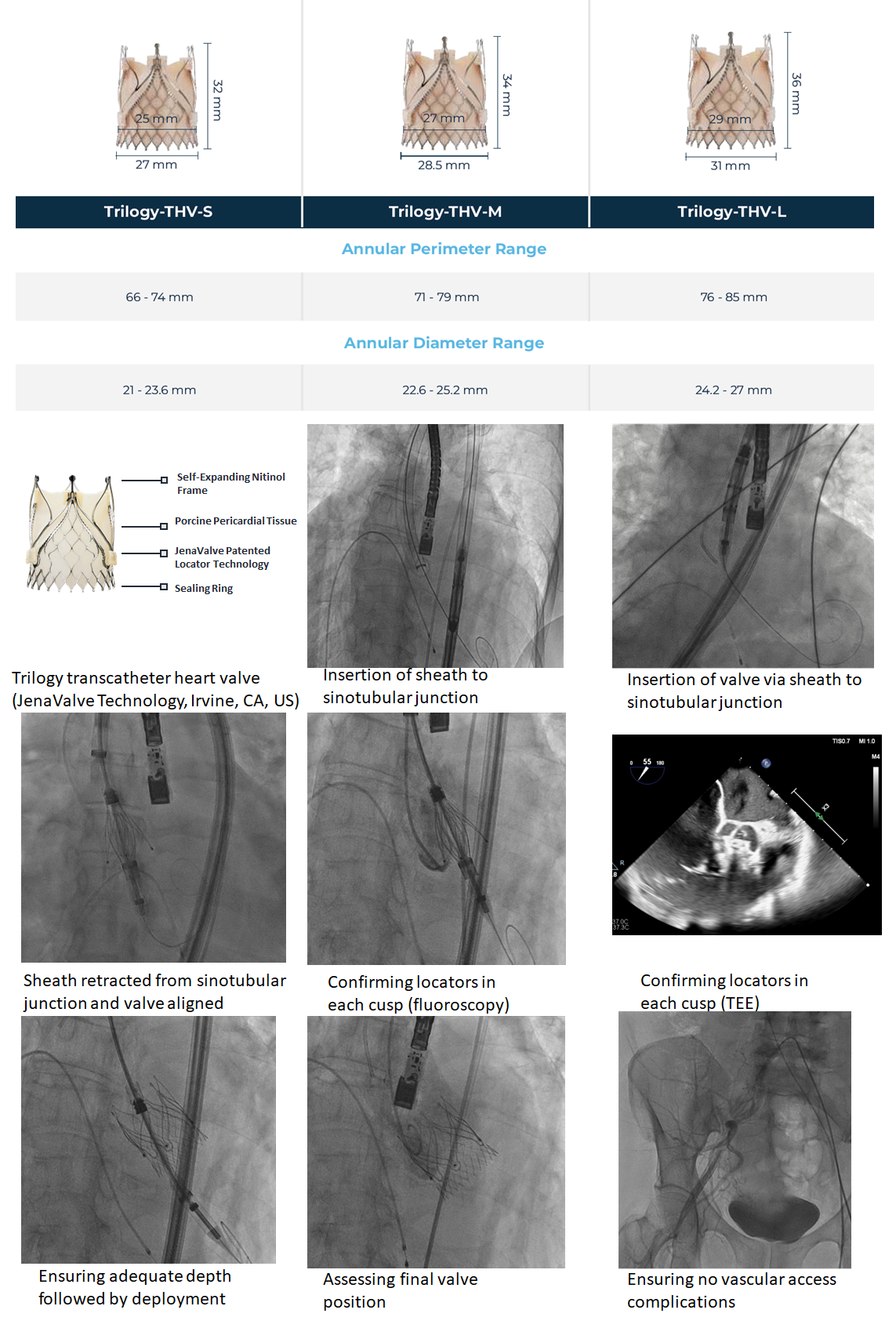
S: small; M: medium; L: large; THV: Trilogy transcatheter heart valve; TEE: transesophageal echocardiography
Image of sizing chart and valve courtesy of JenaValve Technology, Inc.
A total of 5 patients were treated (median age 75 years, range: 49–83 years). Two patients had pre-existing left or right bundle branch blocks (LBBB/RBBB). Three patients were New York Heart Association (NYHA) Class II, while 2 were NYHA I with left ventricular (LV) dysfunction. Four patients were deemed high risk for surgery, and 1 patient repeatedly declined surgery in view of age (75 years old). Echocardiographic and CT measurements are also outlined in Supplementary Table S1.
Overall, procedural success was achieved for all patients, with a median procedure time of 85 minutes. There were no major in-hospital complications. Post-procedural echocardiogram showed mild paravalvular AR in 1 patient, while the rest had no residual AR. However, there was a significant incidence of conduction system disease post-implant, with 1 patient developing new LBBB, and 3 patients developing complete heart block (CHB) requiring device implantation (of which 2 had underlying LBBB and RBBB, respectively). Of the 3 patients, the degree of oversizing ranged from 6.06–18%, with 2 requiring permanent pacemaker (PPM) implantation and 1 requiring cardiac resynchronisation therapy with a defibrillator (because of concomitant indication for primary prevention with an LVEF <35%). Notably, all 3 patients had the smaller of the 2 possible valve sizes implanted. Median length of stay was 6 (range: 3–13) days, largely due to monitoring and management of conduction issues. Two patients who did not require PPM had hospital stays of 3 and 4 days, respectively.
At 3 months, all patients were well, with 4 of the 5 patients at NYHA I and 1 patient stable at NYHA II. Valve performance remained excellent, with no bioprosthetic dysfunction and minimal or no residual AR. Patients with LV dilation demonstrated reverse remodelling.
This first case series in SEA demonstrated that the Trilogy THV represents a safe and feasible option for patients with severe tricuspid AR.
Prior to the advent of AR-specific THVs, there was off-label use of pre-existing TAVI devices for those who were unable to undergo surgery. PANTHEON, the largest investigator-initiated international registry evaluating the off-label use of such TAVI devices for AR, demonstrated an increased incidence of residual paravalvular leak (9.5%), valve embolisation (12.4%), need for a second valve (10.5%), and surgical conversion (2%).5 In contrast to AS, there is often greater annular dilation, and a lack of leaflet and annular calcification, which makes anchoring of the THV challenging.
The advent of AR-specific TAVI devices has changed this. These devices have a dedicated mechanism to anchor on the native valve leaflets, independent of the degree of calcification.10 These include the J-Valve (JC Medical Inc, Burlingame, CA, US) and the Trilogy THV. In the North American experience with the latest transfemoral iteration of the J-Valve,11 procedural success was 81% (22/27) overall and 100% in the last 15 cases. At 30 days, 1 death and 1 stroke occurred. In ALIGN-AR, using the Trilogy valve,7 procedural success was 95% (171/180). At 30 days, there was a 2% mortality rate and a 2% stroke rate. In this case series, there was 100% procedural success with no complications. At 3 months, there was improvement in symptoms with no significant AR.
Several limitations should be noted with this treatment strategy. First, the development of conduction system abnormalities necessitating device implantation remains a concern. In ALIGN-AR, the rate of PPM implantation was 24.0%.7 While the rate of device implantation is higher in this small case series (3/5), 2 of the patients had pre-existing conduction system abnormalities, which put them at a higher risk for the development of CHB. Notably, ALIGN-AR showed a decrease in this complication with less aggressive oversizing and slight modification of implantation technique with operator experience. Further studies are required to assess predictors of the development of conduction system abnormalities, as well as potential mitigators. Second, as with all novel devices, long-term durability will require extended studies.
In this first case series in SEA, the Trilogy THV was safe and efficacious in the treatment of severe tricuspid AR. There was 100% procedural success, and no mortality or significant AR at short-term follow-up. However, a significant proportion of patients developed CHB necessitating device implantation. Current gaps include identifying measures to mitigate conduction system abnormalities and assessing long-term durability.
Table S1. Baseline characteristics, procedural details, and clinical outcomes (n=5).
REFERENCES
- Singh JP, Evans JC, Levy D, et al. Prevalence and clinical determinants of mitral, tricuspid, and aortic regurgitation (the Framingham Heart Study). Am J Cardiol 1999;83:897-902.
- Dujardin KS, Enriquez-Sarano M, Schaff HV, et al. Mortality and morbidity of aortic regurgitation in clinical practice. A long-term follow-up study. Circ 1999;99:1851-57.
- Praz F, Borger MA, Lanz J M-CM, et al. 2025 ESC/EACTS Guidelines for the management of valvular heart disease. Eur Heart J 2025;46:4635-736.
- Lung B, Baron G, Butchart EG, et al. A prospective survey of patients with valvular heart disease in Europe: The Euro Heart Survey on Valvular Heart Disease. Eur Heart J 2003;24:1231-43.
- Poletti E, De Backer O, Scotti A, et al. Transcatheter Aortic Valve Replacement for Pure Native Aortic Valve Regurgitation: The PANTHEON International Project. JACC Cardiovasc Interv 2023;16:1974-85.
- Gao L, Mao R, Zeng J, et al. Single arm meta-analysis of the J-Valve system for aortic regurgitation in Chinese populations. Front Cardiovasc Med 2025;12:1436789.
- Vahl TP, Thourani VH, Makkar RR, et al. Transcatheter aortic valve implantation in patients with high-risk symptomatic native aortic regurgitation (ALIGN-AR): a prospective, multicentre, single-arm study. Lancet 2024;403:1451-59.
- Généreux P, Piazza N, Alu MC, et al. Valve Academic Research Consortium 3: updated endpoint definitions for aortic valve clinical research. Eur Heart J 2021;42:1825-57.
- JenaValve Technology. JenaValve Trilogy Heart Valve System Procedural Manual, PE-0114 Rev B. Irvine, California: JenaValve Technology; 2024.
- Costanzo P, Bamborough P, Peterson M, et al. Transcatheter Aortic Valve Implantation for Severe Pure Aortic Regurgitation With Dedicated Devices. Interv Cardiol 2022;17:e11.
- Garcia S, Ye J, Webb J, et al. Transcatheter Treatment of Native Aortic Valve Regurgitation: The North American Experience With a Novel Device. JACC Cardiovasc Interv 2023;16:1953-60.
Ethics approval for the use of the patient registry was granted by the SingHealth Centralised Institutional Review Board (2014/2165).
Jonathan Yap received speaker’s honorarium from Abbott, Biosensors, Boston Scientific, Edwards, Johnson & Johnson, and Medtronic and is a proctor for Abbott, Edwards and Medtronic. Mohammed Rizwan Amanullah received speaker’s honorarium from GE HealthCare and Philips. The other co-authors declare there are no affiliations with or involvement in any organisation or entity with any financial interest in the subject matter or materials discussed in this manuscript.
A/Prof Jonathan Yap, National Heart Centre Singapore, 5 Hospital Dr, Singapore 169609. Email: [email protected]
