

ABSTRACT
Introduction: Obesity is thought to be a negative predictor of sexual function, but the relationship between body mass index (BMI) and sexual function has been inconsistent. Other factors such as body image and self-esteem may mediate this relationship. This study examined the association of BMI, body image and self-esteem with sexual function in young women.
Method: A total of 514 sexually active women aged 21 to 35 years completed an anonymised online questionnaire that used 3 scales to assess body image, self-esteem and female sexual function: Body Image States Scale (BISS), Rosenberg Self-Esteem Scale (RSES) and Female Sexual Function Index (FSFI). Higher scores for BISS, RSES and FSFI indicate more positive body image, higher self-esteem and better sexual function, respectively. Spearman correlation assessed the association among BMI, BISS and RSES scores, and with FSFI scores. Linear and multivariable logistic regression identified risk factors associated with sexual dysfunction (FSFI <26.55).
Results: BISS and RSES scores significantly correlated with FSFI scores (r=0.27 and r=0.32, respectively; both P<0.001), indicating that better body image and self-esteem were associated with better sexual function. Risk factors for sexual dysfunction were lower BISS and RSES scores, being married (odds ratio [OR] 1.52; 95% confidence interval [CI] 1.07–2.15), having 1 child (OR 2.45; 95% CI 1.26–4.77) and having a perceived mental condition (OR 3.02; 95% CI 1.44–6.33). Factors in lack of sexual dysfunction include being of Malay ethnicity (OR 0.38; 95% CI 0.21–0.71) and being overweight (OR 0.46; 95% CI 0.27–0.78).
Conclusion: Women with poorer body image and lower self-esteem were more likely to have sexual dysfunction. These perceptions and states did not correlate with being overweight, and were better predictors over BMI to identify the population at-risk.

Satisfaction with sexual activity is a good predictor of global life satisfaction.1 Problems with sexual function can lead to lower partner satisfaction and affect a woman’s mental and physical health.2 The prevalence of sexual dysfunction in premenopausal women globally was found to be 40.9% (95% confidence interval [CI] 37.1–44.7).3 In Singapore, it is even higher; a pilot study with 92% of respondents aged below 50 years found that the prevalence of female sexual dysfunction was up to 56.2%,4 with reported rates of up to 70.9% among older women aged 45 to 69 years.5 Lower sexual function has also been shown to impact fecundability.6
Contextual factors, psychosexual factors and biological factors contribute to sexual dysfunction. Some of these include marital or relationship difficulties, socioeconomic factors, medical or psychological conditions, medications and previous surgeries.7 In some studies, total body fat percentage and obesity (measured using body mass index [BMI]) negatively predict sexual functioning.8 However, body weight and BMI appear to have no significant relationship with sexual function in other studies.9 This inconsistency in the association may be due to mediating factors such as body image9 and self-esteem.10
Body image refers to how one perceives one’s projected physical self, including the feelings towards appearance and beliefs related to appearance.11 Women have a higher tendency than men to be cognitively distracted by their body appearance during sexual activity, signifying the importance of assessing body image in relation to sexual function.12 Body image is also closely related to BMI8; as BMI increases, body image satisfaction decreases.13 People with normal BMI may also demonstrate body image dissatisfaction owing to the subjective component of body image and associated appearance anxiety.13-15 Self-esteem, which is described as the personal emotional evaluation of an individual’s worth, has been found to have a mediating role in influencing body image, sexual activity and sexual function.13 Both body image and self-esteem are heavily influenced by emotion, experiences and exposure to media.13,16 The recent focus on body image positivity through all forms of media channels17 may alter the relationship between BMI and body image, and could have implications on self-esteem of young women.
While we have identified the burden of sexual dysfunction on society, how sexual dysfunction is influenced by BMI and its potential mediating factors of body image and self-esteem remains unknown. Data on risk factors and associations are sparse in our population with its unique cultural practices and ethnic diversity. This study focuses on young women of reproductive age as many physiological and hormonal changes can affect sexual function as women age.5,18 We aimed to assess individual and joint associations between BMI, body image and self-esteem, with sexual function, and identify other risk factors for sexual dysfunction. Information gained from this study will help identify women at risk for sexual dysfunction so that they can undergo proper assessment. It can also serve to direct management strategies for a multidisciplinary approach in the treatment of sexual dysfunction in these women.
METHOD
Study design and subjects
An anonymised online questionnaire in English was administered from February to August 2021 in Singapore. Sexually active women aged 21 to 35 years who are either Singaporean or permanent residents were included. The lower limit of the age group was 21 years, given the sensitive nature of the questions. The upper limit of 35 years was chosen to focus on young, reproductive-aged women. Understanding sexual function in young women may provide insight into predictive factors affecting fecundability and sexual activity in midlife and beyond.5 This study was reviewed and approved by the SingHealth Centralised Institutional Review Board (2020/3037). A total of 514 women were recruited.
Recruitment
Recruitment was conducted through a Facebook advertisement as well as through posters put up in a government-based primary care clinic. Paid advertising was chosen to improve recruitment and reach. The questionnaire was hosted on the FormSG website (https://form.gov.sg), a government-based platform that captures classified data. Participation was voluntary and consent was implied for those who completed the questionnaire.
Questionnaire
The questionnaire included basic demographic data, marital status, number of children, smoking and drinking status, gender of sexual partner, number of current sexual partners as well as medical, physical or mental conditions they feel could affect their sexual function. We included 3 scales to assess body image, self-esteem and female sexual dysfunction. The scales used were Body Image States Scale (BISS), the Rosenberg Self-Esteem Scale (RSES) and the Female Sexual Function Index (FSFI). Questionnaires were answered by the participants who used their internet-enabled devices to complete the survey privately.
The BISS is a 6-item scale that assesses body image as a state at a specific point in time. Possible scores range from 6 to 54, in which the lower scores indicate poor body image and higher scores indicate a more positive body image. The BISS is acceptably and internally consistent and applicable to a wide range of contexts as it is easy to administer and assesses both positive and negative experiences as well as the general body image (i.e. not specific to any particular body part).19,20
The RSES assesses self-esteem using 10 items administered on a 4-point Likert scale, with possible scores between 0 and 30. Higher scores indicate higher levels of self-esteem. The scale has been validated for use in multiple populations of varying ages.21 It has high reliability: test-retest correlations are typically in the range of 0.82 to 0.88, and Cronbach α for various samples are in the range of 0.77 to 0.88.21,22
The FSFI is a widely used 19-item tool for the assessment of sexual function that incorporates 6 domains: desire, arousal, lubrication, orgasm, satisfaction and pain. It has demonstrated internal consistency, test-retest reliability, and construct and criterion validity.23,24 It has been translated into various Asian languages such as Malay,25 Chinese26 and Urdu,27 and have been validated afterwards within the various countries. It has also been used in the assessment of sexual dysfunction in both Singapore5 and Malaysia.28 An online version of the FSFI has also shown acceptable validity and reliability compared with the paper version.29
Sample size
A sample size of 503 achieves 90% power to detect a Spearman correlation in the range of 0.2 to 0.4, at a 5% level of significance. Sample size was calculated using 5,000 Monte Carlo simulations by the Power Analysis and Sample Size software program (PASS 16; NCSS, LLC; Kaysville, Utah, US).
Statistical analyses
The scores of BMI, BISS (representing body image) and RSES (representing self-esteem) with the FSFI scores (representing female sexual dysfunction), including the scores for each domain of the FSFI (desire, arousal, lubrication, orgasm, pain, satisfaction), were computed. Correlations among BMI, BISS and RSES and with FSFI scores were assessed. Higher scores for BISS, RSES and FSFI imply a more positive body image, higher self-esteem and better sexual function, respectively. Conversely, lower scores indicate poorer body image, lower self-esteem and poorer sexual function for BISS, RSES and FSFI, respectively.
Continuous variables are expressed as mean ± standard deviation and categorical variables as frequencies and percentages.
Continuous variables were analysed using Spearman correlation. FSFI was categorised as either sexual dysfunction (FSFI <26.55) or normal functioning. Independent samples t-test was used to compare BMI, BISS and RSES scores between the two sexual functioning groups.
Univariable and multivariable logistic regression analyses were used to test the association of different variables with FSFI scores. BMI was categorised as underweight (<18.5kg/m2), normal (18.5–22.9kg/m2), overweight (23.0–27.4kg/m2) and obese (≥27.5 kg/m2). BISS and RSES scores were divided into tertiles representing low, medium and high values.
For the outcome variable of FSFI, we used a cut-off score of <26.55 to identify sexual dysfunction.30 This cut-off point was found to have a sensitivity of 88–89% and specificity of 71–73% in detecting sexual dysfunction. It has been used in our local setting and neighbouring populations in diagnosing female sexual dysfunction.5
SPSS Statistics software version 26 (IBM Corp, Armonk, US) was used for the preliminary statistical analysis of data and a P value of less than 0.05 was considered statistically significant.
RESULTS
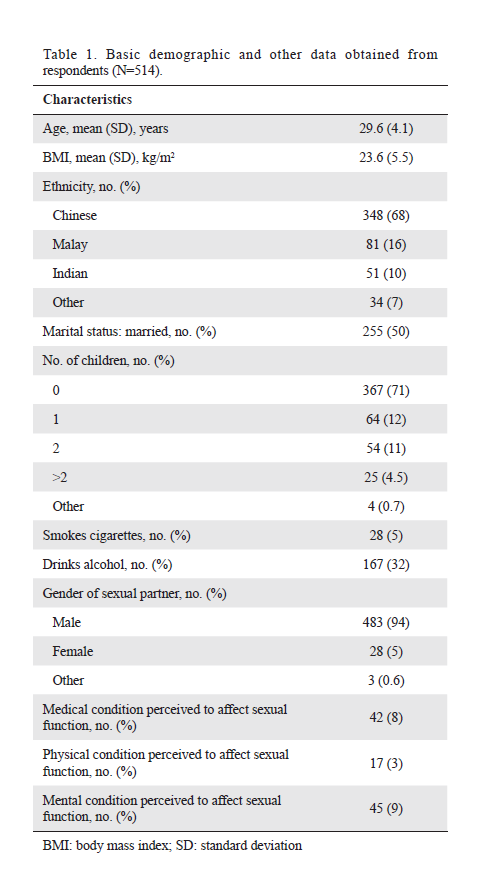
A total of 514 completed questionnaires were available for analysis. The mean age of the respondents was 29.6±4.1 years and the mean BMI 23.6±5.5 kg/m2. Of the respondents, 46.5% (n=239) were classified as having sexual dysfunction (Table 1).
Table 1. Basic demographic and other data obtained from respondents (N=514).
Using Spearman correlation, BMI did not correlate with the FSFI total scores but did with the pain domain. The BISS and RSES scores correlated with the FSFI scores, implying that those with a more positive body image and a higher self-esteem had better sexual function. This finding was consistent across all 6 individual domains of sexual function (Table 2).
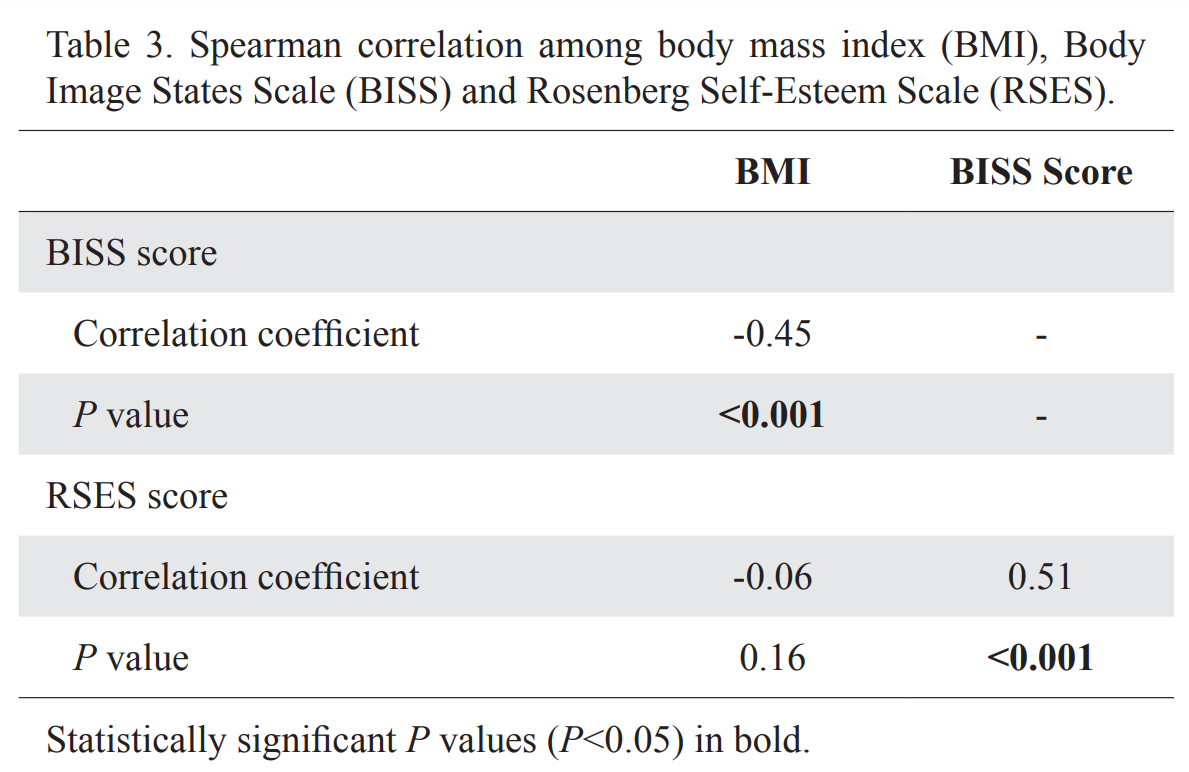
BMI negatively correlated with BISS scores, implying that as BMI increases, body image declines. However, BMI did not significantly correlate with self-esteem as measured by RSES (Table 3). BISS scores and RSES scores were positively correlated, implying that as body image improves, self-esteem improves.
Table 2. Spearman correlation of body mass index (BMI), Body Image States Scale (BISS) and Rosenberg Self-Esteem Scale (RSES) scores with Female Sexual Function Index (FSFI) total and individual domain scores.
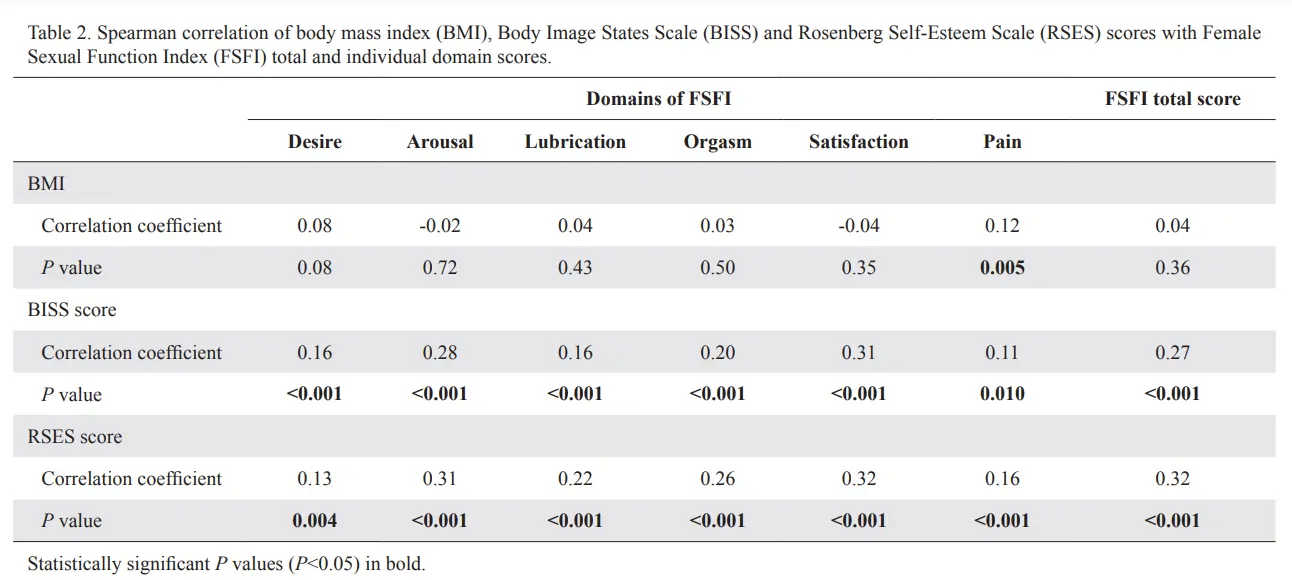
Table 3. Spearman correlation among body mass index (BMI), Body Image States Scale (BISS) and Rosenberg Self-Esteem Scale (RSES).
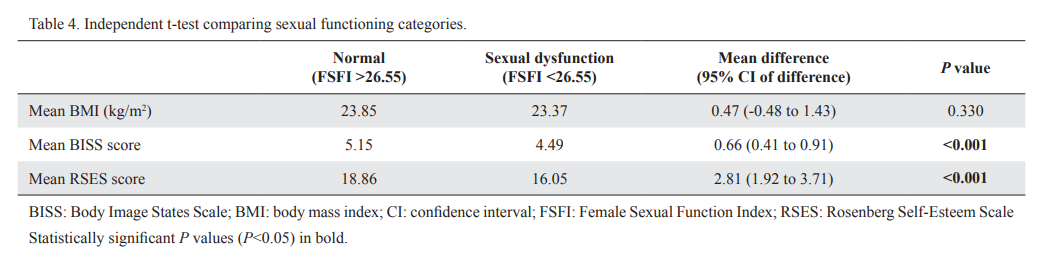
An independent samples test was also done to compare the mean scores of BMI, BISS and RSES between the women with sexual dysfunction (FSFI <26.55) and without sexual dysfunction (Table 4). Women with sexual dysfunction had significantly lower mean BISS and RSES scores. There was no significant difference in BMI between both groups of women.
Table 4. Independent t-test comparing sexual functioning categories.
For univariable and multivariable logistic regression analyses, BMI was divided into categories and BISS and RSES scores into tertiles. This was assessed in women with and without sexual dysfunction (Table 5).
In the univariate analysis, women who were underweight (odds ratio [OR] 0.57; 95% CI 0.33–0.98) and overweight (OR 0.57; 95% CI 0.36–0.91) had a reduced risk of sexual dysfunction. Women with lower BISS and RSES scores (scores in the lower and middle tertiles) were at higher risk of sexual dysfunction. Married women (OR 1.52; 95% CI 1.07–2.15), women with 1 child (OR 2.56; 95% CI 1.47–4.45) and women with a mental condition perceived to affect their sexual function (OR 3.08; 95% CI 1.58–6.02) were also at higher risk.
In the multivariable analysis, women who were overweight were less likely to have sexual dysfunction than those with normal BMIs (39.3% vs 53.1%; OR 0.46; 95% CI 0.27–0.78). Women of Malay ethnicity were also less likely to have sexual dysfunction than those of Chinese ethnicity (41.3% vs 49.7%; OR 0.38; 95% CI 0.21–0.71).
One of the risk factors for sexual dysfunction identified was women with 1 child compared with those with none (OR 2.45; 95% CI 1.26–4.77). Women who perceived themselves as having a mental condition that affected their sexual function were also significantly more likely to suffer from sexual dysfunction (OR 3.02; 95% CI 1.44–6.33). In addition, women who scored in the lower tertile of BISS were more likely to have sexual dysfunction than those in the upper tertile (OR 1.84; 95% CI 1.04–3.25). Those with lower RSES scores were more likely to have sexual dysfunction than those who scored in the upper tertile (OR 3.03 [95% CI 1.76–5.22]) and middle tertile (OR 2.01 [95% CI 1.23–3.26]). With increasing BISS and RSES scores, the proportion of women classified as having sexual dysfunction decreased as demonstrated in Fig. 1. However, BMI was related to sexual dysfunction in a way that was inconsistent across the increasing categories.
Fig. 1. Proportion of women with sexual dysfunction across the body mass index categories and tertiles of Body Image States Scale (BISS) and Rosenberg Self-Esteem Scale (RSES).

DISCUSSION
The results from our study gave a glimpse into the modern woman’s sexual domains and functioning, and how sexual function is influenced by BMI, body image and self-esteem. Although BMI did not relate linearly to sexual function, after classifying BMI as underweight, normal, overweight or obese, overweight women (BMI 23.0–27.4kg/m2) were less likely to have sexual dysfunction. Obese women (BMI ≥27.5 kg/m2) were not at higher or lower risk of sexual dysfunction. Supporting these findings is a Malaysian study that found a low prevalence of female sexual dysfunction of 12.3% among overweight and obese women.28 However, the finding of overweight women being at lower risk of sexual dysfunction is inconsistent with the majority of the current literature, which show either a negative or no relationship.9,31
The proposed pathophysiology of how weight affects sexual functioning is threefold: influences from adipose tissue on hormonal changes, effects from pathophysiologic comorbidities such as metabolic disturbances and cardiovascular consequences, and effects of psychological factors such as mood disorders and body image.32 Overweight and obese women have higher levels of circulating testosterone and lower levels of sex hormone-binding globulin.33 However, increased testosterone levels do not correlate well with sexual dysfunction in women.28,31 This would imply that metabolic and cardiovascular effects as well as psychological factors may play a greater role in mediating sexual function in women with higher BMIs.
A possible explanation for our unique finding could be that our young overweight but not obese population may not yet have suffered metabolic consequences. It is also possible that weight gain in early marriage may indicate better marital satisfaction,34 or a BMI in the overweight range may be considered culturally acceptable.5 Overweight women having a lower risk of sexual dysfunction may also be the effect of multiple media campaigns on body positivity,14 or of affirmations provided by the partner resulting in improved body image and self-esteem and therefore improved sexual function. These explanations highlight the importance of body image and self-esteem, rather than BMI, in the assessment of sexual function.
In the univariable regression analysis, married women, those with poor body image, those with poor self-esteem and those with a perceived mental condition were more likely to have sexual dysfunction. Women with 1 child were 2.4 times more likely than women without children to have sexual dysfunction. Postpartum sexual dysfunction prevalence rates vary from 41% to 83%, with significant worsening in all sexual domains.35 However, for women with more than 1 child, this association no longer holds. These observations may be accounted for by the smaller numbers of participants with more than 2 children, or due to a new normal routine of sexual function resuming with different expectations postpartum, resulting in fewer women being classified as dysfunctional. Unfortunately, our study did not explore other factors like the age of the child or parents when the child was born, parental roles, and physical or relational circumstances, which could further explain the finding.
Multivariable regression analysis showed that Malay women were less likely to have sexual dysfunction. This observation may be related to cultural or socioeconomic differences that may influence sexual behaviours and practices.36 According to the National Population Health Survey in 2020, obesity incidence was highest in the Malay population (23.9% vs 7.4% in Chinese).37 This high incidence may have contributed to obesity not showing any significant association with sexual function.
The women who self-reported a finding of a mental condition were found to be 3 times more likely than those who perceived themselves to have no mental condition to have sexual dysfunction. Mental health has often been found in other studies to be a significant risk factor or predictor of sexual dysfunction in women,38 which is consistent with our findings. Further studies would be useful to determine the specific aspects of mental health conditions that influence body image and self-esteem, resulting in even higher risks of sexual function.
Findings from this study will be useful for clinicians to identify at-risk patients and the modifiable risk factors that are related to sexual problems, and create multidisciplinary treatment plans, if needed, to address sexual dysfunction by tackling the underlying body image and self-esteem problems.
Strengths and limitations
This is the first study in Singapore evaluating the relationship among BMI, body image and self-esteem in the sexual function of young women. An online-based survey was chosen for this research study to take advantage of the internet’s ability to optimise reach to individuals who would otherwise be difficult to reach through other channels. The anonymous nature and freedom for respondents to answer in their own time and in a safe space using their own personal devices could help mitigate response bias. We used lower BMI thresholds for risk prediction in Asians,39,40 as metabolic changes may have an impact on sexual function.
Regarding the limitations, only individuals who understood and read English, and owned and used internet-enabled devices could participate in the study, resulting in selection bias. In view of the sensitive nature of the topic, those with more liberal attitudes towards sex, with more experience with sex, or perhaps suffering from sexual-related problems were likely to participate. Recruitment was conducted through advertising on social media platforms and through posters put up in a primary care clinic, limiting generalisability. Response biases are common in surveys especially when it pertains to sensitive questions, such as weight and sexual function, because of social stigmatisation. This study defined sexual activity to include caressing, foreplay, masturbation and intercourse but did not evaluate for sexual orientation, inclinations and gender identity that could affect sexual practices.
The scales used (BISS, RSES, FSFI) have not been validated in our local population, although they individually have good validity and reliability in various populations globally. We were cognisant that our survey did not assess many other factors that influence sexual function, such as socioeconomic status, educational level, quality of relationship with partner, and sexual issues the partner may be facing. The relationship with the partner can also affect how women view themselves, therefore affecting their body image and self-esteem. Our questionnaires did not evaluate the purpose of sexual encounters (e.g. procreation, enjoyment, intimacy, obligation) as these encounters can affect sexual experiences and partner relationships.
CONCLUSION
Sexual dysfunction among young women in Singapore can be predicted by issues with body image and self-esteem. Protective factors identified include being of Malay ethnicity and being overweight. Women with poor body image, poor self-esteem, perceived mental health conditions or 1 child are at higher risk of sexual dysfunction—the latter group as possibly requiring time to develop a new normal routine of sexual function, with different expectations postpartum.
As the prevalence of female sexual dysfunction in young women in Singapore is high, we need to invest resources to improve public knowledge on this subject. Actively seeking or incidentally finding issues of body image and self-esteem in young women should trigger conversation about sexual function. Clinicians should be equipped with sufficient knowledge of sexual function, body image and self-esteem to identify women at risk, and subsequently work on improving sexual function by improving body image and self-esteem. Managing sexual dysfunction in young women may help mitigate problems as women transition through menopause. Addressing the problems of sexual function may improve women’s sexual relationship with their partners, minimise fertility problems and help them maintain a good quality of life.
Correspondence
Dr Farah Safdar Husain, Department of Family Medicine, KK Women and Children’s Hospital, 100 Bukit Timah Road, Singapore 229899. Email: [email protected]
REFERENCES
- Skałacka K, Gerymski R. Sexual activity and life satisfaction in older adults. Psychogeriatrics 2019;19:195-201.
- Leiblum SR, Koochaki PE, Rodenberg CA, et al. Hypoactive sexual desire disorder in postmenopausal women: US results from the Women’s International Study of Health and Sexuality (WISHeS). Menopause 2006;13:46-56.
- McCool ME, Zuelke A, Theurich MA, et al. Prevalence of female sexual dysfunction among premenopausal women: A systematic review and meta-analysis of observational studies. Sex Med Rev 2016;4:197-212.
- Safdar F, Eng CLJ, Wai KL, et al. Prevalence of female sexual dysfunction in allied health workers: A cross-sectional pilot study in a tertiary hospital in Singapore. BMC Womens Health 2019;19:137.
- Logan S, Thu WPP, Ho K, et al. Sexual inactivity and sexual dysfunction in midlife Singaporean women: A prospective cross-sectional study of prevalence and risk factors. Maturitas 2021;152:1-9.
- Loy SL, Ku CW, Cheung YB, et al. Fecundability in reproductive aged women at risk of sexual dysfunction and associated risk factors: A prospective preconception cohort study. BMC Pregnancy Childbirth 2021;21:444.
- Lewis RW, Fugl-Meyer KS, Corona G, et al. Definitions/epidemiology/risk factors for sexual dysfunction. J Sex Med 2010;7:1598-607.
- Taskin Yilmaz F, Karakoc Kumsar A, Demirel G. The effect of body image on sexual quality of life in obese married women. Health Care Women Int 2019;40:479-92.
- Faubion SS, Fairbanks F, Kuhle CL, et al. Association between body mass index and female sexual dysfunction: A cross-sectional study from the data registry on experiences of aging, menopause, and sexuality. J Sex Med 2020;17:1971-80.
- Wu T, Zheng Y. Effect of sexual esteem and sexual communication on the relationship between body image and sexual function in Chinese heterosexual women. J Sex Med 2021;18:474-86.
- Quinn-Nilas C, Benson L, Milhausen RR, et al. The relationship between body image and domains of sexual functioning among heterosexual, emerging adult women. Sex Med 2016;4:e182-9.
- Meana M, Nunnink SE. Gender differences in the content of cognitive distraction during sex. J Sex Res 2006;43:59-67.
- Ahadzadah AS, Rafik-Galea S, Alavi M, et al. Relationship between body mass index, body image and fear of negative evaluation: Moderating role of self-esteem. Health Psychol Open 2018;5:2055102918774251.
- Radwan H, Hasan HA, Ismat H, et al. Body mass index perception, body image dissatisfaction and their relations with weight-related behaviors among university students. Int J Environ Res Public Health 2019;16:1541.
- Cihan A, Cihan E. Interrelation between appearance anxiety and sexual functions in women: The role of surgical scars, morphologic features, and accompanying depression. J Sex Med 2019;16:1769-78.
- Rounsefell Kim, Gibson S, McLean S, et al. Social media, body image and food choices in healthy young adults: A mixed methods systematic review. Nutr Diet 2020;77:19-40.
- Cohen R, Irwin L, Newton-John T, et al. #bodypositivity: A content analysis of body positive accounts on Instagram. Body image 2019;29:47-57.
- Heidari M, Ghodusi M, Rezaei P, et al. Sexual function and factors affecting menopause: A systematic review. J Menopausal Med 2019;25:15-27.
- Cash TF, Fleming EC, Alindogan J, et al. Beyond body image as a trait: The development and validation of the Body Image States Scale. Eat Disord 2002;10:103-13.
- Thompson JK. The (mis)measurement of body image: Ten strategies to improve assessment for applied and research purposes. Body Image 2004;1:7-14.
- Robins RW, Hendin HM, Trzesniewski KH. Measuring global self-esteem: Construct validation of a single-item measure and the Rosenberg Self-Esteem Scale. Pers Soc Psychol Bull 2001;27:151-61.
- Blascovich J, Tomaka J. Measures of self-esteem. In: Robinson JP, Shaver PR, Wrightsman LS (Ed). Measures of Personality and Social Psychological Attitudes, Volume 1. San Diego: Academic Press; 1991:115-60.
- Neijenhuijs KI, Hooghiemstra N, Holtmaat K, et al. The Female Sexual Function Index (FSFI)—A systematic review of measurement properties. J Sex Med 2019;16:640-60.
- Rosen R, Brown C, Heiman J, et al. The Female Sexual Function Index (FSFI): A multidimensional self-report instrument for the assessment of female sexual function. J Sex Marital Ther 2000;26:191-208.
- Sidi H, Abdullah N, Puteh SE, et al. The Female Sexual Function Index (FSFI): Validation of the Malay version. J Sex Med 2007;4:1642-54.
- Sun X, Li C, Jin L, et al. Development and validation of Chinese version of female sexual function index in a Chinese population—A pilot study. J Sex Med 2011;8:1101-11.
- Rehman KU, Asif Mahmood M, Sheikh SS, et al. The Female Sexual Function Index (FSFI): Translation, validation, and cross-cultural adaptation of an Urdu version “FSFI-U”. Sex Med 2015;3:244-50.
- Abidin A, Draman N, Ismail SB, et al. Female sexual dysfunction among overweight and obese women in Kota Bharu, Malaysia. J Taibah Univ Med Sci 2016;11:159-67.
- Latorre GF, Bilck PA, Cardoso FL, et al. Confiability and reliability of an online version of the Female Sexual Function Index by test-retest. Rev Bras Ginecol Obstet 2013;35:469-74.
- Wiegel M, Meston C, Rosen R. The female sexual function index (FSFI): Cross-validation and development of clinical cutoff scores. J Sex Marital Ther 2005;31:1-20.
- Kadioglu P, Yetkin DO, Sanli O, et al. Obesity might not be a risk factor for female sexual dysfunction. BJU Int 2010;106:1357-61.
- Rowland DL, McNabney SM, Mann AR. Sexual function, obesity, and weight loss in men and women. Sex Med Rev 2017;5:323-38.
- Pasquali R. Obesity and androgens: facts and perspectives. Fertil Steril 2006;85:1319-40.
- Meltzer AL, Novak SA, McNulty JK, et al. Marital satisfaction predicts weight gain in early marriage. Health Psychol 2013;32:824-7.
- Gutzeit O, Levy G, Lowenstein L. Postpartum female sexual function: Risk factors for postpartum sexual dysfunction. Sex Med 2020;8:8-13.
- Wong LP. An exploration of knowledge, attitudes and behaviours of young multiethnic Muslim-majority society in Malaysia in relation to reproductive and premarital sexual practices. BMC Public Health 2012;12:865.
- Epidemiology & Disease Control Division and Policy, Research & Surveillance Group Ministry of Health and Health Promotion Board, Singapore. National Population Health Survey 2020 (Household Interview and Health Examination). https://www.moh.gov.sg/docs/librariesprovider5/default-document-library/nphs-2020-survey-report.pdf. Accessed 17 April 2023.
- West SL, Vinikoor LC, Zolnoun D. A systematic review of the literature on female sexual dysfunction prevalence and predictors. Annu Rev Sex Res 2004;15:40-172.
- Deurenberg-Yap M, Chew SK, Lin VF, et al. Relationships between indices of obesity and its co-morbidities in multi-ethnic Singapore. Int J Obes Relat Metab Disord 2001;25:1554-62.
- WHO Expert Consultation. Appropriate body-mass index for Asian populations and its implications for policy and intervention strategies. Lancet 2004;363:157-63.
