

Dear Editor,
This letter shares findings from the implementation of a decentralised gynaecology genetics clinic for epithelial ovarian cancer (EOC) patients at the National University Hospital, Singapore. This model addresses a critical gap in genetic testing (GT) access while maintaining quality standards through strategic collaboration between gynaecologic oncology and cancer genetics services.
Approximately 15% of EOC patients have an inherited germline mutation with profound implications for treatment selection and family risk assessment.1,2 Current guidelines recommend universal GT for all EOC patients.3,4 However, implementation remains challenging due to prolonged waiting time to see cancer genetics specialists. These delays significantly impact treatment decisions, particularly first-line poly (ADP-ribose) polymerase inhibitors (PARPi) selection as well as the role of concomitant anti-angiogenic therapy.5,6
Two gynaecologic oncology specialists received training with the Cancer Genetics Service at the National University Cancer Institute, Singapore in 2020, including a 1.5-day workshop on hereditary breast and ovarian cancer syndrome (HBOC), including hands-on training in risk assessment, counselling, and result interpretation, followed by a 1-month clinical attachment. Both achieved competency in providing GT services for HBOC patients.
All patients with histologically proven EOC identified at the weekly multidisciplinary tumour board meeting (see workflow in Supplementary Fig. S1) were referred to the decentralised gynaecology genetics clinic for early genetic counselling by the trained gynaecologists, and offered multigene panel testing using a 49-gene next-generation sequencing panel including BRCA1/2, homologous recombination deficiency, and mismatch repair genes (see full gene list in Supplementary Table S1) performed at a College of American Pathologists-accredited laboratory in line with regulation set out by the Clinical Laboratory Improvement Amendments of 1988 (Invitae Corporation, US). Patients found to have pathogenic variants (PV) or variants of uncertain significance (VUS) were reviewed by the cancer genetics service within 2–4 weeks for post-test counselling, while those testing negative received counselling directly in the decentralised clinic. Patients with suspicious family history or further queries post-GT were also offered referral to the cancer genetics service for further evaluation.
Eighty-eight EOC patients were counselled in the decentralised gynaecology genetics clinic during the study period (Supplementary Table S2). Among them, 52/88 (59.1%) agreed to undergo germline GT, comparable to baseline rates (66.6%; P=0.44). Of those tested, 12/52 (23.1%) had PV across multiple genes: BRCA1 (n=3), BRCA2 (n=2), RAD51C (n=2), RAD51D (n=3), MSH2 (n=1), and TP53 (n=1) (Supplementary Table S3). Eleven patients had 15 VUS across 12 genes (Supplementary Table S4).
The median waiting time for genetic counselling reduced drastically from 90 days (interquartile range [IQR] 3–192 days) to 45 days (IQR 4–94 days), representing a 50% reduction from historical data (P<0.001). This enhanced access enabled more timely integration of genetic results into treatment planning.
Fig. 1. Summary of 88 patients with germline testing, somatic testing.
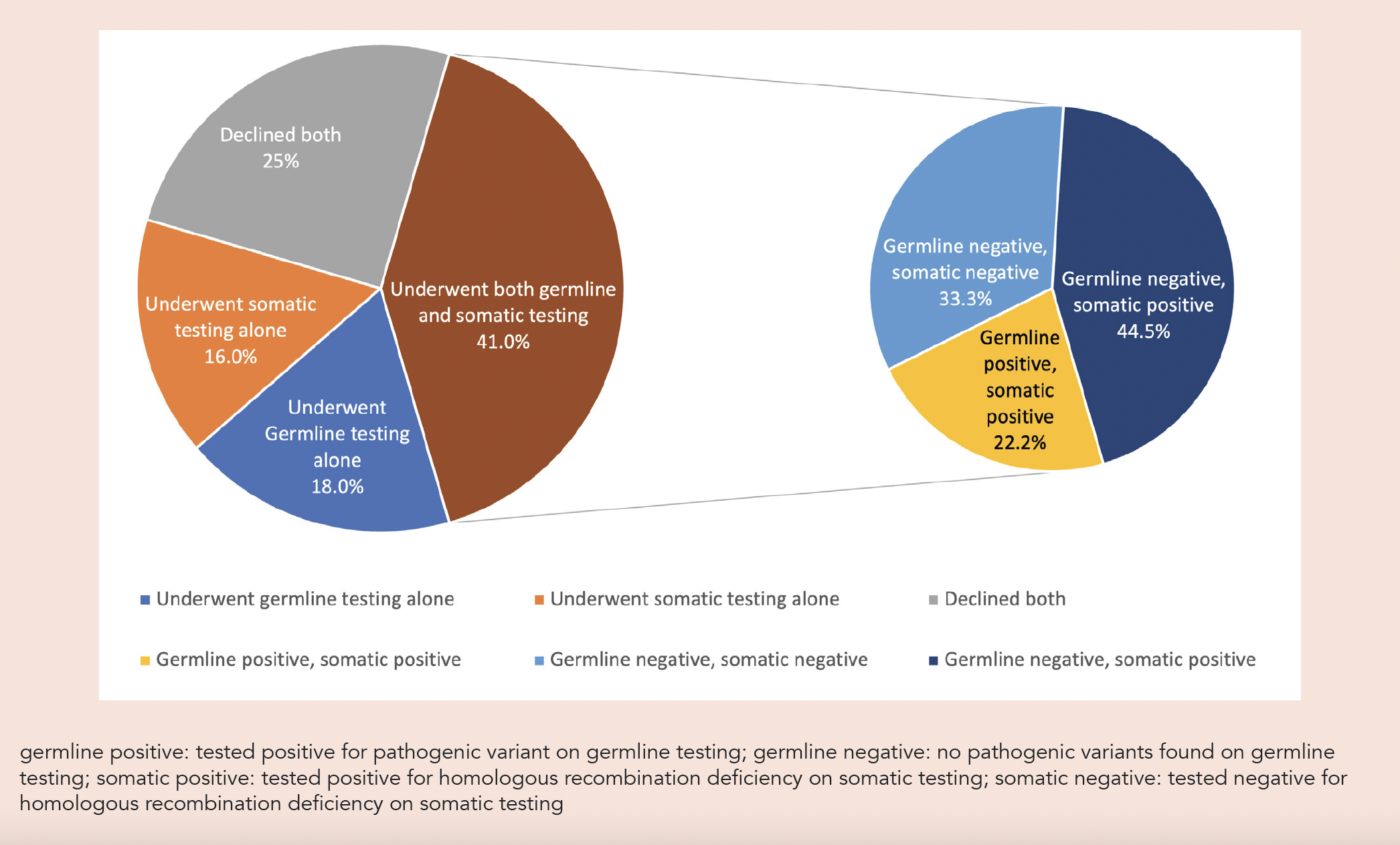
Fifty patients (56.8%) had the tumour specimen sent for somatic testing. Details of germline and somatic testing as well as maintenance PARPi therapy are shown in Fig. 1 and in Supplementary Table S5. Among 36 patients with concomitant germline and somatic testing, 57.1% showed concordant results, with 100% of patients with germline PV having corresponding somatic variants detected. Cascade testing was offered to family members of PV carriers, with 14 relatives of 5 patients underwent testing, identifying 2 additional carriers.
Several cases exemplify the critical importance of universal GT. One patient with germline BRCA2 PV had insufficient tumour tissue for somatic testing and would have missed PARPi therapy opportunity without germline testing. Another patient with Lynch syndrome (MSH2 PV) who declined somatic testing demonstrates how germline testing identifies hereditary cancer syndromes beyond BRCA1/2 with significant treatment and family screening implications.
Most remarkably, the identification of a TP53 PV diagnostic of Li-Fraumeni syndrome in a patient without suggestive personal or family history underscores the limitations of family history-based screening approaches. Given that somatic TP53 mutations are among the most common alterations in ovarian cancer, this finding highlights the unique value of systematic germline testing in revealing unexpected hereditary cancer syndromes requiring specialised management.
This study’s “germline first” approach offers pragmatic benefits, with germline testing costing approximately USD250 compared to comprehensive somatic testing, which costs more than USD3500 per test. This supports prioritising germline testing, particularly in resource-constrained healthcare systems, while improving access through reduced waiting times.7
This care model differs from traditional mainstreaming approaches by decentralising genetic counselling within established gynaecologic oncology pathways, leveraging existing patient-provider relationships.8.9 Integration with the cancer genetics service ensures patients with PV or VUS receive specialist counselling and cascade testing. This hybrid approach maintains quality standards through periodic audit. It also provides a safety net for the 40.9% of patients who initially declined testing, allowing reconsideration through subsequent cancer genetics service consultations.
The success of this model of care hinges on the close collaboration between the department of obstetrics and gynaecology and the cancer genetics service, which is possible in the author’s tertiary cancer centre. This framework could serve as a template for other institutions seeking similar implementations, with potential for expansion to other cancer types (e.g. endometrial and breast cancers), representing opportunities for optimisation. As guidelines increasingly recommend universal or expanded testing across multiple cancer types, decentralised models may become essential for meeting growing demand while maintaining quality standards.
This is a single institutional study limited by the relatively small number of patients seen over 2 years. Additionally, the lack of formal patient-reported outcome measures restricts understanding of patient satisfaction and psychological impact. Future research should include formal cost-effectiveness analyses and longer-term follow-up to evaluate cascade testing uptake and clinical outcomes. Multi-institutional studies will be useful in enhancing generalisability across diverse healthcare settings.
To the best of the authors’ knowledge, this is the first time genetic counselling and testing for EOC patients is being offered by trained gynaecologists in a decentralised clinic at a tertiary cancer centre in Asia, demonstrating feasibility and timely access with meaningful clinical impact. This approach offers a scalable solution for healthcare systems seeking to implement universal GT while managing resource limitations. The model’s success underscores the importance of collaborative care pathways in delivering comprehensive cancer genetics services.
Supplementary materials
Table S1. List of 49 cancer predisposition genes tested.
Table S2. Patient demographics.
Table S3. Clinical characteristics of patients with germline pathogenic variants (n=12).
Table S4. List of VUS identified.
Table S5. Summary of 88 patients with germline testing, somatic testing, and maintenance therapy.
Fig. S1. Workflow for decentralised gynecology genetics clinic.
References
- Ricci MT, Sciallero S, Mammoliti S, et al. Referral of Ovarian Cancer Patients for Genetic Counselling by Oncologists: Need for Improvement. Public Health Genomics 2015;18:225-32.
- Manchana T, Phoolcharoen N, Tantbirojn P. BRCA mutation in high grade epithelial ovarian cancers. Gynecol Oncol Rep 2019;29:102-5.
- Norquist BM, Harrell MI, Brady MF, et al. Inherited Mutations in Women With Ovarian Carcinoma. JAMA Oncol 2016;2:482.
- Slade I, Hanson H, George A, et al. A cost analysis of a cancer genetic service model in the UK. J Community Genet 2016;7185-94.
- Banerjee S, Moore KN, Colombo N, et al. Maintenance olaparib for patients with newly diagnosed advanced ovarian cancer and a BRCA mutation (SOLO1/GOG 3004): 5-year follow-up of a randomised, double-blind, placebo-controlled, phase 3 trial. Lancet Oncol 2021;22:1721-31.
- Meric-Bernstam F, Brusco L, Daniels M, et al. Incidental germline variants in 1000 advanced cancers on a prospective somatic genomic profiling protocol. Ann Oncol 2016;27:795-800.
- Jang J, Kim Y, Kim JH, et al. Cost-Effectiveness Analysis of Germline and Somatic BRCA Testing in Patients With Advanced Ovarian Cancer. Ann Lab Med 2023;4:73-81.
- Yoon SYY, Wong SW, Ahmad NS, et al. Mainstreaming genetic counselling for genetic testing of BRCA1/2 in ovarian cancer patients in Malaysia (MaGIC study). Annals of Oncology 2019;30:ix192.
- Rahman N. Mainstreaming genetic testing of cancer predisposition genes. Clin Med (Lond) 2014;14:436-9.
Patient consent was sought for this study. Ethics approval was obtained from Domain Specific Review Board (DSRB) of National Healthcare Group (DSRB Ref: 2000/00511; date of approval on 8 December 2000).
No funding was received for this study. The authors declare they have no affiliations or financial involvement with any commercial organisation with a direct financial interest in the subject or materials discussed in the manuscript.
Dr Samuel GW Ow, Department of Haematology-Oncology, National University Cancer Institute, 5 Lower Kent Ridge Road, Singapore 119074. Email: [email protected]
