

ABSTRACT
Introduction: Depressive symptoms represent a major public health concern among middle-aged and older adults. Grip strength, a key indicator of physical frailty and biological ageing, and sleep disturbance, a recognised precursor of depression, have been independently linked to mental health outcomes. However, their combined effect on depressive symptoms remains unexplored. This study aimed to examine the association between grip strength levels, sleep status, and their combined effects on the risk of depressive symptoms in middle-aged and older adults.
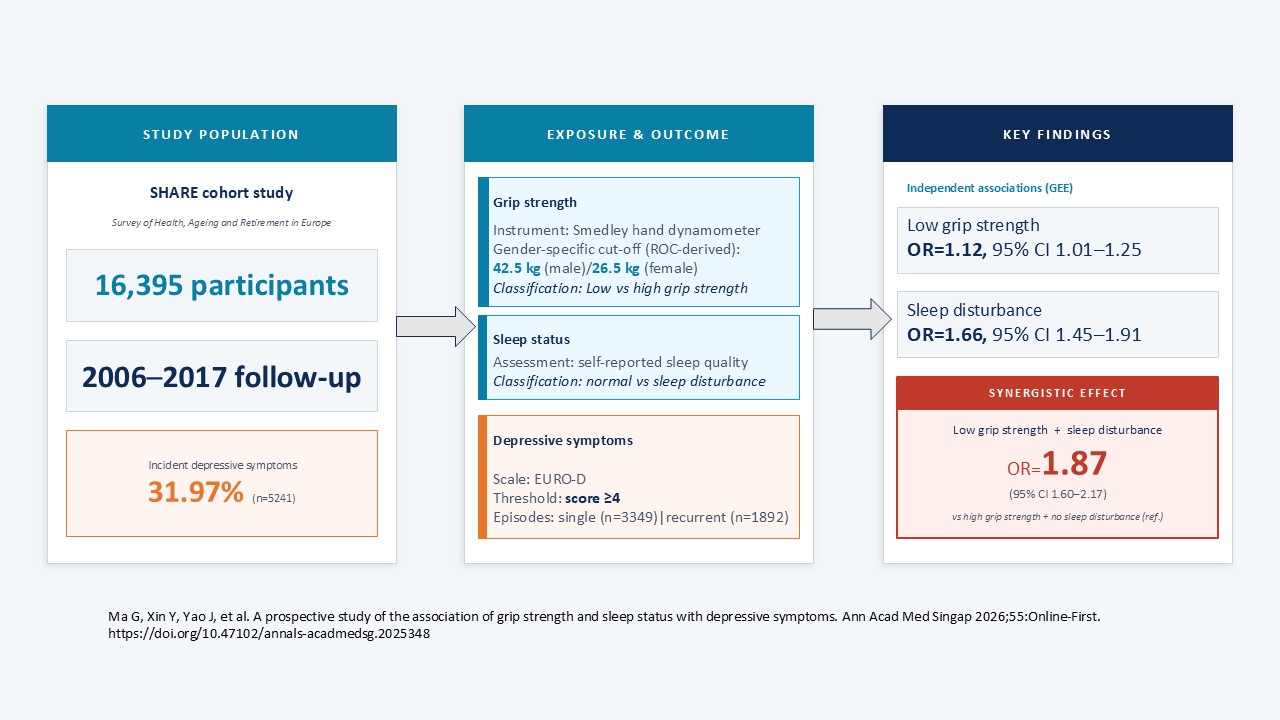
Methods: This prospective cohort study included 16,395 participants from the Survey of Health, Ageing and Retirement in Europe, followed from 2006 to 2017. Logistic regression and generalised estimating equations were used to examine associations.
Results: During follow-up, 5241 participants (31.97%) developed depressive symptoms, with higher incidence in females (58.98%). After adjusting for covariates, both low grip strength (odds ratio [OR] 1.12, 95% confidence interval [CI] 1.02–1.23) and sleep disturbance (OR 1.66, 95% CI 1.50–1.84) were independently associated with elevated risk of depressive symptoms. A synergistic effect was observed: individuals with both low grip strength and sleep disturbance had 1.87 times higher risk (95% CI 1.60–2.17) compared to those with high grip strength and no sleep disturbance. Sex- and age-stratified analyses revealed stronger associations in males and older adults (≥70 years).
Conclusion: Low grip strength and sleep disturbance are independently and synergistically associated with risk of depressive symptoms. Screening for both factors may help identify high-risk individuals for targeted preventive interventions.
CLINICAL IMPACT
What is New
- To the authors’ knowledge, this is the first prospective study to demonstrate a synergistic effect between low grip strength and sleep disturbance on the risk of depressive symptoms in middle-aged and older adults.
- The combined presence of both factors was associated with a 1.87-fold increased risk, substantially exceeding the risk conferred by either factor alone.
Clinical Implications
- Routine screening integrating grip strength measurement and sleep assessment may help identify high-risk individuals for targeted depression prevention.
Depression is a major global health concern that significantly affects health worldwide.1-3 According to the Global Burden of Disease Study 2021, approximately 332 million people globally suffer from depressive disorders, with the age-standardised prevalence increasing by 11.3% from 1990 to 2021 and projected to continue rising through 2040.4,5 Population ageing further compounds this issue, increasing the strain on global health systems.6 As one of the most common psychiatric disorders in middle-aged and older adults, depression severely impairs their quality of life and adds to the societal disease burden.7 Significant depressive symptoms in older adults are linked to numerous health issues, including functional and cognitive impairment, physical disability, and the onset or worsening of chronic diseases.8,9 These symptoms can also elevate the risk of self-harm and suicide.10,11 However, the subtle nature of depression often leads to delayed diagnosis and treatment.12 Therefore, identifying easily measurable and modifiable risk factors is crucial for the early detection and management of depression.
Grip strength, a simple and non-invasive measurement, has emerged as a key indicator of physical frailty and overall health status in older adults.13,14 Low grip strength reflects declining muscle function15 and is recognised as a robust biomarker of biological ageing.16 Grip strength has also been correlated with numerous health outcomes, including nutritional status,17 cognitive function18 and mental health.19 Its simplicity and low cost make it an ideal indicator for large-scale population screening.20,21 Sleep disturbance, another common problem in middle-aged and older adults, is also recognised as both a key precursor and symptom of depression.3,22 The relationship between sleep disturbance and depression is bidirectional, with poor sleep quality potentially preceding and exacerbating depressive symptoms.23
While previous studies have examined the associations of grip strength and sleep status with depression separately, most were cross-sectional in design, limiting causal inference and generalisability due to a lack of longitudinal data and smaller sample sizes. Furthermore, the combined effect of grip strength and sleep status on depression risk remains unexplored. Therefore, this prospective study aimed to investigate the individual and combined associations of grip strength and sleep status with the risk of depressive symptoms in a large cohort of 16,395 middle-aged and older adults.
METHODS
Data source and study population
Data were sourced from the Survey of Health, Ageing and Retirement in Europe (SHARE), a multidisciplinary and cross-national panel database. SHARE collects longitudinal microdata on the health, socioeconomic status and social networks of individuals aged 50 and over across Europe. This study utilised data from SHARE, with wave 2 (2006) serving as the baseline. Participants were monitored for subsequent incident depressive symptoms across 4 waves: wave 4 (2011), wave 5 (2013), wave 6 (2015) and wave 7 (2017).
The inclusion criteria were: (1) age ≥50 years and (2) participation in the baseline survey (wave 2). Participants were excluded if they had: (1) missing information on baseline grip strength or sleep status, (2) incomplete depressive symptoms scale data at baseline, (3) prevalent depressive symptoms at baseline or (4) no participation in any of the 4 follow-up surveys (waves 4–7). A final sample of 16,395 participants was included in the analysis.
Variable definition
Grip strength was measured using a Smedley hand dynamometer following a standardised protocol established by SHARE. Participants performed measurements in a standing position, with 2 trials conducted for each hand. The maximum value from all 4 measurements was used for analysis, consistent with established epidemiological guidelines that recommend using peak grip strength to capture optimal muscle performance.24,25 This approach avoids the complexity of dominant versus non-dominant hand differentiation while maintaining measurement reliability.26,27 Device calibration was performed according to SHARE study protocols. Sex-specific cut-off values were determined using receiver operating characteristic curve analysis to maximise Youden’s index for depression outcomes in the study population, which has been successfully employed in multiple large-scale epidemiological studies.28-31 The optimal cut-offs were 42.50 kg for males and 26.50 kg for females, which were used to classify participants into low and high grip strength groups. Sex represents the most significant determinant of absolute grip strength values,32 while age-related decline in grip strength was appropriately accounted for by including age as a continuous covariate in all adjusted models.33
Sleep status was assessed by self-report and classified as normal sleep or sleep disturbance based on participants’ responses about their recent sleep.
Depressive symptoms were assessed using the 12-item European Depression Scale (EURO-D), which evaluates symptoms experienced over the past month. Items are scored 0 or 1, yielding a total score from 0 to 12, with higher scores indicating greater depressive symptomatology. Consistent with previous studies,34,35 a score ≥4 was defined as depressive symptoms. For the analysis of depressive symptoms frequency, participants were categorised based on the number of follow-up waves in which they met the criteria for depressive symptoms (0, 1, 2 or more times). It should be noted that the EURO-D is a screening tool and does not constitute a clinical diagnosis of major depressive disorder. It identifies individuals with elevated depressive symptomatology warranting clinical attention.
Based on prior literature,28 the following covariates were included: sex, age, region, education level, work status, family economic situation, smoking, alcohol consumption, physical activity, self-rated health and number of chronic diseases.
Statistical analysis
Baseline characteristics were compared using 2-sample t-tests or ANOVA for continuous variables and chi-square tests for categorical variables. Both logistic regression and generalised estimating equations (GEE) were used to analyse the associations.36,37 A 2-sided P value <0.05 was considered statistically significant. All analyses were conducted using SAS version 9.4 (SAS Institute, Cary, NC, US).
RESULTS
Study population characteristics
The study included 16,395 participants with a mean age of 63.15 ± 8.70 years (range: 50–97), comprising 8297 (50.61%) males and 8098 (49.39%) females. During the follow-up period, 5241 participants (31.97%) experienced incident depressive symptoms. Of these, 3349 (20.43%) were identified with depressive symptoms once, and 1892 (11.54%) were identified with depressive symptoms 2 or more times. A total of 3634 participants (22.17%) had never experienced depressive symptoms and served as the control group. Incident depressive symptoms were more prevalent in females (n=3091; 58.98%) than in males (n=2150; 41.02%).
Baseline characteristics of the study population, categorised by depressive symptom outcomes during follow-up, are presented in Table 1. Significant differences were observed across all assessed variables. Compared to the non-depressed group, participants who developed depressive symptoms were generally older, more likely to be retired or unemployed, reported financial difficulties, were physically inactive, had poor self-rated health and a higher number of chronic diseases. They also had a higher prevalence of low grip strength and sleep disturbance, but a lower prevalence of smoking and alcohol consumption.
Table 1. Baseline characteristics of participants by depressive symptom status.
Association between grip strength, sleep disturbance and risk of depressive symptoms
Table 2 presents the results from the logistic regression analysis for the association of baseline grip strength and sleep status with the risk of incident depressive symptoms. After adjusting for all covariates, low baseline grip strength was associated with a higher risk of a single depressive episode (odds ratio [OR] 1.19, 95% confidence interval [CI] 1.02–1.39, P=0.031) and recurrent episodes (OR 1.17, 95% CI 0.97–1.41, P=0.094). The risk associated with low grip strength was similar for a single depressive episode and for recurrent episodes, although the latter did not reach statistical significance. In contrast, baseline sleep disturbance was significantly associated with an increased risk for both a single depressive episode (OR 1.44, 95% CI 1.21–1.71, P<0.001) and recurrent episodes (OR 2.01, 95% CI 1.65–2.45, P<0.001), with the risk being notably higher for recurrent depressive symptoms.
Table 2. Association of grip strength level or sleep status with depressive symptoms.
Combined effect of grip strength and sleep disturbance on risk of depressive symptoms
The combined effects of baseline grip strength and sleep status on risk of depressive symptoms are shown in Table 3. Both logistic regression and GEE were used for the analysis. After full covariate adjustment, in the absence of sleep disturbance, the association between low grip strength and risk of depressive symptoms was not significant for either single (P=0.069) or recurrent episodes (P=0.132). However, a significant interaction was observed, where the presence of sleep disturbance enhanced the association between low grip strength and depressive symptoms. The combination of low grip strength and sleep disturbance was associated with a significantly elevated risk of depressive symptoms, particularly for recurrent episodes (single episode: OR 1.75, 95% CI 1.33–2.31, P<0.001; recurrent episodes: OR 2.38, 95% CI 1.75–3.23, P<0.001).
The GEE analysis yielded consistent results. Individually, both low grip strength (OR 1.12, 95% CI 1.01–1.25, P=0.035) and sleep disturbance (OR 1.66, 95% CI 1.45–1.91, P<0.001) were associated with a higher risk of depressive symptoms. A synergistic effect was observed, with the combined presence of both factors resulting in the highest risk (OR 1.87, 95% CI 1.60–2.17, P<0.001).
Sex-stratified analysis
Sex- and age-stratified analyses are presented in Fig. 1. A significant interaction was found between grip strength and sex (P for interaction = 0.026), but not between sleep status and sex. After full adjustment, low grip strength was significantly associated with a higher risk of depressive symptoms in males (OR 1.19, 95% CI 1.02–1.38, P<0.001) but not in females (OR 1.04, 95% CI 0.89–1.20, P<0.001). Sleep disturbance was associated with a higher risk in both sexes, though the effect was more pronounced in males (OR 1.92, 95% CI 1.56–2.37) than in females (OR 1.48, 95% CI 1.23–1.78). The combined effect of both factors was significant in both sexes but showed a greater magnitude in males (OR 2.14) compared to females (OR 1.66).
Fig. 1. Effects of grip strength and sleep disturbance on depressive symptoms, by sex and age group.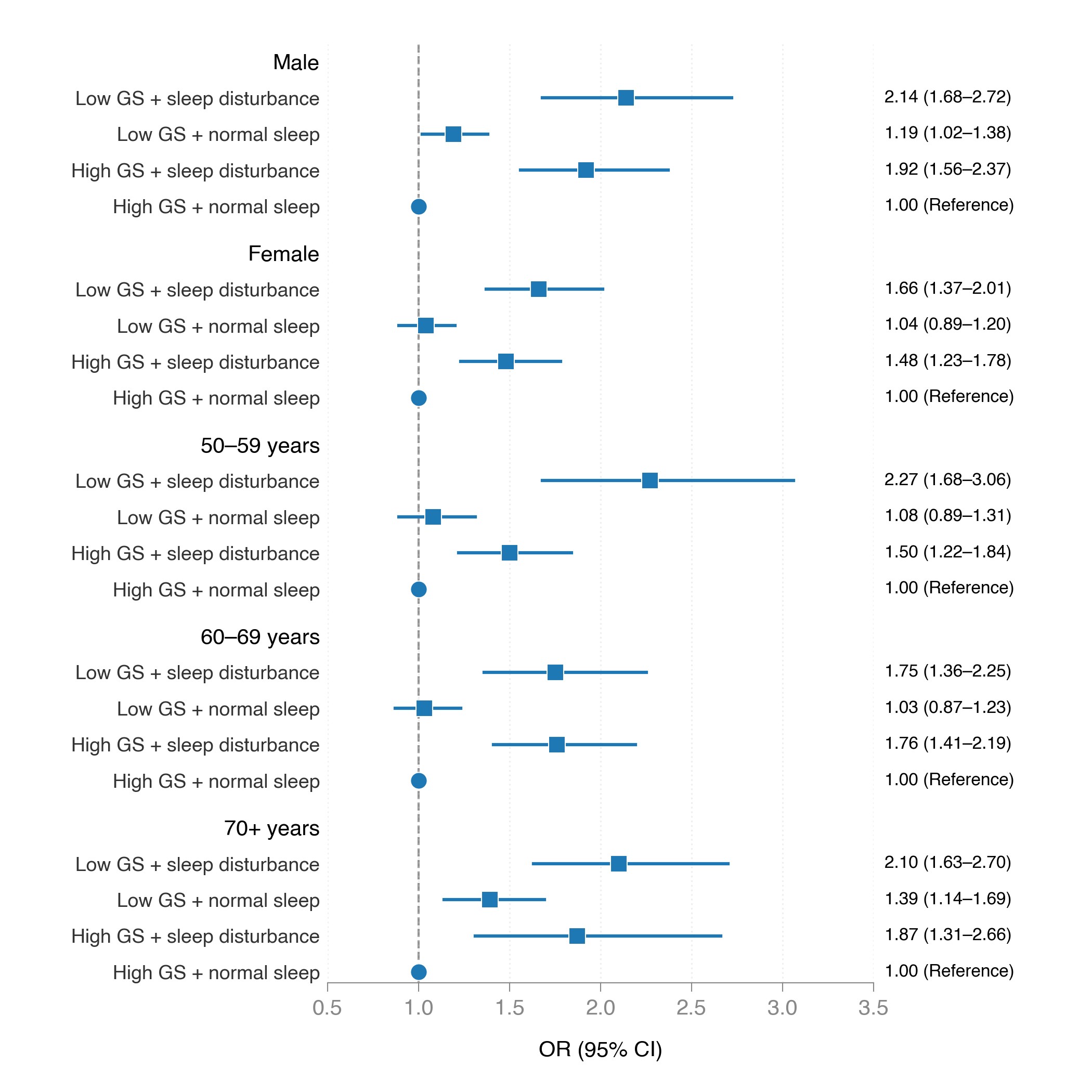 CI: confidence interval; GS: grip strength; OR: odds ratio
Age-stratified analysis
As shown in Fig. 1, the association between grip strength and depressive symptoms varied by age, whereas the association for sleep disturbance was consistent across age strata. After adjusting for covariates, low grip strength was significantly associated with risk of depressive symptoms only in individuals aged 70 years and older (OR 1.39, 95% CI 1.14–1.69, P=0.001). In contrast, sleep disturbance was associated with an elevated risk in all age groups, with the effect size increasing with age, from an OR of 1.50 in the 50–59 age group to 1.87 in the ≥70 age group. A synergistic effect for the combination of low grip strength and sleep disturbance was observed across all age groups, with the highest risk found in the 50–59 age group (OR 2.27, 95% CI 1.68–3.06, P<0.001).
Longitudinal analysis of grip strength, sleep status and risk of depressive symptoms
Fig. 2 illustrates the association of the combined factors with risk of depressive symptoms at each follow-up wave. Compared to the reference group (high grip strength, no sleep disturbance), sleep disturbance alone was consistently associated with an elevated risk of depressive symptoms across all 4 follow-up waves (ORs ranging from 1.53 to 1.96). Low grip strength alone was significantly associated with risk of depressive symptoms only at wave 7 (OR 1.29, 95% CI 1.07–1.56, P<0.001); this association was not significant at other waves. The combined effect of both risk factors was significantly associated with a higher risk of depressive symptoms across all 4 follow-up surveys, with ORs ranging from 1.72 to 2.20.
Fig. 2. Association of the combined effect of grip strength and sleep status with depressive symptoms in successive follow-up surveys. 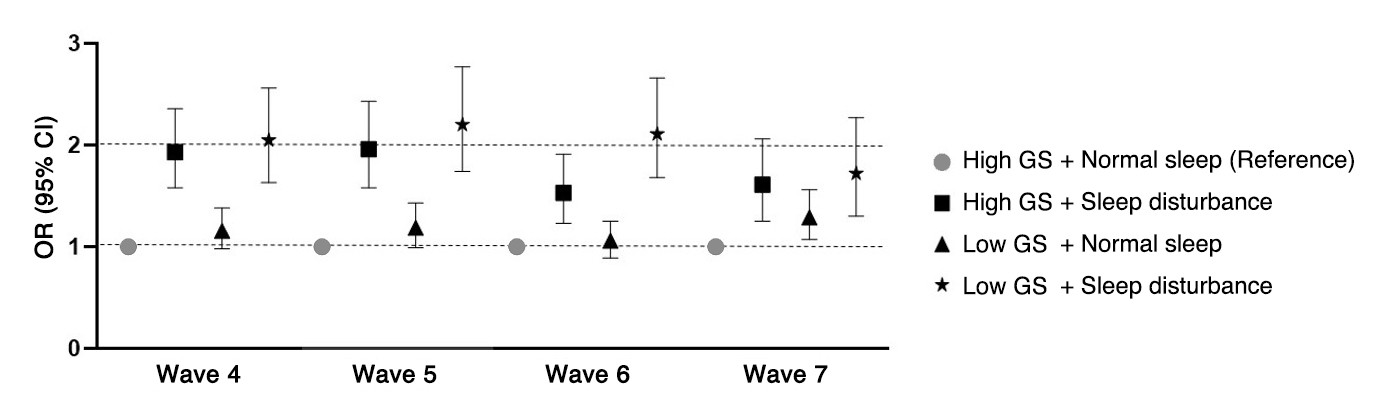 CI: confidence interval; GS: grip strength; OR: odds ratio
DISCUSSION
In this large prospective cohort study of European middle-aged and older adults, findings reveal that low grip strength and sleep disturbance were independently associated with an elevated risk of depressive symptoms. More importantly, a synergistic effect was identified between the following 2 factors: individuals with both low grip strength and sleep disturbance had a substantially higher risk of depressive symptoms compared to those with either factor alone. Sex- and age-stratified analyses revealed that these associations were more pronounced in males and in older adults. Furthermore, longitudinal analysis demonstrated that the combined effect remained consistent across all follow-up waves.
Sex differences in depressive symptoms
Consistent with most existing literature, a significantly higher incidence of depression was found in women than in men.38 This sex disparity is often attributed to a combination of hormonal, psychological and social factors.39,40 Interestingly, while depressive symptoms were more prevalent in women, the associations between low grip strength, sleep disturbance and their combined effects with risk of depressive symptoms were stronger in men. This finding contrasts with some studies reporting more pronounced associations in females and warrants careful interpretation.31 Several factors may explain this observation. First, grip strength may have differential validity as a health indicator across sexes. Some evidence suggests that grip strength is a less sensitive marker of frailty in men compared to women,41 potentially due to greater baseline muscle mass and different patterns of age-related muscle loss in men. Consequently, when men do exhibit low grip strength, it may represent a more advanced stage of physical decline, thereby showing a stronger association with adverse mental health outcomes. Second, occupational factors may differentially influence grip strength in men, particularly in cohorts where manual labour was more common among males.42 Third, men may be less likely to seek help for or report depressive symptoms, meaning that those identified with depressive symptoms in this study may represent more severe cases.43 Finally, psychosocial factors such as the perceived loss of physical strength and functional independence may have a greater psychological impact on men, for whom physical capability is often closely tied to self-identity and social roles.
Grip strength and depressive symptoms
This study reinforces grip strength as a robust predictor of depression. This aligns with numerous studies, including a large cohort study that found a negative association after extensive covariate adjustment,29 and an Irish study where high grip strength was linked to a 34.10% lower prevalence of depression.31
From a biological perspective, grip strength serves as an indicator of overall physical health and sarcopenia,44 which may share several pathways with depression beyond chronic inflammation. These include hormonal dysregulation (particularly cortisol and sex hormones), mitochondrial dysfunction and oxidative stress—all of which are implicated in both muscle function decline and mood regulation.45
Psychological and social mechanisms may underlie the association between reduced grip strength and depressive symptoms.46,47 Declining physical capability can undermine self-efficacy, body image and perceived independence, potentially eliciting grief or fear of future dependency, while also limiting participation in meaningful activities and social roles, thereby increasing social isolation.48 This relationship is likely bidirectional, as depression may further contribute to reduced physical activity, poor nutrition and subsequent muscle loss, creating a negative feedback cycle.49
Sleep disturbance as a risk factor for depressive symptoms
Findings also confirm that sleep disturbance is not merely a secondary symptom but an independent risk factor and a potential prodromal symptom for depression.23 This is supported by studies showing that poor sleep quality can precede depressive symptoms and may mediate the effects of stress on depression,50 possibly through mechanisms like reduced hippocampal volume.51 The strong, dose-response relationship observed—where sleep disturbance conferred a higher risk for recurrent depression—emphasises the critical importance of addressing sleep disturbance in clinical practice.
Combined effect of grip strength and sleep disturbance
To the authors’ knowledge, this is the first study to investigate the combined effect of grip strength and sleep status on the risk of depression. The key finding is the synergistic interaction between these 2 factors. The risk of depression for individuals with both low grip strength and sleep disturbance was substantially greater than the risk associated with either factor alone. This novel finding suggests that individuals with co-occurring poor physical strength and sleep disturbance represent a key high-risk population for targeted preventive interventions that could integrate physical exercise and sleep hygiene programmes.
Advantages and limitations
The strengths of this study include its large sample size; prospective design with a long follow-up; and the use of the standardised, high-quality SHARE database. The application of both logistic regression and GEE models enhances the robustness of the findings. However, several limitations must be considered. First, as an observational study, causality cannot be inferred, and residual confounding may exist. An illustrative example is the counterintuitive finding that participants without depressive symptoms had higher alcohol consumption rates. This may reflect several factors: reverse causation52 whereby depression leads to reduced alcohol intake, the sick quitter phenomenon53 where individuals cease drinking due to health problems, or unmeasured confounding by social engagement patterns typical in European drinking culture.54 Second, the assessment of both grip strength and sleep status could introduce measurement bias. The authors could not adjust for all potential confounders, such as body mass index,55 nutritional status,56 medication use57 (including psychotropic medications and over-the-counter sleep aids) or genetic predispositions, which may influence both grip strength and depressive symptoms. Third, loss to follow-up could have introduced selection bias. Finally, the study population consisted exclusively of European adults, which limits generalisability to other populations.
CONCLUSION
This prospective study found a high prevalence of clinically significant depressive symptoms among European middle-aged and older adults, with notable sex differences. Low grip strength and sleep disturbance were independently associated with elevated risk of depressive symptoms, and their combined presence showed a potentially synergistic association. While these findings should be interpreted with caution given measurement limitations and the possibility of residual confounding, they suggest that screening for both reduced physical strength and sleep disturbance may help identify individuals at elevated risk for depressive symptoms. Future studies with more comprehensive assessments of exposures and outcomes are needed to confirm these associations and inform targeted preventive strategies.
Acknowledgements
The authors gratefully acknowledge the SHARE research team for providing access to the data and thank all SHARE participants for their valuable contributions. The SHARE data collection has been funded by the European Commission and various national funding sources.
REFERENCES
- McCarron RM, Shapiro B, Rawles J, et al. Depression. Ann Intern Med 2021;174:ITC65-ITC80.
- Monroe SM, Harkness KL. Major Depression and Its Recurrences: Life Course Matters. Annu Rev Clin Psychol 2022;18:329-57.
- Park LT, Zarate CA. Depression in the Primary Care Setting. N Engl J Med 2019;380:559-68.
- Xu Q, Qiao Z, Kan Y, et al. Global, regional, and national burden of depression, 1990–2021: a decomposition and age-period-cohort analysis with projection to 2040. J Affect Disord 2025;391:120018.
- GBD 2021 Diseases and Injuries Collaborators. Global incidence, prevalence, years lived with disability (YLDs), disability-adjusted life-years (DALYs), and healthy life expectancy (HALE) for 371 diseases and injuries in 204 countries and territories and 811 subnational locations, 1990-2021: a systematic analysis for the Global Burden of Disease Study 2021. Lancet 2024;403:2133-61.
- Tan J, Ma C, Zhu C, et al. Prediction models for depression risk among older adults: Systematic review and critical appraisal. Ageing Res Rev 2023;83:101803.
- Spangenberg L, Forkmann T, Brähler E, et al. The association of depression and multimorbidity in the elderly: Implications for the assessment of depression. Psychogeriatrics 2011;11:227-34.
- Maatouk I, Herzog W, Böhlen F, et al. Association of hypertension with depression and generalized anxiety symptoms in a large population-based sample of older adults. J Hypertens 2016;34:1711-20.
- Windle M, Windle RC. Recurrent depression, cardiovascular disease, and diabetes among middle-aged and older adult women. J Affect Disord 2013;150:895-902.
- Barry LC, Coman E, Wakefield D, et al. Functional disability, depression, and suicidal ideation in older prisoners. J Affect Disord 2020;266:366-73.
- Yi SW. Depressive Symptoms on the Geriatric Depression Scale and Suicide Deaths in Older Middle-aged Men: A Prospective Cohort Study. J Prev Med Public Health Yebang Uihakhoe Chi 2016;49:176-82.
- Zasadzka E, Pieczyńska A, Trzmiel T, et al. Correlation between Handgrip Strength and Depression in Older Adults-A Systematic Review and a Meta-Analysis. Int J Environ Res Public Health 2021;18:4823.
- Dudzińska-Griszek J, Szuster K, Szewieczek J. Grip strength as a frailty diagnostic component in geriatric inpatients. Clin Interv Aging 2017;12:1151-7.
- Suzuki Y, Matsui Y, Hirano Y, et al. Relationships among Grip Strength Measurement, Response Time, and Frailty Criteria. J Frailty Aging 2023;12:182-8.
- Petermann-Rocha F, Gray SR, Forrest E, et al. Associations of muscle mass and grip strength with severe NAFLD: A prospective study of 333,295 UK Biobank participants. J Hepatol 2022;76:1021-9.
- Kim DR, Park JH, Lai TF, et al. Bidirectional Relationship among Cognitive Function, Muscle Mass, and Grip Strength in Older Adults: the BUSAN Study. Ann Geriatr Med Res 2025;29:199-206.
- Mendes J, Afonso C, Moreira P, et al. Association of Anthropometric and Nutrition Status Indicators with Hand Grip Strength and Gait Speed in Older Adults. JPEN J Parenter Enteral Nutr 2019;43:347-56.
- Kuo K, Zhang YR, Chen SD, et al. Associations of grip strength, walking pace, and the risk of incident dementia: A prospective cohort study of 340212 participants. Alzheimers Dement 2023;19:1415-27.
- Jiang R, Westwater ML, Noble S, et al. Associations between grip strength, brain structure, and mental health in > 40,000 participants from the UK Biobank. BMC Med 2022;20:286.
- Dunn MA, Rogal SS, Duarte-Rojo A, et al. Physical Function, Physical Activity, and Quality of Life After Liver Transplantation. Liver Transpl 2020;26:702-8.
- Dugan SA, Gabriel KP, Lange-Maia BS, et al. Physical Activity and Physical Function: Moving and Aging. Obstet Gynecol Clin North Am 2018;45:723-36.
- Pandi-Perumal SR, Monti JM, Burman D, et al. Clarifying the role of sleep in depression: A narrative review. Psychiatry Res 2020;291:113239.
- Fang H, Tu S, Sheng J, et al. Depression in sleep disturbance: A review on a bidirectional relationship, mechanisms and treatment. J Cell Mol Med 2019;23:2324-32.
- Roberts HC, Denison HJ, Martin HJ, et al. A review of the measurement of grip strength in clinical and epidemiological studies: towards a standardised approach. Age Ageing 2011;40:423-9.
- Dodds RM, Syddall HE, Cooper R, et al. Grip strength across the life course: Normative data from twelve British studies. PLoS One 2014;9:e113637.
- Sousa-Santos AR, Amaral TF. Differences in handgrip strength protocols to identify sarcopenia and frailty – a systematic review. BMC Geriatr 2017;17:238.
- Coldham F, Lewis J, Lee H. The reliability of one vs. three grip trials in symptomatic and asymptomatic subjects. J Hand Ther 2006;19:318-26; quiz 327.
- Marques A, Henriques-Neto D, Peralta M, et al. Exploring grip strength as a predictor of depression in middle-aged and older adults. Sci Rep 2021;11:15946.
- Gu Y, Li X, Zhang Q, et al. Grip strength and depressive symptoms in a large-scale adult population: The TCLSIH cohort study. J Affect Disord 2021;279:222-8.
- López-Bueno R, Calatayud J, Andersen LL, et al. Dose-response association of handgrip strength and risk of depression: a longitudinal study of 115 601 older adults from 24 countries. Br J Psychiatry J Ment Sci 2023;222:135-42.
- McDowell CP, Gordon BR, Herring MP. Sex-related differences in the association between grip strength and depression: Results from the Irish Longitudinal Study on Ageing. Exp Gerontol 2018;104:147-52.
- Dodds RM, Syddall HE, Cooper R, et al. Global variation in grip strength: a systematic review and meta-analysis of normative data. Age Ageing 2016;45:209-16.
- Barry LC, Coman E, Wakefield D, et al. Functional disability, depression, and suicidal ideation in older prisoners. J Affect Disord 2020;266:366-73.
- Kucera M, Wolfová K, Cermakova P. Changes in depressive symptoms of older adults in the czech republic. J Affect Disord 2020;261:139-44.
- Van Herreweghe L, Van Lancker W. Is religiousness really helpful to reduce depressive symptoms at old age? A longitudinal study. PLoS One 2019;14:e0218557.
- Ito T, Sugasawa S. Grouped generalized estimating equations for longitudinal data analysis. Biometrics 2023;79:1868-79.
- Ballinger GA. Using generalized estimating equations for longitudinal data analysis. Organ Res Methods 2004;7:127-50.
- Hernández-Hernández OT, Martínez-Mota L, Herrera-Pérez JJ, et al. Role of Estradiol in the Expression of Genes Involved in Serotonin Neurotransmission: Implications for Female Depression. Curr Neuropharmacol 2019;17:459-71.
- Salk RH, Hyde JS, Abramson LY. Gender differences in depression in representative national samples: Meta-analyses of diagnoses and symptoms. Psychol Bull 2017;143:783-822.
- Lin J, Zou L, Lin W, et al. Does gender role explain a high risk of depression? A meta-analytic review of 40 years of evidence. J Affect Disord 2021;294:261-78.
- Syddall H, Cooper C, Martin F, et al. Is grip strength a useful single marker of frailty? Age Ageing 2003;32:650-6.
- Kröger H, Fritzell J, Hoffmann R. The Association of Levels of and Decline in Grip Strength in Old Age with Trajectories of Life Course Occupational Position. PLoS One 2016;11:e0155954.
- Shi P, Yang A, Zhao Q, et al. A Hypothesis of Gender Differences in Self-reporting Symptom of Depression: Implications to Solve Under-Diagnosis and Under-Treatment of Depression in Males. Front Psychiatry 2021;12:589687.
- Coletta G, Phillips SM. An elusive consensus definition of sarcopenia impedes research and clinical treatment: A narrative review. Ageing Res Rev 2023;86:101883.
- Smith L, White S, Stubbs B, et al. Depressive symptoms, handgrip strength, and weight status in US older adults. J Affect Disord 2018;238:305-10.
- Taekema DG, Gussekloo J, Maier AB, et al. Handgrip strength as a predictor of functional, psychological and social health. A prospective population-based study among the oldest old. Age Ageing 2010;39:331-7.
- Kwak Y, Kim Y. Mental Health and Handgrip Strength among Older Adults: A Nationwide Study. Inquiry 2022;59:00469580211067481.
- Wilkinson DJ, Piasecki M, Atherton PJ. The age-related loss of skeletal muscle mass and function: Measurement and physiology of muscle fibre atrophy and muscle fibre loss in humans. Ageing Res Rev 2018;47:123-32.
- Lindwall M, Larsman P, Hagger MS. The reciprocal relationship between physical activity and depression in older European adults: a prospective cross-lagged panel design using SHARE data. Health Psychol 2011;30:453-62.
- Guo L, Wei M, Namassevayam G, et al. Is sleep quality a moderated mediator between perceived stress and depression among stroke patients? Front Public Health 2023;11:1284197.
- Wang Y, Tian Y, Long Z, et al. Volume of the Dentate Gyrus/CA4 Hippocampal subfield mediates the interplay between sleep quality and depressive symptoms. Int J Clin Health Psychol 2024;24:100432.
- Keyes KM, Allel K, Staudinger UM, et al. Alcohol consumption predicts incidence of depressive episodes across 10 years among older adults in 19 countries. Int Rev Neurobiol 2019;148:1-38.
- Liang L, Hua R, Tang S, et al. Low-to-Moderate Alcohol Intake Associated with Lower Risk of Incidental Depressive Symptoms: A Pooled Analysis of Three Intercontinental Cohort Studies. J Affect Disord 2021;286:49-57.
- García-Esquinas E, Ortolá R, Galán I, et al. Moderate alcohol drinking is not associated with risk of depression in older adults. Sci Rep 2018;8:11512.
- Almeida OP, Calver J, Jamrozik K, et al. Obesity and metabolic syndrome increase the risk of incident depression in older men: the health in men study. Am J Geriatr Psychiatry 2009;17:889-98.
- Amasene M, Besga A, Medrano M, et al. Nutritional status and physical performance using handgrip and SPPB tests in hospitalized older adults. Clin Nutr 2021;40:5547-555.
- Hu W, Mao H, Guan S, et al. Systematic Review and Meta-analysis of the Association between Malnutrition and Risk of Depression in the Elderly. Alpha Psychiatry 2024;25:183-9.
The SHARE study protocol was reviewed and approved by the Ethics Council of the Max Planck Society for the Advancement of Science and by the relevant ethics committees or institutional review boards in each participating country. This study is a secondary analysis of de-identified, publicly available data and was deemed exempt from further institutional review board approval. All SHARE participants provided written informed consent prior to data collection. For participants unable to provide consent, written informed consent was obtained from a legal representative in accordance with country-specific regulations. As this study used exclusively de-identified data, no additional consent was required for this secondary analysis.
The authors declare that they have no affiliations with or involvement in any organisation or entity with any financial interest in the subject matter or materials discussed in this manuscript. The authors also declare that they have no conflicts of interest. The data that support the findings of this study are available from the SHARE Research Data Center. Data are available upon request to qualified researchers through the SHARE data access application process at http://www.share-project.org/data-access.html. Restrictions apply to the availability of these data, which were used under license for this study. This work was supported by the Key Research and Development Program of Shandong Province (Competitive Innovation Platform Project: 2024CXPT091); the Taishan Scholar Project (tsqn202312392) and the youth talent training programme from Qingdao Medical College of Qingdao University (RZ2300002690).
Dr Chao Ren, Department of Neurology, Yantai Yuhuangding Hospital, Qingdao University, No. 20 Yuhuangding East Road, Zhifu District, Yantai, 264000, China. Email: [email protected]
