

ABSTRACT
Introduction: Medical Home (MH) is a hospital-at-home (HaH) service model developed to deliver multidisciplinary acute medical care for patients in their homes. This study evaluated the patient-centred outcomes and cost-effectiveness of the MH service compared with usual care (UC).
Methods: This quasi-experimental study involved 250 patients recruited from July 2021 to May 2023. Data on costs, healthcare resource utilisation, and patient-centred outcomes were collected at index admission, discharge, and 90 days post-discharge. Regression analyses were employed to estimate the incremental differences in patient-centred outcomes and net monetary benefit (NMB) between MH and UC groups, while adjusting for confounders. A probabilistic sensitivity analysis (PSA) was conducted to evaluate the uncertainty surrounding the data inputs for cost-effectiveness analysis. Subgroups excluding U-turn patients (i.e. patients admitted to the hospital before discharge from MH) and deaths were analysed for patient-centred and cost-effectiveness outcomes.
Results: There was no statistically significant difference between the 2 groups in clinical, functional, and experience outcomes, except for length of stay and caregiver’s overall experience in which the MH group had significantly better results compared with UC group. Compared with the UC group, the MH group showed a positive incremental NMB of SGD6895 (approximately USD5361; 95% confidence interval SGD1945–11,845) indicating the cost-effectiveness of the MH service. Results from the PSA showed that the MH group was cost-effective across a range of willingness-to-pay thresholds. Subgroup analyses were consistent with the base case for patient-centred and cost-effectiveness outcomes.
Conclusions: We conclude that an HaH care model like MH is a value-based and cost-effective alternative to admission to hospital for selected frail elderly patients, making it the preferred strategy.
CLINICAL IMPACT
What is New
- To the authors’ knowledge, this study is the first to evaluate the hospital-at-home (HaH) care model for frail older adults in Singapore.
- Findings reveal that HaH is a cost-effective alternative to inpatient hospitalisation with positive benefits, such as shorter length of stay and better caregiver experiences.
Clinical Implications
- This study’s findings will guide future healthcare planning and delivery and support the shift from hospital-centric to community-based care. This is especially relevant for Singapore, being one of the fastest-ageing nations globally.
Singapore faces a significant demographic transition, with the proportion of residents aged 65 years and above projected to reach 25% by 2030.1 This shift, coupled with an increased prevalence of multimorbidity, poses substantial challenges to healthcare sustainability through increased hospital utilisation and frequent readmissions.2
In response, innovative care models like hospital-at-home (HaH) programmes have emerged as alternatives to traditional acute hospital care, delivering hospital-level care in patients’ homes. HaH not only offers potential cost savings through reduced bed occupancy but also mitigates hospitalisation-associated risks.3 This is relevant in Singapore, where 11.7% of adult patients in acute hospitals acquire healthcare-associated infections.4 Hospitalisation also contributes to functional decline in older patients.5
Previous research has demonstrated potential benefits of HaH programmes, including improved patient satisfaction6-8 and positive outcomes for caregivers.8-10 Studies from Western healthcare systems have shown promising clinical outcomes, including reduced hospital readmission rates, albeit with longer length of stay and higher costs.11-15 However, the effectiveness and cost-effectiveness of such schemes in Asian healthcare contexts, particularly for older or frail patients, remain understudied. Moreover, the transferability of these findings to Asian populations, where family dynamics, living arrangements, and healthcare-seeking behaviours differ significantly from Western contexts, requires careful evaluation.
Khoo Teck Puat Hospital, a tertiary acute care hospital in Singapore, manages the national hospital-to-home programme through its Ageing-in-Place community care team (AIP-CCT). This post-discharge transitional home care service targets complex patients and older adults at risk of readmission. However, this model has limitations, particularly when patients develop new acute medical conditions that necessitate a return to the emergency department (ED).
To address these gaps, the hospital introduced the Medical Home (MH) service, a novel acute medical care model to deliver care by a multidisciplinary team in patients’ homes. This service facilitates admission avoidance by accepting patients referred from the ED, specialist outpatient clinic (SOC), or AIP-CCT and early supported discharge for suitable inpatients who can safely continue treatment at home.
We hypothesised that the MH service would achieve comparable clinical and functional outcomes compared with usual care (UC), while providing better patient and caregiver experiences8 as well as generating cost savings for both patients and the healthcare system through reduced bed days, particularly among older adults. This aligns with Singapore’s healthcare transformation efforts to promote value-based and patient-centred care, and to shift focus from hospital-centric to community-based care models.
This study evaluated the patient-centred outcomes and cost-effectiveness of the MH service compared with conventional inpatient ward care in Singapore’s acute hospital setting.
The findings of this study have the potential to significantly influence healthcare policy and practice in Singapore and similar healthcare systems. By providing evidence on MH’s effectiveness and cost-effectiveness, and synthesising insights from global HaH research and contextualising them to Singapore’s healthcare landscape, this study aims to inform resource allocation and care delivery model decisions for the ageing population, ultimately contributing to the development of more efficient and patient-centred care strategies.
METHODS
Design
This quasi-experimental prospective study was conducted at Khoo Teck Puat Hospital, Singapore. The MH intervention group included patients who met the inclusion criteria (Supplementary Annex S1) and were referred from several different sources: ED, SOC, or AIP-CCT patients, who would otherwise have required admission, as well as inpatients admitted for less than 48 hours in wards, deemed suitable for early supported discharge to continue care at home. The UC group consisted of patients who met the inclusion criteria but either declined MH service, resided outside the catchment area, or could not be enrolled due to capacity constraints, and were therefore subsequently admitted to the hospital itself. The primary caregiver was define
d as the main nominated healthcare spokesperson who was overall in charge of the patient’s care decisions and coordination, excluding live-in domestic helpers.
Sample size and recruitment
The study aimed to recruit 250 patient-caregiver dyads, comprising 125 pairs in each of the MH intervention and UC groups. Recruitment occurred from July 2021 to May 2023. MH nurses screened clinical notes to identify potential participants, followed by MH doctors’ confirmation of eligibility based on predetermined criteria (detailed in Supplementary Annex S1). A total of 250 patients were recruited, comprising 125 patients in the MH group and 125 in the UC group. Additionally, 150 caregivers were recruited, with 100 for the MH group and 50 for the UC group. The recruitment disparity between patients and caregivers was attributed to 3 main factors: some patients did not have caregivers, some caregivers declined participation, and recruitment opportunities were limited by COVID-19 visiting restrictions, particularly for the control group. Informed consent was obtained from all participants in both MH and UC groups for study participation and data analysis. Patient flow is detailed in Supplementary Annex S2.
Data collection
The study collected comprehensive data encompassing patients’ baseline characteristics and patient-centred outcomes, including clinical, functional, and patient and caregiver’s experience outcomes. Additionally, health services utilisation, healthcare cost, and health-related quality of life were collected for cost-effectiveness outcomes. Detailed definitions and measurements are listed in Table 1.
Table 1. Definitions and measurements of outcomes.
|
Indicators |
Definitions and measurements |
Timepoints |
|
Baseline characteristics |
||
|
CFS
|
Validated 9-point scale ranging from 1 (very fit) to 9 (terminally ill) |
At admission |
|
Patient Acuity Category Scale |
Used to measure the severity of patients’ health condition and level of care required in 4 categories, P1, P2, P3, and P4; only available for patients who presented through the ED |
At admission |
|
CCI |
Used to measure comorbidity burden; validated tool that predicts mortality by weighting various comorbid conditions |
At admission |
|
Clinical outcomes |
||
|
90-day readmission |
Readmission to hospital within 90 days post-index discharge |
From discharge to 90 days post-index discharge |
|
90-day mortality |
Death within 90 days post-index discharge |
From discharge to 90 days post-index discharge |
|
Institutionalisation |
Nursing home placement within 90 days post-index discharge |
From discharge to 90 days post-index discharge |
|
Duration of care |
Length of stay during index admission (days) |
From admission to discharge |
|
Adverse events |
Occurrence of any of the following during index admission: • Thrombophlebitis • Medication error • New pressure sores • Falls • Catheter-related urinary tract infection • Acute delirium |
From admission to discharge |
|
Functional outcomes |
||
|
MBI |
Used to measure a person’s independence in performing activities of daily living with a total score ranging from 0 to 100, higher scores indicate better function |
At admission, discharge and 90 days post-index discharge |
|
EQ-5D-5L |
Used to measure health-related quality of life by asking about 5 dimensions: mobility, self-care, usual activities, pain/discomfort, and anxiety/depression. Each dimension has 5 levels of severity. Utility scores were calculated based on the Singapore value set. |
At admission, discharge and 90 days post-index dischargea |
|
Experience outcomes |
|
|
|
Patient’s overall experience |
Overall satisfaction rating by a single-item 4-point scale: 1=Excellent, 2=Good, 3=Poor, 4=Very Poor |
At discharge |
|
Caregiver’s overall experience |
Overall satisfaction rating by a single-item 4-point scale: 1=Excellent, 2=Good, 3=Poor, 4=Very Poor |
At discharge |
|
Caregiver burden |
ZBI-12, a 12-item validated scale from 0 to 48; higher scores indicate greater burden |
At admission, discharge and 90 days post-index discharge |
|
Cost-effectiveness outcomes |
|
|
|
Health service utilisation |
Data obtained from hospital databases consist of: • ED visits • Hospital readmissions • Specialist outpatient clinic visits |
From index admission to 90 days post-index discharge |
|
Healthcare costs |
Healthcare costs obtained from hospital databases consisting of: • Index admission costs (professional visits, consultations, transport, treatment fees, medications, investigations for MH; ward charges and treatment fees for usual care) • Post-discharge costs (outpatient, inpatient, ED visits) |
From index admission to 90 days post-index discharge |
|
QALY |
Calculated using EQ-5D-5L utility scores; time-weighted average (area under curve) |
From index admission to discharge and 90 days post-index dischargea |
CCI: Charlson Comorbidity Index; CFS: Clinical Frailty Scale; ED: emergency department; EQ-5D-5L: EuroQol-5 dimension-5 levels; MBI: modified Barthel index; MH: Medical Home; QALY: quality-adjusted life year; ZBI-12: Zarit-12 Burden Interview
a For missing data due to lost to follow-up, it was assumed that utility scores remained as previously recorded. In cases of death, utility scores were assumed to be 0.
Statistical analyses
Baseline characteristics of participants in the 2 groups were obtained via descriptive statistics. Based on their distribution, continuous variables were expressed either as mean with standard deviation (SD) or median with interquartile range (IQR). Categorical variables were reported as absolute numbers and percentages. Tests for significance were performed using either independent t-test or Mann-Whitney U test as appropriate, depending on the distribution of the continuous variables. Categorical data were tested using Pearson chi-square tests.
Patient-centred outcomes: Clinical, functional, and experience outcomes
The efficacy of MH service measured in clinical, functional, and experience outcomes as outlined in Table 1 was further assessed by multiple logistic regressions and multiple linear regressions for dichotomous and continuous outcomes, respectively, with adjustment for potential confounders such as age, sex, education level, Charlson Comorbidity Index score, Clinical Frailty Scale (CFS) score at admission, and Patient Acuity Category Scale.
For outcomes with repeated measurements—such as modified Barthel index (MBI) score, EuroQol 5-dimension (EQ-5D) utility score—and caregiver burden score, when there was no statistically significant difference between the 2 groups for the baseline results, balance was assumed for baseline. Therefore, MBI, EQ-5D, and caregiver burden scores at follow-up visits were directly used as outcomes in regression models instead of change scores. Subgroup analyses were explored by excluding U-turn (i.e. patients who had to be admitted to the hospital before being discharged from MH) patients and deaths.
Cost-effectiveness
A health system perspective was adopted for the cost-effectiveness analysis, covering costs from index admission to 90 days post-discharge. All costs were adjusted to 2024 values using Singapore’s consumer price index16 and reported in Singapore dollars (SGD), with no discounting applied due to the follow-up period being within 1 year. The exchange rate for reference to United States dollars (USD) is at the prevailing rate at the time of publication.17
Cost-effectiveness was evaluated using incremental net monetary benefit (NMB), calculated by multiplying the quality-adjusted life year (QALY) by the willingness-to-pay (WTP) threshold and then subtracting the total cost between the 2 groups. A positive incremental NMB indicates cost-effectiveness when compared with the alternative. The WTP threshold was set at Singapore’s 2024 gross domestic product per capita,18 in line with the World Health Organization’s recommendation.19
A multiple linear regression analysis estimated the incremental NMB of the MH group versus the UC group, adjusting for the same set of confounding factors as the analyses for patient-centred outcomes. Incremental costs and QALYs were estimated separately using regression models with the same adjustments.
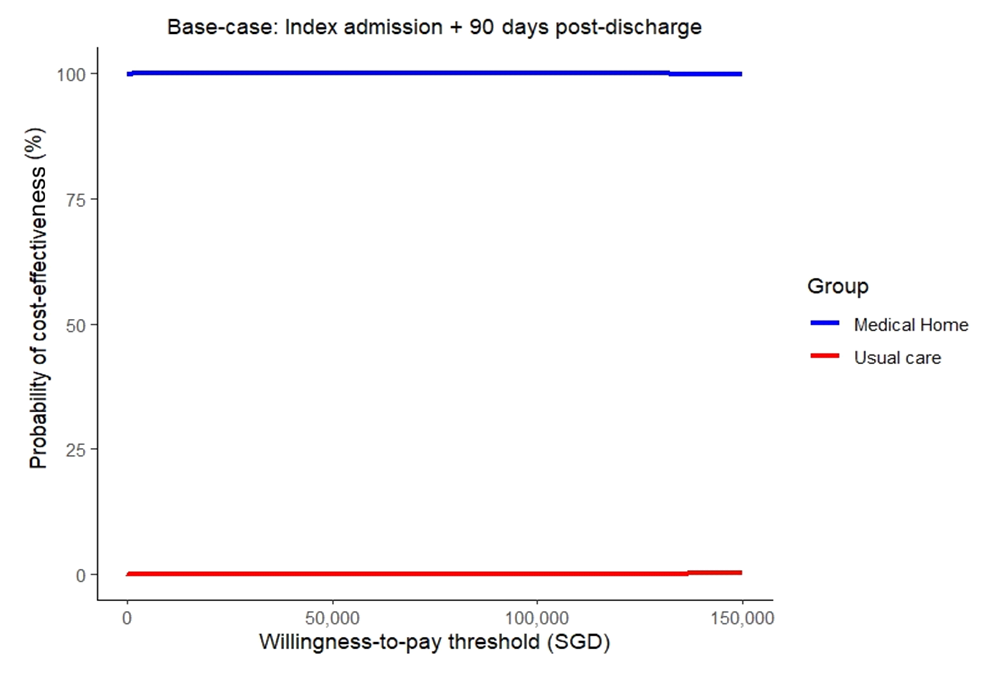
To assess the uncertainty in costs and outcomes, 10,000 bootstrapping iterations were conducted in a probabilistic sensitivity analysis (PSA). Results were summarised by calculating the probability of the MH group being cost-effective across various WTP thresholds, plotted in a cost-effectiveness acceptability curve (CEAC). The same subgroup analyses by excluding U-turn patients and deaths were performed to assess the cost-effectiveness.
RESULTS
Table 2 shows the baseline characteristics of patients and associated outcomes from the study. Patients in the MH group were generally older (UC 78.1, SD 10.2; MH 81.0, SD 10.1; P=0.022), the majority had no formal education (UC 25%; MH 47%; P=0.002), and exhibited higher CFS at admission compared with those in the usual care group (UC 5.0, SD 1.4; MH 5.3, SD 1.2; P=0.043).
Table 2. Baseline characteristics.
|
Characteristics |
Usual care, n=125 |
Medical Home, n=125 |
P value |
|
Age, mean (SD), years |
78.1 (10.2) |
81.0 (10.1) |
0.022 |
|
Sex, no. (%) |
|
|
|
|
Male |
49 (39) |
49 (39) |
>0.999 |
|
Female |
76 (61) |
76 (61) |
|
|
Ethnicity, no. (%) |
|
|
|
|
Chinese |
73 (58) |
76 (61) |
0.735 |
|
Malay |
27 (22) |
30 (24) |
|
|
Indian |
20 (16) |
14 (11) |
|
|
Eurasian and others |
5 (4) |
5 (4) |
|
|
Education level, no. (%) |
n=125 |
n=108 |
0.002 |
|
No formal education |
31 (25) |
51 (47) |
|
|
Primary school and below |
44 (35) |
31 (29) |
|
|
Secondary school/pre-university/polytechnic |
49 (39) |
25 (23) |
|
|
University |
1 (0.8) |
1 (0.9) |
|
|
CCI score, mean (SD) |
n=125 |
n=117 |
|
|
|
7.3 (3.3) |
7.4 (3.0) |
0.805 |
|
CFS, mean (SD) |
5.0 (1.4) |
5.3 (1.2) |
0.043 |
|
Patient Acuity Category Scale, no. (%) |
n=117 |
n=87 |
0.181 |
|
P2 |
117 (100) |
85 (98) |
|
|
P3 |
0 (0) |
2 (2) |
|
CCI: Charlson Comorbidity Index; CFS: Clinical Frailty Scale; SD: standard deviation; UC: usual care
P values in bold indicate statistical significance.
Patient-centred outcomes: Clinical, functional, and experience outcomes
Patient-centred outcomes are presented in Table 3. Clinical outcomes, including readmission, mortality, and adverse event rates within 90 days post-index discharge, did not reveal significant differences between the 2 groups. In contrast, the MH group had a statistically significant shorter length of stay, averaging 5.7 days (SD 2.8), compared with 6.8 days (SD 4.1) in the UC group. Multiple regression analysis, adjusted for confounders, showed a reduction of 1.81 days (standard error [SE] 0.51; P<0.001) in the MH group compared with the UC group.
Functional outcomes measured by MBI and EQ-5D scores revealed no significant differences between the 2 groups at admission, discharge, and 90 days post-index discharge.
The experience outcome that assessed caregiver burden showed a significant difference at 90 days post-index discharge, with an average score of 10.78 (SD 6.94) in the UC group versus 7.67 (SD 6.60) in the MH group. However, this statistically significant result did not persist after adjustment for confounders. Additionally, caregiver’s overall experience score was statistically different between the 2 groups (UC 1.96, SD 0.50; MH 1.62, SD 0.53; P<0.001), with a lower score (indicating better experience) in the MH group after adjustment (-0.35, SE 0.11; P=0.002). There was no significant difference in the patients’ overall experience scores.
Similar results were observed in the subgroup analyses (Supplementary Annexes S3 and S4). The MH group had a statistically significantly lower length of stay and better caregiver’s overall experience score, after adjustment, compared with the UC group.
Cost-effectiveness
The base-case results of the cost-effectiveness analysis, spanning from index admission to 90 days post-index discharge, indicate that the MH group is more cost-effective than the UC group (Table 4). The UC group incurred costs of SGD11,111 (SE 3860), while the MH group incurred SGD6356 (SE 3660), yielding a cost saving of SGD4755 (95% confidence interval [CI] -SGD8053 to -SGD1456) for the MH group after adjusting for confounders. Furthermore, the MH group achieved an incremental QALY gain of 0.02 (95% CI -0.01 to 0.04), demonstrating its dominance due to lower costs and higher QALY gains. The incremental NMB of SGD6895 (95% CI SGD1945 to SGD11,845) at the WTP of SGD121,161 further supports the cost-effectiveness of the MH group. The PSA, comprising 10,000 iterations of bootstrapping, demonstrated a 100% likelihood of MH group being cost-effective across all evaluated WTP thresholds, as illustrated in the CEAC in Fig. 1. The results from the sensitivity analysis are consistent with the base-case results, indicating the robustness of the base-case. The healthcare resource utilisation during index admission and 90 days post-index discharge are detailed in Supplementary Annexes S5 and S6, respectively.
Table 3. Patient-centred outcomes: clinical, functional, and experience outcomes.
|
Patient-centred outcomes |
Usual care, n=125 |
Medical Home, n=125 |
P value |
Multiple regressions with adjustmenta |
|
|
Clinical outcomes |
|
|
|
OR (95% CI) |
P value |
|
Readmission up to 90 days post-discharge, no. (%) |
45 (36.0) |
44 (35.2) |
>0.999 |
0.85 (0.42–1.69) |
0.642 |
|
Mortality within 90 days post-discharge, no. (%) |
7 (5.6) |
10 (8.0) |
0.617 |
0.29 (0.04–1.41) |
0.160 |
|
Nursing home placement at 90 day post-discharge, no. (%) |
0 (0) |
0 (0) |
>0.999 |
– |
– |
|
Length of stay during index admission, mean (SD) |
6.8 (4.1) |
5.7 (2.8) |
0.011 |
Coefficient (SE) -1.81 (0.51) |
<0.001 |
|
Length of stay during index admission, median (IQR) |
6.0 (4.0–8.8) |
5.0 (4.0–6.0) |
0.053 |
|
|
|
Adverse event, no. (%) |
5 (4.0) |
2 (1.6) |
0.443 |
OR (95% CI) 0.23 (0.01–1.67) |
0.203 |
|
Thrombophlebitis |
1 (0.8) |
0 (0) |
|
|
|
|
Medication error |
0 (0) |
0 (0) |
|
|
|
|
New pressure sores |
0 (0) |
0 (0) |
|
|
|
|
Falls |
0 (0) |
1 (0.8) |
|
|
|
|
Catheter-related urinary tract infection |
0 (0) |
1 (0.8) |
|
|
|
|
Acute delirium |
4 (3.2) |
0 (0) |
|
|
|
|
Functional outcomes |
|
|
|
|
|
|
Modified Barthel Index score (MBI) |
|
|
|
Coefficient (SE) |
|
|
Upon admission, mean (SD) |
69.51 (27.81) |
68.02 (33.61) |
0.703 |
– |
– |
|
Upon discharge, mean (SD) |
72.97 (27.04) |
69.44 (33.01) |
0.379 |
0.46 (2.88) |
0.873 |
|
90-day post-discharge, mean (SD) |
76.72 (26.81) |
74.75 (29.39) |
0.627 |
0.77 (3.09) |
0.803 |
|
EQ-5D-5L utility score |
|
|
|
|
|
|
Upon admission, mean (SD) |
0.34 (0.44) |
0.38 (0.45) |
0.461 |
– |
– |
|
Upon discharge, mean (SD) |
0.52 (0.44) |
0.46 (0.47) |
0.357 |
0.06 (0.05) |
0.229 |
|
90-day post-discharge, mean (SD) |
0.48 (0.45) |
0.51 (0.47) |
0.628 |
0.10 (0.06) |
0.067 |
|
Experience outcomes |
|
|
|
|
|
|
Caregiver burden score |
|
|
|
|
|
|
Upon admission, mean (SD) |
12.90 (8.79) |
12.32 (7.84) |
0.685 |
– |
– |
|
Upon discharge, mean (SD) |
12.19 (7.95) |
10.77 (7.50) |
0.301 |
0.24 (1.70) |
0.890 |
|
90-day post-discharge, mean (SD) |
10.78 (6.94) |
7.67 (6.60) |
0.020 |
-2.12(1.55) |
0.177 |
|
Patient’s overall experience, mean (SD) |
1.77 (0.47) |
1.66 (0.48) |
0.153 |
-0.10 (0.09) |
0.279 |
|
Caregiver’s overall experience, mean (SD) |
1.96 (0.50) |
1.62 (0.53) |
<0.001 |
-0.35 (0.11) |
0.002 |
CCI: Charlson Comorbidity Index; CFS: Clinical Frailty Scale; CI: confidence interval; EQ-5D-5L: EuroQol-5 dimension-5 level; OR: odds ratio; IQR: interquartile range; SD: standard deviation; SE: standard error
a Multiple logistic regressions for dichotomous outcome and multiple linear regression for continuous outcome, with adjustment for age, sex, education level, CCI score, CFS, and Patient Acuity Category Scale.
P values in bold indicate statistical significance.
Table 4. Cost-effectiveness analysis results from index admission to 90 days post-index discharge.
|
Strategies |
Cost (SE)a |
Incremental Cost (95% CI)a |
QALY (SE)a |
Incremental QALY (95% CI)a |
Incremental NMB (95% CI)a |
|
Usual care |
SGD11,111 (3860) |
– |
0.13 (0.03) |
– |
– |
|
Medical Home |
SGD6356 (3660) |
-SGD4755 (-SGD8053 to -SGD1456) |
0.15 (0.03) |
0.02 (-0.01 to 0.04) |
SGD6895 (SGD1945 to SGD11,845) |
CI: confidence interval; NMB: net monetary benefit; QALY: quality-adjusted life year; SE: standard error
a Adjusted for age, sex, education level, Charlson Comorbidity Index, Clinical Frailty Scale, and Patient Acuity Category Scale.
Fig. 1. Cost-effectiveness acceptability curve from a probabilistic sensitivity analysis of cost-effectiveness analysis.
Subgroup analyses, excluding U-turn cases and deaths, corroborate the base-case findings, showing positive incremental NMB of SGD7361 (95% CI SGD2423 to SGD12,299) and SGD5049 (95% CI SGD728 to SGD9370), respectively, shown in Supplementary Annexes S7 and S8.
DISCUSSION
Main findings
This study demonstrates that MH is a cost-effective alternative to conventional inpatient care, with an incremental NMB of SGD6895 (95% CI SGD1945 to SGD11,845) generated from cost savings of SGD4755 and QALY gain of 0.02 per patient at the WTP threshold of SGD121,161. These benefits were achieved while maintaining comparable clinical and functional outcomes, with no significant differences in 90-day readmission rates, mortality, institutionalisation, and adverse event rates. Notably, the MH group had shorter length of stay (5.7 versus [vs] 6.8 days; P=0.011 and adjusted P<0.001) with better caregiver experiences (1.62 vs 1.96; P<0.001 and adjusted P=0.002), suggesting value-based care and more efficient resource utilisation.
Comparison with existing literature
This study’s findings align with but extend beyond previous research in several ways. While an earlier study by Leff et al. demonstrated the feasibility of HaH programmes, it reported longer lengths of stay and higher costs.7 In contrast, this study observed both reduced length of stay and cost savings. The cost-effectiveness observed (incremental QALY gain: 0.02) is comparable to findings from Harris et al., who reported similar QALY gains in their randomised controlled trial, though in a younger population.9
Strengths and limitations of study
This study demonstrates several strengths. First, it focused on the impact of HaH on an older frail patient population, which is currently under-studied. These patients are often admitted to the wards as they are considered unsafe for home treatment due to perceived higher risk of deterioration and complexity of care. However, this conventional approach increases the risk of iatrogenic complications such as acute delirium, falls, functional decline, and nosocomial infections leading to prolonged hospitalisation, consistent with the observation of longer length of stay and higher inpatient care episode costs in the UC group. This study’s findings suggest that when appropriately selected, older frail patients with suitable medical conditions can be safely and effectively cared for under HaH, and reap the benefits of person-centred value-based care with shorter length of stay and improved caregiver satisfaction at lower costs.
A second key strength of this study lies in the extended 90 days post-discharge follow-up period, providing insight into longer-term outcomes, which were potentially missed in shorter evaluations. The study captured the full spectrum of healthcare utilisation patterns, showing comparable readmission rates between MH and UC (36% vs 35%; P>0.999). Additionally, this study demonstrated sustained functional outcomes through MBI scores and notably, revealed lasting benefits for caregivers, with significantly reduced caregiver burden scores at 90 days (MH vs UC: 7.67 vs 10.78; P=0.02). The loss of significance in the multiple regression analysis is likely the result of the small sample size.
Another strength of this study is its relevance in Asian healthcare contexts where family caregivers play a crucial role in long-term care arrangements, an area currently not well studied in the Asian HaH context. Contrary to perceived concerns, HaH care resulted in better caregiver experiences and lower caregiver stress levels at 90 days post-discharge. The positive outcomes could be attributed to the programme’s focus on caregiver empowerment and education during MH care, resulting in improved caregiver confidence when caring for patients at home even in the longer term. HaH care also enables the care team to better understand and address caregiving concerns early, facilitating timely implementation of necessary community care support services.
This study had several limitations. The non-randomised design of the study may introduce selection bias, although it was adjusted for key confounders. Additionally, more robust tools such as the National Early Warning Score updated (NEWS2) could have been used to ensure better comparability of clinical acuity between the 2 groups of patients. The generalisability of the findings is limited by the small sample size and single-centre setting within Singapore’s healthcare context.
Furthermore, the single-item 4-point scale used to assess overall patient and caregiver experiences was not a validated or internationally recognised tool. The authors analysed such discrete data as continuous data. While this approach is common and allows for the use of parametric statistical methods, it may not fully capture the ordinal nature of the data. Consequently, this simplification could affect the precision and interpretation of the results. The presence of live-in domestic helpers may reduce the physical caregiving burden on primary caregivers and could potentially influence their reported experiences. However, this does not invalidate the findings because the study aimed to evaluate empowerment, confidence, stress levels, and overall experiences among primary caregivers, which can remain significant even when some physical tasks are delegated. Future research should consider adopting validated satisfaction measures and explore the impact of household help on caregiver-reported outcomes to enhance comparability and robustness of findings.
In the cost-effectiveness analysis, the authors evaluated costs from the health system perspective only, due to the absence of data on the caregivers’ and patients’ productivity losses. Without these data, the authors were unable to incorporate broader societal costs. The exclusion of these indirect and informal care components may lead to an underestimation of the total economic burden associated with home care services. As such, future evaluations incorporating these indirect costs would offer a more comprehensive understanding of the true economic burden to society.
CONCLUSION
An HaH care model like MH is a value-based and cost-effective alternative to inpatient admission for selected frail older patients, who present with acute medical conditions. The model has comparable clinical and functional outcomes, achieved with shorter length of stay at reduced cost. Improved caregiver experiences as well as lower caregiver stress levels at 90 days post-discharge make HaH care the preferred strategy over conventional inpatient ward care for frail older adults in Singapore.
The results of this study, in an ageing population, lend great support to the move towards shifting care from hospitals to the community. The findings have crucial long-lasting implications for future healthcare system planning and care model delivery, especially to guide strategies to help the frail patient population avoid admission or prolonged hospitalisation.
Future research directions
There are several key areas for future investigation. Priority should be given to developing predictive models to identify optimal patient selection criteria for HaH-type of services. Further research is also needed to evaluate cost-effectiveness across different healthcare settings and funding models, especially in diverse Asian contexts. Additionally, studies examining the integration of remote monitoring technologies and qualitative research, further exploring patient and caregiver experiences, could inform service improvements and optimise the model’s implementation in different cultural settings.
Annex S1. Medical Home (MH) patient selection criteria: inclusion and exclusion criteria.
Annex S2. Patient flow.
Annex S3. Subgroup analysis by excluding U-turn patients: patient-centred outcomes.
Annex S4. Subgroup analysis by excluding deaths: patient-centred outcomes.
Annex S5. Healthcare resource utilisation and associated costs during index admission.
Annex S6. Healthcare resource utilisation and associated costs during 90 days post-index discharge.
Annex S7. Subgroup analysis by excluding U-turn patients: cost-effectiveness outcomes.
Annex S8. Subgroup analysis by excluding deaths: cost-effectiveness outcomes.
Acknowledgements
The authors would like to thank Medical Home colleagues and research assistants (Cherlyen Teo, Charmaine Ng Bao Xuan, and Claudius Lee Ron Ern) from Corporate Development who contributed to the research study as well as MOHT for funding the study.
REFERENCES
- National Population and Talent Division, Singapore Department of Statistics, Ministry of Home Affairs, et al. Population in Brief 2023. https://www.population.gov.sg/files/media-centre/publications/population-in-brief-2023.pdf. Accessed 1 April 2026.
- Rodrigues LP, de Oliveira Rezende AT, Delpino FM, et al. Association between multimorbidity and hospitalization in older adults: systematic review and meta-analysis. Age Ageing 2022;51:afac155.
- Megido I, Sela Y, Grinberg K. Cost effectiveness of home care versus hospital care: a retrospective analysis. Cost Eff Resour Alloc 2023;21:13.
- Cai Y, Venkatachalam I, Tee NW, et al. Prevalence of Healthcare-Associated Infections and Antimicrobial Use Among Adult Inpatients in Singapore Acute-Care Hospitals: Results From the First National Point Prevalence Survey. Clin Infect Dis 2017;64:S61-7.
- Creditor MC. Hazards of hospitalization of the elderly. Ann Intern Med 1993;118:219-23.
- Oh KM, Warnes AM, Bath P. Effectiveness of a rapid response service for frail older people. Nurs Older People 2009;21:25-32.
- Leff B, Burton L, Mader SL, et al. Hospital at home: feasibility and outcomes of a program to provide hospital-level care at home for acutely ill older patients. Ann Intern Med 2005;143:798-808.
- Wang X, Stewart C, Lee G. Patients’ and caregivers’ perceptions of the quality of hospital-at-home service: A scoping review. J Clin Nurs 2024;33:817-38.
- Harris R, Ashton T, Broad J, et al. The effectiveness, acceptability and costs of a hospital-at-home service compared with acute hospital care: a randomized controlled trial. J Health Serv Res Policy 2005;10:158-66.
- Rossinot H, Marquestaut O, de Stampa M. The experience of patients and family caregivers during hospital-at-home in France. BMC Health Serv Res 2019;19:470.
- Caplan GA, Sulaiman NS, Mangin DA, et al. A meta-analysis of “hospital in the home”. Med J Aust 2012;197:512-9.
- Arsenault-Lapierre G, Henein M, Gaid D, et al. Hospital-at-Home Interventions vs In-Hospital Stay for Patients With Chronic Disease Who Present to the Emergency Department: A Systematic Review and Meta-analysis. JAMA Netw Open 2021;4:e2111568.
- Liu AL, Taylor DM. Adverse events and complications among patients admitted to hospital in the home directly from the emergency department. Emerg Med (Fremantle) 2002;14:400-5.
- Mas MÀ, Santaeugènia SJ, Tarazona-Santabalbina FJ, et al. Effectiveness of a Hospital-at-Home Integrated Care Program as Alternative Resource for Medical Crises Care in Older Adults With Complex Chronic Conditions. J Am Med Dir Assoc 2018;19:860-3.
- Montalto M, Lui B, Mullins A, et al. Medically-managed Hospital in the Home: 7 year study of mortality and unplanned interruption. Aust Health Rev 2010;34:269-75.
- Singapore Department of Statistics. Consumer Price Index (CPI) Highlights. https://www.singstat.gov.sg/find-data/explore-data-themes/economy-prices/consumer-price-index/latest-news-data. Accessed 23 July 2025.
- Monetary Authority of Singapore. Exchange Rates. SGD/USD. https://www.mas.gov.sg/statistics/exchange-rates. Accessed 2 April 2026.
- Singapore Department of Statistics. Gross Domestic Product: Per Capita CNI and Per Capita GDP At Current Prices, Annual. https://tablebuilder.singstat.gov.sg/table/TS/M01512. Accessed 23 July 2025.
- Tan-Torres Edejer T, Baltussen R, Adam T, et al (Eds). Making Choices in Health: WHO Guide to Cost-Effectiveness Analysis. Geneva: World Health Organization; 2003.
Ethics approval was granted by the National Healthcare Group Domain Specific Review Board (2020/00326).
The Medical Home programme was supported by 2 funding sources: an operations grant led by Dr Ang Yan Hoon that provided SGD4.28 million over 2 years (FY2019–2020) to fund the pilot programme delivery; and an evaluation grant from MOH Office for Healthcare Transformation (MOHT) Pte Ltd led by Dr Bph Toon Li, providing SGD374,194.80 to support research evaluation activities. The operations grant funded all aspects of service delivery including staff, equipment, and operational costs, while playing no role in the study design or publication. MOHT explicitly granted Alexandra Health Pte Ltd (AHPL) full autonomy over publications without requiring prior approval. AHPL was required to acknowledge MOHT as the funding source and share all publications with them, while retaining all intellectual property rights from the collaboration. The authors declare they have no affiliations with any commercial organisation with a direct financial interest in the subject or materials discussed in the manuscript.
Dr Yan Hoon Ang, Geriatric Medicine, Khoo Teck Puat Hospital, 90 Yishun Central, Singapore 768828. Email: [email protected]
