

ABSTRACT
Introduction: Trastuzumab deruxtecan (T-DXd) has revolutionised treatment for metastatic breast cancer (MBC). While effective, its high cost and toxicities, such as fatigue and nausea, pose challenges.
Method: Medical records from the Joint Breast Cancer Registry in Singapore were used to study MBC patients treated with T-DXd (February 2021–June 2024). This study was conducted to address whether reducing dose intensity and density may have an adverse effect on treatment outcomes.
Results: Eighty-seven MBC patients were treated with T-DXd, with a median age of 59 years. At the time of data cutoff, 32.1% of patients were still receiving T-DXd. Over half (54%) of the patients received treatment with an initial relative dose intensity (RDI) of ≥85%. Overall median real-world progression-free survival (rwPFS) was 8.1 months. rwPFS was similar between RDI groups (<85%: 8.7 months, ≥85%: 8.1 months, P=0.62). However, human epidermal growth receptor 2 (HER2)-positive patients showed significantly better rwPFS outcomes compared to HER2-low patients (8.8 versus 2.5 months, P<0.001). Only 16% with central nervous system (CNS) involvement had CNS progressive disease on treatment. No significant progression-free survival (PFS) differences were found between patients with or without CNS disease, regardless of RDI groups. Five patients (5.7%) developed interstitial lung disease (ILD), with 3 (3.4%) having grade 3 events. Two required high-dose steroids and none were rechallenged after ILD. There were no fatalities.
Conclusion: Our study demonstrated that reduced dose intensity and density had no significant impact on rwPFS or treatment-related toxicities. Furthermore, only 5.7% of patients developed ILD. T-Dxd provided good control of CNS disease, with 82% of patients achieving CNS disease control.
CLINICAL IMPACT
What is New
- Reduced dose intensity had no significant impact on real-world progression-free (rwPFS) survival or treatment-related toxicities.
- Trastuzumab deruxtecan provided good control of central nervous system disease.
Clinical Implications
- Similar rwPFS between different relative dose intensity groups suggests that dose reduction may be a viable option for managing toxicities.
- Better rwPFS outcomes in human epidermal growth receptor 2 (HER2)-positive patients highlight importance of HER2 status in treatment planning.
- Development of interstitial lung disease in a small percentage of patients underscores need for monitoring this potential side effect.

Human epidermal growth receptor 2 (HER2)-positive breast cancer is recognised as a particularly aggressive subtype, associated with a poorer prognosis and a higher risk of recurrence.1,2 The current standard of care for first-line treatment for HER2-positive metastatic breast cancer (MBC) includes a combination of trastuzumab and pertuzumab alongside chemotherapy which have demonstrated improvement in both progression-free survival (PFS) and overall survival (OS) in the CLEOPATRA trial.3,4 The treatment landscape for patients in second-line treatment and beyond has undergone a significant change with the introduction of trastuzumab deruxtecan (T-DXd), an antibody-drug conjugate.5 With its high drug-to-antibody ratio,6-8 T-DXd enables more efficient delivery of its highly potent microtubule inhibitor payload to tumour cells. Due to its strong ability to cross cell membranes, T-DXd exhibits a pronounced bystander effect, enabling it to spread within the tumour microenvironment and affect adjacent tumour cells, irrespective of their HER2 expression levels.9
Results from the pivotal DESTINY-Breast series of studies underscore its efficacy. The phase III DESTINY-Breast0210 trial (for third-line treatment and beyond in HER2-positive MBC) and DESTINY-Breast0311 trial (for second-line treatment following trastuzumab and pertuzumab in HER2-positive MBC) demonstrated superior median PFS and OS compared to standard-of-care regimens. Furthermore, DESTINY-Breast0412 and DESTINY-Breast0613 trials evaluated T-DXd in HER2-negative MBCs with varying levels of HER2 expression, categorised as HER2-low and HER2-ultralow, respectively. These studies also reported improved efficacy compared to chemotherapy of physician’s choice.
T-DXd was first approved by Singapore’s Health Sciences Authority (HSA) in October 2021 for treatment of patients with unresectable or HER2-positive MBC who have received 2 or more prior anti-HER2-based regimens in the metastatic setting.14 It was later approved in April 2023 for the use in the treatment of unresectable or metastatic HER2-low (immunohistochemistry [IHC] 1+ or IHC 2+/in situ hybridisation positive) breast cancer patients who have received at least 1 prior line of chemotherapy in the metastatic setting or developed disease recurrence during or within 6 months of adjuvant chemotherapy completion.15
Where accessible, medical oncologists at the National Cancer Centre Singapore (NCCS) have been prescribing T-DXd since its approval. Although efficacious, adverse events (AEs) associated with T-DXd therapy such as fatigue and nausea can be challenging.16-18 This can be mitigated in part with dose reduction.19,20 Adding to the burden of toxicities is a high drug cost associated with novel therapeutics. Singapore’s healthcare financing system follows a mixed model, which combines government subsidies, mandatory savings, private insurance and out-of-pocket cost to patients.21 The cost of novel therapeutics is not fully reimbursed. As such, a practice has evolved to round down the prescribed dose to match the dose per vial or extend the interval between doses with the intent to ameliorate toxicities and expenses. However, there are concerns that these practices might lead to inferior outcomes compared to those reported in clinical trials.
As opposed to tightly controlled trials which mandate strict adherence to dose modification guidelines and dosing intervals, real-world settings often allow for more flexibility and extension of data to patients who may be less fit and otherwise ineligible for study inclusion.22-24 This variation may influence treatment outcomes.
Hence, this retrospective analysis was designed to evaluate T-DXd treatment data from NCCS. The study examines local prescription practices by medical oncologists managing MBC, such as dosing and scheduling of T-DXd. Our primary objective was to evaluate real-world PFS (rwPFS) for patients receiving upfront standard dosing versus (vs) reduced dosing of T-DXd. We also evaluated rates of disease control for patients with CNS metastases and compared the difference in AEs of special interest specifically interstitial lung disease (ILD) in patients who received standard vs attenuated dosing of T-DXd.
METHOD
The Joint Breast Cancer Registry (JBCR) was established to collect comprehensive real-world data on patients with breast cancer treated across multiple public healthcare institutions in Singapore.25 Medical records from the JBCR were reviewed to identify patients aged 21 years or older who were treated with at least 1 dose of T-DXd for MBC between 1 February 2021 and 30 June 2024. T-DXd was accessible via the special access route prior to HSA approval. Patients enrolled in clinical trials evaluating T-DXd were excluded. HER2-positive disease is defined according to the American Society of Clinical Oncology-College of American Pathologists guidelines, whereas HER2-low disease refers to patients with HER2 IHC scores of 1+ or 2+ with negative fluorescent in situ hybridisation (FISH).26
We calculated the relative dose intensity (RDI) of each dose of T-DXd received by patients. RDI is a measure used to describe dose delays and/or reductions occurring with a chemotherapy regimen. RDI is calculated based on the following formula:
We defined RDI <85% as clinically significant reduction as maintaining RDI has been associated with improved survival in advanced ovarian and breast cancer in both randomised clinical trials and retrospective observational studies.27 We utilised the RDI from the first treatment cycle in our analysis to differentiate between patients who received upfront dose reductions and those who maintained full dosing, aiming to demonstrate that the decision to reduce the initial dose did not adversely affect treatment outcomes.
Tumour assessment with either positron emission tomography or computed tomography (CT) scan was performed between 6-weekly to 4-monthly as per routine clinical practice. Patients who had symptoms suggestive of CNS involvement or with known CNS disease also underwent either CT or magnetic resonance imaging brain.
The primary endpoint of our study was rwPFS which is defined as the time from start of treatment to evidence of clinical or radiological progressive disease (PD) or death, whichever occurred first for patients. Secondary endpoints included first site of PD (CNS or extracranial), incidence rate and severity of ILD. The severity of ILD AEs was graded according to National Cancer Institute’s Common Terminology Criteria for Adverse Events version 5.28 Patients who are alive and do not have any PD will be censored at the date of last follow-up.
Demographic and clinicopathological characteristics as well as treatment details were compared between patients with RDI ≥85% and <85% at the first cycle using the Chi-square test for the categorical variables and Mann-Whitney U test for the continuous variables. The site of PD was also compared by RDI of the first cycle using the Chi-square test. We chose RDI for the first cycle rather than average RDI, as our study focuses on evaluating outcomes in patients who start at a lower dose rather than those who undergo dose reductions due to AEs.
rwPFS were estimated with their corresponding two-sided 95% confidence interval (CI) using Kaplan-Meier method. Difference in survival between the 2 groups was assessed using log-rank test. The reverse Kaplan-Meier method was used to estimate the median follow-up time and corresponding two-sided 95% CI. All P values were two-sided and those less than 0.05 were considered statistically significant. Statistical analyses were performed by using R software version 4.4.1.
RESULTS
A total of 87 female patients who received at least 1 dose of T-DXd between December 2021 and June 2024 were identified (Fig. 1). Their median age was 59.0 (range 32–91) years at the first cycle. Majority of patients had invasive ductal carcinoma (83.9%), estrogen receptor positive disease (67.8%) and HER2-positive disease (78.2%). The remaining patients had HER2-low or HER2-ultralow disease. Approximately one-third (27.6%) had brain metastasis before receiving T-DXd. Six patients (6.9%) received T-DXd as a second-line treatment, while the remaining 81 patients (93.1%) received T-DXd in the third-line or later settings. Patients received a median of 4 (range 2–15) lines of systemic treatment in the metastatic setting before receiving T-DXd. A total of 28 patients (32.1%) were still on ongoing treatment with T-DXd at the end of data collection.
Fig. 1. Consolidated Standards of Reporting Trials (CONSORT) diagram.
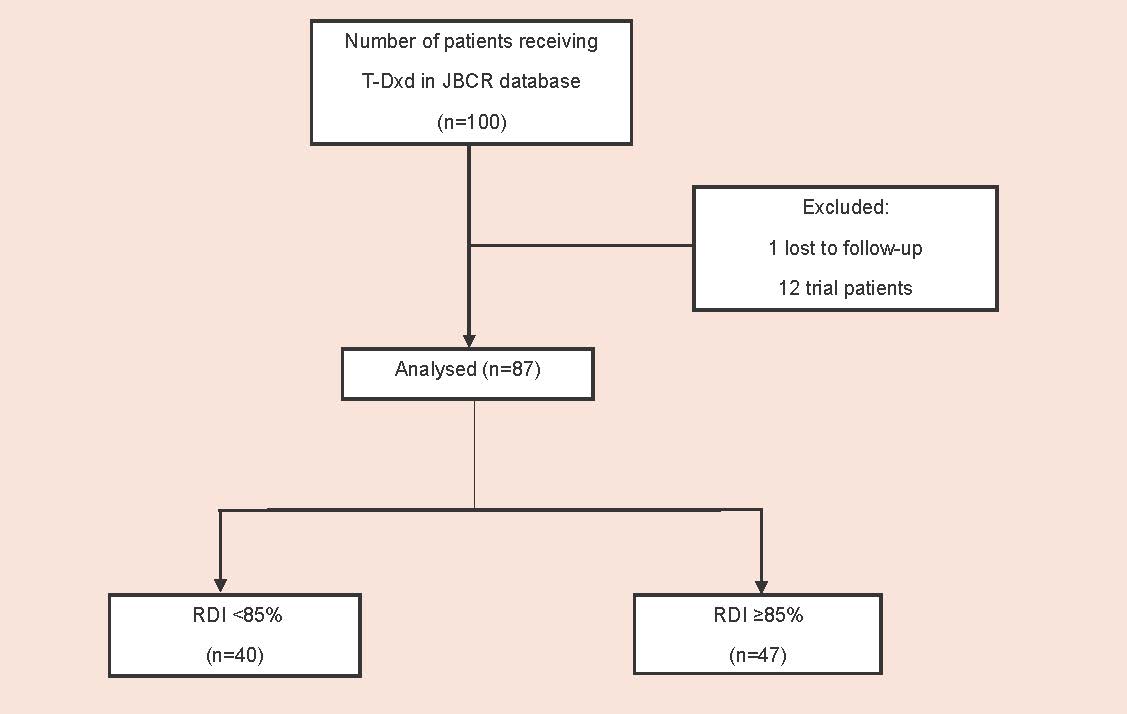 RDI: relative dose intensity; T-Dxd: trastuzumab deruxtecan; JBCR: Joint Breast Cancer Registry
Reference: Hopewell S, Chan AW, Collins GS, et al. CONSORT 2025 Statement: updated guideline for reporting randomised trials. BMJ 2025;388:e081123.
Almost half of the patients (n=40, 46%) received RDI of <85% and remaining half (n=47, 54%) received RDI of ≥85% in the first cycle of treatment. Among patients who received RDI <85%, 22 patients had longer dosing interval while 23 patients received initial dose that was <85% of calculated dose of treatment. Fifteen patients (37.5%) in the group with RDI <85% required further dose reductions during T-DXd treatment while 31 patients (66%) in the group with RDI ≥85% required dose reductions of at least 10% from the first dose (Table 1). Fourteen patients (16.1%) received only 1–2 doses of T-DXd before experiencing PD or succumbing to their illness—9 patients had HER2-positive disease, 2 patients had HER2 IHC2+, FISH negative disease and the remaining 3 patients had HER2 IHC1+ disease.
The median follow-up duration was 6.7 months. In the overall cohort, the median rwPFS was 8.1 months (95% CI, 5.4–10.1 months), with rwPFS rates of 60.0% at 6 months and 29.9% at 12 months (Table 2). When comparing patients with a relative dose intensity (RDI) of <85% to those with an RDI of ≥85% in the first cycle of treatment, the median rwPFS was similar between the 2 groups, at 8.7 months for the RDI <85% group and 8.1 months for the RDI ≥85% group (P=0.62), indicating no significant difference in PFS between these groups (Fig. 2). When divided into HER2-positive vs HER2 low disease, there was a significant difference between rwPFS outcomes of 8.8 months vs 2.5 months.
Patients were grouped by average RDI, with those <85% compared to ≥85%. The analysis showed a statistically significant difference in rwPFS: patients with average RDI <85% experienced a median rwPFS of 8.7 months, whereas patients with average RDI ≥85% had a median rwPFS of 6.1 months (P=0.044).
Table 1. Patients’ characteristics by RDI of first cycle.
Fig. 2. Real-world progression-free survival Kaplan-Meier curve for patients with RDI <85% and RDI ≥85%.
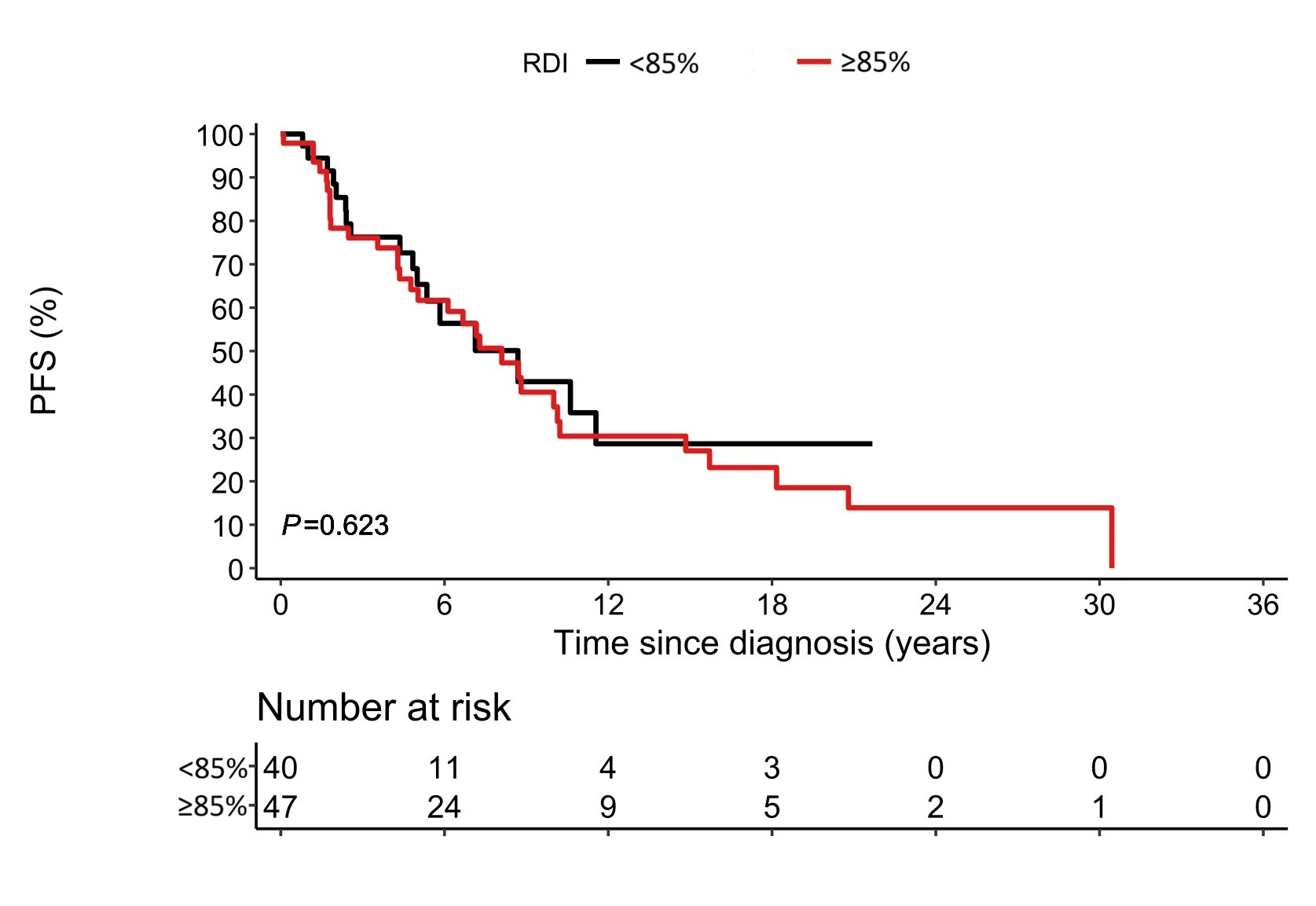 PFS: progression-free survival; RDI: relative dose intensity
Most patients with CNS disease at initiation of T-Dxd had good control of CNS disease, only 4 out of 24 (16.7%) patients had intracranial PD at treatment failure, and 10 patients (41.7%) with CNS disease at initiation continued to receive T-DXd at the time of data analysis. Eleven (10 with HER2-positive disease and 1 with HER2 IHC2+, FISH negative disease) out of 24 patients had CNS disease that were new or progressing on initiation of T-DXd and 9 of these patients achieved control with T-DXd alone (4 patients had partial response while remaining 5 patients had stable disease). There were also no significant differences between rwPFS of patients with CNS disease and those without (8.7 months vs 7.3 months, P=0.85) according to RDI (Fig. 3).
Fig. 3. Real-world progression-free survival Kaplan-Meier curve for patients with CNS metastasis and no CNS metastasis.
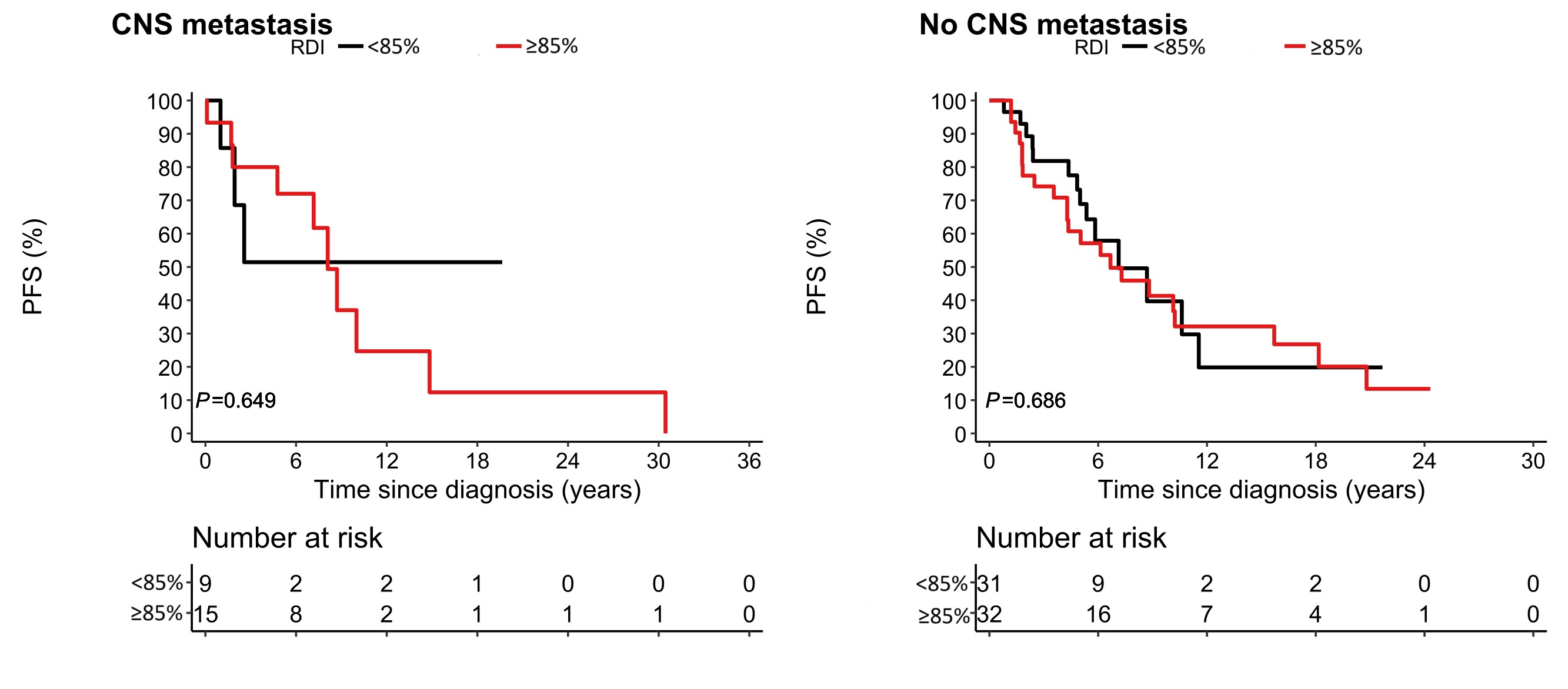 CNS: central nervous system; PFS: progression-free survival; RDI: relative dose intensity
Five patients (5.7%) developed ILD (one grade 1, one grade 2 and three grade 3 events). Among patients who developed grade 3 ILD (3.4%), they received an RDI of 81%, 83% and 91% of T-DXd in the first cycle. ILD occurred in 2 of the 3 patients following 2 doses of T-DXd and the third patient after 3 doses. Only 1 patient required admission to a high dependency unit for respiratory failure but did not require intubation. All 3 patients achieved rapid resolution of ILD through high dose steroids (steroid doses equivalent to 1 mg/kg prednisolone). None of the 5 patients were rechallenged with T-DXd following ILD and there were no fatalities.
DISCUSSION
This real-world study was premised upon concerns of diminished efficacy from prescribing patterns developed in response to practical challenges in accessing novel therapeutics, such as T-DXd. Dose reduction upfront did not seem to have an impact on patients’ PFS or toxicities from treatment from our experience. The observed association between lower average RDI (<85%) and longer rwPFS suggests that reducing the dose does not compromise efficacy and may, in fact, reflect improved tolerability and better treatment adherence. This aligns with the DE-REAL study,29 which found that dose attenuation for AEs did not impact response or survival outcomes. The TRES-Old30 retrospective registry assessed T-DXd toxicity in elderly (>70 years old) patients, reporting that 30% (n=27) initiated treatment with a reduced dose, while another 30% (n=27) required subsequent dose adjustments. Outcomes remained comparable regardless of dose modifications. To our knowledge, this is the first study to evaluate differences in rwPFS based on RDI at T-DXd initiation. This suggests that T-DXd may potentially be used at a lower starting dose or longer dosing interval, especially for MBC patients in resource limited settings. Further dose optimisation studies are needed to determine the optimal dosing regimen, with a broader inclusion of subjects.
This study demonstrated consistent benefits of T-DXd for patients with CNS metastases, with most achieving good control during treatment and a median progression-free survival of 8.7 months. The PFS of these patients receiving reduced RDI did not vary significantly compared to those with standard dosing. Nine out of 11 patients (81%) with new or progressing CNS disease in our cohort achieved CNS disease control with T-DXd alone; this response rate is comparable with results from TUXEDO-131 and DESTINY-Breast1232 but numbers remain too small for meaningful analysis.
Despite being a heavily treated cohort, about 5.7% (5 out of 87 patients) of our patients developed ILD in contrast to the 13% in DESTINY-Breast01.33 It is unclear if the lower rates of ILD are related to the lower dose intensity administered among these patients or because of pharmacogenetic differences between real-world and the DESTINY-Breast study populations. Careful monitoring, early recognition and timely glucocorticoid administration for AE management likely contributed to the avoidance of ILD fatalities in our study.34,35
The rwPFS in our study population was significantly lower than that reported in DESTINY-Breast0210 and DESTINY-Breast03.11 Our cohort included patients with a median of 4 prior lines of treatment before initiating T-DXd, fewer than those in DESTINY-Breast01.33 However, many patients in our study had a high disease burden, with several in impending or actual visceral crisis. Notably, 16.1% (14 patients) received only 1–2 doses of T-DXd before experiencing PD or succumbing to their illness. Additionally, 27.6% of patients in our study had brain metastases at T-DXd initiation, compared to 18% in DESTINY-Breast0210 and 16% in DESTINY-Breast03.11 The optimal utilisation of T-DXd potentially lies in earlier treatment settings, rather than reserving it as a salvage therapy in later lines of treatment. Additionally, delaying T-DXd administration might result in an inadvertent miss in a critical window of opportunity for disease control. Implementing the use of this treatment earlier in the treatment trajectory could therefore potentially maximise its therapeutic efficacy, interrupt disease progression more effectively and improve patient outcomes.
Most real-world data have demonstrated similar PFS compared to DESTINY-Breast0210 and DESTINY-Breast0311 results. The RELIEVE36 study showed that median time to next treatment after T-DXd was 10.4 months, 7.6 months and 3.7 months, at median follow-up of 10.4 months for patients with HER2-positive, HER2-low and HER2-0 status, respectively. Although time to treatment failure generally results in the underestimation of PFS,37 these results were comparatively more like our real-world study. Possible reasons for a lower PFS in our study include inherent differences in the multi-ethnic Singaporean population as well as higher disease burden and requires further evaluation. Relatively short follow-up and small number of patients may have also accounted for the shorter rwPFS and longer-term follow-up is warranted.
The Italian DE-REAL29 study reported an rwPFS of 16 months, which is comparable to the results seen in the DESTINY-Breast0210 and 0311 studies. In the DE-REAL study, a higher proportion of patients received T-DXd in the earlier line settings with 14% receiving T-DXd in the first- or second-line treatment, 29% in the third-line treatment and 57% in fourth line and beyond. In our study, 6.8% received T-DXd in the first or second-line treatment, 13.8% in the third-line treatment and 79.4% on the fourth line and beyond. In the DE-REAL study, 26% of patients required dose reductions due to AEs, but these reductions did not appear to affect the patients’ response and survival outcomes. However, this is a small group of patients who had received recommended dose of T-DXd prior to AEs and does not inform of the potential effects on patients receiving dose-reduced T-DXd from initiation of therapy.
This study supports the importance of ensuring fair and equitable trial allocation, in terms of geographical location and ethnicity.38 Even within the Asian category, there are nuanced differences between different ethnic groups (e.g. South Asians, Han Chinese or Japanese).39 Singapore is a multi-ethnic city-state populated by Chinese, Malays, Indians and other racial minorities.40 Genetic variations among these ethnic groups can lead to differences in how individuals respond to pharmacotherapy, for instance drug metabolism or susceptibility to AEs.41 Therefore, it is crucial for international clinical trials to incorporate a broader representation of Asian populations to better understand drug effects and uncover pharmacogenetic issues on diverse ethnicities during clinical development of novel cancer therapeutics.
CONCLUSION
This study suggests no differences in rwPFS with upfront dose reduction of T-DXd. The relatively shorter rwPFS compared to PFS observed in contemporary pivotal clinical trials suggests that the cohort in this study consisted of heavily pre-treated patients with poorer general fitness. This likely reflects the recent access to T-DXd and the relatively short follow-up period, which may have impacted the observed outcomes. With ongoing efforts to improve access to T-DXd, future inclusion of more patients and longer follow-up will be needed to confirm the findings in our study.
This study was approved by the SingHealth Centralised Institutional Board (2019/2419).
The author(s) declare there are no affiliations with or involvement in any organisation or entity with any financial interest in the subject matter or materials discussed in this manuscript.
Dr Tira J Tan, Division of Medical Oncology, National Cancer Centre, Singapore, 30 Hospital Boulevard Singapore 168583. Email: [email protected]
