

The upper gastrointestinal (UGI) endoscope is often the first scope that a novice endoscopist handles and learns to use. However, being able to navigate the UGI tract safely with proper technique to minimise complications, such as bleeding and perforation, is not equivalent to performing a complete high-quality examination of the UGI tract. A truly complete examination is one that not only avoids procedural complications but also enables careful mucosal visualisation, accurate detection of subtle pathology and ultimately helps to lower post-endoscopic upper gastrointestinal cancer (PEUGIC) rates.
Although numerous guidelines from endoscopic societies around the world have sought to define quality in upper endoscopy, it remains essential to contextualise these recommendations within the local clinical practice setting. The risk profiles for UGI malignancies, the endoscopic case mix and the workflow nuances—beginning even before the patient steps into the endoscopy suite and extending through post-procedure reporting and follow-up—can differ markedly between countries. Establishing Singapore consensus standards ensures that quality indicators remain both relevant and actionable within the country’s healthcare context. In this issue of the Annals, Yim et al. provide clear, evidence-informed, practice-oriented and Singapore-adapted standards that set the foundation for quality benchmarking and continuous improvement across institutions.1
Yim et al. divided the statements into pre-requisites, pre-, intra- and post-procedure components, with the statements targeted to (1) ensure the safety, completeness and quality of the procedure; (2) ensure adequate documentation; and (3) promote competence, accountability and a mechanism for quality auditing so that improvements can be made over time.
In terms of competence to independently perform a UGI endoscopy, in Singapore, a minimum of 200 UGI endoscopies have to be performed for accreditation. The authors acknowledge that while this threshold defines basic competency, the volume required to maintain proficiency may vary between novice and experienced endoscopists, depending on individual case exposure and complexity. Hence, they opted against recommending a fixed number. In terms of sedation, Yim et al. also advocated for endoscopy units to adopt internationally recognised sedation guidelines, with the sedationist—who is often the endoscopist—having proper training and/or accreditation to administer moderate sedation. This is particularly relevant in the Singapore context, where moderate sedation remains the standard in most diagnostic oesophago-gastro-duodenoscopy. Adequate training not only ensures patient safety but also optimises procedural comfort and completion rates, forming a key component of the overall quality framework.
Ensuring the safety of a UGI endoscopy begins from the first point of patient–physician contact prior to listing for the procedure. The pre-procedure statements emphasise that all endoscopies should be appropriately indicated and clearly documented. Informed consent must be obtained and documented and pre-procedure assessment of fitness, including relevant medical history, physical examination and evaluation of sedation-related risks, should be performed by the endoscopist or a medical professional deemed competent to explain the procedure, its benefits and potential risks. In Singapore, this responsibility may be delegated under appropriate supervision. Safety is further reinforced through the use of a team pause or time-out, supported by a documented safety checklist verifying patient identity, procedure details, allergies and key comorbidities. In the Singapore context, it is important to emphasise that this is truly a team-based process, with endoscopy nurses playing a critical role in patient safety. They often initiate the time-out, and lead checklist verification of patient and procedural details and excised specimens—tasks that may not fall under the endoscopist’s direct remit but nonetheless contribute significantly to procedural safety, efficiency and the avoidance of preventable errors. During the procedure, the patient needs to be monitored at regular intervals with documentation of all medications administered and any adverse events encountered. Following the procedure, patients should be monitored until recovery criteria are met, with clear documentation of discharge status and post-procedure instructions and a means to monitor for post-procedure and delayed complications.
A high-quality examination must not miss subtle lesions, and should help make the diagnosis and determine how to manage the patient. In Singapore, gastric and oesophageal cancers are the 7th and 19th most common cancers, and the 6th and 13th2 leading causes of cancer mortality, respectively. A key prognostic factor of survival is the stage at which the cancer is diagnosed, with some early-stage lesions amenable to endoscopic resection. Hence, improving the diagnostic accuracy and lesion detection rates in routine diagnostic endoscopy can have a direct impact on national cancer outcomes. The statements reflect the need for adequate time for careful examination using high-definition video endoscopy. Emphasis was placed on ensuring appropriate time allocation based on the indication and complexity of the case, with a recommended minimum inspection time of 7 minutes with adequate visualisation, thorough mucosal evaluation and optimised lesion detection. Strong focus was also placed on the photo documentation of 10 standard anatomical landmarks, providing objective evidence of completeness and facilitating audit of endoscopic quality. Beyond these procedural aspects, documentation remains a cornerstone of quality. Comprehensive and accurate reporting, including lesion description and use of standardised terminology and classification, is crucial not only for clinical care continuity but also for institutional quality monitoring and training feedback.
The following points were not directly addressed by the authors in this consensus but merit further discussion and form the basis for future clinical research. First, while Yim et al. rightly highlighted the importance of establishing a system to monitor delayed complications and adverse events as a means to drive continual quality improvement, one could further argue that the systematic monitoring of PEUGIC rates3 is equally essential. Such monitoring serves as a national quality benchmark, ensuring that optimal care is delivered to patients and critical feedback is provided to help identify gaps and improve the detection rates over time.
Second, although the risks of aspiration and the need for adequate fasting were briefly mentioned in the discussion of Statement 4, this issue warrants further attention in light of the increasing number of patients receiving glucagon-like peptide-1 receptor agonists. These agents are known to delay gastric emptying and may increase aspiration risk during sedation and UGI endoscopy. Similarly, as the use of sodium-glucose cotransporter-2 inhibitors becomes more prevalent, their potential impact on endoscopic safety—particularly the risk of euglycaemic ketoacidosis associated with prolonged fasting—also deserves consideration. While further studies are needed to clarify these effects, endoscopy societies in Singapore should consider following the lead of the American Society for Gastrointestinal Endoscopy4 in issuing guidance on the peri-endoscopic management of patients taking these medications.
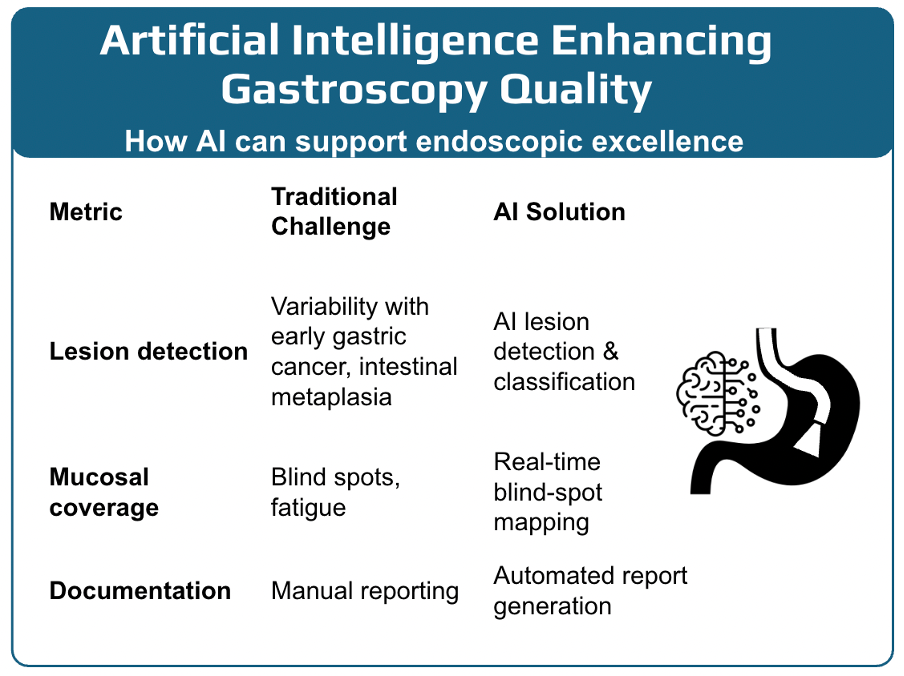
Finally, as the focus of these guidelines was that of white light endoscopy, the use of image-enhanced endoscopy and artificial intelligence (AI)-assisted endoscopy was not discussed in depth. However, these technologies are rapidly advancing and becoming integral to modern diagnostic endoscopy. As AI tools move from research into clinical practice, the establishment of clear, evidence-based guidance is critical to ensure safe, equitable and effective adoption. The Japan Gastroenterological Endoscopy Society5 recently released a position statement comprising 9 key recommendations addressing quality assurance, cost-effectiveness, safety, medico-legal responsibility and preparatory training for AI in endoscopy. This structured approach underscores the need for governance and multidisciplinary oversight as Singapore integrates AI into endoscopic workflows. Similarly, findings from a regional survey of Asian endoscopists6 revealed both optimism and caution toward AI adoption, with concerns centred on accountability, reimbursement and standardisation across healthcare systems. These insights highlight the importance of developing regionally relevant frameworks that balance innovation with practicality (Fig. 1). Moving forward, national societies such as the Gastroenterological Society of Singapore are well-positioned to contextualise international guidance and lead the development of consensus recommendations on AI-assisted endoscopy tailored to the Singapore and wider Asia-Pacific context.
Fig. 1. Artificial intelligence (AI) enhancing gastroscopy quality.
The publication of this consensus document may serve to instil a shared culture of quality and accountability in upper endoscopy practice across Singapore. The 20 statements not only serve as a framework for auditing endoscopy centres but also as a baseline upon which future enhanced imaging, AI integration and advanced training standards can be built. By embracing these standards and embedding them into daily workflow, endoscopists can collectively raise the bar for diagnostic excellence, patient safety and clinical outcomes in UGI endoscopy.
REFERENCES
- Yim HB, Lu W, Chia CTW, et al. Establishing quality standards for white light upper gastrointestinal endoscopy in Singapore: Consensus statements from the Gastroenterological Society of Singapore. Ann Acad Med Singap 2025;54:766-78.
- World Health Organization. Global Cancer Observatory: Cancer Today. https://gco.iarc.who.int/today. Accessed 4 November 2025.
- Ko MT, Fung A, Kumar A, et al. Post-endoscopy upper gastrointestinal cancer: Emerging data and opportunities to improve early detection. Best Pract Res Clin Gastroenterol 2025;75:102003.
- Sharaiha RZ, Shukla AP, Sen S, et al. American Society for Gastrointestinal Endoscopy position statement on periendoscopic management of patients on glucagon-like peptide-1 receptor agonists and sodium-glucose cotransporter-2 inhibitors. Gastrointest Endosc 2025;101:285-94.
- Mori Y, Ishihara R, Ogata H, et al. Artificial Intelligence in Gastrointestinal Endoscopy: The Japan Gastroenterological Endoscopy Society Position Statements. Dig Endosc 2025;37:1116-22.
- Quek SXZ, Koo CS, Liu L, et al. Survey on the perceptions of Asian endoscopists to artificial intelligence. Commun Med (Lond) 2025;5:313.
Not applicable, as no study participants are involved.
The authors declare there are no affiliations with or involvement in any organisation or entity with any financial interest in the subject matter or materials discussed in this manuscript.
Dr Calvin J Koh, The Gastroenterology Group, Gleneagles Hospital, Singapore. Email: [email protected]
