


Dear Editor,
We outline a case of a 59-year-old Malaysian man of Indian origin with no known past medical history apart from diabetes mellitus and hypertension, who presented with a 7-day history of unrelenting fever, myalgia, confusion and unsteady gait. He worked as a shipyard engineer and travelled between Singapore and Ipoh, Malaysia. In Ipoh, he lived in a village with domesticated cows and would frequently drink cow urine as part of his religious and cultural practice. His last travel to Ipoh had been approximately 2 weeks prior to presentation. At presentation, he was febrile (39 °C), with a blood pressure of 100/82 mmHg, and narrowed pulse pressure. He had an unsteady gait, but did not have any other physical signs of cerebellar dysfunction or neurological deficits.
At presentation, his total white cell count was elevated (18.10 x 10⁹/L, N: 4.30–10.40 x 10⁹/L), with elevated haematocrit (50.2%, N: 40.3–50.0%) and thrombocytopenia (40 x 109/L, N: 150–410 x 109/L). There was oliguric acute kidney injury, with raised serum creatinine (153 µmol/L, N: 60–110 µmol/L) and hyponatraemia (127 mmol/L, N: 135–145 mmol/L). His liver enzymes were elevated, with raised aspartate transaminase (AST, 192 U/L N: 6–35 U/L) and alanine transaminase (ALT, 86 U/L, N: 6–40 U/L). The alkaline phosphatase (ALP, 68 U/L, N: 30–110 U/L) and total bilirubin (6 µmol/L, N: 1–20 µmol/L) were not raised.
The magnetic resonance imaging of the brain did not show any leptomeningeal enhancement. Cerebrospinal fluid evaluation was bland, with no positive microbiological studies. He was managed supportively. Over a week, his platelet counts and haematocrit returned to normal limits. There was concurrent improvement in his transaminases and serum creatinine (from 318 µmol/L to 196 µmol/L). He was initially oliguric (<100 mL/day of urine) and subsequently became polyuric (>3 L/day of urine) (Supplementary Table S1).
Serological tests sent 7 days into illness for leptospirosis, rickettsiosis, Chikungunya and Dengue virus were negative. Blood smears for malaria and Brucella antibody test were also negative. The patient’s serum was sent to our reference laboratory at the Mayo Clinic for hantavirus serology. This was an enzyme immunoassay (EIA) test performed at Quest Diagnostics using a mixture of recombinant antigens from Old World and New World hantaviruses.1 Both Immunoglobulin G (IgG) and Immunoglobulin M (IgM) were reactive. The reactive serum was further tested with serial dilutions by indirect immunofluorescence (IIFT) for IgM and IgG against hantaviruses (Hantavirus Mosaic 1, EUROIMMUN, Germany)2 in which Hantaan (HTNV), Sin Nombre, Puumala, Dobrava, Seoul (SEOV) and Saaremaa viruses were included. Both IgG and IgM were reactive (Supplementary Table S2 and Fig. 1), and the highest positive titrations of IgM and IgG was obtained for anti-Hantaan reactions with IgM at 1:1000 and IgG at 1:10,000. The IIFT results suggested that the patient was most likely infected with HTNV. The patient was discharged well with good functional recovery.
Figure 1: Indirect immunofluorescence assay result.
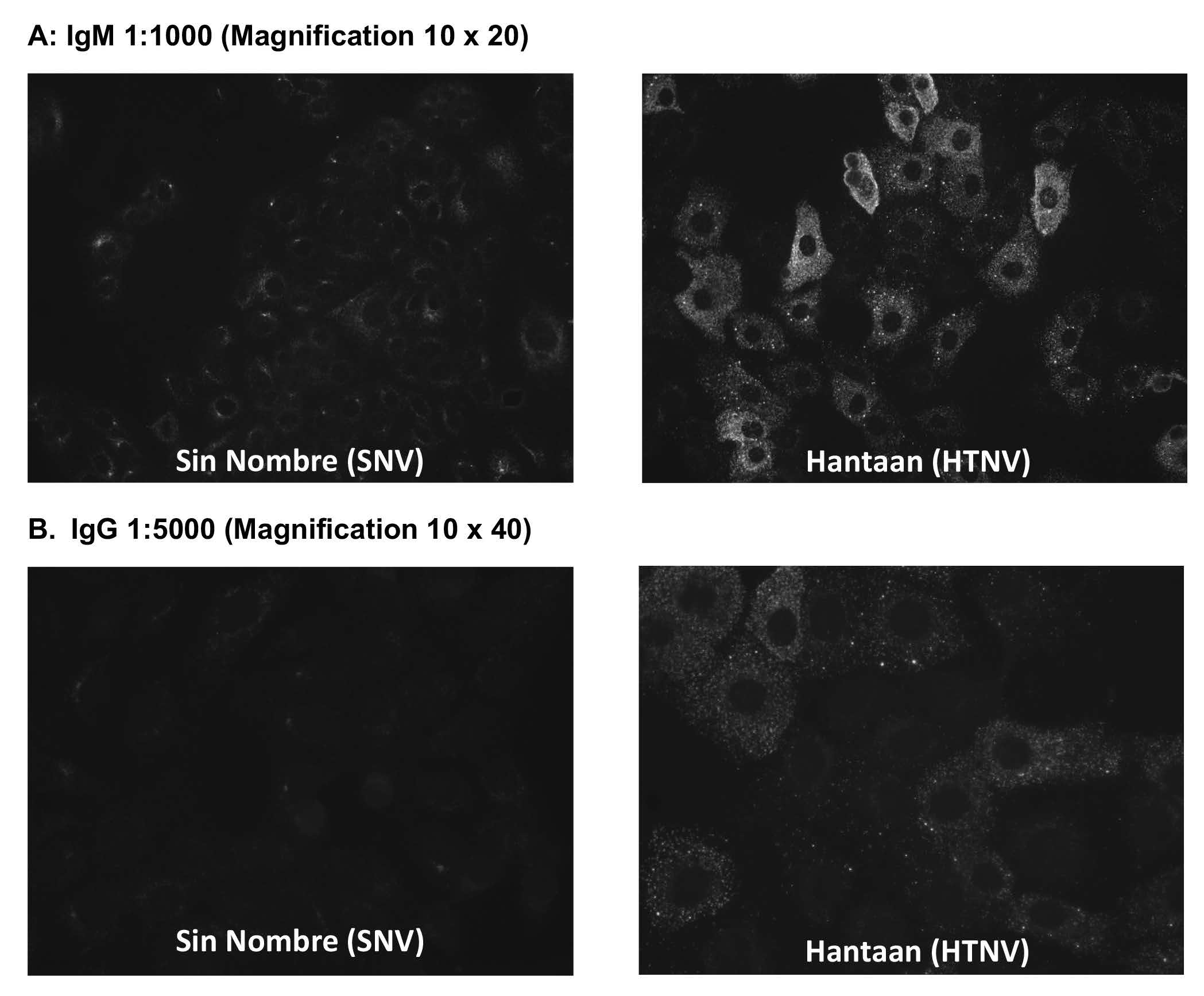
Representative images of negative and positive results were taken under microscope.
Discussion
Hantavirus infections can present with hantavirus cardiopulmonary syndrome and hantavirus haemorrhagic fever and renal syndrome (HFRS).3 In Asia, HFRS is more commonly observed.3 Although our patient had no history of direct rodent exposure, he reported consuming cow urine during his frequent travels to a rural area in Malaysia. This practice of cow urine and dung consumption has been associated with other zoonotic infections, such as Q-fever and leptospirosis, but not hantavirus infection.4 In our case, the cow urine consumed was possibly contaminated with rodent excreta carrying the virus.
The typical presenting features of HFRS include fever, hypotension with narrowed pulse pressure and acute kidney injury. There is initial oliguria followed by polyuria. Thrombocytopenia, elevated haematocrit and elevated liver enzymes are also commonly seen in HFRS.3 In patients with HFRS, central nervous system involvement in the form of posterior reversible encephalopathy syndrome has been reported.5 In our patient, the neurologic symptoms were likely due to encephalopathy, rather than direct central nervous system involvement.
Hantavirus infections are rarely reported in Singapore and Malaysia (Supplementary Table S3).6 Two prior cases had been reported in 2013, both in young males that had frequently travelled back to Malaysia.7 However, these 2 cases were detected on hantavirus serological testing by EIA only and confirmatory testing via specific antibody testing, such as immunofluorescence assay, was not performed. The only confirmed case by IIFT in Singapore prior to our case was reported in 1996.8
Although rarely reported, it is possible that hantavirus infection is underdiagnosed in Singapore. A seroprevalence study conducted from 1985 to 1986 of 142 rodents showed that 25.5% were seropositive for hantavirus.9 A more recent, larger, seroprevalence study of 1143 rodents sampled from 2006 to 2008 in Singapore demonstrated that 35.5% of sera were reactive with SEOV (tested by ELISA serological assay), which was one of the agents of HFRS.10 Furthermore, there was significant seroprevalence of hantavirus among patients studied who presented with a suspected diagnosis of dengue haemorrhagic fever (8.3% seropositive), hepatitis (8.1%), leptospirosis (2.66%) or acute nephritis (1.96%).9 In a similar seroprevalence study from Malaysia, hantavirus antibody was found to be positive in 2.5% of serum samples with chronic renal failure.6
Underdiagnosis may be because testing for hantavirus infection remains challenging, as the gold standard of plaque reduction neutralisation testing for confirmation is often inaccessible outside of research settings. IgM positivity from EIA alone may represent a false positive result, unless subsequently confirmed with the presence of IgG in a convalescent titre. Therefore, suspected cases should first be screened with EIA for hantavirus IgG and IgM. Thereafter, if positive, it should be followed up with specific hantavirus serological testing with IIFT for confirmation and simultaneous detection of specific IgM and IgG against clinically important hantaviruses, as done in our case and in an earlier case report.8 The mainstay of HFRS treatment is supportive. Reassuringly, despite the lack of an effective agent for targeted therapy against HFRS, reported mortality for severe HFRS has decreased in recent years.3
In conclusion, we report a confirmed case of HFRS in Singapore. This case was caused by HTNV, and the diagnosis was established based on both serology by EIA and specific antibody testing with indirect immunofluorescence. Given the seroprevalence of hantavirus in rodents and patients in Singapore and Malaysia, heightened alert for this condition is warranted in the appropriate clinical context and rodent exposure, which should prompt appropriate testing.
Competing interests
None reported. The authors declare no conflict of interest.
Funding/Support
None reported.
Ethics approval and consent to participate
Written informed consent was obtained from the patient prior for this report.
Acknowledgements
We thank Sarah Tan and Pei Ling Loh for performing the indirect immunofluorescence assay.
Data availability statement
Data may be made available on reasonable request from the corresponding author.
Keywords: haemorrhagic fever and renal syndrome, hantavirus, infectious diseases, microbiology, Singapore
Correspondence
Dr Jinghao Nicholas Ngiam, Division of Infectious Diseases, Department of Medicine, National University Health System, Singapore,1E Kent Ridge Rd, NUHS Tower Block, Level 10, Singapore 119228. Email: [email protected]
Supplementary materials
Supplementary Table S1: Patient’s clinical presentation and progress during hospitalisation.
Supplementary Table S3: Summary of reported Hantavirus cases in Singapore.
References
- Quest Diagnostics. Hantavirus Antibody (IgG, IgM). https://testdirectory.questdiagnostics.com/test/test-detail/37547/hantavirus-antibody-igg-igm?cc=MASTER. Accessed 18 August 2023.
- EUROIMMUN Switzerland. Hantavirus Mosaic 1 EUROPattern types… https://www.euroimmun.ch/products/infection-diagnostics/pd/emerging-diseases/278h-1/1/151708/. Accessed 18 August 2023.
- Avšič-Županc T, Saksida A, Korva M. Hantavirus infections. Clin Microbiol Infect 2019;21S:e6-e16.
- Daria S, Islam MR. The use of cow dung and urine to cure COVID-19 in India: A public health concern. Int J Health Plann Manage 2021;36:1950-2.
- Muco E, Hasa A, Rroji A, et al. Posterior Reversible Encephalopathy Syndrome in a Patient with Hemorrhagic Fever with Renal Syndrome. Case Rep Infect Dis 2020;2020:1017689.
- Lam SK, Chua KB, Myshrall T, et al. Serological evidence of hantavirus infections in Malaysia. Southeast Asian J Trop Med Public Health 2001;32:809-13.
- Chan M, Lin L, Yap G, et al. Haemorrhagic Fever with Renal Syndrome in Singapore. Ann Acad Med Singap 2013;42:257-8.
- Chan KP, Chan YC, Doraisingham S. A severe case of hemorrhagic fever with renal syndrome in Singapore. Southeast Asian J Trop Med Public Health 1996;27:408-10.
- Wong TW, Chan YC, Joo YG, et al, Yanagihara R. Hantavirus infections in humans and commensal rodents in Singapore. Trans R Soc Trop Med Hyg 1989;83:248-51.
- Griffiths J, Yeo HL, Yap G, et al. Survey of rodent-borne pathogens in Singapore reveals the circulation of Leptospira spp., Seoul hantavirus, and Rickettsia typhi. Sci Rep 2022;12:2692.
