

Dear Editor,
Infection with human papillomavirus (HPV) remains one of the most common sexually transmitted infections globally and is a leading cause of anogenital and oropharyngeal cancers.1 Although traditionally regarded as a women’s health issue because of its well-established association with cervical cancer and cervical screening programmes, HPV also contributes substantially to disease burden in men.2 Highly effective vaccines are available to prevent HPV infection and associated malignancies in both sexes.3 Many countries have therefore expanded vaccination programmes for HPV to include males.4 However, vaccine uptake among men remains suboptimal, and this disparity is often attributed to factors such as knowledge, perceived risk, cost, and healthcare provider recommendation.5,6
In Singapore, there are limited data on HPV-related knowledge and vaccination attitudes among adults, particularly men. Understanding the sociocultural and structural barriers is important to improve vaccine uptake. Therefore, this study aimed to evaluate factors influencing HPV vaccine uptake in men.
The authors conducted a cross-sectional mixed-methods study among staff aged 21 years and above at Sengkang General Hospital, a 1000-bed public acute care hospital in northeast Singapore. Quantitative and qualitative data were collected and analysed using a convergent approach to assess awareness, knowledge, attitudes, and behavioural drivers related to HPV vaccination in males.
The survey (see Supplementary Appendix S1) was informed by the study objectives, relevant literature on HPV vaccine acceptance, and Singapore’s vaccination recommendations. The study team reviewed the questions for content relevance, clarity, and appropriateness for the Singapore healthcare context.
Prior awareness of HPV was assessed using a screening question (question 5 of the survey, “Before today, had you heard of human papillomavirus [HPV]?”). Participants who reported no prior awareness did not proceed to subsequent sections.
Knowledge was assessed by questions 6–11, including HPV transmission, disease burden, and vaccine eligibility in males. The knowledge score was calculated by adding the number of correct responses. The score was categorised as adequate (≥4) or low (<4). Attitudes were assessed by questions 12–17, including perceptions of disease severity, vaccine safety, cost-effectiveness, and physician influence. A composite score was calculated as the mean of all items and categorised as positive (≥4), neutral (3–3.99), or negative (<3). HPV vaccine acceptance was assessed using self-reported vaccination status and willingness to receive the HPV vaccine for themselves and their sons in questions 18–21. Question 22 was a qualitative open-ended question exploring barriers and facilitators to vaccination.
This study was approved by the SingHealth Centralised Institutional Review Board with a waiver of informed consent. The questionnaire was disseminated via institutional email, using a QR code that linked to an online FormSg survey. The survey was conducted over a 2-week period from 24 February to 10 March 2026.
Descriptive statistics were used to summarise quantitative data. Categorical variables were reported as frequencies and percentages, while Likert-scale items were summarised using means and standard deviations (SDs). Group comparisons were performed using chi-square tests for categorical variables and independent-sample t-tests for continuous variables.
Open-ended responses were analysed using qualitative content analysis by 2 researchers, with themes refined through discussion. Quantitative and qualitative findings were integrated during interpretation.
A total of 306 participants completed the questionnaire. The largest age group was aged 30–39 years (45.1%); participants were predominantly female (69.3%), and highly educated, with 54.3% holding a university degree and 43.5% holding postgraduate qualifications.
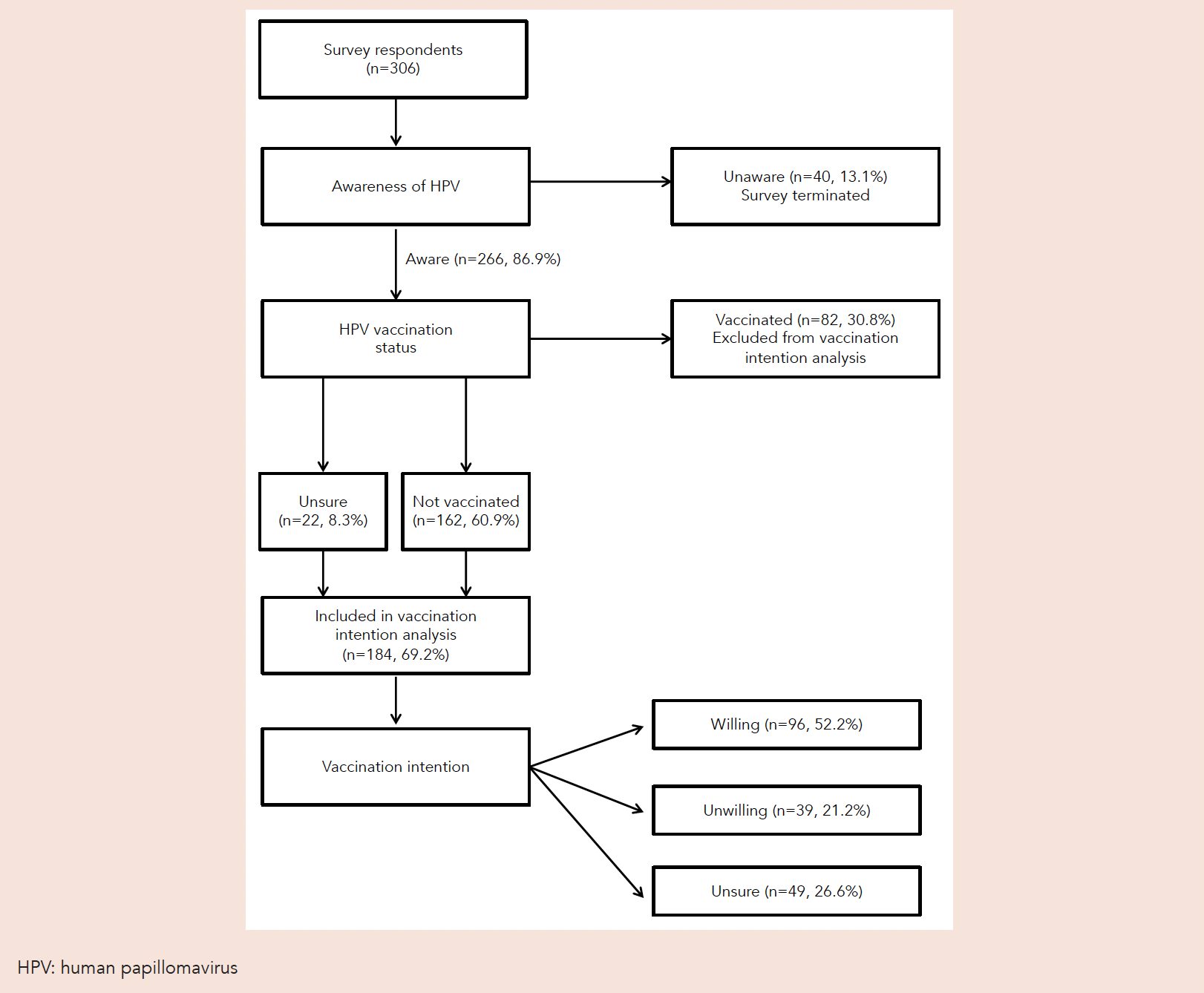
Overall, 266 respondents (86.9%) had previously heard of HPV. Most recognised that HPV can be transmitted through sexual contact (n=252, 94.7%) and that HPV infection can occur in men (n=213, 80.1%). However, awareness of HPV-related cancers in men was lower: 165 (62.0%) identified HPV as a cause of anal cancer, 165 (62.0%) of penile cancer, and 141 (53.0%) of throat cancer in men. Among the respondents, 129 (48.5%) knew that the Gardasil-9 vaccine is approved for men. The mean knowledge score was 4.00 (SD 2.01), with 170 (63.9%) demonstrating adequate knowledge (score ≥4).
Attitudes towards male HPV vaccination were generally favourable, with 182 respondents (68.4%) showing a positive attitude (mean score ≥4.0 on the 5-point Likert scale; overall mean score 4.20, SD 0.60). There were 234 respondents (88.0%) who agreed that HPV vaccination could help protect a person’s sexual partner, while 221 (83.1%) felt that vaccination for men should be more widely publicised. A total of 241 respondents (90.6%) reported they would be more likely to accept vaccination if recommended by a doctor. However, only 103 (38.8%) agreed that HPV vaccination in men was cost-effective at the prevailing out-of-pocket price, while 103 (38.7%) were neutral about it.
There were 82 respondents (30.8%) who reported having previously received the HPV vaccine, while 162 (60.9%) had not been vaccinated, and 22 (8.3%) were unsure of their vaccination status. Among the 184 respondents without confirmed prior vaccination, 96 (52.2%) indicated willingness to receive the HPV vaccine, whereas 39 (21.2%) would not, and 49 (26.6%) were unsure.
Among those with sons eligible for HPV vaccination, 13 (44.8%) indicated willingness to vaccinate their son against HPV, whereas 15 (51.7%) were unsure, and only 1 respondent (3.5%) was unwilling.
Fig. 1. Flow diagram of participant selection and vaccination intent analysis.
This study provides a detailed assessment of knowledge, attitudes, and determinants of HPV vaccination in men, revealing several insights. Although overall awareness of HPV was relatively high, modest knowledge gaps remained regarding HPV-related disease burden and vaccine eligibility in men. The observation that superficial awareness does not translate into a meaningful understanding of the cancer implications of HPV in men is highly consistent with findings from prior studies.6,7
The observed positive attitude rate (68.4%) falls within the upper range reported in prior systematic reviews.6,8 However, positive attitudes do not always translate into vaccination behaviour, suggesting the influence of additional barriers beyond individual perceptions.
Despite generally positive attitudes, actual vaccine uptake remained low. Although only 30.8% of respondents reported prior HPV vaccination, 52.2% of those without confirmed prior vaccination expressed willingness to receive the vaccine, highlighting an “intention–behaviour gap” described in the vaccination literature, whereby expressed willingness does not always translate into vaccination behaviour because of structural or logistical barriers.9 The strong influence of healthcare provider recommendation observed in this study underscores the important role that clinicians can play in shaping vaccination decisions through proactive recommendation and counselling, thereby improving HPV vaccine uptake.
Additionally, this study highlighted the potential influence of perceived cost-effectiveness on vaccine uptake. Indeed, previous studies have consistently established financial costs and the perceived value of HPV vaccination as key determinants of HPV uptake across different populations.6,9
Willingness and indecision regarding HPV vaccination of eligible sons were similarly common, highlighting parents as an important target for educational interventions.
Lastly, it is reassuring to note that confidence in vaccine safety was generally high, with 71.8% of respondents perceiving the vaccine to be safe. This is consistent with the extensive evidence demonstrating the favourable safety profile of HPV vaccination.10 The focus of interventions can be redirected from stressing safety concerns to closing the intention–behaviour gap as mentioned above.
In conclusion, knowledge gaps, uncertainty, and cost concerns remain important barriers to HPV vaccination. Targeted education and clinician-led discussions may help translate willingness into greater HPV vaccine uptake among men in Singapore.
Supplementary material
Appendix S1. Survey questions.
REFERENCES
- Bosch FX, Burchell AN, Schiffman M, et al. Epidemiology and natural history of human papillomavirus infections and type-specific implications in cervical neoplasia. Vaccine 2008;26 Suppl 10:K1-16.
- Giuliano AR, Anic G, Nyitray AG. Epidemiology and pathology of HPV disease in males. Gynecol Oncol 2010;117:S15-9.
- Joura EA, Giuliano AR, Iversen OE, et al. A 9-valent HPV vaccine against infection and intraepithelial neoplasia in women. N Engl J Med 2015;372:711-23.
- Human papillomavirus vaccines: WHO position paper, May 2017. Wkly Epidemiol Rec 2017;92:241-68.
- Markowitz LE, Dunne EF, Saraiya M, et al. Human papillomavirus vaccination: recommendations of the Advisory Committee on Immunization Practices (ACIP). MMWR Recomm Rep 2014;63:1-30.
- Newman PA, Logie CH, Doukas N, et al. HPV vaccine acceptability among men: a systematic review and meta-analysis. Sex Transm Infect 2013;89:568-74.
- Pitts M, Smith A, Croy S, et al. Singaporean men’s knowledge of HPV and attitudes toward vaccination. Vaccine 2009;27:2989-93.
- Shen F, Du Y, Cao K, et al. Acceptance of the Human Papillomavirus Vaccine among General Men and Men with a Same-Sex Orientation and Its Influencing Factors: A Systematic Review and Meta-Analysis. Vaccines (Basel) 2023;12:16.
- Brewer NT, Chapman GB, Rothman AJ, et al. Increasing Vaccination: Putting Psychological Science Into Action. Psychol Sci Public Interest 2017;18:149-207.
- Human papillomavirus vaccines: WHO position paper, May 2017-Recommendations. Vaccine 2017;35:5753-5.
The study was approved by the SingHealth Centralised Institutional Review Board with a waiver of informed consent (2026-0173). Due to the anonymous nature of the online survey, no identifiable personal data were collected. Participation was voluntary and implied consent was provided by proceeding to complete the survey.
No funding was received for this study. The authors declare that they have no affiliations or financial involvement with any commercial organisation with a direct financial interest in the subject or materials discussed in the manuscript. The authors used ChatGPT (OpenAl) for language editing, and the authors take full responsibility for its contents. No generative AI tools were used for data collection, data analysis, or interpretation of results.
Dr Jessica Weizhen Chen, Department of General Medicine, Sengkang General Hospital, 110 Sengkang East Way, Singapore 544886. Email: [email protected]
