

ABSTRACT
Introduction: Despite efforts to improve junior doctors’ working conditions, burnout, distress and disillusionment persist, with implications for patient outcomes. This qualitative study analysed factors shaping the lived experiences of junior doctors in Singapore and their changes over time, thereby seeking to inform improvements to working conditions.
Method: Thirty purposively sampled respondents who were junior doctors in Singapore between 1975 and 2022 were interviewed. Respondents were grouped into 3 cohorts: (1) junior, (2) middle and (3) senior. Employing the framework method of qualitative analysis, open coding was performed with reference to the individual, interpersonal, institutional, community and policy levels of the socioecological model (SEM).
Four themes emerged: (1) inherent challenges of junior doctorship, (2) exacerbating factors, (3) alleviating factors and (4) responses of junior doctors to their experiences. Codes were reconstructed into a modified SEM, demonstrating trickle-down effects of interpersonal or structural forces on the individual doctor and pertinent factors evolving with time.
Results: Across cohorts, respondents echoed mental and physical challenges. While senior cohort doctors recounted higher patient-to-doctor ratios and longer working hours, junior cohort doctors cited new difficulties. These include a hostile medicolegal landscape, patients’ increasingly complex needs and expectations, and higher administrative loads. Amid these difficulties, alleviating factors included good workplace relationships alongside institutional interventions. Doctors responded differently to their challenges. Some externalised difficulties through expression and advocacy; others internalised them, whether into fulfilment or distress.
Conclusion: While some facets of junior doctorship have improved with time, new challenges that warrant consideration are emerging. Junior doctors should be centred, listened to and empowered in shaping improvements to working conditions.
CLINICAL IMPACT
What is New
- To the best of the authors’ knowledge, this exploratory qualitative study is the first to examine the lived experiences of junior doctors in Singapore over several decades.
- Findings demonstrate factors in the junior doctor experience that have impacted junior doctors in Singapore from the 1980s to the present day.
Clinical Implications
- Through first-hand accounts from doctors themselves, this study lends deep insight to policymakers and senior management seeking to improve the experiences of junior doctors in Singapore, with notable downstream effects on patient safety.

Junior doctor well-being is a prominent global issue.1 Navigating the formative years of a career requiring expertise and high-stakes decisions, junior doctors are challenged considerably. These pressures impact patient outcomes and workforce retention.1 Despite interventions intended to improve working conditions,2 distress and disillusionment prevail.1 COVID-19 spotlighted these concerns in the public eye.3 However, in the post-COVID era, junior doctor well-being remains under-addressed.4
Junior doctors in Singapore include house officers (recently-graduated doctors serving their year-long housemanship) and medical officers (either undergoing initial years of training in residency or non-specialty tracks, or rotating every 6 months via the national Medical Officer Posting Exercise).5 To pay subsidised tuition fees, graduates from local medical schools are bonded to the public healthcare system for 4–5 years following housemanship.6
Previous local studies have quantified junior doctor well-being and stress via survey instruments.2,7-9 These addressed specific contexts including COVID-19,9 individual specialties7 and institutions.2 Recent qualitative study examines junior doctors’ experiences in Singapore’s public healthcare system10 via a priori framework concerning job demands and satisfaction. Singapore’s healthcare landscape, cultural perceptions and institutional frameworks have evolved significantly.11 Thus far, no local studies have explored junior doctors’ experiences open-endedly across time.
This qualitative study aims to analyse the factors shaping the junior doctor experience in Singapore and their changes over time. It interprets junior doctors’ experiences in their own words, capturing the interplay of environmental and individual forces. It also seeks to elicit variables promoting well-being or distress in Singapore’s junior doctors, exploring how and why these have evolved. Through this, the aim of this study is to encourage systemic change towards a more conducive environment for junior doctors, thereby improving patient safety.
METHOD
This qualitative study comprised semi-structured interviews with doctors who graduated from 1980 to 2021 and became junior doctors in Singapore’s public healthcare system thereafter. This study was approved by the National University of Singapore Institutional Review Board (2022-248) and reported according to the 2014 Standards for Reporting Qualitative Research.12
Theoretical approach
The framework method of qualitative analysis was adopted, which was formalised in 199413 and has since been widely used in health research.14 This method was chosen because it allowed both a data-driven (inductive) and theory-driven (deductive) analytical approach.14
Our starting point was the socioecological model (SEM) first described by Bronfenbrenner in 1979.15 Widely featured in public health research, the SEM influences health interventions and demonstrates reciprocal relationships between individuals and environments.16 The interview guide was designed to centre on the lived experiences of junior doctors, and having respondents walk through their junior doctorship.
Our team comprised junior doctors and medical students. Cognisant of possibly prioritising our own narratives over participants, this risk was mitigated through regularly discussing the authors’ relationships with the data, with close oversight from the principal investigator, a senior clinician-educator. Simultaneously, identifying with this study afforded a critical lens for data collection and analysis.
Participant recruitment, data collection and data processing
Inclusion criteria required participants to be over 21 years old and to have worked as a junior doctor in Singapore’s public healthcare system between 1975 and 2022. For recruitment, a junior doctor was defined as a house officer or medical officer. During interviews, participants could self-define “junior doctor.”
Employing purposive sampling, participants were recruited online through a form circulated via the Singapore Medical Association. Forty responses were received, among which 9 respondents were subsequently uncontactable and 1 withdrew, leaving 30 participants. The participants were grouped into 3 time-based cohorts that reflect significant policy changes in Singapore’s healthcare system: (1) senior cohort (1980–1999 graduates), (2) middle cohort (2000–2014 graduates) and (3) junior cohort (2015–2021 graduates). Policy changes that were considered included healthcare digitisation in the early 2000s, as well as duty hour mandates and the revision of remuneration in the mid-2010s.
Online interviews were conducted by 4 team members between September and November 2022. Verbal consent was sought in lieu of written consent, and interviewees could disable their video feeds for privacy. Study team members were briefed to identify signs of participant distress and alert the principal investigator if needed; participants were reminded of their ability to withdraw at any time. Interviews were audio-recorded, anonymised, and then transcribed using artificial intelligence (AI). AI-generated transcripts were manually corrected and proofread by medical student volunteers with direct reference to audio recordings. Participants were reimbursed with a SGD20 shopping voucher.
Data analysis
Our coding approach was both deductive and inductive. The layers of the SEM (from individual to policy) formed the skeleton of a coding frame, with an additional category representing factors that evolved over time. Open coding17 was performed by 5 team members and key codes were categorised into the coding frame skeleton. The coding frame was iteratively revised through discussion to resolve any inter-coder disagreement before consolidating overarching themes and generating a modified SEM. Thematic saturation was assessed through iterative team discussions regarding the emergence of new themes within each cohort. There was consensus that code saturation had been achieved within each cohort, with no new meaningful codes generated after 11, 11 and 8 interviews within the senior, middle and junior cohorts, respectively.18 Thus, no additional participants were recruited.
RESULTS
Among the 30 participants interviewed, 11, 11 and 8 doctors were from the senior, middle and junior cohorts, respectively. Participant characteristics are presented in Supplementary Appendix S1. Across all cohorts, most respondents worked in tertiary care, although 4 middle cohort doctors practised in primary care. Most senior cohort doctors were senior consultants who had experience in both private and public institutions; most middle cohort doctors were consultants, with a few resident physicians. Most junior cohort doctors were either medical officers or residents, with one locum.
System differences across generations
Participants surfaced key differences in junior doctors’ work from day-to-day responsibilities to the broader sociocultural climate. These were corroborated with secondary sources19,20 and summarised in Fig. 1.
Fig. 1. Data gathered from interviews and secondary sources about the objective working conditions in each cohort of doctors’ respective experiences. 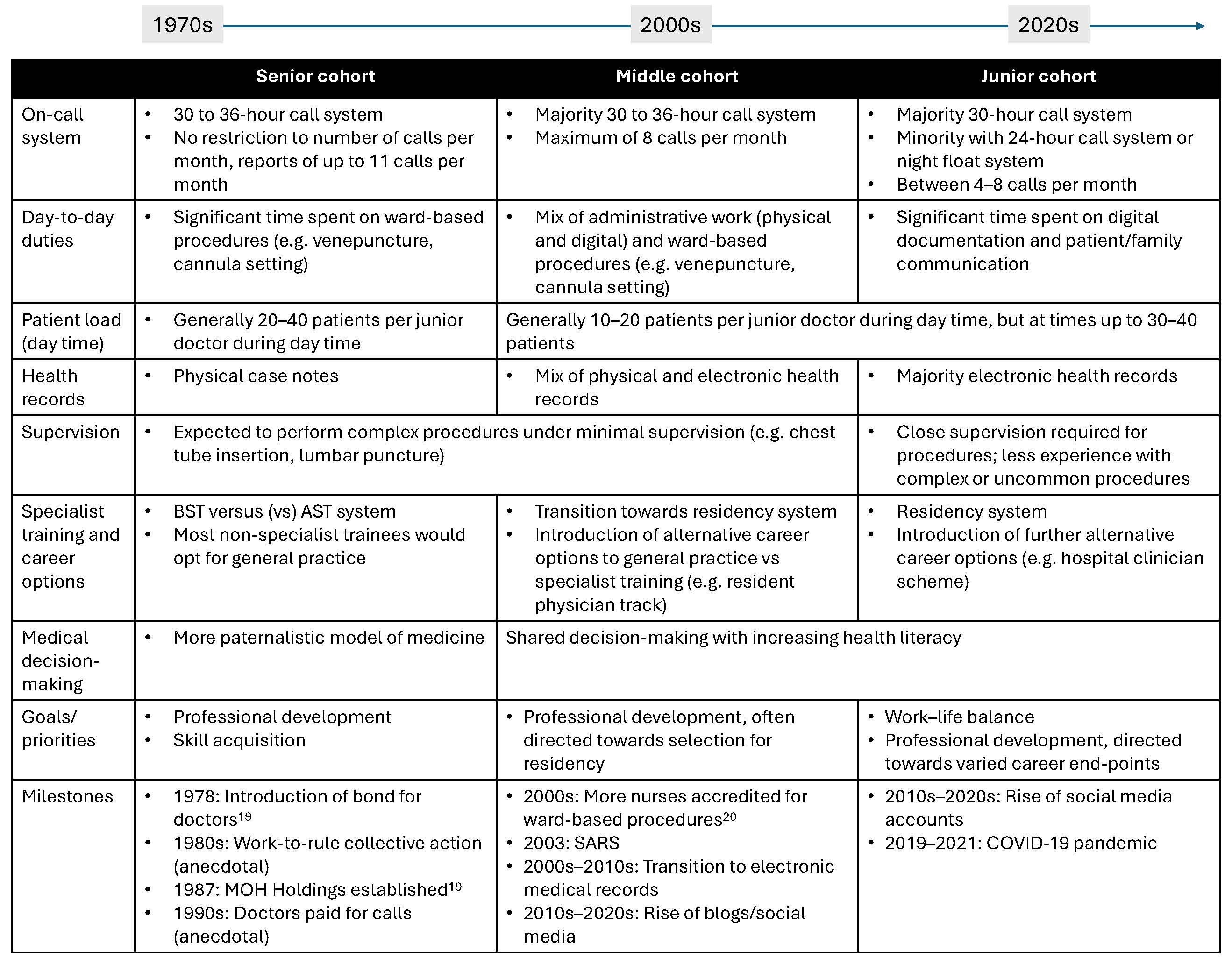
AST: Advanced Specialist Training; BST: Basic Specialist Training; MOH: Ministry of Health; SARS: severe acute respiratory syndrome
Key themes elicited were (1) the junior doctor experience as inherently challenging, (2) exacerbating factors, (3) alleviating factors and (4) responses of junior doctors to their experiences. These themes are discussed sequentially.
Theme 1. The junior doctor experience as inherently challenging.
Table 1. The junior doctor experience as inherently challenging.
Table 1 summarises key quotations from participants about inherent difficulties to being a junior doctor. Across cohorts, participants described challenges arising from their duties and perceived role in the healthcare team. Duties were largely ward-based: attending ward rounds, performing bedside procedures, documenting progress and communicating with families and other professionals. To most, their responsibilities were to execute plans (referred to as “doing changes”) and minimise escalation to seniors. Some described administrative duties as “not very meaningful,” while others lamented following orders they sometimes disagreed with.
On the flipside of this hierarchy lay another inherent challenge of junior doctoring—the steep learning curve. Key milestones included transitioning from student to house officer, and then to medical officer. Several participants across cohorts recounted feeling underprepared for their roles. Often, distress arose when participants had to function alone, whether due to emergencies or barriers in reaching seniors for help—real or perceived. Exacerbating these were the high stakes of medical decision-making, the narrow margin for error and the emotional intensity of the job.
One last challenge partially inherent to junior doctoring was its physical and mental demands. Long working hours and on-call duties were oft-cited stressors. Some respondents cited how fatigue compromised patient care and safety. Many participants described spending their junior doctor years in “survival mode” and making various “sacrifice[s].” Participants recognised that rigour was necessary for them to learn; simultaneously, some considered its extent unwarranted.
Theme 2. Exacerbating factors that made the junior doctor experience more challenging.
Table 2. Exacerbating factors that made the junior doctor experience more challenging.
Table 2 details key interview excerpts regarding factors compounding the inherent challenges at work. Several participants raised concerns about manpower and patient loads, describing workplaces as running at or over capacity. Acknowledging recent institutional efforts to improve working conditions, participants observed barriers or gaps in implementation, including institution-to-institution variations and entrenched workplace norms.
Another issue, especially among middle and junior cohort doctors, was the heavy administrative load which some found disproportionately high compared to overseas. Alongside this were grievances concerning the electronic medical records system.
At a societal level, junior and middle cohort respondents described facing increasingly complex patient care, driven by an ageing population with multiple comorbidities alongside evolving caregiving norms. Treatment advancements further complicated clinical decision-making. Participants identified a shift towards shared decision-making, compounded by internet-driven public access to medical information. While beneficial, this demands effort in explaining medical decisions and combatting misinformation. Several participants even recounted “hostile” behaviours from patients and next-of-kin.
Hostility also came from colleagues, especially seniors. While hierarchy was unavoidable, abuse of this hierarchy led to distress. Anecdotes from senior and middle cohort doctors were harsher, ranging from verbal abuse to physical intimidation. For one respondent, severe workplace bullying contributed to an attempted suicide.
The last set of exacerbating factors concerned careers and finances. Several participants described feeling trapped by their bond or pushed into departments they were uninterested in through the medical officer posting system. Concerns surfaced regarding remuneration amid rising living costs and increasingly competitive specialist training. Additionally, overseas-trained doctors highlighted difficulties transitioning to work in Singapore.
Theme 3. Alleviating and protective factors that improved the junior doctor experience.
Table 3. Alleviating factors that improved the junior doctor experience.
Table 3 details factors that ameliorated the difficulties that participants encountered as junior doctors. Many participants found motivation in witnessing patient recovery, expressions of gratitude or meaningful interactions. Participants appreciated having room to learn from mistakes and grow in clinical competence. Some drew spiritual meaning from their work, while others found support from loved ones or hobbies.
Camaraderie among junior doctors was a common source of strength, with shared struggles cementing lasting friendships. Support from supervisors, nurses and allied health staff was also frequently mentioned. Nurturing seniors were a critical protective factor. Notably, these accounts came more frequently from senior and middle cohorts.
At the institution and policy levels, many participants expressed satisfaction with simply using employment entitlements: taking leave, having feedback considered, or leaving punctually post-call. However, several participants qualified that these entitlements were not guaranteed or varied between departments. Some participants in formal training programmes appreciated departmental efforts to prioritise their learning. Others shared how their department’s discretion or concern benefited them. In contrast, senior cohort anecdotes revealed less institutional regard for junior doctors’ well-being or training.
Theme 4. Responses of junior doctors to their experiences.
Table 4. Responses of junior doctors to their experiences.
Table 4 details the ways in which participants responded to their circumstances as junior doctors. Many respondents viewed junior doctorship as a rite of passage, which allowed them to develop requisite hard and soft skills. Despite the growth, most participants across cohorts agreed that the stress imposed was not completely warranted. A participant characterised this period as “one of the most traumatic experiences of my life”; many felt amazed that they managed to “survive”.
Respondents reacted in varied ways—some weathered the difficulties, others left their places of practice, and others escalated their concerns to authorities or vowed to improve things for their juniors. A notable minority suffered severe repercussions on their mental well-being.
Among the few respondents who expressed their concerns more openly, one ran a blog about their experiences; another recounted a 1980s work-to-rule collective action that preceded salary improvements; one wrote to the Ministry of Manpower and their employer regarding their contract; and another joined their Residents’ Welfare Committee. Among the respondents, some felt disillusionment about the possibility of change, including concerns around speaking out. In contrast, some individuals believed that coping with hardship was a personal prerogative.
Modified socioecological model (SEM)
Fig. 2. Modified socioecological model (SEM) constructed as a Venn diagram.
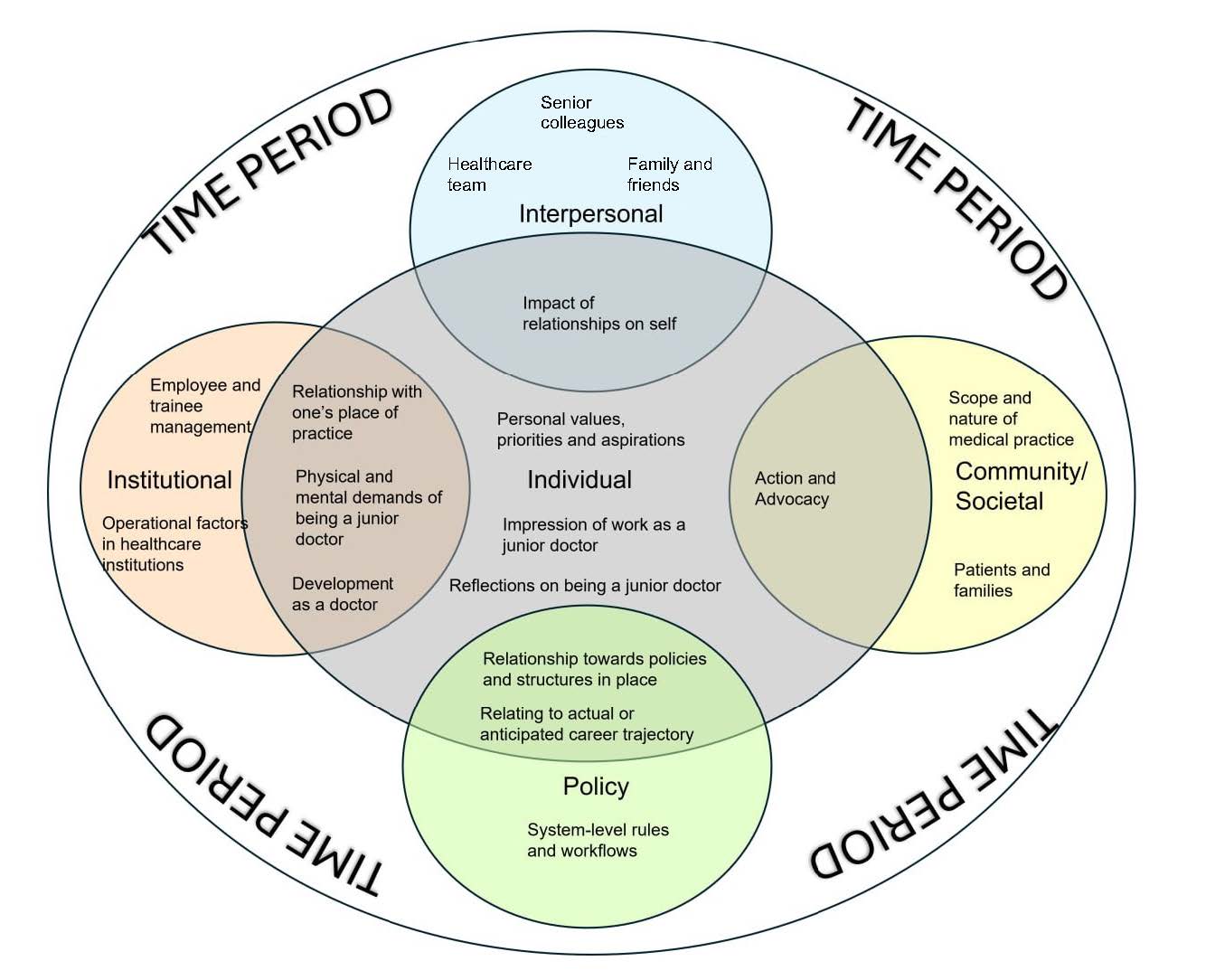
“Time Period” denotes each junior doctor’s experience within its unique time context.
A modified SEM was conceptualised (Fig. 2), encapsulating interconnected relationships between the individual level and interpersonal, institutional, community and policy levels. Instead of concentric circles, the modified SEM’s layers create a Venn diagram, with the individual layer in the middle. This centres the junior doctor’s lived experience and demonstrates trickle-down effects from other SEM layers. Furthermore, certain factors, which defy categorisation into a single layer, are situated between layers. The key factors within the SEM correspond with the salient sub-themes presented in Tables 1–4.
Encapsulating the modified SEM is a time period bubble highlighting how each junior doctor’s experience is situated within its unique time context.
DISCUSSION
Thematic analysis juxtaposed factors that worsened or improved the junior doctor experience, serving as a call to action to reduce exacerbating factors, enhance alleviating factors, and consider and mitigate inherent challenges. The modified SEM pinpoints the layers of stakeholders to engage in improving the junior doctor experience.
Comparisons between cohorts: Objectively different circumstances
Senior cohort experiences were characterised by long working hours, frequent overnight duties, heavy patient loads, minimal structured training or supervision and an entrenched culture that neglected well-being. Moreover, 36-hour calls—up to 11 per month—or having 30 inpatients per doctor were common. In contrast, junior cohort doctors had relatively shorter working hours, fewer overnight duties and improved doctor-patient ratios. Call shifts were 24 or 30 hours long, usually 4–7 times per month; having to manage 30 inpatients day-to-day was not the norm. Middle cohort doctors were at a transition point: 36-hour calls were phased out, stricter regulations around off-days were implemented, structured training programmes were established, and electronic medical records were introduced. These experiences correlate with policies since the 2010s, including 80-hour-weekly limits, some institutions establishing night float systems,21 and the transition to electronic medical records from the early 2000s.
Although junior and middle cohort doctors generally experienced lighter absolute patient loads and hours, present-day conditions exert a significant toll on physical and mental well-being. Crucially, conditions remain poorer or only on par with international standards in high-income countries.22 For example, the Australian Medical Association’s 2016 National Code of Practice recommends that shifts be a maximum of 14 hours long.23 Singapore’s 80-hour work limit mirrors the US,24 and it is far from the 48-hour weekly limit in the UK, where resident doctors follow the European Working Time Directive by default.25 While Singapore does not enforce protected rest time at work, both the UK and Australia have explicit recommendations or requirements for rest.
For junior and middle cohort doctors, new challenges have emerged, such as healthcare digitisation,26 a hostile medicolegal climate and defensive medicine,27 increasingly complex medical care28 and evolving patient expectations. Traditionally defined by a fear of malpractice litigation, defensive medicine encompasses “self-protective” decisions that physicians make, stemming from a “fear of patient dissatisfaction” or “overlooking a severe diagnosis”, among others.29 Defensive medicine promotes unnecessary investigations, interventions and specialist referrals, alongside a tendency to avoid patients or procedures deemed riskier.30 This trickles down to both patients and doctors alike: more tests need to be paid for (and interpreted), and more consultations must be attended (and documented). Many middle and junior cohort doctors recounted juggling extensive medical documentation while being sandwiched between the demands of both seniors and patients. Some also felt “trapped” in these circumstances by their 5-year bond, a feature unique to countries with mandatory service requirements like Singapore.
Comparisons between cohorts: Subjectively similar experiences
It is this interplay of improvements, setbacks and the inherent challenges of junior doctorship that may have contributed to most respondents looking back at their experiences with similar sentiments despite different contexts. Distress pervaded all cohorts. Still, many felt fulfilled “coming out on the other side” of these years. Some doctors externalised this through writing or advocacy. Conversely, others internalised their distress, sometimes harming themselves—notably, 2 separate accounts of attempted suicide surfaced during our interviews. Junior doctors’ distress warrants urgent action.
Efforts to improve the junior doctor experience
Significant steps have been taken to improve junior doctors’ experiences in Singapore: workgroups have been established, remuneration has improved, and efforts are underway to reduce consecutive work hours. Simultaneously, doctors and students are increasingly advocating for themselves through various platforms including social media. Our findings highlight the need to centre junior doctors in improving working conditions, empowering them to be involved without fear of penalisation.
This study raises several potential suggestions for local and international institutions. Workplaces should proactively foster relationships that support junior doctors, such as peer-to-peer, interprofessional and senior-to-junior support. Simultaneously, disruptive behaviour and abuse—whether from patients and next-of-kin or colleagues—should not be tolerated. Working hours and remuneration should match international gold standards; well-intentioned policies must be properly enforced. Institutions with overnight calls may consider alternative night-duty systems such as night floats. Careful watch must be kept on junior doctors’ administrative burdens31 and on prioritising structured professional development for all. Within and outside the medical community, active efforts should be made to mitigate defensive medicine.
As echoed by many participants, improving junior doctors’ experiences is not only a meaningful end in itself, but is crucial for patient safety through reducing attrition, burnout and errors.32 The economic costs of burnout have been quantified previously and should not be underestimated.33 Amid disillusionment, many participants still found deep fulfilment from their work—this sense of purpose must be safeguarded.
Strengths, limitations and future research
The merit of this study lies in its ability to delve deep into the lived experiences of current and former junior doctors across generations in Singapore. This study captures evolving challenges that may be missed in single-time-point studies. While these findings may not be entirely generalisable to an international audience, a key strength is precisely the specificity of the analysis to Singapore’s junior doctors.
This study has limitations. AI transcription may have compromised accuracy, which was mitigated through manual proofreading. While purposive sampling enabled exploration of experiences across cohorts, hindsight bias in the senior cohort may be present, further amplified by its smaller size. Future studies may consider recruiting more senior participants. Given the shared backgrounds of participants with the study team, reflexivity bias and social desirability bias are worth considering. Reflexivity bias was mitigated through inter-coder reflection, alongside consolidating and corroborating themes with objective data. Selection bias is another limitation, with certain profiles, such as those with advocacy interests or with distressing experiences more likely to self-select. Rather than representing a comprehensive scope of doctors in Singapore, this study forms the basis for future studies to evaluate junior doctors’ experiences in specific domains identified from our qualitative inquiry.
Future research may explore solutions to emerging issues, from defensive medicine to healthcare digitisation. Studies with longer time horizons could also follow a fixed cohort of junior doctors via qualitative longitudinal research methods,34 investigating the influence of evolving contextual factors across time.
CONCLUSION
This study uniquely demonstrates Singaporean junior doctors’ experiences over the past decades. Despite material improvements to working conditions, further development is warranted. Emerging challenges also call for thoughtful solutions that consider their implications for junior doctors.
Supplementary material
Appendix S1. Participant characteristics.
Acknowledgements
The study team would like to sincerely thank the 30 respondents who participated in the interviews. The study team would also like to extend its appreciation to the medical student volunteers, some of whom have since graduated, who proofread the transcripts of the interviews conducted. Their names are (in no particular order): Wee Soon Nan, Afra Saiara Oisy, Chia Pei Yun, Aw Zhi Jie Vanessa, Davidson Chee, Sudarshan Thirumalai, Jegan Nicco, Jennifer Teo, Zera Te Yingrui, Lauren Kwang, Saw Lip Wei, Isac Tan, Eugene Wang, Joel Ting, Gayathri Basker, Tay Zhi Quan, Pei Qi and Ng Chuan Kai Jared.
REFERENCES
- Hirayama Y, Khan S, Gill C, et al. Enhancing wellbeing in medical practice: Exploring interventions and effectiveness for improving the work lives of resident (junior) doctors: A systematic review and narrative synthesis. Future Healthc J 2024;11:100195.
- Massar SAA, Chua XY, Leong R, et al. Sleep, Well-Being, and Cognition in Medical Interns on a Float or Overnight Call Schedule. JAMA Netw Open 2024;7:e2438350.
- Poh LW, Teo I, Tewani K, et al. Understanding the needs of health care workers in Singapore during the COVID-19 outbreak: A qualitative analysis. Am J Infect Control 2022;50:1133-9.
- Ng IKS, Tham SZL, Chong KM, et al. Burnout among medical residents: key drivers and practical mitigating strategies. Postgrad Med J 2025;101:475-80.
- Ministry of Health Holdings, Singapore. Medical Service Career Path. https://www.physician.mohh.com.sg/medicine/medical-service-career-path. Accessed 14 June 2025.
- Ministry of Health, Singapore. Medical/Dental Undergraduate Agreement. https://hpp.moh.gov.sg/career-practice/medical-dental-undergraduate-agreement. Accessed 14 June 2025.
- Kwok C. Depression, Stress, and Perceived Medical Errors in Singapore Psychiatry Residents. Acad Psychiatry 2021;45:169-73.
- Tan KH, Lim BL, Foo Z, et al. Prevalence of burnout among healthcare professionals in Singapore. Ann Acad Med Singap 2022;51:409-16.
- Tan BYQ, Kanneganti A, Lim LJH, et al. Burnout and Associated Factors Among Health Care Workers in Singapore During the COVID-19 Pandemic. J Am Med Dir Assoc 2020;21:1751-8.e5.
- Chua JL, Mougammadou Z, Lim RBT, et al. In the shoes of junior doctors: a qualitative exploration of job performance using the job-demands resources model. Front Psychol 2024;15:1412090.
- Tan CC, Lam CSP, Matchar DB, et al. Singapore’s health-care system: key features, challenges, and shifts. Lancet 2021;398:1091-104.
- O’Brien BC, Harris IB, Beckman TJ, et al. Standards for reporting qualitative research: a synthesis of recommendations. Acad Med 2014;89:1245-51.
- Ritchie J, Spencer L. Analysing Qualitative Data. In: Qualitative data analysis for applied policy research. London: Routledge; 1994.
- Gale NK, Heath G, Cameron E, et al. Using the framework method for the analysis of qualitative data in multi-disciplinary health research. BMC Med Res Methodol 2013;13:117.
- Bronfenbrenner U. The Ecology of Human Development: Experiments by Nature and Design. Cambridge: Harvard University Press; 1979.
- McLeroy KR, Bibeau D, Steckler A, et al. An ecological perspective on health promotion programs. Health Educ Q 1988;15:351-77.
- Charmaz K. Constructing grounded theory: A practical guide through qualitative analysis. London: SAGE; 2006.
- Saunders B, Sim J, Kingstone T, et al. Saturation in qualitative research: exploring its conceptualization and operationalization. Qual Quant 2018;52:1893-907.
- Ministry of Health, Singapore. Caring for our people: 50 years of healthcare in Singapore, 2015. https://www.mohh.com.sg/Documents/book/caring-for-our-people-50-years-of-healthcare-in-singapore.pdf. Accessed 24 June 2025.
- Lim SH, Aloweni F, Ang SY, et al. Memories of nursing in Singapore – an oral history approach. J Res Nurs 2023;28:7-20.
- Loo BKG, Ng CL, Chin RT, et al. Nationwide survey comparing residents’ perceptions of overnight duty systems in Singapore: night float versus full overnight call. Singapore Med J 2020;61:559-62.
- Maoz Breuer R, Waitzberg R, Breuer A, et al. Work like a Doc: A comparison of regulations on residents’ working hours in 14 high-income countries. Health Policy 2023;130:104753.
- Australian Medical Association. National Code of Practice – Hours of Work, Shiftwork and Rostering for Hospital Doctors, 2016. https://ama.com.au/sites/default/files/documents/FINAL_NCP_Hours_of_work_2016.pdf. Accessed 26 August 2025.
- Wilson MR. The New ACGME Resident Duty Hours: Big Changes, Bigger Challenges. Ochsner J 2003 Spring;5:3-5.
- British Medical Association. Residents who opt out of the European Working Time Directive. https://www.bma.org.uk/pay-and-contracts/working-hours/european-working-time-directive-ewtd/residents-who-opt-out-of-the-european-working-time-directive. Accessed 26 August 2025.
- Mishuris RG, Linder JA. Electronic health records and the increasing complexity of medical practice: ‘it never gets easier, you just go faster’. J Gen Intern Med 2013;28:490-2.
- Vento S, Cainelli F, Vallone A. Defensive medicine: It is time to finally slow down an epidemic. World J Clin Cases 2018;6:406-9.
- Naik H, Murray TM, Khan M, et al. Population-Based Trends in Complexity of Hospital Inpatients. JAMA Intern Med 2024;184:183-92.
- Baungaard N, Skovvang PL, Assing Hvidt E, et al. How defensive medicine is defined in European medical literature: a systematic review. BMJ Open 2022;12:e057169.
- Studdert DM. Defensive medicine among high-risk specialist physicians in a volatile malpractice environment. JAMA 2005;293:2609-17.
- Tung JYM, Chua JL, Aribou ZM, et al. Reducing non-clinical working hours of junior doctors could benefit patient outcomes. Ann Acad Med Singap 2023;52:105-7.
- Li CJ, Shah YB, Harness ED, et al. Physician Burnout and Medical Errors: Exploring the Relationship, Cost, and Solutions. Am J Med Qual 2023;38:196-202.
- Martinez MF, O’Shea KJ, Kern MC, et al. The Health and Economic Burden of Employee Burnout to U.S. Employers. Am J Prev Med 2025;68:645-55.
- Farrall S. What is Qualitative Longitudinal Research?. https://www.scribd.com/document/303619551/Stephen-Farrall-Qual-Longitudinal-Res. Accessed 24 June 2025.
This study was approved by the National University of Singapore Institutional Review Board (2022-248).
The authors declare there are no affiliations with or involvement in any organisation or entity with any financial interest in the subject matter or materials discussed in this manuscript. The study was funded by an anonymous donor. The authors declare no conflict of interest related to this funding.
Prof Malcolm Ravindran Mahadevan, Department of Emergency Medicine, National University Hospital, 5 Lower Kent Ridge Road, Singapore 119074. Email: [email protected]
