

Dear Editor,
Singapore’s aged population is burdened by advanced chronic illnesses with prolonged and unpredictable disease trajectories.1 More than 70% of Singaporeans want to be cared for at home at the end of life (EOL). Furthermore, 77% want to die at home,2 but only 1 in 4 do.3 The home care service (HCS) tends to home-bound patients. However, when patients deteriorate, they are either admitted to an acute hospital or handed over to a home hospice service, resulting in disruption in care continuity.
In this study, authors describe a novel model of care to address this gap. The integrated home health (IHH) programme, which was piloted in St Luke’s Hospital, a community hospital in Singapore, embedded generalist palliative care into the existing HCS. The programme was run by family physicians and resident physicians with non-specialist training in palliative care. The aim of the pilot was to study the health outcomes of a programme that sought to empower home care providers to provide EOL care in the community.
The pilot ran from February 2024 to February 2025. Patients under the community hospital’s HCS were screened for eligibility, based on the Clinical Frailty Scale, frequency of hospital admissions in the preceding 6 months, and the “surprise question”.4 To ensure appropriateness of IHH enrolment, clinician judgement served as an adjudicator for the screening tool in identifying suitable patients. IHH clinicians would reference existing HCS documentation to assess for (1) complexities requiring specialist input, (2) patient and family readiness for a shift towards comfort-focused, symptom-directed management and (3) availability of a competent carer, which is crucial for home-based EOL care.
Within 5–8 working days, a physical triage visit would be made, and the patient’s needs were evaluated. The IHH journey comprises symptom management, serious illness conversations (SIC), psycho-emotional support and spiritual care through physical and tele-consultations, with 24/7 tele-support. Post bereavement, caregivers continue to be supported by a dedicated social worker.
Fig. 1. IHH programme workflow.
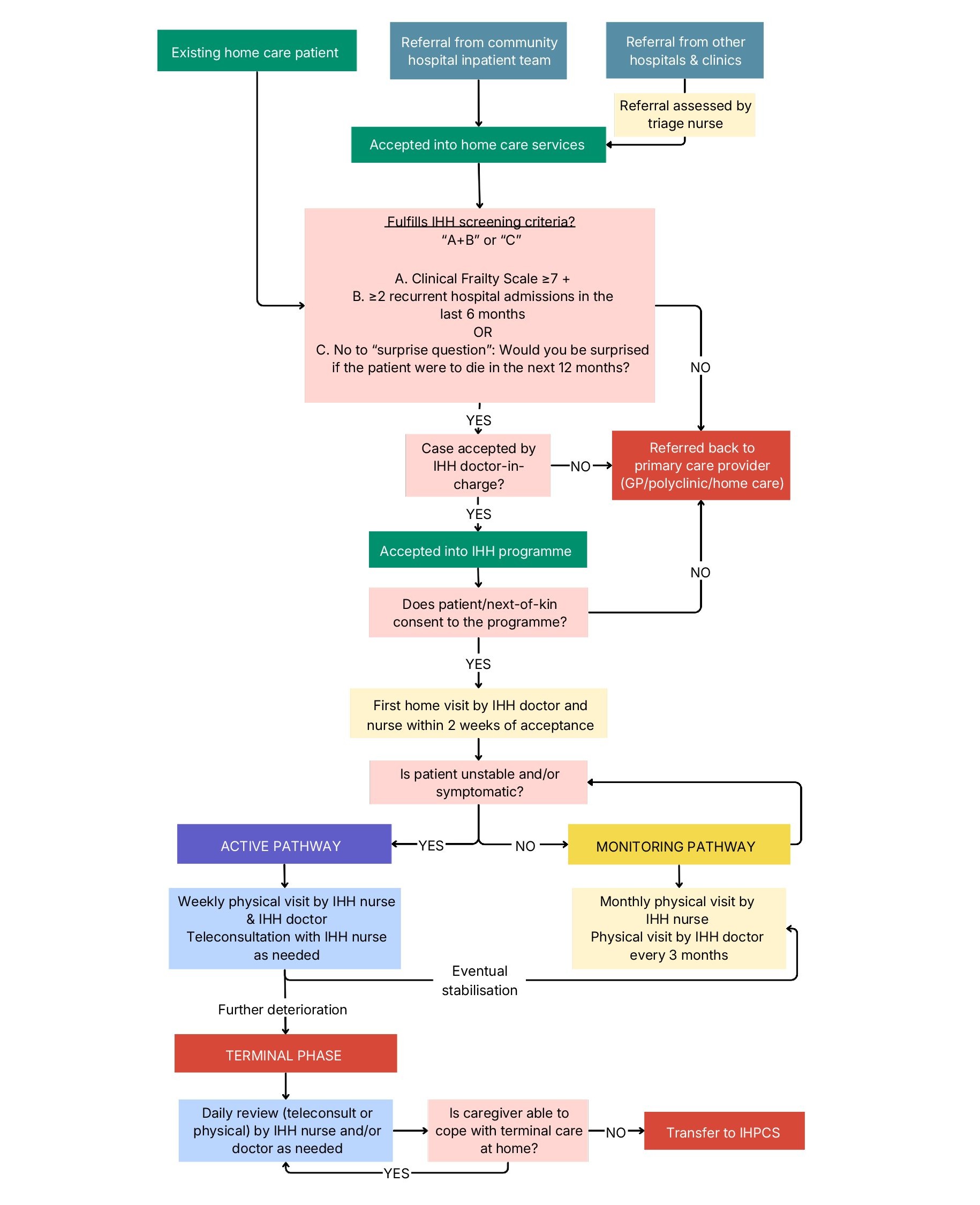
GP: general practitioner; IHH: integrated home hospice; IHPCS: inpatient hospice palliative care service
Note: In deciding between active and monitoring pathways, clinical assessment and the Edmonton Symptom Assessment System-revised (ESAS-r) score, done at each IHH nurse and doctor review, were used. An acute change in or rapid progression of symptoms (represented in the ESAS-r score trend, where a score of ≥4 represented at least moderate symptom severity) or haemodynamic instability would necessitate a switch to the active pathway. Terminal phase is defined as having a prognosis of days.
IHH is different from the home hospice service. First, in terms of clinical leadership, the former is helmed by generalists with interest and training in palliative care, allowing for democratisation of palliative care in the community, while the latter is led by palliative care specialists with advanced training. Second, in terms of patient profile, IHH cares primarily for non-cancer patients who were already HCS recipients for up to 10 years and would otherwise be transferred to another care provider at EOL if not for a programme like IHH, while home hospice providers care for a mix of cancer and non-cancer patients with a prognosis of less than 1 year. Finally, from the systems standpoint, the former is subsidised under home care subsidies and is meant to plug a missing piece in the public long-term care ecosystem, while the latter is provided free of charge by charities with additional support from the Ministry of Health, Singapore.
Of 45 referrals, 38 patients were enrolled. Most were female (79%, n=30), aged 69–102 years. The top 3 primary life limiting illnesses include: dementia (47%, n=18), stroke (28%, n=11), heart failure (5%, n=2), all of which are non-cancer.
A range of length of service (LOS) was observed with most under 6 weeks: 44% (n=17) under 2 weeks, and 36% (n=14) 3–6 weeks. A minority remained in the programme for longer: 20 to 52 weeks (15%, n=6), with frequent unstable episodes or prolonged gradual deterioration. This does not include the duration of preceding HCS. Many patients in IHH had completed Preferred Plan of Care (PPC) discussions (86%, n=33) and still more had at least 1 SIC with the IHH team (96%, n=36).
Of those who had demised (n=28 as of February 2025), most patients had pneumonia (89%, n=25) as the terminal event. Most passed on in the community (92%, 20 at home, 6 in the inpatient hospice palliative care service [IHPCS]), while 2 patients were transferred to the acute hospital for management of the terminal event.
Preferred place of death (PPoD)-concordance, defined as death occurring at the patient’s documented PPoD at enrolment, was 89% of those whose PPoD was known (n=25). Of the 3 patients who did not achieve PPoD-concordance, 2 were transferred to IHPCS while 1 was transferred to the acute hospital.
While advance care planning tends to be low in uptake in generalist settings even among those at EOL (ranging widely from 66% to as low as 5%),5-7 the pilot has achieved high rates of EOL conversations (both SIC and PPC). Compared to national statistics, the pilot has achieved high rates of terminal care in the community (home and IHPCS) and PPoD-concordant care.
About half of the patients were in the “deteriorating” or “terminal” palliative care phase on first visit (47%, n=18), with LOS till death ranging from 1 to 25 days. Interestingly, half of those assessed as “stable” on first visit (52%, n=20) had LOS till death at 28 days and less. The lack of correlation between a patient’s initial palliative care phase and survival in the pilot population showcases the challenge of prognostication in non-cancer. Achieving upstream identification of palliative care needs in non-cancer patients is vital in facilitating quality of life (not too late)8-9 without draining resources (not too early).
In summary, IHH, which is the integration of generalist palliative care in existing HCS, is a feasible, value-based and scalable strategy for home-based palliative care, especially in non-cancer. It plugs an existing gap in the traditional HCS model, facilitating continuity of care and proactive rather than reactive care. IHH must be mainstreamed and strengthened with further research to allow data-driven, integrated care for Singapore’s aged and multimorbid population.
REFERENCES
- Murray SA, Kendall M, Boyd K, et al. Illness trajectories and palliative care. BMJ;330:1007-11.
- Lien Foundation. The Straits Times National Survey on End of Life Care. https://lienfoundation.org/wp-content/uploads/2024/11/Death-survey-Presser-Final-2014.pdf. Accessed 5 December 2025.
- Registry of Births and Deaths, Immigration & Checkpoints Authority. Report on Registration of Births and Deaths, 2024. https://www.ica.gov.sg/docs/default-source/ica/stats/annual-bd-statistics/stats_2024_annual_rbd_report.pdf?sfvrsn=a8f4b7c1_3. Accessed 5 December 2025.
- Gupta A, Burgess R, Drozd M, et al. The Surprise Question and clinician‑predicted prognosis: systematic review and meta‑analysis. BMJ Support Palliative Care 2024;15:12-35.
- Bekker YA, Suntjens AF, Engels Y, et al. Advance care planning in primary care: a retrospective medical record study among patients with different illness trajectories. BMC Palliative Care 2022;21.
- Phua J, Kee ACL, Tan A, et al. End-of-life care in the general wards of a Singaporean hospital: an Asian perspective. Journal of palliative medicine 2011;14:1296-301.
- Yeoh LY, Seow YY, Tan HC. Identifying high-risk hospitalised chronic kidney disease patient using electronic health records for serious illness conversation. Ann Acad Med Singap 2022;51:161-9.
- Hum A, Yap CW, Koh MYH. End-stage organ disease–Healthcare utilisation: Impact of palliative medicine. BMJ Supportive & Palliative Care 2024;14:e2657-63.
- Hum A, Kaur P, Goh WY, et al. Implementing a transmural model of early palliative care in advanced dementia: the use of a hybrid effectiveness-implementation study design. BMC Geriatr 2025;25:303.
The study was approved by St Luke’s Hospital Institutional Review Board (SLH IRB) (IRB-01-2026-02-03).
The authors declare there are no affiliations with or involvement in any organisation or entity with any financial interest in the subject matter or materials discussed in this manuscript.
Dr Rachel Jia Xin Lu, Palliative Integrated Practice Unit, St Luke’s Hospital, 2 Bukit Batok Street 11, Singapore 659674. Email: [email protected]
