

ABSTRACT
Introduction: Although pre-exposure prophylaxis (PrEP) has been available in Singapore since 2016, its uptake among gay, bisexual and other men-who-have-sex-with-men (GBMSM) is low. The iPARTY study was established to evaluate the acceptability and feasibility of PrEP and a PrEP teleconsultation service for young GBMSM aged 18 to 29 years.
Method: A total of 53 young GBMSM were enrolled in the iPARTY study. They had a total of 5 in-person consultations and teleconsultations, at 12-week intervals. Laboratory tests and quarterly baseline surveys were performed to assess PrEP adherence, sexual behaviour, and incidence of human immunodeficiency virus (HIV) and other sexually transmitted infections (STIs).
Results: Thirty-five participants completed the entire 12-month follow-up. Most participants had positive experiences with PrEP teleconsultations. There was a statistically significant fall in participants’ aggregate Patient Health Questionnaire-9 scores throughout the study. Self-reported PrEP adherence decreased over the course of the study, denoting improved mental health. Although self-reported condom use for anal intercourse and participants’ risk perception of HIV decreased after PrEP adoption, there was no statistically significant increase in STI incidence.
Conclusion: This pilot project has shown that PrEP services provide an opportunity for YMSM to access sexual health testing, treatment and counselling, and may even have tangible benefits on the mental health of this population. Teleconsultation is shown to be a suitable platform for the delivery of such services. Collaborative initiatives are crucial to further enhance the affordability and accessibility of PrEP in Singapore, and to improve patient adherence.
CLINICAL IMPACT
What is New
- This pilot study is the first to evaluate the acceptability and feasibility of pre-exposure prophylaxis (PrEP) provision via teleconsultation for young men who have sex with men (YMSM).
Clinical Implications
- The study demonstrates that teleconsultation for PrEP services is practical and well-received by YMSM, providing a foundation to support broader implementation.
- These findings offer guidance to expand PrEP accessibility and enhance sexual health services for this population.
- van Schalkwyk C, Mahy M, Johnson LF, et al. Updated Data and Methods for the 2023 UNAIDS HIV Estimates. J Acquir Immune Defic Syndr 2024;95:e1-e4.
- Update on the HIV/AIDS Situation in Singapore 2023 (July 2024). Singapore: Ministry of Health; 2024.
- Sankaranantham M. HIV – Is a cure possible? Indian J Sex Transm Dis AIDS 2019;40:1-5.
- Shafer RW, Vuitton DA. Highly active antiretroviral therapy (HAART) for the treatment of infection with human immunodeficiency virus type 1. Biomed Pharmacother 1999;53:73-86.
- Currier JS. Management of Long-Term Complications of HIV Disease: Focus on Cardiovascular Disease. Top Antivir Med 2018;25:133-7.
- O Murchu E, Marshall L, Teljeur C, et al. Oral pre-exposure prophylaxis (PrEP) to prevent HIV: a systematic review and meta-analysis of clinical effectiveness, safety, adherence and risk compensation in all populations. BMJ Open 2022;12:e048478.
- Straubinger T, Kay K, Bies R. Modeling HIV Pre-Exposure Prophylaxis. Front Pharmacol 2019;10:1514.
- Chan C, Fraser D, Schmidt H-M, et al. PrEP Product Awareness, Preferences, and Past Experiences among Transgender Women and Men Who Have Sex with Men in Asia and Australia: The PrEP APPEAL Study Report. Sydney: Kirby Institute, UNSW Sydney; 2023.
- Mao X, Wang Z, Hu Q, et al. HIV incidence is rapidly increasing with age among young men who have sex with men in China: a multicentre cross-sectional survey. HIV Med 2018;19:513-22.
- Tan RKJ, O’Hara CA, Koh WL, et al. Delineating patterns of sexualized substance use and its association with sexual and mental health outcomes among young gay, bisexual and other men who have sex with men in Singapore: a latent class analysis. BMC Public Health 2021;21:1026.
- Ong C, Tan RKJ, Le D, et al. Association between sexual orientation acceptance and suicidal ideation, substance use, and internalised homophobia amongst the pink carpet Y cohort study of young gay, bisexual, and queer men in Singapore. BMC Public Health 2021;21:971.
- Hoff CC, Chakravarty D, Bircher AE, et al. Attitudes Towards PrEP and Anticipated Condom Use Among Concordant HIV-Negative and HIV-Discordant Male Couples. AIDS Patient Care STDS 2015;29:408-17.
- Kumar S, Haderxhanaj LT, Spicknall IH. Reviewing PrEP’s Effect on STI Incidence Among Men Who Have sex with Men-Balancing Increased STI Screening and Potential Behavioral Sexual Risk Compensation. AIDS Behav 2021;25:1810-8.
- Unigwe IF, Goodin A, Lo-Ciganic WH, et al. Trajectories of Adherence to Oral Pre-exposure Prophylaxis and Risks of HIV and Sexually Transmitted Infections. Open Forum Infect Dis 2024;11:ofae569.
- Choy CY, Wong CS, Kumar PA, et al. Guidance for the prescription of human immunodeficiency virus pre-exposure prophylaxis in Singapore. Singapore Med J 2024;65:308-11.
- Kroenke K, Spitzer RL, Williams JB. The PHQ-9: validity of a brief depression severity measure. J Gen Intern Med 2001;16:606-13.
- Reinius M, Wettergren L, Wiklander M, et al. Development of a 12-item short version of the HIV stigma scale. Health Qual Life Outcomes 2017;15:115.
- Calabrese SK, Dovidio JF, Tekeste M, et al. HIV Pre-Exposure Prophylaxis Stigma as a Multidimensional Barrier to Uptake Among Women Who Attend Planned Parenthood. J Acquir Immune Defic Syndr 2018;79:46-53.
- Blumenthal J, Pasipanodya EC, Jain S, et al. Comparing Self-Report Pre-Exposure Prophylaxis Adherence Questions to Pharmacologic Measures of Recent and Cumulative Pre-Exposure Prophylaxis Exposure. Front Pharmacol 2019;10:721.
- Antonini M, Silva IED, Elias HC, et al. Barriers to Pre-Exposure Prophylaxis (PrEP) use for HIV: an integrative review. Rev Bras Enferm 2023;76:e20210963.
- Koppe U, Marcus U, Albrecht S, et al. Barriers to using HIV pre-exposure prophylaxis (PrEP) and sexual behaviour after stopping PrEP: a cross-sectional study in Germany. BMC Public Health 2021;21:159.
- Williams AB, Amico KR, Bova C, et al. A proposal for quality standards for measuring medication adherence in research. AIDS Behav 2013;17:284-97.
- Baeten JM, Haberer JE, Liu AY, et al. Preexposure prophylaxis for HIV prevention: where have we been and where are we going? J Acquir Immune Defic Syndr 2013;63 Suppl 2:S122-9.
- Van der Elst EM, Mbogua J, Operario D, et al. High acceptability of HIV pre-exposure prophylaxis but challenges in adherence and use: qualitative insights from a phase I trial of intermittent and daily PrEP in at-risk populations in Kenya. AIDS Behav 2013;17:2162-72.
- Haberer JE, Bangsberg DR, Baeten JM, et al. Defining success with HIV pre-exposure prophylaxis: a prevention-effective adherence paradigm. Aids 2015;29:1277-85.
- Sidebottom D, Ekström AM, Strömdahl S. A systematic review of adherence to oral pre-exposure prophylaxis for HIV – how can we improve uptake and adherence? BMC Infect Dis 2018;18:581.
- Lin B, Liu J, He W, et al. Effect of a Reminder System on Pre-exposure Prophylaxis Adherence in Men Who Have Sex With Men: Prospective Cohort Study Based on WeChat Intervention. J Med Internet Res 2022;24:e37936.
- Weitzman PF, Zhou Y, Kogelman L, et al. mHealth for pre-exposure prophylaxis adherence by young adult men who have sex with men. Mhealth 2021;7:44.
- LeGrand S, Knudtson K, Benkeser D, et al. Testing the Efficacy of a Social Networking Gamification App to Improve Pre-Exposure Prophylaxis Adherence (P3: Prepared, Protected, emPowered): Protocol for a Randomized Controlled Trial. JMIR Res Protoc 2018;7:e10448.
- Macdonald V, Verster A, Baggaley R. A call for differentiated approaches to delivering HIV services to key populations. J Int AIDS Soc 2017;20:21658.
- Sun Z, Gu Q, Dai Y, et al. Increasing awareness of HIV pre-exposure prophylaxis (PrEP) and willingness to use HIV PrEP among men who have sex with men: a systematic review and meta-analysis of global data. J Int AIDS Soc 2022;25:e25883.
- Reiriz M, Rodríguez-Expósito B, Jiménez-García AJ, et al. Pre-Exposure Prophylaxis, Anxiety, Depression and Sexual SatisfactionAmong Men Who Have Sex With Men. Psicothema 2023;35:159-69.
- Protiere C, Sagaon-Teyssier L, Donadille C, et al. Perception of PrEP-related stigma in PrEP users: Results from the ANRS-PREVENIR cohort. HIV Med 2023;24:938-45.
- Remien RH, Stirratt MJ, Nguyen N, et al. Mental health and HIV/AIDS: the need for an integrated response. Aids 2019;33:1411-20.
- Jenness SM, Weiss KM, Goodreau SM, et al. Incidence of Gonorrhea and Chlamydia Following Human Immunodeficiency Virus Preexposure Prophylaxis Among Men Who Have Sex With Men: A Modeling Study. Clin Infect Dis 2017;65:712-8.
- Hevey MA, Walsh JL, Petroll AE. PrEP Continuation, HIV and STI Testing Rates, and Delivery of Preventive Care in a Clinic-Based Cohort. AIDS Educ Prev 2018;30:393-405.
- Golub SA, Kowalczyk W, Weinberger CL, et al. Preexposure prophylaxis and predicted condom use among high-risk men who have sex with men. J Acquir Immune Defic Syndr 2010;54:548-55.
- Tay WC, Chio MT, Ho BWY, et al. Four cases of HIV infection in men taking pre-exposure prophylaxis in Singapore. Ann Acad Med Singap 2023;52:704-6.
- Stansfield SE, Moore M, Boily MC, et al. Estimating benefits of using on-demand oral prep by MSM: A comparative modeling study of the US and Thailand. EClinicalMedicine 2023;56:101776.
- Venter WDF, Gandhi M, Sokhela S, et al. The long wait for long-acting HIV prevention and treatment formulations. Lancet HIV 2024;11:e711-e16.
- Delany-Moretlwe S, Flexner C, Bauermeister JA. Advancing use of long-acting and extended delivery HIV prevention and treatment regimens. J Int AIDS Soc 2023;26 Suppl 2:e26126.

Human immunodeficiency virus (HIV) infection remains a significant global health challenge worldwide, with 39 million people living with HIV as of 2022.1 In Singapore, there were 209 newly diagnosed cases of HIV infections in 2023, a 3% increase from 2022.2 Although highly active antiretroviral therapy (HAART) effectively suppresses viral replication, lifelong treatment is required.3,4 Even with HAART, people living with HIV are more susceptible to various long-term comorbidities, including cardiovascular disease, diabetes, frailty and cognitive disorders.5
Without an effective cure, preventive measures to avoid contracting HIV are imperative. Pre-exposure prophylaxis (PrEP), which involves the use of antiretroviral drugs before potential HIV exposure, is one such measure.6,7 Although PrEP services have been available in Singapore since 2016, PrEP uptake among gay, bisexual and other men who have sex with men (GBMSM) has been slow; in a 2023 report, although PrEP awareness was high in this population (93.0%), only a minority (25.0%) of those who had heard of PrEP were current PrEP users.8 PrEP usage among young men who have sex with men (YMSM) is often even lower than their older counterparts, partially due to their financial limitations. Furthermore, YMSM may benefit from PrEP more than their older counterparts;9 the former are particularly at risk due to their higher rates of risky sexual behaviours, substance use related to sexual activities, and barriers to accessing healthcare services.10,11
Hence, the iPARTY study was conducted, with the aim to establish and pilot a 1-year clinical cohort of 50 YMSM aged 18 to 29 in Singapore to assess the delivery, acceptability and feasibility of daily PrEP, as well as a PrEP teleconsultation service for YMSM. There are also concerns that PrEP utilisation could result in an increase in high-risk sexual behaviours, such as condom-less sexual intercourse, having multiple partners, or not discussing STI statuses, due to a perceived lower risk of HIV infection.12,13 This is known as risk compensation, and could result in a corresponding increase in other STIs.14 Therefore, our study further assessed the sexual practices and STI incidence of participants to evaluate this phenomenon. Counselling on sexually transmitted infection (STI) and risk compensation was also performed concurrently with PrEP provision.15
METHOD
Participant recruitment
Between June 2021 and 2022, 53 participants were enrolled in the study. Inclusion criteria were Singaporean citizen or permanent resident; assigned male at birth (cisgender man or transgender woman); aged 18 to 29 years; HIV-negative (self-reported at enrolment); self-reported sexual intercourse with men and any of the following risk factors for HIV infection in the past 12 months: (1) self-reported condomless anal sex; (2) diagnosis of 1 or more STIs; (3) self-reported use of recreational drugs during sexual activities. The exclusion criteria included the following: unable to provide informed consent; a positive HIV diagnosis; contraindications to the use of the tenofovir disoproxil fumarate (TDF)/emtricitabine (FTC) co-formulation for PrEP, including those with impaired kidney function (estimated creatinine clearance, or CrCl<50 mL/min) and those with active hepatitis B.
Prospective participants were approached by study team members from Action for AIDS (AfA Singapore), a community-based organisation in Singapore that provides sexual health services to YMSM, who assessed participants’ eligibility and willingness to participate using a standardised script. For those keen to participate, written informed consent was obtained in a private, confidential setting at National Centre for Infectious Diseases, Singapore (NCID). To ensure anonymity, all participants were issued unique participant identification numbers, which would become the sole means of identification throughout the study; only the HIV physician and the study coordinator would have access to participants’ identities. All consultations, tests and generic daily PrEP were provided at no cost to the participants; participants only needed to pay nominal fees for medication delivery, if required.
This study received funding from the NCID Catalyst Fund 2021/2022 and was approved by the National Health Group Domain Specific Review Board (2021/00810).
Investigations
To determine eligibility, tests for hepatitis B surface antigen (HBsAg) and Hepatitis B surface antibody (anti-HBs) were conducted at the first visit. Serum creatinine was also measured at the beginning of the study and again at 24 weeks to assess eligibility and tolerability, respectively.
STI screening was performed 5 times throughout the study, with intervals of 12 weeks between each assessment. Tests included a rapid fourth-generation HIV test, rapid syphilis test and polymerase chain reaction (PCR) testing for Neisseria gonorrhoeae and Chlamydia trachomatis using a urine sample.
Participants with positive HIV tests were withdrawn from the study and referred to a specialist HIV care centre for further care. Participants who tested positive for syphilis, gonorrhoea or chlamydia were also referred to an appointed sexual health centre for appropriate treatment but were not withdrawn from the study.
Consultations
Participants attended a total of 5 consultations, at 12-week intervals, with an infectious disease physician who was also a member of the study team. The first and fifth consultations were conducted in-person, and the others were teleconsultations performed over Zoom platform (Zoom Video Communication, San Jose, CA, US), a secure videoconferencing platform with Advanced Encryption Standard 256-bit encryption, user authentication and audit trails. These measures complemented institutional IT policies, including password protection for laptops and electronic medical records, malware protection and strict controls on patient data access.
At these consultations, participants’ test results would be reviewed. Participants also received counselling on the use of daily HIV TDF/FTC PrEP, in accordance with Singapore’s National HIV Programme’s PrEP Guidelines,15 with the following information: (1) that TDF/FTC taken daily has an efficacy of up to 96% in preventing HIV infection in at-risk individuals, if taken as prescribed; (2) that a lead-in period of 14 days is necessary before full protection is achieved, and all sexual intercourse during this lead-in period should be protected with condom use; (3) that PrEP is only effective in preventing HIV infection, and precautions should still be taken to prevent infection with other STIs. At the end of the consultation, participants were given a prescription to purchase their medications from institutional pharmacies or from recommended online sources.
After completing the study, participants were offered the option to continue PrEP follow-up at either the NCID or the Department of Sexual Health Clinic (DSC), a local STI specialist outpatient clinic.
Questionnaires
Three different questionnaires (Supplementary Appendices 1–3) were given to the participants throughout the study, to assess the following: general demographics; sexual outcomes and behaviours; substance use; HIV/STI testing behaviours; HIV risk perception and complacency; mental health screen, including the Patient Health Questionnaire-9 (PHQ-9), the 12-item HIV stigma scale, and questions on anticipated PrEP stigma, adapted from Calabrese et al.;16-18 self-reported adherence to PrEP using questions adapted from a study by Blumenthal et al.;19 and telehealth experience.
Statistical analysis
Statistical analyses were performed using Microsoft Excel 2023 (Microsoft Corporation, Redmond, WA, US). Continuous variables were summarised as mean ± standard deviation (SD), or median and range, as appropriate. For categorical variables, frequencies and percentages were reported.
Student’s t-test was used for statistical analysis of continuous variables, and the chi-square test was used for categorical variables, where appropriate. A P value of <0.05 was considered statistically significant.
RESULTS
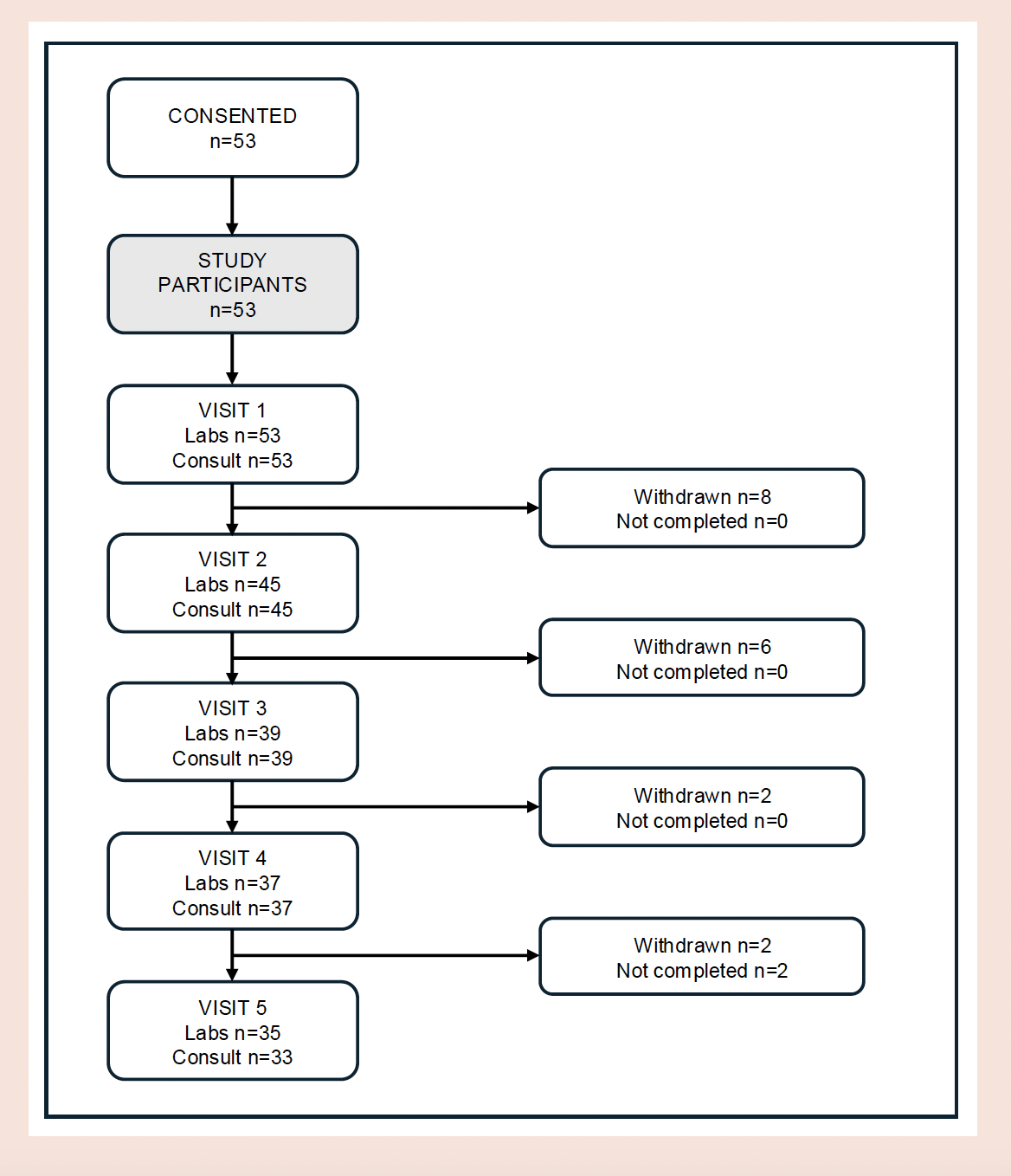
Between June 2021 and June 2022, 53 participants were enrolled in the study. Among them, 62.3% (33/53) of the participants completed the entire 12-month follow-up, and 66.0% (35/53) were able to complete all the surveys (2 participants missed their final doctor’s appointment) (Fig. 1). Of the 20 participants who dropped out of the study, 10 were uncontactable, 3 were “busy and unable to commit”, 2 were “overseas and unable to commit”, 2 were “no longer interested,” 1 felt that “medication delivery was inconvenient,” 1 felt that there was “no urgent need to start PrEP as [he] feels he is not high-risk”, and 1 seroconverted prior to PrEP initiation and was no longer eligible.
Fig. 1. The flow diagram for participant recruitment and retention (n=53).
 Demographics
The mean age of the cohort was 24.2 ± 2.99 years, with the majority of participants being of Chinese ethnicity (37 participants; 69.8%), followed by Malay (12 participants; 22.6%) and Indian (4 participants; 7.6%). All participants had at least secondary school education, with 37.7% (20/53) of participants having completed university education. Among the participants, 75.5% (40/53) lived in public housing and 24.5% (13/53) lived in private housing, with a median income range of SGD 1000 to 2999. Single participants comprised 86.8% (46/53) of the cohort, while 9.4% (5/53) had 1 partner, and 3.8% (2/53) had multiple male partners.
Among the cohort, 90.6% (48/53) were first-time PrEP users. Comparing the participants who completed all study surveys (n=35) against those that defaulted (n=18), there was a statistically significant difference in age (defaulters: 23.2 ± 2.23; non-defaulters: 24.7 ± 3.21; P<0.05) and relationship status (defaulters: 78% single, 22% attached; non-defaulters: 91% single, 9% attached; P<0.05). While the P<0.05 result suggested that the age difference is statistically significant, it is unlikely to be clinically or practically relevant based on the small magnitude of the difference. There were no statistically significant differences in ethnicity, education level, income or housing type (P>0.05).
PrEP adherence
There was a significant decrease in self-reported PrEP adherence among participants consistently taking 7 pills per week, with the adherence rate declining from 55.6% at the second visit to 37.1% at the fifth visit (P<0.05) (Fig. 2A). Notably, by the second visit, only 30% of the defaulters (n=20) reportedly took 7 pills a week, compared to 62.9% of those who completed the study (n=33) (P<0.05) (Fig. 2B).
Fig. 2. Defaulters versus non-defaulters.
Sexual practices
As the study progressed, changes in participants’ sexual practices were observed. At the first visit, 60.4% of participants had 6 or more sexual partners. This decreased to 42.9% at the fifth visit (P<0.05) (Fig. 3A). However, there was a reduction in reported condom use for anal intercourse with both regular and casual partners, from 28.3% to 11.4% for regular partners (P<0.05), and from 56.6% to 28.6% for casual partners (P<0.05) (Fig. 3B).
Fig. 3. Changes in sexual practices.
Substance use
There was a decrease in the percentage of participants who used substances (e.g. alcohol, poppers, Viagra [sildenafil citrate], etc.) during sex activities, from 60.4% at the first visit to 45.7% at the first visit. However, this was not statistically significant (P=0.076).
Sexually transmitted infections
An increase in STI incidence was observed after PrEP initiation among participants, from 18.9% (10/53) at the first visit to 28.6% (10/35) at the fifth visit. STI cases, such as chlamydia, gonorrhoea and syphilis were self-reported by participants. The breakdown of self-reported STIs from the first to the fifth visit is shown in Fig. 4.
Table 1. Cumulative incidence of sexually transmitted diseases from visits 1–5, no. (%).
Risk perception
From the first to the fifth visit, there was an overall decrease in participants’ risk perception of HIV. At the first visit, 69.8% of participants agreed that “HIV was a less serious threat than it used to be”; this increased to 88.6% at the fifth visit (P<0.05). There was also a significant increase in the percentage of participants who agreed that they “practised safe sex less often due to advancements in medical treatment for HIV/AIDS”, from 16.4% at the first visit to 48.6% at the fifth visit (P<0.05).
Mental health screen
There was a statistically significant fall in participants’ aggregate mean (SD) PHQ-9 scores from the first visit (17.7 ± 3.54) to the fifth visit (13.1 ± 3.04) (P<0.05), indicating an overall improvement in mood. There were no significant temporal differences in the aggregated scores for either the HIV Stigma Scale or the PrEP Stigma Scale.
At the first visit, the PHQ-9 scores of the participants who defaulted the study (16.3 ± 3.38) were noted to be lower than the PHQ-9 scores of those who completed the study (18.3 ± 3.46) (P<0.05). There were no significant differences in the aggregated scores for either the HIV Stigma Scale or the PrEP Stigma Scale between the defaulters and non-defaulters.
Telehealth experience
Overall, participants had positive feedback about the telehealth experience; at the fifth visit, 80% of participants either agreed or strongly agreed that they had had positive experiences with PrEP teleconsultations. All participants agreed that their questions and concerns could be addressed adequately by doctors via teleconsultation.
DISCUSSION
This pilot project has shown that telehealth services can significantly improve PrEP uptake among YMSM. Prior to the study, only 9.6% of the surveyed YMSM were taking PrEP, which was even lower than the overall PrEP uptake of 25% in the 2023 Singaporean study.8 By the end of the study, despite some defaulters, 62.3% of participants continued to take PrEP and attend follow-up PrEP appointments.
While PrEP provision has demonstrated its benefits, there was a significant decrease in self-reported PrEP adherence among participants throughout the study. Key barriers to PrEP adherence previously identified include forgetting to take PrEP daily, not wanting to take a chemical substance for a prolonged period, and low perceived vulnerability to HIV.20 Changes in lifestyle and relationship status could also result in a diminished need for PrEP.21
PrEP providers must thus emphasise the importance of consistent PrEP use at each consultation, and provide education on prevention-effective PrEP adherence.22-25 To address the key barriers identified, digital platforms can be leveraged to increase adherence, especially among the younger, tech-savvy population.26 For instance, medication reminders via mobile applications can increase PrEP adherence among YMSM by developing medicine-taking habits, especially when first commencing PrEP.27,28 Further providing incentives for good adherence may also improve retention in PrEP programmes.29 Peer navigators can also be engaged, to address individual barriers to PrEP and provide peer motivation.30
PrEP may also offer significant psychological benefits for recipients. A statistically significant decrease in PHQ-9 scores from the first to the last visit indicates an overall improvement in mental health after starting PrEP. A few mechanisms have been proposed for this positive change. First, PrEP may alleviate the fear of HIV infection, providing reassurance for PrEP users.31 Second, PrEP could independently lead to better sexual satisfaction, ultimately culminating in greater life satisfaction.32 However, maintaining adherence to PrEP regimens can introduce stress, particularly for those concerned about the consequences of missed doses. Some younger participants also felt that taking PrEP could negatively impact how others perceive them. This perception was particularly common among younger individuals and those who were more psychologically vulnerable, as reflected by lower self-esteem scores and higher depression scores, which could, in turn, affect PrEP adherence.33 Additionally, the high initial PHQ-9 scores observed in the study, with many participants showing moderately-severe depression, suggest potential benefits to integrating routine mental health screening into PrEP services, to identify and address mental health challenges in this vulnerable population early.34
Participants also did not partake in regular STI testing prior to this study. However, STI screening conducted during the study revealed that many individuals tested positive for various STIs. Additionally, 1 individual was found to have seroconverted at the start of the study, prior to PrEP initiation. Therefore, expanding PrEP services, along with accompanying STI tests, could be highly beneficial for the early detection and treatment of STIs, including HIV, in this at-risk population.
The study also highlighted concerns that, despite the benefits, PrEP uptake may lead to riskier sexual practices. Although counselling was provided during PrEP consultations, there was still a statistically significant reduction in reported condom use for anal intercourse. Nevertheless, while PrEP provision could lead to riskier sexual practices that confer a high risk of acquiring STIs, the incidental detection and treatment of these STIs as part of PrEP provision, and the benefits of HIV prevention may partially offset risk compensation.35,36
Nevertheless, in the provision of PrEP services, it is essential for clinicians to continue emphasising that PrEP does not prevent other STIs, and to recommend concurrent condom use with PrEP use, which is consistent with national PrEP Guidelines.15,37 Recently published cases of PrEP failure in Singapore further underscore the critical importance of risk counselling and adherence to PrEP to maintain its efficacy, as these cases were patients on self-directed PrEP, who had adherence issues.38
This study has several limitations. First, the cost for PrEP and associated investigations were borne by the study. Eventually, barring policy changes, the participants will have to pay out-of-pocket to continue receiving PrEP services. This financial aspect may deter consistent PrEP usage, especially given the relatively low median income range (SGD 1000 to 2999) among the surveyed YMSM population. Second, the reasons for defaulting were not always fully explored, as some defaulters become uncontactable; such information could provide valuable insights into improving PrEP services. Third, the small sample size in this study limits its statistical power, making it difficult to detect significant effects. There are also potential selection biases, as the population, recruited at STI testing sites from community-based organisations, could have greater familiarity, knowledge and awareness of PrEP than the broader population of YMSM, reducing generalisability. Future studies should be conducted on a larger scale to validate the findings of this pilot study. Finally, while this pilot study focused solely on daily PrEP, future studies could focus on other modalities of PrEP delivery. In particular, on-demand PrEP could be an alternative for individuals poorly adherent to daily PrEP.39 Recently, novel long-acting, extended-delivery injectable PrEP formulations have demonstrated excellent outcomes, offering potential to enhance adherence.40,41
Conclusion
In conclusion, this study demonstrates that PrEP services provide an opportunity for YMSM to access sexual health testing, treatment and counselling, and may even have a positive impact on their mental health. Telemedicine has proven to be a suitable platform for the delivery of such services. Given these immense benefits of improving PrEP uptake, top-down policy changes should be implemented in Singapore to scale up PrEP initiatives, enhancing both its affordability and accessibility. This would serve the public good and better protect the vulnerable YMSM population. While clinicians should emphasise the effectiveness of PrEP in preventing HIV, individuals using PrEP must remain aware that it does not protect against other STIs; engaging in risky sexual behaviours while on PrEP may still increase their vulnerability to these infections.
Supplementary Table S1
Supplementary Appendices 1–3
References
Patient consent was sought for this study. This study received funding from the NCID Catalyst Fund 2021/2022 and was approved by the National Healthcare Group Domain Specific Review Board (2021/000810).
The authors have no affiliations or financial involvement with any commercial organisation with a direct financial interest in the subject or materials discussed in the manuscript.
Dr Pei Hua Lee, Infectious Diseases, National Centre for Infectious Diseases, 16 Jalan Tan Tock Seng, Singapore 308442. Email: [email protected]
