

Dear Editor,
The management of locally advanced laryngeal cancer presents a complex clinical challenge, requiring a delicate balance between maximising oncological control and preserving the critical functions of the larynx. Historically, total laryngectomy (TL) was the standard of care, but landmark trials in the 1990s and 2000s, including the Department of Veterans Affairs Laryngeal Study and the Radiation Therapy Oncology Group 91-11 trial, established larynx-preservation (LP) strategies with chemoradiation (CRT) or radiotherapy (RT) as viable alternatives.1-3 These studies demonstrated that for many patients, the larynx could be preserved without compromising overall survival (OS), leading to a paradigm shift towards non-surgical approaches. However, subsequent studies have revealed a more nuanced reality, questioning whether anatomical preservation always translates to functional preservation and suggesting that the optimal treatment strategy may depend more on other factors such as tumour stage.4,5 Given the high mortality burden of laryngeal cancer in Southeast Asia, this 15-year retrospective study was conducted at Tan Tock Seng Hospital, Singapore to compare the survival and functional outcomes of patients with locally advanced laryngeal squamous cell carcinoma (SCC) treated with either primary surgery or an LP protocol, providing valuable data from an Asian population.6
The clinical records of patients diagnosed with stage 3 or 4 laryngeal SCC between 2006 and 2020 were reviewed. To ensure consistency, all patients diagnosed before 2018 were retrospectively re-staged according to the American Joint Committee on Cancer (AJCC) 8th Edition. The study’s endpoints were survival outcomes, measured by OS and disease-free survival (DFS) and functional outcomes, measured by swallowing and speech status. Swallowing function was defined by the need for long-term feeding tube support. Voice outcomes were categorised based on documented speech function. Data were analysed using Stata version 16.0 (StataCorp, College Station, TX, US), with survival analysed using Kaplan–Meier method and Cox proportional hazard models.
A total of 124 patients were included, with 63 undergoing primary TL and 61 receiving primary LP therapy. Within the surgical arm, 42 patients (67%) received adjuvant RT or CRT while 21 patients (33%) had TL alone. In the LP arm, 48 patients (79%) received concurrent CRT and 13 (21%) received RT alone. The patient population was predominantly male (96%) and Chinese (83.9%), with a high prevalence of smoking (91.1%) and alcohol usage (64.5%). The mean age at diagnosis was 66.1 and 64.0 years for the surgery and LP arms, respectively. There were 39 patients (31.5%) with stage 3 and 85 patients (68.5%) with stage 4 disease. Within the surgical arm, 12 patients (19%) had stage 3 and 51 patients (81%) had stage 4 disease. Within the LP arm, 27 patients (44.3%) had stage 3 and 34 patients (55.7%) had stage 4 disease. The 2 treatment arms exhibited significant differences in AJCC stage (P=0.002), with the surgery arm containing a higher proportion of patients with stage 4 disease. Base of tongue involvement and major cartilage involvement, key features that often influence the decision for primary TL, were not significantly different statistically between the 2 groups.7
This study found a statistically significant survival advantage for patients who underwent primary TL. The 5-year median OS was 35.97 months (lower quartile 16.98, upper quartile was not reached) in the surgery arm compared to 25.28 months (interquartile range [IQR] 11.47–58.49) in the LP arm (P=0.04), as shown in Fig. 1A. Similarly, the median DFS of 32.95 months (IQR 16.95–83.87) in the surgery arm was significantly longer (P=0.02) than 18.42 months (IQR 6.95–53.84) in the LP arm, as illustrated in Fig. 1B. Multivariate Cox regression analysis identified treatment modality as an independent predictor of outcome. Patients who underwent surgery had a significantly lower hazard rate (HR) for death (HR 0.52, P=0.01) and disease recurrence or death (HR 0.45, P<0.001). Subgroup analysis showed that for patients with stage 4 disease, the 5-year OS of the surgery arm was better compared to the CRT arm (P=0.03) (Fig. 1D). For patients with stage 3 disease, there was no significant difference in the 5-year OS between the 2 treatment arms (P=0.41) (Fig. 1C). These findings are consistent with recent large-scale studies where Tang et al. and Grover et al. showed that the OS was significantly better in the surgery arm compared to the LP arm in T4 disease, while Su et al. showed that there was no difference in OS between the 2 arms in T3 disease.4,5,8
Fig. 1. Kaplan–Meier plot for 5-year survival and DFS outcomes.
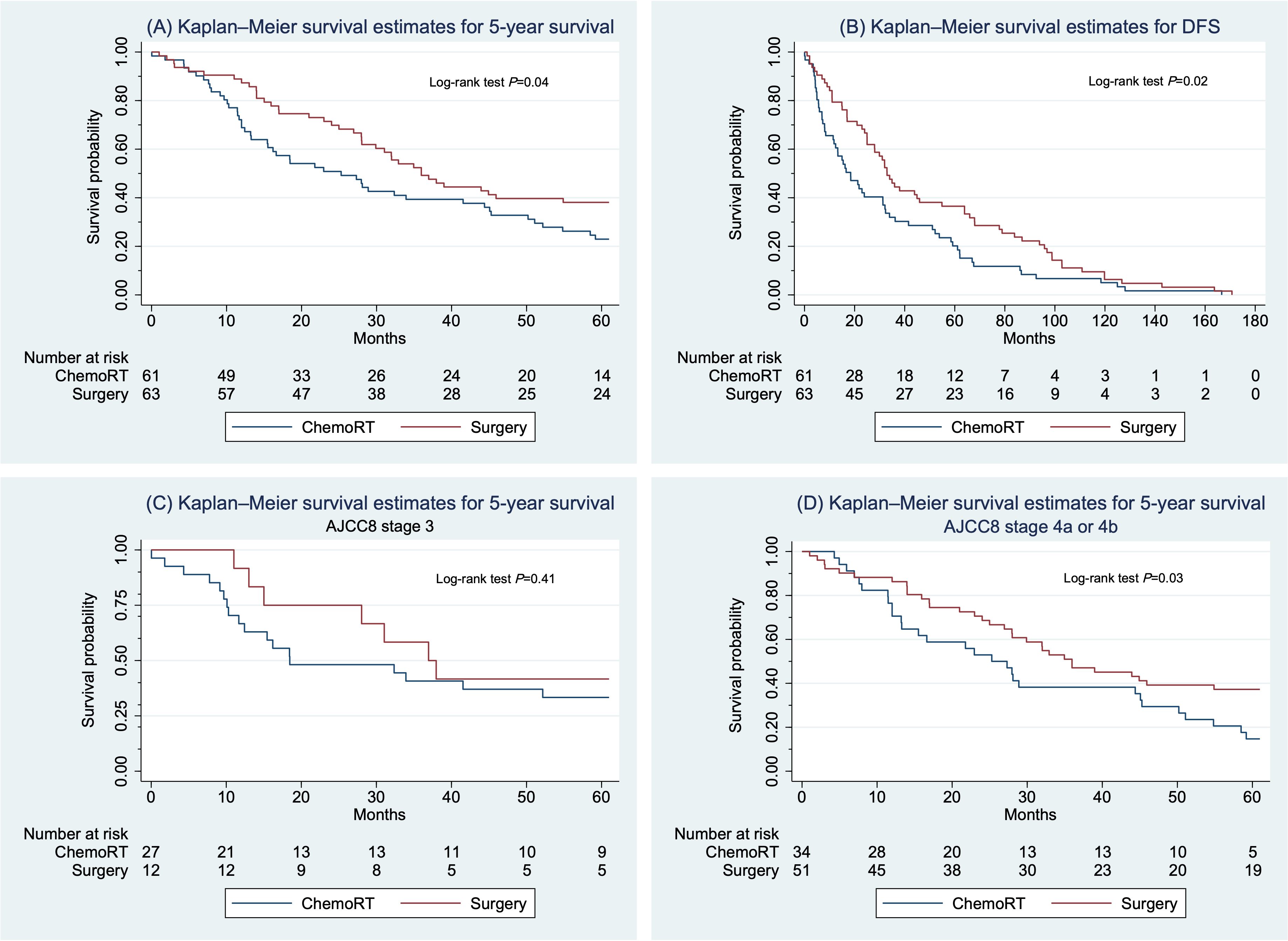
(A) Kaplan–Meier survival estimates for 5-year overall survival. (B) Kaplan–Meier survival estimates for DFS. (C) Kaplan–Meier survival estimates for 5-year overall survival in AJCC8 stage 3 patients. (D) Kaplan–Meier survival estimates for 5-year overall survival in AJCC8 stage 4 patients.
AJCC8: American Joint Committee on Cancer 8th Edition; DFS: disease-free survival; RT: radiotherapy
In selecting the primary treatment approach, patient factors such as comorbidities, performance status and patient preference should be considered alongside disease factors. In this study, the Eastern Cooperative Oncology Group (ECOG) performance status was a statistically significant factor (P<0.001) in determining the choice of primary treatment. Among the 14 patients who had an ECOG status of 2 or 3, 10 (71.4%) of them underwent upfront surgery, while the other 4 (28.6%) underwent LP therapy.
Functional outcomes presented a complex trade-off. The surgical arm demonstrated significantly better swallowing function, with 54 patients (85.7%) retaining oral feeding (including modified diets without tube dependence) compared to only 41 (67.2%) in the LP arm (P=0.017). The remaining patients were on enteral feeding via a gastrostomy tube or nasogastric tube. Similarly, a meta-analysis done by Pfuetzenreiter et al. found that there was a lower risk of long-term dysphagia and feeding tube dependence when surgery was performed.9 Conversely, the primary functional trade-off of TL is the definitive loss of natural voice. In this cohort, 64% of TL patients were rendered aphonic. To restore voice post-TL, 3 different methods can be used: (1) oesophageal speech, (2) electrolarynx and (3) tracheoesophageal prosthesis (TEP), with TEP exhibiting superior speech intelligibility and voice quality.10 In this study, only 23 (36%) out of 63 surgical patients achieved functional speech rehabilitation, a low rate potentially influenced by cultural and socioeconomic factors in Singapore. Among them, 12 had a TEP, 9 had an electrolarynx and only 2 managed to master oesophageal speech after a period of rehabilitation.
Despite the evolution of LP treatment over time, there is still a critical role for TL, not only in advanced primary tumours, but also as salvage therapy and for dysfunctional larynx from organ-preserving treatment.1,2 In this study, 13.1% of patients in the LP arm required salvage laryngectomy for recurrent or residual disease.
Limitations of this study include a retrospective design, which resulted in inherent selection bias and missing data, such as the lack of speech outcome data for the LP group and the number of patients who required a tracheostomy. Despite the limitations, the findings provide real-world validation of the management of locally advanced laryngeal cancer in Singapore. The superior survival in the surgical arm, which was composed of patients with worse prognosis, highlights the benefits of primary TL for advanced stage 4 tumours. For stage 3 tumours, the decision becomes a nuanced trade-off. LP offers a chance to retain the natural voice but carries risks of severe toxicity and swallowing dysfunction. Conversely, TL may offer better locoregional control and swallowing function but at the expense of a natural voice.
In conclusion, the findings provide strong evidence that primary laryngectomy should be considered the standard of care for patients with stage 4 laryngeal SCC in view of the superior OS and DFS outcomes, while LP should be the preferred approach in stage 3 patients given that it does not compromise the OS. Stage 3 patients with a non-functional larynx should undergo TL. Optimal management requires careful, multidisciplinary patient selection to align the chosen treatment modality with both the oncological imperatives and the functional priorities of each patient.
Acknowledgements
The authors would like to acknowledge their colleagues from the Tan Tock Seng Hospital Clinical Research and Innovation Office—Mr Heng Choon Pooh and Ms Lim Chien Joo—for their assistance with the statistical analysis.
REFERENCES
- Department of Veterans Affairs Laryngeal Cancer Study Group, Wolf GT, Fisher SG, et al. Induction chemotherapy plus radiation compared with surgery plus radiation in patients with advanced laryngeal cancer. N Engl J Med 1991;324:1685-90.
- Forastiere AA, Goepfert H, Maor M, et al. Concurrent chemotherapy and radiotherapy for organ preservation in advanced laryngeal cancer. N Engl J Med 2003;349:2091-8.
- Forastiere AA, Zhang Q, Weber RS, et al. Long-term results of RTOG 91-11: a comparison of three nonsurgical treatment strategies to preserve the larynx in patients with locally advanced larynx cancer. J Clin Oncol 2013;31:845-52.
- Grover S, Swisher-McClure S, Mitra N, et al. Total Laryngectomy Versus Larynx Preservation for T4a Larynx Cancer: Patterns of Care and Survival Outcomes. Int J Radiat Oncol Biol Phys 2015;92:594-601.
- Tang ZX, Gong JL, Wang YH, et al. Efficacy comparison between primary total laryngectomy and nonsurgical organ-preservation strategies in treatment of advanced stage laryngeal cancer: A meta-analysis. Medicine (Baltimore) 2018;97:e10625.
- Chen J, Selokar A, Ho FDV, et al. Head and Neck Cancer in Southeast Asia: 2022 Incidence, Mortality, and Projections to 2050. Laryngoscope 2025.
- Vainshtein JM, Wu VF, Spector ME, et al. Chemoselection: a paradigm for optimization of organ preservation in locally advanced larynx cancer. Expert Rev Anticancer Ther 2013;13:1053-64.
- Su X, He HC, Ye ZL, et al. A 10-Year Study on Larynx Preservation Compared With Surgical Resection in Patients With Locally Advanced Laryngeal and Hypopharyngeal Cancers. Front Oncol 2020;10:535893.
- Pfuetzenreiter EG Jr, Ferreron GF, Sadka JZ, et al. Total laryngectomy vs. non-surgical organ preservation in advanced laryngeal cancer: a metanalysis. Braz J Otorhinolaryngol 2024;90:101404.
- Maniaci A, La Mantia I, Mayo-Yáñez M, et al. Vocal Rehabilitation and Quality of Life after Total Laryngectomy: State-of-the-Art and Systematic Review. Prosthesis 2023;5:587-601.
This study was approved by the National Healthcare Group Domain Specific Review Board (2020/00068).
The authors declare there are no affiliations with or involvement in any organisation or entity with any financial interest in the subject matter or materials discussed in this manuscript.
Dr Chrisanda Si Ying Lee, Department of Otorhinolaryngology, Tan Tock Seng Hospital 11 Jalan Tan Tock Seng, Singapore 308433. Email: [email protected]
