

ABSTRACT
Introduction: Nursing home (NH) residents are vulnerable to infections and avoidable hospital transfers. The Infectious Diseases Community Program was developed as a multicomponent intervention to strengthen infection prevention and control (IPC), improve vaccination uptake, and support clinical decision-making in NHs.
Methods: The authors conducted a retrospective cohort study in 6 NHs in western Singapore with pre- and post-implementation data, in collaboration with an acute hospital. A total of 4801 admissions were screened, of which 2045 fever-related admissions were included. The intervention comprised IPC training, policy and process reviews, vaccination support, antimicrobial guidance, and implementation of a structured fever and desaturation pathway to standardise hospital transfer decisions.
Results: New methicillin-resistant Staphylococcus aureus (MRSA) acquisitions declined from 14.6% to 9.7% (relative reduction 33.6%, 95% confidence interval [CI] -6.8 to -3.1, P<0.001). Inappropriate fever-related transfers decreased from 12.0% (108/898) to 7.3% (61/839), a relative reduction of 39.2% (absolute reduction 4.8%, 95% CI -7.5 to -2.0, P<0.001). Influenza vaccination coverage exceeded 90% by 2022. Staff surveys indicated sustained adoption, with 84% reporting regular use of the pathway.
Conclusion: A collaborative model integrating acute hospital expertise with NH teams was associated with improved IPC outcomes, increased vaccination coverage, and reduced inappropriate transfers, supporting safer care delivery in long-term care.
CLINICAL IMPACT
What is New
- Multicomponent infection control programme in nursing homes (NHs) was associated with reduced MRSA acquisition and fewer inappropriate hospital transfers.
- Influenza vaccination coverage exceeded 90%, with sustained staff adoption of structured clinical pathways.
Clinical Implications
- Findings highlight the potential of collaborative models between acute hospitals and NHs to strengthen infection prevention and support safer, more appropriate care delivery.
Nursing home (NH) residents are particularly vulnerable to infections due to advanced age, frailty, comorbidities, and the institutional nature of care. Hospital transfers for acute illnesses, particularly infections, increase the risk of delirium, nosocomial complications, functional decline, and caregiver distress, while imposing additional strain on healthcare resources.1-5 Many of these admissions are preventable through strengthened infection prevention and control (IPC) practices, and improved assessment and decision-making on-site in the NHs.6-9
As of 2024, Singapore has 88 NHs and other long-term care facilities providing for a small percentage of the population aged 65 years and above.10,11 This proportion of older adults is projected to rise to one-quarter by 2030, leading to anticipated corresponding challenges in optimising care quality and healthcare utilisation.12 Strengthening IPC capacity and enhancing NH staff competencies to manage residents in situ are critical strategies to mitigate avoidable hospital transfers.13,14
Infections remain among the most common causes of hospital admission from NHs, particularly respiratory and urinary tract infections.15 Robust IPC systems and vaccination programmes can reduce such events, yet many NHs face implementation barriers including limited resources, competing priorities, as well as consent or cost issues.16,17 For NH residents who develop infections, studies have shown that selected conditions, including pneumonia, can be effectively managed in long-term care settings without transfer when structured assessment and treatment protocols are available.18,19 For example, Naughton et al. demonstrated comparable outcomes when pneumonia was treated within NHs versus in the hospital.20
While studies have shown that up to 40% of transfers from NHs may be preventable with structured clinical pathways and enhanced staff training,21 NH staff often lack decision-making frameworks and medical support to assess acutely ill residents confidently.19
Recognising these challenges, the Infectious Diseases Community Program (IDCP) was introduced as a collaborative initiative between an acute hospital and 20 participating NHs in western Singapore. The multidisciplinary IDCP team included infectious disease physicians, IPC nurses, and pharmacists who worked closely with NH nursing and managerial leads. The programme aimed to strengthen IPC systems, increase vaccination uptake, and support appropriate clinical decision-making for infectious diseases.
This study evaluated the effectiveness of the IDCP programme using routinely available data from 6 representative participating NHs with complete pre- and post-intervention datasets, assessing its impact on infection prevention outcomes, vaccination coverage, and the appropriateness of hospital transfers.
METHODS
Study design and setting
A retrospective cohort study was conducted to evaluate the multipronged IDCP intervention. While the IDCP programme was implemented across 20 NHs, the analysis focused on 6 facilities with complete pre- and post-implementation data, representing a range of sizes, staffing models, and medical coverage. Two periods were compared: pre-implementation (2015–2017) and post-implementation (2019–2021), with 2018 designated as a washout year to allow routine embedding of programme components. Although defined as the pre-implementation period, selected IDCP components (including policy review and early phases of staff training) were progressively introduced from 2016 onwards. These early interventions were not uniformly implemented across all facilities and were limited in scope; however, their presence may have attenuated observed differences between pre- and post-implementation outcomes.
Intervention: Infectious Diseases Community Program (IDCP)
The IDCP comprised several coordinated components designed to strengthen IPC governance, workforce capacity, vaccination uptake, and antimicrobial stewardship.
As an initial and central component of the IDCP, the team collaborated with each NH to review and align policy documents, identifying outdated guidance, gaps, and overlapping content. Revised recommendations were made to standardise policies across facilities and align them with the Ministry of Health’s National Infection Prevention and Control Guidelines for Long-Term Care Facilities.22 Key areas addressed included hand hygiene, isolation or cohorting of residents with known multidrug-resistant organism (MDRO) carriage, environmental disinfection and cleaning, and reporting procedures for infections with outbreak potential. A follow-up review in 2018 demonstrated notable improvements in governance structures and adherence to standardised policies.
To strengthen workforce capacity, a 3-tiered staff training programme was developed and progressively rolled out between 2016 and 2018.
- Tier 1 was a half-day foundational course (approximately 4 hours) for all staff, delivered on-site or virtually, incorporating a train-the-trainer component to enable in-house continuity.
- Tier 2 was a full-day (8-hour) course for supervisory and audit staff, focusing on hand hygiene auditing, environmental cleaning, and outbreak response.
- Tier 3 was an advanced 2.5-day (20-hour) immersion programme conducted at the acute hospital, combining didactic sessions, case-based discussions, and practical ward-based attachments on surveillance, MDRO management, and leadership in IPC.
Training was adapted for virtual delivery during the COVID-19 period. Across all participating NHs, 37 training sessions were conducted for 1260 participants, and by programme completion, all 20 NHs had staff certified through tiers 1 to 3.
Vaccination strategies
Vaccination for the elderly and medically vulnerable individuals is an important preventive measure against infections and reduces hospital admissions.22-24 IDCP engagement sessions identified gaps relating to low vaccine uptake by NH residents and healthcare workers. These included cost, limited knowledge, fear of side effects, and challenges in obtaining consent from residents, staff, or next-of-kin.
To address these barriers, the IDCP team developed A Guide to Vaccination of Residents and Staff in Long-Term Care Facilities in Singapore (internal document), outlining procurement steps, counselling frameworks, and common misconceptions. It was disseminated prior to the post-implementation period and adapted to individual facility needs. Funding from the JurongHealth Fund enabled provision of up to 2500 free pneumococcal vaccinations, primarily administered during the washout period in 2018 and early post-implementation period. While vaccines were largely utilised at the facility level, centralised records of exact uptake and timing were incomplete, precluding precise quantification of coverage and impact on hospital admissions.
Fever and desaturation pathway
A key component of the IDCP was the fever and desaturation pathway (Fig. 1), developed to guide NH staff in assessing residents with fever or respiratory symptoms and standardising decisions on hospital transfer. Early iterations were refined with staff input. The pathway outlined vital-sign monitoring, supportive measures, and recognition of deterioration requiring escalation. Assessments included blood pressure, respiratory rate, oxygen saturation, and mental status using the Glasgow Coma Scale (GCS), supported by targeted training from IPC nurses. Residents meeting severity criteria were transferred, while stable residents received supportive care within the NH. By early 2019, the pathway had been adopted in all participating NHs, with COVID-19-specific elements added subsequently.
Fig. 1. The Infectious Diseases Community Program’s fever and desaturation pathway.
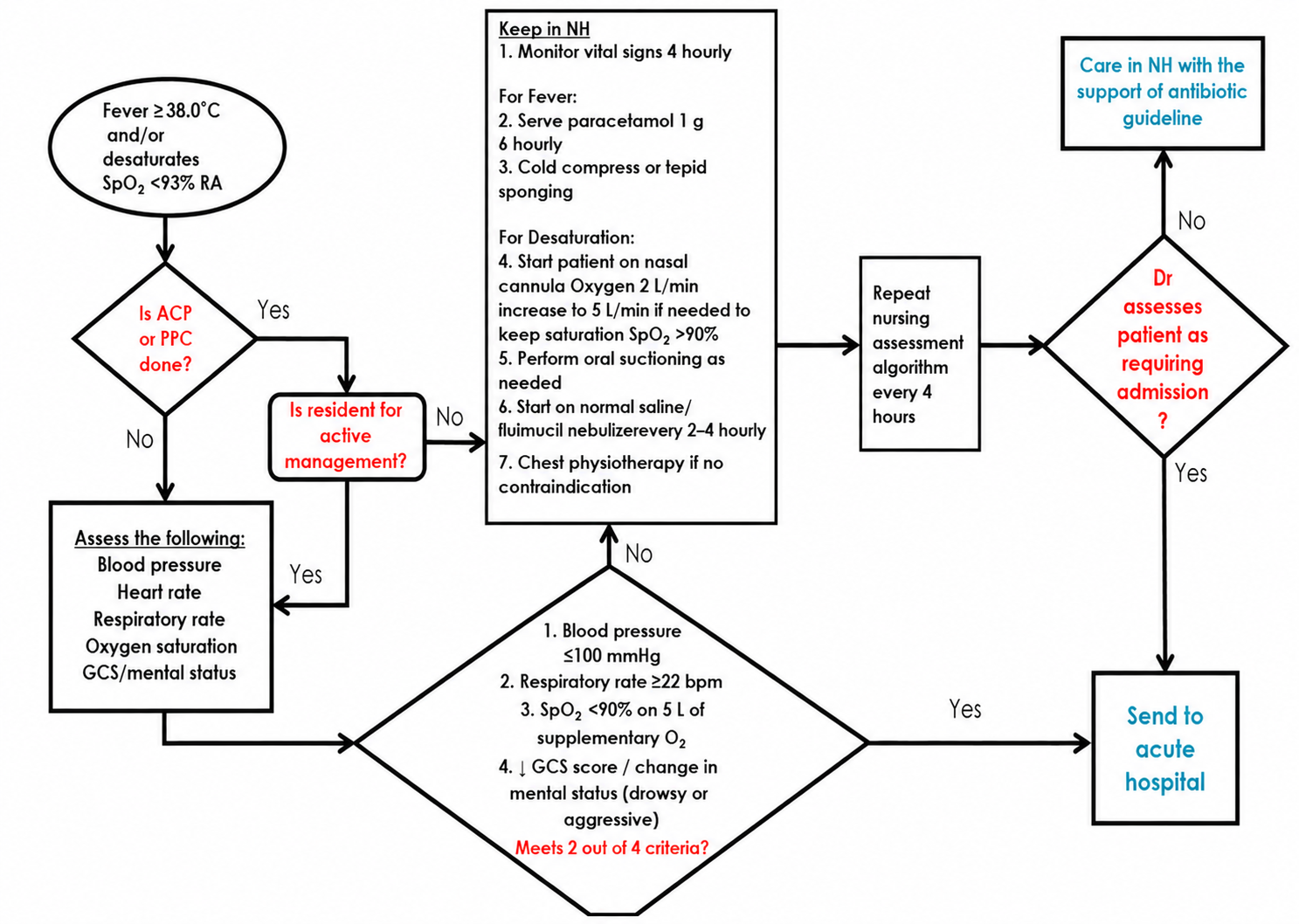
Structured clinical pathway used to guide NH staff in assessing residents with fever or desaturation, standardising decisions on supportive management within the facility versus transfer to acute hospital care.
Training comprised a combination of didactic teaching, case discussions, and simulation. Introductory modules covered fundamental IPC practices, while advanced modules built competence in clinical assessment, recognition of deterioration, and understanding of advance care plans (ACPs) to ensure alignment with residents’ goals of care.
Antimicrobial stewardship component
An antimicrobial-choice guideline was developed with primary care physicians, infectious disease specialists, and pharmacists. Introduced prior to the post-implementation period, it addressed an existing gap in national guidance, and enabled facilities to establish in-house formularies for timely access. Its specific impact was not evaluated in this study, and may represent an unmeasured co-intervention.
Data and outcome measures
Patient data were retrieved from hospital electronic medical records, NH transfer forms, and internal IDCP logs. Admissions were screened for any mention of fever as a leading or contributing factor.
To evaluate IPC initiatives, methicillin-resistant Staphylococcus aureus (MRSA) acquisition rates were used as a surrogate measure. Acquisition was defined as the detection of MRSA at hospital admission in residents whose prior screening results were negative or unknown. During this period, all adult admissions to Singapore’s acute hospitals underwent MRSA active surveillance using standard culture-based methods (nares, axilla, and groin swabs), with discharge screening for those initially negative.25 No major changes in sampling sites, laboratory techniques, or surveillance protocols occurred during the study period. Residents who were negative on 1 admission but positive on a subsequent admission were classified as having NH-acquired MRSA, providing an objective, though imperfect, measure of NH IPC performance. MRSA infections (distinct from colonisation) were not analysed separately. As residents may have been admitted to other acute healthcare facilities between admissions to the study site, interim MRSA acquisition events may not have been captured, introducing potential misclassification. However, as the study hospital is the primary referral centre for participating NHs, such events were likely limited and non-differential across study periods. MRSA acquisition was assessed at the level of admission episodes rather than unique residents. As patient-level linkage across admissions and institutions was not available, repeat admissions by the same resident could not be excluded, and the proportion of frequently readmitted individuals could not be determined. This approach was applied consistently across study periods, and any resulting bias is likely non-differential.
To assess the impact of the fever and desaturation pathway, hospital transfers were considered appropriate if residents met at least 2 of the following criteria: systolic blood pressure ≤100 mmHg, respiratory rate ≥22 breaths/min, oxygen saturation ≤90%, or a decrease of 2 or more points on the GCS from baseline. Documentation of an ACP was also reviewed. During the COVID-19 pandemic, the pathway was adapted to include suspected or confirmed COVID-19 cases as legitimate indications for hospital admission, consistent with evolving national guidance. Transfers were classified as inappropriate if residents failed to meet these criteria, and had no other urgent medical indication for hospitalisation.
An anonymous survey of NH staff was also conducted to capture qualitative insights into adherence to the pathway and perceptions of whether the approach reduced unnecessary admissions. Surveys were conducted at 2 time points: 2018 (washout year) and 2022 (post-implementation).
Statistical analysis
Data were analysed at both the individual NH and aggregate level, excluding facilities with incomplete pre-intervention data. Differences in proportions between pre- and post-implementation periods were compared using chi-square tests. All data analyses were performed using R, version 2024.09.0+375 (R Foundation for Statistical Computing, Vienna, Austria), within the RStudio environment (Posit Software, Boston, MA, US).
RESULTS
Over the study period, 4801 hospital admissions of NH residents were screened, of which 2045 admissions involved fever as a primary or contributory reason. Screening for MRSA on hospital admission demonstrated a significant decline in new acquisitions, from 14.6% (329 of 2247) in the baseline period to 9.7% (253/2613) after programme implementation (Table 1). This represented a relative reduction of 33.6% (absolute reduction 5.0 percentage points, 95% confidence interval [CI] -6.8 to -3.1, P<0.001). The decline coincided with greater uptake of standard precautions, regular staff training, and the establishment of multidisciplinary IPC committees within most participating NHs. All established facilities recorded meaningful improvements, with relative reductions ranging from 30.7% to 48.9%. NH C achieved the largest improvement, from 19.0% to 9.7%—a 48.9% relative reduction, although CIs for individual facilities were wide due to year-to-year variability (Table 1).
Table 1. Changes in new MRSA acquisition rates pre- and post-implementation of the Infectious Diseases Community Program (2015–2017 versus 2019–2021).
|
Nursing home |
Pre-Intervention, % |
Post-intervention, % |
Change in MRSA acquisition, % (95% CI) |
|
NH A |
14.0 |
9.7 |
-4.3 (-55.9 to 47.2) |
|
NH B |
20.7 |
13.7 |
-7.0 (-67.1 to 53.1) |
|
NH C |
19.0 |
9.7 |
-9.3 (-64.9 to 46.2) |
|
NH D |
14.3 |
9.3 |
-5.0 (-56.5 to 46.5) |
|
NH Ea |
4.7 |
7.7 |
+3.0 |
|
NH Fa |
4.0 |
7.3 |
+3.3 |
|
Overallb |
14.6 |
9.7 |
-5.0 (-6.8 to -3.1) (P<0.001) |
CI: confidence interval; MRSA: methicillin-resistant Staphylococcus aureus; NH: nursing home; P: P value
a For NH E and NH F, there were only had data for 2017 in the pre-intervention period.
b Overall analysis based on total MRSA screenings and acquisitions across all facilities.
Percentages represent the proportion of new MRSA-positive cases among residents screened in the respective period. Facility-level data were available only as aggregated percentages derived from institutional reports, and corresponding numerator and denominator values were not consistently available.
Training outcomes reflected broad engagement across NH staff. A total of 20 tier 1 sessions, including 10 face-to-face, 5 virtual, and 5 train-the-trainer modules, trained 959 participants. Ten tier 2 sessions trained 170 staff in supervisory roles, while 8 tier 3 sessions reached 131 staff identified for IPC leadership responsibilities. Most training occurred during the washout year (2018), with additional sessions conducted through 2019 to accommodate new facilities and staff turnover.
Analysis of inappropriate transfers focused on 4 NHs (A to D) with complete pre- and post-intervention data. Across these facilities, the overall proportion of inappropriate fever-related transfers decreased significantly from 12.0% (108/898) before implementation to 7.3% (61/839) afterwards, representing a 39.2% relative reduction (absolute reduction 4.8 percentage points, 95% CI -7.5 to -2.0, P<0.001; Table 2). Improvements were consistent across most facilities, with the exception of NH A, which showed no significant change. Two additional NHs (E and F), which lacked full pre-intervention data, achieved post-implementation inappropriate-transfer rates (7.8% and 7.9%) within the same range as those observed in the 4 fully evaluated facilities.
Table 2. Changes in inappropriate fever transfers pre- and post-implementation of the Infectious Diseases Community Program (2015–2017 versus 2019–2021).
|
Nursing home |
Pre-intervention total no. (inappropriate %) |
Post-intervention total no. (inappropriate %) |
Change in inappropriate transfers, % (95% CI) |
P value |
|
NH A |
324 (6.8) |
292 (9.2) |
+2.5 (-1.8 to 6.8) |
0.41 |
|
NH B |
190 (20.0) |
167 (7.2) |
-12.8 (-19.7 to -5.9) |
<0.001 |
|
NH C |
236 (14.8) |
241 (7.1) |
-7.8 (-13.3 to -2.2) |
<0.001 |
|
NH D |
148 (8.8) |
139 (3.6) |
-5.2 (-10.7 to 0.3) |
<0.001 |
|
NH Ea |
25 (8.0) |
129 (7.8) |
-0.2 (-11.8 to 11.3) |
0.94 |
|
NH Fa |
27 (18.5) |
127 (7.9) |
-10.6 (-26.0 to 4.7) |
<0.001 |
|
Overallb |
898 (12.0) |
839 (7.3) |
-4.8 (-7.5 to -2.0) |
<0.001 |
CI: confidence interval; NH: nursing home
a For NH E and NH F, there were only data for 2017 in the pre-intervention period.
b Overall results exclude NH E and NH F due to incomplete pre-intervention data.
Staff perceptions similarly reflected these quantitative findings. An anonymous survey conducted in 2018 across 3 NHs demonstrated high engagement with the fever and desaturation pathway, with between 63.6% and 91% of staff reporting that they “always” used the pathway when assessing residents with fever. More than 95% were familiar with the tool, and only 2.2% reported awareness without use. Regarding impact, between 54.5% and 75.6% of staff reported that the pathway “often” prevented unnecessary transfers, while a further 20% to 45.5% reported that it prevented transfers “a few times”. A follow-up survey in 2022 confirmed sustained use, with 78% reporting continued adoption and 84% (combining “always” and “very often”) indicating regular use for clinical decision-making. Across participating NHs, all staff surveyed either strongly agreed (58%) or somewhat agreed (42%) that the programme had improved their facility’s capacity to triage fever cases appropriately.
Influenza vaccination uptake trends improved across most participating NHs over the study period. Although coverage varied between facilities, by 2021, 7 of 9 NHs with available data had reached at least 80% influenza vaccination coverage among residents (including 4 with coverage above 90%; Fig. 2), and 6 of 9 had reached the 80% target among healthcare workers (including 3 above 90%). By the end of the programme, more than 90% of residents had received at least 1 influenza vaccination. Additionally, educational sessions and vaccination guidelines were well received, with a majority of 89% of healthcare workers reporting that these resources improved their knowledge and understanding of different vaccines.
Fig. 2. Annual influenza vaccination rates among residents in participating nursing homes (2016–2021). Data provided by institutional quality reports.
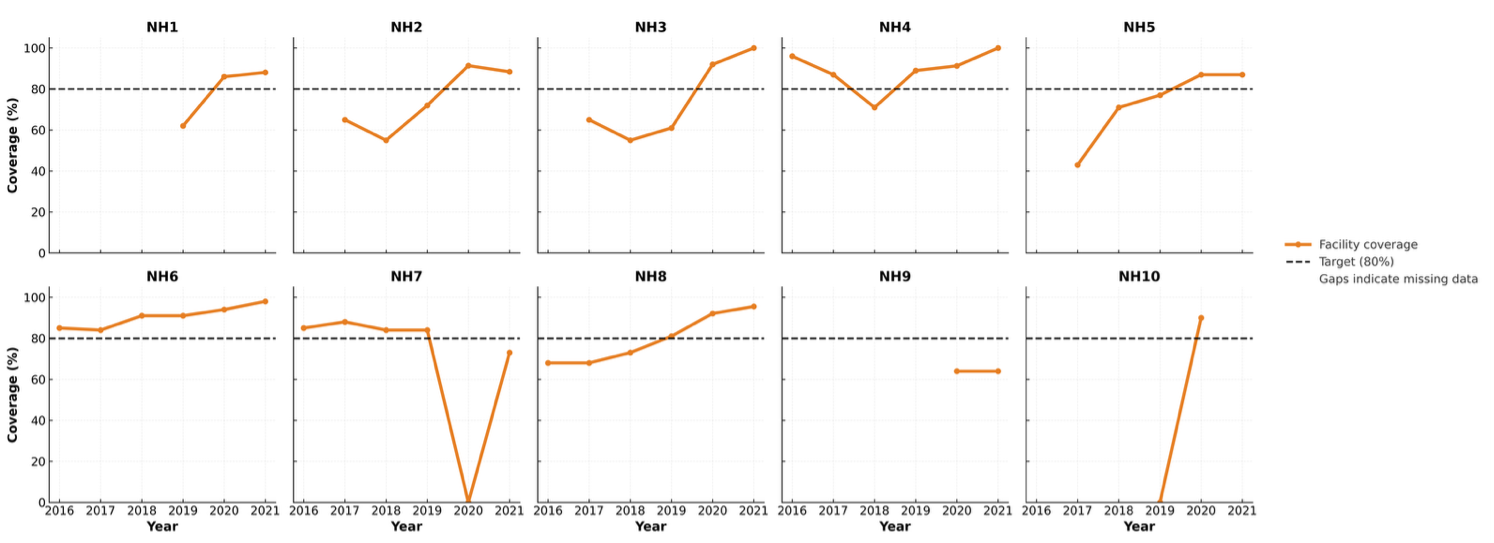
NH: nursing home
Each panel represents 1 NH (NH A–J). Naming is consistent with Tables 1 and 2 for NH A–F; additional NHs (NH G–J) are included in this figure where vaccination data were available but were not part of the MRSA and transfer analyses due to incomplete datasets. Solid orange lines show annual vaccination coverage (%) for NH residents. Dashed line indicates the 80% coverage target. Gaps in trend lines indicate years for which data were not available.
DISCUSSION
This study demonstrated that a multipronged infectious disease programme in NHs was associated with measurable improvements in IPC and clinical decision-making. New MRSA acquisitions declined significantly across most established facilities, inappropriate fever-related transfers were reduced by nearly 40%, and influenza vaccination coverage exceeded 90% of residents by 2022. However, NH E and NH F demonstrated increases in MRSA acquisition rates in the post-implementation period. These facilities had only 1 year of baseline data, limiting the reliability of pre- and post-implementation comparisons. In addition, later programme onboarding, smaller sample sizes, and unmeasured factors such as resident case-mix, staffing variability, and referral patterns may have contributed to the observed increases. Staff surveys confirmed high and sustained adoption of the fever and desaturation pathway, highlighting increased confidence and more standardised triage decisions. Together, these outcomes reflect not only adherence to structured IPC processes but also the value of collaboration and sustained engagement between acute hospital IPC teams and NH leadership.
Working with NHs presents inherent challenges. These facilities are often understaffed and underfunded, with leadership balancing competing priorities.18,26 Support from acute hospital teams may be perceived as adding workload or introducing standards that do not align with existing systems, particularly when documentation is manual and clinical outcomes are not routinely captured. Despite these barriers, staff enthusiasm in participating in training and assuming IPC leadership roles demonstrated that improvement was both recognised and welcomed.
Measuring IPC outcomes is difficult even in acute care settings. In this real-world intervention, prospective surveillance within NHs was not feasible; however, leveraging acute hospital systems enabled a practical evaluation. Routine screening for MRSA carriage on hospital admission and discharge provided a consistent surrogate of IPC standards. These data were extracted directly from hospital IPC surveillance systems, allowing for consistent and objective measurement across the study period. Although limited by swab sensitivity, and the assumption that a negative discharge swab followed by a positive admission swab reflected NH acquisition, the use of identical processes pre- and post-intervention, alongside consistent declines across multiple facilities, support the validity of the observed improvements. Direct quantitative measures of IPC practices (e.g. hand hygiene compliance rates) were not consistently available across facilities; however, multiple system-level indicators, including policy standardisation, establishment of IPC governance structures, and sustained staff training, support improved adherence to IPC practices over time.
There are also meaningful risks and costs associated with frequent hospital transfers for self-limiting conditions. The structured fever and desaturation pathway reduced admissions that did not meet objective transfer criteria. Staff surveys reinforced that the pathway increased clinical confidence and provided a standardised approach to fever management. Inappropriate transfers from NHs should be regarded as a valuable quality metric, particularly given increasing global pressure on acute care bed availability. Although this study required manual data extraction, real-time monitoring and feedback could more effectively prevent unnecessary transfers and their negative consequences for residents, families, and health systems.
Strengthening medical support within NHs will be essential to build on progress. Some facilities lacked daily medical input, which constrained staff capacity to manage acute changes. Enhanced access to primary care, deployment of advanced practice nurses, and expansion of hospital-at-home services are potential strategies to fill this gap.26-28 Staff turnover was another challenge, as new employees were not always adequately trained in the pathway. Limited documentation of ACPs or preferred plans of care also introduced uncertainty, as staff were sometimes unsure whether hospitalisation was consistent with the residents’ preferences. Although awareness of advance care planning improved, the absence of clear directives complicated decision-making in some cases.
Several limitations should be considered. As expected in a real-world programme evaluation, this retrospective study relied on routinely collected data and was therefore subject to variability in documentation and completeness. Baseline demographic and clinical characteristics of residents were not consistently available, limiting adjustment for potential confounders. The analysis was conducted within a single regional cluster of NHs, which may affect generalisability to other settings with different resources and care structures. External factors, including the COVID-19 pandemic and the evolving national policies on infection control and hospital transfer criteria, may also have influenced observed outcomes. Formal health economic evaluation of the programme was not conducted. As such, cost-effectiveness and long-term financial sustainability could not be assessed and represent important areas for future study.
However, the consistency of improvements across multiple facilities and outcome measures, alongside stable data collection processes before and after implementation, supports a meaningful programme effect. These findings should therefore be interpreted as a pragmatic evaluation of a complex, multicomponent intervention, reflecting the realities of implementation in long-term care settings.
CONCLUSION
In conclusion, this study provides evidence that a collaborative strategy encompassing IPC policy reviews, staff education, and vaccination support can strengthen infection control in NHs. The use of a structured clinical pathway improved the appropriateness of hospital transfers, aligning decisions with objective clinical criteria while supporting resident well-being. Although resource-intensive, such work is feasible and sustainable when built on partnership, shared goals, and an appreciation of the unique challenges faced by NHs and their staff.
Supplementary material
Acknowledgements
The authors gratefully acknowledge the contributions of the IDCP team, and the Infection Prevention Team at the National University Hospital whose expertise and commitment were essential in the design and implementation of this work. We thank Mr Thomas Soo, Dr Natasha Bagdasarian, Dr James Molton, Ms Nai Ying Jiin, Ms Hon Qi, Ms Alison Cheng, Ms Bindu Karunakaran, Ms Amira Toriman, Ms Jessica Michaels, and Ms Tan Shire Yang among countless others for their invaluable support.
Reporting Guidelines
The authors used the STROBE reporting guideline30 to draft this manuscript, and the STROBE reporting checklist31 during editing (Supplementary Annex S1).
REFERENCES
- Webb HT, Lieb KM, Stump TE, et al. Describing transfers originating out-of-facility for nursing home residents. J Am Med Dir Assoc 2022;23:105-10.
- Quah WC, Leong CJ, Chong E, et al. Unplanned hospitalisations among subsidised nursing home residents in Singapore: insights from a data linkage study. Ann Acad Med Singap 2024;53:657-69.
- Pérez-Cruz M, Parra-Anguita L, López-Martínez C, et al. Burden and anxiety in family caregivers in the hospital that debut in caregiving. Int J Environ Res Public Health 2019;16:3977.
- Lemoyne SE, Herbots HH, De Blick D, et al. Appropriateness of transferring nursing home residents to emergency departments: a systematic review. BMC Geriatr 2019;19:17.
- Bally KW, Nickel C. Acute hospital admissions among nursing home residents–benefits and potential harms. Praxis (Bern 1994) 2013;102:987-91.
- Ouslander JG, Lamb G, Tappen R, et al. Interventions to reduce hospitalizations from nursing homes: evaluation of the INTERACT II collaborative quality improvement project. J Am Geriatr Soc 2011;59:745-53.
- Trahan LM, Spiers JA, Cummings GG. Decisions to transfer nursing home residents to emergency departments: a scoping review of contributing factors and staff perspectives. J Am Med Dir Assoc 2016;17:994-1005.
- Saliba D, Kington R, Buchanan J, et al. Appropriateness of the decision to transfer nursing facility residents to the hospital. J Am Geriatr Soc 2000;48:154-63.
- Ouslander JG, Lamb G, Perloe M, et al. Potentially avoidable hospitalizations of nursing home residents: frequency, causes, and costs. J Am Geriatr Soc 2010;58:627-35.
- Immigration & Checkpoints Authority, Singapore. Report on Registration of Births and Deaths 2020. https://www.ica.gov.sg/docs/default-source/ica/stats/annual-bd-statistics/stats_2020_annual_rbd_report.pdf?sfvrsn=21a3e11e_4. Accessed 6 May 2026.
- Ministry of Health, Singapore. Health Facilities. 26 May 2025. https://www.moh.gov.sg/others/resources-and-statistics/health-facilities/?utm_source=chatgpt.com/. Accessed 14 May 2026.
- World Bank. Population ages 65 and above (% of total population). https://data.worldbank.org/indicator/SP.POP.65UP.TO.ZS. Accessed 27 August 2025.
- Rolland Y, Mathieu C, Tavassoli N, et al. Factors associated with potentially inappropriate transfer to the emergency department among nursing home residents. J Am Med Dir Assoc 2021;22:2579-86.
- Thandar MM, Rahman MO, Haruyama R, et al. Effectiveness of infection control teams in reducing healthcare-associated infections: a systematic review and meta-analysis. Int J Environ Res Public Health 2022;19:17075.
- Lee MH, Lee GA, Lee SH, et al. Effectiveness and core components of infection prevention and control programmes in long-term care facilities: a systematic review. J Hosp Infect 2019;102:377-93.
- Bloch N, Männer J, Gardiol C, et al. Effective infection prevention and control measures in long-term care facilities in non-outbreak and outbreak settings: a systematic literature review. Antimicrob Resist Infect Control 2023;12:113.
- Chambers D, Cantrell A, Preston L, et al. Reducing unplanned hospital admissions from care homes: a systematic review. Health Soc Care Deliv Res 2023;11:1-130.
- Basso I, Gonella S, Bassi E, et al. Impact of quality improvement interventions on hospital admissions from nursing homes: a systematic review and meta-analysis. J Am Med Dir Assoc 2024;25:105261.
- Høyvik E, Doupe MB, Ågotnes G, et al. Barriers to healthy transitions between nursing homes and emergency departments. Geriatr Nurs 2024;59:639-45.
- Naughton BJ, Mylotte JM, Tayara A. Outcome of nursing home–acquired pneumonia: derivation and application of a practical model to predict 30-day mortality. J Am Geriatr Soc 2000;48:1292-9.
- Graverholt B, Forsetlund L, Jamtvedt G. Reducing hospital admissions from nursing homes: a systematic review. BMC Health Serv Res 2014;14:36.
- Ministry of Health Singapore. The national infection prevention and control guidelines for long-term care facilities. Revised 2021. https://isomer-user-content.by.gov.sg/95/cba04fe1-6ec5-497a-8e4f-de4566ffa6e8/national-ipc-guidelines-for-long-term-care-facilities_2021_revised_2nd-edition_moh-website.pdf. Accessed 18 May 2026.
- Gravenstein S, Dahal R, Gozalo PL, et al. A cluster randomized controlled trial comparing relative effectiveness of two licensed influenza vaccines in US nursing homes: design and rationale. Clin Trials 2016;13:264-74.
- Cai S, Temkin-Greener H. Influenza vaccination and its impact on hospitalization events in nursing homes. J Am Med Dir Assoc 2011;12:493-8.
- Streeter AJ, Rodgers LR, Masoli J, et al. Real-world effectiveness of pneumococcal vaccination in older adults: cohort study using the UK Clinical Practice Research Datalink. PLoS One 2022;17:e0275642.
- Fisher DA, Tambyah PA, Lin R, et al. Sustained MRSA control in a hyper-endemic tertiary acute care hospital with infrastructure challenges in Singapore. J Hosp Infect 2013;85:141-8.
- Yang XF, Guo JY, Peng WS, et al. Global perspectives on challenges, coping strategies, and future preparedness of nursing home staff during COVID-19: a systematic review and meta-synthesis. BMC Health Serv Res 2025;25:872.
- Sturmberg JP, Gainsford L, Goodwin N, et al. Systemic failures in nursing home care: a scoping study. J Eval Clin Pract 2024;30:484-96.
- Senek M, Robertson S, Taylor B, et al. Consequences of understaffing on type of missed community care: a cross-sectional study. Int J Nurs Stud Adv 2022;4:100075.
- von Elm E, Altman DG, Egger M, et al. Strengthening the reporting of observational studies in epidemiology (STROBE): explanation and elaboration. Ann Intern Med 2007;147:573-7.
- von Elm E, Altman DG, Egger M, et al. The Strengthening the Reporting of Observational Studies in Epidemiology (STROBE) statement: guidelines for reporting observational studies. Lancet 2007;370:1453-7.
Ethics approval for this study was granted by the National Healthcare Group Domain Specific Review Board (2018/00533), with a waiver of individual consent granted on the basis that no identifiable patient information was disclosed.
The authors declare there are no affiliations with or involvement in any organisation or entity with any financial interest in the subject matter or materials discussed in this manuscript. The Infectious Diseases Community Program received partial support from the Jurong Health Fund, which enabled pneumococcal vaccination for NH residents. This funding did not support the present study, and the funder had no role in study design, data collection and analysis, or manuscript writing.
Prof Dale Andrew Fisher, Division of Infectious Diseases, Department of Medicine, National University Hospital, NUHS Tower Block 1E Kent Ridge Road, Singapore 119228. Email: [email protected]
