


Dear Editor,
In older adults, herpes zoster, also known as shingles, is a common infectious disease. The estimated lifetime risk of shingles in the general population is about 30%;1 this increases to 50% at age 85 years old.2 Among the morbidities associated with shingles, postherpetic neuralgia is the most common complication that has a huge negative impact on quality of life.3
In Asia-Pacific countries, the average shingles incidence of 3–10/1000 person-years is rising at around 5% per year.4 Shingles is a major public health concern in Singapore given its rapidly ageing population. The recombinant zoster vaccine (Shingrix, GlaxoSmithKline) has been shown in clinical trials to have over 90% effectiveness in preventing shingles and its complications across all age groups above 50 years.5 It has higher vaccine efficacy compared to the older live attenuated vaccine (Zostavax, Merck Sharp & Dohme), which is contraindicated in adults with immunosuppression.
The shingles vaccine uptake in adults older than 50 years in the UK is known to be low.6 Currently, there is no publicly available data on shingles vaccination uptake rates in Singapore.
Healthcare workers (HCWs) play a vital role in shaping public health practices, hence it is important to understand their perception of the shingles vaccine as it is essential for promoting vaccination.7 We present our research findings to better understand vaccination perception among HCWs and explore the nature of their concerns, their knowledge of shingles and their perceived role in responding to the shingles vaccine.
This study employed a cross-sectional design to examine the knowledge of shingles and its vaccination in health care workers in Sengkang General Hospital, a 1000-bed tertiary teaching hospital in the northeast district of Singapore.
The survey questionnaire comprised demographic information and 18 true-false questions on knowledge of shingles and its vaccination, as well as perception and attitudes on shingles prevention with vaccination. The questionnaire was developed after conducting a literature review of the existing questionnaires on shingles vaccination.
The survey was distributed via hospital email through a survey invite link via forms.sg. Data was collected over a 2-month period from 4 July to 28 August 2024. The data was analysed using SPSS version 28.0 (IBM Corp, Armonk, NY, US).
This survey has been approved by the SingHealth Centralised Institutional Review Board with a waiver of informed consent. Confidentiality and anonymity of the participants were maintained during this survey.
There were a total of 430 respondents including 154 doctors, 252 nurses and 24 pharmacists (response rate 14.3%). The vast majority of respondents were females (307, 71.4%), nurses (252, 58.6%) and attained at least a degree (276, 64.2%).
The knowledge score is the sum of the correct responses for the 13 knowledge questions. The mean knowledge score is 9.24 (standard deviation [SD] of 2.05) for doctors; 6.45 (SD of 2.00) for nurses; and 10.01 (SD of 1.82) for pharmacists. A wide variability was noted in the nurses’ scores with a range of 2 to 11. The differences between nurses and doctors, and nurses and pharmacists were significant (1-way analysis of variance P<0.001), while that between doctors and pharmacists was not (P=0.138).
Table 1. Participants’ knowledge of shingles and its vaccine by speciality.
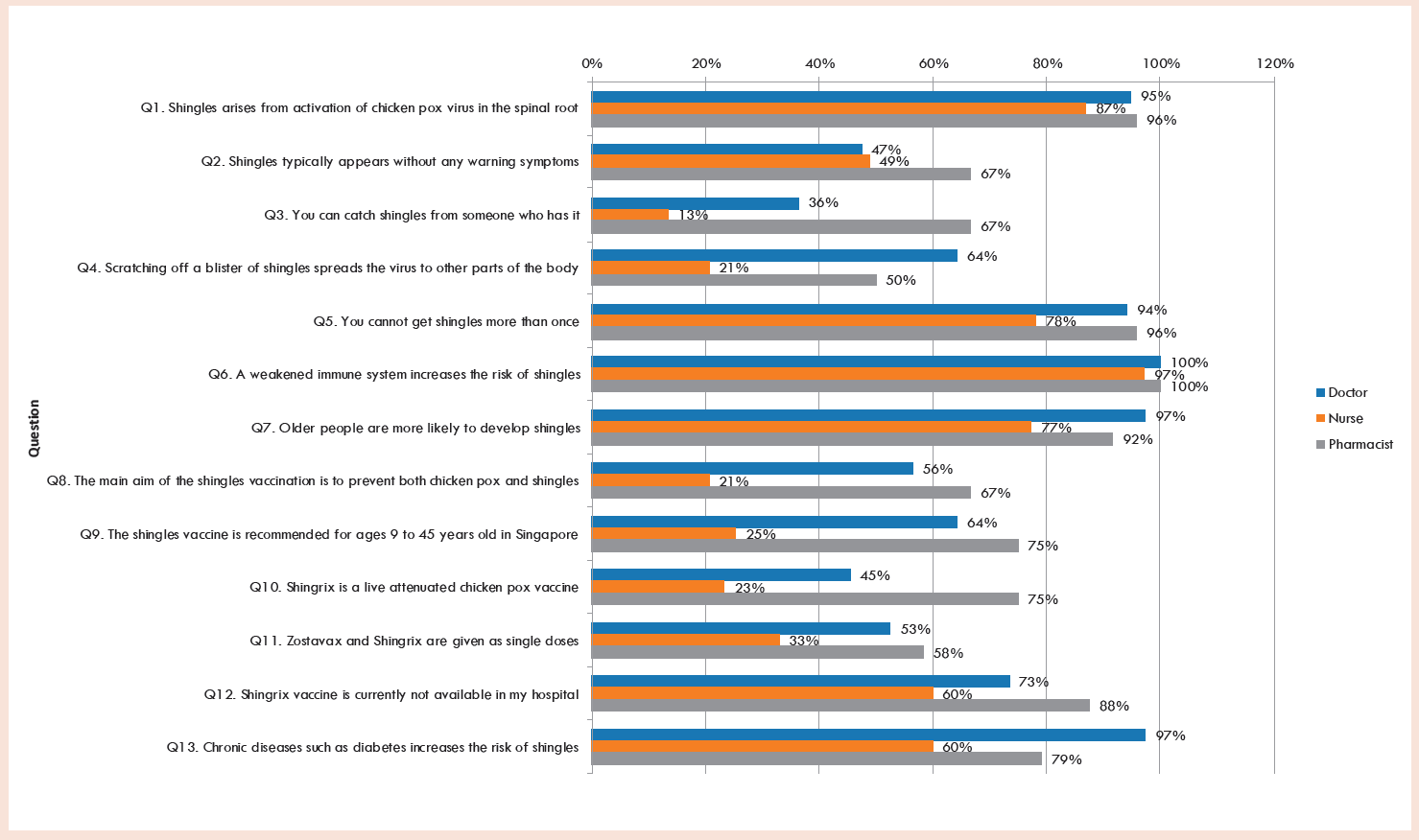
A positive correlation was demonstrated between education level and knowledge scores. Participants with basic tertiary education (diploma or degree) had a mean score of 7.35, while those with advanced tertiary education (master’s and doctorate) had a significantly higher score of 9.41 (P<0.05).
However, the study found no correlation between seniority (surrogate marker being the number of years in clinical practice) and knowledge of shingles. As clinicians gain years in their clinical practice, knowledge from medical training can diminish without reinforcement through practice or ongoing learning.8
We explored the perception of shingles vaccination with 5 statements in the survey:
Question 14: “I am not convinced that Shingrix is able to effectively prevent shingles.”
Here, 78.84% of respondents were convinced that Shingrix is effective in preventing shingles. A weak correlation was found with knowledge (coefficient -0.238) indicating that individuals with higher knowledge levels are less likely to express scepticism about the effectiveness of the Shingrix vaccine.
Question 15: “I am confident to provide credible shingles vaccine recommendations to my patients.”
A weak correlation was found with knowledge (coefficient -0.158), suggesting that the more knowledge respondents have about shingles and the vaccine, the slightly less confident they feel when making recommendations. Profession, however, showed a weak positive correlation (coefficient 0.167) with confidence. A slight increase in confidence was observed from doctors (49.35%) to pharmacists (66.67%) to nurses (68.25%). Higher knowledge was paradoxically associated with lower confidence in vaccine recommendations. This may be due to increased awareness of vaccine limitations and ethical dilemmas in balancing patient autonomy with public health advocacy.
Question 16: “My busy work schedule does not allow me to discuss shingles vaccine with patients.”
The affirmative was found in 62.99% of doctors, 55.16% of nurses and 87.50% of pharmacists (P= 0.0051). Pharmacists being the last point of patient contact through hospital journey with patients have the least bandwidth to discuss vaccination. To address this, strategies such as integrating vaccination prompts into clinic consults, delegating education to trained staff, and leveraging technology such as pre-visit reminders and digital aids can help. Streamlined documentation and institutional support, including protected time or incentives, may further reduce barriers. For pharmacists, brief consultation slots and visual prompts can facilitate vaccine discussions without adding to workload. A team-based approach is essential to overcoming time-related barriers to vaccination counselling.
Question 17: “I find it difficult to communicate with older adults about shingles vaccine.”
The majority of respondents (n=263, 61.16%) struggle to discuss the shingles vaccine with older patients. Communication barriers persist in discussing vaccination with older adults, underscoring the need for structured communication training for HCWs.
Question 18: “In patients who developed or had developed shingles, there is no point to discuss the shingles vaccine with them.”
A small proportion of respondents (n=71, 16.51%) felt that discussing the shingles vaccine with patients who developed or had developed shingles was pointless. Knowledge gaps exist regarding post-infection vaccination benefits, highlighting the need for improved public health messaging to ensure patients and HCWs understand that shingles can recur and vaccination reduces future risk.
Our study is the first hospital-based study in Singapore which looked at the healthcare workers’ knowledge and perception of shingles and its vaccination.
A key limitation of the questionnaire design is its exclusive use of true-false questions, which can oversimplify complex attitudes and beliefs about vaccination. Question 14 (“I am not convinced that Shingrix is able to effectively prevent shingles”), for instance, is prone to ambiguity. Participants may interpret such questions in nuanced ways that a binary response format cannot capture, leading to potential misrepresentation of their actual views.
Future surveys should cover the cost consideration. Incorporating questions about cost and perceived benefit to patients would be highly relevant especially when exploring barriers to vaccine uptake. Cost is often a pragmatic and psychological barrier, and healthcare providers’ perceptions of this can influence how strongly they recommend the vaccine.
As HCWs recommendations remains one of the most important predictors of vaccination among adults as their recommendations directly influence patients’ acceptance,9 efforts need to be urgently directed at enhancing HCWs’ knowledge and addressing misconceptions about the shingles vaccine, thereby empowering them to recommend vaccination and improve uptake among the at-risk adults and particularly the older patients.
Such efforts are particularly vital today since the government has recently announced that Shingrix vaccine was to be incorporated into the National Adult Immunisation Programme from 2026.
References
- Yawn BP, Gilden D. The global epidemiology of herpes zoster. Neurology 2013;81:928-30.
- John AR, Canaday DH. Herpes Zoster in the Older Adult. Infect Dis Clin North Am 2017;31:811-26.
- Liu Y, Liu H, Bian Q, et al. Impact of Herpes Zoster and Postherpetic Neuralgia on the Quality of Life in China: A Prospective Study. Clin Cosmet Investig Dermatol 2024;17:1905-15.
- Chen LK, Arai H, Chen LY, et al. Looking back to move forward: a twenty-year audit of herpes zoster in Asia-Pacific. BMC Infect Dis 2017;17:213.
- Lal H, Cunningham AL, Godeaux O, et al. Efficacy of an adjuvanted herpes zoster subunit vaccine in older adults. N Engl J Med 2015;372:2087-96.
- Draper M, Stergiopoulos S. Shingles vaccination uptake in Massachusetts adults aged 50 years and older. Vaccine 2021;39:6781-86.
- Bricout H, Torcel-Pagnon L, Lecomte C, et al. Determinants of shingles vaccine acceptance in the United Kingdom. PLOS ONE 2019;14:e0220230.
- Custers E. Long-term retention of basic science knowledge: a review study. Adv Health Sci Educ Theory Pract 2010;15:109-28.
- National Vaccine Advisory Committee. Recommendations from the National Vaccine Advisory committee: standards for adult immunization practice. Public Health Rep 2014;129:115-23.
Ethical approval from the SingHealth Centralised Institutional Review Board (2024-3016) with a waiver for informed consent.
The authors declare they have no affiliations or financial involvement with any commercial organisation with a direct financial interest in the subject or materials discussed in the manuscript.
Prof Derrick Chen Wee Aw, Sengkang General Hospital, 110 Sengkang East Way, Singapore 544886. Email: [email protected]
