

ABSTRACT
Introduction: This study aimed to investigate whether canagliflozin improves diabetic kidney disease (DKD) through a podocyte protective mechanism.
Methods: DKD patients were randomly assigned to the experimental group (87 patients: standard therapy plus cangliflozin 100 mg/day) and the control group (85 patients: standard therapy plus placebo tablets), with a treatment course of 12 weeks. Investigators and outcome assessors were blinded to allocation. Changes in blood glucose, DKD-related indicators (serum albumin, serum creatinine, blood urea nitrogen [BUN], 24-hour urinary protein [24h-UP], urinary albumin-to-creatinine ratio (UACR), and podocyte injury markers (urinary podocyte count, urinary podocalyxin-to-urinary creatinine ratio [UPCX/Ucr]) were compared. Linear mixed-effects models were used to compare intergroup differences, and mediation effect analysis was performed to evaluate the role of UPCX/Ucr in the improvement of DKD-related indicators by canagliflozin.
Results: Under comparable blood glucose control, the experimental group showed superior outcomes in reducing BUN (between‑group difference at week 12: –0.67 mmol/L, 95% confidence interval [CI] –1.10 to –0.24), 24h-UP (geometric mean ratio 0.73, 95% CI 0.65 to 0.82), UACR (geometric mean ratio 0.72, 95% CI 0.65 to 0.80), urinary podocyte count (geometric mean ratio 0.48, 95% CI 0.43 to 0.54), and UPCX/Ucr (geometric mean ratio 0.72, 95% CI 0.66 to 0.79) compared to the control group. Mediation analysis revealed that UPCX/Ucr exerted a significant indirect effect in the reduction of UACR (indirect effect = –0.968, 95% CI –1.171 to –0.774) and 24h‑UP (indirect effect = –0.783, 95% CI –1.127 to –0.655) by canagliflozin, with no statistically significant direct effects. For serum creatinine reduction, UPCX/Ucr played a partial mediating role with a small indirect effect (indirect effect = –0.301, 95% CI –0.437 to –0.153), alongside a significant direct effect.
Conclusion: Canagliflozin provides significant renal protective effects for DKD patients, effectively lowering blood glucose while reducing urinary protein, lowering serum creatinine from baseline, and protecting podocytes. The reduction in urinary protein appears to be statistically mediated by podocyte protection, rather than being solely dependent on blood glucose control. However, this mediation analysis does not establish causality.
CLINICAL IMPACT
What is New
- Canagliflozin, a sodium-glucose cotransporter 2 inhibitor, provides favourable glycemic control and renal protection in diabetic kidney disease (DKD), reducing urinary protein and serum creatinine while preserving podocytes.
- Mediation analysis suggests that podocyte protection partially mediates canagliflozin’s reduction of urinary protein, with other mechanisms also likely contributing.
Clinical Implications
- Canagliflozin demonstrates significant renoprotective effects in DKD, primarily evidenced by a substantial reduction in urinary protein excretion—an effect that appears to be statistically mediated by the preservation of podocyte integrity.
- Its effect on serum creatinine, however, appears to involve a combination of podocyte protection and additional mechanisms. Given its favourable safety profile, canagliflozin may be an effective therapeutic option for slowing the progression of DKD.
Diabetic kidney disease (DKD) is a common and severe microvascular complication of diabetes mellitus, a leading cause of chronic kidney disease (CKD), the primary aetiology of end-stage renal disease (ESRD), and a contributor to increased patient mortality.1 Early DKD is characterised by microalbuminuria, which progressively advances to macroalbuminuria. As serum creatinine and blood urea nitrogen levels rise, the condition eventually progresses to renal failure. Podocyte dysfunction and pyroptosis play a significant role in the development and progression of albuminuria.2 Podocytes, also known as glomerular epithelial cells, are highly terminally differentiated cells that, together with the glomerular basement membrane and endothelial cells, constitute the glomerular filtration barrier. Podocalyxin (PCX), a specific podocyte marker protein, is a crucial component of glomerular podocytes—elevated levels in urine indicate podocyte damage.3 Current research has established a causal relationship between podocyte depletion and the severity of proteinuria in progressive glomerular diseases.4 Therefore, investigating mechanisms that protect against podocyte injury may offer new therapeutic strategies for DKD. Sodium-glucose cotransporter 2 inhibitors (SGLT2i) are a novel class of anti-diabetic drugs widely used clinically. They may exert protective effects against podocyte injury, but the underlying mechanisms remain incompletely understood.5 Hence, this study investigates whether canagliflozin, an approved SGLT2i, exerts protective effects on podocytes in DKD patients, for potential insights into DKD treatment.
METHODS
Study population
Inclusion criteria
At the start, a total of 180 patients with type 2 diabetes mellitus who attended Shangyu People’s Hospital of Shaoxing City in China from January 2023 to July 2025 and met the diagnostic criteria for DKD were enrolled. Patients with type 2 diabetes mellitus (diagnosed according to the 2022 American Diabetes Association criteria)6 and DKD were included. DKD was diagnosed based on an estimated glomerular filtration rate (eGFR) <60 mL/min/1.73 m² or a urinary albumin-to-creatinine ratio (UACR) ≥30 mg/g persisting for more than 3 months.7
Exclusion criteria
Exclusion criteria are as follows. (1) rapid decline in eGFR (>5 mL/min/1.73 m² per year) suggestive of non-diabetic kidney disease,8 a doubling or more of UACR within 2 years,9 or presentation with nephrotic syndrome. (2) initiation or dose change of angiotensin-converting enzyme inhibitors (ACEi), angiotensin II receptor blockers (ARB), aldosterone antagonists (stable therapy for ≥3 months was allowed), or SGLT2i within 3 months prior to enrolment. (3) Liver dysfunction: alanine aminotransferase or aspartate aminotransferase >3 times the upper limit of normal, or gamma-glutamyl transferase >5 times the upper limit of normal. (4) Abnormal findings in urine erythrocytes, leucocytes, or cellular casts. (5) Presence of other types of kidney disease, severe cardiac or cerebrovascular disease, malignancy, autoimmune disease, acute conditions such as diabetic ketoacidosis, hyperosmolar hyperglycaemic state, severe infection, or other physiological stress states. (6) Pregnancy or lactation.
Study design and randomisation
This was a prospective, randomised, placebo‑controlled, double‑blind, parallel‑group trial (Supplementary Annex S1). Eligible patients were randomly assigned (1:1) to either the experimental group or the control group using a computer‑generated random number sequence with a block size of 4. Allocation concealment was achieved using sequentially numbered, opaque, sealed envelopes. Participants, care providers, outcome assessors, and data analysts were all blinded to group assignment.
Study interventions
Patients in the experimental group received standard therapy plus canagliflozin (100 mg orally once daily; Janssen-Cilag S.p.A., Italy). Patients in the control group received standard therapy plus placebo tablets identical in appearance to canagliflozin (100 mg orally once daily). Standard therapy included lifestyle intervention combined with glucose-lowering agents (insulin or oral hypoglycaemic drugs), statins for dyslipidaemia, and stable ARB or ACEi for proteinuria reduction, excluding SGLT2i and glucagon-like peptide-1 receptor agonists.
Assuming a 29% reduction in UACR in the canagliflozin group compared to placebo based on a previous study,10 with a two‑sided alpha of 0.05 and power of 80%, a minimum of 70 patients per group was required. Accounting for a 15% dropout rate, the authors enrolled 180 patients (90 per group). Following loss to follow-up or inability to tolerate drug side effects, 87 patients in the experimental group and 85 in the control group completed the study and were included in the final analysis (Fig. 1).
Laboratory measurements
Blood and urine samples were collected before treatment and at weeks 4, 8, and 12 post-treatment. Measurements included fasting plasma glucose (FPG), 2-hour postprandial glucose (2hPG), glycated haemoglobin (HbA1c), serum albumin, serum creatinine, blood urea nitrogen (BUN), 24-hour urinary protein (24h-UP), UACR, urinary podocyte count, and urinary PCX/urinary creatinine (UPCX/Ucr). For urinary podocyte count, due to the lack of automated urinary sediment analysers, urinary podocyte counting was performed manually. Morning urine sediment smears were stained with anti‑podocalyxin antibody and examined under light microscopy by 2 independent experienced technicians who were blinded to group allocation. The average number of podocytes in 20 high‑power fields was recorded. Inter‑observer agreement was high (κ=0.86, 95% confidence interval [CI] 0.78–0.94). For UPCX/Ucr, urine samples (5.0 mL) were centrifuged at 4000 rpm for 10 minutes, the supernatant discarded, and the sediment resuspended in 2 mL normal saline. After mixing thoroughly and recentrifuging under the same conditions, the supernatant was discarded. The sediment was dissolved in 2 mL normal saline, stored in cryotubes at −20°C, and subsequently analysed using enzyme-linked immunosorbent assay.
Fig. 1. CONSORT flow diagram.
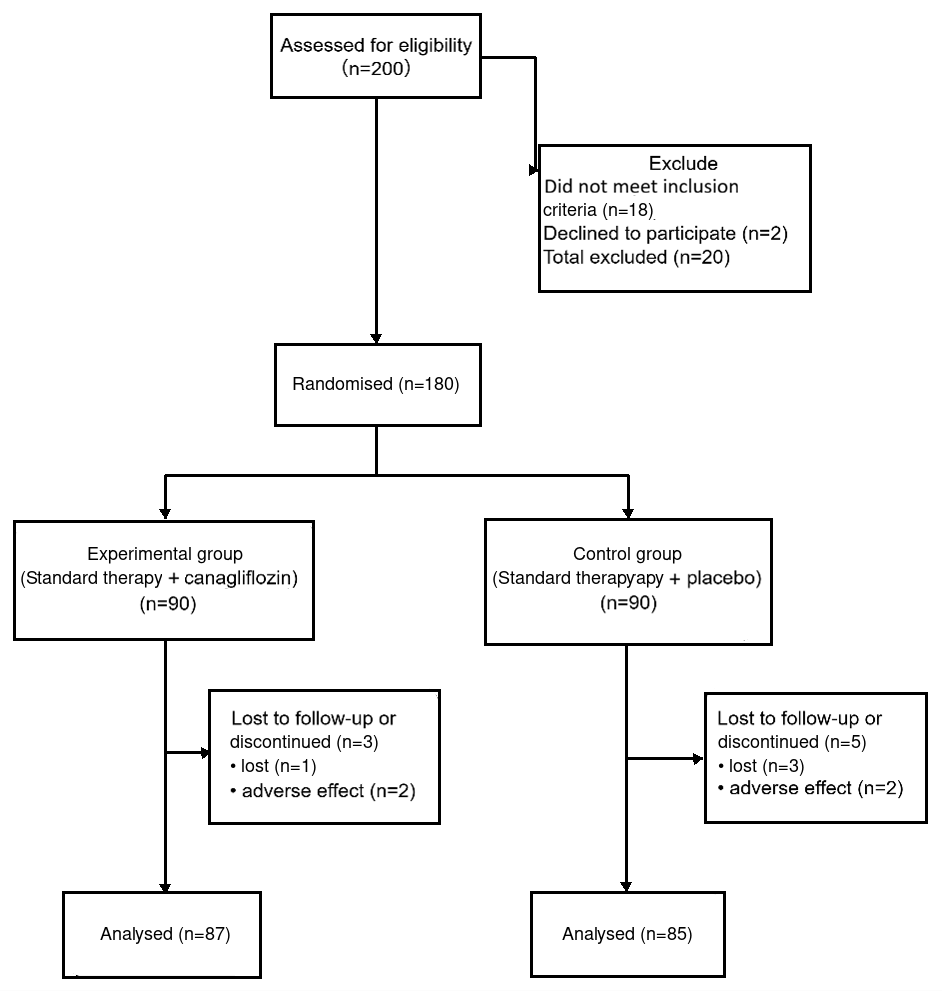
Adapted from Schulz KF, Altman DG, Moher D; CONSORT Group. CONSORT 2010 statement: updated guidelines for reporting parallel group randomised trials. BMJ 2010;340:c332.
Standard therapy included lifestyle intervention combined with glucose-lowering agents (insulin or oral hypoglycaemic drugs), statins for dyslipidaemia, and stable angiotensin II receptor blockers or angiotensin-converting enzyme inhibitors for proteinuria reduction, excluding SGLT2i and glucagon-like peptide-1 receptor agonists.
Outcomes
The primary outcome was the change in UACR from baseline to week 12. Secondary outcomes included changes in 24h‑UP, serum creatinine, eGFR, BUN, urinary podocyte count, and UPCX/Ucr, as well as the mediation proportion of UPCX/Ucr in the reduction of UACR, 24h‑UP, and serum creatinine reduction. Safety outcomes included the incidence of adverse events (genitourinary infection, hypoglycaemia, hypotension, clinically significant weight loss).
Statistical analysis
Statistical analyses were performed using SPSS Statistics version 27 (IBM Corp, Armonk, NY, US). Normally distributed continuous variables are presented as mean ± standard deviation and compared between the groups using the independent‑sample t-test. Non‑normally distributed variables (UACR, 24h‑UP, UPCX/Ucr, urinary podocyte count) were log‑transformed before analysis and are presented as median (interquartile range) and compared using Mann‑Whitney U tests. Categorical variables are expressed as counts (percentages) and compared using the chi-square test.
For longitudinal data, linear mixed‑effects models were used with fixed effects for treatment assignment, time, and treatment‑by‑time interaction, and a random intercept for each participant. This approach handles missing data under the missing-at-random assumption, using all available data without requiring imputation. Kenward‑Roger correction was applied for small samples. Results are presented as estimated mean difference (95% CI).
Multivariable linear regression was performed to assess the independent effect of canagliflozin on the change in UACR, adjusting for age, sex, diabetes duration, body mass index (BMI), baseline eGFR, systolic blood pressure, and baseline HbA1c.
Mediation analysis to assess the role of UPCX/Ucr in the improvement of DKD-related indicators by canagliflozin was performed using the PROCESS v4.2 macro for SPSS by Andrew F. Hayes.11 A two‑sided P value <0.05 was considered statistically significant.
RESULTS
Baseline characteristics
Table 1 shows the baseline demographic and clinical characteristics of the 2 groups. There were no statistically significant differences between groups for any variable, indicating successful randomisation.
Table 1. Baseline demographic and clinical characteristics.
|
Characteristics |
Experimental (n=87) |
Control (n=85) |
Mean/median difference (95% CI) |
|
Age, mean ± SD, years |
60.48 ± 16.16 |
63.20 ± 16.60 |
−2.72 (−7.65 to 2.22) |
|
Male, no. (%) |
47 (54.0) |
44 (51.8) |
– |
|
Asian, no. (%) |
87 (100) |
85 (100) |
– |
|
Diabetes duration, mean ± SD, years |
11.71 ± 5.66 |
12.50 ± 6.59 |
−0.79 (−2.62 to 1.04) |
|
BMI, mean ± SD, kg/m² |
23.65 ± 3.80 |
24.20 ± 4.51 |
−0.55 (−1.82 to 0.72) |
|
Current smoker, no. (%) |
19 (21.8) |
21 (24.7) |
– |
|
SBP, mean ± SD, mmHg |
132.5 ± 12.3 |
134.1 ± 13.0 |
−1.6 (−5.3 to 2.1) |
|
DBP, mean ± SD, mmHg |
80.2 ± 8.1 |
81.4 ± 8.5 |
−1.2 (−3.7 to 1.3) |
|
HbA1c, mean ± SD, % |
11.30 ± 1.92 |
11.63 ± 2.33 |
−0.33 (−0.97 to 0.31) |
|
Serum albumin, mean ± SD, g/L |
39.36 ± 3.71 |
38.75 ± 3.67 |
0.61 (−0.52 to 1.74) |
|
Serum creatinine, mean ± SD, μmol/L |
96.96 ± 6.89 |
95.08 ± 6.78 |
1.88 (−0.18 to 3.94) |
|
BUN, mean ± SD, mmol/L |
9.02 ± 1.69 |
9.46 ± 2.18 |
−0.44 (−1.03 to 0.15) |
|
eGFR, mean ± SD, mL/min/1.73 m² |
75.5 ± 15.2 |
73.8 ± 16.1 |
1.7 (−3.0 to 6.4) |
|
UACR, median (IQR), mg/mmola |
36.2 (29.8 to 42.5) |
36.8 (30.1 to 43.9) |
−0.6 (−2.9 to 1.7) |
|
24h‑UP, median (IQR), g/24ha |
0.65 (0.52 to 0.78) |
0.63 (0.50 to 0.76) |
0.02 (−0.03 to 0.07) |
|
TC, mean ± SD, mmol/L |
4.82 ± 1.01 |
4.95 ± 1.12 |
−0.13 (−0.45 to 0.19) |
|
TG, mean ± SD, mmol/L |
2.45 ± 1.10 |
2.52 ± 1.15 |
−0.07 (−0.41 to 0.27) |
|
HDL‑C, mean ± SD, mmol/L |
1.15 ± 0.30 |
1.12 ± 0.28 |
0.03 (−0.06 to 0.12) |
|
LDL‑C, mean ± SD, mmol/L |
3.05 ± 0.85 |
3.12 ± 0.90 |
−0.07 (−0.33 to 0.19) |
|
Use of statin, no. (%) |
52 (59.8) |
50 (58.8) |
– |
|
Use of ACEi/ARB, no. (%) |
68 (78.2) |
65 (76.5) |
– |
ACEi: angiotensin‑converting enzyme inhibitor; ARB: angiotensin II receptor blocker; BMI: body mass index; BUN: blood urea nitrogen; CI: confidence interval; DBP: diastolic blood pressure; eGFR: estimated glomerular filtration rate; HbA1c: glycated haemoglobin; HDL‑C: high‑density lipoprotein cholesterol; IQR: interquartile range; LDL‑C: low‑density lipoprotein cholesterol; SBP: systolic blood pressure; SD: standard deviation; TC: total cholesterol; TG: triglycerides; UACR: urinary albumin‑to‑creatinine ratio; 24h‑UP: 24‑hour urinary protein
a For skewed variables, the Hodges‑Lehmann estimate of median difference (experimental − control) with 95% CI is presented.
For normally distributed variables, mean difference (experimental − control) with 95% CI is shown. All between‑group comparisons were non‑significant (all P>0.05).
Glycaemic control
FPG, 2hPG, and HbA1c decreased significantly over time in both groups (time effect P <0.001). However, there were no statistically significant differences between groups (treatment effect P>0.05 for all), nor were there significant treatment‑by‑time interactions, indicating comparable glycaemic control throughout the study (Table 2).
Table 2. Glycaemic parameters over time by group.
|
Parameters |
Time point |
Experimental (n=87) |
Control (n=85) |
Between‑group mean difference (95% CI) |
P for interaction |
|
FPG, mean ± SD, mmol/L |
Baseline |
9.64 ± 1.67 |
9.87 ± 1.72 |
−0.23 (−0.74 to 0.28) |
0.246 |
|
Week 4 |
8.48 ± 1.60 |
8.58 ± 1.74 |
−0.10 (−0.60 to 0.40) |
|
|
|
Week 8 |
7.02 ± 1.48 |
7.15 ± 1.81 |
−0.13 (−0.63 to 0.37) |
|
|
|
Week 12 |
6.26 ± 1.95 |
6.37 ± 1.56 |
−0.11 (−0.64 to 0.42) |
|
|
|
2hPG, mean ± SD, mmol/L |
Baseline |
17.74 ± 2.73 |
17.29 ± 2.45 |
0.45 (−0.33 to 1.23) |
0.209 |
|
Week 4 |
13.21 ± 2.22 |
12.90 ± 1.62 |
0.31 (−0.28 to 0.90) |
|
|
|
Week 8 |
11.22 ± 2.24 |
11.14 ± 2.01 |
0.08 (−0.55 to 0.71) |
|
|
|
Week 12 |
9.00 ± 2.07 |
8.74 ± 1.64 |
0.26 (−0.31 to 0.83) |
|
|
|
HbA1c, mean ± SD, % |
Baseline |
11.30 ± 1.92 |
11.63 ± 2.33 |
−0.33 (−0.97 to 0.31) |
0.096 |
|
Week 12 |
7.00 ± 1.34 |
7.11 ± 1.38 |
−0.11 (−0.51 to 0.29) |
|
2hPG: 2-hour postprandial glucose; CI: confidence interval; FPG: fasting plasma glucose; HbA1c: glycated haemoglobin; SD: standard deviation
Between‑group mean difference (experimental − control) at each time point was estimated from linear mixed‑effects model.
P value for group × time interaction from linear mixed‑effects model (F‑test).
DKD‑related indicators
Overall treatment effect
Linear mixed‑effects models revealed significant group‑by‑time interactions for all DKD‑related indicators. They include serum albumin, serum creatinine, BUN, 24h‑UP, UACR, urinary podocyte count, and UPCX/Ucr (all P<0.001), indicating that the trajectory of these parameters differed significantly between groups over the 12‑week period (Table 3).
Between‑group comparisons at each time point
At weeks 4, 8, and 12, the experimental group showed significantly lower values than the control group for BUN, UACR, urinary podocyte count, and UPCX/Ucr. For 24h‑UP, significant differences emerged from week 8 onwards. Serum albumin showed significant differences at weeks 4 and 8 but not at week 12; serum creatinine showed a significant difference only at week 8 (Table 3).
Within‑group changes over time
Within both groups, all DKD‑related indicators improved significantly over time (time effect: P<0.001 for all). Pairwise comparisons with Bonferroni correction showed statistically significant reductions between consecutive time points for most parameters (Table 3).
Table 3. Diabetic kidney disease‑related indicators over time by group.
Multivariable linear regression for UACR change
To assess the independent effect of canagliflozin on UACR reduction, the authors constructed a multivariable linear regression model with log‑transformed change in UACR (week 12 value minus baseline) as the dependent variable. Univariate analysis showed that treatment with canagliflozin, baseline eGFR, and baseline HbA1c were associated with UACR change. In the multivariable model, after adjusting for age, sex, diabetes duration, BMI, baseline eGFR, systolic blood pressure, and baseline HbA1c, canagliflozin remained significantly associated with UACR reduction (adjusted β=–0.89, 95% CI –1.21 to –0.57, P<0.001). This result suggests that the improvement in proteinuria by canagliflozin is independent of glycaemic control and other confounders.
Table 4. Univariate and multivariable linear regression for change in urinary albumin‑to‑creatinine ratio.
|
Variable |
Univariate β (95% CI) |
P value |
Multivariable adjusted β (95% CI) |
P value |
|
Canagliflozin (vs control) |
−0.85 (−1.18 to −0.52) |
<0.001 |
−0.89 (–1.21 to –0.57) |
<0.001 |
|
Age (per year) |
0.01 (−0.02 to 0.04) |
0.45 |
0.02 (–0.01 to 0.05) |
0.142 |
|
Male (vs female) |
0.08 (−0.26 to 0.42) |
0.65 |
0.11 (–0.23 to 0.45) |
0.521 |
|
Diabetes duration (per year) |
0.02 (−0.03 to 0.07) |
0.42 |
0.03 (–0.02 to 0.08) |
0.213 |
|
BMI (per kg/m²) |
0.04 (−0.03 to 0.11) |
0.26 |
0.05 (–0.02 to 0.12) |
0.168 |
|
Baseline eGFR (per mL/min/1.73 m²) |
−0.03 (−0.05 to −0.01) |
0.04 |
−0.01 (–0.03 to 0.01) |
0.289 |
|
Baseline SBP (per mmHg) |
0.01 (−0.01 to 0.03) |
0.35 |
0.01 (–0.01 to 0.03) |
0.402 |
|
Baseline HbA1c (per %) |
0.18 (0.02 to 0.34) |
0.03 |
0.12 (–0.03 to 0.27) |
0.115 |
BMI: body mass index; CI: confidence interval; eGFR: estimated glomerular filtration rate; HbA1c: glycated haemoglobin; SBP: systolic blood pressure; UACR: urinary albumin-to-creatinine ratio; vs: versus
Adjusted R²=0.34, F=6.82, P<0.001 for the multivariable linear regression model.
Mediation analysis of UPCX/Ucr in the improvement of DKD markers by canagliflozin
To further explore whether canagliflozin delays DKD progression by protecting podocytes, mediation analysis was performed with treatment group as the independent variable; change in UPCX/Ucr as the mediator; and changes in UACR, 24h‑UP, and serum creatinine as dependent variables. Results showed that for reducing UACR and 24h‑UP, the direct effects of canagliflozin were not statistically significant, while the indirect effects through UPCX/Ucr were significant. For reducing serum creatinine, both the direct and indirect effects were statistically significant, suggesting that UPCX/Ucr plays a partial mediating role (Table 5).
Table 5. Mediation analysis of UPCX/Ucr in the improvement of diabetic kidney disease markers by canagliflozin.
|
|
Point estimate |
SE |
t |
P value |
95% CI |
Mediation proportion |
|
Path 1: Treatment→UPCX/Ucr→UACR |
84.39% |
|||||
|
Direct effect (treatment→UACR) |
−0.180 |
0.121 |
−1.481 |
0.141 |
−0.419 to 0.060 |
|
|
Indirect effect (treatment→ UPCX/Ucr→UACR) |
−0.968 |
0.100 |
– |
– |
−1.171 to −0.774 |
|
|
Total effect |
−1.147 |
0.124 |
−9.230 |
<0.001 |
−1.393 to −0.902 |
|
|
Path 2: Treatment→UPCX/Ucr→24h-UP |
86.42% |
|||||
|
Direct effect (treatment→ 24h-UP) |
−0.022 |
0.100 |
−0.224 |
0.823 |
−0.220 to 0.175 |
|
|
Indirect effect (treatment→ UPCX/Ucr→ 24h-UP) |
−0.783 |
0.119 |
– |
– |
−1.127 to −0.655 |
|
|
Total effect |
−0.906 |
0.124 |
−7.323 |
<0.001 |
−1.150 to −0.662 |
|
|
Path 3: Treatment→UPCX/Ucr→serum creatinine |
25.13% |
|||||
|
Direct effect (treatment→ serum creatinine) |
−0.892 |
0.280 |
−3.198 |
0.002 |
−1.450 to −0.343 |
|
|
Indirect effect (treatment→ UPCX/Ucr→ serum creatinine) |
−0.301 |
0.071 |
– |
– |
−0.437 to −0.153 |
|
|
Total effect |
−1.198 |
0.238 |
−5.039 |
<0.001 |
−1.667 to −0.728 |
|
24h-UP: 24-hour urinary protein; CI: confidence interval; SE: standard error; UACR: urinary albumin-to-creatinine ratio; UPCX/Ucr: urinary podocalyxin-to-urinary creatinine ratio
All paths are adjusted for age, sex, diabetes duration, BMI, and baseline HbA1c.
Comparison of adverse reactions
There was no statistically significant difference in the incidence of adverse reactions between the 2 groups (Table 6).
Table 6. Comparison of adverse reactions between experimental and control groups.
|
Adverse events |
Experimental (n=87), no. (%) |
Control (n=85), no. (%) |
Risk difference (95% CI) |
P value |
|
Genitourinary infection |
3 (3.45) |
1 (1.18) |
2.27% (−1.97% to 6.51%) |
|
|
Hypoglycaemia |
1 (1.15) |
3 (3.53) |
−2.38% (−6.70% to 1.94%) |
|
|
Hypotension |
1 (1.15) |
0 (0) |
1.15% (−1.10% to 3.40%) |
|
|
Clinically significant weight loss |
1 (1.15) |
1 (1.18) |
−0.03% (−3.39% to 3.33%) |
|
|
Any adverse event |
6 (6.90) |
5 (5.88) |
1.02% (−6.18% to 8.22%) |
0.786 |
CI: confidence interval
Hypoglycaemia was defined as random blood glucose <3.9 mmol/L.
Hypotension was defined as blood pressure <90/60 mmHg.
Weight loss was defined as >5% body weight loss within 3 months affecting daily life (e.g. persistent fatigue or weakness interfering with routine activities; difficulty climbing stairs or carrying groceries; reduced ability to perform usual household chores).
DISCUSSION
DKD is primarily characterised by albuminuria, glomerulosclerosis, and progressive loss of kidney function, ultimately leading to ESRD and contributing significantly to global mortality. Its pathogenesis is complex and not yet fully elucidated. Current research indicates that immune dysregulation-mediated chronic inflammation and podocyte pyroptosis are key factors in DKD onset and progression.5,12 Podocytes are specialised cells within the kidney, crucial for maintaining the glomerular filtration barrier. They regulate the passage of macromolecular proteins, stabilise the glomerular capillary structure, and protect glomerular endothelial cell function. However, under pathological conditions, podocytes can be injured, depleted, and their regenerative capacity impaired, ultimately leading to proteinuria and kidney damage. Therefore, podocyte injury and dysfunction are critical triggers in the progression of DKD.13 PCX is a transmembrane protein located on the apical surface of glomerular podocytes and serves as a major surface antigen. As a negatively charged sialoprotein, it contributes to the charge-selective barrier of glomerular filtration, preventing the leakage of negatively charged proteins into the urine, maintaining the separation between adjacent podocytes (foot processes), and preventing adhesion between epithelial cells and the glomerular capillary tuft.14 UPCX levels are significantly elevated in DKD patients,15 making it a reliable indicator of the extent of podocyte injury in DKD. Furthermore, as a biomarker of early podocyte injury in DKD, PCX may appear earlier than proteinuria, potentially serving as a more sensitive indicator of renal damage.15 Human and animal studies have also demonstrated that podocyte injury is evident in the early stages of DKD progression.17,18 Therefore, exploring effective measures and pathways to protect podocytes from injury holds significant clinical importance for DKD prevention and treatment.
SGLT2i are a novel class of glucose-lowering drugs widely used in current clinical practice. Numerous studies have demonstrated their renoprotective effects, and they are recommended by several authoritative guidelines as first-line therapy for DKD. Clinical studies have shown that SGLT2i can prevent the progressive increase in urinary excretion of podocyte-specific molecules in DKD patients, thereby protecting podocytes.19,20 The protective effects of SGLT2i on podocytes are considered multifaceted, involving various mechanisms, such as maintaining podocyte integrity, reducing foot process effacement, enhancing podocyte autophagy, attenuating lipotoxicity, reducing oxidative stress and inflammation, and reversing podocyte epithelial-mesenchymal transition.21 Canagliflozin, one of the approved SGLT2i, primarily lowers blood glucose by increasing renal glucose excretion. Concurrently, it reduces proteinuria, demonstrating good efficacy and safety in treating early-stage DKD,22 and lowering the risk of adverse renal events in DKD patients.23 Animal studies indicate that canagliflozin treatment significantly improves serum creatinine levels, 24-hour urinary albumin excretion, and UACR in DKD mice. Additionally, canagliflozin reduces the expression of key inflammatory markers in the renal cortex and prevents podocyte pyroptosis, thereby attenuating glomerular and podocyte injury, and reducing overall pathological damage.5
This study investigated whether canagliflozin exerts podocyte-protective effects and explored the association between podocyte protection and DKD improvement, aiming to elucidate the possible mechanisms by which canagliflozin delays DKD progression. Baseline characteristics were comparable between groups. After treatment, glycaemic control was similar in both groups, minimising the confounding effect of glucose reduction on renal parameters. However, the experimental group showed significantly greater reductions in 24h-UP, UACR, urinary podocyte count, and UPCX/Ucr compared with the control group, demonstrating the beneficial effects of canagliflozin in reducing proteinuria and protecting podocytes. Subsequent mediation analysis revealed that UPCX/Ucr played a significant mediating role in the improvement of proteinuria by canagliflozin, with mediation proportions of 84.39% for UACR and 86.42% for 24h-UP. The direct effects were not statistically significant, suggesting that the reduction in proteinuria is largely statistically mediated by changes in UPCX/Ucr, a marker of podocyte integrity. While this supports the authors’ hypothesis, it is important to emphasise that mediation analysis demonstrates statistical association, not direct biological causality. Regarding renal function, canagliflozin significantly reduced serum creatinine and BUN compared to baseline. While it showed an advantage over standard therapy in reducing BUN, its effect on serum creatinine reduction was comparable to standard therapy. Current evidence on whether canagliflozin reduces serum creatinine is inconsistent; animal studies have confirmed its creatinine-lowering effect in diabetic models,5,24 but a systematic review of 20 randomised controlled trials suggested that canagliflozin does not significantly alter eGFR.25 Therefore, the authors included serum creatinine as a dependent variable in the mediation analysis. The results showed that while UPCX/Ucr had a mediating effect, the proportion was approximately 25.13%, and both direct and total effects were statistically significant. This finding indicates that canagliflozin does reduce serum creatinine in this study, but podocyte protection only accounts for about a quarter of the effect, suggesting that other mechanisms (such as haemodynamic effects) also play substantial roles. Why did the authors not observe the initial rise in creatinine often seen with SGLT2i and ACEi/ARB in this study? The most plausible explanation for the absence of this phenomenon in this study is the well-preserved baseline renal function in the cohort (mean eGFR 73–75 mL/min/1.73 m²). Large clinical trials of canagliflozin have consistently demonstrated that the initial haemodynamic dip in eGFR is modest in magnitude (approximately 3.75 mL/min/1.73 m²),26 such a subtle change may be difficult to detect statistically in the small sample size. Future studies with a longer follow-up period and a broader range of baseline eGFR are needed to clarify this. Regarding safety, canagliflozin did not increase the incidence of adverse reactions compared to standard therapy, suggesting a favourable safety profile.
Several limitations should be acknowledged. First, this was a single‑centre study with a modest sample size, which may limit generalisability. Second, the authors used UPCX as a surrogate marker of podocyte injury rather than direct histological confirmation (kidney biopsy). While PCX is well‑validated, direct visualisation of podocyte foot process effacement would be stronger evidence. Third, the authors did not employ advanced techniques, such as immunofluorescence, flow cytometry, or PCR for podocyte quantification, which could reduce measurement variability. Fourth, the follow‑up duration (12 weeks) is relatively short; longer‑term renal outcomes (eGFR slope, ESRD) were not assessed. Fifth, despite multivariable adjustment, residual confounding cannot be excluded (e.g. dietary salt intake). Sixth, a placebo‑controlled design was used, but the absence of an active comparator (e.g. another SGLT2i or GLP‑1RA) limits comparison of class effects. Seventh, the mediation analysis assumes a causal ordering (treatment → podocyte protection → proteinuria), which is supported by biological plausibility but not proven by this observational mediation approach.
CONCLUSION
Canagliflozin, as a established SGLT2i, effectively improves glycaemic control and provides significant renal protective benefits in DKD patients by reducing proteinuria, lowering serum creatinine, and protecting podocytes. The reduction in proteinuria appears to be largely statistically mediated by podocyte protection, with a very high mediation proportion. Canagliflozin is a safe and effective agent for improving DKD, although longer‑term studies are warranted to confirm the durability of these effects and their translation into hard renal endpoints.
Annex S1. CONSORT 2025 checklist of information to include when reporting a randomised trial.
REFERENCES
- Koh SWC, Ang PY, Wong HC, et al. Five-year outcomes of a holistic programme for managing early chronic kidney disease in primary care. Ann Acad Med Singap 2024;53:597-607.
- Yang C, Zhang Z, Liu J, et al. Research progress on multiple cell death pathways of podocytes in diabetic kidney disease. Mol Med 2023;29:135.
- Perumal J, Mehalingam V, Ramasamy R. Utility of urinary podocalyxin levels in patients with and without type 2 diabetic nephropathy and its correlation with renal function. BMC Res Notes 2026;19:126.
- Meliambro K, He JC, Campbell KN. Podocyte-targeted therapies – progress and future directions. Nat Rev Nephrol 2024;20:643-58.
- Li SY, Wang J, Chen Y, et al. Canagliflozin Attenuates Podocyte Inflammatory Injury through Suppressing the TXNIP/NLRP3 Signaling Pathway in Diabetic Kidney Disease Mice. Inflammation 2025;48:3180-93.
- American Diabetes Association Professional Practice Committee. 2. Classification and Diagnosis of Diabetes: Standards of Medical Care in Diabetes-2022. Diabetes Care 2022;45:S17-38.
- Lim GJ, Low S, Liu AYL, et al. Association between self-care and chronic kidney disease in patients with type 2 diabetes mellitus. Ann Acad Med Singap 2023;52:52-4.
- Sreedharan S, Mohandas MK, Vismaya KB, et al. Non-diabetic Kidney Disease in Type 2 Diabetes: From Kidney Biopsy to Precision Medicine. Cureus 2026;18:e100716.
- Kidney Disease: Improving Global Outcomes (KDIGO) CKD Work. KDIGO 2024 Clinical Practice Guideline for the Evaluation and Management of Chronic Kidney Disease. Kidney Int 2024;105:S117-314.
- Doi Y, Hamano T, Yamaguchi S, et al. Mediators between canagliflozin and renoprotection vary depending on patient characteristics: Insights from the CREDENCE trial. Diabetes Obes Metab 2023;25:2944-53.
- Hayes AF. Introduction to Mediation, Moderation, and Conditional Process Analysis: A Regression-Based Approach. 3rd ed. New York, NY: The Guilford Press; 2022.
- Zhou T, Fang YL, Tian TT, et al. Pathological mechanism of immune disorders in diabetic kidney disease and intervention strategies. World J Diabetes 2024;15:1111-21.
- Li L, Liu YH. Podocyte aging and diabetic kidney disease. Kidney Int 2025;107:596-8.
- Li C, Szeto CC. Urinary podocyte markers in diabetic kidney disease. Kidney Res Clin Pract 2024;43:274-86.
- Zeng LF, Fung WW, Chan GC, et al. Urinary and Kidney Podocalyxin and Podocin Levels in Diabetic Kidney Disease: A Kidney Biopsy Study. Kidney Med 2022;5:100569.
- Yilmaz SK, Ersoy B, Bayar NTI, et al. Urinary podocalyxin identifies a pre-albuminuric kidney injury window and stratifies 12-year diabetic kidney disease risk in youth with type 1 diabetes mellitus. Pediatr Nephrol 2026:3569-78.
- Zheng Z, Tao D, Wu W, et al. Experimental Validation and Bioinformatics Analysis Elucidate the Role of MTDH-Mediated PTEN Ubiquitination and Degradation in Podocyte Injury in Diabetic Kidney Disease. Hum Mutat 2026;2026:8914266.
- Xu L, Guo XL, Gan W, et al. Diagnostic value of the correlation between urinary MDM2 and podocyte mitotic catastrophe in diabetic kidney disease. Diabetol Metab Syndr 2025;17:272.
- Li C, Ng JK, Chan GC, et al. Preservation of Urinary Podocyte Markers in Diabetic Kidney Disease by Sodium-Glucose Cotransporter 2 Inhibitor Therapy. Kidney Dis (Basel) 2025;11:218-25.
- Urs A, Moldovan D, Rusu CC, et al. Dynamics and Predictive Values of Urinary Podocyte Biomarkers Following SGLT2 Inhibition in CKD. Life (Basel) 2026;16:529.
- Jiang BC, Cheng ZW, Wang DJ, et al. Unveiling the podocyte-protective effect of sodium-glucose cotransporter-2 inhibitors. Kidney Res Clin Prac 2025;44:69-78.
- Miyamoto S, Heerspink HJL, de Zeeuw D, et al. A randomized, open-label, clinical trial examined the effects of canagliflozin on albuminuria and eGFR decline using an individual pre-intervention eGFR slope. Kidney Int 2024;106:972-84.
- Cardoza K, Kang A, Smyth B, et al. Geographic and racial variability in kidney, cardiovascular and safety outcomes with canagliflozin: A secondary analysis of the CREDENCE randomized trial. Diabetes Obes Metab 2024;26:3530-40.
- Wang QY, Liang Y, Zuo QJ, et al. Canagliflozin ameliorates high-salt-induced renal injury and premature aging in male Dahl salt-sensitive rats, with associated changes in SIRT6/HIF-1α signaling. Ren Fail 2025;47:2546624.
- Lin R, Hsu CL, Shih MC, et al. Comparison of the renal outcomes of novel antidiabetic agents in patients with type 2 diabetes with chronic kidney disease: A systematic review and network meta-analysis of randomized controlled trials. Diabetes Obes Metab 2025;28:518-28.
- Perkovic V, Jardine MJ, Neal B, et al. Canagliflozin and Renal Outcomes in Type 2 Diabetes and Nephropathy. N Engl J Med 2019;380:2295-306.
This study was approved by the Hospital Ethics Committee of Shangyu People’s Hospital of Shaoxing City (Ethics Approval Number: PJ2022-Res 032-01). All participants provided written informed consent.
This study was funded by the Shaoxing Municipal Health and Health Technology Plan (Grant No. 2022KY091) and the Zhejiang Provincial Medical and Health Science and Technology Project (Grant No. 2024KY496). The authors declare there are no affiliations with or involvement in any organisation or entity with any financial interest in the subject matter or materials discussed in this manuscript.
Dr Weiping Tu, Department of Endocrinology and Metabolic Diseases, Shangyu People's Hospital of Shaoxing City, No. 517 Baiguan Street, Shangyu District, Shaoxing City, Zhejiang Province, China. Email: [email protected]
