

ABSTRACT
Introduction: Structured school-based myopia prevention programmes are increasingly promoted, but real-world evidence supporting multicomponent models remains limited. This study evaluated the 12-month effectiveness of the “1146” programme in China in a routine primary school setting.
Methods: This prospective, non-randomised controlled study included 24 classes from a single primary school, assigned to intervention or control groups according to teaching schedule. After follow-up, 100 children from the intervention group and 98 children from the control group were analysed. Intervention classes received the multicomponent “1146” programme, which integrated education, visual behaviour, environmental measures, outdoor activity promotion, monitoring, and adjunctive professional components. Control classes followed standard teaching. Routine refractive correction was provided to myopic children in both groups when indicated. Continuous outcomes were analysed using linear mixed-effects models adjusted for baseline value, age, and sex, with class included as a random effect.
Results: At 12 months, axial length increased less in the intervention group than in controls (0.01 ± 0.11 mm versus [vs] 0.29 ± 0.37 mm; adjusted mean difference −0.288 mm; 95% confidence interval −0.363 to −0.213). Spherical equivalent changed by 0.20 ± 0.61 D vs −0.45 ± 0.77 D, and uncorrected visual acuity changed by 0.37 ± 0.30 vs −0.27 ± 0.25 (all adjusted P<0.001). Improvement of ≥2 lines in uncorrected visual acuity (UCVA) occurred in 53.0% vs 1.0%, indicating meaningful functional gain. No subgroup interaction was significant.
Conclusion: The “1146” programme was associated with less axial elongation and more favourable refractive and UCVA changes over 12 months. The single-school, non-randomised design limited causal inference and generalisability. Larger randomised multicentre studies with longer follow-up are needed.
CLINICAL IMPACT
What is New
- This study evaluated a multicomponent school-based myopia prevention programme in China, called the “1146” model, in routine primary school settings.
• The programme was associated with reduced axial elongation, more favourable refractive changes, and improved unaided visual function over 12 months.
Clinical Implications
- Coordinated school-based implementation may support integrated myopia prevention in primary school children.
• Larger randomised multicentre studies with longer follow-up are needed to confirm effectiveness, generalisability, and component-specific contributions.
Myopia is a major public health concern, with global prevalence projected to approach 50% by 2050.1 In China, a large school-based study of 864,828 children aged 6–16 years reported a myopia prevalence of 54.71% in 2021.2 During the COVID-19 pandemic, reduced outdoor activity and increased near-work demands contributed to a pronounced myopic shift among children and adolescents.3,4 School-based surveillance studies have indicated that the upper grades of primary school—usually corresponding to Grades 3–6 and approximately ages 8–12 years in the Chinese school system—represent a critical window for the onset and rapid progression of myopia, during which axial length (AL) and spherical equivalent (SE) may change within a single academic year.3 High myopia is associated with sight-threatening conditions such as glaucoma and myopic retinal detachment,5 and contributes to burdens on individuals, families, and society.6 Therefore, implementing myopia prevention and control interventions during sensitive periods of visual development is important in both clinical practice and public health.
In recent decades, national technical guidelines have emphasised a shift in myopia prevention from “single techniques” to “integrated strategies”.7 These strategies combine established approaches, including health education, visual behaviour interventions, improvements in the learning environment, promotion of outdoor activities, and optical correction, while traditional Chinese medicine (TCM)-based approaches are considered adjunctive components.8 Because comprehensive school-based programmes involve multiple components and implementation steps, they need to be understood not only in terms of ocular outcomes, but also in terms of how they are designed, delivered, adopted, and maintained in routine school settings. The Reach, Effectiveness, Adoption, Implementation, and Maintenance (RE-AIM) framework provides an implementation-science approach for assessing these aspects of health programmes, including their delivery, adoption, maintenance, and potential for scaling up in real-world settings.9 Current myopia control interventions include orthokeratology,10 defocus incorporated multiple segments (DIMS) spectacle lenses,11 and low-concentration atropine eye drops.12 Although these approaches have shown effectiveness, they may be limited by cost, suboptimal adherence, wearing discomfort, or rebound after discontinuation.13,14 Because myopia development is influenced by genetic, environmental, and behavioural factors,15-17 single interventions may be insufficient to address these influences simultaneously.
Previous studies have examined combined myopia control approaches, mainly integrating behavioural interventions, environmental modifications, and optical or pharmacological strategies.18,19 However, many studies differ in intervention structure, delivery setting, and outcome assessment, and few have evaluated structured and reproducible comprehensive programmes delivered in routine school settings. In addition, evidence remains limited and inconsistent regarding whether comprehensive intervention effects differ by baseline refractive characteristics, age, or sex. The authors therefore evaluated the “1146” comprehensive myopia prevention and control model over 12 months in a primary school in Hohhot, Inner Mongolia, China, where the programme was delivered as part of routine school settings. This model integrates health education, visual behaviour management, environmental modification, outdoor activity promotion, optical correction, visual health monitoring, and professional adjunctive components, including TCM-based measures and visual training. The study aimed to evaluate its effects on AL, SE, and uncorrected visual acuity (UCVA), and to explore whether intervention effects differed across subgroups defined by baseline myopia status, age, and sex.
METHODS
Study design and participants
This was a prospective, non-randomised controlled study with class-level allocation. In September 2023, a total of 24 classes from Grades 1 to 6 (4 classes per grade) at a primary school in Hohhot, Inner Mongolia, China were enrolled using a class-based cluster sampling approach. Within each grade, 2 classes were assigned to the intervention group and 2 to the control group according to the school’s teaching schedule, without individual-level or class-level randomisation. Only right-eye data were analysed to avoid inter-eye correlation.
The inclusion and exclusion criteria applied in this study were adapted from those commonly adopted in myopia-control trials involving low-concentration atropine eye drops20 and DIMS spectacle lenses.11 Children were eligible for inclusion if they met the following criteria: age 6–11 years; cycloplegic SE in both eyes ranging from −3.00 D to +1.00 D; astigmatism ≤2.50 D; and willingness to complete a 1-year follow-up. Children were excluded if they had received myopia interventions such as atropine, orthokeratology, or defocus-based lenses before or at baseline; had organic ocular disease affecting visual function, strabismus, or amblyopia; or had poor follow-up compliance or incomplete data. According to the 2019 diagnostic threshold issued by the International Myopia Institute, myopia in this study was defined as a cycloplegic SE of ≤ −0.50 D.21 This classification was used only for subsequent subgroup analyses.
Sample size
The sample size was estimated a priori using a 2-sample comparison of proportions, with myopia prevalence as the reference outcome. Based on the reported prevalence of myopia among urban children and adolescents in Inner Mongolia in 2021 (58.95%), the authors assumed the same prevalence in the control group and an expected reduction to 30.50% in the intervention group. With a 2-sided α of 0.05 and 80% power, the required sample size was 47 participants per group. Allowing for 10% attrition, the target sample size was 52 participants per group (total 104). Because allocation occurred at the class level, the calculation did not incorporate a design effect and was therefore used only as a reference. All eligible children in the selected classes were screened.
Intervention
The intervention lasted 12 months. Intervention classes received the “1146” comprehensive myopia prevention and control programme, whereas control classes followed the usual teaching schedule. Myopic children in both groups received single-vision spectacle correction when clinically indicated.
The “1146” model, developed by Hohhot Myopia Prevention and Control Association, incorporated recommendations on near-work distance, interruption of prolonged near work, and outdoor activity, adapted to the school setting and lifestyle of primary school children in Inner Mongolia.22 The RE-AIM framework informed consideration of programme reach, effectiveness, adoption, implementation, and maintenance.23 The conceptual framework is provided in Supplementary Fig. S1.
Components of the “1146” comprehensive myopia prevention and control model
“1” set of scientific myopia-prevention lectures
Centralised lectures for students, parents, and teachers covered healthy visual habits, near-work management, outdoor activity, and optimisation of the home visual environment.
“1” set of professional prevention and control records
An individual visual health record documented refractive status, intervention delivery, and adherence (Supplementary Annex S1).
“4” key prevention and control objectives
(1) For children at the pre-myopic stage, to delay myopia onset;
(2) For primary school children with low myopia (−1.00 D < SE ≤ −0.50 D), to maintain good UCVA, prescribe spectacles as needed, and avoid premature correction;
(3) For primary school children with myopia of −6.00 D < SE ≤ −1.00 D, to limit refractive progression and axial elongation;
(4) For primary school children with high myopia (SE ≤ −6.00 D), to prevent related complications.
“6” intervention measures
(1) Structured health education: Seventeen recorded myopia-prevention sessions were disseminated weekly online to students, parents, and teachers.
(2) Behavioural habit correction: Behavioural targets included a reading distance of ≥33 cm and screen time <2 hours/day, with adherence supervised by parents and teachers.
(3) Environmental optimisation: Classroom desk illuminance was maintained at ≥300 lx. The home visual environment and related behaviours were assessed using a study-specific checklist (Supplementary Annex S2).
(4) Nutritional intervention: Parents received TCM constitution-based dietary guidance, covering regular breakfast, water intake of ≥1,000 mL/day, and reduced sugar and fat intake.
(5) Enhanced physical activity: Outdoor activity was targeted at ≥2 hours per day.
(6) Professional adjunctive interventions:
- Repeated low-level red-light therapy (RLRL): Eligible myopic children received RLRL at 650 ± 10 nm for 3 minutes twice daily, ≥4 hours apart, on ≥5 days/week under teacher supervision.
- Visual function training: Monocular lens reading and binocular mirror training were performed for 20 minutes twice weekly.
- Auricular acupoint pressing: The liver, kidney, heart, spleen, eye, eye 1, and eye 2 points were pressed once weekly, with daily self-pressing.24
The schedule, frequency, and participant coverage of each component of the “1146” programme are summarised in Table 1.
Table 1. Components, schedule, and participant coverage of the “1146” programme.
|
Component |
Schedule/frequency |
Participant coverage |
|
Structured health education |
A total of 17 recorded sessions, disseminated weekly online |
Students, parents, and teachers in intervention classes |
|
Behavioural habit correction |
Daily supervision during learning and daily activities |
Students in the intervention group |
|
Environmental optimisation |
Classroom desk illuminance maintained at ≥300 lx |
Intervention classrooms; students’ home visual environment |
|
Nutritional intervention |
Throughout the intervention period, with parental cooperation |
Students in the intervention group |
|
Enhanced physical activity |
Target of ≥2 h/day outdoor activity |
Students in the intervention group |
|
Visual health monitoring |
Baseline and 12-month assessments; ongoing monitoring |
Students in the intervention group |
|
Routine refractive correction |
According to refractive status and clinical need |
Myopic children in both groups, when clinically indicated |
|
Repeated low-level red-light therapy |
3 min/session, twice daily, ≥4 h apart, ≥5 days/week |
A total of 41 myopic students in the intervention group |
|
Visual function training |
20 min/session, twice weekly |
21 students in the intervention group |
|
Auricular acupoint pressing |
Once weekly, with daily self-pressing |
All students in the intervention group |
Compliance assessment
Adherence to RLRL, visual function training, and auricular acupoint pressing was calculated for each participant as completed sessions divided by scheduled sessions. Behavioural and environmental components were monitored at class level through teacher supervision and standardised classroom checks.
Outcome measures
The primary outcomes were changes in AL and SE from baseline to 12 months. AL was measured using an SW-9000 optical biometer (Tianjin Suowei Electronic Technology Co Ltd, Tianjin, China). The agreement of the SW-9000 with other optical biometers for paediatric ocular biometric measurements has been evaluated previously.25 Each eye was measured 5 consecutive times, and the mean value was calculated. If the standard deviation (SD) of the 5 consecutive measurements exceeded 0.05 mm, the measurements were repeated. Flat and steep keratometry values (K1 and K2) were also recorded. Cycloplegia was induced with compound tropicamide (Shenyang Xingqi Pharmaceutical Co Ltd, Shenyang, China), and adequacy was assessed using pupil diameter and the pupillary light reflex. Cycloplegic refraction was measured 3 times with an RM-1 autorefractor (Topcon, Tokyo, Japan), and the mean was used. Subjective refraction was performed when required. SE was calculated as sphere plus half the cylinder.
The secondary outcome was change in UCVA, measured at 5 m using an Early Treatment Diabetic Retinopathy Study chart (Precision Vision, Woodstock, IL, US) under standard illumination. The smallest correctly identified line was recorded in decimal units. Using the prespecified definition of a 0.1-logMAR change as 1 line, UCVA change was categorised as improvement (≥2-line increase), stability (within ±1 line), or deterioration (≥2-line decrease). All ocular examinations were performed by the same experienced optometrist.
Quality control and blinding
All assessors received standardised training and followed a study-specific protocol. Devices of the same model were used throughout and calibrated before assessment. Quality-control staff reviewed records and attendance logs, and monitored protocol adherence during on-site assessments. Device-generated data were exported electronically, while manually collected data were independently entered by 2 researchers and cross-checked.
As the intervention was overt, participants and intervention providers could not be masked. However, ocular outcome assessments and data analyses were conducted without knowledge of group allocation.
Adverse events
All participants who received any intervention were included in safety monitoring. A structured questionnaire completed by participants and their guardians recorded ocular and systemic symptoms, including ocular irritation, transient glare, photophobia, headache, and auricular tenderness. Events occurring between scheduled assessments were documented during unscheduled consultations. All reported events were documented in the case report forms and reviewed by the research team. Suspected serious intervention-related events prompted immediate suspension of the relevant intervention and clinical assessment according to predefined procedures. The full assessment form is provided in Supplementary Annex S3.
Statistical analysis
Analyses were performed using Stata version 18.0 (StataCorp, College Station, TX, US). Continuous variables are presented as mean ± SD or median (interquartile range), and categorical variables as n (%).
Baseline continuous variables were compared using independent-samples or Welch’s t-tests, as appropriate, and categorical variables using Pearson’s χ² test.
Changes in AL, SE, and UCVA were analysed using linear mixed-effects models with class as a random effect and intervention group as a fixed effect. Models were adjusted for the corresponding baseline value, age, and sex.
Exploratory subgroup analyses were conducted by baseline myopia status, sex, and age group. Group-by-subgroup interaction terms were added to the models to assess effect modification. All tests were 2-sided, with P<0.05 considered statistically significant.
RESULTS
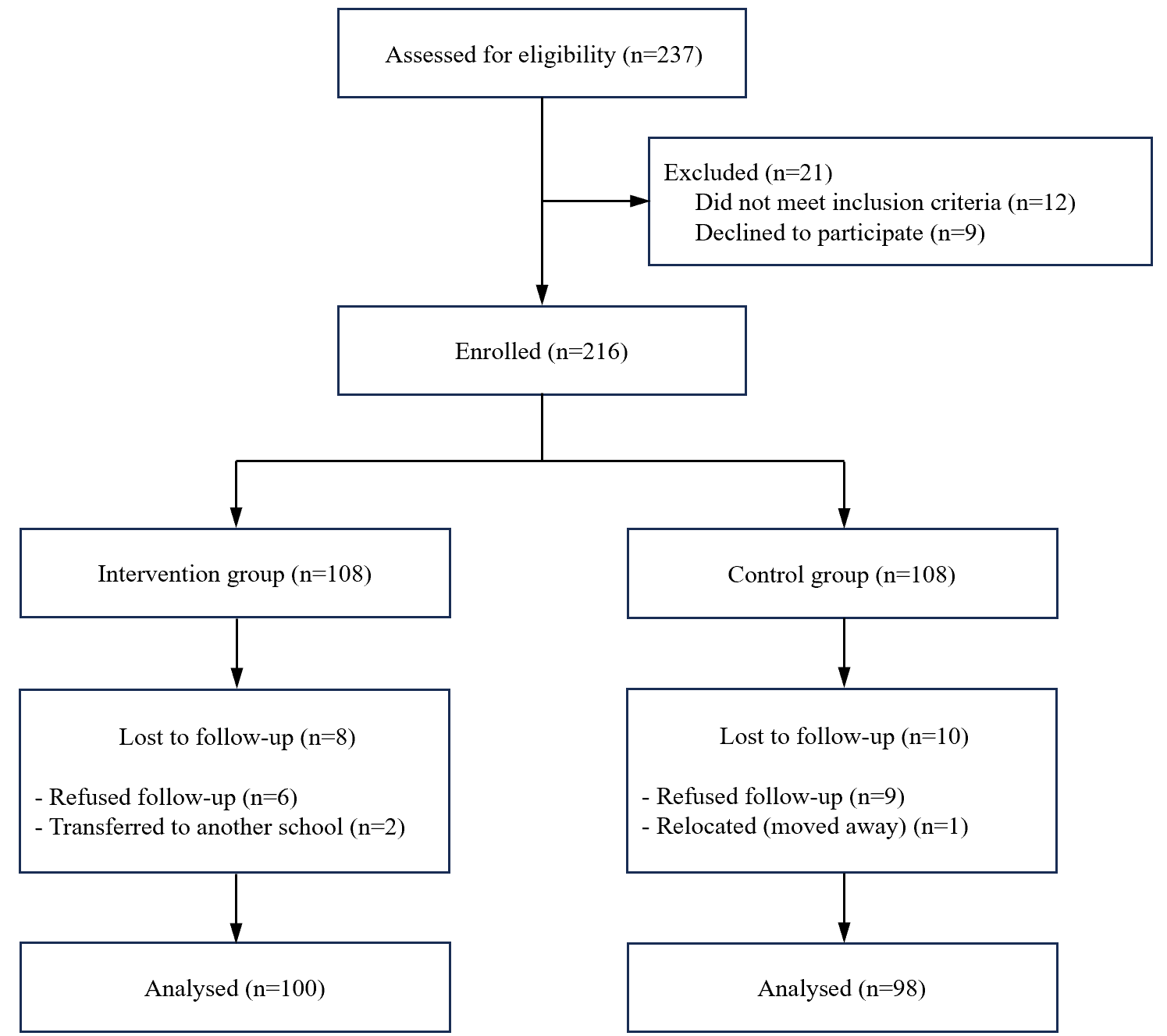
Of 237 children screened, 216 were enrolled and allocated by class to the intervention and control groups (108 each). Eight intervention and 10 control participants were lost to follow-up, leaving 100 and 98 participants, respectively, for analysis (Fig. 1).
Fig. 1. Participant flowchart from eligibility assessment to study inclusion.
Baseline characteristics
At baseline, there were no statistically significant differences between the intervention and control groups with respect to sex, age, SE, UCVA, or corneal curvature parameters (K1 and K2) (all P>0.05), although a small but statistically significant difference in AL was observed (P=0.047). Overall, the baseline characteristics of the 2 groups were broadly comparable (Table 2).
Table 2. Baseline characteristics of the study participants.
|
Variable |
Intervention (n=100) |
Control (n=98) |
t/χ² value |
P value |
|
Age, years |
7.70 ± 0.67 |
7.61 ± 0.64 |
−0.942 |
0.348 |
|
Boys/girls, n (%) |
52 (52.0)/48 (48.0) |
56 (57.1)/42 (42.9) |
0.528 |
0.467 |
|
AL, mm |
23.24 ± 0.73 |
23.47 ± 0.93 |
2.001 |
0.047 |
|
SE, D |
−0.56 ± 0.58 |
−0.78 ± 0.95 |
−1.95 |
0.053 |
|
UCVA |
0.77 ± 0.18 |
0.84 ± 0.29 |
1.858 |
0.065 |
|
K1, D |
42.69 ± 1.36 |
42.71 ± 1.49 |
0.075 |
0.940 |
|
K2, D |
43.89 ± 1.40 |
44.12 ± 1.69 |
1.025 |
0.307 |
AL: axial length; K1: flat keratometry; K2: steep keratometry; SE: spherical equivalent; UCVA: uncorrected visual acuity Data are presented as mean ± standard deviation or n (%).
P values were calculated using independent-samples t tests or Welch’s t tests for continuous variables, according to variance homogeneity testing, and Pearson’s χ² test for categorical variables.
Compliance results
Individual-level adherence was 85.9% ± 12.1% for RLRL, 85.5% ± 23.9% for visual function training, and 89.3% ± 18.1% for auricular acupoint pressing. Behavioural and environmental components were monitored at class level through teacher supervision and standardised classroom checks.
Changes in axial length (AL)
Over the 12-month period, the intervention group showed a smaller increase in AL, with a mean change of 0.01 ± 0.11 mm, whereas the control group showed a greater axial elongation, with a mean change of 0.29 ± 0.37 mm. After adjustment using the linear mixed-effects model, the between-group difference in AL change remained statistically significant, with an adjusted mean difference of −0.288 mm (95% confidence interval [CI] −0.363 to −0.213; P<0.001). Detailed results are presented in Table 3 and Fig. 2.
Changes in spherical equivalent (SE)
The intervention group showed a slight positive shift in SE over 12 months compared with baseline (0.20 ± 0.61 D), whereas the control group showed a myopic shift (−0.45 ± 0.77 D). After adjustment using the linear mixed-effects model, the between-group difference in SE change remained statistically significant, with an adjusted mean difference of 0.684 D (95% CI 0.501 to 0.868; P<0.001). Detailed results are presented in Table 3 and Fig. 2.
Table 3. Changes in axial length, spherical equivalent, and uncorrected visual acuity at 12 months.
|
Outcome |
Intervention (n=100) |
Control (n=98) |
Adjusted mean difference |
95% CI |
P value |
|
AL change, mm |
0.01 ± 0.11 |
0.29 ± 0.37 |
−0.288 |
−0.363 to −0.213 |
<0.001 |
|
SE change, D |
0.20 ± 0.61 |
−0.45 ± 0.77 |
0.684 |
0.501 to 0.868 |
<0.001 |
|
UCVA change |
0.37 ± 0.30 |
−0.27 ± 0.25 |
0.628 |
0.553 to 0.702 |
<0.001 |
AL: axial length; SE: spherical equivalent; UCVA: uncorrected visual acuity
Data are presented as mean ± standard deviation.
Changes represent the difference between baseline and 12-month follow-up.
Adjusted mean differences and P values were estimated using linear mixed-effects models adjusted for the corresponding baseline outcome value, age, and sex, with class included as a random effect.
Fig. 2. Changes in AL, SE, and UCVA from baseline to 12 months.
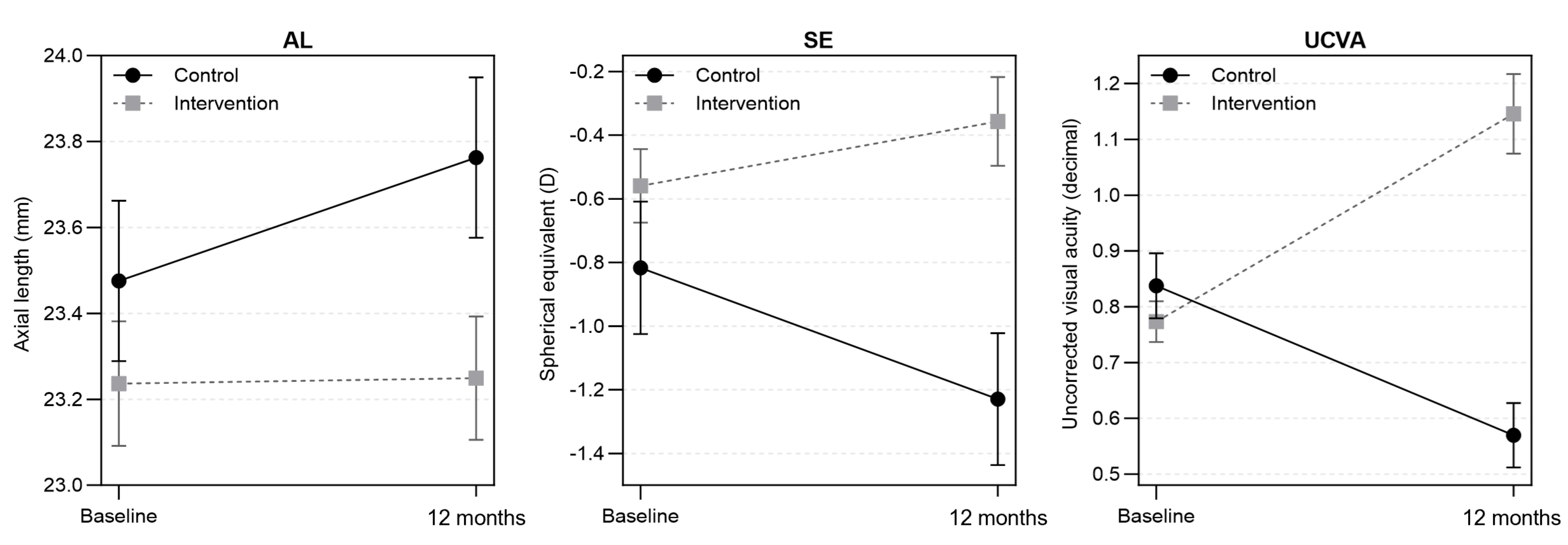
AL: axial length; SE: spherical equivalent; UCVA: uncorrected visual acuity Error bars (vertical lines) represent 95% confidence intervals.
Changes in uncorrected visual acuity (UCVA)
With respect to UCVA, the intervention group showed a mean improvement (0.37 ± 0.30), whereas the control group showed a mean decline (−0.27 ± 0.25). After adjustment using the linear mixed-effects model, the between-group difference in UCVA change remained statistically significant, with an adjusted mean difference of 0.628 (95% CI 0.553 to 0.702; P<0.001; Table 3, Fig. 2).
Improvement of ≥2 lines occurred in 53.0% of intervention participants and 1.0% of controls, whereas deterioration of ≥2 lines occurred in 1.0% and 56.1%, respectively (Supplementary Table S1). Individual outcome distributions are shown in Supplementary Fig. S2.
Subgroup and interaction analyses
Subgroup analyses by baseline myopia status, sex, and age showed generally consistent intervention effects on AL, SE, and UCVA (Table 4). Across all subgroups, the intervention group had less axial elongation, more favourable SE changes, and greater UCVA improvement than controls, with statistically significant adjusted between-group differences. No significant interactions were observed for baseline myopia status, sex, or age for any outcome (all P for interaction > 0.05), indicating no clear evidence of effect modification.
Table 4. Subgroup and interaction analyses of changes in axial length, spherical equivalent, and uncorrected visual acuity at 12 months.
|
Characteristics |
Intervention (n=100) |
Control (n=98) |
Adjusted mean difference (95% CI) |
P value |
P for interaction |
|
Baseline myopia status |
|
|
|||
|
(1) No myopia at baseline (n=101) |
|
|
|||
|
AL change, mm |
0.01 ± 0.05 |
0.25 ± 0.35 |
−0.246 (−0.351 to −0.141) |
<0.001 |
0.356 |
|
SE change, D |
0.08 ± 0.47 |
−0.64 ± 0.71 |
0.606 (0.345 to 0.867) |
<0.001 |
0.427 |
|
UCVA change |
0.41 ± 0.31 |
−0.28 ± 0.26 |
0.599 (0.489 to 0.709) |
<0.001 |
0.732 |
|
(2) Myopia at baseline (n=97) |
|
|
|||
|
AL change, mm |
0.02 ± 0.16 |
0.32 ± 0.39 |
−0.316 (−0.424 to −0.209) |
<0.001 |
– |
|
SE change, D |
0.38 ± 0.74 |
−0.31 ± 0.80 |
0.762 (0.490 to 1.034) |
<0.001 |
– |
|
UCVA change |
0.32 ± 0.29 |
−0.26 ± 0.25 |
0.573 (0.467 to 0.678) |
<0.001 |
– |
|
Sex |
|
|
|||
|
(1) Boys (n=108) |
|
|
|||
|
AL change, mm |
0.01 ± 0.07 |
0.23 ± 0.38 |
−0.229 (−0.330 to −0.129) |
<0.001 |
0.090 |
|
SE change, D |
0.28 ± 0.68 |
−0.47 ± 0.85 |
0.785 (0.539 to 1.031) |
<0.001 |
0.229 |
|
UCVA change |
0.38 ± 0.27 |
−0.30 ± 0.27 |
0.653 (0.550 to 0.757) |
<0.001 |
0.482 |
|
(2) Girls (n=90) |
|
|
|||
|
AL change, mm |
0.01 ± 0.14 |
0.36 ± 0.35 |
−0.358 (−0.468 to −0.248) |
<0.001 |
– |
|
SE change, D |
0.12 ± 0.52 |
−0.43 ± 0.68 |
0.562 (0.291 to 0.832) |
<0.001 |
– |
|
UCVA change |
0.36 ± 0.34 |
−0.23 ± 0.22 |
0.598 (0.488 to 0.709) |
<0.001 |
– |
|
Age group |
|
|
|||
|
(1) 6–7 years (n=85) |
|
|
|||
|
AL change, mm |
0.04 ± 0.12 |
0.29 ± 0.45 |
−0.270 (−0.385 to −0.156) |
<0.001 |
0.678 |
|
SE change, D |
0.13 ± 0.55 |
−0.55 ± 0.77 |
0.732 (0.452 to 1.012) |
<0.001 |
0.695 |
|
UCVA change |
0.41 ± 0.30 |
−0.24 ± 0.27 |
0.629 (0.514 to 0.744) |
<0.001 |
0.957 |
|
(2) 8–10 years (n=113) |
|
|
|||
|
AL change, mm |
0.00 ± 0.10 |
0.29 ± 0.29 |
−0.302 (−0.401 to −0.203) |
<0.001 |
– |
|
SE change, D |
0.25 ± 0.65 |
−0.37 ± 0.77 |
0.658 (0.417 to 0.898) |
<0.001 |
– |
|
UCVA change |
0.35 ± 0.31 |
−0.29 ± 0.24 |
0.625 (0.525 to 0.724) |
<0.001 |
– |
AL: axial length; CI: confidence interval; SE: spherical equivalent; UCVA: uncorrected visual acuity
Data are presented as mean ± standard deviation unless otherwise indicated.
Changes in axial length, spherical equivalent, and uncorrected visual acuity represent the differences between baseline and 12-month follow-up.
Adjusted mean differences and P values were calculated using linear mixed-effects models adjusted for the corresponding baseline outcome value, age, and sex, as appropriate, with class included as a random effect.
Adjusted mean difference = Intervention − Control (95% CI).
P for interaction values were obtained from linear mixed-effects models with interaction terms between intervention group and each subgroup factor. Values are shown once for each outcome within each subgroup factor and are not repeated in the corresponding comparison subgroup.
Adverse events
No serious adverse events or adverse-event-related withdrawals occurred. Mild transient eye fatigue and auricular tenderness were reported and resolved without treatment.
DISCUSSION
Myopia is a multifactorial ocular condition influenced by genetic predisposition, environmental exposure, and behavioural patterns.26 Although single-modality strategies such as low-concentration atropine and orthokeratology are effective, their practical use may be constrained by rebound after discontinuation, suboptimal adherence, and wearing discomfort.14,27 Comprehensive myopia prevention and control models have therefore received increasing attention.28,29 In the present study, the school-based “1146” programme was associated with less axial elongation, more favourable changes in SE, and improved UCVA over 12 months. Given the non-randomised class-level allocation, these findings should be interpreted as programme-level associations in a real-world school setting, where shared classroom environments and teacher supervision may also have contributed to intervention delivery and behaviour change.
After 12 months, children in the intervention group showed substantially less mean axial elongation than controls, suggesting that the programme may be associated with slower AL growth. Previous studies have reported reduced axial elongation or limited AL progression following RLRL.30,31 In the present study, RLRL was incorporated as 1 professional adjunctive component, while visual behaviour management, environmental optimisation, outdoor activity promotion, routine refractive correction, and visual health monitoring were implemented in parallel. The smaller AL increase may therefore reflect the coordinated effect of the integrated programme rather than any single component.
Regarding SE, the intervention group showed a more favourable change than the control group after 12 months, consistent with previous school-based intervention studies. Cluster-randomised trials have shown that increasing outdoor activity at school can reduce myopic refractive shifts and may also slow axial elongation.19,32 In the present study, outdoor activity promotion was implemented together with behavioural, environmental, refractive, and professional adjunctive measures. Therefore, the more favourable SE change should be interpreted as part of the overall effect of the integrated programme and considered together with the AL findings.
Regarding UCVA, mean values improved in the intervention group but declined in controls, indicating different directions of change between groups. The categorical analysis based on the prespecified decimal-acuity thresholds showed a similar pattern: participants improved or remained stable, whereas deterioration was more frequent among controls. A threshold of at least 2 study-defined lines was used to distinguish larger changes from small fluctuations that may fall within test-retest variability.33 However, UCVA may also be influenced by accommodation, participant familiarity, and testing variability. These findings should therefore be interpreted together with the refractive and structural outcomes. Overall, the results suggest that the comprehensive programme may help preserve unaided visual function in primary school children.
Subgroup analyses indicated that the direction of intervention effects was generally consistent across strata defined by baseline myopia status, age, and sex, with no significant interactions. These findings provide no clear evidence that the programme effects differed across the examined subgroups and support the programme’s potential applicability in routine primary school settings. Age and baseline refractive status remain biologically plausible effect modifiers because ocular growth varies across developmental stages; 34,35 however, no significant effect modification was detected in the present study. As some subgroups included relatively few participants, the analyses were exploratory and may have had limited power to detect interactions. Further studies with larger samples and longer follow-up are needed to clarify whether baseline characteristics influence programme effectiveness.
The “1146” myopia prevention and control model developed and implemented in this study integrates strategies across multiple domains, including visual behaviour management, optimisation of learning and visual environments, outdoor activity promotion, visual health monitoring, routine refractive correction, and professional adjunctive components. Its practical value lies in the coordinated implementation of these measures within the school setting rather than in any single intervention component. In this class-based programme, shared classroom environments, teacher supervision, and routine school management may also have supported changes in students’ visual behaviours and intervention adherence. The Guidelines for the Prevention and Control of Myopia (2024 edition) issued by the National Health Commission in May 202436 emphasise a prevention-first approach, early intervention, and multidimensional comprehensive strategies, which are broadly aligned with the design of the present programme.
Although comprehensive intervention strategies for myopia prevention and control in children and adolescents have gained increasing attention, many existing studies have focused on single interventions or short-term outcomes, and evidence regarding the effectiveness of long-term, systematic comprehensive intervention models remains limited.37 Comprehensive interventions involve multiple components and are complex to implement and evaluate. Future studies should include longer follow-up and apply standardised implementation frameworks (such as RE-AIM) to assess reach, effectiveness, adoption, implementation, and maintenance in real-world school settings.9,23
Limitations
Several limitations should be acknowledged. First, the 12-month follow-up may have been insufficient to capture long-term myopia control effects, and the exclusion of participants lost to follow-up may have introduced attrition bias. Second, although the analyses accounted for class-level clustering and adjusted for the corresponding baseline outcomes, the non-randomised class-level allocation may still have introduced selection bias and residual confounding, limiting causal inference. Participants and intervention providers could not be masked, which may also have influenced behaviour and intervention delivery. Third, the absence of single-intervention comparator groups prevented assessment of the independent contribution of each programme component. The observed differences should therefore be interpreted as the overall effect of the integrated “1146” programme. Fourth, behavioural and environmental components were mainly monitored at class level rather than quantified for each participant, limiting the assessment of associations between individual adherence and outcomes. Fifth, the small sample size in some subgroups may have reduced the power to detect interactions. Finally, as a single-school study, the generalisability of the findings to other schools and regions remains uncertain. Larger multicentre studies with randomised allocation, longer follow-up, and more detailed adherence assessment are required.
CONCLUSION
After accounting for class-level clustering and baseline covariates, this study found that a comprehensive, school-based myopia prevention and control programme was significantly associated with reduced axial elongation and favourable changes in refractive status and UCVA over a 12-month period. The direction of these effects was generally consistent across subgroups stratified by baseline myopia status, age, and sex, with no significant interactions. Given that this was a non-randomised controlled study, causal inference should be made with caution. These findings provide preliminary evidence supporting the feasibility of integrated myopia control strategies in school settings and suggest their potential value for further evaluation in larger, multicentre studies.
Supplementary Annex S1. Myopia prevention and control record for children and adolescents.
Supplementary Annex S2. Self-assessment checklist for home visual environment, behaviours, and habits.
Supplementary Annex S3. Adverse event (AE) assessment form for the “1146” comprehensive myopia intervention.
Supplementary Annex S4. Informed consent form for research participants.
Supplementary Fig. S1. Conceptual framework of the “1146” comprehensive myopia prevention and control model.
Supplementary Fig. S2. Box plots of 12-month changes in AL, SE, and UCVA. Changes were calculated as 12-month follow-up minus baseline.
Supplementary Fig. S3. Forest plot of adjusted between-group differences in 12-month changes in AL, SE, and UCVA.
Supplementary Table S1. Comparison of changes in UCVA categories between the 2 groups at 12 months.
Availability of data and materials
The datasets generated and/or analysed during the current study are not publicly available due to ethical restrictions related to participant confidentiality. However, they are available from the corresponding author on reasonable request.
Use of generative AI and AI-assisted technologies
ChatGPT was used only to assist with English language editing. The authors have reviewed and edited the content and take full responsibility for the manuscript.
REFERENCES
- Holden BA, Fricke TR, Wilson DA, et al. Global Prevalence of Myopia and High Myopia and Temporal Trends from 2000 through 2050. Ophthalmology 2016;123:1036-42.
- Li T, Wei R, Du B, et al. Prevalence of myopia among children and adolescents aged 6–16 during COVID-19 pandemic: a large-scale cross-sectional study in Tianjin, China. Br J Ophthalmol 2024;108:879-83.
- He T, Yin L, Zheng Q, et al. Survey on pattern of myopia in school children in Hangzhou after the COVID-19 pandemic: a school-based vision screening study. BMC Public Health 2024;24:1850.
- Tang W, Tan T, Lin J, et al. Developmental characteristics and control effects of myopia and eye diseases in children and adolescents: a school-based retrospective cohort study in Southwest China. BMJ Open 2024;14:e083051.
- Haarman AEG, Enthoven CA, Tideman JWL, et al. The Complications of Myopia: A Review and Meta-Analysis. Invest Ophthalmol Vis Sci 2020;61:49.
- Fricke TR, Holden BA, Wilson DA, et al. Global cost of correcting vision impairment from uncorrected refractive error. Bull World Health Organ 2012;90:728-38.
- Tao FB. [Interpretation of the technical guideline on public health–based comprehensive interventions for myopia prevention and control in children and adolescents]. Chinese Journal of School Health 2023;44:1445-9.
- Ophthalmology Branch of the China Association of Chinese Medicine. [Integrated Chinese and Western medicine guideline for the diagnosis and treatment of high myopia (Part I)]. Chinese Journal of Ophthalmology of Traditional Chinese Medicine 2023;33:801-6.
- Zhang YH, Cai S, Chen ZY, et al. Establishment of outcome indicators for the implementation of comprehensive intervention for multimorbidity of myopia and obesity among children and adolescents based on the RE-AIM framework. Journal of Peking University (Health Sciences). 2025;57:436-41.
- Lee YC, Wang JH, Chiu CJ. Effect of Orthokeratology on myopia progression: twelve-year results of a retrospective cohort study. BMC Ophthalmol 2017;17:243.
- Lam CS, Tang WC, Lee PH, et al. Myopia control effect of defocus incorporated multiple segments (DIMS) spectacle lens in Chinese children: results of a 3-year follow-up study. Br J Ophthalmol 2022;106:1110-4.
- Yam JC, Jiang Y, Tang SM, et al. Low-Concentration Atropine for Myopia Progression (LAMP) Study: A Randomized, Double-Blinded, Placebo-Controlled Trial of 0.05%, 0.025%, and 0.01% Atropine Eye Drops in Myopia Control. Ophthalmology 2019;126:113-24.
- Zhang XJ, Zhang Y, Yip BHK, et al. Five-Year Clinical Trial of the Low-Concentration Atropine for Myopia Progression (LAMP) Study: Phase 4 Report. Ophthalmology 2024;131:1011-20.
- Eppenberger LS, Grzybowski A, Schmetterer L, et al. Myopia Control: Are We Ready for an Evidence Based Approach? Ophthalmol Ther 2024;13:1453-77.
- Morgan IG, Ohno-Matsui K, Saw SM. Myopia. Lancet 2012;379:1739-48.
- Goldschmidt E, Jacobsen N. Genetic and environmental effects on myopia development and progression. Eye (Lond) 2014;28:126-33.
- Wang YM, Lu SY, Zhang XJ, et al. Myopia Genetics and Heredity. Children (Basel) 2022;9:382.
- Tan Q, Ng AL, Cheng GP, et al. Combined 0.01% atropine with orthokeratology in childhood myopia control (AOK) study: A 2-year randomized clinical trial. Cont Lens Anterior Eye 2023;46:101723.
- He M, Xiang F, Zeng Y, et al. Effect of Time Spent Outdoors at School on the Development of Myopia Among Children in China: A Randomized Clinical Trial. JAMA 2015;314:1142-8.
- Yam JC, Li FF, Zhang X, et al. Two-Year Clinical Trial of the Low-Concentration Atropine for Myopia Progression (LAMP) Study: Phase 2 Report. Ophthalmology 2020;127:910-9.
- Flitcroft DI, He M, Jonas JB, et al. IMI – Defining and Classifying Myopia: A Proposed Set of Standards for Clinical and Epidemiologic Studies. Invest Ophthalmol Vis Sci 2019;60:M20-30.
- Huang PC, Hsiao YC, Tsai CY, et al. Protective behaviours of near work and time outdoors in myopia prevalence and progression in myopic children: a 2-year prospective population study. Br J Ophthalmol 2020;104:956-61.
- Glasgow RE, Harden SM, Gaglio B, et al. RE-AIM Planning and Evaluation Framework: Adapting to New Science and Practice With a 20-Year Review. Front Public Health 2019;7:64.
- Ophthalmology Branch of the China Association of Chinese Medicine. [Guideline for prevention and control of myopia in children and adolescents with traditional Chinese medicine (community doctors and school doctors edition)]. Chinese Journal of Ophthalmology of Traditional Chinese Medicine 2021;31:461-5.
- Long W, Ong A, Zheng B, et al. Comparative analysis of a novel spectral-domain OCT biometer versus swept-source OCT or OLCR biometer in healthy pediatric ocular biometry. Sci Rep 2024;14:25252.
- Jin S, Li YQ, Xie JM, et al. [Research progress on factors influencing myopia development and early prevention in children and adolescents]. Chinese Journal of Strabismus & Pediatric Ophthalmology 2024;32:36,40-2.
- Chiu YC, Tsai PC, Lee SH, et al. Systematic Review of Myopia Progression after Cessation of Optical Interventions for Myopia Control. J Clin Med 2023;13:53.
- Wei RH, Zhang HM, Liu SX, et al. Strengthening scientific prevention and control of myopia among children and adolescents in China. Recent Advances in Ophthalmology 2023;43:1-6.
- He XG, Pan CW. Prevention and control of children and adolescent myopia needs more higher-quality research evidence. Chin J Sch Health 2021;42:161-4,169.
- Jiang Y, Zhu Z, Tan X, et al. Effect of Repeated Low-Level Red-Light Therapy for Myopia Control in Children: A Multicenter Randomized Controlled Trial. Ophthalmology 2022;129:509-19.
- Liu G, Liu L, Rong H, et al. Axial Shortening Effects of Repeated Low-level Red-light Therapy in Children with High Myopia: A Multicenter Randomized Controlled Trial. Am J Ophthalmol 2025; 270:203-15.
- Wu PC, Chen CT, Lin KK, et al. Myopia Prevention and Outdoor Light Intensity in a School-Based Cluster Randomized Trial. Ophthalmology 2018;125:1239-50.
- Rosser DA, Cousens SN, Murdoch IE, et al. How sensitive to clinical change are ETDRS logMAR visual acuity measurements? Invest Ophthalmol Vis Sci 2003;44:3278-81.
- Mutti DO, Hayes JR, Mitchell GL, et al. Refractive error, axial length, and relative peripheral refractive error before and after the onset of myopia. Invest Ophthalmol Vis Sci 2007;48:2510-9.
- National Academies of Sciences, Engineering, and Medicine. Onset and Progression of Myopia. Myopia: Causes, Prevention, and Treatment of an Increasingly Common Disease (p. 67-133). Washington, DC: National Academies Press; 2024.
- National Health Commission of the People’s Republic of China. [Guidelines for the prevention and control of myopia (2024 ed.)]. Beijing: National Health Commission of the People’s Republic of China; 2024.
- Zhu Z, Chen Y, Tan Z, et al. Interventions recommended for myopia prevention and control among children and adolescents in China: a systematic review. Br J Ophthalmol 2023;107:160-6.
This study was approved by the Medical Ethics Committee of the Inner Mongolia Autonomous Region Comprehensive Center for Disease Control and Prevention (Approval No. 202309271). The study was retrospectively registered with the Chinese Clinical Trial Registry (Registration No. ChiCTR2500114155). All study procedures complied with the Declaration of Helsinki and Good Clinical Practice guidelines. Written informed consent was obtained from the parents or legal guardians of all participants before enrolment (Supplementary Annex S4).
The authors declare there are no affiliations with or involvement in any organisation or entity with any financial interest in the subject matter or materials discussed in this manuscript.
Dr Xiangxing Duan, Department of Ophthalmology, Inner Mongolia International Mongolian Hospital, No. 83 Daxue East Road, Saihan District, Hohhot 010010, Inner Mongolia Autonomous Region, China. Email: [email protected]; Dr Lina Yun, Inner Mongolia Medical University, No. 5 Xinhua Street, Huimin District, Hohhot 010059, Inner Mongolia Autonomous Region, China. Email: [email protected].
