

ABSTRACT
Introduction: Tuberculosis (TB) remains endemic in Asia, with latent TB infection (LTBI) being prevalent, especially among older adults. People with rheumatic diseases (PRD) who are treated with tumour necrosis factor-alpha inhibitors (TNF-I) are at increased risk of TB reactivation, prompting a strong recommendation for screening and treatment of LTBI prior to initiating TNF-I. However, the need for screening before starting non-TNF-I immunosuppressive agents remains unclear. This consensus statement from Chapter of Rheumatologists, College of Physicians, Academy of Medicine, Singapore, offers recommendations on LTBI screening before initiating non-TNF-I immunosuppressive agents, and the need for repeat LTBI testing in patients on TNF-I who initially tested negative.
Methods: Systematic literature reviews were performed to evaluate published guidelines and recommendations for LTBI screening before starting non-TNF-I immunosuppressive agents, and the need for repeat testing for LTBI during TNF-I use. Recommendations were formulated based on the evidence and expert opinion according to the Grading of Recommendations Assessment, Development and Evaluation (GRADE) methodology.
Results: The consensus comprises 3 overarching principles and 5 recommendations. We conditionally recommend that LTBI screening should be done before starting tocilizumab, Janus kinase inhibitors and moderate-to-high dose glucocorticoids. Conversely, routine screening need not be performed before starting cyclophosphamide. Annual testing for LTBI need not be performed routinely for patients on TNF-I if initial screening is negative.
Conclusion: These recommendations provide guidance for LTBI screening in PRD. All recommendations in this consensus are conditional, reflecting a lack of evidence or low-level evidence. These will be updated as new evidence emerges.
CLINICAL IMPACT
What is New
- This is the first national consensus to address latent tuberculosis infection (LTBI) screening prior to initiation of non-tumour necrosis factor-alpha inhibitors (TNF-I) in patients with rheumatic diseases.
- It also clarifies the role of repeat LTBI testing in patients on TNF-I who initially tested negative.
Clinical Implications
- These recommendations will help clinicians make informed decisions on when to screen for LTBI, reducing variability in practice and avoiding unnecessary testing, while ensuring patient safety.
Tuberculosis (TB), caused by the Mycobacterium tuberculosis complex, is endemic in Asia. Latent TB infection (LTBI) has a prevalence of 12.7% among Singapore residents,1 with rates of up to 30% in older age groups.2 Studies have consistently shown that people with rheumatic diseases (PRD) with LTBI receiving tumour necrosis factor-alpha inhibitors (TNF-I) have higher risk of developing active TB when compared with healthy controls, although the rates vary across studies.3-5 Hence, most international societies and expert groups recommend screening and treating for LTBI prior to starting TNF-I.6-8 However, the evidence for screening and treating prior to treatment with non-TNF-I immunosuppressive agents remains unclear. It is also uncertain whether there is a need for routine repeat (e.g. annual) testing in patients on TNF-I if they initially tested negative. In this consensus statement, the Chapter of Rheumatologists, College of Physicians, Academy of Medicine, Singapore (henceforth called “the Chapter”), sought to address questions regarding the need to screen for LTBI prior to treatment with non-TNF-I immunosuppressive agents—specifically, non-TNF-I biologic disease-modifying antirheumatic drugs (bDMARDs), targeted synthetic disease-modifying antirheumatic drugs (tsDMARDs), high-dose glucocorticoids and cyclophosphamide—as well as the need for routine repeat testing for patients on TNF-I who initially tested negative for LTBI.
METHODS
A core working group (CWG, comprising authors Manjari Lahiri, Kar Mun Chong and Yi Wye Lai) was formed to steer the consensus process. Members of the CWG formulated the research questions and performed a systematic literature review to answer them. The CWG developed draft recommendations for rating by an invited task force panel (TFP). A modified Delphi approach was used. The TFP comprised 10 Singapore-based, recognised adult rheumatologists from public and private healthcare institutions in Singapore, 1 infectious diseases specialist and 1 respiratory medicine specialist with a special interest in TB (i.e. authors Stanley Angkodjojo, Peter Pak Moon Cheung, Li-Ching Chew, Caroline Victoria Choong, Warren Fong, Li Yang Hsu, Weng Giap Law, Mona Manghani, Amelia Santosa, Charlotte Su-Lin Tan, Teck Choon Tan and Gim Gee Teng).
A conflict-of-interest declaration was required from all members of the CWG and TFP prior to the consensus process. Li Yang Hsu received honoraria from QIAGEN Singapore Pte Ltd for a speaking engagement. The other members declared no relevant conflicts of interest.
Literature review
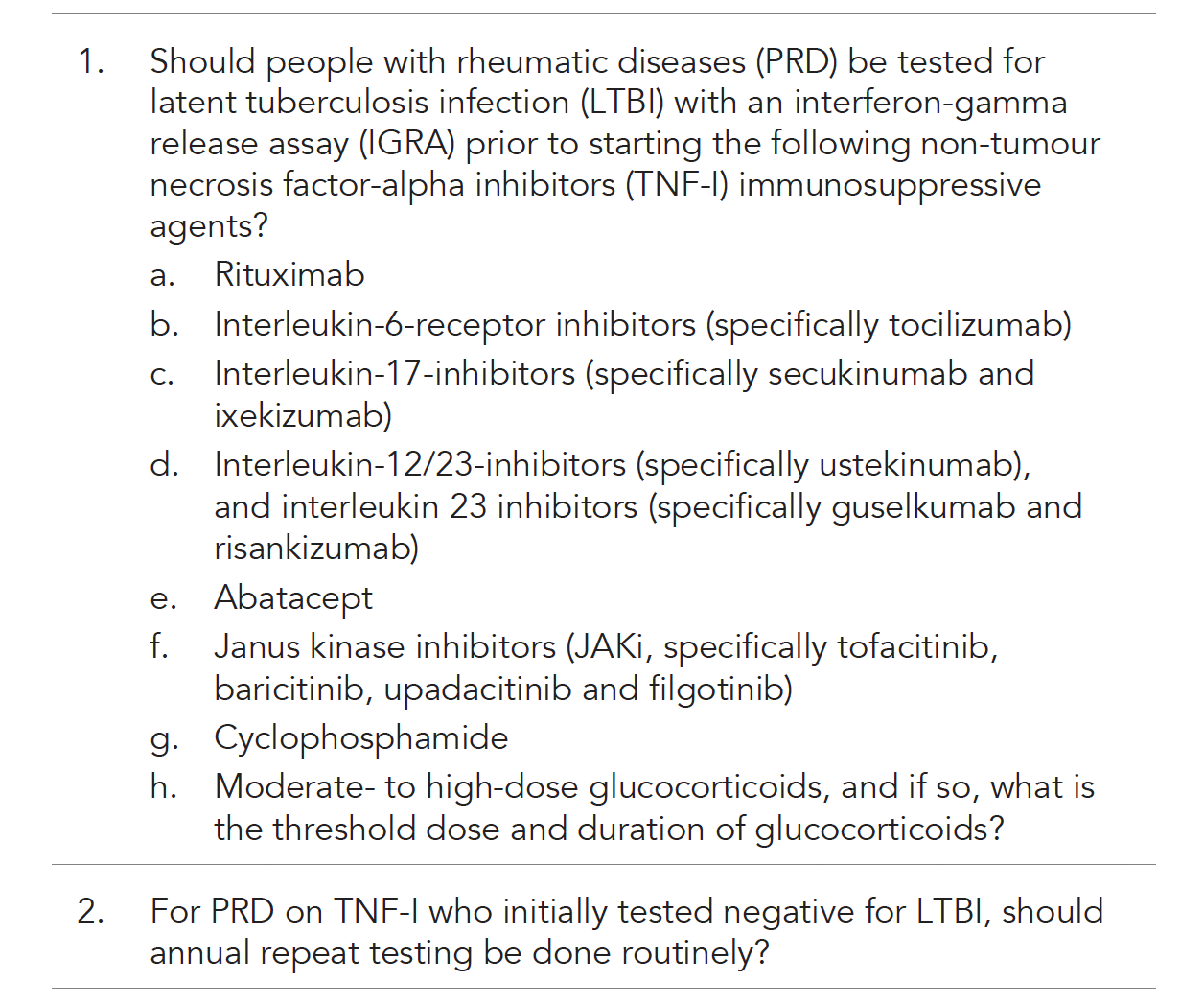
Members of the CWG performed a systematic literature review to answer the following research questions (Fig. 1).
Fig. 1. Research questions.
To review the evidence on LTBI screening in PRD, a systematic review of international best practice guidelines and recommendations from rheumatology, infectious disease, gastroenterology and dermatology societies were reviewed. The authors searched PubMed for publications between 2000 and 2024, using a combination of Medical Subject Headings (MeSH) terms and free text (“Latent Tuberculosis”[MeSH] OR “Tuberculosis”[MeSH] OR “Tuberculosis”) AND (“Immunosuppressive Agents”[MeSH] OR “Antirheumatic Agents”[MeSH] OR “Glucocorticoids”[MeSH] OR “Biologic” OR “DMARD”) AND (“Consensus” [MeSH] OR “Consensus Development Conference, NIH” [Publication Type] OR “Consensus Development Conference” [Publication Type] OR “Guidelines as Topic” [MeSH] OR “Practice Guidelines as Topic” [MeSH] OR “Guideline” [Publication Type] OR “Health Planning Guidelines” [MeSH] OR “Standard of Care” [MeSH] OR “Practice Guideline” [Publication Type] OR “Clinical Protocols” [MeSH]). Article types were limited to “Consensus Development Conference”, “Consensus Development Conference, NIH”, “Guideline” and “Practice Guideline”. The filters “English” (language) and “Humans” were also applied. This search yielded 40 citations. The authors screened through the titles and/or abstracts and excluded those that were duplicates or were outdated recommendations from the same body. They also did a manual search of primary licensing and other landmark drug clinical trials and registries.
Creation of draft statements
The CWG compiled findings from the literature review and formulated draft statements for rating by the TFP through an online survey platform. The Appraisal of Guidelines for Research & Evaluation (AGREE) framework9 was used in the formulation of the statements (see Supplementary Material Table S1), and Grading of Recommendations Assessment, Development and Evaluation (GRADE) methodology10 was used for assigning level of evidence and strength of recommendations.
Rating of statements by the task force panel
Consensus was developed using a modified Delphi approach. The TFP was provided with a summary of evidence from the reviewed guidelines, trials and registries. For the first round of voting, the TFP was given a link to an online rating form and detailed instructions for rating via electronic mail. Based on the summarised evidence and their clinical expertise, the TFP independently rated each statement on a 5-point Likert scale (1 = strongly disagree, 2 = disagree, 3 = neutral, 4 = agree, 5 = strongly agree). Consensus was achieved if there was at least 70% agreement (agree or strongly agree) or at least 70% disagreement (disagree or strongly disagree). The CWG and TFP then convened in a hybrid (in-person and online) synchronous meeting. One member of the CWG (Manjari Lahiri) moderated the proceedings. Results from the first round of rating were discussed and areas of uncertainties were clarified. Statements that did not reach consensus were reworded if necessary, and a second round of rating was carried out immediately via an online survey during the meeting. Results from the second round of voting were further discussed.
Finalising consensus statements
The final consensus statement was circulated to the TFP after the consensus meeting, and was approved by all members. Following this, the recommendations were reviewed by the College of Physicians, Singapore, Academy of Medicine Singapore, and the Ministry of Health, Singapore. Revisions were made, where appropriate, based on their input, prior to finalisation.
RESULTS
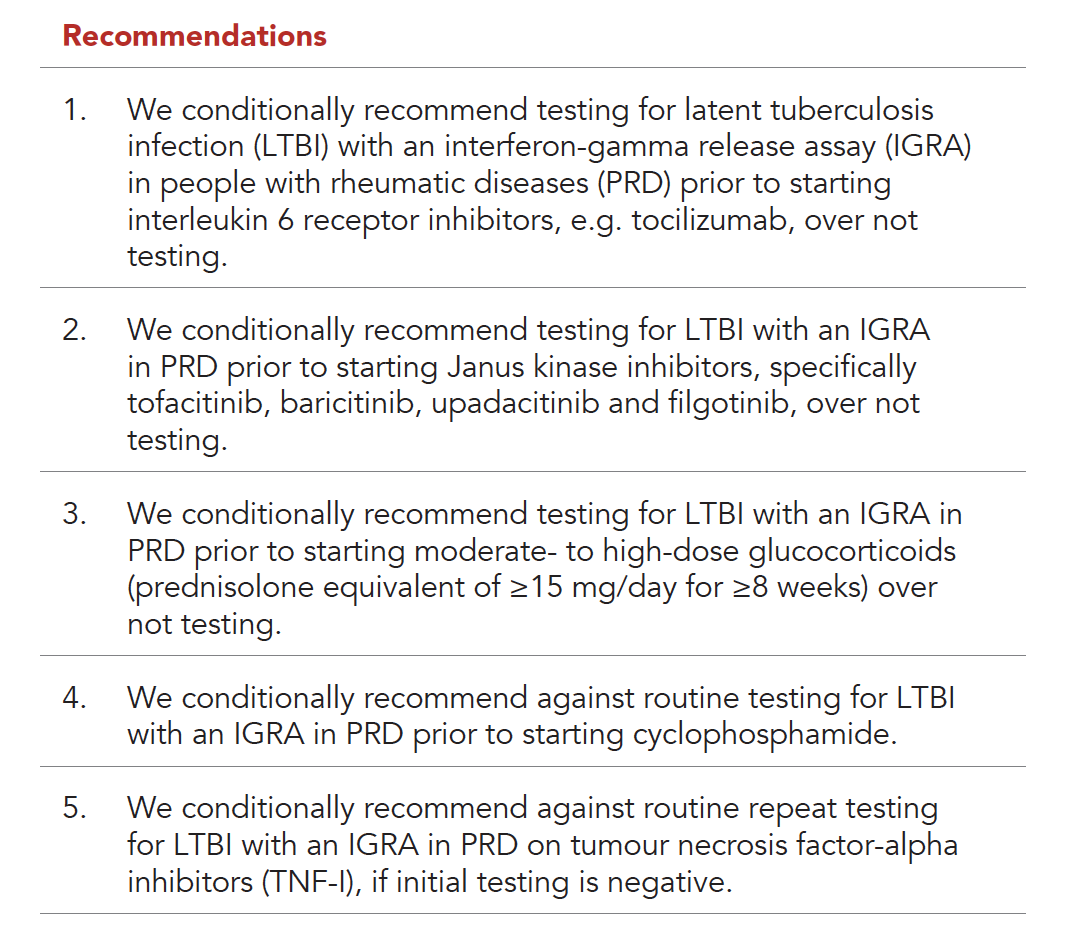
1. We conditionally recommend testing for LTBI with an IGRA in PRD prior to starting interleukin-6-receptor inhibitors e.g. tocilizumab, over not testing.
The level of evidence is low. The European Society of Clinical Microbiology and Infectious Diseases11 and the Canadian Rheumatology Association guidelines12 specifically recommend testing for LTBI prior to starting tocilizumab. Most other guidelines8,13-16 include generic statements recommending testing for LTBI prior to starting biologics; however, they do not specifically mention tocilizumab. In the AMBITION trial17 studying the use of tocilizumab in patients with rheumatoid arthritis, patients were screened according to Singapore standards and were excluded if they had active TB or untreated LTBI. In the RADIATE trial,18 patients with active TB were excluded, but it was not mentioned if LTBI was screened for. In both studies, no opportunistic infections including TB were reported. In the GiACTA trial,19 it was not mentioned if LTBI testing was done and/or if patients with LTBI were excluded. The British Society for Rheumatology Biologics Register–Rheumatoid Arthritis registry20 did not report any TB cases in the tocilizumab group. Very few cases were reported with tocilizumab use in the Hong Kong Society of Rheumatology Biologics Register.21 It was not mentioned if LTBI testing was done and/or if patients with LTBI were excluded.
This statement reached consensus on the first round of voting and was hence not discussed further.
2. We conditionally recommend testing for LTBI with an IGRA in PRD prior to starting JAKi, specifically tofacitinib, baricitinib, upadacitinib and filgotinib, over not testing.
The level of evidence is low. Most guidelines11,13,15,22 recommend that the same TB screening algorithm described for biologics should also be followed for patients receiving targeted synthetic disease-modifying antirheumatic drugs.
There is some evidence suggesting that use of JAKi may confer a higher risk for reactivation of LTBI. In clinical trials studying the use of JAKi in rheumatoid arthritis23-25 and psoriatic arthritis,26 patients with active or untreated TB were excluded. In spite of this, a study with pooled data investigating the long-term safety of tofacitinib in the treatment of RA23 reported 36 patients who developed active TB, 4 of whom had LTBI at screening and were appropriately treated. In another study with pooled data investigating the safety profile of baricitinib,25 10 patients were reported to have developed active TB. Very few cases of TB have been reported with tofacitinib use in registries.21,27,28 It was not mentioned if the patients in these registries had been screened or treated for LTBI prior to the initiation of tofacitinib.
This statement reached consensus on the first round of voting and was hence not discussed further.
3. We conditionally recommend testing for LTBI with an IGRA in PRD prior to starting moderate- to high-dose glucocorticoids (prednisolone equivalent of ≥15 mg/day for ≥8 weeks), over not testing.
The level of evidence is low. Most guidelines13,16,29,30,31 do recommend screening for LTBI for patients who are likely to receive moderate- to high-dose glucocorticoids for a prolonged period of time. There is variation in the dose and duration threshold recommended, but most13,30 suggest a threshold daily dose of ≥15 mg of prednisolone equivalent for ≥4 weeks. These recommendations arose from studies32,33 that compared patients on glucocorticoid dose of <15 mg/day versus ≥15 mg/day. These 2 studies provided relevant observational data, but the level of evidence is low as 1 is a cohort study while the other is a case-control study.
Most cohort studies evaluating the incidence of TB and its risk factors showed that use of glucocorticoids was associated with increased risk of developing active TB,33-38 though the doses were not mentioned. It was also not mentioned if LTBI testing was done prior to initiation of glucocorticoids or whether patients with LTBI were excluded.
The TFP agreed that 15 mg/day of prednisolone equivalent is a reasonable dose as it is considered a moderate dose of glucocorticoids. However, in terms of duration, the TFP felt that a threshold duration of 8 weeks would be more pragmatic compared to 4 weeks. As almost all patients who require pulsed intravenous or high-dose oral glucocorticoids are expected to remain on high doses for at least 4 weeks—but may be able to taper the dose beyond 8 weeks—the higher threshold may reduce the burden of over testing. Given that it takes time for latent TB to reactivate, the TFP felt that 8 weeks is a reasonable threshold. Nevertheless, the decision should be individualised, especially if patients have epidemiological or clinical risk factors for latent TB (e.g. history of TB exposure, radiographic findings suggestive or previous or healed TB, residence in or travel from highly TB-endemic regions).
The TFP also acknowledged that in certain time-sensitive situations where patients require urgent treatment, it would not be feasible to delay initiation of glucocorticoids until after commencement of treatment of LTBI. Moreover, IGRA may yield false negative or indeterminate results in patients on high-dose glucocorticoids, and may hence warrant repeat or alternative modality testing subsequently if clinical suspicion remains. Given these limitations, this recommendation aims to serve as a reminder for physicians to minimally perform a risk assessment for patients who may require high-dose glucocorticoids, and monitor closely for reactivation of TB.
Finally, it was also mentioned that while there is insufficient evidence for TB reactivation while on other modes of administration of glucocorticoids, it may be reasonable to consider screening and treatment of LTBI for PRD prescribed moderate- to high-dose glucocorticoids in all forms.
4. We conditionally recommend against routine testing for LTBI with an IGRA in PRD prior to starting cyclophosphamide.
The level of evidence is low. The European Alliance of Associations for Rheumatology13 suggests that a recommendation for cyclophosphamide cannot be made due to the low level of evidence. Most other guidelines8,11,12,14-16,22,29,31,39,40 are silent regarding LTBI testing prior to starting cyclophosphamide. Furthermore, most large clinical trials investigating the use of cyclophosphamide in ANCA-associated vasculitis41 and lupus nephritis42,43 did not report an increased risk of TB, though it was not mentioned whether LTBI testing was done or whether patients with LTBI were excluded.
Majority of the TFP disagreed with the statement during the first round of voting. A member of the TFP mentioned that screening for LTBI is also not routinely done in haematology patients on cyclophosphamide.
5. We conditionally recommend against routine repeat testing for LTBI with an IGRA in PRD on TNF-I, if initial testing is negative.
The optimal re-testing strategy for LTBI while on TNF-I therapy in those who initially tested negative remains to be established. While some guidelines are silent on repeat testing, others11,12,13,14,39 have suggested repeat testing if there are epidemiological risk factors, such as close contact with active TB cases, countries where TB is endemic, patients with selected underlying medical conditions. Regarding the recommended interval for repeat testing, 2 guidelines11,39 suggested annual repeat testing.
A member of the TFP reminded the group that the incidence of reactivated TB in Singapore is only 27 to 28 per 100,000 per year.2 The rate of TB has been declining over the past 6 years.44 Also, the cost of a single IGRA test in a public-sector hospital is about SGD200. Hence, routine repeat testing in a low-risk group of patients may lead to unnecessary cost with low yield.1,2 The TFP felt that instead, need for repeat testing should be individualised, guided by clinical signs and symptoms, known exposure to TB contacts and change in risk factors.
Rituximab
The level of evidence is low. Most guidelines8,13-16 include generic statements recommending testing for LTBI prior to starting biologics—but do not specifically mention rituximab. Evidence from small retrospective or observational data suggests that the risk of reactivation of TB with rituximab is low. In published clinical trials studying the efficacy of rituximab in rheumatoid arthritis,45,46 ANCA-associated vasculitis47 and lupus nephritis,48 it is not mentioned if LTBI testing was done and/or if patients with LTBI were excluded. The REFLEX trial46 specifically mentioned that there were no reported cases of TB over 24 weeks of the study. In biologics registries,20,21,27,28 very few cases of TB were observed in the rituximab group. Similarly, it was not mentioned if the patients in these registries had been screened or treated for LTBI prior to the initiation of rituximab.
This statement did not reach consensus. The TFP questioned the strength of evidence linking rituximab to an increased risk of TB reactivation. One member commented that the mechanism of action of rituximab primarily targets B cells, and is hence less implicated in TB reactivation compared to therapies affecting T-cell function. It was pointed out that testing for LTBI is also not routinely done in patients with haematological malignancies, where rituximab is commonly used, and no significant safety signals have emerged to date. Others took a more cautious stance, acknowledging that while the evidence is limited, isolated reports of TB reactivation do exist and warrant consideration. It was also pointed out that patients prescribed rituximab are often concurrently receiving other immunosuppressive therapies, including corticosteroids, which could contribute to a cumulative risk of TB reactivation.
Interleukin-17-I, specifically secukinumab and ixekizumab
The level of evidence is low. The Joint American Academy of Dermatology and National Psoriasis Foundation39 and the European Society of Clinical Microbiology and Infectious Diseases guidelines11 recommend screening for LTBI prior to the initiation of interleukin (IL)-17-I. Other guidelines vary in their assessment of risk. In a study pooling data from 21 randomised controlled trials investigating the long-term safety of secukinumab in patients with plaque psoriasis, psoriatic arthritis and ankylosing spondylitis,49 it was mentioned that the patients enrolled in these trials were tested for LTBI, and could be included if LTBI treatment was started. No cases of TB reactivation were reported in these trials.
This statement did not reach consensus though the majority (66.7%) of the TFP agreed with testing for LTBI prior to starting IL-17-I on the first round of voting. Members of the TFP commented that the rates of TB may be low due to existing practices of screening and treating LTBI, rather than a truly low risk. They would still opt to treat LTBI in these patients and hence would test for LTBI prior to starting IL-17-I. Moreover, the drug inserts for Cosentyx (secukinamab; Novartis Pharmaceuticals Corp, NJ, USA) and Taltz (ixekizumab; Eli Lilly and Company, IN, USA) recommend evaluating for TB prior to initiating treatment. It was suggested that from a practical standpoint, since patients considered for IL-17-I often have overlapping indications with TNF-I, LTBI screening would typically be conducted regardless, given the established need for testing prior to initiation of TNF-I. However, others felt that the evidence supporting treating LTBI in these cases is not strong and hence they would not offer screening. One member pointed out that real-world data50 in the dermatology field has shown low reactivation rates among patients with LTBI who received IL-17-I. However, it is important to note that the majority of patients in this study received chemoprophylaxis after being screened for LTBI. Data specifically on patients with untreated LTBI who received IL-17-I are limited.
Interleukin-12/23-I, specifically ustekinumab, and Interleukin-23-I, specifically guselkumab and risankizumab
The level of evidence is low. The Joint American Academy of Dermatology and National Psoriasis Foundation39 and the European Society of Clinical Microbiology and Infectious Diseases guidelines11 recommend screening for LTBI prior to the initiation of IL-12/23-I. Other guidelines vary in their assessment of risk. In the PSUMMIT 2 trial51 investigating the efficacy and safety of ustekinumab in patients with psoriatic arthritis, patients with a history of active TB were excluded. Other patients were tested for LTBI and could be included if LTBI treatment was started. No cases of TB reactivation were reported through week 60. In the DISCOVER-152 and DISCOVER-2 trials53 of guselkumab in patients with psoriatic arthritis, patients with active TB were excluded. Other patients were tested for LTBI and could be included if they were on LTBI treatment. No cases of new-onset TB or reactivation of LTBI occurred through 1 year. Data regarding TB reactivation with IL-12/23-I and IL-23-I use from biologics registries are not yet available.
This statement did not reach consensus. The majority of the TFP concurred that these drugs are less commonly used in Rheumatology. One member remarked that he would test for LTBI in all patients with spondyloarthritis, given the potential need for TNF-I and the associated risk of TB reactivation.
Abatacept
The level of evidence is low. The Canadian Rheumatology Association guidelines12 specifically recommend testing for LTBI prior to starting abatacept. Most other guidelines8,13-16 include generic statements recommending testing for LTBI prior to starting biologics; however, they do not specifically mention abatacept. In biologics registries,20,27,28 very few cases of TB were reported with abatacept use. Again, it was not mentioned if the patients in these registries had been screened or treated for LTBI prior to the initiation of abatacept.
This statement did not reach consensus though the majority (66.7%) of the TFP agreed with testing for LTBI prior to starting abatacept on the second round of voting. The TFP noted that this drug is not commonly used in Singapore.
Table 1. Voting results.
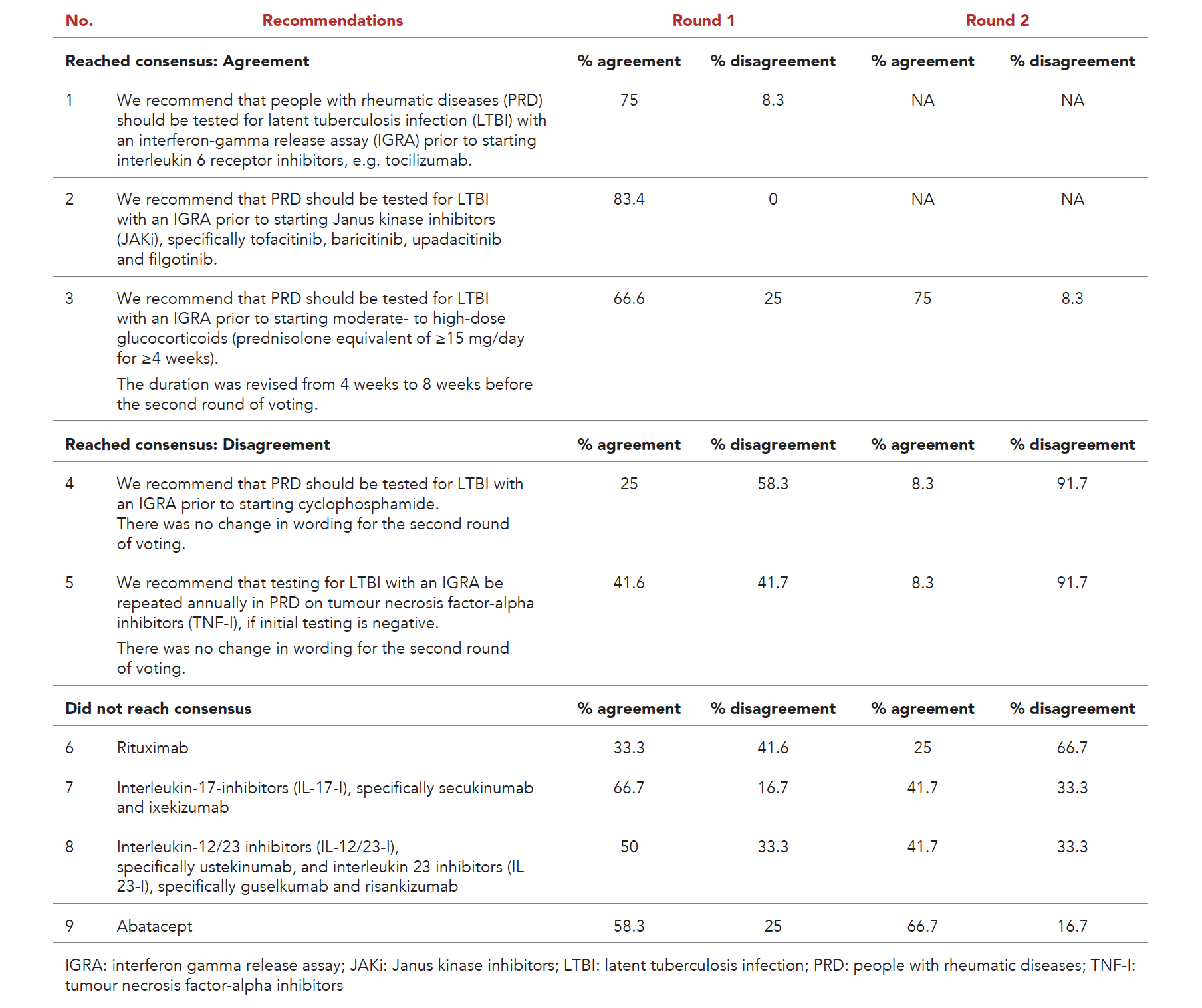
Table 2. Summary of recommendations.
DISCUSSION
This consensus recommendation provides guidance to healthcare providers regarding screening for LTBI prior to treatment with non-TNF-I immunosuppressive agents (specifically non-TNF-I bDMARDs, tsDMARDs, moderate- to high-dose glucocorticoids and cyclophosphamide), as well as regarding routine repeat testing for patients on TNF-I who initially tested negative for LTBI. This recommendation is based on an updated literature review, evidence synthesis using the GRADE methodology, and a modified Delphi consensus method. Ten adult rheumatologists, 1 infectious diseases specialist and 1 respiratory medicine specialist with a special interest in TB were convened for this work, which is representative of the healthcare providers for PRD in Singapore. The updated evidence and consensus are intended to help guide decision making for screening and treatment for LTBI prior to starting non-TNF-I immunosuppressive agents, and to remind physicians of nuances to consider for repeat testing for LTBI in patients on TNF-I.
The consensus recommendation achieved strong agreement for screening and treating for LTBI prior to initiating tocilizumab and JAKi, consistent with recommendations from existing guidelines11,12 and real-world evidence of elevated risk of TB reactivation.23,25 These recommendations are further supported by the known mechanistic effects of these agents, particularly their disruption of T-cell-mediated immunity, a critical defence against latent TB reactivation.54 JAKi block the JAK-STAT signalling pathway, that is critical for cytokine signalling, including interferon-gamma (IFN-γ) which is essential for macrophage activation and control of latent TB. Emerging evidence also suggests additional alteration of regulatory T-cell function, further compromising TB containment.55-57 However, it should be cautioned that delaying initiation of tocilizumab or JAKi while treating LTBI should be balanced against the clinical need for disease control.
Conversely, the majority of the TFP concurred that screening for LTBI need not be done routinely prior to starting cyclophosphamide. For glucocorticoids, the panel endorsed screening for LTBI prior to starting moderate- to high-dose glucocorticoids, defined by the panel as prednisolone equivalent of ≥15 mg/day for ≥8 weeks. This balances the risk of LTBI reactivation against clinical feasibility in acute settings. The TFP also agreed that repeat testing for LTBI while on TNF-I need not be routinely done in view of Singapore’s declining TB rates,44 favouring a case-based approach instead, to best optimise resource use. Despite broad consensus on several recommendations, we acknowledge that none achieved unanimous agreement or disagreement. This reflects the paucity of high-level evidence specifically addressing LTBI screening strategies, as much of the current guidance is extrapolated from observational data and indirect evidence, as well as expert opinion. Prospective studies, ideally randomised controlled trials, or large registry-based cohort studies, that evaluate TB reactivation outcomes under varying screening protocols, are required to strengthen future recommendations. Another limitation is that our recommendations did not consider the cost impact on society or individuals.
In summary, we have synthesised an updated literature review and formulated consensus recommendations on the need for screening for LTBI prior to treatment with non-TNF-I immunosuppressive agents in PRD. This work represents a systematic effort by the Chapter of Rheumatologists, College of Physicians, Academy of Medicine, Singapore. Recommendations for the individual patient need to take into account the patient’s clinical condition and risk factors for TB, values, preferences and accessibility to testing for LTBI. These recommendations will undoubtedly evolve as new evidence becomes available.
Supplementary material
Table S1. AGREE reporting checklist.
Acknowledgements
The authors thank the Chapter of Rheumatologists, College of Physicians, Academy of Medicine, Singapore, for providing funding and logistical support for the consensus meeting.
REFERENCES
- Yap P, Tan KHX, Lim WY, et al. Prevalence of and risk factors associated with latent tuberculosis in Singapore: A cross-sectional survey. Int J Infect Dis 2018;72:55-62.
- Ministry of Health, Singapore.Update on Tuberculosis Situation in Singapore. Ministry of Health Singapore. Published 23 March 2025. https://www.moh.gov.sg/newsroom/update-on-tuberculosis-situation-in-singapore-2025. Accessed 4 May 2025.
- Askling J, Fored CM, Brandt L, et al. Risk and case characteristics of tuberculosis in rheumatoid arthritis associated with tumor necrosis factor antagonists in Sweden. Arthritis Rheum 2005;52:1986-92.
- Gómez-Reino JJ, Carmona L, Valverde VR, et al. Treatment of rheumatoid arthritis with tumor necrosis factor inhibitors may predispose to significant increase in tuberculosis risk: a multicenter active-surveillance report. Arthritis Rheum 2003;48:2122-7.
- Wolfe F, Michaud K, Anderson J, et al. Tuberculosis infection in patients with rheumatoid arthritis and the effect of infliximab therapy. Arthritis Rheum 2004;50:372-9.
- Guidelines on the Management of Latent Tuberculosis Infection. Geneva: World Health Organization; 2015.
- British Thoracic Society Standards of Care Committee. BTS recommendations for assessing risk and for managing Mycobacterium tuberculosis infection and disease in patients due to start anti-TNF-alpha Thorax 2005;60:800-5.
- Holroyd CR, Seth R, Bukhari M, et al. The British Society for Rheumatology biologic DMARD safety guidelines in inflammatory arthritis-Executive summary. Rheumatology (Oxford) 2019;58:220-6. Erratum in: Rheumatology (Oxford). 2019;58:372.
- Brouwers MC, Browman GP, Burgers JS, et al. Appraisal of Guidelines for Research & Evaluation II (AGREE II) Instrument. The AGREE Next Steps Consortium. May
- Winthrop KL, Mariette X, Silva JT, et al. ESCMID Study Group for Infections in Compromised Hosts (ESGICH) Consensus Document on the safety of targeted and biological therapies: an infectious diseases perspective (Soluble immune effector molecules [II]: agents targeting interleukins, immunoglobulins and complement factors). Clin Microbial Infect 2018 ;24:S21-S40.
- Bombardier C, Hazlewood GS, Akhavan P, et al. Canadian Rheumatology Association. Canadian Rheumatology Association recommendations for the pharmacological management of rheumatoid arthritis with traditional and biologic disease-modifying antirheumatic drugs: part II safety. J Rheumatol 2012;39:1583-1602.
- Jones G, Sebba A, Gu J, et al. Comparison of tocilizumab monotherapy versus methotrexate monotherapy in patients with moderate to severe rheumatoid arthritis: the AMBITION study.Ann Rheum Dis 2010;69:88-96.
- Emery P, Keystone E, Tony HP, et al. IL-6 receptor inhibition with tocilizumab improves treatment outcomes in patients with rheumatoid arthritis refractory to anti-tumour necrosis factor biologicals: results from a 24-week multicentre randomised placebo-controlled trial. Ann Rheum Dis 2008;67:1516-23. Erratum in: Ann Rheum Dis 2009;68:296.
- Stone JH, Tuckwell K, Dimonaco S, et al. Trial of Tocilizumab in Giant-Cell Arteritis.N Engl J Med 2017;377:317-28.
- O’Young CKY, Ho KM, So H, et al. Recommendations on management of latent tuberculosis infection in patients initiating anti-tumour necrosis factor biologics. J Clin Rheumatol and Immunol 2021;21:1-7
- Lau CS, Chia F, Dans L, et al. 2018 update of the APLAR recommendations for treatment of rheumatoid arthritis. Int J Rheum Dis 2019;22:357-75.
- Cohen SB, Tanaka Y, Mariette X, et al. Long-term safety of tofacitinib for the treatment of rheumatoid arthritis up to 8.5 years: integrated analysis of data from the global clinical trials.Ann Rheum Dis 2017;76:1253-62.
- Fleischmann R, Pangan AL, Song IH, et al. Upadacitinib Versus Placebo or Adalimumab in Patients With Rheumatoid Arthritis and an Inadequate Response to Methotrexate: Results of a Phase III, Double-Blind, Randomized Controlled Trial.Arthritis Rheumatol 2019;71:1788-800.
- Smolen JS, Genovese MC, Takeuchi T, et al. Safety Profile of Baricitinib in Patients with Active Rheumatoid Arthritis with over 2 Years Median Time in Treatment.J Rheumatol 2019;46:7-18. Erratum in: J Rheumatol 2019;46:1648-9.
- Gladman D, Rigby W, Azevedo VF, et al. Tofacitinib for Psoriatic Arthritis in Patients with an Inadequate Response to TNF Inhibitors.N Engl J Med 2017;377:1525-36.
- Kremer JM, Bingham CO 3rd, Cappelli LC, et al. Postapproval Comparative Safety Study of Tofacitinib and Biological Disease-Modifying Antirheumatic Drugs: 5-Year Results from a United States-Based Rheumatoid Arthritis Registry.ACR Open Rheumatol 2021;3:173-84.
- Simon TA, Suissa S, Skovron ML, et al. Infection outcomes in patients with rheumatoid arthritis treated with abatacept and other disease-modifying antirheumatic drugs: Results from a 10-year international post-marketing study.Semin Arthritis Rheum 2024;64:152313.
- Lichtenstein GR, Loftus EV, Isaacs KL, et al. ACG Clinical Guideline: Management of Crohn’s Disease in Adults. Am J Gastroenterol. 2018 Apr;113(4):481-517. Epub 2018 Mar 27. Erratum in: Am J Gastroenterol 2018;113:1101.
- Internal Clinical Guidelines Team (UK). Tuberculosis: Prevention, Diagnosis, Management and Service Organisation. London: National Institute for Health and Care Excellence (UK); 2016.
- Ang MLT, Chan SM, Cheng LT, et al. Singapore tuberculosis (TB) clinical management guidelines 2024: A modified Delphi adaptation of international guidelines for drug-susceptible TB infection and pulmonary disease. Ann Acad Med Singap 2024;53:170-86.
- Long W, Cai F, Wang X, et al. High risk of activation of latent tuberculosis infection in rheumatic disease patients.Infect Dis (Lond) 2020;52:80-6.
- Jick SS, Lieberman ES, Rahman MU, et al. Glucocorticoid use, other associated factors, and the risk of tuberculosis.Arthritis Rheum 2006;55:19-26.
- Wu PH, Lin YT, Yang YH, et al. The increased risk of active tuberculosis disease in patients with dermatomyositis – a nationwide retrospective cohort study.Sci Rep 2015;5:16303.
- Zhang L, Zou X, Jiang N, et al. Incidence and risk factors of tuberculosis in systemic lupus erythematosus patients: a multi-center prospective cohort study. Front Immunol 2023;14:1157157.
- Wu Q, Liu Y, Wang W, et al. Incidence and prevalence of tuberculosis in systemic lupus erythematosus patients: A systematic review and meta-analysis. Front Immunol 2022;13:938406.
- Brassard P, Lowe AM, Bernatsky S, et al. Rheumatoid arthritis, its treatments, and the risk of tuberculosis in Quebec, Canada.Arthritis Rheum 2009;61:300-4.
- Lai CC, Lee MT, Lee SH, et al. Risk of incident active tuberculosis and use of corticosteroids.Int J Tuberc Lung Dis 2015;19:936-42.
- Menter A, Strober BE, Kaplan DH, et al. Joint AAD-NPF guidelines of care for the management and treatment of psoriasis with biologics. J Am Acad Dermatol 2019;80:1029-72.
- Lewinsohn DM, Leonard MK, LoBue PA, et al. ATS/CDC/IDSA Clinical Practice Guidelines: Diagnosis of Tuberculosis in Adults and Children. Clin Infect Dis 2017;64:e1-e33.
- de Groot K, Harper L, Jayne DR, et al. Pulse versus daily oral cyclophosphamide for induction of remission in antineutrophil cytoplasmic antibody-associated vasculitis: a randomized trial.Ann Intern Med 2009;150:670-80.
- Houssiau FA, Vasconcelos C, D’Cruz D, et al. Immunosuppressive therapy in lupus nephritis: the Euro-Lupus Nephritis Trial, a randomized trial of low-dose versus high-dose intravenous cyclophosphamide.Arthritis Rheum 2002;46:2121-31.
- Appel GB, Contreras G, Dooley MA, et al. Mycophenolate mofetil versus cyclophosphamide for induction treatment of lupus nephritis.J Am Soc Nephrol 2009;20:1103-12.
- The Straits Times. Local TB cases drop for sixth year straight in 2024. The Straits Times. 23 March 2024. https://www.straitstimes.com/singapore/local-tb-cases-drop-for-sixth-year-straight-in-2024. Accessed 4 May 2025.
- Emery P, Fleischmann R, Filipowicz-Sosnowska A, et al. The efficacy and safety of rituximab in patients with active rheumatoid arthritis despite methotrexate treatment: results of a phase IIB randomized, double-blind, placebo-controlled, dose-ranging trial.Arthritis Rheum 2006;54:1390-400.
- Cohen SB, Emery P, Greenwald MW, et al. Rituximab for rheumatoid arthritis refractory to anti-tumor necrosis factor therapy: Results of a multicenter, randomized, double-blind, placebo-controlled, phase III trial evaluating primary efficacy and safety at twenty-four weeks.Arthritis Rheum 2006;54:2793-806.
- Stone JH, Merkel PA, Spiera R, et al. Rituximab versus cyclophosphamide for ANCA-associated vasculitis.N Engl J Med 2010;363:221-32.
- Rovin BH, Furie R, Latinis K, et al. Efficacy and safety of rituximab in patients with active proliferative lupus nephritis: The Lupus Nephritis Assessment with Rituximab study.Arthritis Rheum 2012;64:1215-26.
- Deodhar A, Mease PJ, McInnes IB, et al. Long-term safety of secukinumab in patients with moderate-to-severe plaque psoriasis, psoriatic arthritis, and ankylosing spondylitis: integrated pooled clinical trial and post-marketing surveillance data.Arthritis Res Ther 2019;21:111.
- Torres T, Chiricozzi A, Puig L, et al. Treatment of Psoriasis Patients with Latent Tuberculosis Using IL-17 and IL-23 Inhibitors: A Retrospective, Multinational, Multicentre Study.Am J Clin Dermatol 2024;25:333-42.
- Ritchlin C, Rahman P, Kavanaugh A, et al. Efficacy and safety of the anti-IL-12/23 p40 monoclonal antibody, ustekinumab, in patients with active psoriatic arthritis despite conventional non-biological and biological anti-tumour necrosis factor therapy: 6-month and 1-year results of the phase 3, multicentre, double-blind, placebo-controlled, randomised PSUMMIT 2 trial.Ann Rheum Dis 2014;73:990-9.
- Deodhar A, Helliwell PS, Boehncke WH, et al. Guselkumab in patients with active psoriatic arthritis who were biologic-naive or had previously received TNFα inhibitor treatment (DISCOVER-1): a double-blind, randomised, placebo-controlled phase 3 trial Lancet 2020;395:1115-25. Erratum in: Lancet 2020;395:1114.
- Mease PJ, Rahman P, Gottlieb AB, et al. Guselkumab in biologic-naive patients with active psoriatic arthritis (DISCOVER-2): a double-blind, randomised, placebo-controlled phase 3 trial. Lancet 2020;395:1126-36. Erratum in: Lancet 2020;395:1114.
- Urdahl KB. Understanding and overcoming the barriers to T cell-mediated immunity against tuberculosis.Semin Immunol 2014;26:578-87.
- Shanmuganathan G, Orujyan D, Narinyan W, et al. Role of Interferons inMycobacterium tuberculosis Clin Pract 2022;12:788-96.
- Kubo S, Nakayamada S, Sakata K, et al. Janus Kinase Inhibitor Baricitinib Modulates Human Innate and Adaptive Immune System.Front Immunol 2018;9:1510.
- Ghoreschi K, Jesson MI, Li X, et al. Modulation of innate and adaptive immune responses by tofacitinib (CP-690,550).J Immunol 2011;186:4234-43.
Not applicable. No ethics approval was required as this manuscript is a consensus statement based solely on literature review and Delphi consensus process, with no involvement of human subjects or patient data.
Li Yang Hsu received honoraria from QIAGEN Singapore Pte Ltd for a speaking engagement. The remaining authors declare they have no affiliations or financial involvement with any commercial organisation with a direct financial interest in the subject or materials discussed in the manuscript.
A/Prof Manjari Lahiri, Division of Rheumatology and Allergy, Department of Medicine, National University Hospital, 1E Kent Ridge Road, Singapore 119228. Email: [email protected]
