

ABSTRACT
Introduction: Obstructive sleep apnoea (OSA) is common in Singapore, with moderate to severe OSA affecting around 30% of residents. These consensus statements aim to provide scientifically grounded recommendations for the management of OSA, standardise the management of OSA in Singapore and promote multidisciplinary collaboration.
Methods: An expert panel, which was convened in 2024, identified several areas of OSA management that require guidance. The expert panel reviewed the current literature and developed consensus statements, which were later independently voted on using a 3-point Likert scale (agree, neutral or disagree). Consensus (total ratings of agree and neutral) was set a priori at ≥80% agreement. Any statement not reaching consensus was excluded.
Results: The final consensus included 49 statements that provide guidance on the screening, diagnosis and management of adults with OSA. Additionally, 23 statements on the screening, diagnosis and management of paediatric OSA achieved consensus. These 72 consensus statements considered not only the latest clinical evidence but also the benefits and harms, resource implications, feasibility, acceptability and equity impact of the recommendations.
Conclusion: The statements presented in this paper aim to guide clinicians based on the most updated evidence and collective expert opinion from sleep specialists in Singapore. These recommendations should augment clinical judgement rather than replace it. Management decisions should be individualised, taking into account the patient’s clinical characteristics, as well as patient and caregiver concerns and preferences.
CLINICAL IMPACT
What is New
- This paper provides comprehensive guidance on the diagnosis and management of adult and paediatric obstructive sleep apnoea.
- This guidance has taken into consideration the applicability of the recommendations on the healthcare environment in Singapore.
Clinical Implications
- The recommendations in this paper may guide primary care professionals in providing early screening, prompt diagnosis and effective treatment.
- It also provides guidance on the appropriateness of referral to specialty care.
- These recommendations may optimise care by ensuring only the best care, based on the latest available evidence, is given to patients in Singapore.
Obstructive sleep apnoea (OSA) is a condition characterised by repeated episodes of upper-airway obstruction during sleep associated with desaturations or arousal from sleep.1 This results in fragmented, non-restorative sleep as well as the classic symptoms of OSA (including loud snoring, gasping or choking, and excessive daytime sleepiness), which define OSA syndrome (OSAS).2 Untreated OSA is associated with hypertension, increased rates of myocardial infarction, stroke, depression, accidents and impaired quality of life.1
The Singapore Health Study 2012, a cross-sectional population study that included adults aged 21–79 years, found that 30.5% of Singaporeans had moderate to severe OSA, defined as an apnoea-hypopnoea index (AHI) of ≥15 events/hour. The prevalence of OSAS—defined as an AHI of ≥5 events/hour and an Epworth sleepiness score (ESS) of ≥10—was 18.1%.3 Treatment for OSA, with continuous positive airway pressure (CPAP), has been shown to be cost-effective from the Singapore health system perspective.4
While most diagnostic and therapeutic interventions for OSA are available in Singapore, the complexity and multifactorial nature of OSA, and the potentially high level of resources required in its management necessitate multidisciplinary collaboration and evidence-based clinical guidance. These consensus statements aim to provide scientifically grounded recommendations for the management of OSA, standardise the management of OSA in Singapore, promote multidisciplinary collaboration and elevate clinical decision-making.
METHODS
The panel was convened in January 2024, led by a steering committee formed by members of the Chapter of Sleep Medicine Physicians, Academy of Medicine, Singapore. Workgroup members, representing respiratory physicians, otolaryngologists, paediatricians and dentists in both private and public institutions were nominated by the steering committee. The College of Physicians, College of Pediatrics and Child Health, College of Dental Surgeons and Chapter of Otolaryngologists from the Academy of Medicine Singapore were invited to nominate experts involved in the care of adult or paediatric patients with sleep-disordered breathing for participation in this panel. The College of Family Physicians Singapore was invited but did not nominate any participants. In addition, the consensus voting panel comprised sleep technologists, an internal medicine physician, a public health physician and a sleep scientist.
The expert panel identified several areas of management that require guidance, including the screening, diagnosis, management and long-term care of adult and paediatric patients with OSA.
The expert panel performed an online literature search on PubMed, Cochrane and Google Scholar, using the keywords “obstructive sleep apnea”, “screening”, “diagnosis”, “treatment” and “management.” Evidence summaries were developed based on the results of the literature search and were presented to the expert panel. The evidence was reviewed and appraised using the Grading of Recommendations Assessment, Development, and Evaluation, otherwise known as GRADE system.5 Based on this system, the level of evidence was designated as follows: (1) high (authors have high confidence that the true effect is similar to the estimated effect); (2) moderate (authors believe that the true effect is probably close to the estimated effect); (3) low (true effect might be markedly different from the estimated effect); and (4) very low (low confidence in the effect estimate). The authors adjusted the level of evidence if the estimated effect, when applied in Singapore, may differ from the published evidence due to various factors such as ethnicity, cultural differences, healthcare systems and resources and accepted practice.
Consensus recommendations were developed based on the retrieved evidence and modified using a modified Delphi-based approach facilitated by email voting (in October 2024). The strength of recommendation was classified as “strong” if the panel identified that the desirable effects of an intervention clearly outweigh the undesirable effects and that most informed patients would choose the recommended management; “weak” if the trade-offs are less certain, either because of low-quality evidence, where evidence suggests that desirable and undesirable effects are closely balanced, or where alternative interventions are available; or good practice statement if the recommendation is based on the clinical experience of the expert panel. The experts also independently rated statements on a 3-point Likert scale (agree, neutral or disagree) with an option to submit their comments for further optimisation. Consensus (total ratings of “agree” and “neutral”) was set a priori at ≥80% agreement. Any statement not reaching consensus was excluded.
RESULTS
The expert panel developed 72 consensus statements: 49 statements covered the management of OSA in adults and 23 statements on OSA in children. The 21 statements on the screening and diagnosis of OSA in adults are shown in Table 1. The 28 statements on the treatment and follow-up of OSA in adults are enumerated in Table 2. Lastly, the 23 statements on paediatric OSA are outlined in Table 3.
Table 1. Summary of the recommendations on the screening and diagnosis of OSA in adults.
|
Statement |
Level of evidence |
Strength of recommendation |
|
|
Screening |
|||
|
Screening for OSA is recommended in patients with hypertension, cardiovascular disease, diabetes mellitus or obesity, or preoperative patients. |
Low |
Strong |
|
|
The use of validated screening tools is recommended for OSA screening. |
Moderate |
Strong |
|
|
Screening for OSA is recommended in pregnant individuals with obesity (BMI 30 kg/m2 or higher). |
Moderate |
Strong |
|
|
Diagnosis |
|||
|
Sleep testing is recommended in patients with symptoms of OSA or those found to have elevated risk based on validated screening tools. |
Moderate |
Strong |
|
|
Sleep testing is recommended in patients with young/resistant hypertension, AF requiring cardioversion/ablation, unexplained pulmonary hypertension or unexplained nocturia. |
Moderate |
Strong |
|
|
Sleep testing may be considered in post-stroke patients with OSA symptoms and who are likely to be able to use CPAP. |
Low |
Weak |
|
|
Clinical tools, questionnaires and prediction algorithms SHOULD NOT be used in isolation to diagnose OSA in adults. |
Moderate |
Strong |
|
|
PSG or home sleep tests should only be ordered under the guidance of medical or dental professionals with appropriate training in sleep medicine. |
Very low |
Strong |
|
|
PSG (Level I) is recommended as the gold standard in the diagnosis of OSA. |
Moderate |
Strong |
|
|
In-laboratory PSG performed by personnel qualified in sleep medicine is recommended as the gold standard and reference diagnostic sleep test. |
Moderate |
Strong |
|
|
PSG should include sleep electroencephalogram, electrooculogram, electromyogram, electrocardiogram, respiratory flow, snoring, respiratory effort, oxygen saturation, body position and video monitoring. |
Moderate |
Strong |
|
|
PSG is recommended in patients with clinical suspicion of OSA with discordant HSAT findings. |
Low |
Strong |
|
|
Level III or Level IV sleep studies are NOT recommended to diagnose OSA in patients with significant cardiac, respiratory or neuromuscular comorbidities. |
Moderate |
Strong |
|
|
A split-night diagnostic protocol, rather than a full-night diagnostic protocol for PSG may be considered for the diagnosis of OSA. |
Low |
Weak |
|
|
All sleep studies (Level I to IV) must be interpreted and reported by a specialist trained and certified in sleep medicine. |
Very low |
Strong |
|
|
HSAT |
|||
|
An HSAT is recommended for patients with a high pretest probability for moderate to severe OSA and without significant cardio-respiratory comorbidities. |
Moderate |
Strong |
|
|
The need for, and appropriateness of, an HSAT must be based on the patient’s medical history and a face-to-face examination by a physician, either in person or via telemedicine. |
Very low |
GPS |
|
|
An HSAT to diagnose OSA or assess treatment efficacy must be ordered by a physician. |
Very low |
Strong |
|
|
HSAT should NOT be used for general screening of asymptomatic populations. |
Very low |
GPS |
|
|
Diagnosis, assessment of treatment efficacy, and treatment decisions must NOT be based solely on automatically scored HSAT data. |
Very low |
GPS |
|
|
The raw data from the home sleep apnoea test device must be reviewed and interpreted by a physician who is trained and certified in the management of OSA. |
Very low |
GPS |
|
BMI: body mass index; CPAP: continuous positive airway pressure; GPS: good or best practice statement; HSAT: home sleep apnoea test; OSA: obstructive sleep apnoea; PSG: polysomnography
Table 2. Summary of recommendations on the treatment and follow-up of OSA in adults.
|
Statement |
Level of evidence |
Strength of recommendation |
|
|
CPAP |
|||
|
CPAP treatment is recommended in symptomatic patients with OSA of any severity. |
High |
Strong |
|
|
CPAP therapy is recommended in the treatment of moderate-severe OSA in patients with hypertension. |
Moderate |
Strong |
|
|
In OSA patients who do not fulfil the conventional criteria for treatment, symptomatic improvement after a short trial of CPAP may help determine if long-term CPAP is beneficial. |
Low |
Weak |
|
|
CPAP therapy should be considered in patients with moderate-severe OSA and AF undergoing rhythm control. |
Moderate |
Strong |
|
|
CPAP therapy should be considered in patients with OSA and heart failure. |
Moderate |
Strong |
|
|
OSA treatment should be considered in asymptomatic patients with moderate-severe OSA. |
Moderate |
Strong |
|
|
OSA treatment may NOT be indicated in elderly patients who are minimally symptomatic. |
Low |
Weak |
|
|
CPAP should be prescribed by and used under the guidance of a medical professional appropriately trained and certified in the management of OSA. |
Very low |
GPS |
|
|
A change in PAP mode should be prescribed by and used under the guidance of medical professionals appropriately trained and certified in the management of OSA. |
Very low |
GPS |
|
|
Initiation of CPAP therapy |
|||
|
Home auto-titrating PAP is recommended for CPAP initiation in adults with OSA and no significant comorbidities. |
Moderate |
Strong |
|
|
In adult OSA patients not using auto-PAP, home or in-laboratory PAP titration are recommended for CPAP initiation. |
Moderate |
Strong |
|
|
In-laboratory PAP titration is recommended in adults with OSA with significant comorbidities or who fail home auto-PAP titration. |
Moderate |
Strong |
|
|
Split-night titration may be considered when moderate to severe OSA is observed during a minimum recording time of 2 hours and wherein at least 3 hours are available for CPAP titration. |
Low |
Weak |
|
|
Patient education by professionals trained to provide CPAP therapy is recommended to increase PAP adherence. |
Moderate |
Strong |
|
|
Supportive interventions and behavioural therapies by professionals trained to provide CPAP therapy may be considered to increase CPAP adherence. |
Moderate |
Weak |
|
|
Heated humidification may be considered in OSA patients who report nasal congestion, dry nose or mouth, and sore throat. |
Moderate |
Weak |
|
|
Treatment of nasal obstruction should be considered to improve CPAP adherence. |
Moderate |
Strong |
|
|
In patients with OSA who are overweight or obese, weight management is recommended. |
Moderate |
Strong |
|
|
Oral appliances should be considered in adjunctive treatment of mild to moderate OSA in patients with craniofacial and dentofacial anomalies. |
Moderate |
Strong |
|
|
Hypoglossal nerve stimulation may be considered in selected patients with moderate to severe OSA who are CPAP intolerant. |
Moderate |
Strong |
|
|
Upper-airway surgery should be considered in selected patients with suitable upper-airway anatomy who fail non-surgical treatment. |
Moderate |
Strong |
|
|
Upper-airway surgery should be considered as an adjunct in selected patients to improve adherence to and/or efficacy of other treatment modalities. |
Moderate |
Strong |
|
|
Follow-up PSG or HSAT is recommended to assess response to treatment with non-PAP interventions. |
Low |
Strong |
|
|
Follow-up PSG or HSAT may be considered in patients on OSA treatment with clinically significant weight gain or loss since the initial diagnosis of OSA or the initiation of treatment. |
Low |
Weak |
|
|
OSA patients should be followed up within the initial weeks after CPAP initiation to assess treatment efficacy and adherence. |
Low |
Strong |
|
|
Subsequent yearly evaluation may be considered after CPAP efficacy and adherence are ensured. Longer intervals may be appropriate for selected patients who are highly adherent to PAP therapy, have sustained resolution of OSA-related symptoms, and have no concerns regarding their PAP therapy. |
Very low |
GPS |
|
|
OSA patients with persistent or recurrent sleep-related complaints or persistent difficulties with CPAP use should receive more frequent follow-ups. |
Very low |
GPS |
|
|
Routine sleep testing is NOT recommended to re-evaluate OSA status in patients on CPAP therapy with good symptom control and no change in clinical status (e.g. significant weight loss or upper-airway surgery). |
Very low |
GPS |
|
AF: atrial fibrillation; CPAP: continuous positive airway pressure; GPS: good or best practice statement; HSAT: home sleep apnoea test; OSA: obstructive sleep apnoea; PAP: positive airway pressure; PSG: polysomnography
Table 3. Summary of recommendations on the management of OSA in children.
|
Statement |
Level of evidence |
Strength of recommendation |
|
Screening |
||
|
Children of all ages should be screened by their family physicians or paediatricians for the presence of snoring as well as symptoms and signs suggestive of OSAS during routine health visits. |
Moderate |
Strong |
|
Diagnosis of OSA should be considered in children with adenoid hypertrophy, tonsil hypertrophy, obesity, allergic rhinitis, structural abnormalities of the airways, Down syndrome, Prader-Willi syndrome, achondroplasia, neuromuscular disease and other at-risk comorbidities. |
Moderate |
Strong |
|
For children with prematurity, family history of OSA, genetic, craniofacial or neuromuscular conditions that increase the risk of OSA, a lower threshold to screen and evaluate is recommended. |
Low |
Strong |
|
Diagnosis |
||
|
Clinical evaluation including history, physical examination, audio/video recordings and standardised questionnaires have insufficient sensitivity and specificity for the diagnosis of OSA in children. |
Moderate |
Strong |
|
In-laboratory overnight attended PSG with video recording and CO2 monitoring is recommended as the gold standard and reference diagnostic sleep test for the diagnosis of OSA in children. |
Moderate |
Strong |
|
In selected children with high pretest probability, sleep oximetry may be considered when PSG is not feasible. |
Low |
Weak |
|
Sleep studies including Level I to IV studies should be ordered under the guidance of medical professionals appropriately trained and certified in sleep medicine or the management of OSA. |
Very low |
GPS |
|
Sleep studies including Level I to IV studies should be interpreted and reported by a paediatric sleep specialist with clinical review. |
Very low |
GPS |
|
PSG definition for OSA applies to children 1 to 18 years old. |
Low |
Strong |
|
Using PSG, an AHI ≥1/hour or a pattern of obstructive hypoventilation, defined as hypercapnia (i.e. PaCO2 TcCO2 >50 mmHg) in at least 25% of total sleep time, indicates OSA in children. |
Low |
Strong |
|
The severity of OSA is recommended to be graded on PSG findings as follows: mild (AHI ≥1/hour and <5/hour); moderate (≥5/hour and <10/hour); and severe (≥10/hour). |
Low |
Strong |
|
Treatment |
|
|
|
A trial of nasal corticosteroids with or without montelukast may be considered in children with mild OSA with adenoid and/or tonsil hypertrophy. Regular follow-up is recommended to evaluate efficacy and adverse reactions. |
Moderate |
Weak |
|
If resources permit, a sleep study is recommended for patients being considered for surgery indicated for the treatment of OSA. |
Low |
Strong |
|
For children with OSA with clinical findings discordant with adenoid and/or tonsil hypertrophy, assessment of other risk factors of OSA (e.g. obesity or atopy, dentofacial anomalies, hypotonia) and targeted intervention is recommended. |
Low |
Strong |
|
Clinicians should counsel patients and caregivers and explain that obstructive sleep-disordered breathing may persist or recur after adenotonsillectomy and may require further management. |
Low |
Strong |
|
Follow-up sleep study is recommended post-surgical intervention for those with comorbidity, severe OSA and persistent or recurrent symptoms. |
Low |
Strong |
|
PAP should be considered in children with moderate to severe OSA without adenoid and/or tonsil hypertrophy, persistence after surgery, or those who refuse or are not suitable for surgery. Other treatments may also be considered in developing a treatment plan for these patients. |
Moderate |
Strong |
|
In-laboratory PAP titration is recommended for all children with OSA who are prescribed CPAP for optimal PAP settings. |
Moderate |
Strong |
|
Follow-up PSG with or without CPAP titration in children on chronic PAP support is indicated to determine whether pressure requirements have changed as a result of the child’s growth and development, if symptoms recur while on PAP, or if additional or alternate treatment is instituted. |
Low |
Strong |
|
If PAP is implemented, regular evaluation is recommended to monitor for efficacy and adverse effects. |
Low |
GPS |
|
Dentofacial orthopaedics (growth modification orthodontic treatment) may be considered in children with primary snoring, upper airway resistance syndrome or OSA who exhibit craniofacial or dentofacial anomalies with hypoplastic and/or retrognathic maxilla and mandible. |
Moderate |
Weak |
|
Myofunctional therapy may be considered as a treatment modality or an adjunctive treatment for mild to moderate OSA. |
Low |
Weak |
|
For overweight or obese children with OSA, behavioural and dietary interventions to control weight are recommended. |
Low |
Strong |
AHI: apnoea-hypopnoea index; OSA: obstructive sleep apnoea; OSAS: obstructive sleep apnoea syndrome; PSG: polysomnography
DISCUSSION
OSA in adults
Screening
In asymptomatic patients, there is little evidence that screening or testing for OSA in adults without comorbidities is beneficial. Screening for OSA is aimed at identifying asymptomatic patients with high pretest probability of OSA who should be referred for sleep testing, as they are likely to benefit from potential OSA treatment. Current evidence suggests that OSA screening should be performed in patients with hypertension, cardiovascular disease, diabetes mellitus or obesity, or in preoperative patients (Fig. 1).1,6-9 The Society of Anesthesia and Sleep Medicine (SASM) and the Society for Obstetric Anesthesia and Perinatology (SOAP) also recommend screening for OSA for pregnant individuals with obesity (body mass index [BMI] of 30 kg/m2 or higher), due to their high pretest probability.10
There are several validated screening tools available, including the Berlin questionnaire; snoring, tiredness, observed apnoea, high blood pressure (STOP) questionnaire; and STOP-BMI, age, neck circumference and gender (BANG) questionnaire.11-13 The ESS, an assessment tool for subjective sleepiness, has also been used to screen for symptoms of OSA.14 These 4 aforementioned questionnaires are the most widely used screening tools in primary care and have all been validated across a wide range of patient-types. STOP-BANG, in particular, has been validated in a Singapore population. Identification of OSA symptoms is the foundation of OSA screening tools, as the identification of symptoms substantially improves the diagnostic yield of polysomnography.15 An ESS score of 8 or above predicted a mean sleep latency on the multiple sleep latency test of less than 10 minutes in a Singapore cohort, suggesting that a lower cut-off for excessive daytime sleepiness may be appropriate in Singapore.16 A study that included patients in Singapore with OSA symptoms found that polysomnography (PSG) was able to detect abnormal AHI in 71.8% patients (AHI 5–15: 22.3%; AHI >15–30: 18.3%; AHI >30: 31.2%).17
Fig. 1. Obstructive sleep apnoea screening and testing guidelines.
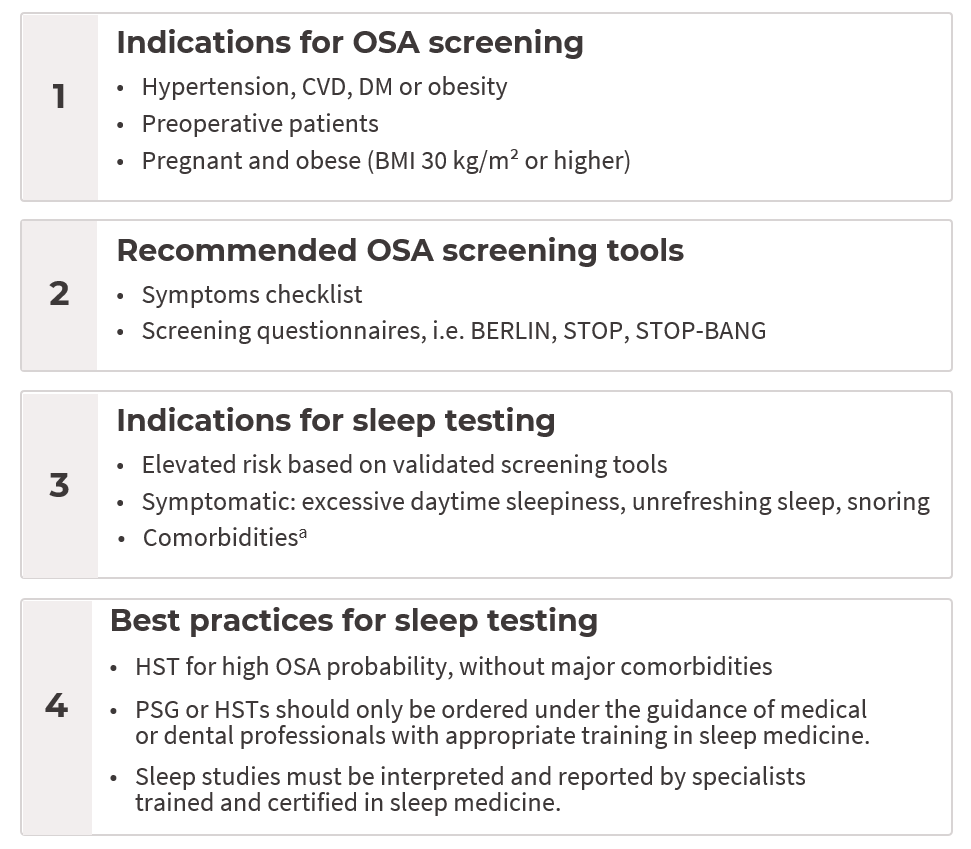
BMI: body mass index; CVD: cardiovascular disease; DM: diabetes mellitus; HST: home sleep test; OSA: obstructive sleep apnoea; PSG: polysomnography; polysomnography; STOP: snoring, tiredness, observed apnoea, high blood pressure; STOP-BANG: STOP-BMI, age, neck circumference and gender
a Young/resistant hypertension, atrial fibrillation requiring cardioversion/ablation, unexplained pulmonary hypertension, unexplained nocturia, post-stroke patients with OSA symptoms who are likely able to use continuous positive airway pressure.
In the primary care setting, a screening test with higher sensitivity may be preferred to ensure adequate diagnostic investigation. Of the 4 questionnaires mentioned, STOP-BANG possessed the greatest pooled sensitivity.12 The evidence is unclear as to which questionnaire is the most specific. Furthermore, the SASM/SOAP guidelines do not recommend the Berlin questionnaire, the STOP-BANG questionnaire and the ESS for screening in pregnant women;18 screening for OSA symptoms may be considered instead.
While the evidence on the harms and costs of screening are limited, the expert panel opines that the harms, financial and workforce burden and disruption to the clinical workflow are minimal. Nonetheless, the real-world cost-utility tradeoff of screening in the primary care setting has yet to be assessed.
Diagnosis
Misdiagnosing patients with OSA can lead to significant harm as a result of over or under treatment. Supervised PSG is the current gold standard for the diagnosis of OSA in adults.1,19 This test involves the recording of multiple physiological signals required for a quantitative assessment of sleep and sleep disorder. This involves sleep electroencephalography, electrooculography, electromyography, respiratory flow and effort, oxygen saturation and carbon dioxide measurement, and video and audio recording.
Given the significant time, effort and cost associated with PSG, it should only be performed in patients that would benefit from testing and eventual treatment, such as those with symptoms of OSA or those found to have elevated risk based on validated screening tools, those at elevated cardiovascular risk, those with conditions that may be aggravated by OSA, such as patients with young/resistant hypertension, atrial fibrillation (AF) requiring cardioversion/ablation, unexplained pulmonary hypertension or unexplained nocturia (Fig. 1).1,6,19,20 Due to the high prevalence of OSA in stroke patients (up to 70%) and a number of studies showing improved recovery in these patients using CPAP, sleep testing may also be considered in post-stroke patients with OSA symptoms and who are likely to be able to use CPAP.1,19
Clinical tools, questionnaires and prediction algorithms do not have sufficient accuracy to diagnose OSA and should, therefore, not be used as the sole test for diagnosing OSA.11-14 While PSG (Level I) remains the gold standard in the diagnosis of OS, Levels II to IV sleep studies may be considered to diagnose OSA in patients with high pre-test probability.1,21 However, Level III or Level IV sleep studies should not be used in patients with significant cardiac, respiratory or neuromuscular comorbidities, as these conditions may affect the accuracy of the sleep test results. PSG is also the preferred diagnostic test in patients with discordant home sleep apnoea test (HSAT), as well as those with persistent suspicion of OSA despite normal or inconclusive respiratory polygraphy.1
As OSA is just one of the various medical conditions that may cause OSA symptoms (e.g. daytime sleepiness, loud snoring, waking up gasping or choking, morning headaches, dry mouth or sore throat, mood changes, and memory and concentration problems), knowledge of sleep medicine is important prior to requesting a sleep test. Hence, guidance from medical or dental professionals with appropriate training in sleep medicine should be sought before ordering a sleep test (Fig. 1). Guidance from trained sleep professionals would also aid in determining the appropriateness of a split-night diagnostic protocol rather than a full-night diagnostic protocol when ordering PSG for the diagnosis of OSA.22 Finally, the expert panel reiterates that sleep studies, regardless of level, must be interpreted and reported by a specialist trained and certified in sleep medicine.
Home sleep apnoea testing (HSAT)
An HSAT is a well-validated alternative to PSG for the diagnosis of OSA in selected populations.23 These devices monitor only selected physiologic variables, which may include peripheral arterial tonometry, electrocardiography, cardiopulmonary coupling, respiratory effort, and airflow and oxygen saturation. Some devices may even include limited electroencephalography channels. Due to their lower resolution and accuracy, these devices are currently recommended only for patients with a high pretest probability of moderate-to-severe OSA with no significant comorbidities, which may affect the accuracy of the HSAT results.1,21 These include significant cardiorespiratory disease, potential respiratory muscle weakness due to neuromuscular conditions, awake hypoventilation or suspicion of sleep-related hypoventilation, chronic opioid medication use, history of stroke, or severe insomnia. In appropriately selected patients, treatment outcomes are similar to those diagnosed with PSG or HSAT.24,25
Given the importance of patient selection for the success of HSAT, the expert panel underscores the performance of a medical history and a face-to-face examination (in person or virtually) by a physician prior to ordering an HSAT. The expert panel also does not recommend the use of HSAT for general screening of asymptomatic populations, as the benefit of an OSA diagnosis and treatment in asymptomatic individuals without associated comorbidities is not established, and may lead to unnecessary discomfort and associated costs. The expert panel also recommends the review and interpretation of raw data from HSAT by a trained physician and suggests to avoid over-reliance on the automatic scoring of HSAT data. Lastly, in-laboratory PSG should be considered in negative, inconclusive, or technically inadequate HSATs in patients with high suspicion for OSA.1,26,27
Continuous positive airway pressure (CPAP)
CPAP is the gold standard treatment for symptomatic OSA, regardless of severity. CPAP acts as a pneumatic splint to maintain the patency of the upper airways during sleep. There is robust evidence that CPAP is associated with improvements in AHI, daytime sleepiness and sleep-related quality of life.28,29 Several studies have also shown that CPAP is associated with a reduction in blood pressure in patients with hypertension, although heterogeneity between studies is high.30-35 Furthermore, a systematic review found that even in non-sleepy OSA patients, CPAP was associated with improved health-related quality of life scores.36 Hence, OSA treatment with CPAP should also be considered in patients with moderate to severe OSA, even if they are asymptomatic. That said, shared decision-making is imperative to discuss the expected benefits of treatment relative to the patient’s baseline risk level, and against the cost of CPAP and the low adherence rates documented in patients with little or no symptoms.37
Due to cardiovascular risks associated with OSA, research has also explored the benefits of CPAP in patients with OSA and various cardiovascular conditions. For example, a meta-analysis found that in patients with both OSA and AF who were on anti-arrhythmic therapy, CPAP use was associated with a 49% reduction in the risk of AF recurrence.38
CPAP therapy should also be considered in patients with OSA and heart failure (HF). The association between OSA and HF is well established. Patients with HF and untreated OSA have heightened risk due to systemic and pulmonary hypertension, risk of arrhythmias, reduced response to HF treatment and lower quality of life. CPAP should be considered in these patients to slow down the progression of HF, improve response to HF treatment, reduce the risk of hospitalisation due to HF and improve quality of life.39
Disadvantages of CPAP include high cost, discomfort and inconvenience associated with the use of the CPAP device, which has led to low adherence and frequent treatment discontinuation as reported in the literature. While the benefits of CPAP typically outweigh its harms and cost, it should still be used judiciously and may not be appropriate in patients who are likely to receive only minimal benefit, such as elderly patients who are minimally symptomatic. Importantly, the expert panel recommends that CPAP be prescribed by and used under the guidance of medical professionals who are appropriately trained and certified in the management of OSA. Changes in CPAP mode should also be made by appropriately trained and certified professionals.
Initiation of CPAP therapy
The initiation of CPAP requires titration of pressures to eliminate apnoeas and hypopnoeas (or at least reduce AHI to <5 events/hour) in all sleep positions and sleep stages while preventing arousal and central apnoea events. Titration may be done manually or automatically, in-laboratory or at home, and via split-night or full-night titration. Manual in-laboratory titration with continuous monitoring of airflow, leak and arterial oxygen saturation during sleep is the gold standard for positive airway pressure (PAP) titration.1 However, automatic PAP (auto-PAP) devices, including automatic CPAP devices, can identify a therapeutic pressure where 90% or 95% of all titration pressures fall regardless of sleep stage or position.40 Furthermore, meta-analyses have been able to demonstrate that in patients with moderate to severe OSA without significant comorbidities, home auto-PAP titration was as effective as in-laboratory PAP titration in reducing OSA severity and daytime sleepiness in improving quality of life.30 In patients with significant comorbidities or those who fail home auto-PAP titration, in-laboratory titration is recommended.
Split-night titration, which involves using the initial hours of the PSG for diagnostic evaluation and the remaining time for PAP titration, has shown comparable outcomes to full-night titration in terms of long-term adherence and subjective sleepiness.41,42 However, specific conditions must be satisfied to conduct a split-night PSG, such as the presence of moderate to severe OSA, a minimum of 2 hours of diagnostic recording and at least 3 hours available for CPAP titration.1
Lastly, the choice of titration strategy should consider other factors, such as patient preferences and the availability of resources, while being guided by the clinical judgement of the sleep medicine specialist.
Improving CPAP adherence
The benefits of CPAP are strongly correlated with treatment adherence; however, non-adherence to CPAP may be as high as 80%.43 Hence, effort should be made to improve CPAP adherence.
Educational interventions aim to enhance awareness of OSA, its implications and the advantages of treatment, on the primary assumption that providing knowledge can influence personal beliefs and attitudes, potentially driving behavioural changes. The nature and delivery of educational approaches varied across studies, encompassing printed materials, video presentations, online education, phone consultations, one-on-one counselling, tailored feedback, and reviews of individual PSG results. The impact of educational interventions on CPAP adherence is varied, with most studies indicating some level of improved compliance with treatment.30,44 These interventions pose minimal risks and are relatively inexpensive, with costs ranging from low to moderate depending on the approach. As a result, the benefits generally outweigh the potential risks.
Supportive interventions provide additional encouragement and reinforcement through various strategies such as telemonitoring (e.g. telephone calls, texting), personalised support platforms and peer buddy systems. These interventions engage patients, increase support and reinforce strategies to increase CPAP adherence. Most studies on supportive interventions report a modest improvement in adherence although some report no benefit.1,44
Behavioural interventions focus on modifying behavioural constructs to improve adherence to CPAP. Unlike educational interventions that provide passive knowledge transfer, these interventions require participant engagement and behavioural changes. Such interventions include motivational enhancement therapy, cognitive behavioural therapy and progressive muscle relaxation training. There is low-quality evidence suggesting that these interventions may increase CPAP adherence, which is associated with improvement in symptoms.30,44 These interventions may be combined with educational and supportive interventions for greater improvement in adherence. While the potential harm of these interventions is negligible, the associated costs may be high, depending on the resources needed to implement specific interventions.
Heated humidification may improve CPAP adherence by relieving upper-airway symptoms such as nasal congestion, dry nose and mouth, and sore throat, which are common adverse effects of PAP.45 Most CPAP machines have built-in humidification systems. However, systematic reviews have failed to show improvement in adherence or symptom scores, while only 1 cohort study showed greater adherence with humidification.30,46,47 Furthermore, water may condense into the PAP circuit or the user’s face. Hence, heated humidification should be used only after careful consideration of the specific adverse effects of CPAP on the patient, being most appropriate in those with nasal congestion, dry nose or mouth or sore throat.
As nasal PAP interfaces require airway patency, the presence of pre-existing nasal obstruction or the development of new nasal obstruction due to CPAP use may lead to low CPAP adherence. Strategies to resolve nasal obstruction may include conservative, medical, or rarely, surgical options. Conservative strategies include the use of nasal pillows or an oronasal/full-face mask as second-line interfaces; however it should be emphasised that studies show that patients with nasal obstruction have better efficacy and compliance outcomes with nasal masks compared to oronasal masks, which should only be used as a last resort.48 Medical interventions include the use of sodium hyaluronate nasal spray, saline nasal spray or intranasal corticosteroid sprays; however, the clinical evidence supporting these interventions is weak and of poor quality.49,50 On the other hand, nasal surgery has been shown to significantly improve adherence in up to 90% of PAP-intolerant users due to nasal obstruction.51,52 Given the variable benefits and risks of these 3 types of intervention, clinicians should combine best clinical judgement, careful patient selection and shared decision-making when deciding the most appropriate strategy to improve CPAP adherence in patients with nasal obstruction.
Other non-surgical treatments
The role of weight loss on the severity of OSA is well established. Meta-analyses of randomised and non-randomised studies employing a variety of weight loss methods resulting in weight changes ranging from -5 to -19 kg also found AHI reductions of 4 to 25 episodes/hour.53-56 The expert panel recognised the benefits of weight loss in individuals who are overweight or obese, regardless of the presence of OSA, and underscored its additional benefit in patients with OSA. Furthermore, weight loss through dietary modification and exercise is not associated with serious adverse effects, and costs may be modest—hence, the strong recommendation given by the expert panel. Additionally, adjunctive weight loss therapies such as pharmacotherapy may be considered in carefully selected patients with OSA.57 The choice of specific intervention should consider the patient’s overall clinical condition, including the severity of obesity and the presence of comorbidities, as well as individual values and preferences. For instance, while GLP-1 receptor antagonists are known to have cardiovascular benefits, phentermine and topiramate may cause insomnia, which may worsen daytime sleepiness.57
Oral appliances, such as mandibular repositioning/advancement devices, relocate the mandible, hyoid, and the attached muscles and soft tissues into a forward position. This increases the pharyngeal airway space and activates the tongue, soft palate, masseter and submental muscles during sleep to minimise pharyngeal collapsibility. Clinical guidelines of the American Academy of Sleep Medicine and American Academy of Dental Sleep Medicine recommend oral appliances over no therapy in adult patients with OSA who refuse or cannot tolerate CPAP.58 Clinical trials have shown that customised oral appliances are effective in reducing AHI; improving daytime sleepiness, quality of life and hypertension in patients with mild to moderate OSA; and have high acceptability and self-reported adherence.59,60 A Singapore study also found that mandibular advancement was noninferior to CPAP for reducing 24-hour mean arterial BP in participants with hypertension and increased cardiovascular risk.61 However, only patients with suitable dentition (i.e. sufficient healthy teeth and periodontium to retain the device), adequate protrusive jaw function, and without temporomandibular disorders may use oral appliances. Patients should also be aware of the impact of long-term use of oral appliances, such as minor tooth movements, occlusion changes, and possible temporomandibular joint-related symptomology.62 Regular follow-up and the management of side-effects are essential to maximise the treatment adherence and clinical effectiveness of oral appliance therapy.63 Hypoglossal nerve stimulation (HNS) is an emerging treatment for OSA and may be considered in carefully selected patients with moderate to severe OSA who cannot tolerate CPAP. The Phase III trial STAR cohort demonstrated that HNS is associated with a 68% reduction in AHI as well as improvements in oxygen desaturation index, oxygen saturation during sleep, snoring, ESS and quality of life.64,65 However, the impact of HNS on cardiovascular health is still currently unknown.
Despite data supporting its efficacy in selected patients, HNS may be associated with surgical risk during implantation, device malfunction and potential for nonresponse, all of which should be discussed with the patient.1 Furthermore, the upfront cost of HNS is high.
Surgical treatment
Soft tissue surgery or maxillomandibular advancement (MMA) surgery for OSA is typically regarded as a secondary treatment option, reserved for patients who do not respond to or cannot tolerate CPAP therapy or other non-surgical approaches. Given the high non-adherence rate to CPAP, alternative treatments, including upper-airway surgery, may be appropriate for a notable proportion of OSA patients. Evidence shows that, for individuals unable or unwilling to use CPAP, surgical intervention can lead to significant improvements in excessive daytime sleepiness, snoring, blood pressure and AHI or respiratory disturbance index (i.e. number of apnoeas, hypopnoeas and respiratory effort-related arousals per hour of sleep) in carefully selected patients with suitable anatomy.66-68 Additionally, surgery has shown clinically meaningful benefits for sleep-related and overall quality of life, with minimal risk of lasting swallowing difficulties. A Singapore study also found that anterior palatoplasty was associated with reduced snoring, improved oxygen saturation and subjective improvement in tiredness.69 The expert panel also recommends surgery as a complementary treatment in select cases to enhance the efficacy of or adherence to other therapies. Ideal candidates for such an approach include those with favourable anatomical features, such as tonsillar hypertrophy, lack of palatal or lateral pharyngeal obstruction, or individuals without a high BMI or severe OSA.
Currently accepted practice favours the use of surgery as a second-line treatment for OSA.1,70,71 Primary surgical intervention may be considered for patients with specific anatomical abnormalities (e.g. craniofacial structural issues or significant tonsillar enlargement) as treatment for these conditions, but not only for the treatment of OSA itself. Nonetheless, improvement in OSA parameters, such as AHI, may be expected when these abnormalities are surgically corrected. MMA is a well-established surgical strategy to improve multi-level upper-airway patency. Surgical success in mitigating the severity of AHI and the cure rate (achieving AHI of less than 5) were 85.5% and 38.5%, respectively. 72,73
Patients considering surgical treatment for OSA should be informed of potential risks and challenges, such as postoperative pain, the possibility of surgical failure and perioperative complications.
Additionally, bariatric surgery may be considered in Asian patients with OSA and obesity-related complications, and a BMI of 32.5 kg/m2 or higher (lower than the 35.0 kg/m2 indicated for Westerners) or >37.5 kg/m2 without complications, as Asians have a higher risk of obesity-related complications at lower BMIs.57
Long-term management and follow-up
Follow-up PSG or HSAT play a role in the assessment of response to non-PAP interventions for OSA. Literature supports the use of follow-up PSG or HSAT after acclimatisation and optimisation of oral appliances. This is usually done when mandibular protrusion and symptom alleviation have been judged as adequate by a qualified dentist and/or sleep medicine specialist.22 The expert panel also recommends the use of follow-up PSG or HSAT following surgical therapy after an appropriate period of healing to evaluate treatment efficacy.74,75 Patients treated with HNS should undergo follow-up PSG or HSAT to aid in HNS system optimisation.22,76 The decision for whether to use PSG or HSAT may be guided by several factors, such as the presence of comorbidities, the ability to wear or operate the HSAT equipment, and the cost and availability of tests.
Follow-up PSG or HSAT may also be considered in patients on OSA therapy who experience significant changes in body weight.22 The Sleep Heart Health Study suggests that a 10% to 20% increase in body weight could lead to a significant increase in AHI even while on therapy, which may lead to inadequate therapy and recurrence of symptoms.77 Hence, a 10% to 20% change in body weight should prompt the clinician to consider follow-up testing.
The expert panel recognised the importance of follow-up visits in OSA patients initiated on CPAP therapy to assess treatment efficacy and adherence. Such visits provide the opportunity to make further adjustments and provide advice on CPAP adherence, as previously discussed. Once CPAP efficacy has been established and adherence is ensured, follow-up visits may be conducted yearly. However, longer intervals may be appropriate for selected patients, such as those who are highly adherent to PAP therapy, have sustained resolution of OSA-related symptoms, and have no concerns regarding their PAP therapy. In contrast, patients with persistent or recurrent sleep-related complaints or persistent difficulties with CPAP use should receive more frequent follow-up to identify issues with therapy and discuss alternative options.
OSA in children
The exact prevalence of OSA in Singapore children is unknown; however, studies from other countries estimate a prevalence rate of 1% to 6%.78,79 One Singapore study did note that in children with obesity, the prevalence was 13.3%.80 If left undiagnosed or untreated, OSA can lead to serious complications in children. These include stunted growth, maxillofacial growth issues, neurocognitive impairments, behavioural and learning difficulties, metabolic disorders, hypertension, and increased cardiovascular risks in adulthood.81,82 Hence, early diagnosis and intervention are crucial in improving the outcomes of affected children. These paediatric consensus statements aim to guide the management of children with OSA up to 18 years of age.
Screening
The screening for OSA in children involves screening for snoring as well as other signs and symptoms suggestive of OSAS. Aside from snoring, symptoms of OSAS in children include pauses or gasps in breathing during sleep, mouth breathing, restlessness during sleep, waking up in different positions or unusual positions, daytime sleepiness, bedwetting, headaches especially in the mornings, poor school performance, or behavioural problems such as irritability, crankiness, hyperactivity, or difficulty paying attention.83-85 A few screening questionnaires for children, such as the OSA score, paediatric sleep questionnaire and OSA-18, have been developed but the diagnostic accuracy of these tools is low and vary widely depending on the target population and the cutoff score, which significantly limit their utility in real-world practice.86-88
Signs of OSAS in children include signs of tiredness or fatigue, “allergic shiners,” swollen nasal mucosa, micrognathia, macroglossia, high arched palate, adenoidal facies, hypertrophied tonsils and hyponasal speech. A standard head and neck examination, including assessment of the tonsils, should be conducted and described according to the Brodsky scale.89 The presence of nasal obstruction, turbinate hypertrophy or septal hypertrophy should be noted. The examination should also include general muscle tone and neurologic status.83-85
Children with adenoid hypertrophy, tonsil hypertrophy, obesity, allergic rhinitis, structural abnormalities of the airways, Down syndrome, Prader-Willi syndrome, achondroplasia, neuromuscular disease and craniofacial abnormalities should all raise suspicion of OSA. The presence of other risk factors, such as a history of prematurity or a family history of OSA, should also prompt primary care providers to screen and evaluate children for OSA.82
Diagnosis
While history and physical examination are essential parts of care for a child suspected of OSA, these procedures alone, as well as the use of audio/video recording or standardised questionnaires, do not have adequate specificity or sensitivity to establish a diagnosis of OSA in children.83-85 In this population, an in-laboratory overnight attended PSG with video recording and carbon dioxide monitoring is recommended as the gold standard and reference diagnostic sleep test.78,84,90
Regarding the use of HSAT in the diagnosis of OSA in children, a task force found that this test is not reliable or valid for routine use in children.91 While some studies compared HSATs with PSG in children, the risk of bias and the heterogeneity between studies were both high. Literature on the use of HSAT to monitor carbon dioxide levels or identify arousals was absent. The task force also noted that the technical feasibility of HSAT in real-world conditions was low when used in children.
The expert panel recognises the limitations of the gold standard diagnostic sleep test for children, such as the lack of availability, high cost and poor tolerance by the patient. Hence, sleep oximetry and other HSAT may be considered when PSG is not feasible in selected children with high pretest probability.91-93 The expert panel also recommends that the order, review and interpretation of raw data from HSAT to be done by a trained paediatric sleep physician. An in-laboratory overnight attended PSG with video recording and carbon dioxide monitoring should be considered in negative, inconclusive or technically inadequate HSATs in patients with high suspicion for OSA.
OSA is diagnosed in children with an abnormal PSG with an obstructive AHI >1. Although there is no universal consensus on cutoffs for OSA severity in children, several studies have used an AHI of 1 to <5 for mild, 5 to <10 for moderate, and ≥10 for severe OSA92-94; the expert panel agreed to adopt this classification.
Treatment
The treatment of paediatric OSA should consider the severity of the disease, the underlying cause of airway obstruction, the benefits and risks of each intervention, and the long-term effect of the treatment on the child throughout growth and development, including the likelihood of recurrence.
A trial of nasal corticosteroids with or without montelukast may be considered in children with mild OSA with adenoid and/or tonsil hypertrophy. Meta-analyses have found that medical therapy using nasal corticosteroids with or without montelukast may significantly improve AHI in children with mild OSA.95,96 However, follow-up of the studies included in this meta-analysis was short; hence, the long-term impact of nasal corticosteroids with montelukast in paediatric OSA is unclear. Therefore, the expert panel recommends regular follow-up in children with mild OSA treated with medical therapy to assess efficacy and monitor for side effects.
With adenotonsillar hypertrophy being the main contributor to OSA in the majority of otherwise healthy children, tonsillectomy and adenoidectomy (T&A) may be considered in children with moderate to severe OSA with adenotonsillar hypertrophy.78 There is robust evidence that T&A results in improvements in PSG parameters, daytime and night-time symptoms, behaviour and quality of life.97-99 However, the expert panel underscores the importance of a sleep study in children being considered for surgery,97 as children with severe OSA at baseline derive the greatest benefit from surgery whereas those with milder disease may experience an improvement or resolution of OSA even with conservative therapy or watchful waiting. Older children (>7 years), and those with chronic asthma or obesity were also more likely to have persistent OSA—in many of these patients, OSA improved but did not completely resolve, even with T&A.100 Other risk factors of persistence or recurrence of OSA after T&A include severe OSA, Down syndrome and craniofacial, and genetic and neuromuscular disorders.
PAP is the standard therapy for moderate to severe OSA in children without adenoid and/or tonsil hypertrophy, those with persistence of OSA after surgery, or those who refuse or are not suitable for surgery.101,102 For children receiving PAP, adjustment and regular evaluation of ventilator parameters under PSG are recommended, as the necessary pressures may change as the child grows. During follow-up, adverse effects such as nasal symptoms, optic irritation or skin irritation should be addressed. Clinicians should also be aware that PAP may lead to craniofacial abnormalities; hence, regular reassessment is encouraged.
Dentofacial orthopaedics (growth modification orthodontic treatment) is recommended in children with OSA who exhibit dentofacial development problems with hypoplastic and/or retrognathic maxilla and mandible.103-108 Those with primary snoring or upper-airway resistance syndrome (increased upper-airway resistance leading to repeated arousals without meeting the criteria for apnoea or hypopnoea) may also benefit from this intervention. Maxillary expansion and/or protraction, with or without mandibular anterior growth guidance, depending on the type of dentofacial deformity, may be implemented in appropriately selected children with mild to moderate OSA by trained dental specialists in conjunction with interdisciplinary management. Maxillary arch expansion and dentofacial growth modification should be considered in children at or before puberty.108 Long-term therapy is associated with better outcomes and regular follow-up is recommended with sleep monitoring.
Myofunctional therapy has emerged as a useful adjunct treatment modality for the management of OSA in children, especially those with non-severe OSA. A meta-analysis found that despite significant heterogeneity in the exercises used in trials, myofunctional therapy decreased AHI by over 40% and increased oxygen saturations in children with mild to moderate OSA.109
Obesity is an independent risk factor for OSA. Children with obesity are likely to be associated with persistent OSA.110,111 Clinicians should recommend weight control in children with OSA who are overweight or obese. Systematic reviews have shown that various types of weight loss interventions improve AHI in paediatric OSA.112,113
Limitations
Given the varied clinical situations and healthcare resources present, these recommendations should augment clinical judgement rather than replace it. Clinicians should be aware of the challenges that may limit the applicability of these consensus recommendations in different ethnic groups within their populations, access to specific technologies, availability of resources, and the availability of sleep-trained clinicians working in multidisciplinary teams.
While the perspectives of patients and their caregivers were widely considered during the development of the consensus statements, the expert panel did not include patient advocates or representatives of patient groups. Their inclusion should be considered in future work.
Lastly, as digital technologies advance, several opportunities on the use of telemedicine and artificial intelligence in the diagnosis and monitoring of patients with OSA are emerging.114 As the expert panel was unable to find sufficient literature to develop recommendations regarding this aspect of OSA management, we recommend well-designed Singapore studies to aid the development of future guidance.
CONCLUSION
The 72 consensus statements presented in this paper aim to guide clinicians based on the most updated evidence and collective expert opinion from sleep specialists in Singapore. These consensus statements strive to provide guidance on important clinical questions and create an interdisciplinary framework for the appropriate management of OSA, thus potentially improving patient outcomes. These recommendations should augment clinical judgement rather than replace it. Management decisions should be individualised, taking into account the patient’s clinical characteristics as well as patient and caregiver concerns and preferences.
Not applicable as this is a systematic review.
This study was funded in full by an unrestricted grant from the Lee Foundation. The funder did not have any role in study design, data analysis or reporting of results. The authors declare there are no affiliations with or involvement in any organisation or entity with any financial interest in the subject matter or materials discussed in this manuscript.
Prof Leong Chai Leow, Department of Respiratory and Critical Care Medicine, Singapore General Hospital, 20 College Road, Level 3 Academia, Singapore 169608. Email: [email protected]
