

Dear Editor,
Spinal muscular atrophy (SMA) is an autosomal recessive neuromuscular disorder due to mutation in the SMN1 gene leading to progressive muscle weakness, motor decline, feeding and respiratory difficulties, and in severe cases, causing premature mortality.1 Over 95% of cases arise from homozygous deletion of SMN1 exon 7, while disease severity is modified by SMN2 copy number.2 The incidence of SMA is about 1:8000 in the Asian population with a carrier frequency of 1:48 individuals.3
Until 2016, SMA was considered untreatable, with management limited to supportive care.4 Today, there are 3 approved therapies—nusinersen, risdiplam and onasemnogene abeparvovec.5 Importantly, clinical evidence shows that treatment is most effective when started before symptoms appear.6 For this reason, many countries have incorporated newborn screening (NBS) programmes for SMA. These include 48 of 50 states in the US, most provinces in Canada, 45% of all newborns across Europe, Taiwan and Australia.7 Singapore has yet to introduce such a programme for SMA.
Recognising this gap, we conducted a pilot study at the National University Hospital, Singapore, to evaluate the feasibility, acceptability and operational considerations of SMA NBS implementation, as well as the practicalities of laboratory developed test to identify homozygous SMN1 exon 7 deletion. Although the study was conducted in a single tertiary hospital, it represents a critical first step towards a potential national implementation of SMA NBS in Singapore, informing future scale-up, financing pathways, and integration with existing national NBS and rare disease registries. Lessons from established regional programmes, such as Taiwan’s nationwide SMA NBS since 2017,11 provide valuable context for adapting screening frameworks to Singapore’s healthcare infrastructure.
From January to April 2024, parents of newborns in 2 postnatal wards were invited to participate. Study recruitment and pre-test genetic counselling was completed by the study team comprising a paediatric geneticist, a paediatric neurologist, a genetic counsellor, a genetic counsellor associate, a general paediatrician, 2 nurses and 3 neonatologists. The study team received training about SMA knowledge from the paediatric neurologist and training to conduct pre-test genetic counselling from the paediatric geneticist, and were evaluated by real-time observation before commencing recruitment.
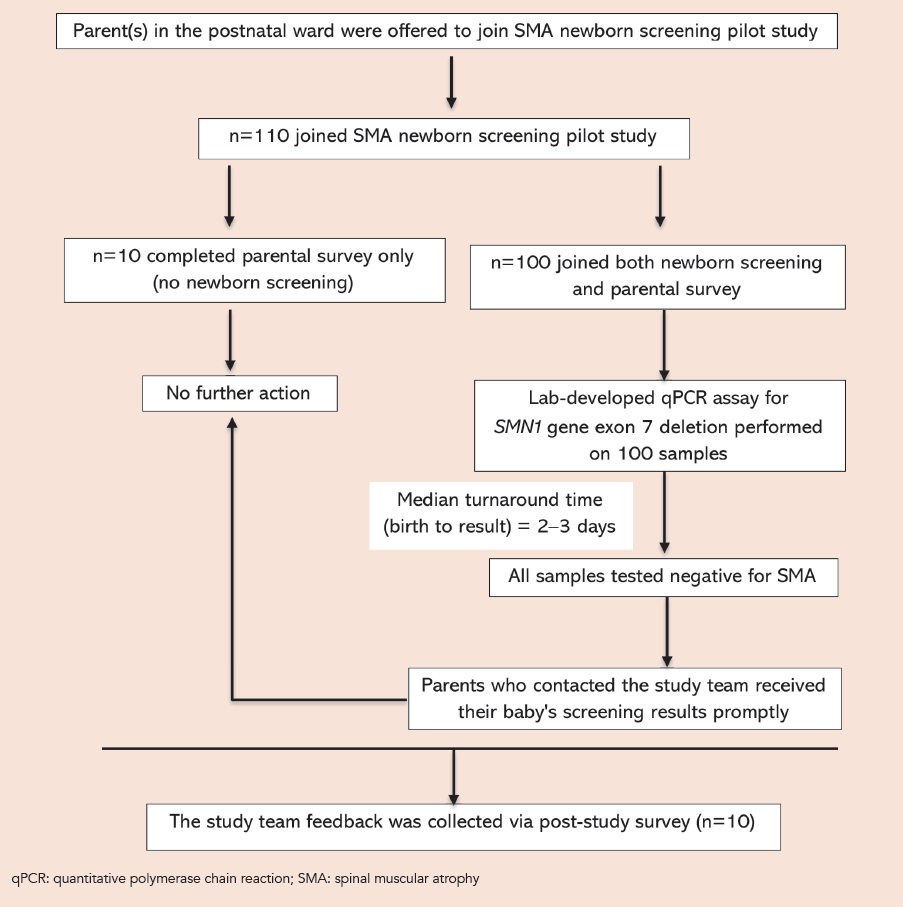
Of the 110 parents surveyed, 100 (91%) agreed to screening after receiving pre-test genetic counselling. Blood samples were collected on dried blood spots via heel prick or venipuncture, concurrent to routine biochemical NBS procedures, and tested using a laboratory-developed quantitative polymerase chain reaction assay that detects homozygous SMN1 exon 7 deletions.8 Positive controls from known SMA patients validated assay performance.
In parallel, parents completed a survey exploring awareness, attitudes, financial considerations and preferred timing of education about SMA (Supplementary Table S1). Only 1 parent (usually the mother, as she was the inpatient at the postnatal ward) was invited to complete the survey after counselling. While both parents often attended counselling sessions, logistical limitations prevented consistent survey collection from both parents. After completion of the pilot study, the healthcare study team of 10 comprising doctors, nurses and genetic counsellors also reflected on their experience via a study team survey (Supplementary Table S1).
The study population comprised 110 parents of participants, with mothers representing the majority at 73% (81/110) and fathers accounting for the remaining 27% (29/110). Parental knowledge of SMA was limited: 66% (73/110) had never heard of the condition, and 77% (85/110) were unaware of available treatments. However, once informed, 85% (95/110) believed that SMA NBS could improve outcomes. Financial acceptability was moderate, with 67% (74/110) willing to pay up to SGD70 for screening and 81% (89/110) up to SGD300 for confirmatory testing. Despite potential financial concerns, 69% (76/110) indicated they would choose to have their newborns screened for SMA. Furthermore, even in the face of possible insurance limitations, a considerable 65% (72/110) of respondents maintained their willingness to proceed with SMA screening (Fig. 1).
Fig. 1. Schematic representation of the SMA newborn screening pilot study.
Notably, most parents (74%, 81/110) preferred to learn about SMA newborn screening during pregnancy, while nearly one third (29%, 32/110) favoured even earlier public health messaging before conception. A large majority (78%, 86/110) indicated preference to know their SMA carrier status prior to pregnancy, suggesting that pre-conceptional couple carrier screening may play an important role in future implementation. Moreover, 91% (100/110) of the parents surveyed were agreeable to proceed with the test. Parents who declined the test were mostly concerned about the additional blood collection, psychological stress of a positive screen, insurance implications, and cost for confirmatory testing and treatment.
From a laboratory perspective, all 100 newborn samples tested negative for SMA. The results returned within 5 working days. No false positives or assay failures occurred, confirming the robustness of the test approach.
For the study team survey, pre-test counselling required 15–30 minutes per family. The most significant challenges were time constraints in the immediate postnatal period, low parental familiarity with SMA and questions about additional blood collection. Team members highlighted the value of written materials or short videos to support counselling. They also noted that antenatal education would be more effective than postnatal explanations, when parents are often fatigued or overwhelmed (Supplementary Table S1).
To the authors’ knowledge, this is the first SMA NBS pilot study in Singapore. High parental acceptance (91%, 100/110) following counselling is encouraging and consistent with international reports.9
Laboratory feasibility was demonstrated, but as with other programmes, the team’s assay only detects exon 7 deletions and not rarer point mutations or duplications. For a national programme, follow-up testing with SMN2 copy number analysis would be essential to guide prognosis and treatment urgency.10
Infants identified with SMA through newborn screening would require rapid referral to a multidisciplinary care team, comprising paediatric neurology, genetics, respiratory medicine and allied health professionals. Confirmed cases are typically co-managed within a coordinated neuromuscular clinic, facilitating early counselling and initiation of therapy. In Singapore, 3 disease-modifying treatments are currently available: nusinersen, risdiplam and onasemnogene abeparvovec. Of these, risdiplam is the most accessible, with partial government subsidy available, while families may also pursue financial assistance or crowdfunding for other therapies. Prompt, presymptomatic treatment initiation remains a key goal to optimise motor and survival outcomes, underscoring the importance of a well-defined linkage-to-care pathway in any future national programme.
Cost remains a critical issue. While many parents expressed willingness to pay, the long-term sustainability of a national screening programme would require policy support, integration into existing NBS workflows and careful consideration of funding and subsidy models. Insurance implications also need to be addressed.
Operational barriers included limited time for postnatal counselling, low parental familiarity with SMA and concerns about additional blood collection. These can be mitigated through antenatal education, multimedia counselling aids, and integration within existing NBS workflows to streamline implementation.
Nationwide implementation would also require substantial manpower for pre-test counselling, currently taking 15–30 minutes per family. Innovative approaches, such as digital or video-based pre-test education and training of existing healthcare staff, could help improve scalability and resource efficiency.
Finally, public education must begin early. Parents in the study overwhelmingly preferred antenatal or even pre-pregnancy information about SMA screening, allowing time for reflection and decision-making. Integrating such education into routine antenatal care could reduce pressure on postnatal information delivery and improve uptake.
The authors acknowledge that the study is limited by its single-centre nature, which may not fully represent the diverse healthcare landscape across Singapore. The relatively short follow-up period restricts the team’s ability to assess long-term outcomes and challenges associated with SMA screening implementation. Additionally, the generalisability of these findings may be limited, as practices and resources in a tertiary hospital setting might differ from those in other healthcare facilities. Despite these limitations, the authors’ experience provides valuable insights for the potential nationwide implementation of SMA newborn screening in Singapore, offering a foundation for future multicentre studies and longer-term evaluations.
This pilot study demonstrates that SMA newborn screening is both feasible and acceptable in Singapore. Parents responded positively once informed, and laboratory testing was reliable. However, successful implementation at the national level will depend on addressing key challenges: raising public awareness, providing timely education, ensuring adequate counselling resources and developing sustainable funding strategies. With these considerations in place, a Singapore SMA NBS programme could enable early intervention, improve outcomes and prevent significant morbidity and mortality in infants affected with SMA.
Supplementary material
Acknowledgment
We gratefully acknowledge study team members, laboratory team, medical and nursing staff of the postnatal wards in in Departments of Neonatology and Obstetrics and Gynaecology, National University Hospital, and parents of the participants for their invaluable support in this study.
REFERENCES
- Mishra K, Mishra A. Spinal muscular atrophy (SMA): Treatment strategies, challenges and future prospects. Pharmacological Research-Reports 2025;3:100031.
- Ogino S, Wilson RB. Spinal muscular atrophy: molecular genetics and diagnostics. Expert Rev Mol Diagn 2004;4:15-29.
- Verhaart IEC, Robertson A, Wilson IJ, et al. Prevalence, incidence and carrier frequency of 5q-linked spinal muscular atrophy – a literature review. Orphanet J Rare Dis 2017;12:124.
- Lim JYX, Wang FS, Ling SR, et al. A consensus survey of neurologists and clinical geneticists on spinal muscular atrophy treatment in Singapore. Ann Acad Med Singap. 2024;53:386-9.
- Day JW, Howell K, Place A, et al. Advances and limitations for the treatment of spinal muscular atrophy. BMC Pediatr 2022;22:632.
- Motyl AA, Gillingwater TH. Timing is everything: Clinical evidence supports pre-symptomatic treatment for spinal muscular atrophy. Cell Reports Medicine 2022;3:100725 .
- Newborn Screening for Spinal Muscular Atrophy (SMA). https://www.novartis.com/diseases/spinal-muscular-atrophy-sma/newborn-screening-spinal-muscular-atrophy-sma. Accessed 14 July 2025.
- Czibere L, Burggraf S, Fleige T, et al. High-throughput genetic newborn screening for spinal muscular atrophy by rapid nucleic acid extraction from dried blood spots and 384-well qPCR. Eur J Hum Genet 2020;2:23-30.
- Kay DM, Stevens CF, Parker A, et al. Implementation of population-based newborn screening reveals low incidence of spinal muscular atrophy. Genet Med 2020;22:1296-302.
- Cooper K, Nalbant G, Sutton A, et al. Systematic review of newborn screening programmes for spinal muscular atrophy. Int J Neonatal Screen 2024;10:49.
- Wang C H, Hsu TR, Liu MY, et al. Newborn screening facilitates early theranostics and improved spinal muscular atrophy outcome: five-year real-world evidence from Taiwan. Orphanet J Rare Dis 2025:20:197.
The Spinal Muscular Atrophy exon 7 deletion newborn screening pilot was approved by the National Healthcare Group Domain Specific Review Board (2023/00754).
The authors declare there are no affiliations with or involvement in any organisation or entity with any financial interest in the subject matter or materials discussed in this manuscript. All authors have no conflicts of interest to declare. Data are available upon reasonable request from the corresponding author.
Adj A/Prof Hui-Lin Chin, Department of Paediatrics, Yong Loo Lin School of Medicine, National University of Singapore, 1E Kent Ridge Road, NUHS Tower Block, Level 12, Singapore 119228. Email: [email protected]
