


Global healthcare challenges are pervasive, hindering delivery of effective, high-quality and sustainable care to populations worldwide. The quadruple aim in healthcare is a strategy to address these challenges by (1) improving population health, (2) enhancing the patient care experience, (3) reducing per capita healthcare costs, and (4) promoting the well-being of healthcare workers.1 A resilient health system relies on sufficient, well-trained health workers, yet the World Health Organization estimates a global shortfall of 11 million by 2030, affecting all countries to varying degrees.2 Achieving these aims requires innovative technologies and tools, such as artificial intelligence (AI).
AI enables machines to simulate aspects of human learning, problem-solving, decision-making and pattern recognition.3 Early AI, based on neural networks inspired by the human brain, comprises interconnected nodes that learn from data to make predictions before it evolved to machine learning (ML). ML enables computers to learn from data and make decisions without explicit programming. It is widely used for data analysis, predictive analytics and risk assessment in healthcare.4
Deep learning (DL), a subset of ML, employs multilayered neural networks to analyse complex patterns, excelling in tasks like medical imaging and natural language processing. Transformer models have accelerated AI, particularly in language processing and multimodal applications like image and video generation. These breakthroughs have been escalated by graphics processing units (GPUs),5 which enable efficient large-scale training and sophisticated model development to solve complex challenges across industries, including healthcare.4
Singapore is rapidly emerging as a global AI hub, adopting the National Artificial Intelligence Strategy (NAIS) in 2019 for AI development, use and governance.6 The local clusters of academic public primary care clinics have tapped their vast patient data and electronic medical records (EMR) systems and dovetailed NAIS to develop and test AI solutions. Such applications, if proven to address the issues, will spread to the private general practice clinics through the primary care networks.
The current impetus to apply AI originates from a surge in chronic complex diseases amid an ageing population. Managing geriatric patients with multimorbidity is tough, compounded by the growing burden of administrative documentation in electronic systems, which are inundated with information from multiple healthcare partners. This strain contributes to widespread burnout in an overstretched healthcare ecosystem. AI is widely perceived as a tool to address these challenges, but requires clear goals, high-quality data collection, appropriate technology selection, pilot testing and ongoing evaluation.7 Collaboration with primary care professionals (PCPs), training and regular ethical reviews help mitigate AI bias. However, AI deployment must align with local healthcare priorities, policy directives and supported by AI expertise and resources within the primary healthcare system.8
Improving the health of the population
Individuals from diverse demographic, clinical and socioeconomic backgrounds can benefit from AI applications in primary care. AI facilitates diagnosis of medical conditions by speeding up reporting of laboratory and imaging results. For example, diabetic retinopathy is the leading cause of blindness in Singapore. The AI-based SELENA+ system now allows diabetic retinal imaging in primary care to be reported within minutes, which facilitates prompt referral of patients with such complication to ophthalmologists for treatment (Table 1).9
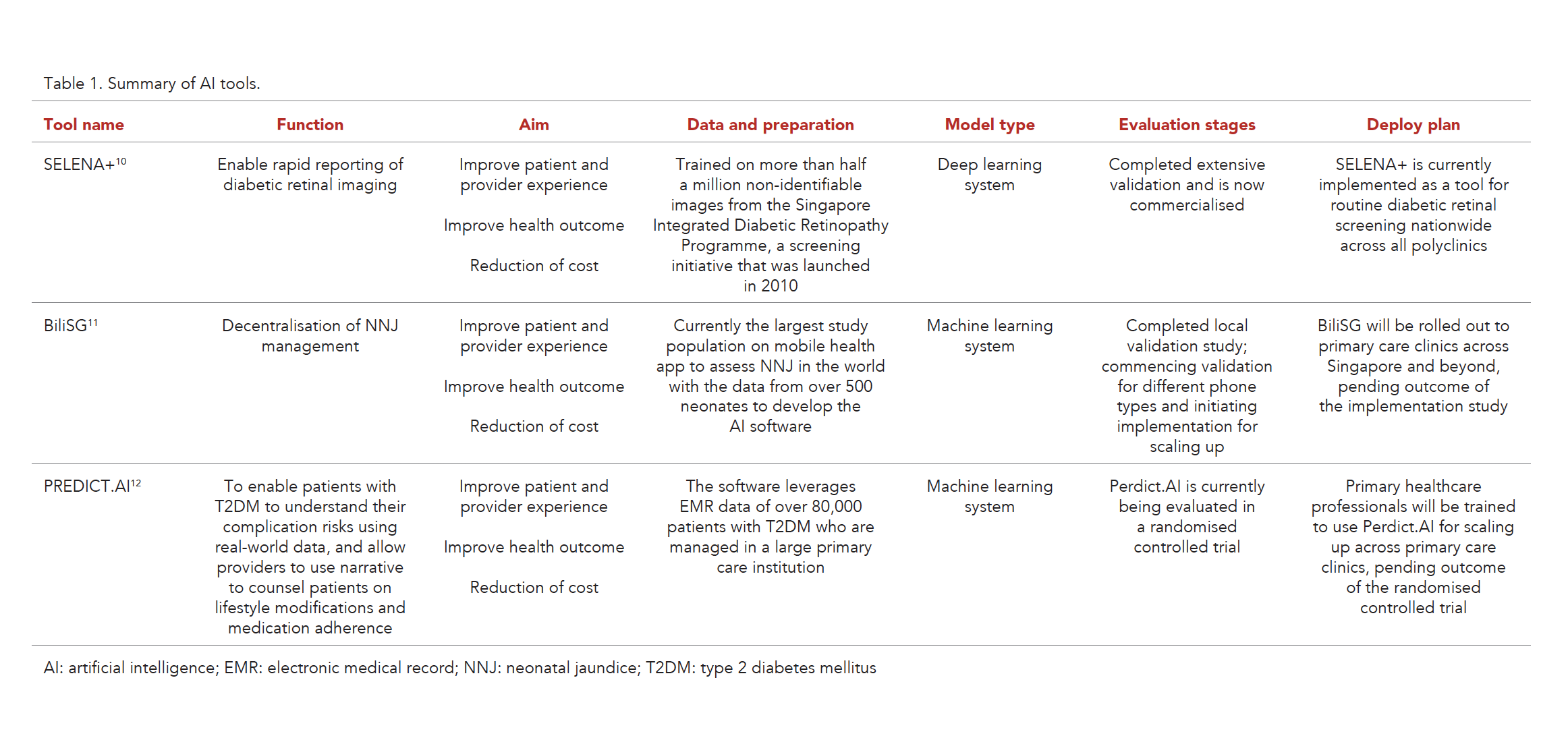
Neonatal jaundice (NNJ), which can cause severe cerebral damage from kernicterus in infants, is commonly evaluated in primary care facilities. BiliSG, an AI-enabled smartphone-based application, has been developed and validated to assess NNJ.13 It aims to decentralise NNJ management for its assessment by parents conveniently at home (Table 1).
Millions of in-person consultations were completed annually in primary care, generating huge volumes of patients’ clinical, prescription, laboratory and imaging data to create risk stratification or predictive models using ML and deep learning. PERDICT.AI is a software that enables primary care professionals (PCPs) to quickly identify high-risk patients with poor diabetic control, recommend medications based on real-world effectiveness data, discuss person-centric lifestyle modifications, and facilitate shared medical decision-making.14 It is currently being evaluated in a randomised controlled trial. The intention is to adopt it as an additional tool to personalise diabetes care in the community (Table 1), which aligns with the recommendations of the Health Foundation in the UK, on harnessing AI potential in clinical practice.15
Enhancing care experience
Long wait times and limited accessibility are common barriers in primary care. AI-powered tools can improve access by streamlining remote appointment scheduling, diagnostics, and follow-ups through AI-chatbots.16 These tools relieve mundane tasks such as answering frequently asked questions like operating hours and service costs, while AI chatbots provide intuitive and personalised responses, accommodating diverse text constructs, sequencing and languages, including voice annotations. These tools empower patients and the public to access timely, affordable healthcare services efficiently.
Virtual health assistants (VHAs) are AI tools that triage and identify individuals’ care needs and direct them to appropriate providers for timely management.16 With their personalisation and portability, VHAs also serve as patient companions, fostering continuity of care and empowering self-efficacy through knowledge sharing and positive motivation. These VHAs offer tailored, easy-to-understand information about specific conditions, actionable care plans, and guidance towards health goals, allowing users to address concerns on demand. Currently, these VHAs are being evaluated for the acceptance, utility, safety and effectiveness in disease management by target users.
Reducing healthcare per-capita cost
Chronic diseases are lifelong conditions requiring regular monitoring to maintain disease control and prevent complications. With their increasing prevalence in an ageing population, episodic in-person medical reviews will place increasing strain on the healthcare system. Remote telemonitoring, where patients use reliable, licensed devices to track clinical parameters and transmit data to their healthcare providers, ensures continuity of care in between clinician-patient interactions. Real-time analysis of telemonitoring data using AI can detect abnormal trends, identify at-risk individuals for timely interventions, and address defaulters.17 AI tools further enhance telemedicine by optimising operational efficiency, reducing no-shows, managing medication supply and demand, and enabling agile deployment of trained telehealth professionals. On a per-patient basis, AI is expected to be cost-efficient, offering scalable solutions to mitigate rising shortage in healthcare manpower.
Boosting healthcare workers’ well-being
During in-person consultations, AI-enabled ambient dictation technology is used in automated voice-to-text transcription, seamlessly documenting clinical notes into EMR systems.18 These digital scribes alleviate PCPs from time-consuming documentation, allowing them to focus on face-to-face interactions with patients, fostering rapport and enhancing clinician-patient relationships. Auditing the transcripts generated by these scribes requires effort, but it also creates an opportunity for PCPs to reflect on their prior patient interaction and care delivery and, if necessary, take remedial measures to address any missteps or lapses. Hence, allowing AI tools to replace repetitive manual tasks without compromising care provision and job security, which can improve staff morale and well-being, both physically and psychologically. These tools free up valuable time, enabling PCPs to spend more time with their families or pursue training for higher-value roles, enhancing their career growth and work-life balance. However, the non-deterministic nature of generative AI can introduce hallucinated or inaccurate content, which poses downstream risks to clinical decision-making. Hallucination can be mitigated through the careful use of guardrails, such as precise prompt engineering, retrieval-augmented generation and clinical finetuning. Therefore, robust validation and clinical studies are essential to select the appropriate AI solutions to ensure safety, minimise verification burden and support responsible adoption.15
AI is transforming learning beyond traditional rote memorisation. AI-powered platforms, trained on extensive knowledge corpus from textbooks and medical journals, provide deep insights across a wide range of specialties.19 Instead of spending hours combing through books and papers, PCPs can now access precise, real-time answers and the latest updates through natural language platforms. Moreover, AI streamlines medical literature search and review, enabling quick access to relevant journal articles. As an e-learning companion, AI adapts to the nuances of various medical topics and personalises the learning experience, teaching PCPs intuitively and effectively to enhance their understanding and application of medical knowledge.
Transforming primary care using AI: Steps ahead
The transition to an AI-powered primary care practice requires a phased approach that integrates advanced technologies while ensuring quality care and regulatory compliance. The process begins with a comprehensive technology audit, reviewing existing systems, such as EMRs, billing software and telemedicine platforms to identify areas compatible with AI-solutions. Simultaneously, workflow and system interoperability analyses are critical to achieving seamless integration of AI tools into the practice’s operations. Since many AI solutions are cloud-based, robust cybersecurity measures must be implemented to safeguard sensitive health data and prevent tampering, ensuring secure and scalable data storage systems that uphold patient confidentiality and trust.
Engaging stakeholders early to gather feedback is crucial to identify pain points within the system and prioritise areas where AI can add value. Healthcare leaders’ support is vital for end-to-end AI implementation in clinical practice.20 The leaders must understand the various AI systems, proactively integrating or modifying existing work routines and processes, and reviewing its deployment progress using efficiency, safety and access metric-indicators.20
Equally important is training staff, including PCPs and administrators, to elevate their AI literacy.21 PCPs need to understand that AI is designed to assist, not replace their work. Emphasising human-AI collaboration in clinical practice can help reduce adoption resistance. PCPs should receive regular updates on emerging capabilities and new applications to stay informed and keep up with rapid AI advancements.21,22 Their capacity for innovative AI adoption should be considered a key attribute when hiring in the healthcare industry.
Patients and the public are also key stakeholders in AI adoption.23 Ensuring that AI solutions are explainable fosters transparency, builds confidence and promotes wider acceptance in the community. Engaging the community through forums, continuing medical education and community platforms allows PCPs and institutional leaders to demonstrate how AI can enhance care and decision-making, debunk misconceptions, address concerns and set realistic expectations for its role in primary care.24
AI implementation in healthcare has its challenges. Algorithmic bias can lead to disparities in patient outcomes, while data privacy and cybersecurity risks raise concerns about the security of sensitive medical information. Clinician resistance, often driven by trust issues and workflow disruptions, can hinder adoption. Rigorous validation is essential to ensure AI systems are accurate, reliable and aligned with clinical standards.25 Addressing these challenges eases the responsible and effective integration of AI into healthcare.26
AI in primary care will evolve as developers translate innovative ideas into novel applications. Collaborating with AI solution providers and medical technology companies to co-create and adopt cutting-edge solutions is essential to stay ahead of the curve.27 Partnering governmental policymakers and insurance providers to conduct cost-effectiveness analyses of AI interventions and care models will ensure fiscal sustainability for an AI-driven primary healthcare ecosystem.28 Establishing AI-specific performance metric-indicators, such as patient outcomes, operational efficiency and employee satisfaction, is equally critical.29 Regular audits of AI tools and systems, guided by AI engineers, experts and ethicists, minimise bias and ensure ethical use.30
Primary care in Singapore is currently at the crossroads of AI transformation. Upskilling AI-trained PCPs and addressing AI fallacies improve implementation outcomes, mitigates bias risk and expedites quadruple aim achievement.
References
- Bodenheimer T, Sinsky C. From triple to quadruple aim: care of the patient requires care of the provider. Ann Fam Med 2014;12:573-6.
- World Health Organization. Health workforce. https://www.who.int/health-topics/health-workforce#tab=tab_1. Accessed 22 April 2025.
- What is artificial intelligence in Medicine? https://www.ibm.com/think/topics/artificial-intelligence. Accessed 11 January 2025.
- Rahman A, Debnath T, Kundu D, et al. Machine learning and deep learning-based approach in smart healthcare: Recent advances, applications, challenges and opportunities. AIMS Public Health 2024;11:58-109.
- Jeon W, Ko G, Lee J, et al. Chapter Six – Deep learning with GPUs. In: Kim S, Deka GC, (Eds). Advances in Computers. Amsterdam: Elsevier; 2021.
- Smart Nation Singapore. National AI Strategy. https://www.smartnation.gov.sg/nais/. Accessed 16 March 2025.
- Malhotra R, Bautista MAC, Müller AM, et al. The Aging of a Young Nation: Population Aging in Singapore. Gerontologist 2019;59:401-10.
- The Health Foundation. Priorities for an AI in health care strategy https://www.health.org.uk/reports-and-analysis/briefings/priorities-for-an-ai-in-health-care-strategy. Accessed 16 January 2025.
- Gunasekeran DV, Miller S, Hsu W, et al. National Use of Artificial Intelligence for Eye Screening in Singapore. NEJM AI 2024;1-8.
- Singapore National Eye Centre. New AI software speeds up detection of diabetic eye disease. https://www.snec.com.sg/about-us/corporate-profile/Documents/SV-Articles/2020/Issue1/21-SPOTLIGHT-New%20AI%20software%20speeds%20up%20detection%20of%20diabetic%20eye%20disease.pdf. Accessed 22 April 2025.
- com.sg. BiliSG: Bringing neonatal jaundice screening to a smart phone near you. http://www.singhealth.com.sg/news/shp-pop/we-advance-bilisg-bringing-neonatal-jaundice-screening-to-a-smartphone-near-you-. Accessed 22 April 2025.
- AI Singapore. Personalized Diabetes, hypertension, hyperLipidimia (DHL) Counselling Tool using AI (PERDICT.AI). https://aisingapore.org/tech-offers/personalized-diabetes-hypertension-hyperlipidimia-dhl-counselling-tool-using-ai-perdict-ai/. Accessed 22 April 2025.
- Ngeow AJH, Moosa AS, Tan MG, et al. Development and Validation of a Smartphone Application for Neonatal Jaundice Screening. JAMA Netw Open 2024;7:e2450260.
- Personalized Diabetes, hypertension, hyperLipidimia (DHL) Counselling Tool using AI (PERDICT.AI). https://aisingapore.org/tech-offers/personalized-diabetes-hypertension-hyperlipidimia-dhl-counselling-tool-using-ai-perdict-ai/ Accessed on 11 Jan 2025
- The Health Foundation. Harnessing the potential of automation and AI in health care. https://www.health.org.uk/features-and-opinion/blogs/harnessing-the-potential-of-automation-and-ai-in-health-care. Accessed on 22 April 2025.
- Maher C, Singh B, Wylde A, et al. Virtual health assistants: a grand challenge in health communications and behavior change. Front Digit Health 2024;6:1418695.
- Tan SHX, Ang SB, Tan NC, et al. Cost-Effectiveness of a Home Telemonitoring System for Asian Adults with Type 2 Diabetes Mellitus. Telemed J E Health. 2024;30:2353-62.
- Seth P, Carretas R, Rudzicz F. The Utility and Implications of Ambient Scribes in Primary Care. JMIR AI 2024;3:e57673.
- Mir MM, Mir GM, Raina NT, et al. Application of Artificial Intelligence in Medical Education: Current Scenario and Future Perspectives. J Adv Med Educ Prof 2023;11:133-40.
- Petersson L, Larsson I, Nygren JM, et al. Challenges to implementing artificial intelligence in healthcare: a qualitative interview study with healthcare leaders in Sweden. BMC Health Serv Res 2022;22:850.
- Liaw W, Kueper JK, Lin S, et al. Competencies for the Use of Artificial Intelligence in Primary Care. Ann Fam Med 2022;20:559-63.
- Kueper JK, Terry A, Bahniwal R, et al. Connecting artificial intelligence and primary care challenges: findings from a multi stakeholder collaborative consultation. BMJ Health Care Inform 2022;29:e100493.
- Adus S, Macklin J, Pinto A. Exploring patient perspectives on how they can and should be engaged in the development of artificial intelligence (AI) applications in health care. BMC Health Serv Res 2023;23:1163.
- Allen MR, Webb S, Mandvi A, et al. Navigating the doctor-patient-AI relationship – a mixed-methods study of physician attitudes toward artificial intelligence in primary care. BMC Prim Care 2024;25:42.
- Bracken A, Reilly C, Feeley A, et al. Artificial Intelligence (AI) – Powered Documentation Systems in Healthcare: A Systematic Review. J Med Syst 2025;49:28.
- Li YH, Li YL, Wei MY, et al. Innovation and challenges of artificial intelligence technology in personalized healthcare. Sci Rep 2024;14:18994.
- Young SA. AI in healthcare startups and special challenges. Intelligent Based Med 2022;6:100050.
- Ramezani M, Takian A, Bakhtiari A, et al. The application of artificial intelligence in health financing: a scoping review. Cost Eff Resour Alloc 2023;21:83.
- Andersen ES, Birk-Korch JB, Hansen RS, et al. Monitoring performance of clinical artificial intelligence in health care: a scoping review. JBI Evid Synth 2024;22:2423-46.
- Esmaeilzadeh P. Use of AI-based tools for healthcare purposes: a survey study from consumers’ perspectives. BMC Med Inform Decis Mak 2020;20:170.
Not applicable
The author(s) declare there are no affiliations with or involvement in any organisation or entity with any financial interest in the subject matter or materials discussed in this manuscript.
Clinical A/Prof Tan Ngiap Chuan, 165, Jalan Bukit Merah, Connection One, Tower 5. #15-10, Singapore 150165. Email: [email protected]
