ABSTRACT
Introduction: Prehabilitation—the process of preparing patients for surgical stressors—plays a pivotal role in improving postoperative recovery. At Sengkang General Hospital in Singapore, the SUrgical PREhabilitation for coMprehensive Enhanced recovery (SUPREME) programme utilises a multimodal approach to optimise patients’ health and comorbidities before major operations. This study evaluates SUPREME using the Reach, Effectiveness, Adoption, Implementation, Maintenance framework.
Methods: A mixed-methods design was utilised. Qualitative data were gathered through semi-structured interviews with key stakeholders (doctors, patient coordinators, dietitians, physiotherapists, and caregivers). These were supplemented by quantitative audit data, including enrolment data and patient-reported health-related quality of life measured with the EuroQol 5-Dimension 5-Level (EQ-5D-5L) index.
Results: Implementation demonstrated progressive departmental adoption, with 1082 patients enrolled between August 2022 and November 2025. Enrolment increased from 496 patients during the first 24 months to 586 over the subsequent 16 months. More than 900 patients completed surgery and were successfully discharged. Stakeholders reported strong belief in programme utility. Quantitative data showed significantly higher EQ-5D-5L scores at 3 months (mean difference +0.037, P=0.001) and 6 months (mean difference +0.036, P=0.006) compared with baseline. Dedicated patient coordinators played a key role in centralising scheduling and minimising logistical burden, supporting programme implementation.
Conclusion: SUPREME demonstrated strong stakeholder support, progressive adoption, and favourable patient-reported health-related quality-of-life outcomes, supported by regular audits to guide workflow improvements. Future efforts should focus on personalising interventions and strengthening communication among stakeholders. SUPREME provides a scalable model for healthcare institutions seeking to integrate prehabilitation into routine surgical care.
CLINICAL IMPACT
What is New
- This study evaluates the implementation of a coordinator-led, multimodal surgical prehabilitation programme using the Reach, Effectiveness, Adoption, Implementation, Maintenance, or RE-AIM, framework, demonstrating progressive departmental adoption and increasing enrolment.
- Dedicated patient coordinators streamlined scheduling, facilitated inter-departmental collaboration, and reduced logistical burdens for healthcare professionals and caregivers.
Clinical implications
- SUPREME was associated with significantly improved health-related quality of life at 3 and 6 months postoperatively compared with baseline, supporting the potential benefits of multimodal prehabilitation.
- The programme offers a scalable model for healthcare institutions seeking to integrate prehabilitation into routine surgical care, with future efforts focusing on personalised interventions and enhanced stakeholder communication.
As practitioners strive to improve surgical outcomes, a new piece of the puzzle has come into view—prehabilitation, the process of optimising patients prior to surgery to reduce complications and enhance recovery. Surgical stressors such as hypermetabolism and immobility contribute significantly to postoperative morbidity,1 especially in patients with sarcopenia,2,3 defined by the Asian Working Group for Sarcopenia (AWGS) 2014 consensus as “age-related loss of muscle mass, plus low muscle strength, and/or low physical performance.”4
Since 2018, multimodal prehabilitation has been a key service provided by Sengkang General Hospital (SKH), Singapore. In August 2022, the SKH prehabilitation programme broadened its reach from patients above 70 years of age to individuals of all ages with sarcopenia diagnosed based on the AWGS 2019 criteria,5 with this change being marked by the formalisation of the SUrgical PREhabilitation for coMprehensive Enhanced recovery (SUPREME) programme (hereafter referred to as SUPREME).6 This amendment of SUPREME’s inclusion criteria was a strategic move given the higher-than-global prevalence of sarcopenia in Singapore, particularly among older adults,7 as well as its close association with increased postoperative complications and prolonged hospital stays.8,9
Beginning with patients treated by SKH’s colorectal service, SUPREME has since expanded into other surgical departments, most recently the orthopaedic surgery department in August 2024. However, translating knowledge into the establishment of a new service can be challenging and requires effective implementation to be successful. SUPREME relies on the synergy of many moving parts: coordinators who first engage with patients and plan appointments; dietitians and physiotherapists who empower patients to improve various domains of health; doctors who treat suitable patients; and the caregivers and patients themselves. This quality improvement project evaluated the implementation of SUPREME using implementation science principles, specifically the Reach, Effectiveness, Adoption, Implementation, Maintenance (RE-AIM) framework. The authors seek to highlight existing strengths and weaknesses in the current programme, to guide future improvements in SKH and provide insight for other institutions on similar journeys of implementing prehabilitation programmes.
METHODS
The implementation of SUPREME was evaluated using the RE-AIM framework.10 RE-AIM evaluates programmes on 5 domains: Reach, the number, proportion and representativeness of patients enrolled; Effectiveness, the impact of SUPREME on patient outcomes; Adoption, the integration of SUPREME with departments and workflows; Implementation, the consistency and quality of programme delivery; and Maintenance, the likelihood that SUPREME will continue as a programme.
Semi-structured interviews with a mixture of open- and closed-ended questions tailored to different stakeholders were designed to address each RE-AIM domain. This format allowed for follow-up questions based on participants’ responses. The complete structure is provided in the Supplementary materials Appendix S1.
Two independent authors who were not involved in the conceptualisation and execution of SUPREME conducted 30-minute video interviews with stakeholders including dietitians, physiotherapists, doctors, patient coordinators, and patient caregivers. Transcripts were made with participants’ consent and analysed with a senior author trained in implementation science.
From the interview responses, a thematic analysis was performed to identify common threads in responses and draw conclusions on the programme’s strengths, areas for improvement, enablers, and barriers. Quantitative evaluation included data from the October 2025 audit and patients’ health-related quality of life (HRQoL) measured with the EuroQol 5-Dimension 5-Level (EQ-5D-5L) index. HRQoL was assessed preoperatively, and 1, 3, and 6 months postoperatively; utility scores were produced ranging from 0 (signifying death) to 1 (signifying full health). Data were collected opportunistically at follow-up appointments. EQ-5D-5L scores were analysed using a linear mixed-effects model with Bonferroni correction for repeated measures. Wilcoxon signed-rank tests were performed as sensitivity analysis given the non-normal distributions of EQ-5D-5L scores; missing data were not imputed.
Programme design
SUPREME operates on the basis of a single-point care coordination model: a trained, non-medical staff member oversees the execution of a standardised protocol. Centralised scheduling reduces logistical friction, supporting patient adherence to preoperative optimisation. Furthermore, reducing the administrative burden on healthcare professionals allows them to focus on providing clinical care. This translates into enhanced functional reserves prior to surgery, which may contribute to postoperative recovery and better patient outcomes.
SUPREME consists of sarcopenia prehabilitation, comorbidity management, and iron/vitamin D supplementation (Fig. 1). Sarcopenic patients go through multimodal prehabilitation involving physiotherapist and dietitian consultations where personalised exercise and nutritional plans are made based on physical capacity and motivation levels. The implementation logic model detailing its inputs, strategies, mechanisms and outcomes can be found in Supplementary Fig. S1.
Fig. 1. The SUPREME programme workflow.
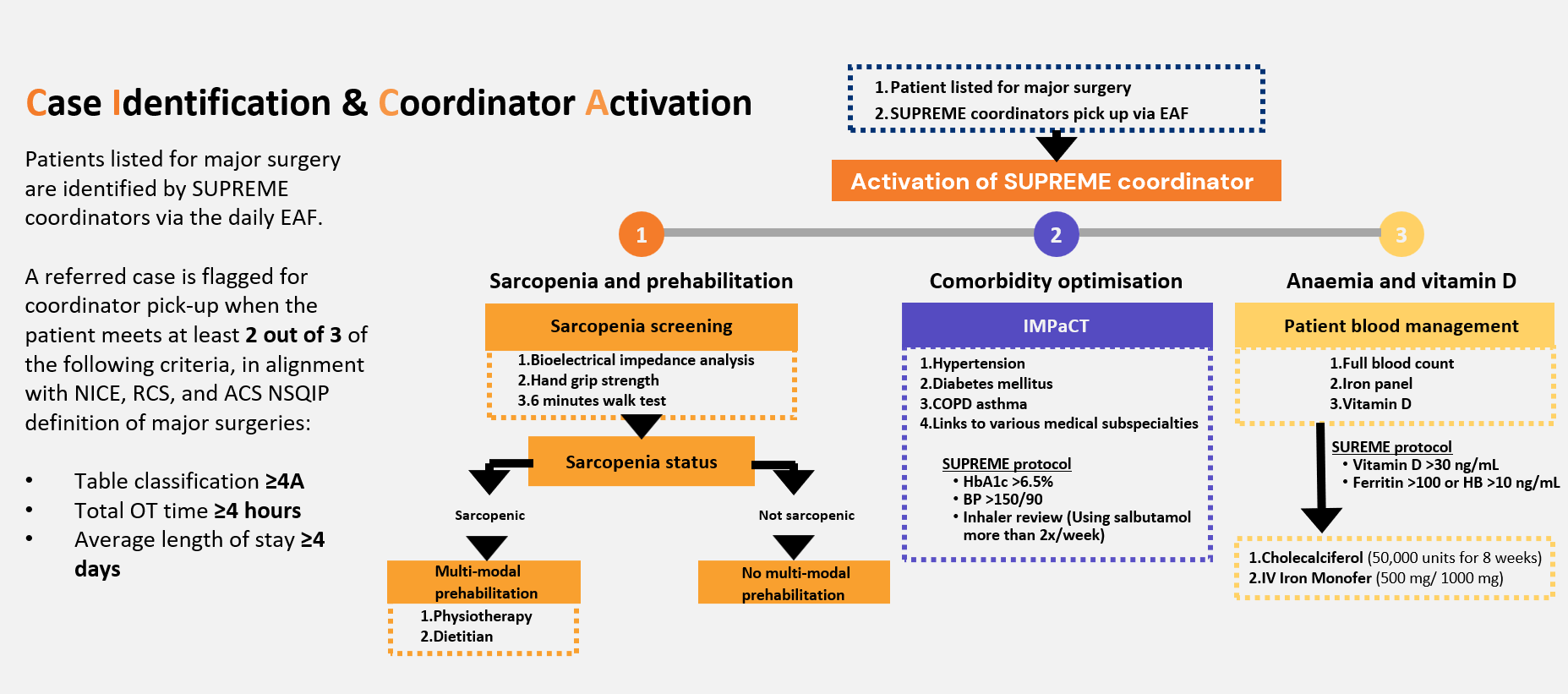
ACS: American College of Surgeons; BP: blood pressure; COPD: chronic obstructive pulmonary disease; EAF: Electronic Admission Form; HB: haemoglobin; HbA1c: haemoglobin A1C; IMPaCT: Internal Medicine Perioperative Collaborative Team; IV: intravenous; OT: operating theatre; NICE: National Institute for Health and Care Excellence; NSQIP: National Surgical Quality Improvement Program; RCS: Royal College of Surgeons; SUPREME: SUrgical PREhabilitation for coMprehensive Enhanced recovery Monofer (Wasserburger Arzneimittelwerk GmbH, Germany).
RESULTS
Reach
Since its inception in 2022, SUPREME has screened over 1000 patients scheduled for major surgeries, with over 900 successfully discharged post-surgery. The remainder include patients who did not undergo surgery, for reasons including cancellations and no-shows. SUPREME utilises an active enrolment system driven by standardised guidelines. A 4-4-4 mnemonic is used to assess eligibility, with patients required to fulfil at least 2 of the 3 following criteria: Table of Surgical Procedures code ≥4A, total operating theatre time ≥4 hours, and average length of stay ≥4 days. Automated pop-up reminders for unreferred eligible patients safeguard against missed referrals. Programme leads hold quarterly meetings to review enrolment rates and workflows, enabling the timely identification of gaps. SUPREME has also been adopted by more surgical departments with consequent increases in patient enrolment. These factors indicate good potential for further expansion.
However, improvements are needed in information dissemination to stakeholders. For instance, some junior doctors responsible for providing referrals have inadequate awareness of the programme. A patient coordinator highlighted that the frequent rotation of doctors between departments complicates sharing of information. Efforts to address this include induction slides detailing SUPREME’s workflow, with an emphasis on their specific actionables (Fig. 2).
Fig. 2. Examples of induction education materials for doctors referring to the SUPREME programme.
SUPREME: SUrgical PREhabilitation for coMprehensive Enhanced recovery
Second, programme enrolment is reduced when surgeons opt to expedite surgery despite the evidence for prehabilitation in improving postoperative outcomes. As a physiotherapist noted, although the programme’s benefits are discussed in meetings, this information “don’t get to the doctors on the ground as only [an] administrator is there,” potentially limiting doctors’ inclination to refer patients for prehabilitation.
Patient characteristics are summarised in Table 1. From the October 2025 audit, 44.2% of patients required iron infusion, 21.2% required vitamin D replacement, 31.0% required comorbidity optimisation, and 15.4% were sarcopenic. Median duration of prehabilitation was 31 days (interquartile range 38). There was no oncological upstaging and no patients transitioned from operable to inoperable during the prehabilitation period.
Table 1. Patient characteristics (n=1083).
|
Domain |
Requirement |
Prevalence |
|
Iron deficiency |
Hb <10 g/dL or Ferritin <100 μg/L |
44.2% |
|
Vitamin D deficiency |
Vitamin D level <30 μg/L |
21.2% |
|
Comorbidity optimisation |
BP >150/90, or HbA1c >6.5%, or salbutamol use more than twice a week |
31.0% |
|
Sarcopenia |
BIA score: <7 (males), <5.7 (females), or hand grip strength: <28 kg (males), <18 kg (females), or gait speed: <1 m/s |
15.4% |
BIA: bioelectrical impedance analysis
Effectiveness
Stakeholders perceived that SUPREME’s multimodal approach contributed to better patient outcomes, including reduced length of hospital stay and preserved patient-reported quality of life. This is supported by audit data. From programme inception in 2022 to July 2024, the proportion of patients with a length of stay less than 7 days was 55.1%. From August 2024 to November 2025, this increased to 69.2%. This suggests a growing proportion of patients with earlier discharge as the programme matured (Table 2). As of October 2025, the postoperative complication rate was 11.3% (103/914), the 30-day readmission rate was 8.8% (80/914), and the 30-day mortality rate was 1.0% (9/914).
Table 2. Postoperative LOS among patients in the SUPREME programme from inception to July 2024 versus August 2024 to November 2025.
|
Inception to July 2024 |
August 2024 to November 2025 |
||
|
LOS <7 days, no. (%) |
LOS ≥7 days, no. (%) |
LOS <7 days, no. (%) |
LOS ≥7 days, no. (%) |
|
226 (55.1) |
184 (44.9) |
339 (69.2) |
151 (30.8) |
LOS: length of stay; SUPREME: SUrgical PREhabilitation for coMprehensive Enhanced recovery
EQ-5D-5L scores improved over time following SUPREME prehabilitation and surgery (F(3, 777.5)=5.25, P=0.001). At 1 month postoperatively, scores had returned to baseline (mean difference +0.013, P=0.838). At 3 months, scores were higher than baseline (mean difference +0.037, 95% confidence interval [CI] +0.012 to +0.062, P=0.001). This was sustained at 6 months (mean difference +0.036, 95% CI +0.008 to +0.065, P=0.006) (Table 3). These findings were corroborated by Wilcoxon signed-rank tests in paired completers (3 months: P=0.0004; 6 months: P=0.018) (Table 4).
Table 3. Health-related quality of life scores measured with EuroQol 5-Dimension 5-Level.
|
Timepoint |
n |
Mean (SD) |
Adjusted mean |
95% CI |
Change from baseline |
P valuea |
|
Baseline |
577 |
0.862 (0.173) |
0.859 |
0.845-0.873 |
— |
— |
|
1 month |
197 |
0.880 (0.196) |
0.872 |
0.850-0.893 |
+0.013 |
0.838 |
|
3 months |
287 |
0.902 (0.136) |
0.896 |
0.877–0.915 |
+0.037 |
0.001 |
|
6 months |
220 |
0.899 (0.164) |
0.895 |
0.874–0.917 |
+0.036 |
0.006 |
CI: confidence interval; SD: standard deviationa Bonferroni-corrected pairwise comparisons versus baseline from linear mixed-effects model (F(3, 777.5)=5.25, P=0.001 for overall time effect). Values in bold are statistically significant.
Table 4. Sensitivity analysis: Wilcoxon signed-rank test (paired completers).
|
Comparison |
n (pairs) |
Median change |
W statistic |
P value |
|
1 month vs baseline |
191 |
+0.000 |
5129.5 |
0.165 |
|
3 months vs baseline |
194 |
+0.038 |
4469.5 |
0.0004 |
|
6 months vs baseline |
119 |
+0.028 |
1758.5 |
0.018 |
vs: versus Values in bold are statistically significant.
The programme was also perceived to empower patients to take greater ownership of their health beyond the perioperative period. As one caregiver shared, “[my] father was not fully aware of how nutrition and exercise are critical to postoperative recovery, and having healthcare professionals explain it helped him understand. So now he’s more keen to exercise.”
Nonetheless, some stakeholders expressed their wishes for a longer prehabilitative period to allow more time for interventions to achieve their intended effects. As a physiotherapist shared, “Some patients require a longer runway but surgery cannot be pushed back further. We often tell our patients that it takes 4–6 weeks before muscle changes can be seen, even in healthy adults. If prehabilitation is only 3 weeks long, it makes things more difficult.” Where clinically appropriate, more consideration can be made to allow more time for prehabilitation before elective surgery, when the benefits of prehabilitation may outweigh the benefits of an earlier operation date.
Adoption
SUPREME has been adopted by an increasing proportion of surgical departments beyond the colorectal service. Of 12 specialties with operated patients meeting the 4-4-4 criteria, 8 have adopted SUPREME (adoption rate: 66.7%).
The onboarding timeline for the specialties are outlined below. The dates indicate when each specialty began participating in SUPREME for eligible patients undergoing surgery within that specialty.
- August 2022: colorectal surgery
- September 2022: upper gastrointestinal, hepatopancreaticobiliary surgery
- February 2023: breast reconstructive surgery, plastic surgery
- August 2023: otorhinolaryngology, urology
- August 2024: orthopaedics (department-wide adoption)
This demonstrates clinicians’ increasing acceptance of the programme and growing institutional support. In addition, dedicated staff have integrated SUPREME into routine workflows to reduce scheduling frictions. As a patient coordinator stated, they “schedule coordinator appointments alongside the pre-op[erative] assessments, like the anaesthetist appointment.” Health professionals have also expressed strong consensus regarding its benefits, with a physiotherapist noting that most patients enrolled “are motivated more than the usual patient and understand the implications of surgery.” These positive perceptions contribute to programme adoption and integration into workflows.
Several stakeholders noted resource and staffing constraints as potential barriers to wider adoption. In response, programme leads have expanded the patient coordinator team from 1 to 4 members. However, departments such as dietetics still face staffing shortages. Unless staffing levels are increased, they may face challenges in keeping pace with programme expansion.
Implementation
The presence of patient coordinators in SUPREME was appreciated by various stakeholders. For caregivers, the coordinator served as the starting point to explain the programme’s importance and lay out next steps. For allied health professionals, the coordinator alleviated their administrative burden, allowing them to focus on the patients’ prehabilitation journeys. In terms of implementation efficiency, 69% of patients (n=1083) scheduled for surgery within a month received their preoperative evaluation clinic appointment within 7 days of listing.
Adherence rates were generally high. A 2024 study of the same multimodal prehabilitation programme reported 83% adherence to the nutritional supplementation prescribed.11 However, it was observed that caregivers tend to under-appreciate the importance of postoperative follow-ups, with an interviewee expressing they were “not sure why patients need[ed] to go down [for a SUPREME-related appointment] after surgery.” Clearer explanations regarding prehabilitation targets, costs, and appointments could improve participation.
Inter-department communication should also be enhanced. Stakeholders shared their desire for more frequent meetings to brainstorm new ideas and troubleshoot existing problems. A physiotherapist shared, “SUPREME can conduct more frequent reviews to look at other outcome measures and explore the possibility of other professionals coming in on a larger scale, for example, by increasing the involvement of psychologists and geriatricians. Having more platforms to discuss changes would also be good, such as Teams [Microsoft Corporation].” Furthermore, some stakeholders requested more regular updates on SUPREME’s progress. This would enhance team morale by demonstrating their impact on patient care, motivating them to take ownership of the programme.
Maintenance
Stakeholders are generally confident in SUPREME’s sustainability. The programme has been integrated into existing workflows, which suggests favourable potential for continued success. Enrolment expanded significantly over time, rising from 496 patients enrolled from August 2022 to July 2024, to 586 patients enrolled in a shorter period from August 2024 to November 2025. The coordinator team has also grown from in 2018 to 4 in 2025 to manage the increasing workload. While the initial 2 coordinators were funded through research grants, they have been converted to permanent hospital staff since 2020, reflecting institutional support for the programme’s sustainability.
Programme leads provide annual updates to the hospital’s medical board and share successes with senior management, who continue their funding and advocacy in recognition of SUPREME’s value. This sustained support has allowed SUPREME to secure necessary resources and plan long-term.
However, barriers to sustainability include manpower constraints and flux, particularly among dietitians and administrative staff. Administrative turnover can create knowledge gaps about the programme and onboarding processes. Therefore, training in standard operating procedures and efforts to resolve staffing limitations are necessary.
DISCUSSION
Overall, SUPREME has demonstrated strong potential for continued expansion and refinement. Since its inception in 2022, the programme’s reach has exhibited an upward trend in patient enrolment and departmental participation. Healthcare staff and patients have expressed strong support for the programme and its perceived benefits, including improvements in postoperative recovery. Patient coordinators were also identified as key contributors to the programme’s success, by improving patient compliance and reducing the administrative load on healthcare providers. Furthermore, regular discussions with key personnel have helped to identify and tackle barriers to expansion. As Singapore’s population ages, SUPREME stands to play an increasing role in facilitating postoperative recovery of the frail and elderly, improving quality of life and mitigating healthcare costs. With strong institutional support and an established workflow, SUPREME has good potential for sustained growth.
Following SUPREME’s successful implementation, efforts should now focus on enhancing interventional efficacy and personalisation. Efforts are underway to improve sarcopenia diagnosis and treatment, including clinical trials such as DINOSAUR12 and HEROS,11 respectively.
Effectiveness
The data collected strongly suggest that SUPREME was associated with improved outcomes, including reduced length of hospital stay and preserved quality of life. Recent studies have shown that in groups with similar demographics, those who had received multimodal prehabilitation at Sengkang General Hospital enjoyed shorter hospital stays and improved median EQ-5D-5L scores,13,14 indicating better health-related quality of life across the dimensions assessed by the EQ-5D. However, as with most programmes, room for improvement exists.
First, the inclusion of more programme domains may benefit patients. For instance, the importance of preoperative psychological readiness has been spotlighted in recent years, with studies reporting an association between preoperative anxiety states and postoperative complications,15 and other Singapore prehabilitation programmes incorporating psychosocial support.16 SUPREME can thus consider conducting psychosocial screening and onboarding professionals accordingly. Additionally—and crucially with the addition of more specialties into SUPREME—the programme can become more customised to the type of surgery the patient is listed for. Various studies have supported this, from the use of respiratory muscle training before cardiac surgeries to synbiotic intake before elective abdominal surgeries.17,18 Trials are currently ongoing to this end, for instance to determine optimal vitamin D supplementation regimens based on patients’ needs.19 While personalisation may require collaborative efforts from different specialties, it will keep prehabilitative interventions both relevant and cost-effective.
Next, the programme’s effectiveness remains constrained by its limited duration. This is sometimes inevitable as certain surgeries cannot be postponed. In other cases, however, urgency may reflect surgeon or patient preference rather than a clear clinical benefit, highlighting the need for greater awareness of the potential benefits of prehabilitation. Efforts to maximise interventions during the programme duration can also be made. For instance, SKH physiotherapists are piloting the use of online applications like Rebee20 to remotely prescribe and track patients’ completion of exercise routines, thereby multiplying the effects of physiotherapy compared with in-person sessions alone. Simultaneously lengthening programme duration while innovating ways to boost programme efficiency would help patients maximise their prehabilitation journey.
Communication
Another aspect of SUPREME’s implementation frequently raised during the stakeholder interviews was communication, specifically interprofessional communication and the dissemination of information to patients and their caregivers.
Moving forward, interprofessional communication will be crucial to drive improvements in the programme. Programme leads have sought to keep stakeholders informed of the latest programme developments through bimonthly email updates. Nevertheless, stakeholders varied in their understanding of the programme, with some expressing a need for more channels of communication, and others potentially being inadvertently excluded from email correspondence. Barriers hampering interprofessional communication also include time constraints, differing schedules, and periodic manpower rotations. Solutions may include utilising existing platforms like Microsoft Teams to create group chats, allowing for 2-way communication without the pressure of scheduled meetings. SUPREME is also supported by dedicated patient coordinators who liaise with different departments and have a bird’s-eye, programme-wide perspective. They are well positioned to facilitate communication across stakeholders, keep relevant parties informed of programme developments, and consolidate feedback from frontline staff.
It is also paramount that any communication with patients and caregivers is clear and comprehensive. To reduce the effects of information overload, verbal communication should be supplemented with take-home infographics and online check-ins. Increasing awareness of SUPREME on a larger scale, such as by leveraging existing communication channels like email newsletters and screens displayed outside clinic waiting areas, might also reduce the inertia of patients enrolling in the programme.
Study limitations
As a single-centre evaluation, the stakeholder pool may not have captured all perspectives, such as multiple sources from the same specialty. This was mitigated through in-depth interviews to obtain comprehensive insights. Future studies could involve eligible patients or surgical departments that declined participation to better understand barriers to uptake. Stakeholder interviews may also be subject to recall or social desirability bias, potentially resulting in underreporting of programme shortcomings. Where possible, interview findings were triangulated with key programme metrics.
The absence of a control group precludes claims of causal effectiveness. Instead, the findings describe improvements over time rather than demonstrating programme effectiveness. EQ-5D-5L data were collected opportunistically during follow-up clinics. Missing data reflect missed appointments or patients declining participation rather than study dropouts, leading to fluctuating sample sizes. Missing data were not imputed, which could introduce attrition bias if missed patients had significantly different outcomes.
Uptake and adherence to each intervention component were not recorded, as this study focused primarily on implementation. Sustainability was analysed through programme expansion and institutional support rather than formal cost analyses. However, a dedicated health economic analysis is underway for a future publication.
CONCLUSION
Across all 5 domains of the RE-AIM framework, SUPREME has demonstrated favourable implementation, with key drivers being the central role of patient coordinators and regular audits. It is a robust model that prehabilitation programmes in other institutions can consider adopting. As SUPREME continues to expand in SKH and beyond, the programme should focus on enhancing intervention effectiveness and inter-stakeholder communication to maximise patient benefit.
Appendix S1. RE-AIM domains and interview questions.Fig. S1. The SUPREME programme implementation logic model.
REFERENCES
- Finnerty CC, Mabvuure NT, Ali A, et al. The surgically induced stress response. JPEN J Parenter Enteral Nutr 2013;37:21S-9S.
- Serati M, Cetin I, Athanasiou S. Recovery after surgery: do not forget to check iron status before. Int J Womens Health 2019;11:481-7.
- Knoedler S, Schliermann R, Knoedler L, et al. Impact of sarcopenia on outcomes in surgical patients: a systematic review and meta-analysis. Int J Surg 2023;109:4238-62.
- Chen LK, Liu LK, Woo J, et al. Sarcopenia in Asia: consensus report of the Asian Working Group for Sarcopenia. J Am Med Dir Assoc 2014;15:95-101.
- Chen LK, Woo J, Assantachai P, et al. Asian Working Group for Sarcopenia: 2019 Consensus Update on Sarcopenia Diagnosis and Treatment. J Am Med Dir Assoc 2020;21:300-307.e2.
- Sengkang General Hospital. Growing Old is Not Growing Feeble. SKH SKOOP Issue 15. https://www.skh.com.sg/about-skh/news/skoop/skoop-issue-15/growing-old-is-not-growing-feeble.newsdetails. Accessed 1 December 2025.
- Pang BWJ, Wee SL, Lau LK, et al. Prevalence and Associated Factors of Sarcopenia in Singaporean Adults-The Yishun Study. J Am Med Dir Assoc 2021;22:885.e1-885.e10.
- Yang Y, Sun M, Chen WM, et al. Adverse postoperative outcomes in elderly patients with sarcopenia. BMC Geriatr 2024;24:561.
- Wahlen BM, Mekkodathil A, Al-Thani H, et al. Impact of sarcopenia in trauma and surgical patient population: A literature review. Asian J Surg 2020;43:647-53.
- Glasgow RE, Vogt TM, Boles SM. Evaluating the public health impact of health promotion interventions: the RE-AIM framework. Am J Public Health 1999;89:1322-7.
- Koh FH, Yik V, Chin SE, et al. Evaluating the Impact of Multimodal Prehabilitation with High Protein Oral Nutritional Supplementation (HP ONS) with Beta-Hydroxy Beta-Methylbutyrate (HMB) on Sarcopenic Surgical Patients-Interim Analysis of the HEROS Study. Nutrients 2024;16:4351.
- Yik V, Kok SSX, Chean E, et al. Diagnosing Sarcopenia with AI-Aided Ultrasound (DINOSAUR)-A Pilot Study. Nutrients 2024;16:2768.
- Koh FH, Loh CH, Tan WJ, et al. Structured presurgery prehabilitation for aged patients undergoing elective surgery significantly improves surgical outcomes and reduces cost: A nonrandomized sequential comparative prospective cohort study. Nutr Clin Pract 2022;37:645-53.
- Rabin R, de Charro F. EQ-5D: a measure of health status from the EuroQol Group. Ann Med 2001;33:337-43.
- Rong Y, Hao Y, Wei D, et al. Association between preoperative anxiety states and postoperative complications in patients with esophageal cancer and COPD: a retrospective cohort study. BMC Cancer 2024;24:606.
- Pang NQ, He SS, Foo JQX, et al. Multimodal prehabilitation before major abdominal surgery: A retrospective study. Ann Acad Med Singap 2021;50:892-902.
- Cursino de Moura JF, Oliveira CB, Coelho Figueira Freire AP, et al. Preoperative respiratory muscle training reduces the risk of pulmonary complications and the length of hospital stay after cardiac surgery: a systematic review. J Physiother 2024;70:16-24.
- Chowdhury AH, Adiamah A, Kushairi A, et al. Perioperative Probiotics or Synbiotics in Adults Undergoing Elective Abdominal Surgery: A Systematic Review and Meta-analysis of Randomized Controlled Trials. Ann Surg 2020;271:1036-47.
- National Library of Medicine. Regime for Vitamin D Maintenance in Post-Operative Patients (D‑ECISIVE). ClinicalTrials.gov, identifier: NCT06708741. https://www.clinicaltrials.gov/study/NCT06708741. Accessed 8 December 2025.
- Rebee Health. For clinicians. https://www.rebeehealth.com/for-clinicians. Accessed 8 December 2025.
This study involved interviews with staff involved in the SUPREME programme and did not recruit patients or other clinical study participants. Informed consent was obtained from all interviewees for participation in the interviews and the use of their anonymised quotations in this paper. The Research Office of Sengkang General Hospital reviewed the study protocol and determined that an institutional review board application was not required (14 August 2025), as this quality improvement project evaluated the implementation of an existing programme and therefore did not fall within the purview of the SingHealth Centralised Institutional Review Board.
The research was funded by the SingHealth Duke-NUS Academic Medicine Research Grant Initiative FY2024: Special Category (HSR-HEARTS) - AM/HRT037/2024 (SRDUKAMR24H7). The funder had no role in the design and conduct of the study; collection, management, analysis, and interpretation of the data; preparation, review, or approval of the manuscript; and decision to submit the manuscript for publication. The authors declare that they have no affiliations with or involvement in any organisation or entity with any financial interest in the subject matter or materials discussed in this manuscript.
A/Prof Frederick H Koh, Colorectal Service, Department of General Surgery, Sengkang General Hospital, 110 Sengkang East Way, Singapore 544886. Email [email protected]
