

ABSTRACT
Modern clinical training is increasingly conducted in technology-rich environments supported by advanced diagnostics, automated systems, and structured workflows. These environments support efficient learning but may offer fewer opportunities for trainees to develop adaptive expertise, particularly when familiar resources, technologies, or processes are unavailable. Resource availability, however, exists on a spectrum, and even well-resourced systems can become stretched during pandemics, supply-chain disruptions, workforce shortages, or service overload. In such situations, clinicians need to prioritise, communicate clearly, reason with incomplete information, and adapt to changing conditions. For this reason, exposure to settings where resources are stretched, variable or constrained can complement modern training by strengthening clinical judgement, observation, teamwork and confidence in core clinical skills. Evidence on elective placements has described self-reported improvements in clinical examination skills, reduced reliance on extensive investigations and greater cultural awareness. However, such experiences must also be ethically and feasibly structured, with attention to host-institution needs, supervision, scope of practice, financing, and equity of access. Since external placements may not be available to all trainees, adaptive expertise should also be cultivated within existing training programmes through history-and-examination-first teaching, no-investigation case discussions, simulation under constraint and structured reflection. The aim is not to privilege 1 training environment over another, but to prepare clinicians to practise safely and thoughtfully across the full spectrum of resource availability by intentionally building adaptive expertise.
Modern clinical training frequently unfolds in hospitals filled with advanced tools, automated systems, digital platforms, and highly structured workflows. These settings are efficient and supportive, and they allow early-career clinicians (including students, medical officers, residents, and junior consultants) to learn with clarity and precision.1 Yet, this abundance can create an unspoken assumption that technology will always be available. This may limit opportunities to develop “adaptive expertise”—the capacity to balance efficient routine performance with flexible learning, problem reframing, and adjusted reasoning when familiar approaches, resources, or systems are insufficient.2,3 Many trainees in modern practice have never had to function without technology-enabled systems, familiar devices, complete equipment or full information. The belief that such tools are permanent becomes so ingrained that it goes unnoticed. What is often overlooked is that these systems are meant to support practice and not define it, and when clinicians train entirely in well-resourced settings, this distinction becomes less obvious. As a result, we may be inadvertently producing clinicians who are less prepared for uncertainty. Furthermore, formal curricula specifically teaching trainees and students about rationing, prioritisation, and adaptive decision-making remain limited.4-6
Adaptive expertise is essential whenever clinical practice moves away from ideal conditions. Even in routine practice, it enables clinicians to apply prior knowledge flexibly, understand why decisions work, and adjust their reasoning when faced with unfamiliar problems, limited resources, or disrupted systems.7 This is important because resource availability is not always uniform, even within the same country, region, or healthcare network. Well-resourced tertiary hospitals may coexist with smaller hospitals, rural facilities, crowded emergency departments, outreach services, or clinical situations where diagnostics, staffing, equipment, time, or supply chains are limited. This diversity is evident across Southeast Asia, where advanced tertiary centres, regional referral hospitals, rural facilities, and outreach services may operate within the same health system or regional ecosystem.8 Singapore, for example, has highly developed healthcare infrastructure but also functions as a regional referral and training hub within a diverse Southeast Asian healthcare landscape shaped by varying workforce, financing, geographic, and service-delivery constraints. The central issue here is whether clinical education prepares trainees to function across this spectrum. When trainees are educated and employed only within a single type of system, they may have limited opportunity to appreciate either the possibilities created by advanced infrastructure or the adaptations required when such support is unavailable. This is especially relevant for clinicians trained mainly in well-resourced environments, as adaptive expertise prepares them for sudden disruption when familiar systems, technologies or resources may become unavailable in unforeseen circumstances.
The value of constraint
Constraint is not limited to 1 type of healthcare setting. It may be seen in rural facilities, crowded emergency departments, outreach services, tertiary units during service overload, or during periods of supply-chain disruption. However, settings where resources are more visibly limited can make these constraints more explicit for trainees. In such environments, clinical work often depends more heavily on judgement, observation, hands-on skill, teamwork, and prioritisation. Trainees may learn to pause before ordering investigations, consider what information is truly necessary, and make decisions based on what is available and feasible. This does not mean that technology-rich settings lack uncertainty or that resource-constrained settings are educationally superior. Rather, each setting teaches a different part of clinical practice. Well-resourced environments show what advanced systems can provide, while constrained environments highlight how clinicians adapt when those supports are delayed, stretched, or unavailable. Exposure across this spectrum can therefore help trainees develop a more balanced understanding of clinical decision-making, where technology supports practice but does not replace clinical reasoning.
When systems are stretched
The COVID-19 pandemic reminded the world how quickly technology and supply chains can be disrupted.9 Many well-resourced centres had to function with reduced equipment availability, limited diagnostics, and unpredictable workflows. This did not just reflect poor planning, but also showed that even advanced healthcare systems remain vulnerable to global shocks. In such situations, clinicians may need to make decisions with incomplete information, prioritise resources, communicate clearly, and adapt when familiar systems are unavailable. This experience reinforces the need to prepare trainees for clinical practice beyond routine conditions. When systems are stretched, the ability to observe carefully, reason clinically, work within available resources and communicate effectively becomes especially important. These skills translate directly into well-resourced settings, where the pace may be faster but the need for clinical judgement, teamwork and situational awareness remains the same. Clinicians who have learnt to function when resources and technology are limited may also understand their value more deeply because they have experienced their absence.
Building clinical adaptability
Clinical exposure across different resource settings can be valuable for early-career clinicians. It can expand their perspective and show that healthcare is not a uniform experience, with real-world practice varying across locations, systems and circumstances.10,11 Training in settings where resources are stretched or constrained may prepare trainees to adapt when technology fails, when situations are unfamiliar or when unexpected challenges arise, and it can strengthen cultural competence.12 Students often pursue such experiences through electives in low- and middle-income countries, rural missions, community outreach programmes, and global health attachments.13 Such exposure does not replace modern education; rather, it can complement it by helping trainees develop resilience and confidence in core clinical skills. It can also help ground their adaptive expertise in lived experience rather than theoretical assumptions, allowing them to respond more practically when systems are stretched.
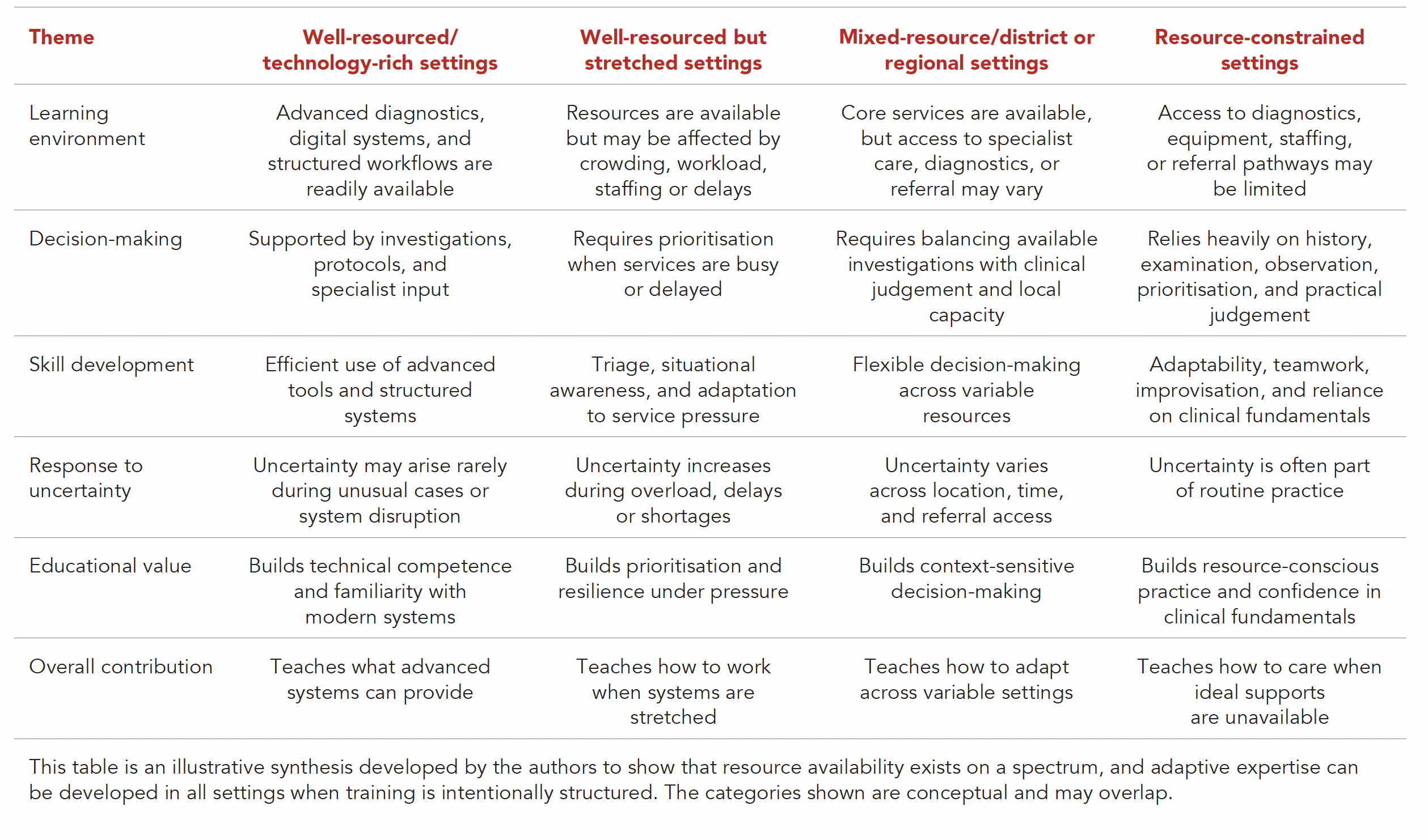
Multiple reports examining self-reported outcomes from elective participants showed improved clinical examination skills, reduced reliance on extensive investigations, enhanced cultural competence, greater ability to recognise diverse disease presentations and increased cost-consciousness in practice.14-16 These findings should be interpreted in light of the available evidence base, which relies largely on uncontrolled post-elective surveys with an attendant risk of selection and social desirability bias. Nevertheless, as healthcare grows more complex and uncertainty becomes the norm, these qualities remain important. However, the educational value of different settings should be understood as a spectrum rather than a simple contrast between well-resourced and resource-limited environments (Table 1). Such exposure across settings must also be ethically structured, as the educational value for visiting trainees should not come at the expense of host institutions, patients, or local learners.
Table 1. Clinical learning across a spectrum of resource availability.
Integrating adaptive expertise
Today, not every trainee has the opportunity to work across settings where resources are stretched, variable, or constrained. However, considering its importance, training for constraint should not be incidental, but a deliberate component of medical education. This requires moving beyond opportunistic exposure towards intentional curriculum design. Institutions, together with mentors and collaborators, can play an active role by establishing structured exchange programmes and partnerships, rather than leaving trainees to seek such experiences independently. In doing so, exposure to different resource settings can become a routine and supported part of training rather than an exception. However, such programmes require clear ethical guardrails.
Poorly structured placements may create unintended harm through inadequate supervision, work beyond the trainee’s competence, disruption of host services, unequal benefit, or additional supervisory burden on host institutions.17,18 Therefore, formal partnerships should not merely streamline access for trainees, but should be based on host-identified needs, appropriate supervision, clear scope of practice, informed consent where relevant, ethics oversight, trainee preparation, and structured reflection. Partnerships should also be bidirectional, so that learning and benefit flow both ways between participating institutions. This may include reciprocal training opportunities, where learners from resource-constrained settings also gain exposure to advanced technologies, specialist services and structured systems in well-resourced environments. The guidelines developed by the Working Group on Ethics Guidelines for Global Health Training provide useful principles for designing such programmes ethically, including mutual benefit, clear agreements between host and sending institutions, attention to host needs and costs, defined trainee roles, appropriate supervision, trainee preparation, safety, feedback, and periodic review.17 Subsequent work examining partner-organisation perspectives further reinforces the importance of matching trainee skills to host needs and ensuring that host institutions have a meaningful voice in programme design.18
Feasibility must also be considered before such programmes are implemented. Structured exposure across different resource settings requires clear planning for travel, accommodation, insurance, indemnity, visa and regulatory clearance, as well as clarity on scope of practice across jurisdictions. Host institutions may also require adequate supervisory capacity and appropriate support for the time spent orienting, supervising, and assessing visiting trainees.17 Programme design should also account for host-identified needs and ensure that trainee roles are matched to local priorities.18 To avoid making such experiences available only to trainees who can self-fund them, institutions should consider equitable funding models, bursaries or centrally supported placements. Therefore, implementation should involve not only educational planning, but also financing, governance, legal clarity, and equity of access.
In-house strategies to build adaptive expertise
While the above-mentioned strategies are being developed, adaptive expertise can also be deliberately introduced into routine training within any clinical setting. This may be the most immediately feasible approach for many institutions, including well-resourced training programmes, and is consistent with curriculum-design approaches that support the development of adaptive expertise.19 Practical strategies include history-and-examination-first teaching rounds, where trainees are asked to present an initial assessment and management plan before reviewing advanced investigations; “no-investigation” case discussions, where imaging, laboratory tests, or subspecialty input are temporarily withheld to encourage clinical reasoning; and simulation sessions in which familiar resources are deliberately made unavailable. For example, trainees can be asked to manage deterioration with limited monitoring, plan referral when transport is delayed, prioritise patients during service overload, or make decisions when diagnostic results are incomplete.
These exercises should be followed by structured debriefing that asks what assumptions were made, what resources were prioritised, what risks were accepted, and how decisions would change if additional support became available. Mentorship from clinicians with experience across different resource settings can further help trainees understand how clinical reasoning, communication, and teamwork change under constraint.20 While these approaches may not fully replicate the perspective gained on the ground in settings where resource limitations shape daily practice, they can introduce the core principles of adaptive reasoning without the ethical, equity, and cost barriers of external placements. Without such intentional training, clinicians may become highly competent within familiar systems but less prepared for the realities of uncertainty.
Acknowledgements
ChatGPT 5.3 Instant (OpenAI) was used solely as a general-purpose writing aid. The initial drafts were written by the authors, and AI was employed to polish grammar and improve coherence. All suggested edits were manually reviewed and selectively incorporated by the authors.
REFERENCES
- Zainal H, Xin X, Thumboo J, et al. Medical school curriculum in the digital age: perspectives of clinical educators and teachers. BMC Med Educ 2022;22:428.
- Mylopoulos M, Kulasegaram K, Woods NN. Developing the experts we need: Fostering adaptive expertise through education. J Eval Clin Pract 2018;24:674-7.
- Cutrer WB, Miller B, Pusic MV, et al. Fostering the Development of Master Adaptive Learners: A Conceptual Model to Guide Skill Acquisition in Medical Education. Acad Med 2017;92:70-75.
- Krütli P, Rosemann T, Törnblom KY, et al. How to Fairly Allocate Scarce Medical Resources: Ethical Argumentation under Scrutiny by Health Professionals and Lay People. PloS One 2016;11:e0159086.
- Berezowski J, Czapla M, Manulik S, et al. Rationing in healthcare-a scoping review. Front Public Health 2023;11:1160691.
- Lakhani A, Lass E, Silverstein WK, et al. Choosing Wisely for Medical Education: Six Things Medical Students and Trainees Should Question. Acad Med 2016;91:1374-8.
- Kua J, Lim WS, Teo W, et al. A scoping review of adaptive expertise in education. Med Teach 2021;43:347-55.
- Chongsuvivatwong V, Phua KH, Yap MT, et al. Health and health-care systems in southeast Asia: diversity and transitions. Lancet 2011;377:429-37.
- Ranney ML, Griffeth V, Jha AK. Critical Supply Shortages — The Need for Ventilators and Personal Protective Equipment during the Covid-19 Pandemic. N Engl J Med 2020; 382:e41.
- Lu PM, Park EE, Rabin TL, et al. Impact of Global Health Electives on US Medical Residents: A Systematic Review. Ann Glob Health 2018;84:692-703.
- Sawatsky AP, Rosenman DJ, Merry SP, et al. Eight Years of the Mayo International Health Program: What an International Elective Adds to Resident Education. Mayo Clin Proc 2010;85:734-41.
- Jeffrey J, Dumont RA, Kim GY, et al. Effects of international health electives on medical student learning and career choice: results of a systematic literature review. Fam Med 2011;43:21-8.
- Drain PK, Holmes KK, Skeff KM, et al. Global Health Training and International Clinical Rotations during Residency: Current Status, Needs, and Opportunities. Acad Med 2009;84:320-5.
- Drain PK, Primack A, Hunt DD, et al. Global health in medical education: a call for more training and opportunities. Acad Med 2007;82:226-30.
- Thompson MJ, Huntington MK, Hunt DD, et al. Educational effects of international health electives on U.S. and Canadian medical students and residents: a literature review. Acad Med 2003;78:342-7.
- Davis C, Chan BY, Zhen Ong AS, et al. An evaluation of a medical student international service-learning experience in Southeast Asia. Educ Health 2021;34:3-10.
- Crump JA, Sugarman J. Ethics and Best Practice Guidelines for Training Experiences in Global Health. Am J Trop Med Hyg 2010;83:1178-82.
- Lough BJ, Tiessen R, Lasker JN. Effective practices of international volunteering for health: perspectives from partner organizations. Glob Health 2018;14:11.
- Mylopoulos M, Steenhof N, Kaushal A, et al. Twelve tips for designing curricula that support the development of adaptive expertise. Med Teach 2018; 40: 850-4.
- Amri MM, Kocsis E, Dhawan S, et al. The utility of a structured mentorship program for enhancing competencies in global health. J Glob Health 2020;10:010301.
Not applicable as no patient data was used in this article.
No funding was received for this study. The authors declare that they have no affiliations or financial involvement with any commercial organisation with a direct financial interest in the subject or materials discussed in the manuscript.
Dr Arun-Kumar Kaliya-Perumal, Rehabilitation Research Institute of Singapore, Nanyang Technological University, 11 Mandalay Rd, #14-03/04 Clinical Sciences Building, Singapore 308232. Email: [email protected]
