

ABSTRACT
Introduction: Mycobacterium abscessus complex (MABC) is an emerging global threat due to its intrinsic and acquired resistance to many antibiotics, making treatment particularly challenging. This systematic review aimed to evaluate current treatment regimens and clinical outcomes in patients with MABC pulmonary disease.
Methods: A comprehensive electronic search of PubMed, Embase and Cochrane databases was conducted for studies published between 1 January 2010 and 31 December 2024. A total of 28 studies met the inclusion criteria, comprising 24 retrospective chart reviews and 4 multicentre prospective studies.
Results: Sputum culture conversion (SCC) was reported in 25 studies, with rates ranging from 29% to 77%. Radiographic improvement was observed in 33% to 54% of patients, while clinical improvement varied widely, ranging from 14% to 91%. Notably, infections caused by M. massiliense were consistently associated with superior clinical, radiologic, and microbiologic outcomes compared to M. abscessus. Although surgical intervention was reported in selected cases, it was associated with higher SCC rates and remains a definitive treatment option in refractory disease. The overall risk of bias across studies was moderate to high, largely due to the predominance of retrospective study designs and heterogeneity in treatment protocols and outcome measures.
Conclusion: These findings underscore the suboptimal outcomes associated with current treatment strategies for MABC pulmonary disease. There is an urgent need for large-scale, multicentre prospective studies utilising standardised treatment outcome definitions and unified therapeutic regimens to improve patient care and clinical outcomes.
CLINICAL IMPACT
What is New
- This systematic review underscores the complexity of treating abscessus pulmonary disease, including drug resistance, frequent drug related adverse effects, variable treatment outcome definitions and poor treatment outcomes among patients with underlying chronic lung diseases.
- The findings highlight the potential disease burden in an ageing population with rising prevalence of chronic lung diseases.
Clinical Implications
- The review highlights the urgent need for the development of novel therapies, multicentre prospective studies using standardised treatment outcomes and unified therapeutic regimens to optimise patient care and clinical outcomes.
Mycobacterium abscessus complex (MABC) is a group of rapidly growing, non-tuberculous mycobacteria (NTM) increasingly recognised as clinically significant pathogens worldwide.1,2 The complex comprises 3 subspecies: Mycobacterium abscessus subspecies massiliense (M. massiliense), Mycobacterium abscessus subspecies bolletii (M. bolletti), with Mycobacterium abscessus subspecies abscessus (M. abscessus) being the most frequently isolated.3,4 NTM are ubiquitous in the environment—particularly in soil and water—with municipal water systems serving as notable reservoirs.5 Pulmonary disease caused by MABC predominately affects immunocompromised individuals, such as patients receiving immunosuppressive therapy, and individuals with underlying structural lung diseases, notably bronchiectasis and cystic fibrosis.6,7 Despite the increasing incidence of MABC infections, diagnostic delays and misdiagnosis remain common due to overlapping clinical features with other chronic cough, weight loss, dyspnoea, fever and fatigue, which often mimic diseases like tuberculosis or non-MABC NTM infections. Importantly, MABC pulmonary disease is associated with recurrent pulmonary exacerbations, leading to airway remodelling and progressive lung damage.
Diagnosis of MABC pulmonary disease requires the integration of clinical, radiographic, and microbiologic criteria as recommended by the American Thoracic Society (ATS) and Infectious Diseases Society of America (IDSA).6 Clinically, patients typically present with chronic respiratory symptoms. Radiographic imaging may reveal nodular or cavitary opacities, bronchiectasis, or tree-in-bud patterns. Microbiological confirmation is essential, necessitating either 2 positive cultures from separate expectorated sputum samples or 1 positive culture from bronchoalveolar lavage, bronchial wash or lung tissue biopsy showing histopathologic evidence of mycobacterial infection. Notably, other differential diagnoses—particularly pulmonary tuberculosis—must be rigorously excluded before establishing a definitive diagnosis.6 Management of MABC pulmonary disease remains challenging. The ATS/IDSA guidelines underscores the absence of a standardised, highly effective treatment regimen.6 Currently, therapy typically involves prolonged multidrug regiments, often centred around a macrolide in combination with intravenous agents such as amikacin, imipenem or tigecycline. However, these regimens are frequently associated with limited efficacy, poor tolerability and significant toxicity.
Treating MABC is difficult due to intrinsic and acquired antibiotic resistance.8 Key mechanisms include efflux pumps, drug-modifying enzymes, target gene mutations erm(41), rrl and low membrane permeability.8 In refractory cases, surgical resection may be considered despite its risk.9 To standardise outcome reporting, the NTM-Network European Trials (NTM-NET) group proposed definitions such as sputum culture conversion (SCC), microbiological cure, clinical cure, treatment failure, relapse, reinfection and treatment discontinuation.10 In practice, outcomes are assessed through clinical symptoms, imaging and SCC—defined as sustained negative sputum cultures over time.6
Despite the increasing recognition of MABC as a major pulmonary pathogen, there is a lack of consolidated evidence assessing the comparative effectiveness of various antibiotic regimens in real-world clinical settings. Furthermore, heterogeneity in study design, outcome measures and follow-up durations complicates the interpretation of existing data. Therefore, we conducted a systematic review of the literature to evaluate the treatment regimens used for MABC pulmonary disease and assess their impact on clinical, microbiologic and radiologic outcomes in accordance with internationally accepted criteria.
METHODS
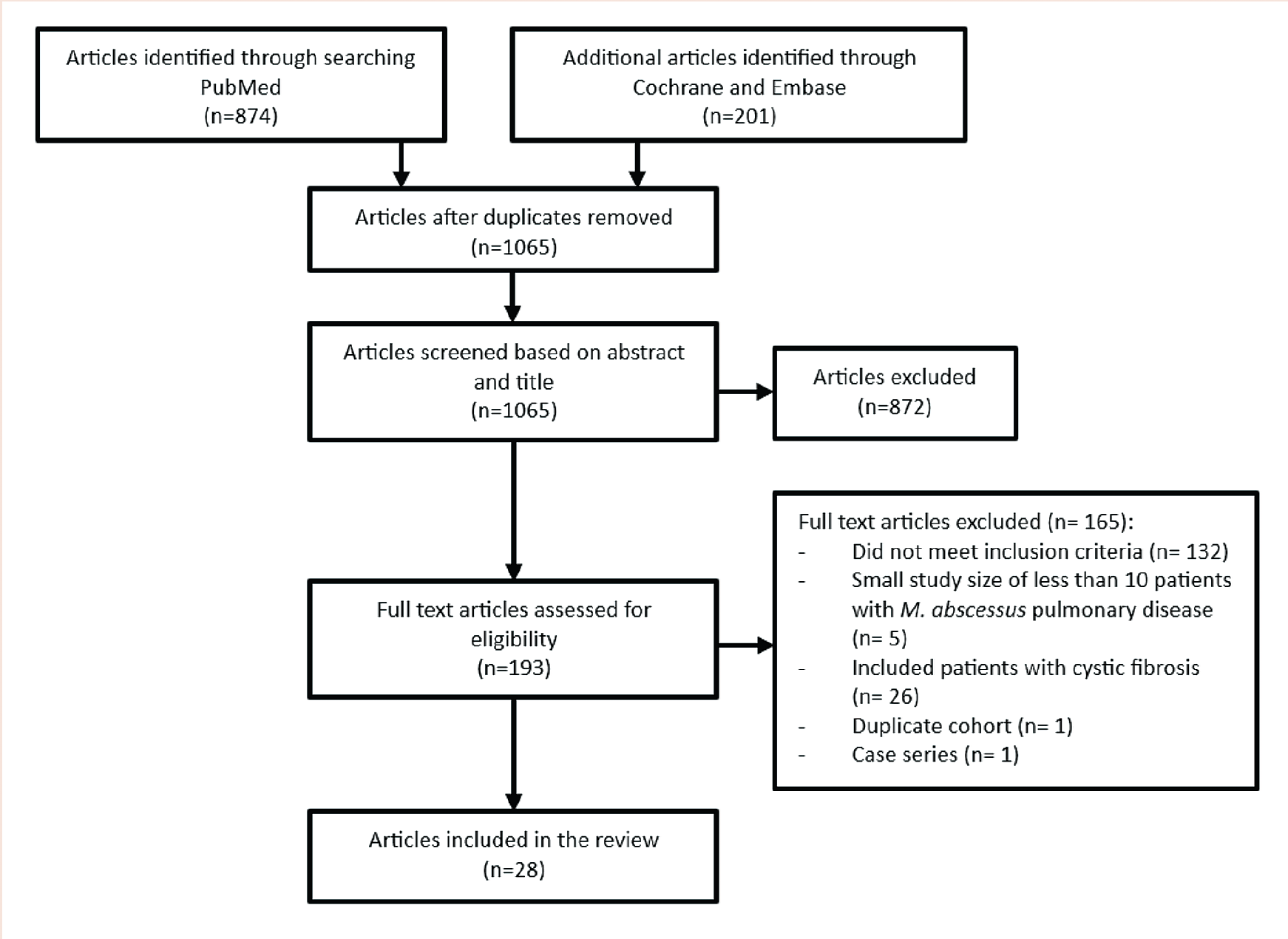
This systematic literature review was conducted to identify and synthesise evidence on treatment regiments and clinical outcomes in patients with M. abscessus pulmonary disease. The review followed the Preferred Reporting Items for Systematic Reviews and Meta-Analyses (PRISMA) guidelines, and a PRISMA flow diagram is included in Fig. 1.
Fig. 1. Flowchart of study selection.
Search strategy
A comprehensive electronic search was conducted in 3 databases: PubMed, Embase and Cochrane Library, for studies published between 1 January 2010 and 31 December 2024. The search strategy employed a combination of Medical Subject Headings (MeSH) and free-text keywords related to M. abscesses, treatment regimens and pulmonary disease, using Boolean operators. The full search strategy is provided in Supplementary Table S1. All references were managed using EndNote X9 (Clarivate Analytics, Philadelphia, PA, US), and Covidence (Veritas Health Innovation, Melbourne, Australia) was used for duplicate removal, title/abstract screening and full-text review.
Inclusion and exclusion criteria
Studies were included if they met the following criteria: (1) published in English between 2010 to 2024; (2) reported on antimicrobial treatment regiments for M. abscessus pulmonary disease; and (3) reported treatment outcomes based on clinical, microbiologic or radiologic parameters. Studies were excluded if they were (1) conference abstract, editorials, letters to the editor, guidelines or narrative reviews; (2) case reports or small case series (fewer than 10 patients); (3) focused exclusively on cystic fibrosis populations; (4) not specifying treatment regiments and/or treatment outcomes; or (5) published in a non-English language.
Study selection
Title and abstract screening were conducted independently by 2 reviewers in a double-blind manner using Covidence. Full texts of potentially relevant studies were retrieved and assessed against inclusion criteria. Disagreements were resolved through discussion and consensus. Reference lists of included studies were also manually searched; however, no additional eligible studies were identified.
Data extraction
Data extraction was conducted using a standardised data extraction template. One reviewer extracted data, which were independently verified by a second reviewer. Extracted variables included: (1) study design and setting, (2) sample size and population demographics, (3) treatment regimens (drug combinations, duration), (4) clinical outcomes (e.g. symptom improvement), (5) microbiological outcomes (e.g. sputum culture conversion), (6) radiologic outcomes (e.g. computed tomography or x-ray findings), (7) adverse events and complications and (8) follow-up duration.
Risk of bias assessment
The ROBINS-I tool (Risk of Bias in Non-randomised Studies ‒ of Interventions) was used to assess the quality of included studies. The tool evaluates bias across 7 domains, including confounding, selection of participants, classification of interventions, deviations from intended interventions, missing data, measurement of outcomes and selection of the reported result.
RESULTS
A total of 1076 articles were identified in the initial search. Following screening and eligibility assessment, 28 studies were included in this review (Fig. 1).9,11-37 Table 1 summarises sample sizes, demography and underlying lung diseases of study population. Table 2 presents treatment regimens, adverse events and outcomes.
Table 1. Demography and underlying lung diseases of study population.
Table 2. Treatment regimens, adverse events and outcomes.
Study characteristics
Of the 28 included studies, 2 were prospective cohort studies14,15 and 26 were retrospective.9,11-13,16-37 Outcomes assessed included survival,23 amikacin toxicity and pharmacokinetics,19 long-term disease progression23 and treatment success.34 Four studies were multicentre.25,27,28,37 Geographically, studies were conducted in 6 countries: South Korea,9,11–23,36,37 Japan,24-28 China,29-31 Taiwan,32,33 Brazil34 and the US.35
Study participants
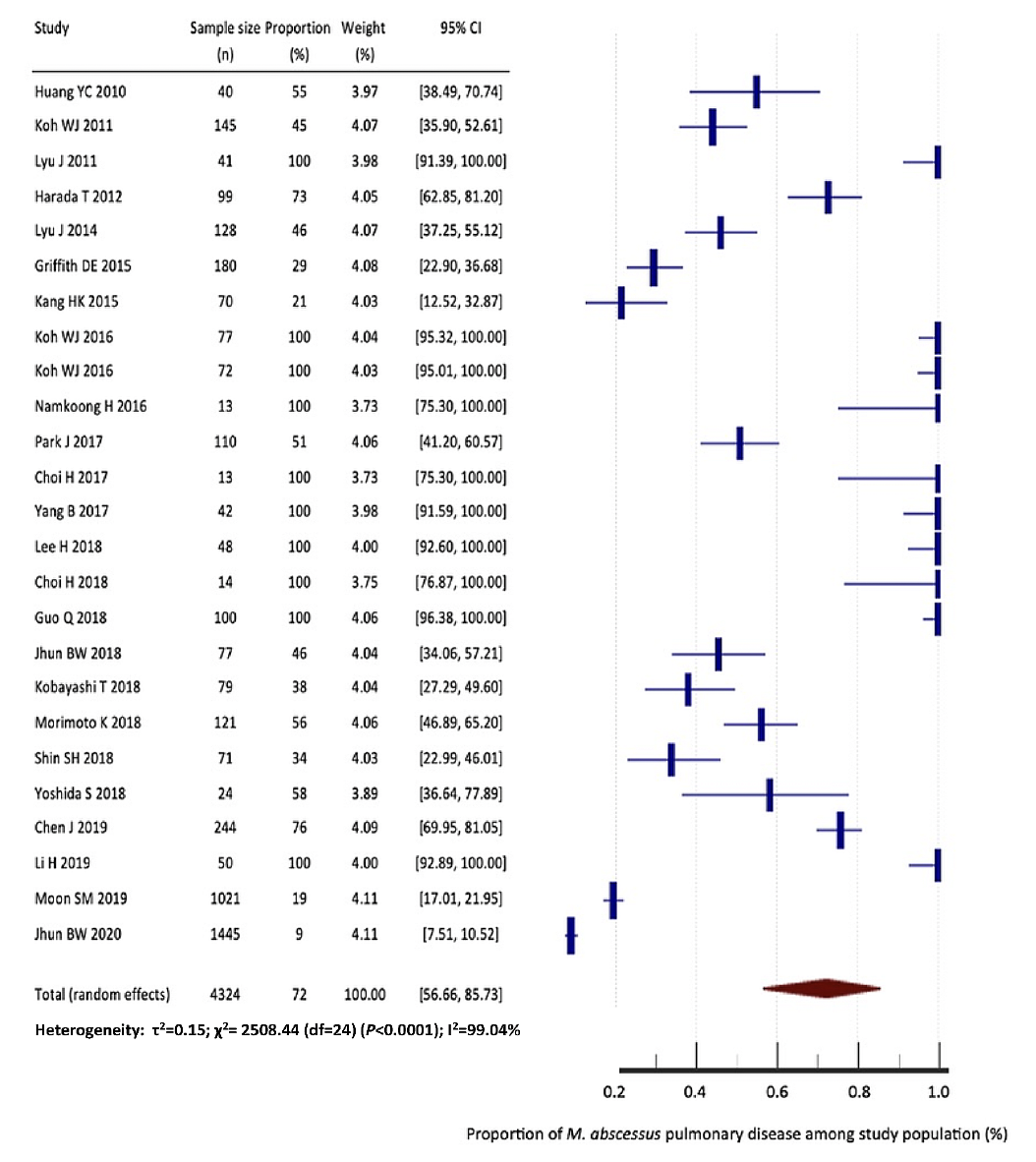
Across 28 studies, 4183 patients were diagnosed with MABC pulmonary disease based on the 2007 ATS/IDSA guidelines,6 of whom 2769 received treatment. The pooled prevalence of M. abscessus among treated patients was 72.4% (95% confidence interval [CI] 56.7–85.7) (Fig. 2). Subspecies identification was inconsistent; 7 studies did not specify the subspecies.12,21,23,29,32–34 Eighteen studies reported on 1047 patients with M. abscessus,9,11,13,14,16,18-20,22,24-28,30,31,35,37,38 and 11 studies documented 568 patients with M. massiliense.9,11,13,15,16,22,25-27,30,36 A history of pulmonary tuberculosis (PTB) was reported in 1452 patients (35.4%) across 22 studies, while NTM disease was noted in 124 patients (3%) from 11 studies. One study grouped prior PTB and NTM infections for analysis.30 HIV status was reported in 13 studies, with only 1 study identifying 2 HIV-positive cases,33 indicating low co-infection prevalence in this cohort.
Fig. 2. Prevalence of M. abscessus pulmonary disease among study population.
Reported mortality
Mortality was reported in 13 of 27 studies (48.1%),9,15,17,18,22,24-26,32-36 with 328 deaths among 1334 treated patients, yielding an overall mortality rate of 24.6%. Three studies did not provide mortality data.15,24,35 A large population-based study found no significant difference in mortality between treated and untreated NTM pulmonary disease patients.22 Survival varied by subspecies: patients with M. massiliense (n=174) had better outcomes than those with M. abscessus (n=129). Compared to Mycobacterium avium (M. avium), M. abscessus had a higher adjusted hazard ratio (aHR 2.19), while M. massiliense showed no increased risk (aHR 0.99), indicating poorer prognosis with M. abscessus infection.
Treatment regimens
Combined treatment regimes
Fourteen studies used a combination of a macrolide, amikacin and either cefoxitin or imipenem, with SCC rates ranging from 8% to 93%.11-20,22,29,31,37 Seven of these studies also included fluoroquinolones, reporting SCC rates between 40% and 100%.11,14,15,22,29,31,37
Inhaled amikacin
Five studies evaluated inhaled non-liposomal amikacin as adjunct therapy. 17,18,21,22,36 Jhun et al. reported an SCC rate of 13%, with clinical and radiological improvement in 44% and 33% of patients, respectively.36 Adverse events, mainly ototoxicity, affected 38% (29 patients), leading to discontinuation in 27% (21 patients). Reducing dosing frequency to 3 times per week decreased adverse effects.
Tigecycline and clofazimine
Tigecycline was used in 2 studies,30,32 both showing favourable outcomes, particularly for M. abscessus.30 Clofazimine was included in 7 studies.17-22,37 Yang et al. reported an SCC rate of 24%, including 15% in refractory M. abscessus. Gastrointestinal side effects occurred in 43% of patients, prompting dose adjustments or discontinuation, though no severe events were reported.19
Ten studies reported macrolide-contained regimens for all patients.11,13,14,17,20,21,24,27,32,37 For subgroup analysis on the association between treatment duration and SCC rates for these regimens: median (range) SCC rates were 28.4 (25‒31.8) for 1-year treatment, 42.1 (25‒52.4) for 2-year treatment and 44.5 (24‒65) for treatment exceeding 2 years. There was no statistically significant difference among the treatment durations, which may be attributed to small sample size (1-year versus [vs] 2-year treatment, P=0.3; 1-year vs exceeding 2-year treatment, P=1). Six studies used macrolide-intravenous (IV) amikacin contained regimens for all patients.11,13,14,17,21,37 There was no statistically significant difference in SCC rates between studies reported of all versus some patients that received the macrolide-IV amikacin regimens (median [range]: 42.1 [46.6‒93] vs 33.3 [38.9‒65] respectively, P=0.6).20,24,27,32 This may be attributed to small sample size.
Surgical treatment
Adjunctive pulmonary resection was reported in 9 studies.9,12-17,20,37 The criteria for surgery included inadequate response to medical therapy or recurrent NTM pulmonary disease with persistent sputum culture positive, cavitary lesions and or severe focal bronchiectasis with complications such as massive haemoptysis.9,12,13,15 In 5 studies, SCC rates post-surgery ranged from 42% to 100%.9,12,14,15,18 Choi et al. reported SCC in a patient with macrolide-resistant M. abscessus following surgery.18 Outcomes varied: Lyu et al. found no significant difference between surgical and medical therapy,12 whereas Kang et al. reported an SCC rate of 81% with a 21% complication rate.9 Koh et al. noted higher SCC at 36 months in the surgery-plus-antibiotics group compared to antibiotics alone (54% vs 42%).14 Reported complications included pneumonia, bronchopleural fistula and wound dehiscence.13 In comparing SCC rate, patients who received both antibiotic therapy and surgical treatment had a higher SCC rate than those who received antibiotic therapy alone (median [range]: 76.9% [65‒100%] vs 34.2% [5.9‒93%], P=0.007).
Treatment-related adverse effects
Ten studies (35.7%) reported treatment-related side effects, which were experienced by 356 patients (12.8% of 2769).9,12,13,15,19,20,30,31,36,37 Among these, 147 patients required dose reduction or discontinuation of treatment due to adverse effects.
Amikacin-related adverse effects
Amikacin was administered via inhalation and intravenous (IV) routes.
Inhaled amikacin
Five studies evaluated inhaled non-liposomal amikacin.17,18,21,22,36 Jhun et al. reported detailed safety outcomes,36 where all patients receiving 500 mg once daily experienced adverse effects, leading to a reduced frequency (3 times weekly), which minimised further events. Overall, 29 patients (38%) experienced side effects, and 21 (27%) discontinued treatment. Common adverse events included ototoxicity (19.5%), fatigue (9.1%), tinnitus (5.2%) and cough (2.6%).
Intravenous amikacin
IV amikacin was included in 20 studies.11-22,24,26,28-31,33,37 No adverse effects were reported in 6 studies.13,15,19,20,28,31 Reported dosages ranged from 8 to 20.2 mg/kg/day.13,15 Two studies documented adverse events in 23 patients (8.1%), including ototoxicity, tinnitus and nephrotoxicity.12,30 Dosages varied: 6 studies used 15 mg/kg/day,11,12,17,18,20,29 while 2 used 400 mg/day.26,31 Therapeutic drug monitoring was noted in some studies: Namkoong et al. adjusted dosing based on trough levels;28 Lee et al. used peak serum levels (Cmax) for dose optimisation.19
Cefoxitin-related adverse effects
Cefoxitin was used in 17 studies as part of combination therapy.9,11-22,29-31,37 Four studies reported adverse effects, primarily hepatotoxicity (11.2–14.3%) and leukopenia (9.9%).12,15,31,37 Symptoms typically resolved after switching to imipenem, highlighting the need for close monitoring and timely regimen adjustment.
Tigecycline-related adverse effects
Tigecycline was used in 2 studies,30,32 and was associated with gastrointestinal toxicity. Chen et al. reported nausea, vomiting, diarrhoea and abdominal pain as the most common effects.30 Among 244 patients, 14 (5.7%) required dose reduction or discontinuation due to severity.
Clofazimine-related adverse effects
Clofazimine was included in 7 studies,17-22,37 with adverse effects reported in 2.19,20 In 1 cohort,20 55% experienced side effects, including gastrointestinal symptoms (26%) and skin discoloration (12%). These led to dose reduction in 12% and discontinuation in 43% of cases. While not life-threatening, these reactions impacted adherence and tolerability.
Treatment outcomes
Treatment outcomes were evaluated across 3 primary domains: clinical response, microbiological response (measured via SCC) and radiological improvement. Due to heterogeneity in outcome definitions and assessment methods, direct comparisons between studies were limited.
Clinical outcomes
Twelve studies assessed clinical outcomes based on symptoms such as cough, sputum production, dyspnoea and physician-assessed respiratory status.11-13,20,21,26,28,32-34,36 However, interpretation was limited by the lack of standardised definitions for clinical improvement. Four studies used both symptom and radiological findings to evaluate response,21,26,32,33 with improvement rates ranging from 13.6% to 91% and a pooled estimate of 37.1 % (95% CI 29.3–45.2%) (Fig. 3).
Fig. 3. Successful treatment for M. abscessus pulmonary disease.
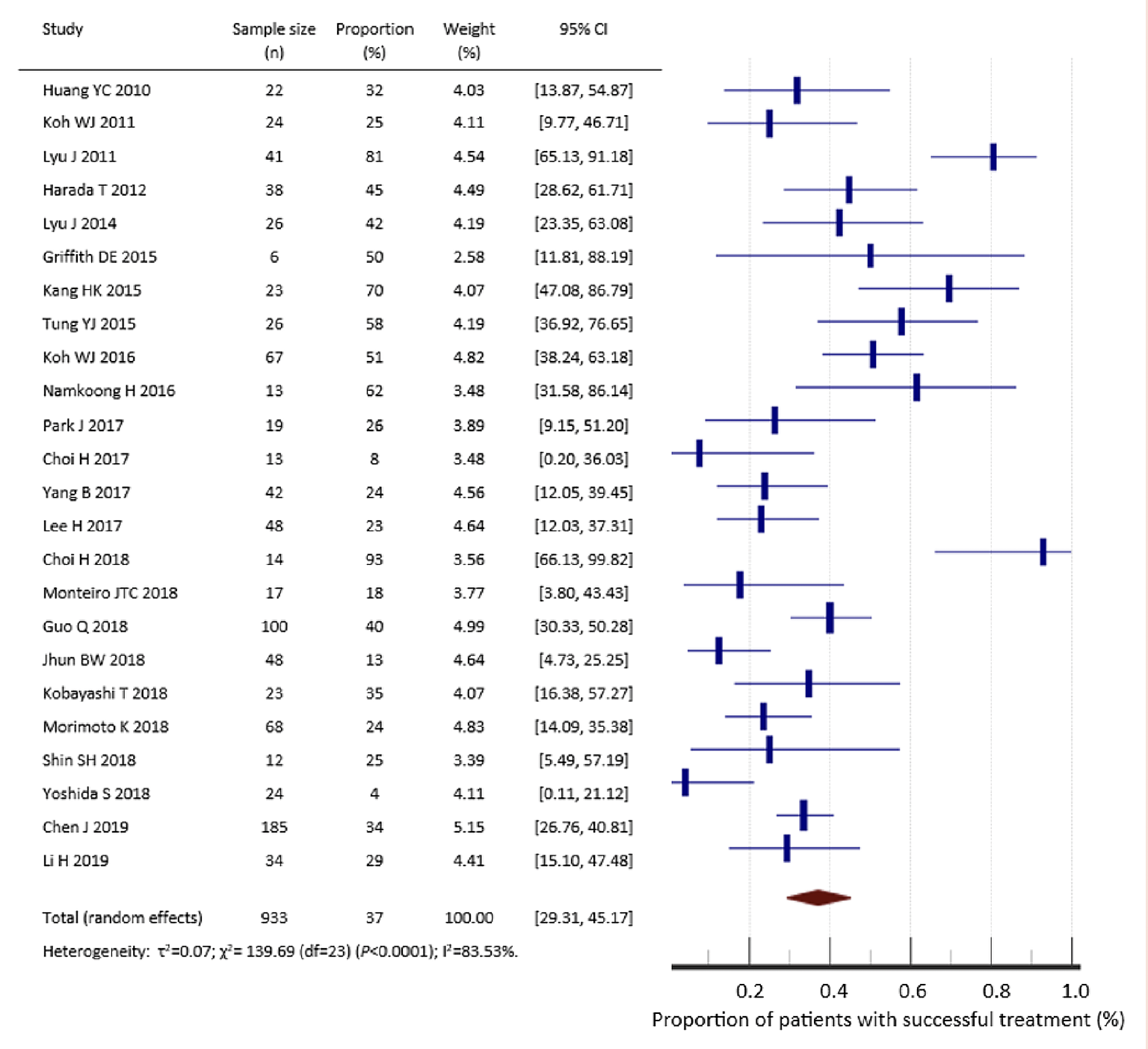
Six studies assessing symptoms alone reported improvement rates between 17.6% and 100%, reflecting heterogeneity in regimens, disease severity and study populations.13,15,20,28,34,36 Koh et al. found higher response rates in M. massiliense (97%) than in M. abscessus (75%), emphasising the influence of subspecies.11 Notably, 1 study reported spontaneous symptom improvement in 42.5% of untreated patients, suggesting possible host-related or self-limiting disease mechanisms.33
Microbiological outcomes
SCC was reported in 25 studies,9,11-18,20,21,23-33,36,37 with 12-month SCC rates ranging from 29% to 77%. M. massiliense consistently showed higher SCC rates (72.4–100%) compared to M. abscessus (31–81.3%). Park et al. reported SCC in 82.4% of M. massiliense cases versus 26.3% in M. abscessus.15 In an untreated cohort, Moon et al. observed spontaneous SCC in 34% (157/459),23 although 26 later developed NTM disease from different species, highlighting the dynamic nature of NTM colonisation. A large study by Park et al. reported SCC and microbiological cure rates of 52.4% and 41.5%,37 respectively, based on NTM-NET definitions.10 These findings emphasise the importance of standardised outcome measures in evaluating treatment efficacy.
Radiological outcomes
Nine studies assessed radiological response using high-resolution computed tomography (HRCT).11,13,15,20,27-29,36,37 Among 6 studies focusing on MABC,13,20,28,29,36,37 radiographic improvement ranged from 33 to 53.8%, with 23–37.8% showing no change and 19.5–33% demonstrating deterioration. Subspecies differences were evident. Koh et al. reported 91% radiologic improvement in M. massiliense cases after 2 weeks of IV antibiotics.15 Similarly, Koh et al. and Harada et al. found higher response rates in M. massiliense (82% and 48%) compared to M. abscessus (42% and 29%).11,29 In contrast, Tung et al. observed deterioration in 77% of patients, with only 13.9% showing improvement and 44.4% remaining stable.32
Other factors associated with treatment outcomes
Three studies analysed demographic, clinical, and genetic factors potentially influencing treatment outcomes.22,23,29
Genotypic associations
Guo et al. found that bacterial genotype significantly influenced outcomes, including SCC rates, radiological improvement and overall treatment success.29 In their multivariate analysis, patients infected with clarithromycin-resistant genotypes were significantly less likely to experience favourable treatment outcomes compared to those with clarithromycin-sensitive genotypes (adjusted odds ratio: 0.185, 95% CI 0.059–0.579, P=0.004).
Host-related factors
Findings on the influence of age, sex, body mass index (BMI) and comorbidities on treatment outcomes were mixed. Guo et al. reported no significant association between these variables and treatment success.29 Conversely, Jhun et al. identified several factors linked to increased mortality in NTM pulmonary disease, including age ≥65 years, male sex, low BMI (<18.5 kg/m²) and comorbidities such as chronic pulmonary aspergillosis, malignancy, chronic cardiac or hepatic disease.22 Moon et al. observed spontaneous SCC in 34% of untreated patients;23 however, some later developed NTM disease due to different species, highlighting the dynamic interaction between host immunity and pathogen behaviour.
DISCUSSION
Treatment of M. abscessus pulmonary disease remains highly challenging due to factors such as bacterial genotype, subspecies, antimicrobial resistance and patient-specific clinical variables. These elements contribute to heterogeneity in treatment outcomes and complicate cross-study comparisons. Clinical success depends on appropriate antibiotic selection, accurate subspecies/genotype identification, and host factors including comorbidities, immune status and underlying lung disease. Antibiotic regimens vary significantly across regions and institutions, influenced by drug availability and local protocols. The organism’s intrinsic and acquired resistance limits consistent treatment responses. Interpretation of outcomes is further complicated by the absence of standardised definitions for clinical, microbiological and radiological responses, and differences in follow-up duration.
In this review, SCC rates for combination regimens—including a macrolide, amikacin and cefoxitin or imipenem—ranged from 8% to 93%. Some studies reported improved outcomes with the addition of fluoroquinolones. However, sustained SCC was more consistently linked to subspecies differences, with M. massiliense infections showing better microbiological response than M. abscessus. Tigecycline, clofazimine and inhaled amikacin were effective options for refractory cases.19,30,36
Studies have underscored the importance of macrolide susceptibility as a key predictor of outcome. For instance, Choi et al. reported the poorest outcomes in patients with macrolide-resistant strains,17 while Park et al. emphasised that clarithromycin susceptibility significantly influenced treatment success.16 These findings reinforce the need for routine genotypic testing, including erm(41) and rrl mutations, to guide personalised antimicrobial therapy and improve prognostication.
Earlier studies and clinical guidelines have supported the use of inhaled amikacin in patients with refractory M. abscessus pulmonary disease,38-42 although its application has been inconsistent across clinical settings. Jhun et al. reported low SCC rates but moderate clinical and radiological improvement with amikacin inhalation therapy.38 However, frequent adverse events, particularly ototoxicity, necessitated a protocol adjustment from daily to thrice-weekly dosing, which reduced the incidence of toxicity. These findings suggest a potential role for inhaled amikacin as a supportive adjunct but emphasise the need for standardised protocols that balance efficacy and tolerability.
Emerging antimicrobials such as clofazimine and tigecycline have shown potent in vitro activity against M. abscessus,4 and their incorporation into multidrug regimens has yielded promising early clinical results.17,30 However, in most cases, their use was at the discretion of the treating physician and, therefore, direct causal conclusions regarding their individual efficacy could not be established. Future randomised controlled trials are warranted to determine the clinical utility of clofazimine and tigecycline as potential first-line agents, especially in patients infected with macrolide-resistant strains of M. abscessus. Surgical resection remains an important adjunctive therapy, particularly in cases of localised or drug-resistant disease. Several studies reported SCC rates exceeding 40% in patients undergoing surgical intervention. For instance, Kang et al. reported high SCC rates with a low incidence of postoperative complications, suggesting that surgical management should be considered in appropriately selected patients, especially those with multidrug-resistant or treatment-refractory disease.9
Treatment outcomes also vary significantly between MABC subspecies. Patients with M. massiliense infection consistently demonstrated better clinical, microbiological and radiological responses compared to those with M. abscessus.11,16,27 This is largely attributed to the dysfunctional erm(41) gene in M. massiliense, which results in macrolide susceptibility,26 thereby improving the efficacy of macrolide-based regimens. Whole-genome sequencing (WGS) and genotypic analysis may therefore play a critical role in tailoring therapy, enabling more accurate predictions of antimicrobial response. Notably, Park et al. reported that clarithromycin susceptibility alone accounted for approximately 40% of the variation in treatment outcomes, highlighting the interplay of bacterial genetics and host-specific factors in determining treatment success.16
The interpretation of treatment outcomes remains challenging due to a lack of standardised definitions among the studies. Many studies relied on subjective criteria, such as symptom relief and radiological improvement, which are prone to bias and inter-observer variability. The NTM-NET group proposed outcome definitions such as SCC, microbiological cure, clinical cure, treatment failure, relapse, reinfection and treatment discontinuation, which are important for standardisation of treatment outcome reporting in future studies.10 While SCC is often used as a more objective outcome, recent studies have emphasised that patient-reported outcomes, quality of life and long-term survival may be more meaningful endpoints for evaluating therapy in MABC lung disease.43 Furthermore, this review also revealed important methodological limitations in the existing literature. Of the 28 included studies, only 8 enrolled more than 100 participants;11,16,22,23,25,29,30,33 the remaining 20 studies were largely single-centre and retrospective, with limited sample sizes, thereby constraining the generalisability of findings. Additionally, most studies did not evaluate the pharmacokinetic or pharmacodynamic relationships of antibiotics, nor did they assess non-pharmacologic interventions, such as airway clearance techniques or nutritional status, which may also influence outcomes.
In addition to currently available treatment options, repurposing anti-tubercular drugs presents a promising strategy for developing new chemotherapeutic alternatives against M. abscessus complex (MABC) infections.44 Several potential molecular targets have been identified, including RNA polymerase, aspartate decarboxylase PanD, enzymes involved in peptidoglycan synthesis, mycolic acid transport and the F-ATP synthase, a critical component of oxidative phosphorylation. Notably, rationally designed rifabutin analogs have demonstrated 50- to 100-fold increased potency against M. abscessus by targeting RNA polymerase.45 Additionally, a first-in-class inhibitor of PanD has recently been identified, showing promising activity. A combination therapy involving the oral β-lactam tebipenem, which targets L,D-transpeptidases (LdtMab1 and LdtMab2) and D,D-transpeptidases (PonA1, PonA2 and PbpA), with the β-lactamase inhibitor avibactam, has shown low micromolar, bactericidal activity against M. abscessus, and may be co-administered with existing anti-MABC agents to enhance efficacy.46
Further breakthroughs have emerged with validation of novel targets such as MmpL3, a transporter of mycolic acids across the plasma membrane,47,48 and InhA, the enoyl-ACP reductase involved in fatty acid synthesis.49 While most current drugs target biomass-generating pathways, increasing attention has turned toward bioenergetic pathways, particularly the F-ATP synthase, which remains essential in both replicating and non-replicating bacterial states—the latter being highly drug-tolerant. Recent work has identified several F-ATP synthase inhibitors with promising in vitro and in vivo activity. These include repurposed compounds such as squaramide SQ31f,50 the diarylquinoline bedaquiline,51 and newer analogues TBAJ-876 and TBAJ-5307.52,53 Novel inhibitors such as GaMF1 and Ep1MabF1 have also been developed, offering additional scaffolds for the discovery of curative regimens.54,55
The persistently poor treatment outcomes in M. abscessus pulmonary disease emphasise the urgent need for stronger antimicrobials, improved drug delivery systems and resistance-reversing strategies. The intrinsic resistance mechanisms of M. abscessus, particularly its mycolic acid-rich, impermeable cell wall, continue to pose major barriers to drug efficacy.56 Nonetheless, advances in whole-cell phenotypic screening and synergistic drug combination assays have begun to yield new candidate molecules with potent anti-MABC activity.56-58 Improved delivery systems also hold potential. Novel pulmonary drug delivery technologies, including nanoparticle-based inhalation therapies and dry-powder formulations, may allow for higher local drug concentrations while minimising systemic toxicity.59 Currently, treatment success relies on eradicating of M. abscessus, which often fails and does not reflect patients’ functional status. Coping with daily activities may be more important to patients than the eradication of M. abscessus. Thus, functional status should be given importance equally as radiological and microbiological outcomes for indicating treatment response in NTM disease. It indicates the extent of clinical symptoms experienced in the daily activities of patients. This functional approach explains real life suffering rather than just pathological and radiological symptoms.60
Finally, the development of relevant experimental models is critical to support the preclinical evaluation of new therapies. These models must accurately replicate host-pathogen interactions and reflect the complex immunopathology of M. abscessus infections.
CONCLUSION
This review highlights the complexity of treating M. abscessus pulmonary disease, largely due to intrinsic drug resistance, variable treatment responses, and frequent adverse effects. Outcomes are influenced not only by antibiotic regimens but also by bacterial subspecies, genotype and host-related factors. Surgical resection remains a valuable adjunct, particularly in localised or refractory cases, and is associated with higher sputum culture conversion (SCC) rates. Macrolide-IV amikacin contained regimens may potentially increase SCC rate and hence, is a preferred treatment option, particularly when M. abscessus is susceptible to these drugs. Optimising treatment will require integration of genotypic profiling, novel therapeutic agents and advanced drug delivery systems, supported by robust clinical and microbiological endpoints to enable more personalised and effective management strategies.
Supplementary material
Table S1. Search strategy with Boolean operators.
Acknowledgements
We thank Dr Pradeep Paul George, Health Services and Outcomes Research, National Healthcare Group, Singapore, for statistical analysis. The authors acknowledge funding by National Research Foundation (NRF) Singapore through the Singapore-MIT Alliance for Research and Technology Antimicrobial Resistance IRG and the NRF Competitive Research Programme (CRP), NRF-CRP27-2021-0002.
REFERENCES
- Prevots DR, Shaw PA, Strickland D, et al. Nontuberculous mycobacterial lung disease prevalence at four integrated health care delivery systems. Am J Respir Crit Care Med 2010;182:970-6.
- Lee SJ, Ju S, You JW, et al. Trends in the prevalence of non-TB mycobacterial infection in patients with non-cystic fibrosis bronchiectasis in South Korea, 2012-2016. Chest 2021;159:959-62.
- Adekambi T, Sassi M, van Ingen J, et al. Reinstating Mycobacterium massiliense and Mycobacterium bolletii as species of the Mycobacterium abscessus complex. Int J Syst Evol Microbiol 2017;67:2726-30.
- Koh WJ, Stout JE, Yew WW. Advances in the management of pulmonary disease due to Mycobacterium abscessus complex. Int J Tuberc Lung Dis 2014;18:1141-8.
- Aksamit TR, Philley JV, Griffith DE. Nontuberculous mycobacterial (NTM) lung disease: the top ten essentials. Respir Med 2014;108:417-25.
- Griffith DE, Aksamit T, Brown-Elliott BA, et al. An Official ATS/IDSA Statement: Diagnosis, Treatment, and Prevention of Nontuberculous Mycobacterial Diseases. Am J Respir Crit Care Med 2007;175:367-416.
- Field SK and Cowie RL. Lung disease due to the more common nontuberculous mycobacteria. Chest 2006;129:1653-72.
- Nessar R, Cambau E, Reyrat JM, et al. Mycobacterium abscessus: a new antibiotic nightmare. J Antimicrob Chemother 2012;67:810-8.
- Kang HK, Park HY, Kim D, et al. Treatment outcomes of adjuvant resectional surgery for nontuberculous mycobacterial lung disease. BMC Infect Dis 2015;15:76.
- van Ingen J, Aksamit T, Andrejak C, et al. Treatment outcome definitions in nontuberculous mycobacterial pulmonary disease: an NTM-NET consensus statement. Eur Respir J 2018;51:1800170.
- Koh WJ, Jeon K, Lee NY, et al. Clinical Significance of Differentiation of Mycobacterium massiliense from Mycobacterium abscessus. Am J Respir Crit Care Med 2011;183:405-10.
- Lyu J, Jang HJ, Song JW, et al. Outcomes in patients with Mycobacterium abscessus pulmonary disease treated with long-term injectable drugs. Respir Med 2011;105:781-7.
- Lyu J, Kim BJ, Kim BJ, et al. A shorter treatment duration may be sufficient for patients with Mycobacterium massiliense lung disease than with Mycobacterium abscessus lung disease. Respir Med 2014;108:1706-12.
- Koh WJ, Jeong BH, Kim SY, et al. Mycobacterial Characteristics and Treatment Outcomes in Mycobacterium abscessus Lung Disease.Clin Infect Dis 2016;64:309-16.
- Koh WJ, Jeong BH, Jeon K, et al. Oral Macrolide Therapy Following Short-term Combination Antibiotic Treatment of Mycobacterium massiliense Lung Disease. Chest 2016;150:1211-21.
- Park J, Cho J, Lee CH, et al. Progression and Treatment Outcomes of Lung Disease Caused by Mycobacterium abscessus and Mycobacterium massiliense. Clin Infect Dis 2017;64:301-8.Erratum in: Clin Infect Dis 2017;64:1469.
- Choi H, Kim SY, Kim DH, et al. Clinical Characteristics and Treatment Outcomes of Patients with Acquired Macrolide-Resistant Mycobacterium abscessus Lung Disease. Antimicrob Agents Chemother 2017;61:e01146-17.
- Choi H, Jhun BW, Kim SY, et al. Treatment outcomes of macrolide-susceptible Mycobacterium abscessus lung disease. Diagn Microbiol Infect Dis 2018;90:293-5.
- Lee H, Sohn YM, Ko JY, et al. Once-daily dosing of amikacin for treatment of Mycobacterium abscessus lung disease. Int J Tuberc Lung Dis 2017;21:818-24.
- Yang B, Jhun BW, Moon SM, et al. Clofazimine-Containing Regimen for the Treatment of Mycobacterium abscessus lung disease. Antimicrob Agents Chemother 2017;61:e02052-16.
- Shin SH, Jhun BW, Kim SY, et al. Nontuberculous Mycobacterial Lung Diseases Caused by Mixed Infection with Mycobacterium avium Complex and Mycobacterium abscessus Complex. Antimicrob Agents Chemother 2018;62:e01105-18.
- Jhun BW, Moon SM, Jeon K, et al. Prognostic factors associated with long-term mortality in 1445 patients with nontuberculous mycobacterial pulmonary disease: a 15-year follow-up study. Eur Respir J 2020;55:1900798.
- Moon SM, Jhun BW, Baek SY, et al. Long-term natural history of non-cavitary nodular bronchiectatic nontuberculous mycobacterial pulmonary disease. Respir Med. 2019;151:1-7.
- Kobayashi T, Tsuyuguchi K, Yoshida S, et al. Mycobacterium abscessus subsp. abscessus Lung Disease: Drug Susceptibility Testing in Sputum Culture Negative Conversion. Int J Mycobacteriol 2018;7:69-75.
- Morimoto K, Nakagawa T, Asami T, et al. Clinico-microbiological analysis of 121 patients with pulmonary Mycobacteroides abscessus complex disease in Japan – An NTM-JRC study with RIT. Respir Med 2018;145:14-20.
- Yoshida S, Tsuyuguchi K, Kobayashi T, et al. Association between sequevar and antibiotic treatment outcome in patients with Mycobacterium abscessus complex infections in Japan. J Med Microbiol 2018;67:74-82.
- Harada T, Akiyama Y, Kurashima A, et al. Clinical and microbiological differences between Mycobacterium abscessus and Mycobacterium massiliense lung diseases. J Clin Microbiol 2012;50:3556-61.
- Namkoong H, Morimoto K, Nishimura T, et al. Clinical efficacy and safety of multidrug therapy including thrice weekly intravenous amikacin administration for Mycobacterium abscessus pulmonary disease in outpatient settings: a case series. BMC Infect Dis 2016;16:396.
- Guo Q, Chu H, Ye M, et al. The Clarithromycin Susceptibility Genotype Affects the Treatment Outcome of Patients with Mycobacterium abscessus Lung Disease. Antimicrob Agents Chemother 2018;62:e02360-17.
- Chen J, Zhao L, Mao Y, et al. Clinical Efficacy and Adverse Effects of Antibiotics Used to Treat Mycobacterium abscessus Pulmonary Disease. Front Microbiol 2019;10:1977.
- Li H, Tong L, Wang J, et al. An Intensified Regimen Containing Linezolid Could Improve Treatment Response in Mycobacterium abscessus Lung Disease. Biomed Res Int 2019;2019:8631563.
- Huang YC, Liu MF, Shen GH, et al. Clinical outcome of Mycobacterium abscessus infection and antimicrobial susceptibility testing. J Microbiol Immunol Infect 2010;43:401-6.
- Tung YJ, Bittaye SO, Tsai JR, et al. Risk factors for microbiologic failure among Taiwanese adults with Mycobacterium abscessus complex pulmonary disease. J Microbiol Immunol Infect 2015;48:437-5.
- Monteiro JTC, Lima KVB, Barretto AR, et al. Clinical aspects in patients with pulmonary infection caused by mycobacteria of the Mycobacterium abscessus complex, in the Brazilian Amazon. J Bras Pneumol 2018;44:93-8.
- Griffith DE, Philley JV, Brown-Elliott BA, et al. The significance of Mycobacterium abscessus subspecies abscessus isolation during Mycobacterium avium complex lung disease therapy. Chest 2015;147:1369-75.
- Jhun BW, Yang B, Moon SM, et al. Amikacin Inhalation as Salvage Therapy for Refractory Nontuberculous Mycobacterial Lung Disease. Antimicrob Agents Chemother 2018;62:e00011-18.
- Park Y, Park YE, Jhun BW, et al. Impact of susceptibility to injectable antibiotics on the treatment outcomes of mycobacterium abscessus pulmonary disease. Open Forum Infect Dis 2021;8:ofab215.
- Safdar A. Aerosolized amikacin in patients with difficult-to-treat pulmonary nontuberculous mycobacteriosis. Eur J Clin Microbiol Infect Dis 2012;31:1883-7.
- Olivier KN, Shaw PA, Glaser TS, et al. Inhaled amikacin for treatment of refractory pulmonary nontuberculous mycobacterial disease. Ann Am Thorac Soc 2014;11:30-5.
- Yagi K, Ishii M, Namkoong H, et al. The efficacy, safety, and feasibility of inhaled amikacin for the treatment of difficult-to-treat non-tuberculous mycobacterial lung diseases. BMC Infect Dis 2017;17:558.
- Daley CL, Iaccarino JM, Lange C, et al. Treatment of nontuberculous mycobacterial pulmonary disease: An official ATS/ERS/ESCMID/IDSA clinical practice guideline. Clin Infect Dis 2020;71:e1-36.
- Haworth CS, Floto RA. Introducing the new BTS Guideline: Management of non-tuberculous mycobacterial pulmonary disease (NTM-PD). Thorax 2017;72:969-70.
- Czaja CA, Levin AR, Cox CW, et al. Improvement in Quality of Life after Therapy for Mycobacterium abscessus Group Lung Infection. A Prospective Cohort Study. Ann Am Thorac Soc 2016;13:40-8.
- Dartois V, Dick T. Drug development challenges in NTM lung disease: TB to the rescue. J Exp Med 2022;219:e20220445.
- Ganapathy US, Lan T, Krastel P, et al. 2021. Blocking bacterial naphthohydroquinone oxidation and ADP-ribosylation improves activity of rifamycins against Mycobacterium abscessus. Antimicrob Agents Chemother 65:e00978-21.
- Negatu DA, Zimmerman MD, Dartois V, et al. 2022. Strongly bactericidal all-oral beta-lactam combinations for the treatment of Mycobacterium abscessus lung disease. Antimicrob Agents Chemother 2022;66:e0079022.
- Dupont C, Viljoen A, Dubar F, et al. A new piperidinol derivative targeting mycolic acid transport in Mycobacterium abscessus. Mol Microbiol 2016;101:515-29.
- Alcaraz M, Edwards TE, Kremer L. New therapeutic strategies for Mycobacterium abscessus pulmonary diseases – untapping the mycolic acid pathway. Expert Rev Anti Infect Ther 2023;21:813-29.
- Alcaraz M, Roquet-Banères F, Leon-Icaza SA, et al. Efficacy and Mode of Action of a Direct Inhibitor of Mycobacterium abscessus InhA. ACS Infect Dis 2022;8:2171-86.
- Ragunathan P, Sae-Lao P, Harikishore A, et al. (2025) SQ31f is a potent non-tuberculous mycobacteria antibiotic by targeting specifically the mycobacterial F-ATP Synthase. J Antimicrob Chemoth 2025; 80:270-80.
- Dupont C, Viljoen A, Thomas S, et al. Bedaquiline inhibits the ATP synthase in Mycobacterium abscessus and is effective in infected zebrafish. Antimicrob Agents Chemother 2017;61:e01225-17.
- Sarathy JP, Ganapathy US, Zimmerman MD, et al. 2020. TBAJ-876, a 3,5-dialkoxypyridine analogue of bedaquiline, is active against Mycobacterium abscessus. Antimicrob Agents Chemother 2020;64:e02404-19.
- Ragunathan P, Sae-Lao P, Hamela, C, et al. High efficacy of the F-ATP synthase inhibitor TBAJ-5307 against non-tuberculous mycobacteria in vitro and in vivo. J Biol Chem 2024;300:105618.
- Ragunathan P, Dick T, Grüber G. Anti-Mycobacterium abscessus Activity of Tuberculosis F-ATP Synthase Inhibitor GaMF1. Antimicrob Agents Chemother 2022;66:e0001822.
- Shin J, Harikishore A, Wong CF, et al. Atomic solution structure of Mycobacterium abscessus F-ATP synthase subunit ε and identification of Ep1MabF1 as a targeted inhibitor. FEBS J 2022; 289:6308-23.
- Lee BS, Pethe K. Therapeutic potential of promiscuous targets in Mycobacterium tuberculosis. Curr Opin Pharmacol 2018;42:22-6.
- Ollinger J, Kumar A, Roberts DM, et al. A high-throughput whole cell screen to identify inhibitors of Mycobacterium tuberculosis. PLoS One 2019;14:e0205479.
- Abrahams KA, Besra GS. Mycobacterial drug discovery. RSC Med Chem 2020;11:1354-65.
- He S, Gui J, Xiong K, et al. A roadmap to pulmonary delivery strategies for the treatment of infectious lung diseases. J Nanobiotechnology 2022;20:101.
- Guyatt GH, Townsend M, Keller J, et al. Measuring functional status in chronic lung disease: conclusions from a randomized control trial. Respir Med 1989;83:293-7.
Ethical approval was not required for this study as it used publicly available, anonymised data.
The authors declare they have no affiliations or financial involvement with any commercial organisation with a direct financial interest in the subject or materials discussed in the manuscript. No generative artificial intelligence (AI) or AI-assisted technologies was used in writing this manuscript.
A/Prof. Albert Yick Hou Lim, Department of Respiratory and Critical Care Medicine, Tan Tock Seng Hospital, 11 Jalan Tan Tock Seng, Singapore 308433. Email: [email protected]
