

Dear Editor,
The emergence of Trichophyton (T.) indotineae—a drug-resistant dermatophyte—has raised international public health concerns. First identified as a new species in 2020 with origins in South Asia, it has since spread elsewhere. The first case was reported in the US in 2023, and in the UK in 2024.1 We report 2 cases of T. indotineae in migrant workers in Singapore, illustrating the clinical challenges and public health concerns with this emerging pathogen.
A 32-year-old Bangladeshi welder presented with a pruritic rash of 6 months affecting his trunk and buttocks. He had no medical history and had been working in Singapore for 11 years, residing in a dormitory. Examination showed annular plaques with scales and a rim of erythema. Scattered follicular papules with small abscesses were present on the lower abdomen (Fig. 1A). Prior treatments included over-the-counter creams, fixed-dose antifungal-corticosteroid creams and antifungal tablets (unspecified) from Bangladesh, itraconazole 200 mg once daily (OD) for 2 weeks and terbinafine 250 mg OD for 2 weeks. Fungal culture yielded Trichophyton species, later confirmed as T. indotineae on Internal Transcribed Spacer (ITS) sequencing. The patient was subsequently treated with itraconazole 200 mg OD for 6 weeks with improvement.
Fig. 1. Two cases of T. indotineae in migrant workers in Singapore.
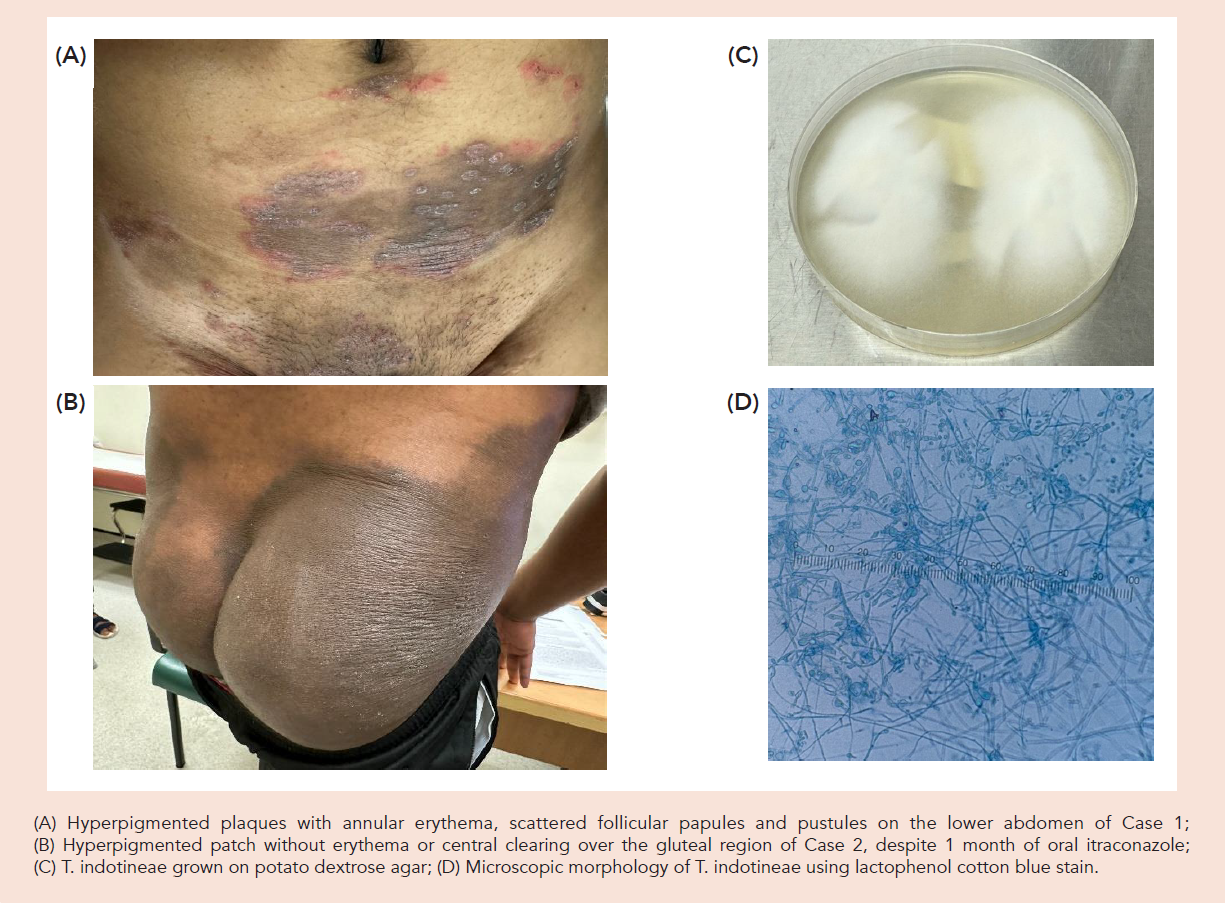
The second case, a 25-year-old Indian construction worker with no medical history, presented with a pruritic groin rash for 6 months. A dormitory resident, he reported that over half his roommates had symptoms but could not afford treatment. He sought care incidentally during management of an unrelated fracture. Examination showed a large hyperpigmented region over the buttocks without central clearing (Fig. 1B). Prior treatments included steroid-antibiotic combination creams for 3 months. Skin scrapings demonstrated hyphae, and tinea corporis was diagnosed. Topical and oral terbinafine 250 mg OD were administered for 2 weeks with no improvement. Fungal culture grew T. mentagrophytes complex (Figs. 1C and 1D), later confirmed as T. indotineae on ITS sequencing. He was given ketoconazole wash, miconazole cream and itraconazole 200 mg OD for 6 weeks with improvement. Mild transaminase derangement developed, which subsequently resolved. Both patients were compliant to treatment.
T. indotineae, a part of the T. mentagrophytes complex, is also known as T. mentagrophytes ITS Genotype VIII. Its rapid emergence has seen it overtake T. rubrum as the predominant dermatophyte. T. indotineae is now identified in 40% of samples sent to the UK’s National Reference Mycology Laboratory.2 It is anthropophilic and predominantly spread via direct contact, although sexual and zoonotic transmission have been suggested.1,3 The global concern is its high resistance rate to firstline systemic antifungals (terbinafine). Resistance arises from squalene epoxidase (SQLE) gene mutations and is believed to stem from unregulated widespread use of corticosteroid and combination creams in India, Nepal and Bangladesh. More worrying is the emergence of itraconazole resistance, leading to multi-drug-resistant tinea.4
Our cases describe the local emergence and clinical features of T. indotineae while highlighting several key challenges:
Delayed recognition/diagnosis. Tinea typically affects covered body areas. Despite the disease burden and psychological distress from pruritus, providers may downplay its impact. Misdiagnosis is common: up to 70% of tinea, particularly those pre-treated with topical corticosteroids (tinea incognito), were diagnosed as eczema. Tinea is the most common cause of topical steroid misuse.5 Widespread indiscriminate use of over-the-counter creams, topical corticosteroids and corticosteroid-antifungal-antibacterial combination creams temporarily masks the rash and symptoms, further delaying diagnosis. The estimated diagnostic delay of T. indotineae is 10 months.6 These issues are compounded in the migrant population where costs and access to care are barriers to early diagnosis.
Diagnostic difficulties. Unlike conventional tinea, T. indotineae is more extensive, facial involvement is more common, and 14% lack hallmark features like scaling and central clearing.4 Similar microbiological challenges exist. Microscopic morphology cannot distinguish T. indotineae from T. mentagrophytes complex, causing misdiagnosis as T. mentagrophytes/interdigitale. Confirmatory diagnosis requires DNA sequencing, which is not routinely available in clinical diagnostic laboratories.3 Matrix-Assisted Laser Desorption/Ionization Time-of-Flight Mass Spectrometry (MALDI-TOF MS) is a potential tool to identify T. indotineae with some in-house or publicly available databases, but this may not be practised widely in clinical diagnostic laboratories.7
Treatment resistance. Terbinafine resistance was reported in up to 85% of samples.5 Although itraconazole is recommended as the treatment of choice, resistance was reported in 27% of cases, and 15% are resistant to both terbinafine and itraconazole. Prolonged higher doses of itraconazole (200 mg/day for 6–12 weeks) may be needed to achieve cure. Alternatives include newer triazoles posaconazole and voriconazole. Fluconazole may not be helpful due to high minimum inhibitory concentrations.4
Several strategies are important in response to the looming T. indotineae epidemic. First, having an index of suspicion of T. indotineae is key. The unique morphology, extensiveness, along with epidemiological risk factors of ethnicity, contact history and recent travel to South Asia are important clues.1 A pragmatic low-cost indicator is poor response despite standard therapySecond, initial evaluation of suspected dermatophyte infection with microscopy is essential. Fungal cultures, although non-diagnostic of T. indotineae, may suggest T. indotineae if T. mentagrophytes complex is cultured. Sequence-based identification and antifungal testing are confirmatory, thus healthcare investment and access to such technologies is essential. Third, antifungal-corticosteroid or triple combination creams (corticosteroid-antifungal-antibacterial) should be discouraged and topical steroid regulation strengthened. In India, 80% of dermatophyte infections received prior combination creams.8 In the US, 15% of prescribed topical medications for fungal infections contained corticosteroids.9
The burden of T. indotineae in Singapore’s 450,000 migrant workers in the construction, marine and process industries and the larger Singapore context remains unclear.10 These 2 cases are likely the tip of the iceberg, given its endemicity in South Asia coupled with high-density living, costs and barriers to healthcare in Singapore. Local transmission of T. indotineae may already be occurring, as seen in other communities with similar socio-economic conditions.2
Our report highlights the importance of recognising T. indotineae, an evolving global epidemic with diagnostic and treatment challenges. Its local burden in migrant workers and the wider community is potentially significant and could be worsened by combination cream use. Accordingly, access and optimal treatment for migrant workers must be a public health priority to prevent widespread community emergence and ensure health equity.
REFERENCES
- Bui TS, Katz KA. Resistant Trichophyton indotineae Dermatophytosis-An Emerging Pandemic, Now in the US. JAMA Dermatol 2024;160:699-700.
- Abdolrasouli A, Barton RC, Borman AM. Spread of Antifungal-Resistant Trichophyton indotineae, United Kingdom, 2017-2024. Emerg Infect Dis 2025;31:192-4.
- Abdolrasouli A, Hay RJ. Antifungal-resistant Trichophyton indotineae: transmission is occurring outside previously identified endemic areas – are we prepared? Br J Dermatol 2024;191:145-6.
- Leeyaphan C, Saengthong-Aram P, Laomoleethorn J, et al. Therapeutic Outcomes in Patients With Trichophyton indotineae: A Systematic Review and Meta-Analysis of Individual Patient Data. Mycoses 2025;68:e70048.
- Dhaher S. Tinea incognito: Clinical perspectives of a new imitator. Dermatol Reports 2020;12:8323.
- Caplan AS, Sikora M, Strome A. Potential Sexual Transmission of Tinea Pubogenitalis From TMVII. JAMA Dermatol 2024;160:783-5.
- De Paepe R, Normand AC, Uhrlaß S, et al. Resistance Profile, Terbinafine Resistance Screening and MALDI-TOF MS Identification of the Emerging Pathogen Trichophyton indotineae. Mycopathologia 2024;189:29.
- Nenoff P, Verma SB, Vasani R et al. The current Indian epidemic of superficial dermatophytosis due to Trichophyton mentagrophytes-A molecular study. Mycoses 2019;62:336-56.
- Benedict K, Smith DJ, Chiller T, et al. Topical Antifungal Prescribing for Medicare Part D Beneficiaries – United States, 2021. MMWR Morb Mortal Wkly Rep 2024;73:1-5.
- Ministry of Manpower, Singapore. Foreign workforce numbers, 19 March 2025. https://www.mom.gov.sg/foreign-workforce-numbers. Accessed 9 May 2025.
Written informed consent was obtained from the patients for publication of this case report and any accompanying images.
The author(s) declare there are no affiliations with or involvemenAll authors declare they have no affiliations or financial involvement with any commercial organisation with a direct financial interest in the subject or materials discussed in the manuscript.t in any organisation or entity with any financial interest in the subject matter or materials discussed in this manuscript.
Lee Haur Yueh, Department of Dermatology, Singapore General Hospital, 20 College Road, Singapore 169856. Email: [email protected]
