

ABSTRACT
Introduction: The authors aim to determine tuberculosis (TB) incidence and ascertain risk factors for TB in patients with stage 5 chronic kidney disease (CKD5) in the Singapore population.
Methods: A retrospective cohort study of all stage CKD5 patients registered in Singapore’s renal registry who developed active pulmonary and extra-pulmonary TB between 2012 and 2021, after their CKD5 diagnosis.
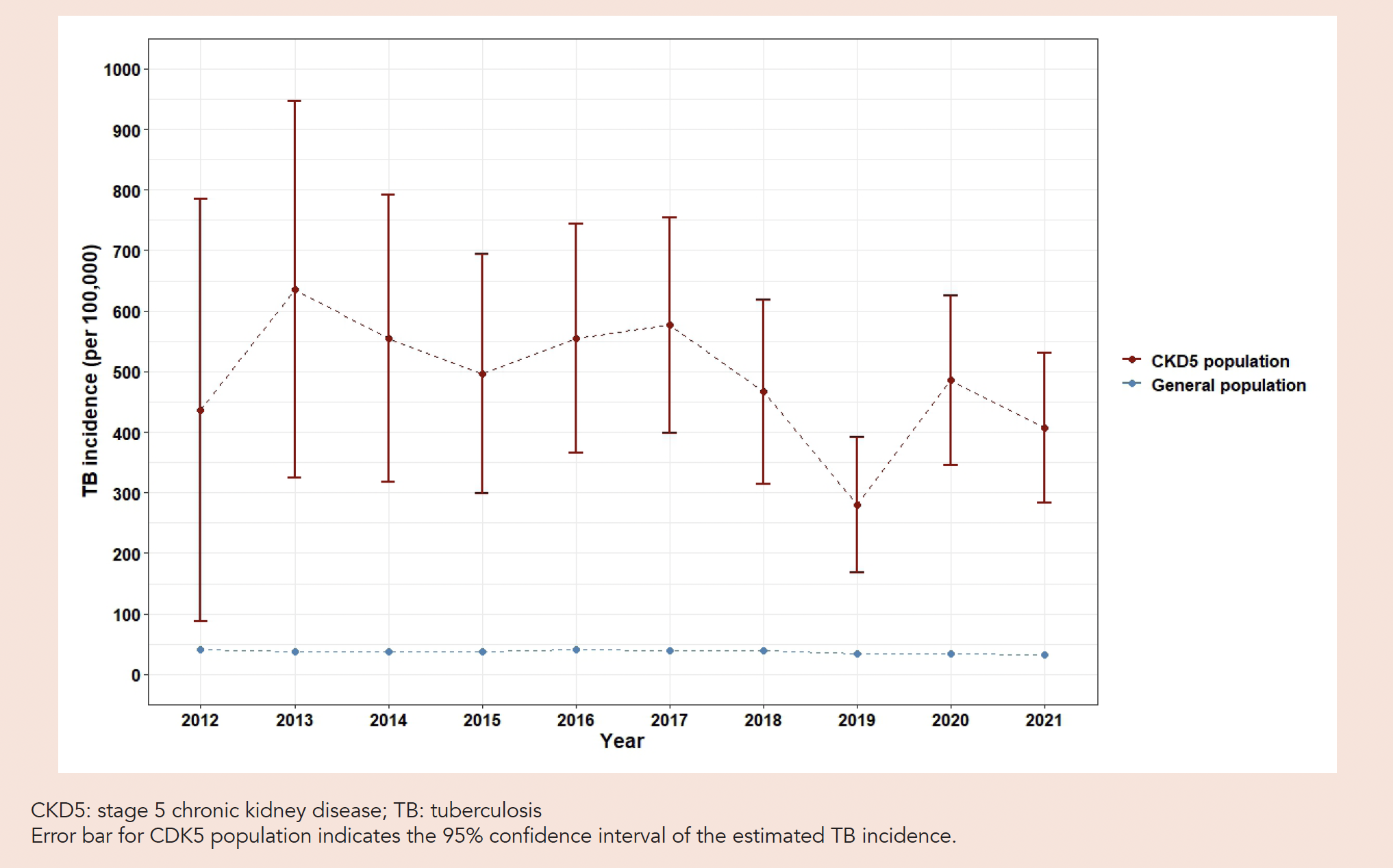
Results: TB incidence among CKD5 patients was significantly higher compared to the general Singapore population, ranging from 279 to 630 per 100,000 CKD5 population over the period from 2012 to 2021, versus 32.6 to 41.1 per 100,000 general population during the same period. In univariable comparisons, statistically significant risk factors for development of TB disease in CKD5 patients were: male sex (odds ratio [OR] 1.66, 95% confidence interval [CI] 1.3–2.12, P<0.001), Malay ethnicity (OR 1.33, 95% CI 1.02–1.72, P=0.03) and reported history of “ever smoking” (OR 2.93, 95% CI 2.15–4.03, P<0.001). CKD5 patients who were on any type of dialysis were also observed to have a significantly higher risk of developing TB disease, haemodialysis (OR 2.31, 95% CI 1.69–3.23, P<0.001), peritoneal dialysis (OR 2.53, 95% CI 1.46–4.23, P=0.001) or a combination of haemodialysis and peritoneal dialysis (OR 2.55, 95% CI 1.63–3.95, P<0.001), compared to those who had not been initiated on dialysis. These factors remained significant in the multivariable models except ethnicity.
Conclusion: CKD5 patients have an increased risk of developing TB, particularly when certain risk factors are present, such as male sex or receiving dialysis. Clinicians should maintain a high degree of suspicion for TB in CKD5 patients with compatible clinical symptoms.
CLINICAL IMPACT
What is New
- This study provides context-specific evidence for evidence on the increased risk of developing tuberculosis among stage 5 chronic kidney disease patients.
- Findings underscore the potential disease burden in this population.
Clinical Implications
- This study can increase awareness among clinicians to maintain a high degree of suspicion of tuberculosis for stage 5 chronic kidney disease patients with compatible clinical symptoms.
Tuberculosis (TB) remains a major global infectious disease threat, particularly to vulnerable people or those in resource-limited settings.1 Estimated TB incidence has continued upward post-COVID-19 pandemic, with a rise of 3.9% between 2020 and 2022 (from 128 to 133 cases per 100,000 population), and reflects a reversal in the progress made over the past 20 years.2 In Singapore, the incidence rate was 28.9 cases per 100,000 population in 2023 compared to 30.4 cases per 100,000 in 20223 and continued a downward trend in 2024 with a reported incidence rate of 27.6 cases per 100,000 residents.4
While TB incidence among residents in Singapore has dropped, a substantial number of TB cases occur in population subgroups who are elderly, immunocompromised, patients with chronic kidney disease or on dialysis.1,2,5-8 Determining the burden of TB in groups at risk is therefore critical in prioritising population groups and interventions to reduce TB transmission.2 Identifying key population groups at risk for TB represents a crucial step to direct efforts and resources for TB screening and the allocation of preventive therapy thereafter. This process aligns with one of the agreed global targets announced at the second United Nations High-Level Meeting on the fight against tuberculosis, held in November 2023, which was to record a 90% increase in TB preventive treatment by 2027.5,9-13 Evidence has consistently shown that within the renal patient population, dialysis patients and renal transplant recipients are at higher risk of developing TB.8,14-17 Chronic renal impairment, with or without progression to dialysis, has been associated with multiple comorbidities including increased risk of infection. The pathogenesis behind this increased risk is based on immune alteration, which is associated with the uraemic state in chronic kidney disease (CKD) leading to impaired T and B cells function.8,18,19 In addition to adaptive immune system alterations, defects in the innate immune system have also been suggested.20
The incidence of stage 5 CKD (CKD5) has increased in Singapore with reported rates of 513.2 per million population in 2018, signalling a 34% rise from 383.9 per million population in 2010.21 The latest Singapore Renal Registry Annual Report in 2022 indicated that the crude incidence rate was 540.5 per million population in 2021, although the age-standardised incidence rate remained stable and ranged between 266.7 and 299.2 per million population during the period from 2012 to 2021.22
In March 2024, Singapore also published updated management guidelines for drug susceptible TB disease and pulmonary disease, which includes screening for TB in dialysis patients.6 The objectives of this study were therefore to (1) determine the incidence of TB disease in CKD5 patients in Singapore and (2) examine specific risk factors associated with developing TB after a diagnosis of CKD5.
METHODS
Study design, setting and population
We conducted a retrospective cohort study of all patients diagnosed with CKD5 who were registered in Singapore’s renal registry and who developed active TB disease between 2012 and 2021, after their CKD5 diagnosis.
The study population included all patients diagnosed with CKD5 with an estimated glomerular filtration rate (eGFR) <15 mL/min/1.73m2, patients on renal replacement therapy, (i.e. haemodialysis), peritoneal dialysis and persons with a renal transplant. The outcome of interest was a diagnosis of active TB following CKD5 diagnosis, obtained after matching patient records in the National TB Registry (2012–2021) with CKD5 cases recorded in the National Renal Registry from 2012–2021 (followed up to 2023).
Data sources
Records from the 2 national registries were matched to conduct this study, both of which collect comprehensive national-level patient data in Singapore. The Renal Registry receives CKD5 case notifications from public hospitals, dialysis centres, private nephrology clinics, kidney transplant centres and the National Organ Transplant Unit Singapore.22 Patient demographics, aetiology of renal disease and kidney function (creatinine, eGFR) at the onset of CKD were collected at the time of CKD5 diagnosis.
Longitudinal data on lifestyle factors—such as history of smoking (categorised as no smoking or ever smoking), comorbidities including diabetes mellitus, cardiovascular disease, acute myocardial infarction, malignancy and disease outcomes or death—were updated yearly. The treatment modality variable was categorised into “haemodialysis (HD), peritoneal dialysis (PD), renal transplant and no dialysis.” Patients coded as “no dialysis” included CKD5 patients with stable eGFR <15 mL/min/1.73m2 not yet initiated on dialysis, as well as those opting for non-dialytic conservative management of renal failure.
Singapore’s National TB Registry records all patients diagnosed with TB disease. Under the Infectious Diseases Act of 1976, TB notification is mandatory. Data fields were predetermined and selected variables were included from each data set, using a codebook for each dataset.
Statistical analysis
The analysis was conducted in 2 parts. After matching the datasets using a unique identifier, the authors derived TB incidence with 95% confidence interval (CI) in the study population, where incidence was defined as the total number of new TB cases each year divided by the total number of CKD5 patients at risk in that same year.
For the second part of the analysis, a multivariable logistic regression model was initially performed to examine factors associated with TB development during the entire study period. This approach provided odds ratios for ever-developing TB, treating it as a binary outcome. A complete case analysis was used; odds ratios and adjusted odds ratios were derived; P values <0.05 were considered statistically significant.
However, given the generally high risk of death in this cohort and the time-to-event nature of TB development, the authors conducted a primary analysis using a competing risks model. This survival analysis approach accounts for death as a competing risk that prevents TB occurrence and treats patients without TB disease who remain alive as censored at last follow-up. The competing risks framework is more appropriate for this study population as it properly handles the substantial mortality risk in CKD5 patients and provides unbiased estimates of TB risk over time.
Cumulative incidence analysis was performed to show the association of risk factors including age at which CKD5 is diagnosed, smoking, history of malignancy and types of dialysis, with the probability of TB disease. Gray’s test was used for equality of cumulative incidence functions across groups of each factor.21 Furthermore, a proportional subdistribution hazard model was fitted to assess the effect of the risk factors on the subdistribution of TB development in a competing risks setting, providing subdistribution hazard ratios that represent effects on cumulative TB incidence.20,22 Results are reported according to the STROBE guidelines for observational studies.23 All analyses were conducted using Stata v16 (StataCorp, College Station, TX, US) and R software (R Core Team, Vienna, Austria).
RESULTS
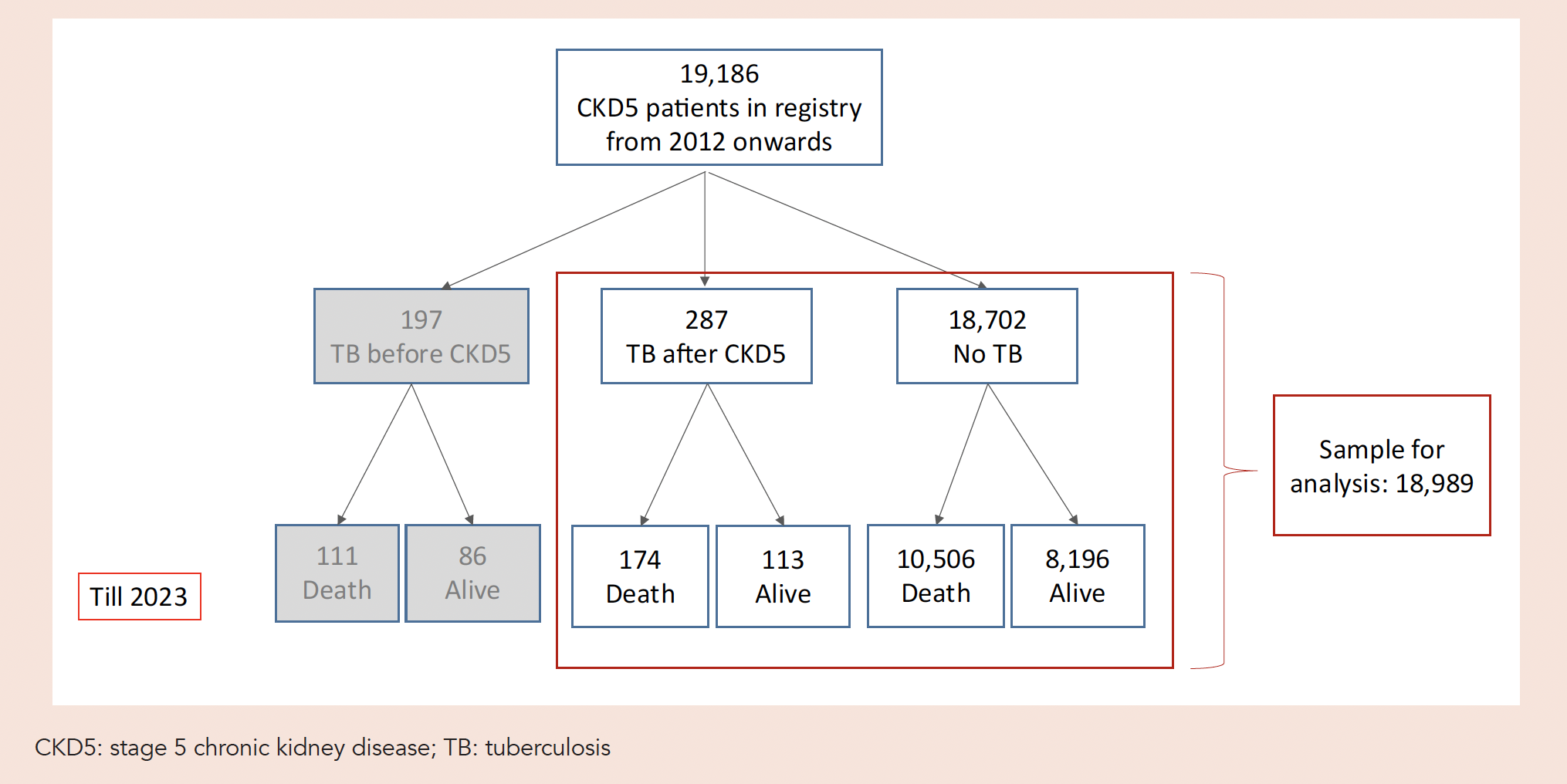
A total of 19,186 patients diagnosed with CKD5 and registered between 2012 and 2021 were included in the study (Fig. 1). After excluding 197 patients diagnosed with TB prior to CKD5 diagnosis, 18,989 eligible CKD5 patients were included in the analysis. A total of 287 eligible CKD5 patients were diagnosed with TB after their CKD5 diagnosis and 18,702 did not develop TB during the study period. Of those CKD5 patients who developed TB, 174 died during the study period, while 113 were still alive. Among the 18,702 CKD5 controls who did not develop TB, 8,196 were still alive by the end of the study period.
Fig. 1. Study sample from the TB (2012–2021) and CKD registries (diagnosed in 2021-2021) with follow-up until 2023.
The annual TB incidence in this cohort of CKD5 patients ranged from 279 to 630 per 100,000 population over the period from 2012 to 2021, significantly higher than annual TB incidence in the general Singapore population which ranged between 32.6 and 41.1 per 100,000 population during the same period (2012–2021). These trends are depicted in Fig. 2. However, given that the vast majority of CKD5 patients were above 50 years of age, which differs from the age structure of the general population, the authors performed an age-adjusted comparison using age-specific TB incidence rates from Singapore’s general population. When applying the general population’s age-specific TB rates to the CKD5 cohort’s age distribution, the authors would expect approximately 95 TB cases per year. In contrast, the authors observed an average of 489 TB cases per year in the CKD5 cohort, representing a 5.2-fold higher risk after accounting for age differences.
Fig. 2. Annual TB incidence in chronic kidney disease patients and in the general population in Singapore.
Univariate analysis of risk factors for TB disease post-CKD5 diagnosis
Description of the study cohort and the univariate analysis of potential risk factors for TB disease in CKD5 patients are shown in Table 1. The mean age of the cohort was 66 years old. CKD5 patients who developed TB were significantly more likely to be male (odds ratio [OR] 1.66, 95% CI 1.3–2.12, P<0.001), Malay (OR 1.33, 95% CI 1.02–1.72, P=0.03) and or report a history of “ever smoking” (OR 2.93, 95% CI 2.15–4.03, P<0.001). In contrast, the 80 years and older age group suggested lower odds of being diagnosed with TB disease (OR 0.38, 95% CI 0.23–0.63, P<0.001) when compared with the age group below 50 years old.
For the CKD5 patients included in the study, nearly one-third (30.8%) did not receive dialysis; 54.2% were on haemodialysis only; 5.4% were on peritoneal dialysis only; and 9.6% had been treated with both haemodialysis and peritoneal dialysis. Renal transplantation was performed in 2.9% of this cohort. CKD5 patients who were on any type of dialysis had significantly increased odds of TB infection; haemodialysis with OR 2.31, 95% CI 1.69–3.23, P<0.001, peritoneal dialysis with OR 2.53, 95% CI 1.46–4.23, P=0.001; or a combination of haemodialysis and peritoneal dialysis with OR 2.55, 95% CI 1.63–3.95, P<0.001, compared to those who had not been initiated on dialysis.
Table 1. Key characteristics of CKD5 patients with and without TB: univariate results and crude odds ratio.
|
Variables |
Total (N=18989) |
TB (N=287) |
Non-TB (N=18702) |
Crude OR |
95% CI |
P value |
|
Sex, n (%) Female Male |
8957 (47.2) 10032 (52.8) |
101 (35.2) 186 (64.8) |
8856 (47.4) 9846 (52.6) |
Reference 1.66 |
Reference (1.3–2.12) |
Reference <0.001 |
|
Age, mean (SD) |
66.3 (14.4) |
63.1 (11.9) |
66.3 (14.4) |
0.99 |
(0.98–0.99) |
<0.001 |
|
Age group, n (%) <50 years old 50–59 years old 60–69 years old 70–79 years old ³80 years old |
2313 (12.2) 3362 (17.7) 5077 (26.7) 4588 (24.2) 3649 (19.2) |
41 (14.3) 68 (23.7) 86 (30) 67 (23.3) 25 (8.7) |
2272 (12.1) 3294 (17.6) 4991 (26.7) 4521 (24.2) 3624 (19.4) |
Reference 1.14 0.95 0.82 0.38 |
Reference (0.78–1.7) (0.66–1.4) (0.56–1.22) (0.23–0.63) |
Reference 0.5 0.809 0.325 <0.001 |
|
Ethnicity, n (%) Chinese Indian Malay Others |
12,756 (67.2) 1407 (7.4) 4469 (23.5) 357 (1.9) |
183 (63.8) 14 (4.9) 85 (29.6) 5 (1.7) |
12,573 (67.2) 1393 (7.4) 4384 (23.4) 352 (1.9) |
Reference 0.69 1.33 0.98 |
Reference (0.38–1.15) (1.02–1.72) (0.35–2.15) |
Reference 0.184 0.03 0.957 |
|
Smoking, n (%) Never Ever NA |
12,103 (63.7) 6196 (32.6) 690 (3.6) |
66 (23) 98 (34.1) 123 (42.9) |
12,037 (64.4) 6098 (32.6) 567 (3) |
Reference 2.93 NA |
Reference (2.15–4.03) NA |
Reference <0.001 NA |
|
eGFR (mL/min) at ESRD, mean (SD) |
12 (4.7) |
11.6 (3.1) |
12 (4.7) |
0.96 |
(0.92–1.01) |
0.109 |
|
Creatinine (mg/dL) at 1st dialysis, mean (SD) |
8.3 (3.5) |
9.1 (3.5) |
8.3 (3.5) |
1.06 |
(1.03–1.1) |
<0.001 |
|
Modality type, n (%) No dialysis PD only HD only PD + HD |
5854 (30.8) 1019 (5.4) 10298 (54.2) 1818 (9.6) |
46 (16) 20 (7) 185 (64.5) 36 (12.5) |
5808 (31.1) 999 (5.3) 10113 (54.1) 1782 (9.5) |
Reference 2.53 2.31 2.55 |
Reference (1.46–4.23) (1.69–3.23) (1.63–3.95) |
Reference 0.001 <0.001 <0.001 |
|
Transplant, n (%) Yes |
18,432 (97.1) 557 (2.9) |
284 (99) 3 (1) |
18148 (97) 554 (3) |
Reference 0.35 |
Reference (0.09–0.91) |
Reference 0.068 |
|
Diabetes mellitus, n (%) Non- diabetic Diabetic NA |
5096 (26.8) 13,892 (73.2) 1 (0) |
79 (27.5) 208 (72.5) NA |
5017 (26.8) 13,684 (73.2) 1 (0) |
Reference 0.97 NA |
Reference (0.75–1.26) NA |
Reference 0.791 NA |
|
Malignancy, n (%) No Yes NA |
16,667 (87.8) 2321 (12.2) 1 (0) |
266 (92.7) 21 (7.3) NA (NA) |
16,401 (87.7) 2300 (12.3) 1 (0) |
Reference 0.56 NA |
Reference (0.35–0.86) NA |
Reference 0.012 NA |
CI: confidence interval; eGFR: estimated glomerular filtration rate; ESRD; end-stage renal disease; HD: haemodialysis; NA: not available; PD: peritoneal dialysis; OR: odds ratio; SD: standard deviation; TB: tuberculosis
P values in bold denote statistical significance.
Multivariable analysis of risk factors for TB disease post-CKD5 diagnosis
Results from multivariable logistic regression showed that male sex, age >80 years, having ever smoked, dialysis and presence of malignancy were independently associated with the development of TB disease in people with CKD5, which are shown in Table 2. Creatinine and eGFR were excluded from the model, given that 20% of values were missing for these variables.
The statistical modelling demonstrates that being 80 years and above was associated with a lower odds of developing TB disease (adjusted odds ratio [aOR] 0.41, 95% CI 0.19–0.85, P=0.020). Haemodialysis and peritoneal dialysis remained associated with increased odds of TB disease (aOR 2.04, 95% CI 1.24–3.52, P=0.007 and aOR 2.38, 95% CI 1.10–4.97, P=0.023, respectively). Similarly, reporting a history of ever smoking was positively correlated with a higher odds of TB disease post-CKD5 diagnosis (aOR 2.19, 95% CI 1.53–3.15, P<0.001).
Table 2. Adjusted odds ratio and 95% confidence interval for TB disease in CKD5 patients from a multivariable logistic model.
|
Variable |
aOR |
95% CI |
P value |
|
Age group <50 years old 50–59 60–69 70–79 80 and above |
reference 1.12 0.73 0.63 0.41 |
reference (0.71–1.78) (0.46–1.18) (0.37–1.07) (0.19–0.85) |
reference 0.636 0.197 0.089 0.020 |
|
Sex Female Male |
reference 1.51 |
reference (1.01–2.29) |
reference 0.049 |
|
Ethnicity Chinese Indian Malay Others |
reference 0.62 1 0.84 |
reference (0.29–1.17) (0.69–1.42) (0.21–2.25) |
reference 0.178 0.985 0.767 |
|
Dialysis modality No dialysis PD only HD only PD + HD |
reference 2.38 2.04 1.65 |
reference (1.1–4.97) (1.24–3.52) (0.82–3.29) |
reference 0.023 0.007 0.152 |
|
Never smoked Ever smoked |
reference 2.19 |
reference (1.53–3.15) |
reference <0.001 |
|
Diabetes |
0.66 |
(0.47–0.92) |
0.013 |
|
History of malignancy |
0.57 |
(0.29–1.02) |
0.080 |
aOR: adjusted odds ratio; CI: confidence interval; HD: haemodialysis; PD: peritoneal dialysis
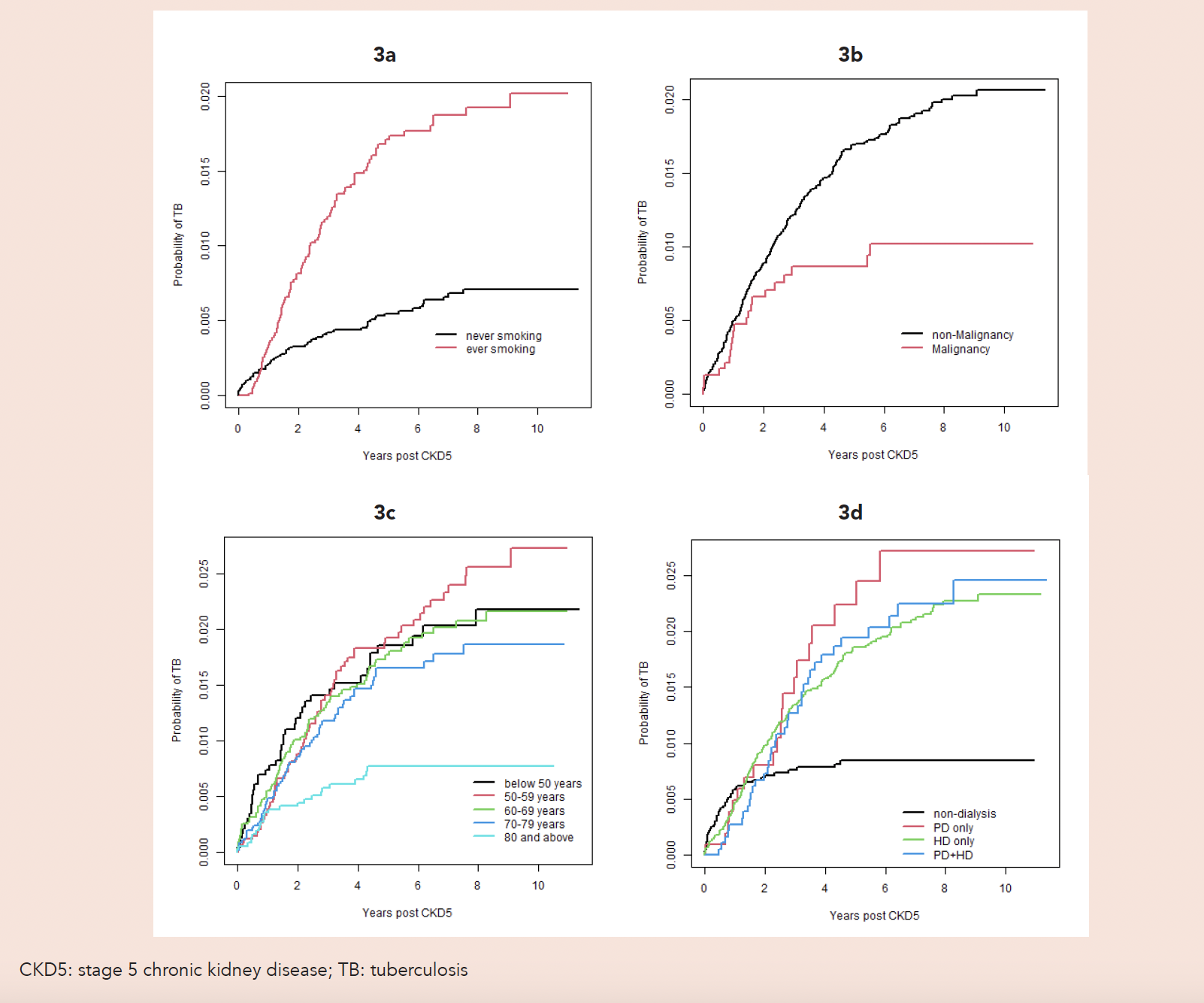
The plots of cumulative incidence for TB show those 4 risk factors that significantly impact the probability of TB disease over a period of 10 years post-CKD5 diagnosis. Having never smoked, history of malignancy, being 80 years and above and CKD5 “not on dialysis” correlated with lower risk of TB disease (Fig. 3). Competing risk comparisons for key variables are shown in Supplementary Table S1.
Fig. 3. Estimated cumulative incidence curves of TB disease with death as competing event (death was not plotted) for significant risk factors: smoking (3a), history of malignancy (3b), age groups(3c) and CKD5 treatment modality (3d).
Results from a proportional subdistribution hazards regression model are shown in Table 3. Male sex was significantly associated with an increased risk of TB disease in patients with CKD5 (adjusted hazard ratio [aHR] 1.72, 95% CI 1.30–2.28). Dialysis, regardless of modality, was associated with an increased risk of developing TB disease (aHR 2.05, 95% CI 1.18–3.58 for haemodialysis only; aHR 1.7, 95% CI 1.16–2.5 for peritoneal dialysis only; and aHR1.76, 95% CI 1.08–2.88 for those receiving both modalities). In contrast, a history of malignancy was significantly associated with a lower risk of TB disease (aHR 0.61, 95% CI 0.39–0.96). In this model, age, diabetes and smoking status were not significant.
Table 3. Relative risk of each risk factor for TB disease in CKD5 patients from a proportional sub-distribution hazards regression model.
|
Variable |
Sub-distribution hazard ratio Adjusted (relative risk) |
95% CI |
P value |
|
Age group <50 years old 50–59 years old 60–69 years old 70–79 years old 80 years old and above |
Reference 1.13 1.05 0.63 1.72 |
Reference (0.76–1.68) (0.72–1.55) (0.69–1.61) (0.36–1.1) |
Reference 0.540 0.790 0.810 0.100 |
|
Sex Female Male |
Reference 1.72 |
Reference (1.3–2.28) |
Reference <0.001 |
|
Ethnicity Chinese Indian Malay Others |
Reference 0.65 1.28 0.92 |
Reference (0.37–1.11) (0.98–1.66) (0.38–2.24) |
Reference 0.120 0.072 0.860 |
|
Dialysis modality No dialysis PD only HD only PD + HD |
Reference 2.05 1.7 1.76 |
Reference (1.18–3.58) (1.16–2.5) (1.08–2.88) |
Reference 0.011 0.007 0.024 |
|
Diabetes |
0.92 |
(0.7–1.21) |
0.55 |
|
History of malignancy |
0.61 |
(0.39–0.96) |
0.031 |
CKD5: stage 5 chronic kidney disease; HD: haemodialysis; PD: peritoneal dialysis; TB: tuberculosis
DISCUSSION
TB incidence in CKD5 patients versus general population
The findings suggest a significantly higher incidence of TB disease in patients with CKD5, compared to the incidence of TB disease in the general Singapore resident population (406 per 100,000 population vs 32.6 per 100,000 in 2021) over the same period. A similar study, conducted in 2011 by Dobbler et al., found TB incidence to be 66.8 per 100,000 population per year in CKD patients receiving dialysis in Australia, compared to the general population incidence of 5.7 per 100,000 population.15 This study—conducted in a medium TB incidence setting with overall incidence adjusted for TB incidence by country of birth—echoes findings observed in several other international studies.17,8 In a recent study published in the US population, TB incidence in the kidney failure population ranged from 26.1 to 45.4 per 100,000 population, in contrast with general population TB incidence of 2.1 to 3.5 per 100,000 population.24 The findings are also consistent with evidence on the vulnerability of CKD patients to TB, attributable to alterations in the immune system resulting from elevated uraemia and impairment of humoral and cell-mediated immune function. 8,18,20
Of the patients included in the study, the odds of TB disease for patients on dialysis were at least two-fold higher than those who never received dialysis. The authors postulate the reason for this is the competing risk of death in patients with CKD5 who did not receive dialysis, as this group of patients likely died before they had time to develop or reactivate TB disease, compared to those who received dialysis. Second, dialysis patients—especially those on haemodialysis—are at a greater risk of TB as they are often younger and therefore had a longer time to develop or reactivate TB.
Risk factors for TB in CKD patients
The study found several risk factors associated with developing TB disease following a CKD5 diagnosis: they included being male, of Malay ethnicity and having a history “ever smoking”. Other studies have also found significant associations between smoking and TB, including a study of latent TB infection (LTBI) in CKD patients in Indonesia by Bandiara et al. which found Interferon-gamma Release Assay (IGRA) positivity to be more frequent in smokers.14 Cigarette smoke contains harmful components which lead to peribronchial inflammation and fibrosis, disruption of mucociliary clearance and subsequently increase susceptibility to pulmonary infections including TB progression. However, they did not observe significant association between age and sex otherwise.14
In this analysis, it is observed that the age group 80 years old and above correlated with a lower rate of TB disease compared to the age group below 50 years old. The authors also found that 74% of CKD5 patients who were not on dialysis were aged >70 years old. This is likely a reflection of an individualised clinical decision-making process made between the managing renal physician with the patient after weighing risks and benefits of dialysis initiation including the impact on quality of life and expected survival outcomes.25 The authors hypothesised that the seemingly lower risk for TB disease in CKD5 patients aged 80 years and above may be due to the shorter time and lower chance they have of developing TB prior to death from other causes, rather than a protective effect of older age. Another potential explanation for this could be that elderly patients may have increased social isolation and frailty.26 This hypothesis may be borne out in another study where most TB-dialysis patients were also in the age range 55–74 years.14 These findings would suggest that patients of advanced age may benefit the least from TB screening, as compared to younger patients, given the high competing risk of death.
Additionally, the observation of higher odds of TB in dialysed patients is consistent with findings from studies modelling transmission in enclosed and less ventilated, institutional settings like dialysis centres—showing that TB transmission may be facilitated especially when patients attend 3 times a week.7,27 Dialysis centres are often environments with closed, limited air exchanges per hour and minimal UV light exposure thereby providing an ideal environment for airborne particles containing M. tuberculosis to remain viable and infectious.7,27 Measuring TB transmission is challenging as it depends on multiple factors, such as the infectiousness of the index patient, the immunity of exposed individuals, the frequency and proximity of exposure and lastly the environment in which the exposure occurred.7
CKD5 patients with a history of malignancy were less likely to develop TB disease although the authors believe this may result from other confounding factors either directly or indirectly related to the malignancy itself. Often, patients who are diagnosed with malignancy undergo screening for TB infection prior to most chemotherapy regimens. They might therefore have been diagnosed with TB infection and received preventive therapy, which subsequently reduces the risk of TB reactivation. Alternatively, they may not have had enough time to develop TB disease given their individualised limited prognosis and lifespan from the malignancy point of view.
Case detection and screening for TB
Given the findings of a higher incidence of TB in patients with CKD5, particularly those on dialysis, the authors would suggest increased vigilance in this patient population to test for TB, with the understanding that the clinical presentation of TB in dialysis patients is often atypical.8 The presence of unexplained systemic symptoms should prompt a detailed clinical history and physical examination, and a high suspicion of TB disease including extrapulmonary disease.8
Further, given the high incidence of TB, patients with CKD5 who are planned for initiation of dialysis or already on dialysis could benefit from latent TB screening. This typically involves screening with IGRA. A positive IGRA test would likely lead to efforts to exclude active TB, which would typically include a chest X-ray, acid-fast bacilli smear and mycobacterial cultures. These tests would help to differentiate between LTBI and asymptomatic TB disease.15,28 Those diagnosed with LTBI would typically be treated with a 4-month course of rifampicin. The treatment of LTBI and/or TB disease would not only provide individual benefits, but also be beneficial from a public health perspective. This is in line with the updated Singapore Tuberculosis Management Guidelines 2024.6,28 However, the cost effectiveness of this approach is unclear and requires further analysis.29
Study strengths and limitations
The main strength of this study includes access to 2 well-established, systematic national registries with comprehensive data on key outcomes and variables of interest. The authors’ primary analysis therefore used a complete case analysis and used independent variables with the least missing values for statistical modelling (max 10–20%). The large number of patients included in the analysis allows generalisability of the findings to the Singapore’s local context.
However, the authors identified that a major limitation was the lack of complete data for certain variables; for instance, eGFR values were unavailable for 35% of the TB cohort. While missing data may have influenced results by excluding observations from the model fitting, to address this concern a sensitivity analysis was conducted using multiple imputation to handle the missing values. Multiple imputation were performed, accounting for the probability of missingness and both the multivariable logistic regression and Fine-Gray competing risks models were re-run including the imputed values. The results from the sensitivity analysis were consistent with the main findings. Another limitation of this study was the reliance on established registry datasets, which may not collect all variables desired for the authors’ analysis, including the proportion of pulmonary TB versus extra-pulmonary TB in CKD5 patients or the proportion of CKD5 patients who received or did not receive a tuberculin skin test or IGRA testing upon dialysis initiation or as part of their CKD work-up. While this may not have influenced the results, these variables could provide additional insights into TB prevalence in the CKD5 patients locally and should be considered in future analysis.
CONCLUSION
The findings strengthen the evidence on the increased risk among CKD5 patients of developing TB disease, compared to the general population, especially in a moderate TB incidence country with a growing CKD5 population such as Singapore. This, together with the risk factors associated with developing TB disease in this population group—being male, of Malay ethnicity, having a history of smoking or receiving dialysis—should be considered to target case detection and screening for TB in CKD5 patients. Further studies are also needed to assess the interval benefit of latent TB screening, to assess the feasibility and cost-effectiveness of reducing TB incidence in the CKD5 population in Singapore and to quantify the magnitude of benefit from treating LTBI in a population with high-competing risk of death.
Supplementary materials
Table S1. STROBE Statement—Checklist of items that should be included in reports of cohort studies.
Table S2. Competing risk comparisons for key variables.
REFERENCES
- Litvinjenko S, Magwood O, Wu S, et al. Burden of tuberculosis among vulnerable populations worldwide: an overview of systematic reviews. Lancet Infect Dis 2023;23:1395-407.
- Global Tuberculosis Report 2023. Geneva: World Health Organization; 2023.
- Communicable Diseases Agency, Singapore. Tuberculosis. https://www.cda.gov.sg/professionals/diseases/tuberculosis#5eced111b89ec60dcb0301ee6c5022e6. Accessed 25Jul 2025 .
- Ministry of Health, Singapore. Update on Tuberculosis Situation in Singapore. 23 March 2025 https://www.moh.gov.sg/newsroom/update-on-tuberculosis-situation-in-singapore-2025. Accessed 25Jul 2025.
- Bruchfeld J, Correia-Neves M, Kallenius G. Tuberculosis and HIV coinfection. Cold Spring Harb Perspect Med 2015;26;5:a017871.
- Teng AML, Min CS, Tim-Ee CL, et al. Singapore tuberculosis (TB) clinical management guidelines 2024: A modified Delphi adaptation of international guidelines for drug-susceptible TB infection and pulmonary disease. Ann Acad Med Singap 2024;53:170-86.
- Heemskerk D, Caws M, Marais B, et al. Tuberculosis in Adults and Children. London: Springer; 2015.
- Romanowski K, Clark EG, Levin A, et al. Tuberculosis and chronic kidney disease: an emerging global syndemic. Kidney Int 2016;90:34-40.
- Goldfeld A, Ellner JJ. Pathogenesis and management of HIV/TB co-infection in Asia. Tuberculosis 2007;87:S26-30.
- Mathema B, Andrews JR, Cohen T, et al. Drivers of Tuberculosis Transmission. Journal of Infectious Diseases 2017;216:S644-53.
- Selwyn PA, Hartel D, Lewis VA,et al. A prospective study of the risk of tuberculosis among intravenous drug users with human immunodeficiency virus infection. N Engl J Med. 1989;320:545-50.
- WHO Guidelines on Infection Prevention and Control for Tuberculosis 2019 Update. Geneva: World Health Organization; 2019.
- Tubach F, Salmon D, Ravaud P, et al. Risk of tuberculosis is higher with anti-tumor necrosis factor monoclonal antibody therapy than with soluble tumor necrosis factor receptor therapy: The three-year prospective French research axed on tolerance of biotherapies registry. Arthritis Rheum 2009;60:1884-94.
- Bandiara R, Indrasari A, Dewi Rengganis A, et al. Risk factors of latent tuberculosis among chronic kidney disease with routine haemodialysis patients. J Clin Tuberc Other Mycobact Dis 2022;27:100302.
- Dobler CC, McDonald SP, Marks GB. Risk of Tuberculosis in Dialysis Patients: A Nationwide Cohort Study. PLoS One 2011;6:e29563.
- Ruzangi J, Iwagami M, Smeeth L, et al. The association between chronic kidney disease and tuberculosis; A comparative cohort study in England. BMC Nephrol 2020;21:420.
- Al-Efraij K, Mota L, Lunny C, Schachter M, Cook V, Johnston J. Risk of active tuberculosis in chronic kidney disease: A systematic review and meta-analysis. Int J Tuberc Lung Dis 2015;19:1493-9.
- Okada RC, Barry PM, Skarbinski J, et al. Epidemiology, detection, and management of tuberculosis among end-stage renal disease patients. Infect Control Hosp Epidemiol 2018;39:1367-74.
- Lim WH, Kireta S, Leedham E, et al. Uremia impairs monocyte and monocyte-derived dendritic cell function in hemodialysis patients. Kidney Int 2007;72:1138-48.
- Betjes MGH. Immune cell dysfunction and inflammation in end-stage renal disease. Nat Rev Nephrol 2013;9:255-65.
- Khan BA, Singh T, Ng ALC, et al. Health economics of kidney replacement therapy in Singapore: Taking stock and looking ahead. Ann Acad Med Singap. 2022;51:236-40.
- Khor L, Ghim A, Ms S, et al. Singapore Renal Registry Annual Report 2022 National Registry of Diseases Office. Singapore: National Registry of Diseases Office Registry Coordinators; 2024.
- Cuschieri S. The STROBE guidelines. Saudi J Anaesth 2019;13:S31-4.
- Schildknecht KR, Deutsch-Feldman M, Cummins J, et al. Tuberculosis in the US Kidney Failure Population. J Am Soc Nephrol 2025:23;36:1391-17.
- Ahmed FA, Catic AG. Decision-making in geriatric patients with end-stage renal disease: Thinking beyond nephrology. J Clin Med 2019;8:5.
- Davies K, Maharani A, Chandola T, et al. The longitudinal relationship between loneliness, social isolation, and frailty in older adults in England: a prospective analysis. Lancet Healthy Longev 2021;2:e70-7.
- Escombe AR, Oeser CC, Gilman RH, et al. Natural ventilation for the prevention of airborne contagion. PLoS Med 2007;4:e68.
- WHO Consolidated Guidelines on Tuberculosis. Module 2: Screening – Systematic Screening for Tuberculosis Disease. Geneva: World Health Organization; 2021.
- Sturman J, Baharani J, Ashman J, et al. Screening for latent tuberculosis infection in patients with chronic kidney disease: a review of evidence and current practice in the UK. Clin Kidney J 2025;18:sfaf197.
Patient data were aggregated and de-identified for this research, and the use was approved by the Ministry of Health as custodians of the TB Registry, and the National Registry of Diseases Office Policy, Research and Surveillance Division for the Renal Registry data (10/09/2025).
The authors declare there are no affiliations with or involvement in any organisation or entity with any financial interest in the subject matter or materials discussed in this manuscript. All authors have no conflicts of interest to declare. This research received no specific grant from any funding agency.
Dr Deborah Hee Ling Ng, National TB Programme, Communicable Diseases Agency, Singapore, 238A Thomson Road, A, #23-01 to 05 Novena Square Tower, Singapore 307684. Email: [email protected]
