

 Dear Editor,
Global ageing has led to a rise in osteoporosis1 and fragility fractures, which are fractures that occur due to low-energy trauma. Upper limb fragility fractures, particularly proximal humerus and distal radius fractures, are known risk factors for future hip fractures.2 Clinical guidelines recommend secondary preventive assessments and interventions after any fragility fracture. These include fall risk evaluation, lifestyle modifications, calcium and vitamin D supplementation, and bone mineral density (BMD) testing to detect and guide osteoporosis treatment.3 However, implementation rates of secondary prevention after upper limb fractures remain poorly studied.
Our study primarily aimed to investigate the prevalence of prior upper limb fragility fractures in a hip fracture cohort. Our secondary aims were to analyse implementation rates of secondary prevention measures after the upper limb fracture, and compare the function of hip fracture patients with and without prior upper limb fractures.
We conducted a retrospective cohort study of patients in a prospective hip fracture registry admitted between January 2012 and June 2020 to Tan Tock Seng Hospital, a major trauma centre in Singapore. Patients with pathological fractures or high-energy trauma were excluded. For patients with multiple hip fractures, only the first was included. We identified patients who had an upper limb fragility fracture of the proximal humerus, distal humerus or distal radius prior to the hip fracture.
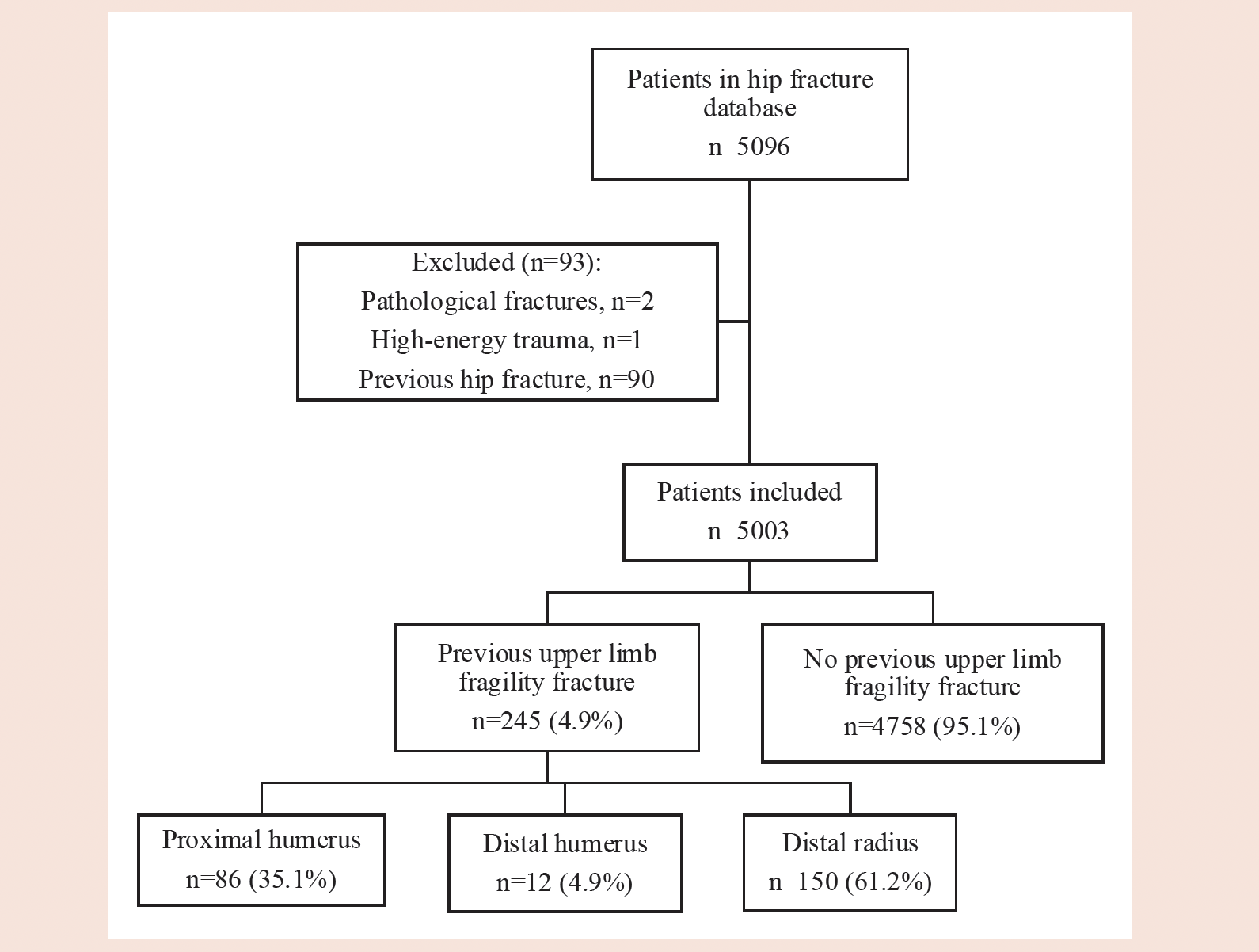
Among 5003 hip fracture patients (Fig. 1), 245 (4.9%) had a previous upper limb fragility fracture. The upper limb fracture was sustained at a mean age of 77 (standard deviation [SD] 8.9), and the hip fracture at 82 (SD 8.6). The upper limb fracture occurred a mean of 52 months (SD 41.2) before the hip fracture. Patients were mostly female (206/245, 84.1%) and ambulant independently without aid (227/245, 75.9%). Distal radius (150/245, 61.2%) and proximal humerus (86/245, 35.1%) fractures were most common. Regarding risk factors for falls, 28.2% (69/245) had a previous hospital encounter for a fall, and 61.2% (150/245) had comorbidities predisposing them to falls, most frequently diabetes (73/245, 29.8%), lower limb arthritis (61/245, 24.9%), cardiovascular disease (41/245, 16.7%) or stroke (31/245, 12.7%).
Fig. 1. Flowchart of study cohort derivation.
Despite these risk factors, 80.8% (198/245) did not undergo BMD testing after their upper limb fracture. Among those tested, 86.7% (39/47) were osteoporotic and the rest were osteopaenic. The mean Singapore fracture risk assessment tool 10-year risk was 29.1% (SD 12.1%) for a major osteoporotic fracture and 15.7% (SD 8.6%) for a hip fracture. The majority (192/245, 78.4%) were not prescribed osteoporosis medications. Additionally, most were not subjected to fall prevention interventions; 49.4% (121/245) had no fall risk assessment, 64.9% (159/245) had no vision assessment, and 51.4% (126/245) had no physiotherapy.
Of the 245 patients, 80 (32.7%) had at least 1 new fall or fracture before their hip fracture. Among them, 60.0% (48/80) sustained a new fracture. Most of these (42/80, 52.5%) were fragility fractures, most commonly of the distal radius (20/80, 25.0%), humerus (11/80, 13.8%), vertebra (10/80, 12.5%) or pubic ramus (7/80, 8.8%). Even after these events, 72.5% (58/80) did not undergo BMD testing and 81.3% (65/80) were not prescribed osteoporosis medications. Among patients with new fragility fractures, 69.0% (29/42) did not undergo BMD testing and 83.3% (35/42) were not prescribed osteoporosis medications.
Patients with prior upper limb fractures were more likely to be homebound (adjusted odds ratio 1.55, 95% confidence interval 1.07–2.23, P=0.020). While they had lower abbreviated mental test (mean 5.92, SD 3.43 versus [vs] mean 6.96, SD 6.57, P=0.057) and Modified Barthel Index scores (median 90, interquartile range [IQR] 79–98 vs median 90, IQR 83–100, P=0.132), these differences were not significant after adjusting for age and gender. Age-adjusted Charlson Comorbidity Index was similar between the 2 groups (mean 5.53, SD 3.48 vs mean 6.96, SD 6.57, P=0.242).
Our findings highlight a significant prevalence of prior upper limb fragility fractures in a hip fracture cohort. The “osteoporotic career” has been described in which patients have a sequence of fragility fractures, starting with wrist fractures and leading up to hip fractures.4 Despite this, rates of secondary prevention after the upper limb fracture were low, and remained inadequate even after a second fall or fracture. All patients who underwent BMD testing after the upper limb fracture were osteoporotic or osteopaenic, suggesting underdiagnosis in the majority who were not screened.
Possible barriers to secondary prevention include low physician awareness that certain types of upper limb fractures are osteoporotic fractures,5 lack of willingness from orthopaedic surgeons to manage osteoporosis,6 and inadequate interdisciplinary communication.7 Patients may also underestimate their fracture risk, resulting in reduced adherence to follow-up and treatment.8
Concerningly, rates of fall prevention interventions such as fall risk assessment, vision assessment and physiotherapy were inadequate. This is despite many patients having risk factors for future falls such as a previous fall or comorbidities that predispose them to falls. Fall risk assessment and prevention are key aspects of secondary fracture prevention.9 International guidelines recommend a multicomponent fall risk assessment to identify modifiable risk factors, including mobility issues, vision and hearing problems, diseases and medications, nutrition and environmental factors.10 The failure to implement fall prevention represented opportunities to prevent future fractures and their associated morbidity.
Our study’s strengths include its large sample size and the use of a well-established hip fracture registry with prospectively collected data. The study also had limitations. As a retrospective study, causal relationships could not be established. While the electronic medical records system captured most medical records from public healthcare institutions, some records, especially those from private institutions or from the years prior to widespread adoption of the electronic records system, could not be accessed. Finally, our study was not scoped to identify reasons for the low rates of secondary prevention.
In conclusion, this study underscores the urgent need to improve fall risk interventions and osteoporosis screening and treatment in patients with upper limb fragility fractures. In view of the rapidly ageing population and rising burden of osteoporosis in Asia, stakeholders—including orthopaedic surgeons, geriatricians, policymakers and insurers—must urgently implement structured programmes to ensure that every fragility fracture event leads to appropriate osteoporosis and fall risk assessments.
Acknowledgement
The authors thank Ms Stephanie Tai Wai Ling for her assistance with data collection and extraction.
References
- Salari N, Ghasemi H, Mohammadi L, et al. The global prevalence of osteoporosis in the world: a comprehensive systematic review and meta-analysis. J Orthop Surg Res 2021;16:609.
- Shoji MM, Ingall EM, Rozental TD. Upper Extremity Fragility Fractures. J Hand Surg Am 2021;46:126-32.
- Mitchell P, Magaziner J, Costa M, et al. FFN Clinical Toolkit. Zurich: Fragility Fracture Network 2020. https://www.fragilityfracturenetwork.org/wp-content/uploads/2020/10/FFNClinicalToolkit_English_v1_web.pdf. Accessed 13 March 2024.
- Akesson K, Mitchell P. Capture the Fracture: A Global Campaign to Break the Fragility Fracture Cycle. Nyon: International Osteoporosis Foundation; 2012. https://share.osteoporosis.foundation/WOD/2012/report/WOD12-Report.pdf. Accessed 28 March 2024.
- Kim TI, Choi JH, Kim SH, et al. The Adequacy of Diagnosis and Treatment for Osteoporosis in Patients with Proximal Humeral Fractures. Clin Orthop Surg 2016;8:274-9.
- Barton DW, Griffin DC, Carmouche JJ. Orthopedic surgeons’ views on the osteoporosis care gap and potential solutions: survey results. J Orthop Surg Res 2019;14:72.
- Benzvi L, Gershon A, Lavi I, et al. Secondary prevention of osteoporosis following fragility fractures of the distal radius in a large health maintenance organization. Arch Osteoporos 2016;11:20.
- Langer FW, da Silveira Codevilla AA, Bringhenti R, et al. Low self-awareness of osteoporosis and fracture risk among postmenopausal women. Arch Osteoporos 2016;11:27.
- Ambrose AF, Cruz L, Paul G. Falls and Fractures: A systematic approach to screening and prevention. Maturitas 2015;82:85-93.
- Montero-Odasso M, van der Velde N, Martin FC, et al. World guidelines for falls prevention and management for older adults: a global initiative. Age Ageing 2022;51:afac205. Erratum in: Age Ageing 2023;52:afad188. Erratum in Age Ageing 2023;52:afad199.
Ethics approval was granted by the National Healthcare Group Domain Specific Review Board (2022/00402).
All authors have no affiliations or financial involvement with any commercial organisation with a direct financial interest in the subject or materials discussed in the manuscript.
Dr Bryan Yijia Tan, Department of Orthopaedic Surgery, Woodlands Health, 17 Woodlands Drive 17, Singapore 737628. Email: [email protected]
