

ABSTRACT
Introduction: Antimicrobial resistance (AMR) poses a critical global health threat, with millions of deaths attributed to it annually. Antibiotic stewardship to combat AMR is the responsibility of all healthcare professionals. Despite evidence suggesting that it is unnecessary, dentists routinely prescribe prophylactic antibiotics following third molar (3M) surgeries.
Method: This mixed-methods study examined the behavioural barriers influencing antibiotic prescribing practices within the Division of Oral and Maxillofacial Surgery at the National University Centre for Oral Health Singapore. This study used the capability, opportunity and motivation for behavioural change or COM-B framework to implement interventions targeting the behavioural barriers.
Results: Pre- and post-intervention data over 6 months showed a significant reduction in antibiotic prescriptions from 84.45% to 20.89%, following the implementation of COM-B strategies (P<0.001). Qualitative feedback from focus group discussions highlighted a positive shift in clinicians’ attitudes towards antibiotic reduction, acknowledging the minimal infection risk associated with non-prescribing practices. Notably, complication rates remained stable throughout the study period, indicating no adverse effects from reduced antibiotic usage.
Conclusion: These findings demonstrated that the COM-B model can be successfully applied to modify deeply ingrained prescription habits, and underscored the effectiveness of a structured behavioural change intervention in enhancing compliance with antibiotic stewardship guidelines. The study advocates continuation of initiatives to sustain this positive trend and mitigate AMR in clinical practice.
CLINICAL IMPACT
What is New
- This study demonstrated the effectiveness of an antibiotic stewardship programme to reduce antibiotic prescription by dental practitioners in Singapore.
Clinical Implications
- The COM-B approach is an effective tool to induce behavioural change in antibiotic prescription.
- Demonstrated reduction in antibiotic prescription can bolster confidence in dental practitioners to reduce unnecessary antibiotic prescription.

Antimicrobial resistance (AMR) is a critical global public health crisis, associated with 4.7 million deaths worldwide in 2021 alone.1 Antibiotic stewardship is one of the key interventions in the World Health Organization’s multipronged strategy to combat AMR.2 Antibiotic stewardship is a systematic approach aimed to educate and support healthcare professionals in adhering to evidence-based guidelines for antibiotic prescription and administration.
In the field of dentistry, the surgical removal of the third molar (3M) is the most common procedure leading to antibiotic prescription.3 Prophylactic antibiotics are frequently prescribed due to concerns about post-surgical infections given the constant exposure of the surgical site to oral microflora.3 However, systematic reviews demonstrated low infection rates, and the numbers needed to treat ranged from 15 to 19.4-6 Consequently, a growing consensus suggests that prophylactic antibiotics are unnecessary for 3M removals, particularly in healthy adults.4-6
Despite the scientific evidence, many clinicians continue to inappropriately prescribe antibiotics due to various behavioural barriers. These include biases based on past experiences, pressure to prescribe, comfort with existing prescribing practices and a disconnect from the issue of antibiotic resistance.7
Behaviour change is needed to improve compliance with antibiotic stewardship. While there are many models or strategies available to bring about behavioural change, the COM-B framework is particularly useful for identifying the factors affecting behaviour in a structured manner.8,9 Interventions can then be designed based on the factors identified.8 The COM-B framework proposes that behavioural change is influenced by 3 factors: capability, opportunity and motivation.8 Capability encompasses the knowledge, skills and abilities required to perform the desired behaviour. Opportunity refers to external factors that facilitate behavioural change while motivation refers to the internal processes that drive the individual towards the change. Implementing interventions that target these 3 factors are more likely to result in effective behavioural changes.9
Wilding et al. employed COM-B to sequentially identify factors that required correction and determined that an animated film to convey antimicrobial stewardship messages would be the most effective.10 Participants (n=211) who viewed the test film were statistically significantly less likely to ask their doctor or dentist for antibiotics if they could do without it as compared to participants who viewed the control film (n=206). Similarly, Hayes et al., under the UK AMR National Action Plan, developed the Antibiotic Guardian Youth Badge, a paediatric AMR programme with the aid of the COM-B model. Only 7% of participants (n=147) indicated that they would not adhere to the recommendations of only taking antibiotics when they really need it.11 Like many prior studies on AMR, most studies only investigated how the COM-B model was applied or determined the effectiveness of the model based on qualitative measures.10-13
As part of the appropriate care initiative, an antibiotic stewardship programme utilising the COM-B approach was implemented. This study aimed to use the COM-B approach to develop interventions and evaluate the effectiveness of these interventions.
METHOD
Baseline antibiotic practices
The prevailing antibiotic prescription practice within the Division of Oral and Maxillofacial Surgery (OMS) was established through a retrospective review of all patients who underwent surgical removal of their 3M at the National University Center for Oral Health Singapore from 1 May to 31 July 2024 (pre-intervention period). Ethics review exemption (review not required) was granted by National Healthcare Group Domain Specific Review Board (NHG DSRB Ref 2024-4480). Data were extracted from their electronic health records (Epic; Epic Systems Corporation, Wisconsin, US), including patient demographics (age, sex, medical history and drug allergy), teeth removed, antibiotic prescription details and postoperative complications. The data were extracted by a clinician who was not involved in the clinical care of the patients and analysed in their anonymised form by the authors. The purpose of the analysis was to determine the baseline antibiotic prescription practice of the clinicians in the absence of any restrictions or guidance on antibiotic prescription for 3M surgeries.
Intervention design
A mixed-methods approach was employed to explore the behavioural factors influencing current antibiotic prescription practice, with an aim to develop a targeted COM-B intervention. These preliminary investigations are summarised in Fig. 1. It consisted of a comprehensive literature review, an electronic survey and focus group discussions with OMS clinicians. The detailed methods and findings are presented in Supplementary Material S1. These preliminary investigations revealed several behavioural barriers including uncertainty about AMR and the benefits of antibiotics, lack of prescription guidance, fear of deviating from the norm, concerns about patient complaints and impact on clinical performance indices (including postoperative infections and unscheduled returns), and indifference towards antibiotic resistance. Based on these findings, interventions were formulated targeting each component of the COM-B model.
Fig. 1. COM-B approach to reducing antibiotic prescription.

Intervention 1: Improving capability
An education session was conducted to enhance clinicians’ capability to counsel patients on the evidence against routine antibiotics prescription. A summary of relevant literature was disseminated via email to allow the clinicians to read at their own pace. A set of criteria was also developed to guide clinicians in their prescription decision, including the rationale of the behind the criteria (Table 1).
Table 1. Criteria for considering to stop routine antibiotics prescription.
| Criteria | Rationale | |
| Patients who are immunocompetent AND | ||
| 1 | Age ≤25 years | Most primary studies either used 25 years of age as the upper limit for inclusion criteria, or as the upper limit for age group classification of “young patients”. In these studies, patients aged 25 or younger have low risk of infection after third molar surgeries. |
| 2 | Not associated with pathologies such as cyst, tumour or abscess/infection | The cavity that resulted from third molar surgeries are not significantly large and should not predispose patients to infection risks greater than a typical dental extraction. |
| 3 | Routine surgical removal whereby surgical time is not extended (not deep, difficult or complex). | Routine surgical removal of third molars is considered a short surgical procedure with low risk of infection. |
| 4 | No history of anti-angiogenic agents, anti-resorptive agents or radiotherapy | These therapies have an impact on bone remodelling. It is still debatable whether antibiotics play a role in preventing disease progression. |
| 5 | Low-moderate bleeding risk | Even though clinicians may be worried that an infection may arise from a haematoma, local haemostatic measures should be sufficient to prevent the formation of haematoma in these cases. |
| 6 | Root tip not left behind | If a root tip was left behind inadvertently, there may be an increased risk of infection, although this has not been definitively reported in the literature. Conversely, if a root tip was not left behind inadvertently, there should not be an increased risk of infection. |
Intervention 2: Improving opportunity
Interventions under the opportunity category aim to create a supportive environment for behaviour changes across the entire division. Clinicians were assured that the interventions aligned with an institution-wide appropriate care initiative and were supported by the centre’s directorate. A commitment was made to discontinue the interventions if a statistically significant increase in infection rates or patient complaints was observed.
Information posters were placed in prominent locations in the operatories and pharmacy to raise awareness of antibiotic stewardship among patients and serve as a reminder to clinicians to modify their antibiotic prescription patterns. Pharmacists and patient service associates were also briefed on appropriate patient counselling techniques.
Intervention 3: Improving motivations
To enhance motivation, division members were engaged in developing the set of criteria to guide prescription, and their input was sought prior to implementation of the interventions to foster a sense of ownership and involvement. This shared decision-making approach was designed to increase compliance with the proposed changes. By applying the criteria on the pre-intervention patient data, a 50% reduction in antibiotic prescription following 3M surgery was expected. With agreement from the division, a goal of at least 50% reduction from the pre-intervention prescription rate was set. Clinicians were informed of a common start date and that compliance rates would be shared periodically to encourage positive peer influence.
Post-intervention changes in prescription practices
The post-intervention changes in antibiotic prescription practices were evaluated over 3 months from 1 August to 30 October 2024. Data extracted from the electronic health records were similar to the pre-intervention baseline data extraction. In addition, if antibiotics were prescribed, the reasons for the prescription were recorded.
Post-intervention focus group discussion
A focus group discussion was convened to evaluate clinicians’ perception, acceptance and adherence to the changes in antibiotic prescription practices 3 months after the implementation of interventions. All 4 participants of the focus group prescribed antibiotics routinely prior to the intervention. The focus group discussion aimed to explore 4 themes: (1) perception towards the initiative to reduce antibiotic prescription; (2) facilitators to change; (3) barriers to change; and (4) principles in antibiotic prescription. Details of the questions are summarised in Supplementary Material S2.
Data analyses
Statistical analysis was performed using SPSS version 26.0 (IBM Corp, Armonk, NY, US). Fisher’s Exact and chi-square tests were done to evaluate the differences in categorical variables between the pre- and post-intervention groups, as well as between patients with and without antibiotics prescribed. Statistical significance was set at P<0.05.
RESULTS
In the 6-month duration of this study, 2057 3M were surgically removed from 1839 patients, with an average age of 24.67 ± 8.11. Patients ≤25 years of age comprised 79.5% of the population. Table 2 summarises the detailed patient demographics. There were no significant differences in these demographics before and after the intervention.
Table 2. Pre- and post-intervention monthly antibiotic prescription patterns and demographic profiles.
| No. | Age, mean (SD) |
>25 | M | F | #18 | #28 | #38 | #48 | Compli-cations | |
| Pre-intervention: First month | ||||||||||
| AB (85.15%) | 304 | 24.19 (6.74) | 51 | 247 | 57 | 13 | 16 | 156 | 143 | 7 pain, 3 dry socket, 2 bone protrusion, 1 spicule, 1 bleeding (total 14) |
| No AB | 53 | 24.75 (9.25) | 12 | 37 | 16 | 2 | 0 | 28 | 25 | 1 infection, 1 pain (total 2) |
| Subtotal | 357 | – | 63 | 284 | 73 | 15 | 16 | 184 | 168 | |
| Pre-intervention: Second month | ||||||||||
| AB (85.82%) | 224 | 24.53 (8.06) | 42 | 166 | 58 | 17 | 14 | 112 | 106 | 3 bone spicules, 3 pain, 4 dry socket, 1 bleeding (total 11) |
| No AB | 37 | 24.89 (6.49) | 10 | 27 | 10 | 1 | 2 | 19 | 17 | 1 pain (total 1) |
| Subtotal | 261 | – | 52 | 193 | 68 | 18 | 16 | 131 | 123 | |
| Pre-intervention: Third month | ||||||||||
| AB (82.55%) | 265 | 24.01 (6.96) | 53 | 186 | 79 | 9 | 12 | 130 | 141 | 4 dry socket, 1 pain, 2 bone spicules (total 7) |
| No AB | 56 | 24.98 (8.32) | 8 | 42 | 14 | 2 | 3 | 29 | 22 | 1 dry socket (total 1) |
| Subtotal | 321 | – | 61 | 228 | 93 | 11 | 15 | 159 | 163 | |
| Post-intervention: First month | ||||||||||
| AB (34.7%) | 109 | 26.9 (9.74) | 35 | 76 | 33 | 5 | 4 | 55 | 59 | 1 loose spicule, 2 pain (total 3) |
| No AB | 205 | 24.35 (7.09) | 34 | 143 | 62 | 11 | 6 | 98 | 100 | 3 infection, 3 dry socket, 1 pain (total 7) |
| Subtotal | 314 | – | 69 | 219 | 95 | 16 | 10 | 153 | 159 | |
| Post-intervention: Second month | ||||||||||
| AB (20.9%) | 57 | 29.49 (12.09) | 24 | 34 | 23 | 5 | 4 | 31 | 28 | 1 pain, 1 dry socket (total 2) |
| No AB | 215 | 24.67 (8.54) | 46 | 156 | 59 | 15 | 10 | 107 | 134 | 1 dehiscence, 4 pain, 5 dry socket, 1 infection (total 11) |
| Subtotal | 272 | – | 70 | 190 | 82 | 20 | 14 | 138 | 162 | |
| Post-intervention: Third month | ||||||||||
| AB (7%) |
22 | 32.22 (12.60) | 14 | 17 | 5 | 1 | 2 | 13 | 9 | 1 dry socket, 1 bleeding (total 2) |
| No AB | 292 | 23.63 (8.068) | 48 | 228 | 64 | 25 | 32 | 156 | 128 | 1 pain, 1 bone spicule, 1 infection, 10 dry socket (total 13) |
| Subtotal | 314 | – | 62 | 245 | 69 | 26 | 34 | 169 | 137 | |
AB: antibiotics prescribed; SD: standard deviation; F: female; M: male; #18: surgical removal of the upper right third molar; #28: surgical removal of the upper left third molar; #38: surgical removal of the lower left third molar; #48: surgical removal of the lower right third molar; >25: age greater than 25 years
In the 3-month pre-intervention period, antibiotics were prescribed in 84.45% (793/939) of 3M surgeries. After the COM-B interventions were implemented, the proportion of cases in which antibiotics were prescribed was significantly reduced to 20.89% (188/900) of 3M surgeries (P<0.001). Monthly trends over the 3-month post-intervention period revealed a progressive reduction in antibiotic prescription rates, declining from a baseline of >80% to 34.7%, 20.9% and eventually 7% (Fig. 2). For patients ≤25 years of age, the antibiotic prescription rate dropped from 84.80% at baseline to 16.45% post-intervention. Meanwhile, for older adults (>25 years), the antibiotic prescription rate reduced from 82.95% to 36.32%.
Fig. 2. Relationship of antibiotics prescription and infection rates.
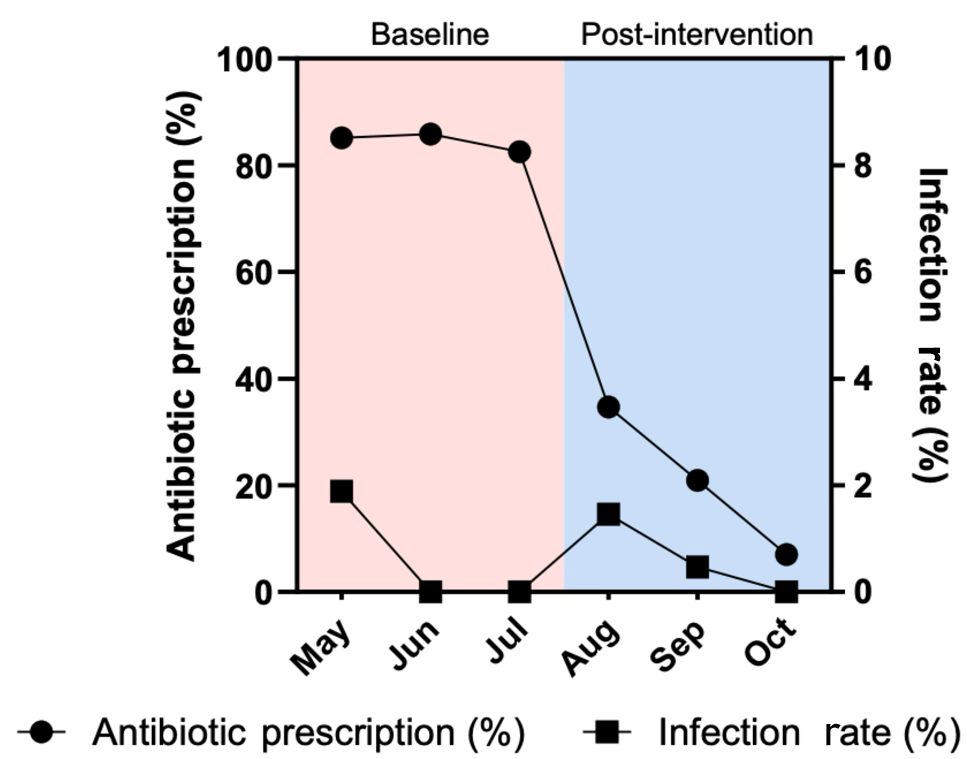
There was no statistically significant increase in overall complication rates before and after intervention (3.62% pre-intervention and 4.2% post-intervention, P=0.506). The complications that occurred included persistent pain, bone protrusion and spicules, bleeding, dry socket/alveolar osteitis and surgical site infection. While the surgical site infection rates pre- and post-intervention increased from 0.11% to 0.56%, this increase was not statistically significant (P=0.09). Throughout the study period, no patients who had prophylactic antibiotics developed infection (0/981), whereas 6 out of 856 patients who did not have prophylactic antibiotics developed infection. The number needed to harm (NNH) for antibiotics to prevent surgical site infection was 142.
Of the 6 patients who developed postoperative infection, 4 were healthy males aged between 20 and 22 years, and their postoperative infections achieved full resolution with local irrigation and systemic antibiotics. The remaining 2 patients required incision and drainage in addition to antibiotic therapy; they were an 81-year-old female patient and a 22-year-old male patient who was later diagnosed with type II diabetes mellitus.
No statistically significant differences were found in the dry socket rates in patients with antibiotics (12/981) and without antibiotics (20/856, P=0.069). All cases of dry sockets were managed according to clinical protocol and resolved completely within 1 week of treatment initiation. The NNH for antibiotics to prevent dry socket was 112. Apart from infection and dry socket, the other complications were not conventionally associated with antibiotics.
The reasons for antibiotic prescription were tracked in the post-intervention period. Clinicians were required to indicate a reason for prescribing antibiotics in their treatment notes. The most common reason was that the surgical removal of the 3M was “deep, difficult or complex”, followed by “given by previous clinician” and “patient’s age” (Table 3). Prescriptions were considered unnecessary if antibiotics had been given because it was “given by previous clinician” or at “patient’s request”; these accounted for 42.3%, 8.1% and 0% of the antibiotic prescription over the 3 months after the interventions.
Table 3. Reasons for valid and unnecessary antibiotic prescriptions after third molar surgeries.
| Valid prescriptions | Unnecessary prescriptions | Total | |||||||||
| Age | IS | Haem | Cyst | Infx | DDC | Perio | Root | Prev | Req | ||
| August | 15 | 7 | 1 | 1 | 2 | 34 | 1 | 3 | 35 | 12 | 111 |
| September | 10 | 2 | 5 | 3 | 2 | 31 | 1 | 3 | 2 | 3 | 62 |
| October | 8 | 1 | 2 | 1 | 1 | 8 | 0 | 1 | 0 | 0 | 22 |
| Total | 33 | 10 | 8 | 5 | 5 | 73 | 2 | 7 | 37 | 15 | 195 |
Age: patient’s age; DDC: deep, difficult or complex; Haem: haematological disorders or haemorrhage; Infx: infection; IS: immunocompromised state; Perio: periodontal disease; Prev: antibiotics given by previous clinician for third molar surgery; Req: patient’s request despite counselling; Root: root left behind
No patients filed complaints regarding either the absence of antimicrobial prescription or occurrence of infection. The most common type of antibiotic prescription was amoxicillin, 500 mg, 3 times a day (TDS) for 5 days. The prescription patterns also included augmentin (amoxicillin-clavulanate) or clindamycin of varying frequency and duration (Supplementary Material S3).
All 4 participants of the focus group prescribed antibiotics routinely prior to the intervention. It consisted of 2 junior (registrars) and 2 senior (associate consultant and consultant) members who volunteered to participate in the discussion. During the post-intervention focus group discussion, all 4 participants reaffirmed their commitment to prescribing antibiotics only when clinically necessary rather than as routine practice. They identified the following scenarios in which prescribing antibiotics may be warranted:
- Immunocompromised patients
- Cases with increased bleeding risk with potential haematoma formation
- Oro-antral communication
- Root fracture left in situ
- Pre-existing abscess
- Geriatric patients undergoing complex surgery
All the participants felt that there were more conditions where antibiotics could have been reduced, such as for middle aged patients and for cases of deeply impacted wisdom teeth. Participants unanimously had a positive perception towards efforts to decrease antibiotic use. They identified several enablers that facilitated reduction in antibiotic prescription:
- Assurance that the lack of antibiotics will not significantly increase infection risk for healthy patients
- Success could only be possible because it was a centre-wide change
- Knowing that the rest of the division is also making the change
- Posters were useful when counselling patients
- It becomes easier over time as patients were not prescribed antibiotics for their previous surgery (3M surgery for the other side of the jaw)
DISCUSSION
This study employed a behavioural change approach to reduce unnecessary antibiotic prescription for 3M surgeries. The interventions generated led to a reduction in antibiotic prescriptions from 84.45% to 20.89%, without an increased risk of post-surgical infections. Antibiotics prescribed were mostly deemed to be appropriate, as they were prescribed for patients who did not fit in the recommended criteria to stop routine antibiotics prescription. A multiprong approach was utilised to appreciate the different perspectives towards routine prescription of antibiotics. The investigation revealed that while clinicians were cognisant of AMR resulting from routine antibiotic prescription, they were reluctant to change prescription practice. This would suggest that knowledge alone may not be enough to overcome either the indifference to the problem or the natural passive resistance to change.14
The COM-B model was found to be a valuable tool in formulating strategies to develop a conducive ecosystem for change.9 It allowed for a multidimensional approach where the clinician (who makes the change) feels supported from all tiers (auxiliary staff, peers and superiors). Apart from external impetus, an important motivator is in allowing clinicians to feel that they are part of the decision-making process. Active communication and involvement of the target audience has been shown to be crucial in behavioural change.15,16 Through this approach, the antibiotic prescription rates dropped dramatically from 82.55% to 34.71% within a month of the interventions. The reasons for inappropriate antibiotic prescription also correspondingly reduced over the months. The outcome underscores the importance in generating an ecosystem for change, where administrators and leaders avoid a top-down approach, and instead engage their staff when attempting to alter behaviours.
A focus group discussion method was chosen over individual interviews so that active discussion could occur between the participants. The interpersonal and interactive nature of these discussion can elicit information that might not otherwise be gathered from an individual interview. Guest et al. reported that while individual interviews were highly effective at brainstorming for ideas, sensitive and personal disclosures were more likely to occur in focus group discussions.17 The latter was more suited for our purpose as the discussions were directed at learning the reasons behind their prescription behaviours. The downside of a focus group discussion includes less in-depth data collected due to the group setting, and a risk of power differences between the participants that could lead to a fear of speaking up. There was a need for positive dynamics between the participants, to mitigate possible fears of repercussions for speaking honestly.
A continued downtrend in antibiotic prescription was observed, with approximately 15% reduction each month during the audit period. The sustained decrease could be attributed to clinicians observing firsthand that infection rates did not increase for their patients, as well as peer pressure from seeing fellow colleagues participating in the change. Applying the list of criteria to the pre-intervention data suggested that we could expect a reduction in antibiotic prescription of 50%, yet the average prescription rates dropped to 20.87%. This substantial reduction was only possible because the clinicians did not strictly adhere to the list of criteria and continued to expand beyond their prior comfort zone. For instance, the proportion of patients older than 25 years who did not receive antibiotics steadily increased over time without a corresponding increase in infection rate among the older patients. This finding highlighted the limitation of using an arbitrary number for age limits. Similarly, participants of the focus group discussion also expressed comfort with withholding prescription of prophylactic antibiotics for patients who did not meet the criteria. This is because they understood that the criteria given was stricter and covered only a subset of patients who did not require antibiotics. However, it was enough to give them the confidence to practice evidence-based medicine to a broader group of patients.
Apart from an overall reduction in antibiotic prescription, unnecessary prescriptions of antibiotics also reduced over the 3 months after the interventions were implemented. Most of the unnecessary prescriptions had been given to prevent confusion to the patients, as many of these patients had been given antibiotics for their previous 3M surgery for the contralateral side prior to the interventions. These were mostly seen during the transition period in the first 2 weeks post-intervention and therefore, rates of antibiotic prescription for this reason reduced significantly by the second and third months (31.5% to 3.2% to 0%). The other common reason for unnecessary antibiotic prescription was “patient’s request”. Although they do not constitute to a significant portion of the antibiotic prescriptions (10.8% to 4.8% to 0%, over 3 months), the reduction of prescription for this reason could reflect either improved counselling skills from the staff over time or that patients were more educated in AMR.
The significant reduction in antibiotic prescription is supported by sound scientific evidence. The results of this study are aligned with previous research, reaffirming the view that stopping routine antibiotics is safe due to the high NNH, particularly given the very low infection rate observed (<1%). While reasons for low infection rate were not explored, potential contributing factors may include sterile practices, a predominantly healthy and young patient population, and clinician expertise.
In this study, we have mapped out 9 interventions. These interventions can also be broadly categorised into social changes, guidelines, education and audits. In a systematic review, Loffler et al. reported that the latter 3 were most often used in promoting antibiotic stewardship in a dental setting, typically in combination. Guidelines are not only useful in setting the standard of practice but also provide a benchmark for comparison. On the other hand, audits, while itself an intervention, can be used to measure the effectiveness of the other interventions. Elouafkaoui et al. compared the prescription patterns of dentists who received individualised audit and feedback (n=1999), and dentists who did not (n=567, control), along with the introduction of national guidelines to both groups.18 The authors reported that the prescription rates in the intervention group reduced from 8.5 items to 7.5 items per 100 treatment claims.18 This was compared with the control group, which yielded a decrease from 8.3 items to 7.9 items per 100 treatments.18 Although the success was not as drastic as that seen in our study, Elouafkaoui et al. demonstrated that these interventions can be successful in a multicentre or a multi-practice setting too.18
Out of the 9 interventions, 3 are considered to be educational activities. These include education sessions for clinicians on the role of antibiotics in 3M surgeries and the importance of combatting AMR; educational posters for patients; and training of auxiliary staff to counsel patients. Educational interventions are common as they are relatively easy to conduct and can target a large group at once. Teoh et al. employed the use of an online education platform and compared the prescription patterns of dentists 6 weeks before and after the education session.19 The authors noted a 40.5% reduction in antibiotic prescription and that the percentage of correct prescriptions, according to the Australian therapeutic guidelines, were 74.2%, 93.8% and 100% for amoxicillin, metronidazole and phenoxymethylpenicillin, respectively. This was a significant increase from 2.5%, 0% and 64.7%, respectively.19 Chate et al. compared the antibiotic prescription patterns of dentists 6 weeks before and after introducing a combination of education sessions, guidelines and audits to 212 dentists.20 The authors reported a 43.6% reduction in antibiotic prescription. In addition, appropriate prescriptions increased from 29.2% to 48.5%.20
Education should not be limited to clinicians alone. Al-Khatib et al. conducted an online survey of 345 respondents; 33.9% reported to have been pressured by patients to prescribe unnecessary antibiotics at least once per week and 31.9% once per month.21 A team-based approach to antibiotic stewardship has been well described in literature. Gross et al. reported how collaborative efforts of dentists, pharmacists and physician leaders led to a 72.9% decrease in antibiotic prescription after their intervention.22 Similarly, Okihata et al. described how a pharmacist-led antibiotic stewardship in a university dental clinic led to a reduction in antibiotic prescriptions.23 In our study, we have identified the importance of having a united front among all staff involved in a patient’s journey, including not only the clinician but dental assistants, patient service associates and pharmacists. This allowed the patients to have multiple opportunities to be counselled on the appropriate prescription of antibiotics.
Our study also implemented systemic interventions, which can influence social factors in antibiotic prescription, such as peer pressure, shared decision-making and giving clinicians reassurance that the intervention is a centre-wide change. The impact of these interventions on antibiotic stewardship in a dental setting is not well reported. Carlsson et al. surveyed 371 medical doctors and the authors reported that the doctor’s choice on prescribing antibiotics were strongly correlated with the perceived norms.24 Apart from breaking down perceptions and cultural norms, Krockow et al. also described the potential of crowd-based decision-making in the process of guideline development, which can also improve compliance to these guidelines.25 Shared decision-making not only helped to reduce fear with regard to changing treatment methods, but also bolstered a sense of responsibility towards the guidelines. These interventions may be better able to drive intrinsic motivations towards antibiotic stewardship, and thus, be more sustainable than extrinsic motivations such as audits.
The impact of this study extends beyond the evaluated centre, contributing to the literature relevant to both the dental and Singapore community. Only 3 prior Singapore primary studies on antibiotic use in dentistry were identified. They explored the prophylactic antimicrobial prescribing patterns for infective endocarditis and the efficacy of antibiotics in dental implantology.26-28 This study affirms that routine antibiotic prescription following 3M surgery is unnecessary, and demonstrates that reduction in antibiotic prescriptions will not be detrimental to patient care.
Another important element in AMR is the sustainability of the results. While the interventions had the potential to change the innate motivations of the clinicians towards AMR, there is still a need to maintain regular checks and audits. These will also serve as further external motivation for the clinicians. Following the success of the project, our centre has adopted a target antibiotic prescription rate of <15% for 3M surgeries. This has been maintained for 8 months since the start of the interventions (up to the point of manuscript preparation). In addition, frequent continuing education is required to keep clinicians up to date on evidence-based antibiotic prescription.
This study is not without limitations. First, causal efficacy could not be established due to a lack of randomised patient allocation on antibiotic administration, as the primary intention of the study was a clinical audit and quality improvement, rather than research. Second, the validity of the criteria for patients for whom antibiotics were not necessary could not be assessed; it was noted that not prescribing antibiotics for patients who did not meet the criteria did not appear to increase their infection risk. Third, a longer follow-up period of at least a year would be necessary to determine the true sustainability of the behavioural change. Fourth, this study was limited to only 1 tertiary centre and the external validity to other settings such as primary care practices may be limited, as interventions recommended may not be directly applicable. Last, as the interventions were implemented simultaneously, it was not possible to differentiate the degree of contribution of each intervention to the improvements seen.
CONCLUSION
This study demonstrates that targeted behavioural interventions, rooted in the COM-B framework, can significantly reduce both the overall rate of antibiotic prescriptions and that of unnecessary prescriptions in dental practice, particularly for 3M surgeries. The findings reveal that despite entrenched traditions in antibiotic prescription, clinicians can align their practices with evidence-based guidelines when equipped with the appropriate tools and support. By addressing the behavioural barriers influenced by capability, opportunity and motivation, we cultivated an environment conducive to change, leading to a substantial reduction in antibiotic prescriptions without compromising patient safety. The positive reception of these interventions by clinicians highlights the potential for sustained compliance with antibiotic stewardship initiatives. This study not only underscores the need for systematic approaches to behavioural change in healthcare but also advocates for a collaborative effort across divisions to enhance the quality of patient care.
- Supplementary Material S1. Pre-intervention investigations and evaluations.
- Supplementary Material S2. Post-intervention focus group discussion guiding questions.
- Supplementary Material S3. Type of prescriptions and their cost.
Acknowledgements
The authors would like to thank all the OMS clinicians at the National University Centre for Oral Health Singapore for their support towards antibiotic stewardship.
REFERENCES
- GBD 2021 Antimicrobial Resistance Collaborators. Global burden of bacterial antimicrobial resistance 1990-2021: a systematic analysis with forecasts to 2050. Lancet 2024;404:1199-226.
- World Health Organization. Global action plan on antimicrobial resistance. 2015. https://iris.who.int/handle/10665/193736. Accessed 19 March 2025.
- Cuevas-Gonzalez MV, Cuevas-Gonzalez JC, Espinosa-Cristóbal LF, et al. Use or abuse of antibiotics as prophylactic therapy in oral surgery: A systematic review. Medicine (Baltimore) 2023;102:e35011.
- Lodi G, Figini L, Sardella A, et al. Antibiotics to prevent complications following tooth extractions. Cochrane Database Syst Rev 2012;11:Cd003811.
- Torof E, Morrissey H, Ball PA. The Role of Antibiotic Use in Third Molar Tooth Extractions: A Systematic Review and Meta-Analysis. Medicina (Kaunas) 2023;59:422.
- Ramos E, Santamaría J, Santamaría G, et al. Do systemic antibiotics prevent dry socket and infection after third molar extraction? A systematic review and meta-analysis. Oral Surg Oral Med Oral Pathol Oral Radiol 2016;122:403-25.
- Săndulescu O, Preoțescu LL, Streinu-Cercel A, et al. Antibiotic Prescribing in Dental Medicine-Best Practices for Successful Implementation. Trop Med Infect Dis 2024;9:31.
- Michie S, van Stralen MM, West R. The behaviour change wheel: a new method for characterising and designing behaviour change interventions. Implement Sci 2011;6:42.
- Essack SY, Sartorius B. Global antibiotic resistance: of contagion, confounders, and the COM-B model. Lancet Planet Health 2018;2:e376-7.
- Wilding S, Kettu V, Thompson W, et al. Development and randomized controlled trial of an animated film aimed at reducing behaviours for acquiring antibiotics. JAC Antimicrob Resist 2021;3:dlab083.
- Hayes CV, Eley CV, Ashiru-Oredope D, et al. Development and pilot evaluation of an educational programme on infection prevention and antibiotics with English and Scottish youth groups, informed by COM-B. J Infect Prev 2021;22:212-9.
- Rosário F, Santos MI, Angus K, et al. Factors influencing the implementation of screening and brief interventions for alcohol use in primary care practices: a systematic review using the COM-B system and Theoretical Domains Framework. Implement Sci 2021;16:6.
- Duan Z, Liu C, Han M, et al. Understanding consumer behavior patterns in antibiotic usage for upper respiratory tract infections: A study protocol based on the COM-B framework. Res Social Adm Pharm 2021;17:978-85.
- Nilsen P, Schildmeijer K, Ericsson C, et al. Implementation of change in health care in Sweden: a qualitative study of professionals’ change responses. Implement Sci 2019;14:51.
- Khaw KW, Alnoor A, Al-Abrrow H, et al. Reactions towards organizational change: a systematic literature review. Curr Psychol 2022:1-24.
- Oreg S, Vakola M, Armenakis A. Change Recipients’ Reactions to Organizational Change: A 60-Year Review of Quantitative Studies. The Journal of Applied Behavioral Science 2011;47:461-524.
- Guest G, Namey E, Taylor J, et al. Comparing focus groups and individual interviews: Findings from a randomized study. Int J Soc Res Methodol 2017;20:693-708.
- Elouafkaoui P, Young L, Newlands R, et al. An Audit and Feedback Intervention for Reducing Antibiotic Prescribing in General Dental Practice: The RAPiD Cluster Randomised Controlled Trial. PLoS Med 2016;13:e1002115.
- Teoh L, Stewart K, Marino RJ, et al. Improvement of dental prescribing practices using education and a prescribing tool: A pilot intervention study. Br J Clin Pharmacol 2021;87:152-62.
- Chate RA, White S, Hale LR, et al. The impact of clinical audit on antibiotic prescribing in general dental practice. Br Dent J 2006;201:635-41.
- Al-Khatib A, AlMohammad RA. Dentists’ Habits of Antibiotic Prescribing May be Influenced by Patient Requests for Prescriptions. Int J Dent 2022;2022:5318753.
- Gross AE, Hanna D, Rowan SA, et al. Successful Implementation of an Antibiotic Stewardship Program in an Academic Dental Practice. Open Forum Infect Dis 2019;6:ofz067.
- Okihata R, Michi Y, Sunakawa M, et al. Pharmacist-led multi-faceted intervention in an antimicrobial stewardship programme at a dental university hospital in Japan. J Hosp Infect 2023;136:30-7.
- Carlsson F, Jacobsson G, Lampi E. Antibiotic prescription: Knowledge among physicians and nurses in western Sweden. Health Policy 2023;130:104733.
- Krockow EM, Kurvers R, Herzog SM, et al. Harnessing the wisdom of crowds can improve guideline compliance of antibiotic prescribers and support antimicrobial stewardship. Sci Rep 2020;10:18782.
- Tong HJ, Hu S, Mok BY, et al. Antibiotic prophylaxis prescribing practices of dentists in Singapore. Int Dent J 2014;64:108-14.
- Tan WC, Ong M, Han J, et al. Effect of systemic antibiotics on clinical and patient-reported outcomes of implant therapy – a multicenter randomized controlled clinical trial. Clin Oral Implants Res 2014;25:185-93.
- Payer M, Tan WC, Han J, et al. The effect of systemic antibiotics on clinical and patient-reported outcome measures of oral implant therapy with simultaneous guided bone regeneration. Clinical Oral Implants Res 2020;31:442-51.
Ethics review exemption (review not required) was granted by National Healthcare Group Domain Specific Review Board (NHG DSRB Ref 2024-4480).
The authors declare they have no affiliations or financial involvement with any commercial organisation with a direct financial interest in the subject or materials discussed in the manuscript. This research received no specific grant from any funding agency in the public, commercial or not-for-profit sectors.
Dr Chee Weng Yong, National University Centre for Oral Health Singapore, 9 Lower Kent Ridge Road, Singapore 119085. Email: [email protected]
