

Dear Editor,
Like many other developed countries, Singapore is currently facing a rapidly ageing population that is anticipated to reach 1 in 4 persons above the age of 65 years by 2030.1 Given that the rates of clinical and subclinical depression among the elderly in Singapore range between 4.4–11.9%,2 the disease burden of elderly depression is likely to increase in the upcoming decade. However, manpower constraints in the healthcare sector remain an issue,3 resulting in calls to rely on innovative technology to meet these needs.4
Virtual reality (VR) is one such technological innovation that has potential to meet our growing mental healthcare needs. Although relatively nascent, recent studies on the use of VR in the treatment of elderly mental health have been encouraging,5,6 especially for those residing in long-term care facilities.6 This article illustrates the use of VR as an adjunctive treatment for elderly depression.
Mr A was a 72-year-old man diagnosed with bipolar disorder and admitted to inpatient care at a restructured hospital in Singapore for a total of 4 months due to a relapse of depression. He also presented with mood-incongruent psychotic features, which were secondary to his non-compliance to medication. Mr A lived alone and was socially isolated. He was estranged from most of his family, apart from occasional visits by his biological brother. He also blamed himself and experienced intense guilt over his divorce. These contributed to his apathy and hopelessness as there was “no point [in trying]”.
Despite being treated with various psychotropics during his stay, he exhibited poor medication tolerance and a sensitivity to side-effects, leading to repeated complaints and medication refusal. He was referred for psychotherapy to address the possible underlying psychological factors, which contributed to his low mood and medication non-compliance, while his ward team continued to adjust his medication.
Psychotherapy commenced but Mr A’s engagement and progress was limited due to his significantly depressed mood, low energy, poor motivation and poor attention. Attempts to further explore Mr A’s inner experiences were met with resistance and refusal. After the second session, Mr A informed the ward doctors that sessions were “stressful” and requested to stop.
Although Mr A initially agreed to participate in group occupational therapy, he eventually stopped, expressing that it was “too difficult”. Attempts by different parties to encourage activity engagement in the ward were also met with refusal, and he spent most of his time in bed with limited engagement.
Several attempts were made to increase Mr A’s hopefulness by exploring his spirituality and past aspirations. He was ambivalent, but a breakthrough came on 1 occasion when he recounted his desire to scuba dive and explore the ocean. Correspondingly, his affect changed slightly, and he was excited for the first time in 2 months. He verbalised regret that he had not acted on it. Mr A was offered the opportunity to experience scuba diving using a VR headset. Approval was obtained from his psychiatric team, and he was started on 4x 30-minute weekly VR intervention using a commercially available headset and programme that were purchased by the department.
The first session commenced on day 94 of Mr A’s inpatient stay. Although he was already on 200 mg sertraline, response was limited and the plan was for him to start on bupropion and cross-titrate. A VR video was selected, simulating the experience of scuba diving. Mr A sat on a stationary swivel chair with handlebars, which allowed him to be immersed in the 360° virtual landscape safely. Mild giddiness was reported by Mr A during the first 5 minutes of VR headset use, but he adjusted to the device and denied any discomfort after. Changes to his mental state were observed during the session. Mr A’s affect became more reactive. He was also more verbally expressive during the session, commenting on several aspects of his experience. After the session, Mr A remarked that he was “excited”, that the experience was “interesting”, and that he wanted to continue with the trial.
Subsequent VR sessions involved different video scenes, which were chosen collaboratively with Mr A. There were no adverse reactions reported during these sessions as he experienced a virtual tour of the Spanish countryside, a German Christmas market and an animal safari. Beyond mood improvements, Mr A’s excitement for sessions was readily observed—he was quick to get off his bed for sessions unprompted. In addition to interacting with these immersive landscapes, VR sessions also included elements of psychotherapy aimed at eliciting Mr A’s emotions, thoughts and hopefulness. Mr A eventually started sharing what he would do when discharged from the hospital, and expressed a liveliness to engage in meaningful living that was absent just a month earlier.
Mr A was discharged after 118 days of inpatient stay. He completed the VR trial, and his medication had been optimised (stable on bupropion monotherapy). Although no standardised instruments were used to evaluate his improvement, as he struggled with self-reporting his mood on questionnaires pre-VR intervention, his mental state and presentation were observed to have improved at discharge.
Fig. 1. Timeline of inpatient treatment.
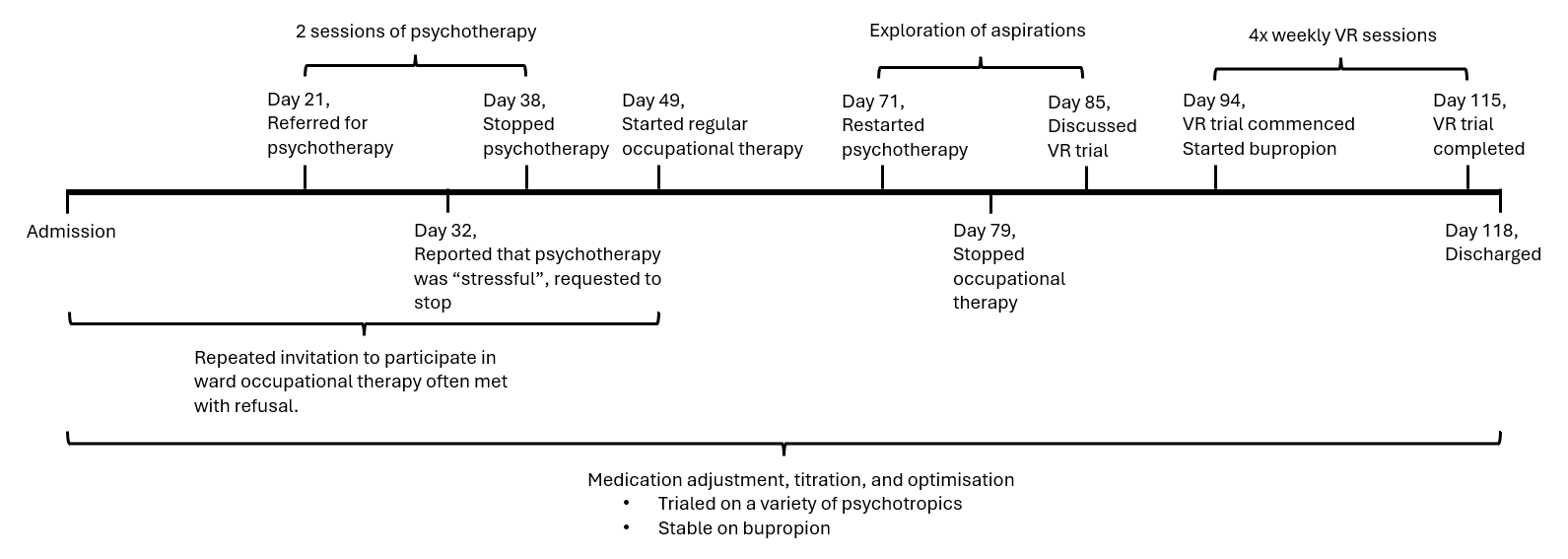
VR: virtual reality
Fortunately, Mr A’s experience with VR is not unique. A study conducted in Hong Kong found that the use of VR in the elderly population elicited increased positive affect such as excitement and inspiration, and reduced negative affect such as guilt, distress, irritability and shame.7
While the use of VR in Singapore had previously been limited to cognitive screening8,9 or to promote active ageing,10 the current case report demonstrates the potential of VR as an adjunctive treatment for geriatric depression, complementing traditional treatment modalities such as pharmacotherapy or psychotherapy. While conclusions about the effectiveness of VR in treatment are limited in this case study, rigorous studies using randomised controlled trials can be conducted in future to evaluate the efficacy and utility of VR interventions in elderly depression, especially for patients who are open to technological adoption, whose interests or emotional needs can be met by VR, and who do not present with conditions that contraindicate VR use.
Acknowledgements
The author would like to thank Dr Andre Tay Teck Sng (HOD, Department of Psychological Medicine, Changi General Hospital) for supporting the purchase of the VR software, and Dr Cheryl Loh Bee Lock for the provision of the VR headset that was used in the trial.
REFERENCES
- National Population and Talent Division. Strategy Group Prime Minister’s Office. Longevity. Published 2024. https://www.population.gov.sg/our-population/population-trends/longevity/. Accessed 2 June 2025.
- AshaRani PV, Abdin E, Roystonn K, et al. Tracking the Prevalence of Depression Among Older Adults in Singapore: Results From the Second Wave of the Well‐Being of Singapore Elderly Study. Depress Anxiety 2025;2025:9071391.
- National Population and Talent Division, Prime Minister’s Office. Occasional Paper: Projection of Foreign Manpower Demand for Healthcare Sector, Construction Workers and Foreign Domestic Workers. Published 2012. https://www.population.gov.sg/files/media-centre/press-releases/occasional_paper_projection_of_foreign_manpower_demand_healthcare_construction_foreign_domestic_workers.pdf. Accessed 2 June 2025.
- Tan CC. Innovating for future health. Singapore Med J 2016; 57:533-8.
- Cieślik B, Juszko K, Kiper P, et al. Immersive virtual reality as support for the mental health of elderly women: a randomized controlled trial. Virtual Real 2023;27:2227-35.
- Zhai K, Dilawar A, Yousef MS, et al. Virtual Reality Therapy for Depression and Mood in Long-Term Care Facilities. Geriatrics (Basel). 2021;6:58.
- Chan JYC, Chan TK, Wong MPF, et al. Effects of virtual reality on moods in community older adults. A multicenter randomized controlled trial. Int J Geriatr Psychiatry 2020;35:926-33.
- Chua SIL, Tan NC, Wong WT, et al. Virtual Reality for Screening of Cognitive Function in Older Persons: Comparative Study. J Med Internet Res 2019;21:e14821.
- Tan NC, Lim JE, Sultana R, et al. A virtual reality cognitive screening tool based on the six cognitive domains. Alzheimers Dement (Amst) 2024;16:e70030.
- Foo, JJ, Chew, KH, Lim, P, et al. Using Virtual Reality Recreation Therapy to Enhance Social Interaction and Well-Being in Homebound Seniors. J Ageing Longev 2024;4:373-93.
Case report of one patient does not meet the definition of research and does not require review by the SingHealth Centralised Institutional Review Board. Patient’s identity has been anonymised. Consent was obtained from the patient to present this case report.
The author declares there are no affiliations with or involvement in any organisation or entity with any financial interest in the subject matter or materials discussed in this manuscript.
Mr Wei Long Eugene Kheng, Changi General Hospital, 2 Simei St 3, Singapore 529889. Email: [email protected]
