

ABSTRACT
Simulation-based training is a vital tool in obstetrics and gynaecology education, addressing challenges such as limited clinical exposure during short rotation periods and gender-related sensitivities. This need is further underscored by the fact that non-obstetricians and non-midwives often serve as first responders in out-of-hospital and acute care settings where vaginal birth (VB) is imminent. Traditional mannequin-based simulations depend on in-person tutors with demands on time and physical space. In the absence of realistic clinical scenarios, they serve no better than low-fidelity task trainers. Capitalising on recent advancements in affordable virtual reality (VR) head-mounted display (HMD) technology, we developed and iteratively refined a VR-based childbirth training system between 2020 and 2025. Initial user studies demonstrated strong knowledge retention although participants expressed a preference for in-person mannequin-based simulations due to the lack of tactile feedback in VR. To address this limitation, we introduced a mixed reality (MR)-enhanced childbirth training system in 2024. This innovative approach integrates high-precision alignment of virtual elements with physical mannequins and introduces a tactile component to enhance skill acquisition. A pilot study involving 35 Year 4 undergraduate students yielded positive feedback with participants praising the system’s heightened realism and opportunities for peer-to-peer interaction. While both VR and MR have distinct advantages and limitations, the affordability and versatility of modern HMD make VR/MR-based training modules highly scalable and adaptable to diverse scenarios, surpassing the single-task limitations of traditional mannequins. This promises to improve training efficiency and expand access to VB training for a broader range of healthcare professionals.
Witnessing the start of life in the labour ward is the hallmark of every medical student’s obstetrics & gynaecology (O&G) rotation.1 In recent years, however, there has been a trend away from demonstrating competence in independently conducting routine vaginal births (VBs) towards one of participation or observation due to competing factors, such as limited posting durations, patient aversion to male students2 and competition from other healthcare trainees. This reduction in opportunities for medical students to participate in VBs is worrying considering that non-obstetricians/non-midwives are frequently first responders to unexpectedly precipitous VBs occurring out-of-hospital or in acute care settings and that obstetrics comprises a large and continually rising proportion of medicolegal liabilities in developed countries, i.e. 38.2% of all liabilities (about 21 billion GBP)3 in the UK and 54% of malpractice claims in the US.4 Given the significant consequences to mother and child arising from improperly carried out VBs, familiarity with the steps involved is important in preventing avoidable complications arising from healthcare provider unfamiliarity. Mannequin-based simulations5,6 serve as task trainers but lack interactivity and realism unless incorporated into a hybrid model-driven clinical scenario simulation.7 Further, while reusable, these models are often expensive, bulky and require maintenance and spare parts. Teaching sessions also need curricular time, space and skilled tutor involvement with higher manpower needs and preparation if done as part of a complex medical simulation. There is a strong impetus towards creating better and more efficient ways of improving competency in VB through realistic clinical simulations amid a climate of rising medicolegal concerns.
Leveraging self- and distance-learning technologies popularised during the COVID-19 pandemic for procedural training pedagogy, virtual reality (VR)8 emerged as a viable solution. However, even high-fidelity VR simulations have limited interactions with physical surroundings and peers due to its fully virtual environment. This limits its role for procedural skills training. Mixed reality (MR) or augmented reality was popularised by Google Glass® (Google X, Mountain View, US) and is an attractive option for merging user virtual and physical environmental interactions in real-time with scalable potential due to the recent release of cost-effective commercial MR-capable headsets.
In 2020, the Department of Obstetrics and Gynaecology, Yong Loo Lin School of Medicine and the Immersive Reality Laboratory, College of Design and Engineering, both of the National University of Singapore, partnered to develop an in-house comprehensive VR childbirth training system using off-the-shelf technology and local programming know-how. In this article, we share our experience with each iteration and the eventual transition to a novel MR version.
Previous VR iterations
Our first iteration of a VR normal childbirth system occurred in 2020, using Unity® (Unity Technologies, San Francisco, US) for virtual content development and the HTC Vive Pro® (HTC, Taoyuan City, Taiwan) and Manus VR® gloves (Manus VR, Eindhoven, Netherlands) for training experience delivery. The Manus gloves replaced conventional gaming controllers or keyboard-mouse set-ups to provide intuitive hand interactions within the virtual environment. A pilot study involving 23 Year 4 students in January 2021 showed it was well-received by participants. The realism of the birthing process and the virtual labour ward environment scored 4.0 and 4.1 out of 5, respectively. Text instruction, audio instruction and virtual hand guides scored 4.1–4.5 for clarity and informativeness. Participants rated its usefulness as 4.0. Nevertheless, it was perceived as less realistic than mannequin simulation with a score of 2.8 and not as intuitive to use with a score of 3.6.
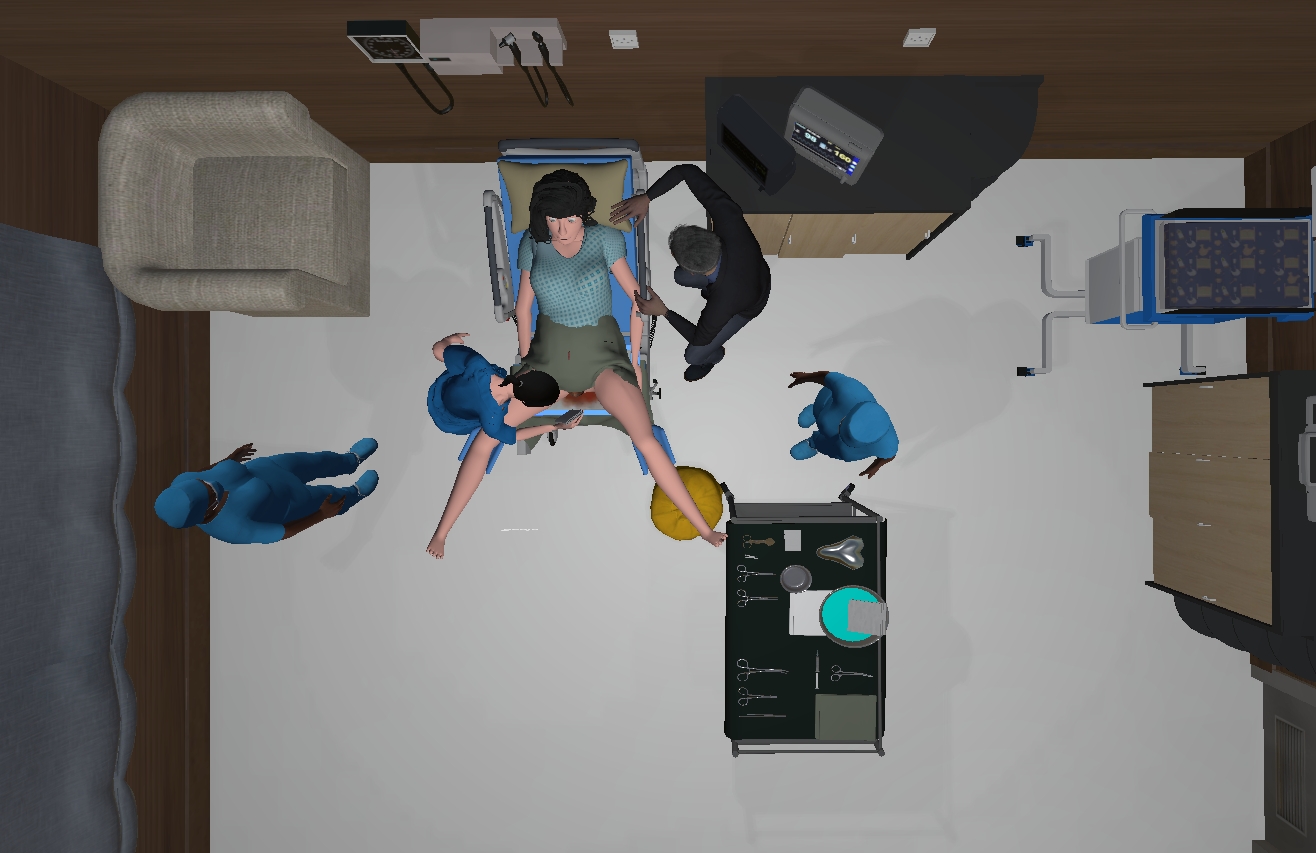
With the release of the standalone Meta Quest 2® headset (Reality Labs, Meta Platforms, Cambridge, US) in the late 2020s, we ported this VR system over and developed the second iteration, ViVaDeX, to teach the second and third stages of VBs (Figs. 1 and 2). ViVaDeX was incorporated into the Year 4 O&G syllabus in academic year 2022–2023. We conducted a cluster-randomised crossover study with 111 participants to compare the effectiveness in knowledge gain and qualitative feedback between VR group against our legacy mannequin (Prompt Flex®, Limbs & Things, Bristol, UK).9 Clinical groups were randomised to either the VR- or mannequin-based simulation and undertook a pre- and post-simulation knowledge quiz before crossing over to the other simulation modality. Both groups had no significant differences in baseline knowledge or familiarity with VR devices and no participant had any prior experience with childbirth. ViVaDeX was associated with a significantly higher change in mean percentage correct scores post-simulation compared to traditional tutor-led mannequin-based teaching (+40.8% versus [vs] +15.1%, P<0.001), which is in keeping with a well-established preference for active learning over passive methods and superior learning when audio and animations are incorporated.10 As all 111 participants eventually experienced both teaching modalities, we conducted a 6-domain feasibility assessment. Interestingly, despite higher objective knowledge gain scores, ViVaDeX had significantly lower median scores in 5 feasibility domains, i.e. knowledge retention (8.05 vs 8.54, P=0.002), feedback (12.8 vs 13.2, P=0.020), usability (7.80 vs 8.63, P<0.001), enjoyment (8.55 vs 8.91, P=0.003) and presence (8.09 vs 8.56, P=0.009) with no significant difference in the knowledge domain (13.1 vs 13.1, P=0.981). This aligns with other studies reporting that instructor-led classes provided insightful learning experiences that e-learning methods often lacked.11 Nevertheless, most participants (42%) preferred a hybrid approach comprising both VR- and mannequin-based simulations with 40% and 5% preferring either only mannequin- or VR-based simulations, respectively.9 ViVaDeX was also provided to a batch of 17 midwifery advanced diploma students from Nanyang Polytechnic in May 2024 to assess applicability to other healthcare trainees. Participants reported a generally positive experience, where on a 5-point scale they rated the simulation’s mean effectiveness in knowledge acquisition and procedural understanding at 4.26 (standard deviation [SD] 0.86), quality of feedback and flow at 4.12 (SD 0.99), and overall engagement at 4.03 (SD 1.11).
Fig. 1. Virtual reality vaginal delivery and complications simulator.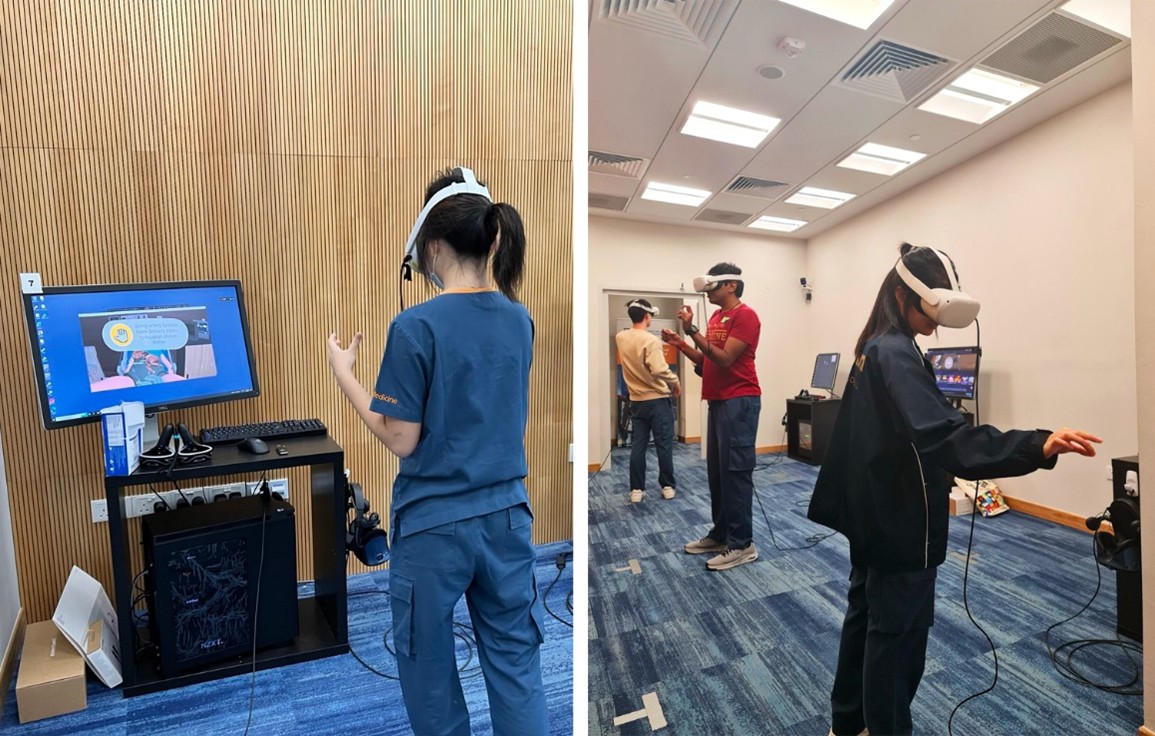
Fig. 2. Virtual labour ward environment.
Progression to MR
Encouraged by positive overall receptivity towards ViVaDex and the successful proof-of-concept that an in-house designed VR programme could teach VB in any empty room without physical instruments, we attempted to address a key limitation and recurring feedback item—the lack of tactile feedback—by using MR technology. For this next iteration, we selected the Meta Quest 3® which was newly released in 2023 and offered higher performance in a compact, cost-effective, MR-capable device.
Despite high-quality graphics and seamless transitions between the MR and VR environments, restrictions in using built-in cameras to feed images in real-time were an obstacle towards fully leveraging on Meta Quest 3®’s hardware capabilities. To address this, we connected the Intel RealSense® camera (Intel Corp, Santa Clara, US), a lightweight external RGB-D camera, to the headset to provide an alternative source of visual and depth data for MR integration (Fig. 3). This enabled the alignment of virtual objects with physical counterparts using object detection and tracking algorithms which, in this case, was a virtual labouring mother overlaid on a physical Prompt Flex® mannequin (Fig. 3). Participants could visualise and interact with a virtual delivery trolley, perform an episiotomy, and perform a VB by matching hands with a virtual overlay in passthrough mode. The simulation ended with virtual cord clamping and blood collection.
Fig. 3. Set-up for mixed reality (MR) simulation.
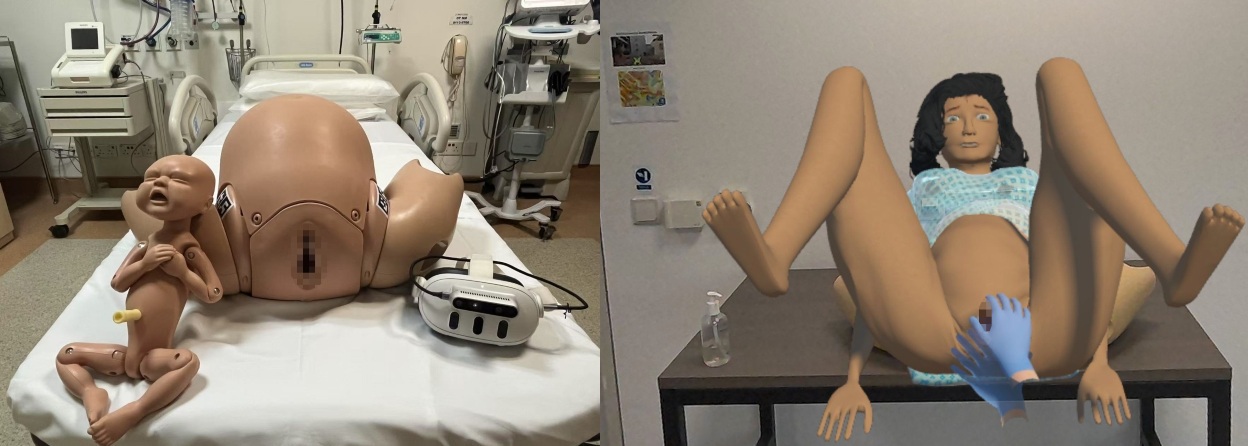
Note: The set-up comprises Prompt Flex® mannequin with Intel RealSense® camera attached to a Meta Quest 3® headset and user view of an MR simulation with a virtual delivering mother integrated with a real-world table in a classroom.
In 2024, we conducted a pilot study with 35 Year 4 undergraduate students, evaluating their perceptions of this MR simulation with a questionnaire comprising a 5-point Likert-scale and 1 short answer question adapted from Witmer and Singer’s Presence Questionnaire and the System Usability Scale.9 Despite the MR simulation being a prototype, 82.9% of participants responded Agree or Strongly Agree to the question “How involved were you in the MR environment?” with 65.7% replying as such to “How well could you concentrate on the assigned tasks or required activities rather than on the mechanisms used to perform those tasks or activities?” and 62.9% to “I prefer the MR environment over the VR environment.” With respect to interacting with the MR device, only 5.7% of participants indicated Disagree or Strongly Disagree when asked “How well could you move or manipulate objects in the MR environment?” Nevertheless, there is significant room for improvement as only 57.1% indicated Agree or Strongly Agree to “I think I would like to practice using this simulation frequently.” Common themes in the qualitative feedback included excitement when switching to the passthrough MR mode and appreciation for tactile feedback and realism provided by overlaying the virtual model on the physical mannequin. While some participants needed more time to adapt, most found the system easy to use. Anecdotally, we noticed more peer-to-peer interaction between participants using MR compared to previous VR sessions. We also intend to evaluate the MR iteration with different healthcare trainees including midwifery advanced diploma students, family medicine residents and house officers to assess generalisability as a training tool.
Limitations
While our MR pilot was encouraging, several practical barriers remain. Both VR and MR often require onsite technical support during early use, to guide learners and resolve usability issues. Moreover, while MR offers the advantage of integrating a tactile component, it needs physical mannequins that are not required in a fully VR-based simulation. Time and manpower are needed to calibrate the alignment between physical and virtual components. Additionally, the attached external camera increased power consumption and reduced headset battery life to only 2 hours in continuous usage, thus requiring a dedicated power management plan.
Ideally, novel learning tools should be evaluated using the Kirkpatrick model, aiming for level 3 (behavioural change) and level 4 (organisational outcomes). However, as our simulation targeted medical students and was designed to address limited real-life exposure, evaluation was limited to level 1 (satisfaction) and level 2 (knowledge gain). This is a common limitation in medical education studies. We are addressing this in an ongoing trial assessing skill transfer, where students from MR, VR and control groups will be evaluated on their ability to independently perform VB by faculty experts remotely via video-recorded simulation. In due time, these simulations should be evaluated with different groups of healthcare trainees at multinational sites with reduced onsite technical support and interval assessments to understand real-world impact.
Finally, usability issues were noticed in all study groups. These included difficulties in interacting with virtual medical instruments, ergonomic discomfort with frequent headset adjustments especially for females with hair buns, minor spatial disorientation when initially entering the virtual space, and lengthened module completion times due to user interface unfamiliarity. Nevertheless, almost all participants progressed with minimal technical help, suggesting issues would likely be circumvented with improved familiarity and more exposure.
DISCUSSION
While mannequins are usually designed for specific tasks, a VR/MR-based system offers modularity and upgradability with minimal requirements for physical space and specialised tutors.13,14 The introduction of cost-effective retail head-mounted display (HMD) has enhanced scalability for medical simulation. As demonstrated by our earlier ViVaDeX study,9,10 VR/MR-based simulations can serve as an immersive, tutor-independent means of remote learning that is effective in knowledge acquisition through multimodal teaching techniques. Both VR and MR have their strengths and weaknesses (Table 1). VR simulation is superior in immersion, although at the expense of peer-to-peer interaction while MR simulation allows tactile feedback through interaction with real-world items and engagement with other real-world participants. Nevertheless, legacy mannequin-based simulations provide a mature means of hands-on learning that supports “fishbowl”15 and peer-assisted learning16 and benefits from direct tutor engagement, which contributes to better learner experiences. A VR/MR approach can serve as a component of a hybrid teaching approach to reduce the strain of limited resources needed for mannequin-based teaching and, with further technology maturation, may be a viable standalone substitute in medical education. There is great potential to integrate this into a suite of complex and realistic obstetric emergency simulations. We hope this demonstrates the availability of competent local know-how in developing such procedural skills simulations to allow a closer loop for local customisation while maintaining global potential. This will be especially important for high-acuity and low-occurrence scenarios where society has an expectation for competent emergency care delivery.
Table 1. Pros and cons of different simulation modalities in teaching obstetric emergencies.
REFERENCES
- Singh K, Yong EL, Wong PC. The teaching of obstetrics and gynaecology in Singapore from 1905 to the present. Ann Acad Med Singap 2005;34:121C-5C.
- Akkad A, Bonas S, Stark P. Gender differences in final year medical students’ experience of teaching of intimate examinations: a questionnaire study. BJOG 2008;115:625-32.
- NHS Resolution. Annual statistics. https://resolution.nhs.uk/resources/annual-statistics/. Accessed 10 February 2025.
- Singapore Courts. Evolving Paradigms for Medical Litigation in Singapore, 28 October 2014. https://www.judiciary.gov.sg/docs/default-source/news-docs/chief-justice-sundaresh-menon_address-delivered-at-the-obstetrical-and-gynaecological-society-of-singapore-2014—evolving-paradigms-for-medical-litigation-in-singapore.pdf. Accessed 10 February 2025.
- Stetzer B, Sarfoh V, Mercer B, et al. Simulation Training Regarding Vaginal Delivery Versus Traditional Medical Student Clinical Education. Obstetrics & Gynecology 2017;130:59S-60S.
- Nitsche JF, Butler TR, Shew AW, et al. Optimizing the amount of simulation training used to teach vaginal delivery skills to medical students. Int J Gynaecol & Obstet 2018;140:123-7.
- Gardner R. Simulation and simulator technology in obstetrics: past, present and future. Expert Review of Obstetrics & Gynecology 2007;2:775-90.
- Barteit S, Lanfermann L, Bärnighausen T, et al. Augmented, Mixed, and Virtual Reality-Based Head-Mounted Devices for Medical Education: Systematic Review. JMIR Serious Games 2021;9:e29080.
- Gosavi A, Kanneganti A, Khoo ET, et al. Virtual reality simulation training for childbirth: A cluster randomized crossover study. Int J Gynecol Obstet 2025. Epub ahead of print.
- Liu C, Tan FF-Y, Zhao S, et al. Facilitating Virtual Reality Integration in Medical Education: A Case Study of Acceptability and Learning Impact in Childbirth Delivery Training. In: Proceedings of the 2024 CHI Conference on Human Factors in Computing Systems. Honolulu: Association for Computing Machinery; 2024.
- Kononowicz AA, Krawczyk P, Cebula G, et al. Effects of introducing a voluntary virtual patient module to a basic life support with an automated external defibrillator course: a randomised trial. BMC Med Educ 2012;12:41.
- Johnston S, Coyer FM, Nash R. Kirkpatrick’s Evaluation of Simulation and Debriefing in Health Care Education: A Systematic Review. J Nurs Educ 2018;57:393-8.
- Pottle J. Virtual reality and the transformation of medical education. Future Healthc J 2019;6:181-5.
- Mergen M, Graf N, Meyerheim M. Reviewing the current state of virtual reality integration in medical education – a scoping review. BMC Med Educ 2024;24:788.
- Sutherland R, Reid K, Kok D, et al. Teaching a fishbowl tutorial: sink or swim? Clin Teach 2012;9:80-4.
- Nunnink L, Thompson A, Alsaba N, et al. Peer-assisted learning in simulation-based medical education: a mixed-methods exploratory study. BMJ Simul Technol Enhanc Learn 2020;7:366-71.
Ethical approval was obtained from the National University of Singapore Institutional Review Board (NUS-IRB-2020-606).
The authors declare they have no affiliations or financial involvement with any commercial organisation with a direct financial interest in the subject or materials discussed in the manuscript. This research did not receive any specific grant from funding agencies in the public, commercial or not-for-profit sectors.
Asst Prof Arundhati Tushar Gosavi, Department of Obstetrics and Gynaecology, National University Centre for Women and Children, National University Health System, Singapore. Email: [email protected]
