

ABSTRACT
Introduction: This study aimed to examine patterns of diagnosis, cognitive and adaptive functioning, and school placement outcomes in autistic children in Singapore, and to assess earlier predictive factors of cognitive outcomes.
Method: Retrospective data were extracted from medical records of a specialist developmental paediatrics service for children born in 2008–2011 and referred to the autism clinic or were given a diagnosis of autism. Data items included demographic data, diagnostic methods, psychological assessment results, early intervention attendance and school placement outcomes.
Results: A total of 2124 children (82.6% male; 66.4% Chinese, 13.4% Malay, 9.8% Indian and 10.5% Others) were diagnosed with autism from the 4 birth-year cohorts. The mean (SD) age of the first clinical diagnosis of autism was 3.56 (1.14) years, with 81.0% of children receiving a concordant initial clinical diagnosis. A total of 1811 (85.2%) had a formal diagnostic assessment using the Autism Diagnostic Observation Schedule (ADOS) at a mean (SD) age of 4.16 (1.11) years. Of 1326 with cognitive and adaptive assessment results, 16.6% had mild and 19.8% had moderate-severe cognitive impairment. Of 1483 with school placement outcomes, 45.9% went to mainstream schools, 21.8% entered SPED schools offering the national curriculum and 32.3% required customised curriculum SPED schools. Logistic regression showed that factors predicting intellectual impairment included higher ADOS scores (aOR 95% CI 1.13 [1.08–1.19] for Comm+SI total and 1.53 [1.33–1.75] for SBRI total), higher social communication level of support (based on the DSM-5 criteria) (aOR [95% CI] 2.14 [1.10–4.16] for level 2 and 14.94 [5.77–38.64] for level 3), and minority race (aOR [95% CI] 2.82 [1.52–5.20] for Malay, 5.19 [2.36–11.44] for Indian, and 4.54 [1.91–10.79] for Others).
Conclusion: These findings could guide policymakers and practitioners worldwide to strategically allocate diagnostic, intervention and educational resources, maximising developmental outcomes for autistic children across diverse settings.
CLINICAL IMPACT
What is New?
- This study is one of the largest to track school-age outcomes of autistic children in Singapore.
- In the absence of any other national prevalence or outcome data, the current study provides useful insights into the patterns of diagnosis, cognitive and adaptive functioning, and cognitive and school placement outcomes.
Clinical Implications
- Information from this study can be useful for resource planning purposes for national agencies or ministries involved in providing autism diagnostic, early intervention and educational services.

Autism spectrum disorder (ASD or autism) is a neurodevelopmental condition characterised by differences in social communication and social interaction, with restricted, repetitive behaviours (RRBs).1 The prevalence of autism in Singapore is estimated to be 1 in 100,2 which is similar to that quoted by the World Health Organization based on global data,3 but lower than the 1 in 36 reported by the US.4
In 1998, a national child development programme (CDP) was established by the Ministry of Health, Singapore, and has evolved into a nationwide community-based, family-focused and child-centric collaborative service network involving government bodies and voluntary welfare organisations.5,6 The Department of Child Development (DCD) in KK Women’s and Children’s Hospital (KKH) and the Child Development Unit (CDU) of National University Hospital are the 2 national CDUs in Singapore. In 2007, they received 1200–1400 new preschool referrals and saw 4000–5000 follow-up consultations per year.5 Today, new referrals in KKH alone have increased to approximately 5000 children per year with 13,000 follow-up consultations. Autism comprises approximately 28% of CDP diagnoses, with 360–500 children diagnosed annually in the mid-2000s to an estimated 1200–1400 today.
Following a diagnosis of autism in early childhood, most toddlers and preschoolers in Singapore are typically referred to a government-funded Early Intervention Programme for Infants and Children (EIPIC), which provides specialised therapy and educational support for 6–8 hours per week to those requiring medium to high levels of support. While waiting for an EIPIC placement, hospital-based interim therapy incorporating caregiver training is usually provided, but at much lower intensity. Children with milder needs, however, might only require isolated speech-language, occupational or behavioural therapy provided in either hospital or preschool settings, rather than EIPIC. Some parents may also opt for private services. Throughout this period, the children usually continue with medical follow-up at 1 of the 2 CDUs.
In Singapore, formal schooling starts in the year a child turns 7 years old, and children on the autism spectrum may attend mainstream schools, special education (SPED) schools offering the national curriculum, or SPED schools offering a customised curriculum. At about 5–6 years of age, most autistic children would be recommended to undergo a holistic needs assessment that takes into account the child’s level of cognitive and adaptive functioning in order to inform on appropriate school placement needs.7 Usually, a cognitive profile indicative of normal intellectual ability would be required for a child to attend mainstream schools or the SPED schools offering the national curriculum. However, some children may not undergo the assessment, usually either because there are no significant concerns for the child needing SPED placement or because parents decline it.
Three published studies have reported on profiles of autistic children in Singapore. The first was by Bernard-Opitz et al. in 2001, at a time when Singapore’s resident population was about 3 million.8 Survey data from 176 parents of autistic children 3–12 years old indicated that 81% of children were boys and 60% were diagnosed before 3 years of age. There was a high (39%) incidence of both parents working and the involvement of foreign maids as caregivers. Concerns were raised about a possible lack of stimulation in many homes and the influence of psychosocial deprivation on child development.
The second study was Lian and Ho who reported on 170 autistic children from a total of 542 children referred to KKH in 2003 and followed up after 1 year.9 The ratio of males to females was 4.5:1, and the median age of first consultation was 42 months (range 19–112 months). In addition, 74% received a psychological assessment confirming autism. Autism was moderate-to-severe in 86% of the children, and only 14% were deemed potentially capable of mainstream ability. Children with high-functioning autism presented at a higher median age (52 months) than children with more severe autism (38 months). The younger the child at presentation, the higher the likelihood of a diagnosis of at least a moderately severe variant of autism.
The most recent paper by Aishworiya et al. was a cross-sectional study in 193 autistic children on modifiable factors prior to early intervention that are associated with better adaptive skills.10 The mean age of diagnosis was 35.5 months and 84% were boys. The study found that shorter waiting times for entry into regular early intervention services were associated with better adaptive skills at 6 and 7 years old.
Early identification of children on the autism spectrum leads to early intervention during a critical period for brain development, and better outcomes due to earlier correction of developmental delays.11,12 Singapore is on its fourth Enabling Masterplan 2030 to build a more inclusive society and to improve the quality of life of persons with disabilities.13 The Academy of Medicine, Singapore published evidence-based recommendations in the Clinical Practice Guidelines on ASD in Children and Adolescents for gold-standard assessment, intervention and management.14 The recent years have seen increasing awareness of autism in Singapore,15 and the number of EIPIC centres in Singapore has ballooned from 2 therapy hubs in the mid-2000s to 27 across the island today. However, details on diagnostic patterns and longer-term outcomes of autistic children are less clear. Having large-scale Singapore data on these topics would greatly facilitate national resource provision and planning, as ethnic, cultural, healthcare provision and educational framework differences can result in the need for tailored policymaking and resource planning in Singapore and elsewhere in Asia.
Aims
The primary aim of this study was to examine patterns of diagnosis, cognitive and adaptive functioning, and school placement outcomes in autistic children in Singapore. A secondary aim was to examine for earlier predictive factors of cognitive outcomes.
METHOD
The study was conducted in KK Women’s and Children’s Hospital, which is a tertiary hospital that provides specialist developmental paediatrics services and is the largest diagnostic centre for autism in Singapore. It receives preschool-age referrals—mostly from primary care, for a wide range of developmental concerns—who are first seen in a triage clinic. Children with concerns for autism are then referred to an autism clinic for a detailed autism-specific interview conducted by trained developmental behavioural paediatricians (DBPs), who would then order the Autism Diagnostic Observation Schedule (ADOS)16,17 (conducted later by an ADOS-trained clinical psychologist) if a child showed features of autism. The DBP would also give a clinical diagnosis of autism first if the child met the Diagnostic and Statistical Manual of Mental Disorders (DSM) criteria based on the detailed interview and direct observations. Some children might instead be referred directly from the triage clinic for a full assessment (interview and ADOS) in a single session by a psychologist. The ADOS is a standardised, semi-structured, play-based behavioural measure that is one of the gold standard assessment tools used to aid in the diagnosis of autism.16,17 The ADOS Module 1 is used for children who have limited verbal communication, Module 2 for those with phrase speech but who are not yet verbally fluent and Module 3 for verbally fluent children. The Toddler Module is not used for diagnostic purposes by this centre.
Retrospective data were manually extracted from medical records for children meeting the following inclusion criteria: (1) born in years 2008–2011 and (2) referred to the autism clinic for further evaluation, or (3) ever given a primary or secondary diagnosis of autism. The birth years were selected such that the most complete data on cognitive assessments and final school placement outcomes could be obtained. Data items extracted included demographic data, diagnostic methods and dates, results of any psychological assessments (whether conducted in-house or externally), early intervention attendance and school placement outcomes.
Data extraction was conducted from 2019 to 2020 by a team of 2 associate psychologists and 4 medical students who were trained on how to find and extract data items thoroughly from both electronic and paper medical records. Data cleaning and reliability checks were conducted by the associate psychologists and principal investigator, and there was no imputation of missing data or patient contact to obtain additional data.
As the study cohort underwent diagnostic assessments over a period when the DSM, Fourth Edition (DSM-IV-TR) was replaced by the Fifth Edition (DSM-5), the diagnosis conferred to each child varied between DSM-IV-TR and DSM-5 diagnostic terms. For data analysis, and as per the DSM-5 workgroup recommendations, all children given a DSM-IV-TR diagnosis of autistic disorder, Asperger syndrome or pervasive developmental disorder—not otherwise specified were grandfathered into a diagnosis of ASD under the DSM-5. Similarly, the ADOS version used changed from the ADOS-Generic (ADOS-G) to the current ADOS-Second Edition (ADOS-2) over this period.
Children were classified to have a diagnosis of intellectual disability (ID) if a formal ID diagnosis was given by the psychologist conducting the assessment of cognitive and adaptive functioning, or a diagnosis of intellectual impairment if there was no formal diagnostic statement of ID but the child’s full-scale intelligence quotient (FSIQ) was <70; if FSIQ was not available, then the majority of IQ subscale scores and/or the adaptive skill subscale scores was <70. School placement recommendations were extracted from formal psychological reports, whereas actual school placement outcome was based on clinical follow-up information.
To ensure that the study cohort strictly comprised children with an accurate diagnosis of autism, the following were used as exclusion criteria and hence removed from the sample prior to data analysis: (1) children who did not meet autism diagnostic criteria following a full psychological assessment and in whom no further concerns for autism were raised on follow-up, (2) children who were only seen for a single clinic visit and (3) children with no concerns for autism beyond the initial appointment (Fig. 1).
Fig. 1 Flowchart of study cohort.
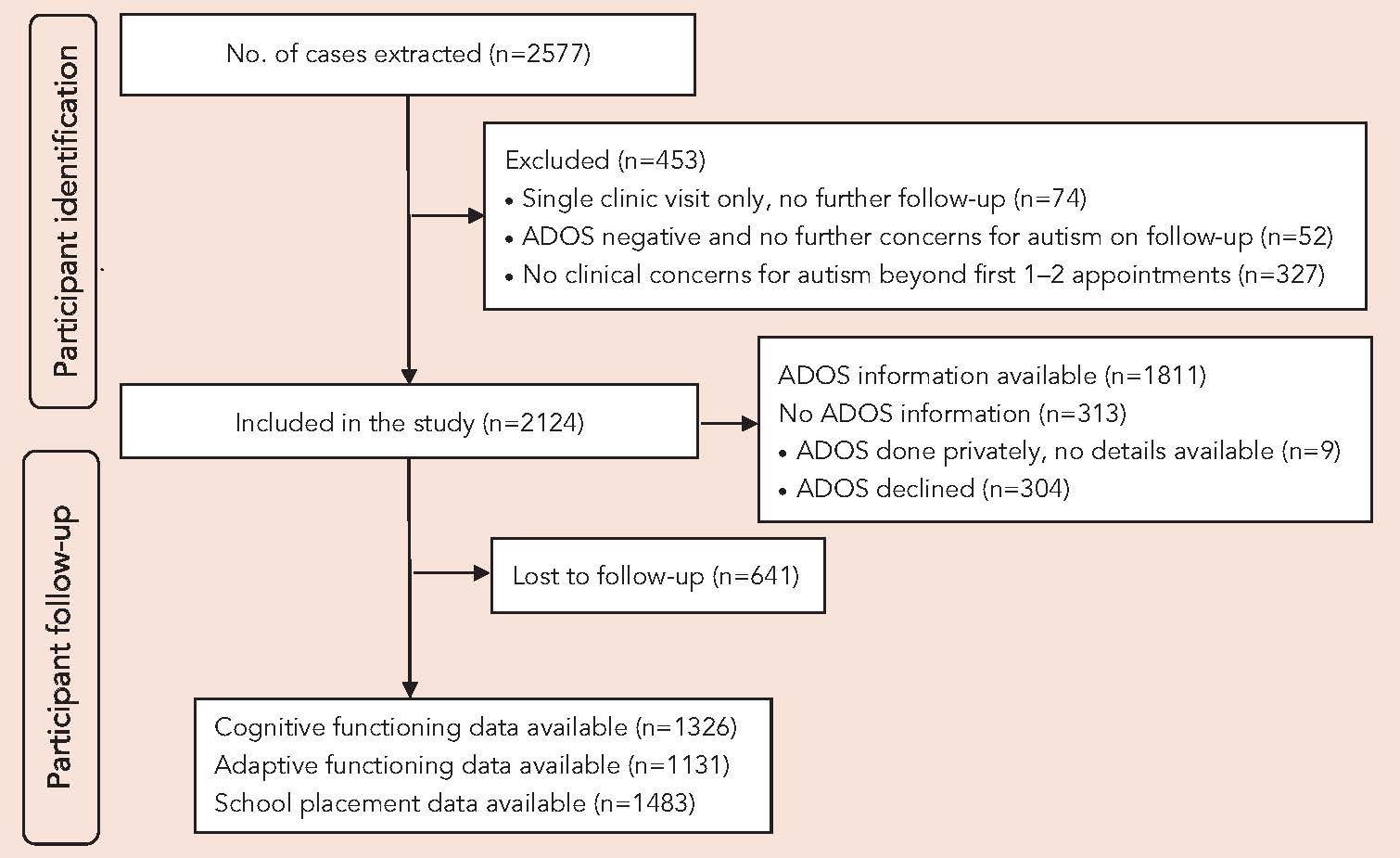 ADOS: Autism Diagnostic Observation Schedule
The study was approved by the SingHealth Centralised Institutional Review Board (2017/2103), and waiver of consent was granted in view of the retrospective and minimal risk nature of the study.
Statistical analyses were conducted using SPSS Statistics software version 28 (IBM Corp, Armonk, NY, US). Pearson correlation analyses were conducted to look for linear correlations between continuous variables, whereas independent t-tests and Pearson chi-squared (ꭕ2) tests were used to assess for differences between groups. Binomial logistic regression analyses were then conducted to analyse the relative contributions of proposed factors in predicting cognitive outcomes of ID/intellectual impairment versus (vs) no ID.
RESULTS
Using the inclusion criteria, 2577 children were identified, and data for all of these were extracted. After removing records for those who did not meet criteria for data analysis, a total of 2124 records were included (Fig. 1). Table 1 shows the demographic characteristics of the study cohort. The majority were male (n=1754, 82.6%), and there was a gradual increase in numbers diagnosed from years of birth 2008 to 2011. The ethnic group distribution was slightly different (fewer Chinese and more Others) to Singapore’s resident population (74.1% Chinese, 13.5% Malay, 9.0% Indian, 3.4% Others)18 but was reflective of the ethnic composition of children seen under the national CDP services. Only 18 (0.8%) had genetic syndromes, of which 3 had no ID, and another 3 had no outcome data. They were not removed from the analyses as the numbers were very few.
Table 1. Demographic characteristics of study cohort (n=2124).
Diagnostic data patterns
Table 2 shows the diagnostic and cognitive data of the study cohort. The mean (standard deviation [SD]) age at first clinic visit and first clinical diagnosis of autism were 3.23 (1.01) and 3.56 (1.14) years, respectively, with 718 (34.5%) being diagnosed before 3 years of age. The majority (81.0%) of children received a concordant clinical diagnosis before ADOS assessment was conducted. For those who only had a diagnosis of autism confirmed after the psychological assessment, their clinical diagnoses were mainly global developmental delay or language delay.
Table 2. Diagnostic, early intervention, cognitive and adaptive data of study cohort.
A total of 1811 (85.2%) had ADOS assessments at a mean (SD) age of 4.16 (1.11) years, with most using Module 1 (70.9%). The vast majority had ASD or autistic disorder (97.4%). Three children were deemed to not meet full diagnostic criteria following their ADOS assessment, but eventually met clinical diagnosis on longer term follow-up when more symptoms emerged (n=2) or a private reassessment using additional diagnostic tools was conducted (n=1).
For children diagnosed by DSM-5 criteria, the levels of support for each domain (social communication and RRBs) are provided in Table 2. Most children were deemed to require level 2 (substantial) support for social communication and level 1 (some) support for RRBs.
Early intervention data patterns
Table 2 shows that the mean (SD) waiting time for EIPIC entry in a subgroup of 1194 children was almost a year. Of these, 390 were in an EIPIC centre for an average of about 2.5 years. However, this duration should be interpreted with caution as there were no clear EIPIC end dates for the other 804.
Cognitive and adaptive data patterns with school placement outcomes
There were 641 (30.2%) children who were lost to follow-up for school placement assessments and outcomes (Fig. 1). A total of 1285 (60.5%) and 1131 (53.2%) of the study cohort had information on cognitive and adaptive assessment results, respectively (Table 2). The mean (SD) age at which a cognitive assessment was conducted was 5.61 (0.76) years, and the most common assessment tool was the Wechsler Preschool and Primary Scale of Intelligence (79.0%). Some children with substantial developmental delays or behavioural difficulties could not complete a cognitive assessment. Instead, 143 (11.3%) were tested using developmental scales and 34 (2.7%) had testing abandoned.
The number of children with normal cognitive functioning was 622 (46.9%) and included 101 children with no clinical concerns for cognitive impairment and were deemed by the DBP to not need formal cognitive assessment. Another 222 (16.7%) had non-verbal intelligence quotient (IQ) subscale scores in the normal range but associated with a verbal IQ score of <70, indicating verbal impairment. Additionally, 220 (16.6%) had mild and 262 (19.8%) had moderate-severe cognitive impairment or ID. Mean Vineland Adaptive Behavior Scale scores ranged in the 70s. As expected, there was a high positive correlation between cognitive functioning and adaptive skill scores (r=0.72, P<0.001, n=1081).
School placement recommendations were recorded for 1282 (60.4%) children (Table 3). Actual school placement outcome was available for 1483 (69.8%) and indicated that 681 (45.9%) progressed to mainstream school, 323 (21.8%) entered SPED schools offering the national curriculum, and 479 (32.3%) went to customised curriculum SPED schools. Moreover, 16.8% obtained a deferment from commencement of Primary 1.
Table 3. School placement recommendations and outcome of study cohort.
Predictors of cognitive outcomes
Although duration of EIPIC attendance was considered one of the potential predictors of cognitive outcomes, the start and end dates of EIPIC were available in only 390 children. Furthermore, the information collected was limited in that attendance rates and any breaks in the programme (e.g. due to holidays or illness) were not accounted for. Correlation analyses also showed that children attended EIPIC for longer if they received a clinical diagnosis of autism at a younger age (r=-0.325, P<0.001), had higher ADOS scores (ADOS-G r=0.153, P=0.034; ADOS-2 r=0.233, P=0.002), or had lower Vineland scores (r=-0.246, P<0.001), indicating that longer EIPIC attendance was likely associated with pre-existing higher support needs. Hence, duration of EIPIC attendance was not used in further regression analyses. Additionally, some children would have attended other forms of early intervention instead of EIPIC, and these data were not available to be extracted. Furthermore, the therapy that a child would receive differs depending on each child’s unique presentation of autism symptoms and severity, overall making it impossible to analyse early intervention received as a predictor of cognitive outcomes.
Waiting time for entry into EIPIC was not correlated with Vineland Adaptive Behavior Composite scores or ADOS scores but was negatively correlated with age at first clinic visit (r=-0.25, P<0.001, n=1194), indicating that children presenting at older ages were more likely to be given expedited entry into EIPIC. Mean (SD) waiting time for entry into EIPIC was also no different between children with ID vs no ID (334.9 [227.8] vs 340.1 [216.2] days, P=0.739).
Table 4 shows the factors associated with whether a child was more likely to have ID or mild/moderate-severe impairment in cognitive functioning. Age at first clinical diagnosis and sex were not significant.
Table 4. Factors associated with a diagnosis of intellectual disability or intellectual impairment.
Table 5 shows 2 binomial logistic regression models examining predictors of ID or intellectual impairment. As parents’ highest educational levels attained were strongly correlated with each other and with combined monthly household income, to avoid multicollinearity, only mother’s educational level was retained in the regression models. For those assessed using the DSM-IV-TR criteria, ADOS-G scores were used, whereas for those assessed using the DSM-5, levels of support were used. DSM-5 levels of support for social communication and RRBs were used as separate factors as some children may have very discrepant levels of support between the 2 domains. Both models were statistically significant.
In those diagnosed on the DSM-IV-TR, mother’s educational level and higher ADOS-G scores in both domains were significant predictors of intellectual impairment (ꭕ2 [6]=97.406, P<0.001). While adjusted odds ratios showed that there seemed to be a trend towards minority races to be at increased odds of a child having intellectual impairment, these did not reach statistical significance in the model. Approximately 23.2% of the variability is accounted for by the model. However, in those diagnosed on the DSM-5, race and DSM-5 social communication level of support, but not RRBs level of support, were significant predictors of intellectual impairment (ꭕ2 [8]=111.374, P<0.001). Children given level 3 (very substantial) support for their social communication domain had 14.9 times the odds of having intellectual impairment, and children of a minority racial group had 2.8–5.2 times the odds. Approximately 32.9% of the variability is accounted for by the model.
DISCUSSION
This is the first large-scale study to examine patterns of diagnosis, cognitive and adaptive functioning in a clinically representative sample of autistic children in Singapore, and to explore predictors of cognitive outcomes. Despite being retrospective, detailed clinical data were obtained from 2124 autistic children with follow-up information until 9–12 years old. There was a gradual increase in the numbers of children with autism born in each year from 2008 to 2011, possibly reflecting improved identification of autism over the years, as well as a true increase in prevalence. Other data from our department have shown a substantial increase in annual numbers of children presenting with concerns for autism, from 540 in 2014, to 936 in 2020 and stabilising at around this figure since then. This is consistent with the rising prevalence of autism reported elsewhere.4
The mean (SD) age of first clinical diagnosis of autism was 3.56 (1.14) years, similar to a paper on 206 children who underwent diagnostic assessments for autism from 2012 to 2013,19 and not too different from studies by Lian and Ho and Aishworiya et al.9,10 Interestingly, fewer children (34.5%) were diagnosed before 3 years of age compared to Bernard-Opitz’s 2001 paper (60%), although that study was on a small, selected group of parents who completed a survey and the children appeared to have more severe autism, which might explain their earlier age of diagnosis. More importantly, majority (81.0%) received a concordant clinical diagnosis, given 0.6 years (7.2 months) before ADOS assessment was conducted. This emphasises the reliability of using a careful clinical diagnosis to initiate care plan discussions with caregivers and obtain access to early intervention. Currently, preschool children in Singapore can enter early intervention programmes for autism based on a clinical diagnosis of autism given by a DBP, even if a full psychological assessment has not been conducted yet. Hence, an accurate clinical diagnosis is vital for appropriate intervention programme referrals to be made.
Currently, the routine practice in Singapore is for all preschoolers with suspected autism to undergo a diagnostic assessment using the ADOS and a detailed autism-specific interview. This has led to resource constraints and long waiting times for psychological assessments, similar to that reported elsewhere. The 2023 Clinical Practice Guidelines on ASD in Children and Adolescents has highlighted that a single-clinician approach to diagnosing autism may be considered, provided that certain criteria on the experience of the clinician and the diagnostic procedure are met.14 The guidelines also state that standardised assessment tools are not always necessary, particularly in children with very clear features of autism. Given again that 81% of children with autism in this study received a concordant clinical diagnosis before ADOS was conducted, it is highly likely that a significant number of autistic children can be reliably diagnosed via a single-clinician approach, with consequential easing of the pressure on autism diagnostic services nationally. Careful selection of children who may be diagnosed this way is advised, but discussion of the selection criteria is outside the remit of this paper. However, it is noteworthy that as this study was conducted in a national CDU, most children in the sample underwent an ADOS Module 1 at a preschool age and the diagnostic concordance rate may be different for children detected later or with milder symptoms.
Only 85.2% of the cohort underwent the ADOS, which is higher than previously reported.9 The data included private diagnostic assessments for which data fields could be extracted from a psychological report. The main reasons for not having the ADOS done included caregivers declining the assessment, or care being transferred elsewhere, for whom school placement outcome data were usually also missing. It is recognised that autism diagnostic assessments are sometimes conducted during school-age years for some children in whom caregivers initially declined an assessment. This is usually due to a child having ongoing support needs, often as social and academic demands start to outweigh the child’s abilities. The fact that 3 children did not meet diagnostic criteria following their ADOS assessment but eventually achieved clinical diagnosis later, highlights the importance of long-term follow-up for children in whom there remain ongoing concerns for social communication, behavioural or sensory difficulties.
Although most autistic children in Singapore undergo formal cognitive testing at 5–6 years of age to facilitate school placement, these data have highlighted that approximately 14% of children were unable to complete a standardised cognitive assessment, and either had testing abandoned or required alternative tests (developmental or adaptive scales) to gauge their needs. However, for those who were able to complete cognitive assessments, almost half (46.9%) had normal functioning, and only 36.4% were confirmed to have intellectual impairment. This is quite different to the previous 2012 publication, which indicated that only 14% of autistic children in Singapore were considered of mainstream school ability.9 The current study cohort is more than 10 times the size of the previous study, and outcome data were tracked for a much longer follow-up duration, hence these findings are likely to be more accurate and hold important implications for SPED resource allocation at a national level. More children on the autism spectrum with milder needs are now being diagnosed compared to before, thus there are likely to be more children with autism without intellectual impairment in our sample.
Another important finding is that 16.7% had IQ subscale scores, which were in the normal range but associated with a verbal IQ score of <70, indicating significant verbal impairment. This is a group of autistic children who could potentially be supported more effectively towards better outcomes if their language needs are supported, for example through speech-language therapy or the increased use of visual-based pedagogical methods. SPED schools offering the national curriculum may offer this group of children the support needed to navigate the language-rich mainstream curriculum. Approximately two-thirds of children went on to attend schools that offered the national curriculum, whether in a mainstream or SPED setting. Although 16.8% obtained a deferment from commencement of Primary One, with the changes in the deferment processes of the Ministry of Education Singapore as of 2024,20 this figure may change in the future.
The limited data available on the 390 children with EIPIC attendance information did show that children attended EIPIC for longer if they received a clinical diagnosis of autism at a younger age, had higher ADOS scores or had lower Vineland scores. These factors were likely to be reflective of them having higher support needs, resulting in them presenting earlier to services. As opposed to Aishworiya’s paper, waiting time for entry into EIPIC was not correlated with Vineland Adaptive Behavior Composite scores or ADOS scores, but was negatively correlated with age at first clinic visit, indicating that children presenting at older ages were more likely to need expedited entry into EIPIC. However, that study was on a smaller cross-sectional sample, included only children with an ADOS-confirmed diagnosis of autism, and collected Vineland data at an older age.
In the logistic regression models, factors which were significant in predicting ID or intellectual impairment included lower mother’s educational level, higher ADOS scores and higher DSM-5 social communication level of support. Some of this information could be used to guide clinicians and begin conversations with parents about educational options for their child at appropriate times of school transition. Interestingly, race was also a significant predictive factor for ID or intellectual impairment in the DSM-5 regression model, with a trend towards significance in the DSM-IV-TR model. A separate paper has been published focusing on the ethnic group differences found in this same cohort of children.21
Limitations
Although the sample size was large, this was a single-centre study. However, this centre sees 70–80% of Singapore’s CDP caseload. As this was a retrospective study conducted on available medical records data, there might be potential selection bias in that children referred for diagnostic evaluations at a preschool age may have more obvious symptoms of autism already, while those with milder symptoms may only be diagnosed if they continued to attend follow-up appointments. A total of 641 (30.2%) children were lost to longer term follow-up and hence did not contribute data to cognitive/adaptive assessments and school placement outcomes. Although the accuracy of the retrospective data is limited to the available information in each child’s records, most children with longer-term follow-up had full psychological assessment results available. However, there was limited information on the duration of EIPIC attendance as well as other interim or non-EIPIC intervention received, hence it was not possible to evaluate early intervention received as a predictor of cognitive outcomes. There was also limited information on family history of autism. Another limitation is that there is a time lag between age at first clinic visit/first clinical diagnosis and age of ADOS of about 0.93/0.6 years respectively, meaning that the autism severity as captured by the ADOS might not be very representative of baseline severity. Finally, data were extracted when the children in the cohort were aged between 9 and 12 years, and hence further follow-up data beyond that are not available. It is not known how many children who started out in mainstream schooling eventually needed to be transferred to a SPED school, or vice versa. There was scant data on older-age onset co-occurring conditions, and the study cannot extrapolate to any conclusions on adult outcomes.
CONCLUSION
This study is one of the largest to track school-age outcomes of a sizeable population of autistic children in Singapore. In the absence of any other national prevalence or outcome data, the current study provides useful insights into the patterns of diagnosis, cognitive and adaptive functioning, and school placement outcomes. Such information can be useful for resource planning purposes for national agencies involved in providing autism diagnostic, early intervention and educational services.
Acknowledgement
The authors would like to thank the following individuals who contributed to data collection for this study: Taralyn Sue Wen Teo, Nurhafizah Mohd Zambri, and medical students from the National University of Singapore Yong Loo Lin School of Medicine—Grace Ang, Hannah Lim, Simone Quek and Benedix Sim.
REFERENCES
- American Psychiatric Association. Diagnostic and Statistical Manual of Mental Disorders, Fifth Edition, Text Revision (DSM-5-TR). 5th ed. Washington, DC: APA Publishing; 2022.
- Zheng RM, Chan SP, Law EC, et al. Validity and feasibility of using the Modified Checklist for Autism in Toddlers, Revised with Follow-Up (M-CHAT-R/F) in primary care clinics in Singapore. Autism 2024;28:1758-71.
- Zeidan J, Fombonne E, Scorah J, et al. Global prevalence of autism: A systematic review update. Autism Res 2022;15:778-90.
- Maenner MJ, Warren Z, Williams AR, et al. Prevalence and Characteristics of Autism Spectrum Disorder Among Children Aged 8 Years – Autism and Developmental Disabilities Monitoring Network, 11 Sites, United States, 2020. MMWR Surveill Summ 2023;72:1-14.
- Ho LY. Child development programme in Singapore 1988 to 2007. Ann Acad Med Singap 2007;36:898-910.
- Sung M, Magiati I, Goh TJ, et al. Singapore and Autism Spectrum Disorder. In: Volkmar F (eds). Encyclopedia of Autism Spectrum Disorders. New York, NY: Springer; 2015.
- Ministry of Education, Ministry of Social and Family Development and Early Childhood Development Agency, Singapore. Professional Practice Guidelines: Developmental and Psycho-Educational Assessments and Provisions For Preschool-Aged Children, February 2021. https://ecda.gov.sg/docs/default-source/default-document-library/parents/guidelines-(for-professionals)-2021.pdf. Accessed 1 July 2025.
- Bernard-Opitz V, Kwook KW, Sapuan S. Epidemiology of autism in Singapore: findings of the first autism survey. Int J Rehabil Res 2001;24:1-6.
- Lian WB, Ho SK. Profile of children diagnosed with autistic spectrum disorder managed at a tertiary child development unit. Singapore Med J 2012;53:794-800.
- Aishworiya R, Goh TJ, Sung M, et al. Correlates of adaptive skills in children with autism spectrum disorder. Autism 2021;25:1592-600.
- Koegel LK, Koegel RL, Ashbaugh K, et al. The importance of early identification and intervention for children with or at risk for autism spectrum disorders. Int J Speech Lang Pathol 2014;16:50-6.
- Zwaigenbaum L, Bauman ML, Choueiri R, et al. Early Intervention for Children With Autism Spectrum Disorder Under 3 Years of Age: Recommendations for Practice and Research. Pediatrics 2015;136 Suppl 1:S60-81.
- Ministry of Social and Family Development, Singapore. Enabling Masterplan 2030. https://www.msf.gov.sg/what-we-do/enabling-masterplans/emp2030. Accessed 1 July 2025.
- Wong CM, Aljunied M, Chan DKL, et al. 2023 clinical practice guidelines on autism spectrum disorder in children and adolescents in Singapore. Ann Acad Med Singap 2024;53:541-52.
- Tsang LPM, How CH, Yeleswarapu SP, et al. Autism spectrum disorder: early identification and management in primary care. Singapore Med J 2019;60:324-28.
- Lord C, Rutter M, DiLavore PC, et al. Autism diagnostic observation schedule: Manual. Los Angeles, CA: Western Psychological Services, 1999.
- Lord C, Rutter M, DiLavore PC, et al. Autism Diagnostic Observation Schedule, Second Edition. Torrence, CA: Western Psychological Services, 2012.
- Resident population in Singapore as of June 2024, by ethnic group. https://www.statista.com/statistics/622748/singapore-resident-population-by-ethnic-group/. Accessed 1 July 2025.
- Wong CM, Koh HC. Brief Report: Investigating the Implications of Applying the New DSM-5 Criteria for Diagnosing Autism Spectrum Disorder in a Preschool Population in Singapore. J Autism Dev Disord 2016;46:3177-82.
- Ministry of Education, Singapore. Defer from commencement of Primary 1 or Junior 1. https://www.moe.gov.sg/primary/compulsory-education/deferment. Accessed 1 July 2025.
- Teo T, Koh HC, Mohd Zambri N, et al. Ethnic Group Differences in the Timing of Autism Diagnosis, Intellectual Disability, and Educational Placement of Autistic Children in Singapore. J Racial Ethn Health Disparities 2025;12:1240-50.
This retrospective study was approved by the SingHealth Centralised Institutional Review Board (2017/2103). Informed consent was waived, as it involved no participant contact and had no effect on their usual care.
The authors declare they have no affiliations or financial involvement with any commercial organisation with a direct financial interest in the subject or materials discussed in the manuscript. This research received no specific grant from any funding agency in the public, commercial or not-for-profit sectors.
Dr Chui Mae Wong, Department of Child Development, KK Women’s and Children’s Hospital, 100 Bukit Timah Road, Singapore 229899. Email: [email protected]
