

Rapid staff mobilisation is critical during mass casualty incidents (MCIs), yet the performance of hospital-wide recall systems is rarely described in the literature. MCIs are events generating patient loads exceeding available local resources.1 Surge capacity represents a healthcare system’s ability to manage such demands across space, staff, supplies, and systems.2 Among these, staff availability is paramount, requiring timely mobilisation through reliable recall processes.3 Pyramid call trees were traditionally used,4 and contemporary systems such as short message service (SMS) cascades, instant messaging platforms, and application-based recall systems have enabled rapid dissemination, yet real-world evaluations in healthcare settings are limited.5
Singapore’s MCI framework comprises a coordinated pre-hospital response led by the Singapore Civil Defence Force and the Disaster Site Medical Command from the Ministry of Health, Singapore, followed by hospital-based management where emergency departments receive, triage, and treat casualties.6 At the authors’ institution, MCI notification from national command centres is verified by call-back and escalated through departmental and hospital leadership for approval by the chief executive officer. The staff recall system (Fig. 1) is then activated by the hospital’s Crisis Planning and Operations via an application-based platform, disseminating messages simultaneously through the application, SMS, and email. Staff respond using predefined options indicating availability: (1) present at the hospital, (2) will return within 1 hour, (3) will return within 2 hours, (4) will return for the next shift, or (5) on official leave. Staff who do not respond within 10 minutes receive an automated follow-up call. Uncontactable staff are classified as non-responders.
Fig. 1. Emergency department staff recall activation workflow during a mass casualty incident.
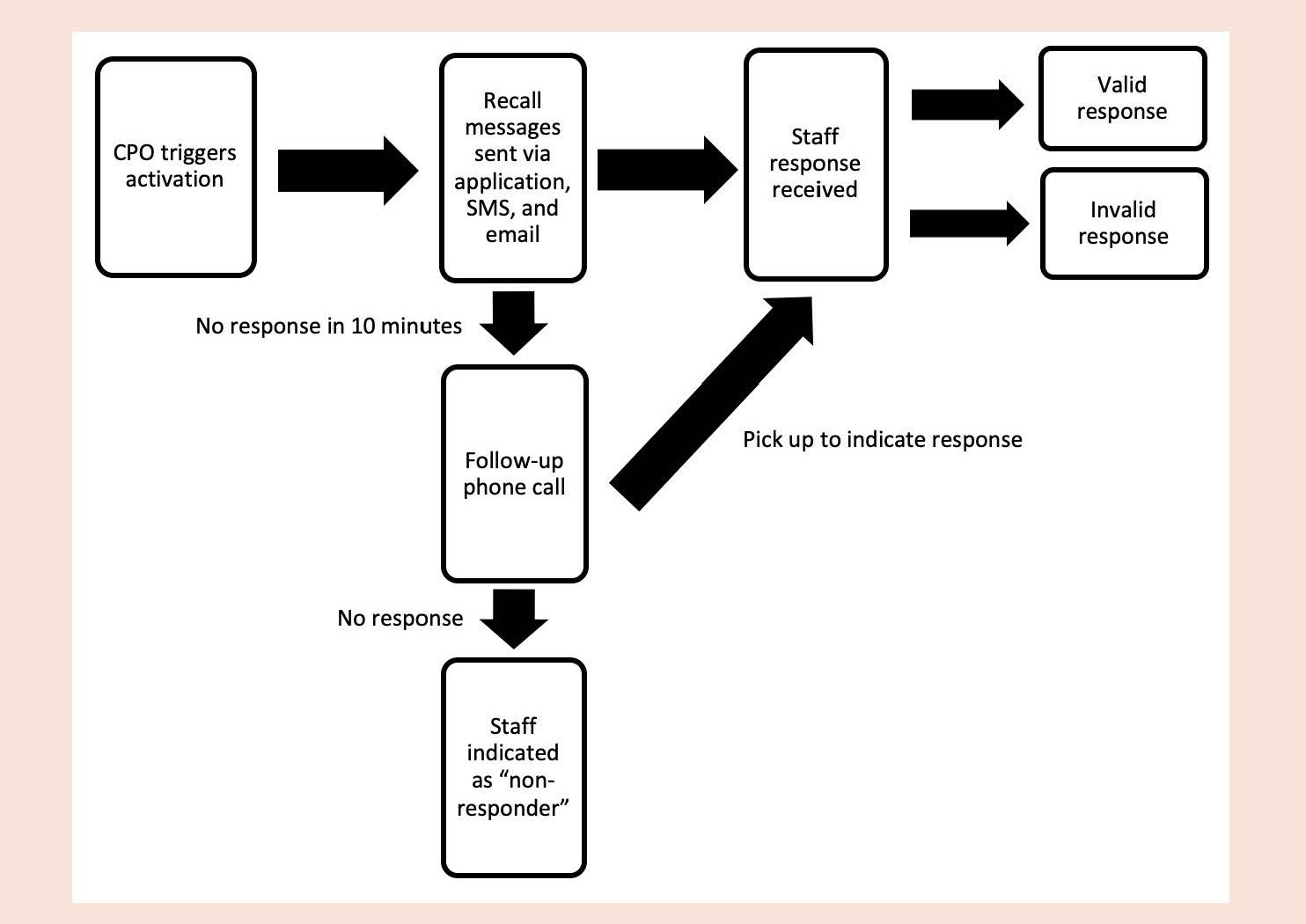 CPO: Crisis Planning and Operations; SMS: short message service
To better understand system performance and gaps in institutional readiness for MCIs, the authors conducted a repeated cross-sectional evaluation of 2 staff recall exercises (9 October 2024, 1409 hours; 30 July 2025, 1830 hours) at Sengkang General Hospital in Singapore. All staff registered in the recall system were included, spanning medical, nursing, allied health, operations, and administrative departments. Staff were not required to return physically. Non-responders were contacted post-exercise, and qualitative feedback was obtained through departmental representatives.
The primary outcome was the response rate, defined as submission of a valid response via any platform. Secondary analysis compared office-hours (0800–1700) and after-hours (1700–0800) activations. Proportions were compared using chi-square testing, with P<0.05 considered statistically significant.
In October 2024 (office hours), 5164 personnel were involved; 4183 (81.0%) responded, 842 (16.3%) did not respond, and 139 (2.7%) submitted invalid responses. In July 2025 (after hours), 5642 personnel were involved; 4446 (78.8%) responded, 750 (13.3%) did not respond, and 446 (7.9%) submitted invalid responses. The difference in response rates was significant (P<0.01).
Barriers to response highlighted operational and usability issues. Some staff were overseas or unable to reply because prepaid mobile plans did not support outgoing SMS. Others could not access the application because of forgotten login credentials. Some did not notice the alert, while others submitted free-text entries rather than predefined options. Several staff received follow-up calls despite having responded, suggesting system synchronisation delays.
Overall, the exercises demonstrated high response rates but identified vulnerabilities, particularly after hours. The lower response rate may reflect off-duty commitments and is consistent with evidence that successful message delivery does not ensure response.7 Qualitative feedback identified usability issues, including login difficulties and redundant notifications. In addition, the higher proportion of invalid responses after hours may reflect the relatively early timing of the exercise at 1830 hours, with staff communicating post-work commitments not captured by predefined options. Expanding these options to reflect after-hours circumstances may reduce invalid responses.
Effective recall systems must balance speed, reliability, and usability. Approaches range from traditional telephone trees to application-based recall platforms, each with inherent strengths and limitations. Manual call trees are inexpensive but inefficient.4 SMS and messaging platforms enable rapid dissemination,5 but depend on network stability and user settings,8 and may pose cybersecurity risks.4 Application-based recall platforms offer multi-channel delivery, structured response tracking, and scalability, but introduce challenges in account access, system complexity, and cost.9 System selection should therefore reflect institutional needs and technological readiness.
The appropriate extent of recall testing is equally important. Different exercise tiers offer distinct value. Reviewing a recall system ensures that institutional workflows remain clear and current,1 while testing the recall mechanism verifies its technical reliability.10 Exercises such as those conducted in this study evaluate staff responsiveness, while more advanced drills evaluating physical staff return provide insights into operational readiness. A progressive testing framework is therefore recommended,10 with each tier informing refinements to policy, workflow design, and training.
These findings demonstrate that even when recall systems appear effective on the surface, structured exercises can uncover latent vulnerabilities that may compromise manpower mobilisation during an actual emergency. They also emphasise the need for continuous review and iterative improvement of MCI plans. Exercises should be viewed not as endpoints but as opportunities to identify and address gaps. The issues identified in this study—such as login difficulties and synchronisation delays causing unnecessary follow-up calls—require corrective actions. The authors recognise that recalling credentials during an emergency imposes additional cognitive load when rapid decision-making is critical. Planned improvements focus on simplifying response pathways by reducing reliance on login-dependent processes, ensuring reliable message delivery across mobile plans and devices, and engaging vendors to improve response tracking. Strengthening user familiarity through targeted training may reduce invalid responses.
This study has several limitations. It reflects a single institution using a specific recall platform, limiting generalisability. Data constraints precluded analysis of response times and preferred response modalities. Staff were not required to return physically; hence, downstream operational readiness was not assessed. The absence of response data stratified by staff group and department may also have obscured variation in recall performance across the hospital, including potential vulnerabilities within critical frontline services.
To the authors’ knowledge, this is the first Singapore study describing real-world hospital-wide staff recall exercises using an application-based system. Differences between office-hours and after-hours activations highlight the need to anticipate variability in staff responsiveness. Regular testing and iterative improvements are essential for reliable staff mobilisation during MCIs.
REFERENCES
- World Health Organization. Mass casualty management systems: strategies and guidelines for building health sector capacity. Geneva (Switzerland): World Health Organization; 2007.
- American College of Emergency Physicians. Health care system surge capacity recognition, preparedness, and response. Ann Emerg Med 2005;45:239.
- Mazaheri N, Khajehaminian MR, Fallah-Aliabadi S, et al. Key features in designing an integrated recall system for dispatch in mass casualty incidents: a systematic review. Arch Acad Emerg Med 2024;12:e58.
- Pelfrey WV. Emergency manager perceptions of the effectiveness and limitations of mass notification systems: a mixed method study.J Homel Secur Emerg Manag 2020;18:49-65.
- Homier V, Hamad R, Larocque J, et al. A randomized trial comparing telephone tree, text messaging, and instant messaging app for emergency department staff recall for disaster response. Prehosp Disaster Med 2018;33:471-7.
- Quah LJJ, Pek JH, Cheng L, et al. Disaster medicine in Singapore: past, present, future. Singapore Med J 2024. Epub 13 March 2024.
- Mowbray F, Mills F, Symons C, et al. A systematic review of the use of mobile alerting to inform the public about emergencies and the factors that influence the public response. J Conting Crisis Manag 2024;32:e12499.
- Liu X, Sutton PR, McKenna R, et al. Evaluation of secure messaging applications for a health care system: a case study. Appl Clin Inform 2019;10:140-50.
- Husaini BA, Sugiarto S, Rahmanand S, et al. Assessing hospital disaster preparedness: A scoping review of available tools. Narra J 2023;3:e210.
- Federal Emergency Management Agency. Homeland security exercise and evaluation program (HSEEP). Washington (DC): Federal Emergency Management Agency; 2020.
Ethics approval was obtained from the SingHealth Centralised Institutional Review Board (2020/2853) with waiver of informed consent because of the study’s operational nature.
The authors have no affiliations or financial involvement with any commercial organisation with a direct financial interest in the subject or materials discussed in the manuscript. Generative artificial intelligence (AI) tools were used in the preparation of this manuscript. Specifically, ChatGPT (OpenAI) was used to assist with language refinement, grammar correction, and improving clarity of expression. The authors reviewed and edited all outputs to ensure accuracy and take full responsibility for the final content. No AI tools were used for data analysis, interpretation, or generation of results.
Dr Jenshen Cheng, Department of Emergency Medicine, Sengkang General Hospital, 110 Sengkang East Way, Singapore 544886. Email: [email protected]
