

ABSTRACT
Introduction: Good compliance of the management of abnormal results is important for effective cervical screening. This study investigated the rate of surveillance and follow-up outcomes for human papillomavirus (HPV)-positive women in cervical screening.
Method: Women on surveillance by repeat HPV testing were identified in a prospectively managed database. Data retrieved included women’s age, country residence status, history of colposcopy, HPV-DNA status on the first and repeat tests, dates of follow-up during the 5 years since the initial screening, and histological diagnosis of cervical lesions. The main outcome measures were compliance rate for repeat HPV testing, regression and persistence rates of HPV subtypes, and detection rate of high-grade lesions (CIN2+).
Results: This analysis included 680 residents in the community, mean age 44.8 (95% confidence interval 20.1–69.5) years. The compliance rate of repeat testing was 28.2% at 12 months and, cumulatively, 42.8% for the entire 5-year follow-up period. The rates were unaffected by age (P=0.5829) nor prior colposcopy (P=0.1607). There were 5 (1.7%) cases of CIN2+ detected. Of 391 women on longitudinal follow-up, 194 (60.8%) cleared their HPV infection. Some women with multiple HPV infection cleared 1 but not the other subtype(s). Thus, the regression rate was 90.3% for HPV-16, 87.0% for HPV-18 and 65.2% for HPV-12-others (P=0.0001). The annualised HPV regression rates were similar for HPV subtypes and for each follow-up year.
Conclusion: Surveillance of HPV positivity is clinically important for detecting high-grade lesions. Despite a high regression rate of HPV, surveillance hesitancy is a serious weakness in routine cervical screening.
CLINICAL IMPACT
What is New
- The novel findings of this study indicate the prevalence of surveillance hesitancy in cervical cancer screening in Singapore—a reluctance in the follow-up monitoring of abnormal test results.
- To our knowledge, for the first time in Singapore, data are presented to show the importance of surveillance of HPV screening positivity in terms of the detection rate of high-grade lesions of the cervix and the regression rate of cancer-causing HPV subtypes.
- Findings underscore weak points in the current strategy of cervical screening in Singapore.
Clinical Implications
- The study highlights the need to introduce structured call-recalled system in the surveillance of abnormal screening results in cervical cancer screening in Singapore.
- This data can potentially help further reduce the incidence of cervical cancer in Singapore.

Cervical cancer is one of the most preventable public health challenges worldwide.1-3 In 2020, a global estimate reported that 604,127 new cases of cervical cancer were diagnosed and 341,831 died from it.4 The World Health Organization launched a Cervical Cancer Elimination Initiative in 2018, with an aim to reduce the incidence of cervical cancer to 4 of 100,000 women in every country by the year 2030. This ambitious goal called for a concerted effort to mass vaccinate against high-risk HPV for girls below 15 years old, screen 70% or more of eligible women, and adequately treat 90% or more of pre-malignant conditions of the cervix. The plethora of publications have provided undisputable evidence on the efficacy of organised cervical cancer screening; even more data are available on sensitivity and specificity of several screening tests.5-9 Challenges in the execution of a mass screening programme include implementation of follow-up surveillance, and diagnostic and therapeutic measures, are well recognised. In addition, many important considerations have been raised for implementing cervical screening programme, including demographic characteristics of the screening population, and the local political and financial settings of Singapore.10-11
A mathematical modelling analysis reported that an increase by 2% in compliance rate in screening would reduce the lifetime risk of cervical cancer by up to 3%.12 On the other hand, lapses in follow-up action for abnormal screening results would greatly derail the cost-effectiveness of the screening programme. However, to date, literature on studies with primary objectives focusing on the compliance of follow-up after abnormal screening was surprisingly sparse. Information to fill this knowledge gap is needed for a comprehensive appraisal of optimal strategy in cervical screening.
The objectives of the current study aimed (1) to determine the follow-up attendance rate of women placed on clinical surveillance after abnormal primary human papillomavirus-deoxyribonucleic acid (HPV-DNA) screening, and (2) to investigate the follow-up outcome of the abnormal results by examining the regression and persistence of HPV infection and detection rate of high-grade lesions of the cervix.
METHOD
This was a retrospective descriptive quantitative study of data extracted from a research database, which contained clinical data prospectively collected between January 2014 and 31 July 2021 for investigating the effectiveness of cervical screening using primary HPV-DNA test at Singapore General Hospital.
Ethical approval
This research project was approved by the SingHealth Centralised Institutional Review Board (CIRB number 2016/2385, expiry October 2021).
Subjects
The database included 10,967 women who undertook primary HPV cervical screening. Of these, 822 women who were tested positive for 14 high-risk HPV-DNA testing between January 2014 and 31 July 2021 formed the basis of subjects for the current study. Women who undertook cervical excision procedures—either loop electro-excision procedure or conisation—and laser vaporisation of the transformation zone of the cervix after the initial round of screening were excluded.
HPV-DNA test
Physician-collected cervical smear samples were kept in 20 mL PreservCyst® Solution (ThinPrep, Hologic, US). Laboratory polymerase chain reaction test for the DNA of 14 high-risk HPV subtypes was carried out in the institutional molecular diagnostic laboratory using Cobas 4800 platform (Roche, US) according to the manufacturer’s manual of protocols. The data outputs were either positive or negative for HPV-DNA in 3 HPV subtype groupings—HPV-16, HPV-18 and HPV-12-others—which included HPV subtypes: HPV-31, HPV-33, HPV-35, HPV-39, HPV-45, HPV-51, HPV-52, HPV-56, HPV-58, HPV-59, HPV-66 and HPV-68.
Data collection
Information extracted from the database included women’s age; country residential status; dated HPV-DNA status for HPV-16, HPV-18 and HPV-12-others on primary screening and at follow-up visits; colposcopy attendance; histology diagnosis based on biopsies; and conisation or hysterectomy.
Data analysis
The analysis was performed in 2 parts: (1) compliance of follow-up and (2) the outcome of HPV positivity on follow-up. The follow-up compliance analysis included residents of Singapore only (women normally living in Singapore, excluding migrant workers who stayed in the country for a variable duration and would naturally not be available for follow-up surveillance). The analysis for the outcome of HPV positivity on follow-up included women of all residential status in Singapore and who had attended at least 1 follow-up repeat HPV-DNA testing.
Compliance of follow-up was defined as a follow-up for a repeat HPV testing within the 5 years from the initial screening test. Only the first follow-up attendance was counted towards the computation of compliance rate. The denominator for the computation of overall compliance rate was the entire cohort of women assigned for follow-up attendance, and the numerator was the total number of women who had attended their first follow-up visit within the 5 years from their initial screening date. A breakdown of follow-up compliance rate for successive years following the initial date of screening was computed using the number of new first-time follow-up for the year as the numerator.
Analysis was also performed to assess the potential impact of women’s age and colposcopy attendance on follow-up compliance.
Outcome of HPV positivity was analysed for HPV regression or persistence on follow-up and the detection of high-grade lesions of the cervix. HPV regression was defined by a negative HPV testing. Regression rate was computed for individual HPV subtype groupings at yearly interval after the initial positive test. Incidence of HPV regression was defined as clearance of all HPV subtypes in an individual woman. The cumulative incidence rate of HPV regression was computed for the period of analysis. HPV persistence was defined as detection of HPV-DNA of the same subtype grouping in the consecutive repeat tests 12 months apart.
Detection of high-grade lesions included all cases of CIN2, CIN3, invasive epithelial carcinoma of the cervix, and adenocarcinoma in-situ of the cervix. The overall detection rate was computed from the cumulative number of high-grade lesions detected among the total number of women in the compliance of follow-up study who had attended at least 1 follow-up visit.
Statistical analysis
Statistical Package for Social Sciences version 21.0 (SPSS, Chicago, IL, US) was used to analysed for the significance of difference for variables that could influence the follow-up compliance rate or outcome of HPV positivity between groups. Continuous data such as women’s age were analysed using 2 independent sample t-test and categorical data, and frequency distribution between categories was analysed using chi-square statistics. Statistical significance was set at P<0.05.
RESULTS
Outcome of follow-up study
There were 680 women in the follow-up study cohort. The mean age of the women was 44.8 years (95% confidence interval [CI] 20.1–69.5). Of these, 292 women had colposcopy evaluation for their HPV and/or reflex cytology abnormalities and were subsequently recommended for a 12-month surveillance by repeat HPV testing. Also, there were 388 patients who were HPV-12-others positive with normal cytology and were managed clinically by a recommended repeat HPV/cytology testing in 12 months.
Follow-up attendance rate
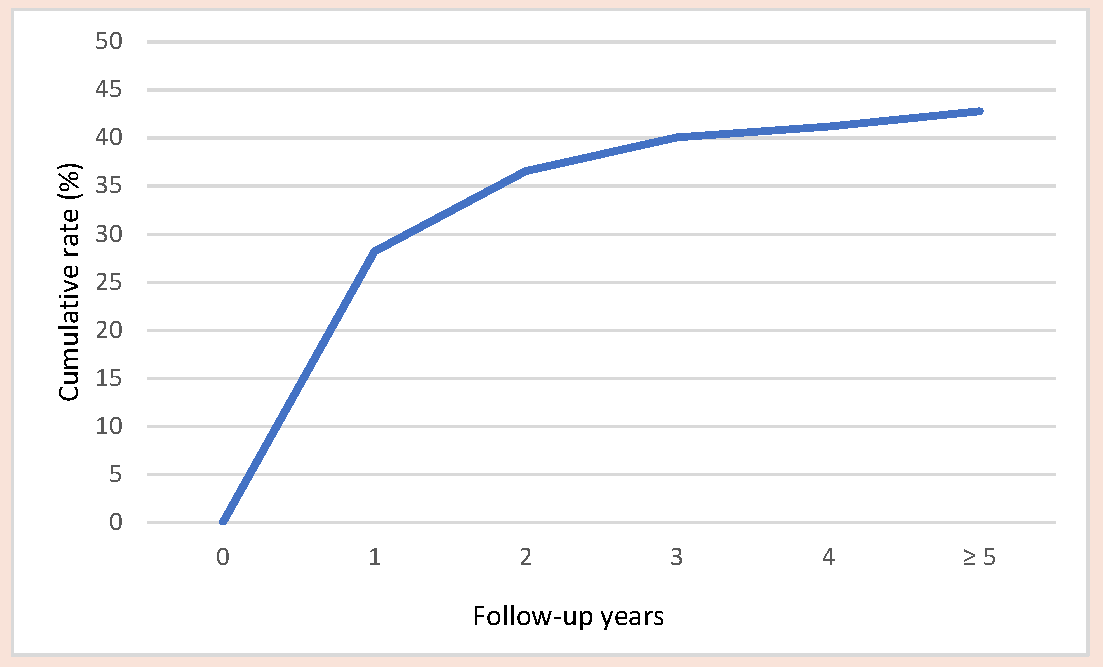
The overall follow-up attendance rate was 42.8% (291 of 680) for the entire period of analysis. It included 116 out of 292 (39.7%) women in the subgroup who were initially evaluated by colposcopy and 175 of 388 (45.1%) from the subgroup of women who were managed by recommendation for repeat screening in the following 12 months (Table 1). The difference in the overall follow-up rate between the 2 subgroups of follow-up attendees was not significant statistically (chi-square=1.9678, P=0.1607). Only 28.2% of the women attended the recommended follow-up 12 months after the initial screening (year 1). The frequency of attendance reduced sharply with increasing duration after the initial screening, as shown in Table 1. Of the total number of 291 follow-up attendees, 192 (66.0%) returned during the first year of follow-up (Fig. 1).
Fig. 1. Cumulative rate of follow-up over the 5-year period after the initial screening.
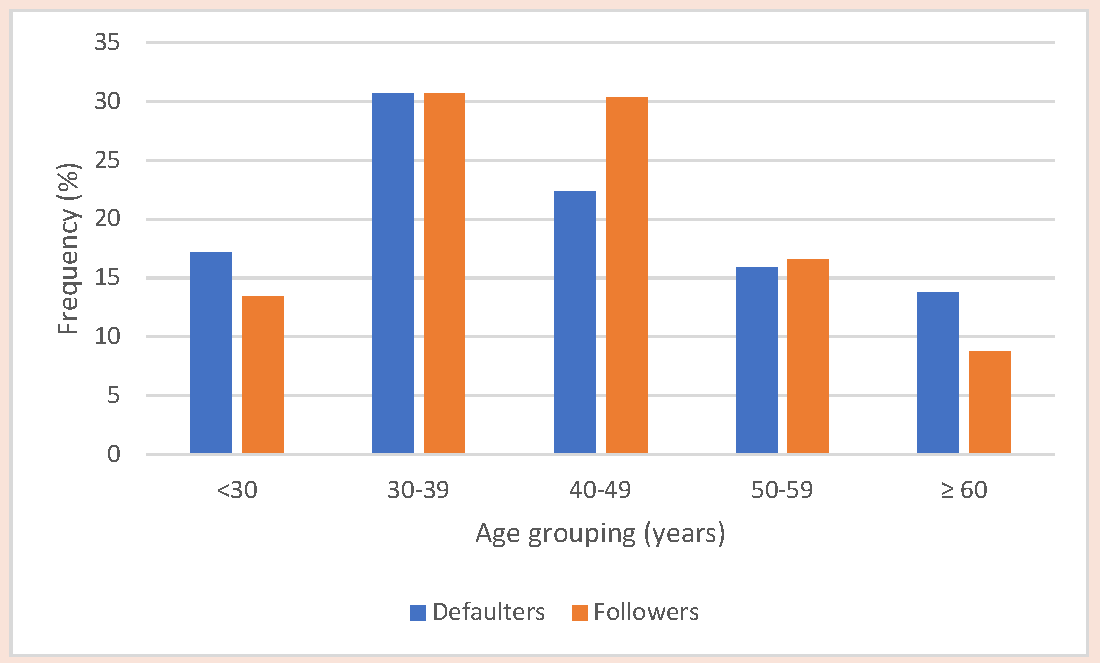
The frequency trend of follow-up was similar regardless of experience of prior colposcopy. Exploration of the impact of women’s age on follow-up rate showed that the mean age (95% CI) was 42.6 (16.6, 68.6) years for the defaulters and 42.1 (19.7, 64.5) years for those who attended the follow-up for repeat testing. Fig. 2 shows the comparison of the frequency distribution of age-grouping between patients who attended and who defaulted follow-up. The difference was not statistically significant (P=0.5829).
Fig. 2. Comparison of frequency distribution of age-groupings between follow-up defaulters and attendees.
Potential impact of HPV subtypes of follow-up was evaluated. The distribution of HPV subtypes among HPV-positive patients during the initial screening and for the follow-up patients is summarised in Table 2. HPV-12-others were the most prevalent HPV subtypes at both testing settings but more pronounced among the follow-up patients. However, HPV subtype distribution between the follow-up population and the initial screening population was not statistically significant (P=0.4808).
Table 2. Distribution of HPV subtypes at the initial screening and during follow-up.
Incidence of high-grade lesions
During the study period, 4 cases of CIN2 and 1 case of CIN3 were detected. The details of these cases are summarised in Table 3. The incidence of high-grade squamous lesions (CIN2+) was 1.7% (5 of 291).
Table 3. Details of high-grade lesions identified during follow-up.
Outcome of HPV clearance study
HPV clearance was separately analysed for the cohort of women for follow-up study and for longitudinal clearance study. In the longitudinal HPV clearance study cohort were 319 women, mean age was 42.5 years (95% CI 19.5–65.3). The follow-up duration of the entire group of women ranged from 1 to 7 years, mean number of years was 2 years (95% CI 1.87–2.13).
HPV clearance rate in the follow-up cohort (n=291)
Women in the follow-up cohort were counted once on the first follow-up attendance. HPV clearance rate was therefore referred to the first repeat testing. Overall, 47.8% of women (139 of 291) were found to be HPV-DNA negative on the follow-up. The clearance rate of HPV infection was similar for all HPV subtypes for the follow-up that took place at different time points throughout the span of 5 or more years (Table 4).
Table 4. Comparison of HPV-negative rate across follow-up period.
Longitudinal study cohort (n=319)
Overall, 194 (60.8%) women cleared the HPV positivity for all subtypes on repeat HPV-DNA testing over the period of follow-up of up to 7 years. For individual HPV subtypes, the overall clearance rate was 90.3% (56 of 62 cases) for HPV-16, 87.0% (20 of 23 cases) for HPV-18 and 65.2% (165 of 253 cases) for HPV-12-others (Table 5). The difference in HPV clearance between the HPV subtypes was statistically significant (P=0.0001). The longitudinal study showed that HPV clearance continued to occur in successive follow-up years at a similar rate across the period of study for each HPV subtype groups (Table 6).
Table 6. Comparing HPV-negative rate between HPV subtypes for each follow-up year.
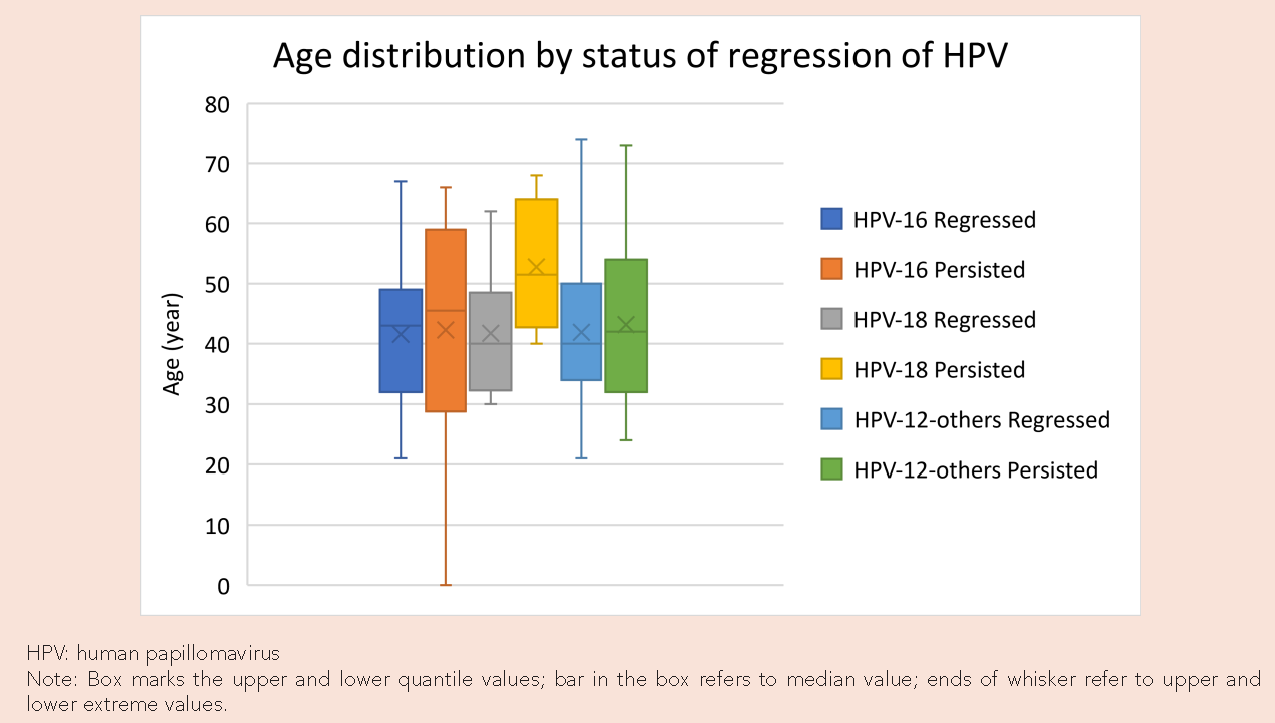
There was no statistical difference in the mean age of women between women in each group of HPV subtypes (Table 5). Comparison analysis between HPV persistence and clearance groups showed that women in the HPV persistence group tended to be older (Fig. 3). The difference between the 2 groups, however, was not statistically significant.
Fig. 3. Age comparison of women according to HPV regression and persistence status for each HPV subtype.
DISCUSSION
Compliance of follow-up for abnormal results is one of the critically important determining factors in an effective screening programme.13 Based on a mathematical model analysis, Burger et al. reported that a 2% increase in compliance to screening protocol could reduce a woman’s lifetime cancer risk by 1–3%.12
This study found that the compliance for follow-up attendance at 12 months after an abnormal initial screening result was merely 28.2%. Investigation on an extended period of 5 years after initial screening showed that the latecomers for follow-up came in dribs and drabs, and in a diminishing number for each successive year (Table 1). Taking all attendance during the 5-year period together, the overall follow-up attendance rate was 42.8% (Fig. 1). Of these, 66.0% occurred during the first year. This study confirmed the significance of the follow-up of HPV-positive cases. The findings showed that almost 40% of women had persistent HPV infection for more than 12 months. More concerning, some women remained HPV-positive in the last testing 7 years later. Most importantly, the detection rate of high-grade lesions in the cervix—1.7%—was 4.6 times higher than the prevalent rate in the local screening population.
The current study performed a novel analysis comparing the follow-up rate of women who had attended colposcopy against women whose abnormal initial screening results prompted a recommendation for a repeat screening test at 12 months. The study included 292 (42.9%) women who were stratified into the subgroup at clinically significant, high probability of a high-grade lesion and who had undertaken a colposcopy evaluation (Table 1). One might have thought that these women would have taken the cue of their risk for the disease and showed a higher compliance for follow-up compared to other HPV-positive women at intermediate risk for high-grade lesions and who were managed with a recommended repeat screening at 12 months. This was proven not to be the case in this study. The frequency of attendance for follow-up was statistically similar between the 2 subgroups of women (39.7% for colposcopy subgroup vs 45.1% for repeat screening subgroup, P=0.1607).
It is known that appropriate follow-up testing in cervical screening was highly variable, ranging from around 50% in Brazil and Japan to more than 80% in European countries.14-18 Poor compliance rate of less than 50% was also reported in Nigeria and Hong Kong.19,20 However, the overall follow-up rate of 42.8% for an extended period of 5 years found in the current study was one of the lowest rates ever reported in literature. This rate was akin to the local routine primary screening rate found in several previous reports.21,22 The exact reasons for the low follow-up rate were unknown. Commonly reported reasons for low participation rate of cervical screening included women in older age group, poor socio-economic status, low educational levels and poor access to healthcare. These factors might not be operating for follow-up testing as the women had taken the step of initial screening. Indeed, the current study found that the frequency distribution of women’s age groupings between the defaults and attendees was similar (Fig. 2).
It was interesting to note that a study on the follow-up of abnormal screening results for breast, colorectal and cervical cancers found a return rate of 46.6% for cervical cancer screening compared to 93.2–96.7% for breast cancer and 46.8–68.7% for colorectal cancer.23 These findings highlight that it was not screening lethargy or cancer phobia (a phenomenon of fear of cancer) but something specific or peculiar to cervical cancer screening that results in the low return rate for screening. Unlike mammography in breast cancer screening and fecal immunochemical test in colorectal cancer screening, cervical screening is emotionally stressful and embarrassing, as it involves sensitive sexual organs and is physically invasive in vaginal examination and instrumentation. Attempts to overcome deterrence of attending a screening clinic by physical distance and time factor and anxiety of embarrassment have led to the development of women’s self-sampling technique and devices. However, many women who failed to attend routine cervical screening were also poor respondents of self-sampling.24 Sharp et al. identified that women’s high level of anxiety and distress in general, experience of pain in prior screening, and lack of support as significant factors negatively influenced women’s participate rate and return to follow-up of cervical screening.25 In this respect, the heightened anxiety and psycho-sexual morbidity commonly associated with colposcopy could have further contributed to the low follow-up rate found in the current study among the colposcopy subgroup (39.7% overall or 26.0% at 12 months). Research to identify effective measures to address this concern and explanation of compliance hesitancy and reluctance is critically important to improve the completeness of cervical screening cycle to achieve the optimal efficacy of the programme.
Of practical importance, an active call-recall approach to encourage women to participate in cervical screening has been shown to increase the primary screening uptake.26 Similar data are not available for the impact of call-recall on the compliance of surveillance of abnormal screening results. Emerging anecdotal information from several community screening clinics in Singapore suggests that designated personnel to call-recall women for follow-up increased the return rate for re-testing. The impact of call-recall system warrants a formal evaluation.
Data from this study showed that there was no difference in the distribution of HPV-16, HPV-18 and HPV-12-others between women in the initial screening and at follow-up (Table 2). The apparent numerical predominance of HPV-12-others compared to HPV-16 and HPV-18 was not statistically significant. Overall, 60.8% of women on longitudinal study became HPV-DNA negative over a mean follow-up period of 2 years (range from 1 to 7 years). HPV clearance rate was statistically significantly higher (P=0.0001) for HPV-16 (90.3%) and HPV-18 (87.0%) compared to HPV-12-others (65.2%). The overall HPV clearance rate and the high persistence of HPV-12-others observed in this study concurred with the data reported from elsewhere.27-29 In the current study, HPV clearance was similar for all age groups (Fig. 3). Adebamowo et al. had previously reported that HPV clearance was similar for all subtypes of high-risk HPV and for women across all ages.30 It was interesting to note that HPV clearance occurred throughout the follow-up period at a similar annualised rate, 49.8–54.5% (Tables 3–5). Evidently, a small group of women seemed to be unable to clear the genital HPV infection (Table 5). The long duration of the persistence of HPV is etiologically related to the risk of neoplasia development in the cervix. Existing data indicated that follow-up should continue until HPV clearance is confirmed.31
The importance of follow-up surveillance was shown in this study by the detection of 5 cases of high-grade lesions among the 291 women or 1.7% (Table 6). This rate was 4.6-fold higher than the prevalence rate (0.37%) in the cohort analysis of the initial screening.32 The cases were associated both with HPV-16 and HPV-12-others within 3 years of follow-up.
Strengths and limitations
The data collected prospectively in the database were reliable information and the analysis of compliance rate for the residents of Singapore ensured the best captive population for the study. The completeness of data for analysis was strengthened further by the inclusion of follow-up cases who appeared late but within the 5 years of the initial screening to accommodate women who might have difficulties with accessing the follow-up facilities.
On the analysis of HPV clearance rate, the study included a subgroup of women who attended repeated HPV testing. The subgroup population was increased by including foreign nationals who resided long-term in Singapore and attended the repeat HPV testing. The analysis was repeated for each followed up year, which showed the consistency in the clearance rate.
The main limitation of the study was the fact that the database from a single institution may miss some women who might have attended other healthcare facilities for follow-up of their abnormal results. There was no reason to believe that this had happened in any significant number if one referred to the same database that reported almost a complete compliance of calls for colposcopy on abnormal results on the initial screening.32
CONCLUSION
The compliance of follow-up after abnormal HPV tests in this study was unacceptably low. Although many women cleared HPV spontaneously, a group of women remained HPV-positive for a long duration. There was a significant absolute risk of high-grade lesions of the cervix among these women. Research in compliance hesitancy and reluctance, including the evaluation of the impact of a call-recall system, is needed for formulating measures to improve the effectiveness of cervical screening.
Declaration
This study was not affiliated to or financially supported by any commercial organisation.
Ethics statement
This manuscript was approved by the SingHealth Centralised Institutional Review Board (Reference number 2016/2385).
Acknowledgements
The author would like to thank Dr Lee Wai Yen, Dr Joella Ang and SN Chow Siew Khian of the Department of Obstetrics and Gynaecology, Singapore General Hospital for their assistance in updating the patient database.
Correspondence: Prof SK Tay, Department of Obstetrics and Gynecology, Singapore General Hospital, 20 College Road, Singapore 169856. Email: [email protected]
REFERENCES
- Sundström K, Elfström KM. Advances in cervical cancer prevention: Efficacy, effectiveness, elimination? PLoS Med 2020;17:e1003035.
- Pimple SA, Mishra GA. Global strategies for cervical cancer prevention and screening. Minerva Ginecol 2019;71:313-20.
- Viveros-Carreño D, Fernandes A, Pareja R. Updates on cervical cancer prevention. Int J Gynecol Cancer 2023;33:394-402.
- Singh D, Vignat J, Lorenzoni V, et al. Global estimates of incidence and mortality of cervical cancer in 2020: a baseline analysis of the WHO Global Cervical Cancer Elimination Initiative. Lancet Glob Health 2023;11:e197-e206.
- Kyrgiou M, Arbyn M, Bergeron C, et al. Cervical screening: ESGO-EFC position paper of the European Society of Gynaecologic Oncology (ESGO) and the European Federation of Colposcopy (EFC). Br J Cancer 2020;123:510-7.
- Melnikow J, Henderson JT, Burda BU, et al. Screening for Cervical Cancer With High-Risk Human Papillomavirus Testing: A Systematic Evidence Review for the U.S. Preventive Services Task Force [Internet]. Rockville (MD): Agency for Healthcare Research and Quality (US); 2018.
- Jansen EEL, Zielonke N, Gini A, et al. EU-TOPIA consortium. Effect of organised cervical cancer screening on cervical cancer mortality in Europe: a systematic review. Eur J Cancer 2020;127:207-23.
- Terasawa T, Hosono S, Sasaki S, et al. Comparative accuracy of cervical cancer screening strategies in healthy asymptomatic women: a systematic review and network meta-analysis. Sci Rep 2022;12:94.
- Shastri SS, Temin S, Almonte M, et al. Secondary Prevention of Cervical Cancer: ASCO Resource-Stratified Guideline Update. JCO Glob Oncol 2022;8:e2200217.
- Alfaro K, Maza M, Cremer M, et al. Removing global barriers to cervical cancer prevention and moving towards elimination. Nat Rev Cancer 2021;21:607-8.
- Kramer J. Eradicating cervical cancer: Lessons learned from Rwanda and Australia. Int J Gynaecol Obstet 2021;154:270-6.
- Burger EA, Kim JJ. The value of improving failures within a cervical cancer screening program: an example from Norway. Int J Cancer 2014;135:1931-9.
- Doubeni CA, Gabler NB, Wheeler CM, et al. Timely follow-up of positive cancer screening results: A systematic review and recommendations from the PROSPR Consortium. CA Cancer J Clin 2018;68:199-216.
- dos Santos AV, dos Santos GT, Brackmann RL, et al. Follow-Up of Women with Cervical Cytological Abnormalities: Progression and Regression Events. Asian Pac J Cancer Prev 2019;20:1019-24.
- Sasaki Y, Iwanari O, Arakawa I, et al. Cervical Cancer Screening With Human Papillomavirus DNA and Cytology in Japan. Int J Gynecol Cancer 2017;27:523-9.
- Veijalainen O, Kares S, Kujala P, et al. Implementation of HPV-based cervical cancer screening in an organised regional screening programme: 3 years of experience. Cytopathology 2019;30:150-6.
- Luyten A, Buttmann-Schweiger N, Luyten K, et al. Early detection of CIN3 and cervical cancer during long-term follow-up using HPV/Pap smear co-testing and risk-adapted follow-up in a locally organised screening programme. Int J Cancer 2014;135:1408-16.
- Del Mistro A, Frayle H, Ferro A, et al. Cervical cancer screening by high risk HPV testing in routine practice: results at one year recall of high risk HPV-positive and cytology-negative women. J Med Screen 2014;21:30-7.
- Tse KY, Lau SK, Lui MW, et al. Patient compliance with cervical smear surveillance in a shared-care setting. Int J Gynaecol Obstet 2016;135:177-81.
- Ezechi OC, Petterson KO, Gbajabiamila TA, et al. Predictors of default from follow-up care in a cervical cancer screening program using direct visual inspection in south-western Nigeria. BMC Health Serv Res 2014;14:143.
- Jin AZ, Louange EC, Chow KY, et al. Evaluation of the National Cervical Cancer Screening Programme in Singapore. Singapore Med J 2013;54:96-101.
- Tay K, Tay SK, Tesalona KC, et al. Factors affecting the uptake of cervical cancer screening among nurses in Singapore. Int J Gynaecol Obstet 2015;130:230-4.
- Tosteson AN, Beaber EF, Tiro J, et al. Variation in Screening Abnormality Rates and Follow-Up of Breast, Cervical and Colorectal Cancer Screening within the PROSPR Consortium. J Gen Intern Med 2016;31:372-9.
- Viviano M, Vassilakos P, Meyer-Hamme U, et al. HPV self-sampling in the follow-up of women after treatment of cervical intra-epithelial neoplasia: A prospective study in a high-income country. Prev Med Rep 2021;24:101564.
- Sharp L, Cotton S, Cruickshank M, et al. The unintended consequences of cervical screening: distress in women undergoing cytologic surveillance. J Low Genit Tract Dis 2014;18:142-50.
- Abdullah F, Su TT. Applying the Transtheoretical Model to evaluate the effect of a call-recall program in enhancing Pap smear practice: a cluster randomized trial. Prev Med 2013;57 Suppl:S83-6.
- Skinner SR, Wheeler CM, Romanowski B, et al. Progression of HPV infection to detectable cervical lesions or clearance in adult women: Analysis of the control arm of the VIVIANE study. Int J Cancer 2016;138:2428-38.
- Jaisamrarn U, Castellsagué X, Garland SM, et al. Natural history of progression of HPV infection to cervical lesion or clearance: analysis of the control arm of the large, randomised PATRICIA study. PLoS One 2013;8:e79260.
- Shi W, Zhu H, Yuan L, et al. Vaginal microbiota and HPV clearance: A longitudinal study. Front Oncol 2022;12:955150.
- Adebamowo SN, Befano B, Cheung LC, et al. Different human papillomavirus types share early natural history transitions in immunocompetent women. Int J Cancer 2022;151:920-9.
- Gilham C, Sargent A, Kitchener HC, et al. HPV testing compared with routine cytology in cervical screening: long-term follow-up of ARTISTIC RCT. Health Technol Assess 2019;23:1-44.
- Ang XJ, Lee WY, Tay SK. Clinical efficacy of primary human papillomavirus (HPV) screening with partial genotyping for HPV-16 and HPV-18 subtypes in women from 25 years old. Ann Acad Med Singap 2023;52:259-67.
