

ABSTRACT
Introduction: Preterm birth (PTB) remains a leading cause of perinatal morbidity and mortality worldwide. Understanding Singapore’s PTB trends and associated risk factors can inform effective strategies for screening and intervention. This study analyses PTB trends in Singapore from 2017 to 2023, identifies risk factors in this multi-ethnic population and evaluates a predictive model for PTB.
Method: A retrospective analysis of all PTBs between 22+0 and 36+6 weeks of gestation, from 1 January 2017 to 31 December 2023, was performed by extracting maternal and neonatal data from electronic medical records. These PTBs were taken from the registry of births for Singapore and SingHealth cluster data. Cochran-Armitage trend test and multinomial logistic regression were used. An extreme gradient boosting (XGBoost) model was developed to test and predict the risk of PTB.
Results: The PTB rate in Singapore did not show a significant change. However, there was modest downward trend in the SingHealth population from 11.3% to 10.2%, mainly in late spontaneous PTBs (sPTBs). sPTBs accounted for ~60% of PTBs. Risk factors for very/extreme sPTB included Chinese ethnicity, age ≥35 years, body mass index (BMI) ≥23 kg/m², being unmarried, primiparity, twin pregnancy and maternal blood group AB. The XGBoost model achieved an area under the receiver operating characteristic curve of 0.75, indicating moderate ability to predict PTB.
Conclusion: The overall PTB rate in Singapore has not improved. This study underscores the importance of local factors, particularly advanced maternal age, BMI, primiparity, unmarried, Chinese ethnicity and maternal blood group AB influencing PTB risk. Artificial intelligence methods show promise in improving PTB risk stratification, ultimately supporting personalised care and intervention.
CLINICAL IMPACT
What is New
- The incidence of preterm birth (PTB) globally (10%) and in Singapore (8.1%) has not improved in the last 10 years.
- Using artificial intelligence, we have modestly improved the predictive risk for spontaneous PTB. Notable risk factors include Chinese ethnicity, single mother and maternal blood group AB.
Clinical Implications
- Our findings can better guide risk stratification and predict the population at risk of spontaneous PTB.
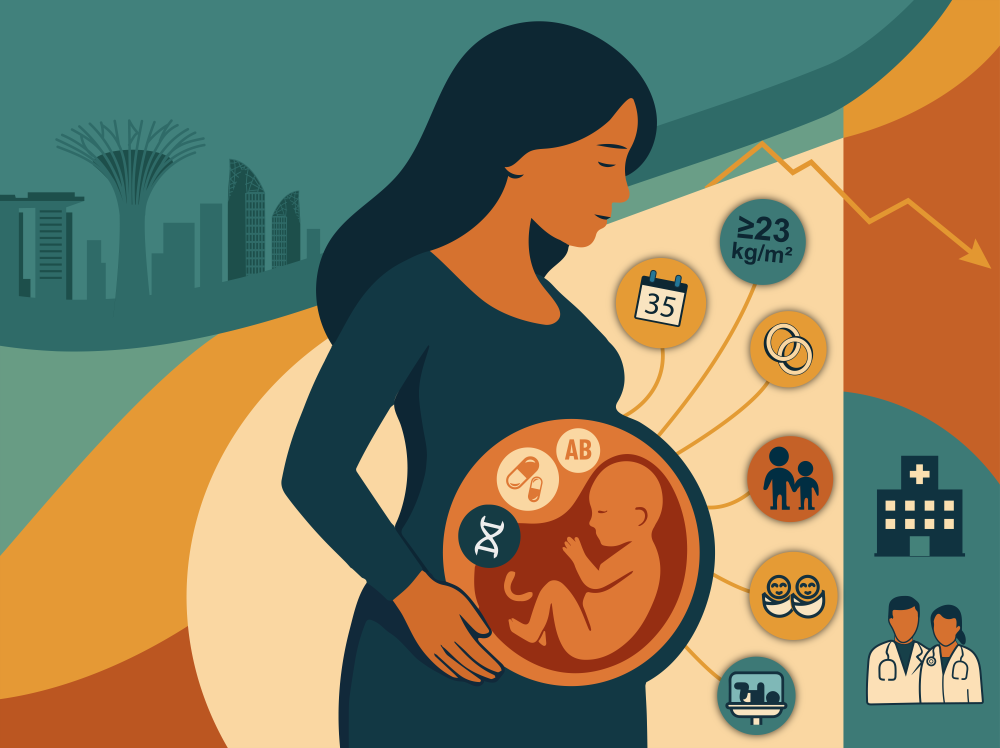
Preterm birth (PTB), defined by the World Health Organization as delivery before 37 weeks of gestation, is the primary contributor to perinatal morbidity and mortality worldwide.1–3 Despite advances in clinical and public health interventions, global PTB rates have remained relatively constant at approximately 10%.4 Rates vary by region and ethnicity; for instance, the US reported a 10.4% PTB rate in 2022,5 the UK 7.6% in 2021,6 and the Netherlands 6.9% in 2015.7 While there have been slight decreases in some regions, disparities persist.8 In Asia, PTB rates also differ widely; Bangladesh (16.2%), Pakistan (14.4%) and India (13.0%) report higher rates, while China’s rate is lower (6.1%).4 Singapore’s PTB rate was 8.12% in 2023.9 Ethnic disparities in PTB are well-documented in countries such as the US and UK, where black women experience disproportionately higher PTB rates.10-12 Singapore’s population comprises 74.0% Chinese, 13.5% Malay, 9.0% Indian and 3.4% from other ethnicities,13 but the role of ethnicity in Singapore’s PTB rates has not been explored in detail previously.
PTB can be further categorised by gestational age: (1) extreme preterm birth (ExPTB, <28 weeks), (2) very preterm birth (vPTB, 28 to <32 weeks), (3) late preterm (32 to <37 weeks). Although most PTBs occur in the late preterm category,14 ExPTB and vPTB are disproportionately linked to mortality and severe long-term complications.15-17 PTB is also subdivided by clinical subtype into (1) iatrogenic PTB (iPTB), where delivery is indicated for maternal or foetal reasons, and (2) spontaneous PTB (sPTB), which includes spontaneous labour or pre-labour premature rupture of membranes (PPROM).14,18
A history of PTB is the strongest risk factor for recurrent PTB.14,19 Maternal age over 35 years, abnormal body mass index (BMI), tobacco use, single marital status and medical comorbidities have all been linked to an increased risk of PTB.14,20-26 Short interpregnancy intervals (<6 months) further increase PTB risk.27,28 In multiple pregnancies, especially twins, PTB rates can be as high as 60%, with ~40% being spontaneous.14 Emerging research also suggests an association between maternal ABO blood group and PTB.29,30 Given the multifactorial aetiology of PTB and its significant burden on neonates, the healthcare system and families, a deeper understanding of local PTB risk profiles is needed to develop timely and targeted interventions. This study represents the first large-scale analysis of PTB in a large multi-ethnic, high-income Asian setting (Singapore), focusing on trends and risk factors. We used our findings to develop a predictive model for screening high-risk women. To our knowledge, this is the first study to include maternal blood group in a large multi-ethnic population using machine learning methods to predict risk of sPTB.
METHOD
Study design and setting
This retrospective cohort study analysed all PTBs between 22+0 and 36+6 weeks of gestation within the Obstetrics units of SingHealth institutions, namely, the 2 restructured hospitals—KK Women’s and Children’s Hospital (KKH) and Singapore General Hospital (SGH)—1 January 2017 to 31 December 2023. Both hospitals provide a significant portion of Singapore’s maternity and neonatal care, including the management of early gestational deliveries. Prior to 2017, paper notes formed the majority of data many of which were incomplete, and it was decided to use electronic data from 2017 to the present to best predict trends in PTB. The Singapore PTB was obtained from the births and deaths registry published by the Immigration and Checkpoints Authority of Singapore.
Data collection
We extracted maternal and neonatal data from electronic medical records. Collected variables included (1) maternal factors: age, ethnicity, parity, booking BMI, blood group, marital status, obstetric history (previous PTB and PPROM), medical conditions (hypertension, diabetes), cervical surgery history, use of cerclage or progesterone, smoking, illicit drug use, and interpregnancy interval; (2) pregnancy and delivery details: gestational age, mode of delivery, clinical subtype of PTB (spontaneous or iatrogenic), singleton or twin pregnancy; (3) neonatal outcomes: birth weight, sex and neonatal intensive care unit admission; (4) socioeconomic status: data for this were incomplete. Private and subsidised care was initially thought of to differentiate financial status. However, this was challenging to differentiate in the context of KK Women’s and Children’s Hospital and Singapore General Hospital, as almost all private patients opted for subsidised status when admitted to both hospitals. This was due to the high differential costs of neonatal care between the 2 groups of patients. As such, average household income among the different ethnicities as determined by the Singapore Department of Statistics Census of Population 2020 was used as proxy.
Inclusion and exclusion criteria
We included PTBs between 22+0 and 36+6 weeks of gestation. For multiple pregnancies, only twin gestations were included; higher-order multiples were excluded due to their distinct risk profile and rarity.
Classification of PTBs
PTBs were categorised by gestational age into (1) ExPTB: <28 weeks, (2) vPTB: 28 to <32 weeks, (3) late preterm: 32 to <37 weeks. Given their significant contribution to neonatal complications but with their comparatively smaller numbers, ExPTB and vPTB were grouped together for analysis in this paper.16,17 PTBs were also classified by clinical subtypes into (1) sPTB: onset of labour or PPROM before 37 weeks; (2) iPTB: deliveries induced due to maternal or foetal complications.
Statistical analysis
Categorical variables were presented as frequencies and percentages. Maternal age was grouped as <30, 30–34 and ≥35 years. Booking BMI was divided into <23 kg/m2 and ≥23 kg/m² using Asian cut-off points.31 Race was categorised into Chinese, Malay, Indian and Others. Parity was classified as 1 (primiparous), 2 and ≥3 births (multiparous including current pregnancy). Marital status was dichotomised into married versus (vs) single/divorced, and birth type into singleton vs twin.
We used the Cochran-Armitage trend test to assess yearly PTB incidence trends. Multinomial logistic regression was performed to examine risk factors for late PTB vs term birth, and ExPTB/vPTB vs term birth. Odds ratios (ORs) with 95% confidence intervals (CIs) are reported.
Development of the prediction model
A risk score prediction model for sPTB was developed based on the identified risk factors, using an extreme gradient boosting (XGBoost) classifier. XGBoost operates by sequentially expanding an ensemble of decision tree models, with each new tree model correcting for residual errors from the previous ensemble. The training of the ensemble is performed with gradient descent optimisation to minimise prediction error. The XGBoost classifier was first trained on the training set with 5-fold cross-validation to optimise the model hyperparameters. The final model was then trained using the optimised hyperparameters on the training set data and evaluated on the held-out test set.
For this study, data were available for PTBs from 2017 to 2023 inclusive, and term births from 2017 to 2019 inclusive. Data from 2017 and 2018 inclusive were designated as the training set (2503 PTB cases and 20,827 term birth cases), and from 2019 onwards as the test set (5615 PTB cases and 10,145 term birth cases). The model included 7 maternal features (age, race, marital status, blood group, BMI at booking, multiple pregnancy and parity) as its input features, with the target variable being PTB. A second risk score prediction model for sPTB was developed based on identified risk factors (excluding multiple pregnancy). The test set for this model has 4814 PTB and 10,136 term births.
Ethical considerations
Ethical approval was obtained from the SingHealth Institutional Review Board (2023-2278). Patient confidentiality was maintained, and data were anonymised prior to analysis.
RESULTS
PTB incidence and trends
From 2017 to 2023, SingHealth institutions recorded 91,174 births, accounting for 34.5% of all births in Singapore during that period. Of Singapore’s total PTBs, 44.1% were managed in SingHealth, with an increase from 42.5% in 2020 to 47.3% in 2023.
SingHealth delivered 42.9% of late preterm infants and 79.3% of ExPTB/vPTB infants in 2023. Due to the specialised tertiary neonatal care that is provided by SingHealth institutions, more extreme and very PTB babies were delivered in our hospitals (Table 1). ExPTB and vPTB constituted 18.3% of the total PTBs in SingHealth institutions and 0.7% of total births nationwide.
Overall PTB rates and subtypes
Although there was no statistically significant shift in PTB rates in Singapore, a slight downward trend from 11.3% to 10.2% (2017–2023) was observed within SingHealth institutions (P<0.001). This decline was mostly due to fewer late sPTBs being born in SingHealth institutions (from 9.3% to 8.2%, P<0.001), while rates of ExPTB/vPTB and iPTB remained unchanged. Approximately 60% of PTBs were spontaneous, and 40% were iatrogenic (Table 2).
Multiple pregnancies
Among twin pregnancies, the PTB rate exhibited a significant upward trend from 11.6% in 2017, dropping to 6.8% in 2020, and increasing again to 12.2% in 2023 (P<0.001). This fluctuation likely reflects the temporary suspension of assisted reproductive technology (ART) services during the COVID-19 pandemic, followed by a post-pandemic rebound. With adjustment for potential risk factors such as age, race, booking BMI, parity and marital status, women who gave birth in 2023 were 2.21 times (95% CI 1.31–3.75) more likely to have a PTB as compared to 2020, but it was not statistically significant when compared with 2017 (adjusted OR 1.07; 95% CI 0.58–1.98). In twin pregnancies, 62.6% of PTBs were iatrogenic, while 37.4% were spontaneous.
Maternal and neonatal characteristics
Table 3 summarises the demographic characteristics of patients delivering at SingHealth in 2017 to 2023 who experienced sPTB, stratified by gestational age.
Table 3. Demographic characteristics of patients by type of sPTB.
Risk factors for sPTB
Multinomial logistic regression identified several key risk factors (Table 4). Advanced maternal age (≥35 years), booking BMI ≥23 kg/m², single/divorced marital status, primiparity, twin pregnancy and Chinese ethnicity were associated with increased odds of very/extreme sPTB.
Table 4. Multinomial logistic regression analysis of risk factors for sPTB.
ABO blood group and PTB
Univariable logistic regression revealed that mothers with blood group AB were 13% more likely to experience PTB compared to blood group O (OR 1.13, 95% CI 1.03–1.24). Blood groups A and B showed slightly lower elevations in risk (Table 5).
Table 5. Association between blood groups and PTB.
Neonatal sex
No association was found between neonatal sex and sPTB risk (P=0.589).
Risk prediction model for sPTB
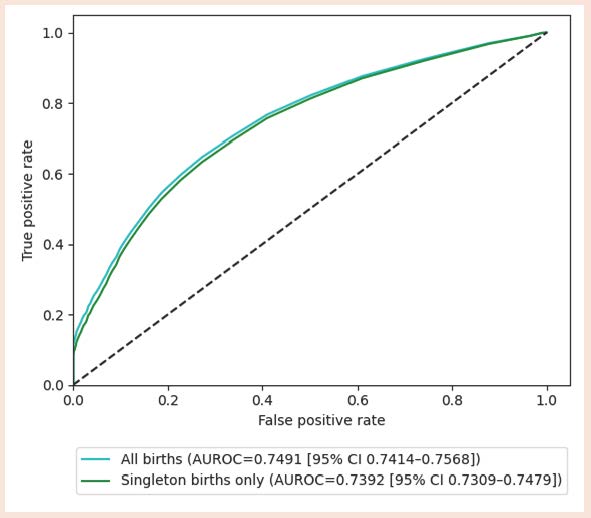
Using maternal age, ethnicity, marital status, blood group, booking BMI, multiple birth indicator and parity, our XGBoost-based risk prediction model achieved sensitivity of 0.7040 (95% CI 0.6919–0.7159) and specificity of 0.6647 (95% CI 0.6554–0.6739), with an area under the receiver operating characteristic (AUROC) curve of 0.7491 (95% CI 0.7414–0.7568) on the test set (Fig. 1). The most important predictors (based on Shapley Additive Explanation values) were booking BMI, ethnicity, age and blood group. When multiple pregnancy indicator was excluded from the database, we had a similar predictive AUROC of 0.7392 (95% CI 0.7309–0.7479) on the test set (Fig. 1).
Fig. 1. Area under the receiver operating curve for preterm birth detection.
CI: confidence interval
DISCUSSION
Principal findings
Our analysis showed that Singapore’s and SingHealth’s PTB rates remained relatively unchanged during the study period.
There was a modest decline only in the number of late sPTBs within the SingHealth population. A possible explanation is that most maternity units in Singapore are able to care for late PTBs in their own units while higher risk PTBs less than 32 weeks are referred into SingHealth for tertiary care. This supports the recognition of better prognosis of in-utero rather than ex-utero transfer of PTB to specialist neonatal units.
ExPTB and vPTB rates were unchanged, posing a continued challenge in PTB prevention as this is the group with significant effects on neonatal mortality and morbidity.16,17 Notably, SingHealth managed a growing proportion of PTBs in earlier gestation (78% in 2023), highlighting the cluster’s expanding role in caring for high-risk pregnancies.
SingHealth has set up a PTB clinic in 2022 in attempt to provide specialised care for patients at risk of PTB. We will now apply our prediction model to identify women at risk of PTB and provide personalised and early intervention.
Comparisons with other studies
The PTB rates we observed align with global trends, where overall PTB rates have not declined significantly.4 The higher PTB rates among Chinese mothers in Singapore compared to China (6.1%)4 may reflect distinct environmental or lifestyle factors. In addition, although socioeconomic status is associated with higher risk of PTB, this may not necessarily apply to our Singapore population. This is highlighted when we used the monthly median household income differentiated by ethnic groups as our proxy for socioeconomic status. Here, the Indian ethnic group had the highest monthly median income followed by the Chinese and Malay ethnic groups. Meanwhile, Malay women had relatively lower PTB rates, which is intriguing given potential socioeconomic disadvantages.32 These findings underscore the complexity of PTB aetiology, where genetic, cultural and healthcare access variables interact.
Risk factors
Advanced maternal age (≥35 years), higher booking BMI (≥23 kg/m²) and single/divorced marital status were all found to significantly increase PTB risk, consistent with existing evidence.14,20-23,25,26 Our results also point to primiparity as a risk factor and identify Chinese ethnicity as an important consideration. The role of ABO blood group in influencing PTB risk, particularly blood group AB conferring a higher risk than blood group O, warrants further mechanistic investigation.29,30,33
Multiple pregnancies
Twin pregnancies were associated with considerably elevated PTB risk.14,18 The observed fluctuations in twin PTB rates, especially around 2020, likely reflect changes in ART availability during the pandemic, followed by increased demand post-pandemic.
Risk prediction model
Our XGBoost model demonstrated moderate performance (AUROC ≈ 0.75) in identifying women at risk for sPTB using demographic and basic clinical features alone. This is the first reported paper using a machine learning model to predict risk of sPTB incorporating maternal blood group in a large study (n=30,827) of a multi-ethnic population, and it underlies the potential benefit of including more information to improve predictive accuracy. Due to the multifactorial associations with PTB, it is envisaged that prospective studies incorporating more detailed clinical information, such as cervical length measurements, previously identified biomarkers, microbiota flora and possible multi-omics in pregnancy associated with PTB, would certainly enhance the goal of early risk stratification to provide personalised care in diverse populations.
Strengths and limitations
A key strength of this study is the large sample size and comprehensive data collection from these 2 maternity centres with specialist neonatal units on-site. Specifically, as SingHealth accounts for approximately 80% of ExPTBs and vPTBs, we are better able to study the characteristics of this population with the highest risk of perinatal and infant mortality, enhancing the generalisability of the findings for this group within Singapore. However, limitations include the retrospective design and potential for unmeasured confounding factors. Incomplete data on certain variables (e.g. smoking status, illicit drug use, prior cervical procedures, cervical length measurement) may have limited the analysis. Additionally, data prior to 2017 were unavailable due to transition from hardcopy to electronic record. In our risk predictive model, we only included information that we could accurately obtain to form our database for artificial intelligence model analysis. In addition, there was no second set of data available for validation.
Implications for practice and research
The findings demonstrate that there are geographical and cultural differences to the multifactorial cause of PTB. This highlights the need for targeted interventions to reduce PTB rates specific for each region, particularly among high-risk groups identified in this study.
Personalised screening could help identify those who may benefit from preventive strategies. Those currently available are of limited success or perhaps misdirected as demonstrated by the stable PTB rates. Our predictive model could be refined further by incorporating multi-omics in pregnancy, biomarkers and cervical length measurements, together with emerging and improving technologies in machine learning. Further research is needed to explore the role of ABO blood groups and other novel risk factors in PTB aetiology.
CONCLUSION
Despite a slight decline in late PTBs in the SingHealth population, the overall PTB rate in Singapore has remained relatively unchanged between 2017 and 2023. This study highlights several key risk factors—Chinese ethnicity, advanced maternal age, higher BMI, primiparity, single/divorced marital status and maternal blood group AB. This points to opportunities for tailored screening and interventions. Our machine learning model provides moderate predictive value, underscoring the need for further refinements. Ongoing research integrating additional clinical and biological markers may enhance PTB prevention efforts and improve neonatal outcomes both in Singapore and globally.
Acknowledgment
We thank the staff of KK Women’s and Children’s Hospital and Singapore General Hospital for their assistance in data collection.
REFERENCES
- World Health Organization. Preterm Birth. https://www.who.int/news-room/fact-sheets/detail/preterm-birth/. Accessed 10 May
- American College of Obstetricians and Gynecologists’ Committee on Practice Bulletins—Obstetrics. Prediction and Prevention of Spontaneous Preterm Birth: ACOG Practice Bulletin, Number 234. Obstet Gynecol 2021;138:e65-90.
- Shapiro-Mendoza CK, Barfield WD, Henderson Z, et CDC Grand Rounds: Public Health Strategies to Prevent Preterm Birth. MMWR Morb Mortal Wkly Rep 2016;65:826-30.
- Ohuma EO, Moller A-B, Bradley E, et al. National, regional, and worldwide estimates of preterm birth in 2020, with trends from 2010: a systematic Lancet 2023;402:1261-71.
- Osterman MJK, Hamilton BE, Martin JA, et al. Births: Final Data for 2022. Natl Vital Stat Rep 2024;73:1-56.
- Office for National Statistics. Birth characteristics in England and Wales: 2021. https://cy.ons.gov.uk/peoplepopulationandcommunity/birthsdeathsandmarriages/livebirths/bulletins/birthcharacteristicsinenglandandwales/2021. Accessed 15 November 2024.
- Van Zijl MD, Koullali B, Oudijk MA, et Trends in preterm birth in singleton and multiple gestations in the Netherlands 2008–2015: A population-based study. Eur J Obstet Gynecol Reprod Biol 2020;247:111-5.
- Liang X, Lyu Y, Li J, et Global, regional, and national burden of preterm birth, 1990-2021: a systematic analysis from the global burden of disease study 2021. EClinicalMedicine 2024;76:102840.
- Immigration and Checkpoints Authority, Ministry of Home Affairs, Singapore. Report on Registration of Births and Deaths 2023, July 2024. pdf. Accessed 15 November 2024.
- United States Census Bureau. Quick Facts. https://www.census.gov/quickfacts/fact/table/US. Accessed 15 November 2024.
- Barreto A, Formanowski B, Peña MM, et al. Preterm Birth Risk and Maternal Nativity, Ethnicity, and JAMA Netw Open 2024;7:e243194.
- Kayode G, Howell A, Burden C, et al. Socioeconomic and ethnic disparities in preterm births in an English maternity setting: a population-based study of 3 million births. BMC Med 2024;22:371.
- Demographics of Singapore in 2023 – Structrure, Labor, Regional Trends. https://oosga.com/demographics/sgp/. 8 May 2025.
- Goldenberg RL, Culhane JF, Iams JD, et al. Epidemiology and causes of preterm Lancet 2008;371:75-84.
- Martin JA, Osterman MJK. Shifts in the Distribution of Births by Gestational Age: United States, 2014–2022. Natl Vital Stat Rep 2024;73:1-11.
- Hirai AH, Sappenfield WM, Ghandour RM, et The Collaborative Improvement and Innovation Network (CoIIN) to Reduce Infant Mortality: An Outcome Evaluation From the US South, 2011 to 2014. Am J Public Health 2018;108:815-21.
- Centers for Disease Control and Prevention. User Guide to the 2015 Period Linked Birth/Infant Death Public Use https://ftp.cdc.gov/pub/health_statistics/nchs/dataset_documentation/dvs/periodlinked/LinkPE15Guide.pdf. Accessed 15 November 2024.
- Aughey H, Jardine J, Knight H, et al. Iatrogenic and spontaneous preterm birth in England: A population-based cohort study. BJOG 2023;130:33-41.
- Passini R Jr, Cecatti JG, Lajos GJ, et Brazilian multicentre study on preterm birth (EMIP): prevalence and factors associated with spontaneous preterm birth. PLoS One 2014;9:e109069.
- Cobo T, Kacerovsky M, Jacobsson B, et Risk factors for spontaneous preterm delivery. Int J Gynaecol Obstet 2020;150:17-23.
- Ferrero DM, Larson J, Jacobsson B, et al. Cross-Country Individual Participant Analysis of 4.1 Million Singleton Births in 5 Countries with Very High Human Development Index Confirms Known Associations but Provides No Biologic Explanation for 2/3 of All Preterm Births. PLoS One 2016;11:e0162506.
- Cnattingius S, Villamor E, Johansson S, et Maternal obesity and risk of preterm delivery. JAMA 2013;309:2362-70.
- Hendler I, Goldenberg RL, Mercer BM, et al. The Preterm Prediction Study: association between maternal body mass index and spontaneous and indicated preterm Am J Obstet Gynecol 2005;192:882-6.
- Soneji S, Beltrán-Sánchez Association of Maternal Cigarette Smoking and Smoking Cessation With Preterm Birth. JAMA Netw Open 2019;2:e192514.
- Smith LK, Draper ES, Manktelow BN, et al. Socioeconomic inequalities in very preterm birth rates. Arch Dis Child Fetal Neonatal Ed 2007;92:F11-4.
- Thompson JMD, Irgens LM, Rasmussen S, et al. Secular trends in socio-economic status and the implications for preterm Paediatr Perinat Epidemiol 2006;20:182-7.
- Smith GCS, Pell JP, Dobbie R, et al. Interpregnancy interval and risk of preterm birth and neonatal death: retrospective cohort study. BMJ 2003;327:851.
- Männistö J, Bloigu A, Mentula M, et al. Interpregnancy Interval After Termination of Pregnancy and the Risks of Adverse Outcomes in Subsequent Birth. Obstet Gynecol 2017;129:347-54.
- Yu JY, Jiang B, Zhang XJ, et Relationship between maternal ABO blood groups and pregnancy outcomes: a retrospective cohort study in Dongguan, China. J Obstet Gynaecol 2023;43:2243508.
- Poudyal P, Joshi A, Bastakoti R, et al. Risk Factors and Clinical Profile of Preterm Deliveries at Dhulikhel Hospital, Kathmandu University Hospital. Kathmandu Univ Med J 2018;16:248-52.
- Pan WH, Yeh WT. How to define obesity? Evidence-based multiple action points for public awareness, screening, and treatment: an extension of Asian-Pacific recommendations. Asia Pac J Clin Nutr 2008;17:370-4.
- Singapore Department of Census of Population 2020. https://www.parliament.gov.sg/docs/default-source/default-document-library/cop2020sr2.pdf. Accessed 15 November 2024.
- Mountain K, MacIntyre D, Chan D, et ABO blood group antigens and preterm birth risk. J Reprod Immunol 2023;159:104083.
Ethical approval was obtained from the SingHealth Institutional Review Board (2023-2278).
No external funding was received for this study. The authors declare they have no affiliations or financial involvement with any commercial organisation with a direct financial interest in the subject or materials discussed in the manuscript. This research did not receive any specific grant from funding agencies in the public, commercial or not-for-profit sectors.
Dr Rachel Phoy Cheng Chun, Department of Obstetrics and Gynaecology, KK Women’s and Children’s Hospital, 100 Bukit Timah Road, Singapore 229899. Email: [email protected] Prof Tiong Ghee Teoh, Department of Maternal Fetal Medicine, KK Women’s and Children’s Hospital, 100 Bukit Timah Road, Singapore 229899. Email: [email protected]
