

 Dear Editor,
Frailty increases vulnerability to dependency and death.1 With Singapore’s ageing population, early frailty identification in the emergency department (ED) is critical yet constrained by time and resources. Clinical Frailty Score (CFS) is a validated 9-point tool used for frailty identification, with scores ³5 indicating frailty (Supplementary materials Appendix S1).2 In Singapore, the CFS algorithm (CFS-A) (Supplementary materials Appendix S2) showed comparable performance against the gold-standard Frailty Index (FI)3 in hospitalised older persons and predicted outcomes, such as mortality and institutionalisation.4 However, there is currently no validated frailty tool for the ED in Singapore.
To address this issue, we developed 2 novel scoring tools; CFS-Fast (Supplementary materials Appendix S3), a simple visual aid; and CFS-Self (Supplementary materials Appendix S4), a self- or proxy-administered version. We aimed to validate these tools, alongside CFS-A, by comparing agreement, diagnostic and predictive performance against FI. In a prior pilot,5 CFS-Fast (formerly CFS-ED) and CFS-Self showed moderate agreement with the CFS-A, prompting refinements and renaming to CFS-Fast.
We conducted a prospective observational study at Tan Tock Seng Hospital ED, a tertiary care hospital with 120,000 ED visits annually. Patients aged ³65 years presenting on weekdays from 10am to 5pm were enrolled. Patients who were critically ill, previously enrolled or lacked mental capacity without an accompanying legally acceptable representative (LAR) were excluded. Research assistants obtained written informed consent.
Triage nurses scored CFS-Fast; patients or caregivers scored CFS-Self; and non-study team geriatric-trained staff scored CFS-A, with all raters blinded. Trained research assistants conducted interviews and accessed records to complete a baseline data collection form; and performed telephonic follow ups at 1-, 3- and 6-months to record outcomes including mortality, hospitalisations, ED re-attendances and falls.
Based on sensitivity and specificity estimates of 50% and 90%, respectively, and an 80% frailty prevalence, we aimed to recruit 210 participants. Agreement between the 3 tools and FI was assessed using weighted kappa statistics. Predictive performances were compared with FI for the abovementioned adverse health outcomes. Area under the receiver operating characteristic curves were compared against FI to determine their diagnostic performance, sensitivity, specificity, predictive values and optimal cut-off scores. Frailty was defined as CFS scores ≥5 or FI ratio ≥0.25.
Outcomes at 1, 3 and 6 months were analysed using univariate analysis to compare the level of agreement of adverse health outcomes; and multivariate analysis using logistic regression, adjusting for a priori confounders (age, gender and comorbidities), to determine the predictive ability of each tool in predicting adverse outcomes. To account for multiple hypothesis testing across multiple outcomes, the odds ratio (OR) of adverse outcomes were reported with 99% confidence intervals (CI).
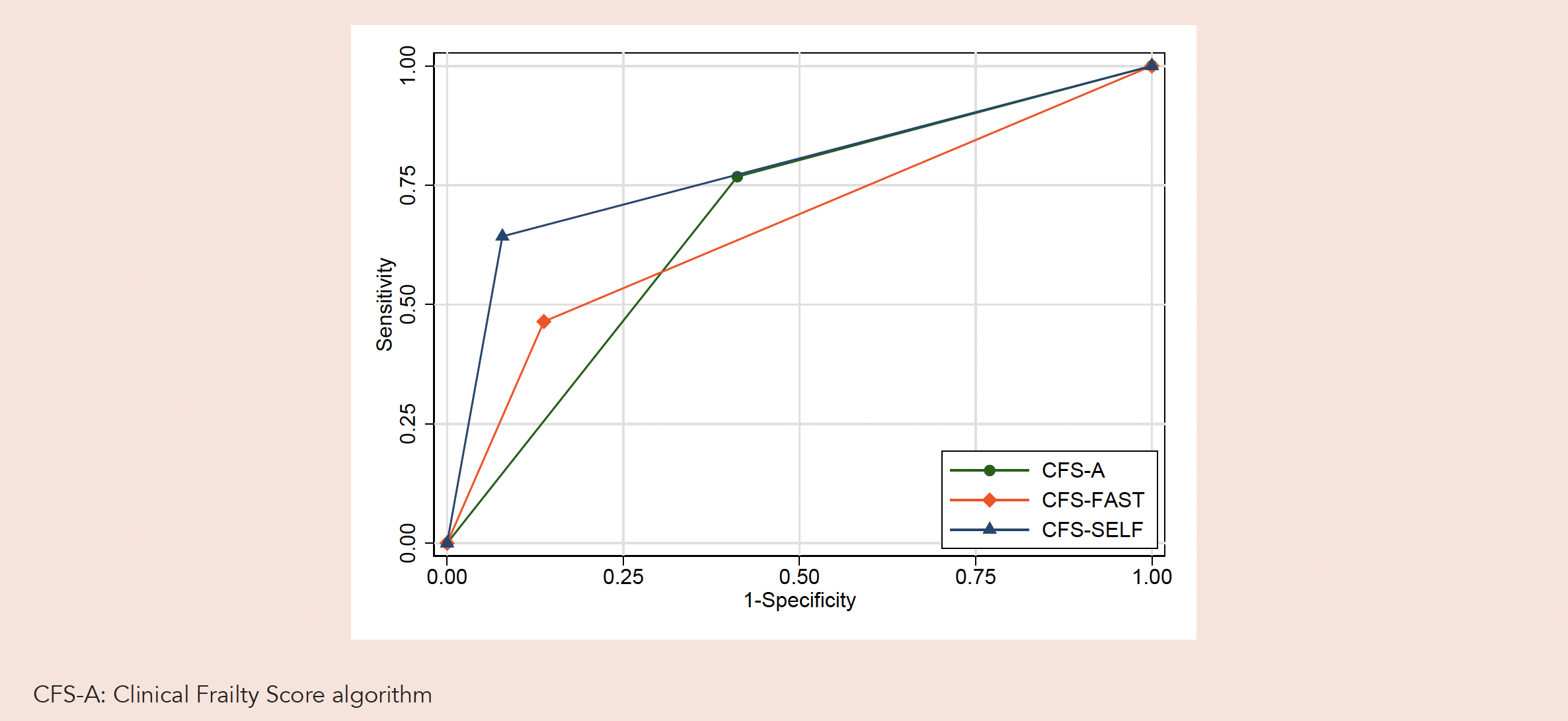
A total of 210 patients were enrolled (Supplementary materials Appendix S5). CFS-A identified 106 (50.7%) as frail, compared to 48 (22.7%) by CFS-Fast and CFS-Self. Agreement on frail classification with FI was moderate for CFS-Self (kappa 0.58, 95% CI 0.45–0.72), and fair for CFS-A (kappa 0.28, 95% CI 0.16–0.40) and CFS-Fast (kappa 0.35, 95% CI 0.22–0.49). CFS-Self had the highest area under the curve [AUC] at 0.78 (95% CI 0.71–0.84), followed by CFS-A (0.68, 95% CI 0.61–0.75) and CFS-Fast (0.67, 95% CI 0.60–0.74) (Fig. 1). CFS-A exhibited the highest sensitivity (76.8%, 95% CI 65.7–87.8%) and the lowest positive predictive value (40.6%, 95% CI 31.2–49.9%).
Fig. 1. Comparison of receiver operating characteristic curves of frailty tools.
Over the study period, 3 (1.4%) participants died. At 3 months, 25 (11.9%) were hospitalised while 33 (15.7%) re-attended the ED. FI-identified frail patients were more likely to be hospitalised (odds ratio [OR] 3.69, 99% CI 1.09–12.45) or re-attend (OR 4.23 99% CI 1.42–12.59). Patients identified as frail by CFS-A were more likely to be hospitalised (OR 4.04, 99% CI 1.01–16.16), and patients identified as frail by CFS-Self were more likely to re-attend (OR 3.61, 99% CI 1.15–11.34). At 6 months, 36 (17.1%) had been hospitalised, 43 (20.5%) had re-attended and 14 (6.7%) had fallen. FI-identified frail patients were more likely to re-attend or fall.
Adjusting frailty threshold to CFS ≥6, CFS-A agreement with FI improved (kappa 0.41, 95% CI 0.28–0.54), but sensitivity reduced from 76.8% to 46.4% (95% CI 33.4–59.5%). No improvements in sensitivity, AUC or agreement were observed for CFS-Fast and CFS-Self.
To the authors’ knowledge, this is the first local study validating CFS scoring tools for ED use. Only CFS-Self reliably identified frailty, showing the most promise as a front-door diagnostic tool. Self-scoring tools, given their speed and practicality, are best suited for the time-constrained ED. The variable performance of the tools may stem from challenges in clinician-administered assessments, which are often conducted under time constraints with limited information. Conversely, self or proxy assessments may offer more accurate and consistent evaluations of premorbid function, reducing inter-rater variability. Our findings align with previous studies showing moderate interrater agreement between patient- and clinician-reported CFS.6,7 Self-scoring frailty tools should be further explored for use in the ED or primary healthcare institutions. Early risk stratification incorporating frailty screening could be cost-effective, reducing ED utilisation, hospitalisations and improving patient outcomes.8 Further, CFS-Self was translated into Singapore’s 4 major languages, improving accessibility and feasibility in our multilingual population.
This prospective observational study had several strengths. Data collection over 6 months minimised recall bias and improved the accuracy of outcome assessment. Importantly, the tools were tested in a real-world setting, ensuring their validity and effectiveness in clinical use. Longitudinal follow-up strengthened the assessment of predictive validity. However, convenience sampling and exclusion of patients lacking mental capacity without an accompanying LAR, would potentially introduce bias. These patients are likely more frail, resulting in an underestimation of frailty prevalence in our sample. Future research should seek to include a more representative sample, including patients who lack mental capacity to improve generalisability.
In conclusion, CFS-Self demonstrated the strongest agreement with FI, good diagnostic accuracy, and predictive ability for adverse outcomes. Its self-administered nature is practical for frailty screening in time-constrained ED settings, though further validation is needed.
Supplementary materials
Appendix S1. Clinical Frailty Scale.
Appendix S2. CFS algorithm (CFS-A).
Appendix S3. CFS-Fast.
Appendix S4. CFS-Self.
Appendix S5. Baseline characteristics of surveyed patients.
Acknowledgements
The authors would like to thank the Institute of Geriatrics and Aging (IGA), Ms Zhu Birong and Ms Jewel Baldevarona-Llego for their contributions in data collection for this study.
References
- Dent E, Lien C, Lim WS, et al. The Asia-Pacific Clinical Practice Guidelines for the Management of Frailty. J Am Med Dir Assoc 2017;18:564-75.
- Hothi H, Paolone AR, Pezeshki M, et al. The Implementation of Frailty Assessment Tools in the Acute Care Setting: A Scoping Review. J Am Geriatr Soc Published Online First: 15 March 2025.
- Searle SD, Mitnitski A, Gahbauer EA, et al. A standard procedure for creating a frailty index. BMC Geriatr 2008;8:24.
- Chong E, Chia JQ, Law F, et al. Validating a Standardised Approach in Administration of the Clinical Frailty Scale in Hospitalised Older Adults. Ann Acad Med Singap 2019;48:115-24.
- Chong E, Tham A, Chew J, et al. Brief Aids to Guide Clinical Frailty Scale Scoring at the Front Door of Acute Hospitals. J Am Med Dir Assoc 2021;22:1116-7.e2.
- Ringer T, Thompson C, McLeod S, et al. Inter-rater Agreement Between Self-rated and Staff-rated Clinical Frailty Scale Scores in Older Emergency Department Patients: A Prospective Observational Study. Acad Emerg Med Off J Soc Acad Emerg Med 2020;27:419-22.
- Dresden SM, Platts-Mills TF, Kandasamy D, et al. Patient Versus Physician Perceptions of Frailty: A Comparison of Clinical Frailty Scores of Older Adults in the Emergency Department. Acad Emerg Med 2019;26:1089-92.
- Chong E, Ong T, Lim WS. Front-Door Geriatrics: Frailty-Ready Emergency Department to Achieve the Quadruple Aim. J Frailty Aging 2023;12:254-7.
Ethics approval was granted by the National Healthcare Group Domain Specific Review Board (2022/00127).
The study is supported by a grant from the Ng Teng Fong Healthcare Innovation Programme. The authors declare they have no affiliations or financial involvement with any commercial organisation with a direct financial interest in the subject or materials discussed in the manuscript.
Dr Audrey Tham, Emergency Department, Tan Tock Seng Hospital, 11 Jalan Tan Tock Seng, Singapore 308433. Email: [email protected]
