

Volume 55, Number 10 October 2026
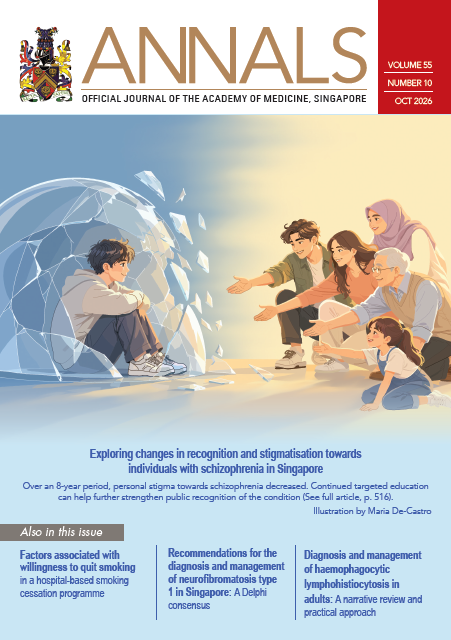
Over an 8-year period, personal stigma towards schizophrenia decreased. Continued targeted education can help further strengthen public recognition of the condition.
Illustration by Maria De-Castro
Editorial
From teachable moment to national strategy: Acting on readiness to quit smoking
In this issue of the Annals, Fong et al. note that Singapore's daily smoking prevalence has continued its long-term decline, reaching 8.4% among residents...

Editorial
Replacing fear with familiarity: Schizophrenia, stigma, and the shared work of recovery
World Mental Health Day, observed annually on 10 October, is an opportunity to reflect on how far Singapore has come in improving public understanding...
Editorial
Tailoring neurofibromatosis type 1 care to Singapore: From consensus to implementation
Rare diseases are easily overlooked in health systems, which are typically built around common diseases, and neurofibromatosis type 1 (NF1) is no exception. In...
Original Article
Factors associated with willingness to quit smoking in a hospital-based smoking cessation programme
Cigarette smoking is a leading cause of preventable morbidity and mortality, and is a major contributor to premature death and cancer burden globally.1,2 Although...
Original Article
Exploring changes in recognition and stigmatisation towards individuals with schizophrenia in Singapore
Schizophrenia is a common yet debilitating illness that affects 1% of the global population and is associated with a reduction in life expectancy of...
